Introduction
The interactions of biological organic molecules with mineral surfaces are fundamental processes that control the rate and extent of various geochemical reactions in the Earth’s surface environments involving dissolution, precipitation, and transformation of minerals. The geochemical processes alter mineral stability, surface charge and reactivity of minerals, transfer of inorganic and organic monomer to polymer ions, and their adsorption and deposition on the mineral surfaces. (Huang et al. Reference Huang, Berthelin, Bollag, McGill and Page1995; Banfield & Nealson Reference Banfield and Nealson1997; Barker et al. Reference Barker, Welch, Banfield, Banfield and Nealson1997; Berthelin et al. Reference Berthelin, Huang, Bollag and Andreux1999; Chorover et al. Reference Chorover, Kretzschmar, Garica-Pichel and Sparks2007; Huang Reference Huang, Huang, Huang and ante2008; Gadd Reference Gadd2010; Mueller Reference Mueller2015; Cuadros Reference Cuadros2017). Among the diverse effects of the interactions, mineral dissolution is an important process in understanding the chemical weathering of the Earth’s surface constituents, as well as the formation and evolution of clay minerals and soils, elemental releases into soils and aquatic environments, and consumption of atmospheric CO2 (Ullman & Welch Reference Ullman and Welch2002; Greathouse et al. Reference Greathouse, Johnson and Greenwell2014). Therefore, many studies involving dissolution of silicate minerals such as feldspar, pyroxene, olivine, and quartz have been carried out on systems that interact with organic molecules, including monomers to polymer compounds (Bennett Reference Bennett1991; Wogelius & Walther Reference Wogelius and Walther1991; White & Brantley Reference White and Brantley1995; Welch & Ullman Reference Welch and Ullman1996; Welch et al. Reference Welch, Barker and Banfield1999; Ganor et al. Reference Ganor, Reznik, Rosenberg, Oelkers and Schott2007; Renforth et al. Reference Renforth, Pogge von Strandmann and Henderson2015).
Amorphous silica is widespread and composed of short-range ordered SiO4 tetrahedra, which is a much simpler chemical composition and structure compared with the silicate minerals above. Furthermore, amorphous silica has only the silanol group (>Si-OH) as a functional group available for interaction, whereas silicate minerals, excluding quartz, have additional functional groups such as >Al-OH, >Fe-OH, and >Mg-OH, leading to an increased complexity of the reaction processes on the mineral surfaces. In the present study, to investigate the effect of biological organic molecules on mineral dissolution and its reaction mechanism in a simpler reaction system, amorphous silica and six-membered heterocyclic compounds were used as representatives for a mineral and an organic molecule, respectively.
In the last two decades, dissolution experiments of amorphous silica in the presence of various organic molecules have been conducted to quantify the enhancement effects of the molecules on dissolution rates and their molecular-level mechanisms. Basically, these studies demonstrated that biological organic molecules can enhance amorphous silica dissolution depending on the adsorption affinity for the surface of amorphous silica. For example, basic amino acids such as arginine, lysine, and histidine enhanced dissolution rates of amorphous silica up to ~10 times compared with amino acid-free controls at concentrations of 10.0 mM and solution pH of 6 and 4. However, neutral amino acids such as cysteine, asparagine, serine, tryptophan, alanine, and threonine exhibited no significant effect on the dissolution rate at pH 6 and increased slightly by ~3–3.5 times at pH 4 (Kawano & Obokata Reference Kawano and Obokata2007; Kawano et al. Reference Kawano, Hatta and Hwang2009). Similarly, rate-enhancement of the amorphous silica dissolution with an enhancement factor of ~5.5–6.5 was confirmed in the experiments using the 10.0 mM guanidine and imidazole, which are functional molecules that constitute the side chain of arginine and histidine, respectively. Pyrazole and pyrrole, which are five-membered heterocyclic compounds having smaller pK values compared with guanidine and imidazole, showed less or no significant enhancement effects corresponding to their pK values (Kawano & Hwang Reference Kawano and Hwang2010b). Proteins are major constituents of humic substances in soils and sediments; thus, much interest has been shown in their interactions with mineral surfaces (Quiquampoix & Burns Reference Quiquampoix and Burns2007; Andersen et al. Reference Andersen, Reardon, Chacon, Qafoku, Washton and Kleber2016). Kawano & Hwang (Reference Kawano and Hwang2010a) used bovine serum albumin (BSA) as a proxy protein for organic molecules in a dissolution experiment of amorphous silica, and they confirmed that BSA enhanced greatly the dissolution rate of amorphous silica, up to 3–13 times with increasing BSA concentrations of 1.0 mg/L at pH ~6–4. This series of studies indicated that biological organic molecules are capable of enhancing the dissolution rate of amorphous silica, depending on the chemical structure that is contributing to the adsorption affinity for the amorphous silica surface. The adsorption of these molecules occurred successively with an increasing ionic species of monomer cations or a positive charge on the polymer molecules. This suggests that these organic molecules would adsorb on the amorphous silica surface through electrostatic bonding to the negatively charged SiO– sites, which weakens and breaks the Si–O–Si bonds of the framework structure by an hydrolysis reaction.
The objective of the present study was to discover the enhancement effects of six-membered ring heterocyclic compounds on amorphous silica dissolution and their molecular-level mechanism(s). Dissolution experiments of amorphous silica were performed using three selected compounds, piperidine (pK = 11.12), pyridine (pK = 5.25), and pyridazine (pK = 2.33), which have simple structures and pK values that differ from one another. Considering the differences in their pK values, the degree of protonation of the dissolved molecule is predicted as follows: piperidine > pyridine > pyridazine. Therefore, the same order of enhancement effect on the amorphous silica dissolution is expected (piperidine > pyridine > pyridazine), if the main contributing factor is the electrostatic adsorption of the cationic species of the dissolved molecules.
Experimental methods
Materials
The amorphous silica sample used in this study was prepared in a similar procedure as the earlier dissolution experiments (Kawano & Hwang Reference Kawano and Hwang2010a, Reference Kawano and Hwang2010b). Briefly, the chemical reagent of amorphous silicon dioxide (Kanto Chemical Co., Inc, Tokyo, Japan) was ground by hand using an agate mortar, and 5–100 μm-sized grains were separated by dry sieving. To remove adhering ultrafine particles, the powdered sample was cleaned ultrasonically and washed with 0.1 M HCl and distilled water at least five times. This sample was freeze-dried and used in the dissolution experiments. X-ray powder diffraction showed a broad halo around 22o2θ with no crystalline phase. The surface area of this powdered sample, measured using the BET method, was 205 m2/g.
Three six-membered ring heterocyclic compounds, piperidine (C5H11N, MW = 85.15), pyridine (C5H5N, MW = 79.1), and pyridazine (C4H4N2, MW = 80.09), which were guaranteed reagent grade, were obtained from Nacalai Tesque, Inc. (Kyoto, Japan). These heterocyclic compounds are hydrophilic and partially protonate when dissolved in water, depending on the solution pH (Fig. 1). The pK values for the protonation of these compounds are 11.12, 5.25, and 2.33 for piperidine, pyridine, and pyridazine, respectively (Dean Reference Dean1985).
The schematic structures of six-membered ring heterocyclic compounds (piperidine, pyridine, and pyridazine) used in this study

Dissolution Experiments
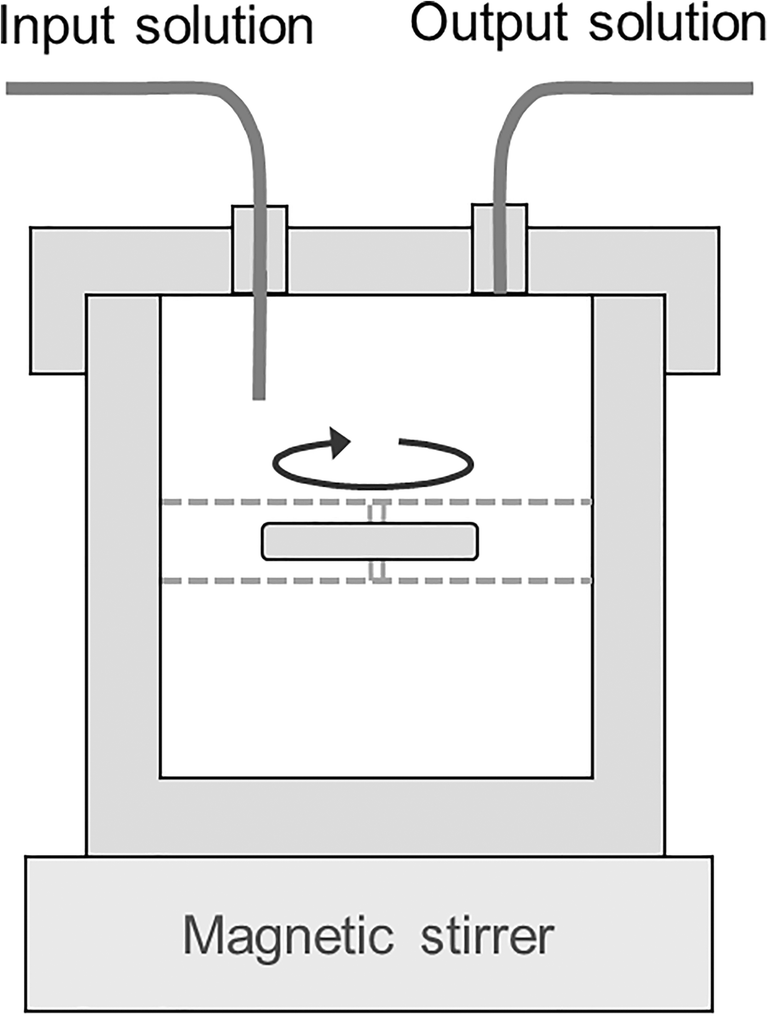
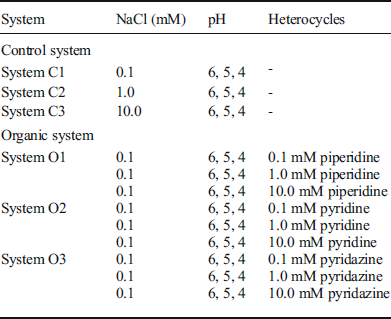
The dissolution experiments of amorphous silica were conducted using an acrylic resin flow-through reactor placed on the magnetic stirrer at a constant temperature of 25oC for 10 days (Fig. 2). The input solution was flowed into the reaction chamber at a constant flow rate of 0.050 mL/min using a peristaltic pump, and the reactant solution was removed continuously through a 2.0 μm pore-size PEEK filter. The volume of the reaction chamber was 100 mL, in which 0.1 g of amorphous silica grains was placed with a full volume of the input solution. The reaction systems of these experiments can be divided into two systems depending on the solutions used, one is the control system and the other is the organic system. The dissolution experiments of the control system were carried out using 0.1, 1.0, and 10.0 mM NaCl solutions with no heterocyclic compounds at three different solution pH values of ~6.0, ~5.0, and ~4.0 to confirm the effect of solution pH and the concentrations of background Na+ ions on the dissolution rates of amorphous silica. This control system was further divided into systems C1, C2, and C3 by the NaCl concentration of 0.1, 1.0, and 10.0 mM, respectively (Table 1). Conversely, the dissolution experiments of the organic system were performed using 0.1 mM NaCl electrolyte solutions containing 0.1, 1.0, and 10.0 mM heterocyclic compounds at three different solution pH values of ~6.0, 5.0, and 4.0 to evaluate the influence of the heterocyclic compounds on the dissolution rates. This organic system was also divided into systems O1, O2, and O3 with the heterocyclic compounds, piperidine, pyridine, and pyridazine, respectively (Table 1). Prior to the dissolution experiments, 1000 mL of input solutions containing 0.1, 1.0, or 10.0 mM NaCl with one of three different solution pH values of 6.0 ± 0.1, 5.0 ± 0.1, or 4.0 ± 0.1 were prepared for the control system experiments. Additionally, another 1000 mL of input solutions containing 0.1, 1.0, or 10.0 mM of each heterocyclic compounds with a constant concentration of 0.1 mM NaCl and solution pH of 6.0 ± 0.1, 5.0 ± 0.1, or 4.0 ± 0.1 were prepared for the organic system experiments. The pH of each stock solution was adjusted by adding HCl solution. Throughout the dissolution experiments, 3.0 mL of output solution was collected in a glass tube daily, and was used for measurement of solution pH and analysis of dissolved Si ion concentrations.
The schematic illustration of the flow-through reactor system used in this study

Solution conditions of dissolution experiments for the control (C1 to C3) and organic systems (O1 to O3).

The dissolution rates (R, mol/m2/s) of amorphous silica in both the control and organic systems were calculated from the equilibrium concentrations of Si in each experiment, which can be expressed by the following equation:

where C is equilibrium concentration of Si in the output solution (mol/L), v is the flow rate of the solution through the system (L/s), and S and m are the surface area (m2/g) and the mass (g) of amorphous silica, respectively. The effect of heterocyclic compounds on the dissolution rate of amorphous silica was estimated by the enhancement factor (k), which is defined as:

where R o is the dissolution rates of amorphous silica in the organic system that contains heterocyclic compounds and R c is the dissolution rate in the control system at a corresponding solution pH.
Adsorption Experiments
Adsorption experiments with piperidine, pyridine, or pyridazine on the surface of amorphous silica were conducted to confirm the interaction of the heterocyclic compounds with the amorphous silica surfaces. The experiments were carried out using the batch method, in which 0.01 g of amorphous silica and 10.0 mL of solution containing 1.0 mM of the selected heterocyclic compound were placed in 10 mL polypropylene tubes. Ten polypropylene tubes, with a solution pH range of ~2.5–10, were prepared for reaction systems of each compound. The solution pH of the tubes was adjusted by adding HCl or NaOH solution. After shaking the solution for 24 h at 25°C, the supernatant solutions were separated by centrifuge, and concentrations of piperidine, pyridine, or pyridazine and solution pH were measured using HPLC and a pH meter, respectively.
Analysis
The measurements of the Si concentrations were made using the post-column pH buffer HPLC method, which is a modified procedure proposed by Li & Chen (Reference Li and Chen2000). The instrument used for this method was a LaChrom Elite HPLC system (Hitachi High-Technologies Corporation, Tokyo, Japan) equipped with an electrical conductivity (EC) detector and an ion-exclusive column of TSKgel OApak-A (Tosoh Corporation, Tokyo, Japan). To separate Si ions, a 0.75 mM H2SO4 solution was used for the mobile phase with a flow rate of 1.0 mL/min. Subsequently, 0.1% diethylaminoethanol was mixed with the mobile phase at a flow rate of 0.5 mL/min to increase the solution pH to ~10, thereby enabling the detection of Si ions as the H3SiO4 – oxyanion using an EC detector. The concentrations of piperidine, pyridine, and pyridazine were also measured with the HPLC instrument equipped with a cation-exchange column of TSKgel IC-Cation I/II HR (Tosoh Corporation, Tokyo, Japan) using the mobile phase of 1.0 mM H2SO4 solution with a flow rate of 1.0 mL/min. The solution pH was measured using a pH meter equipped with a glass electrode (Mettler Toledo, Greifensee, Switzerland).
Results
Dissolution Rates in the Control System
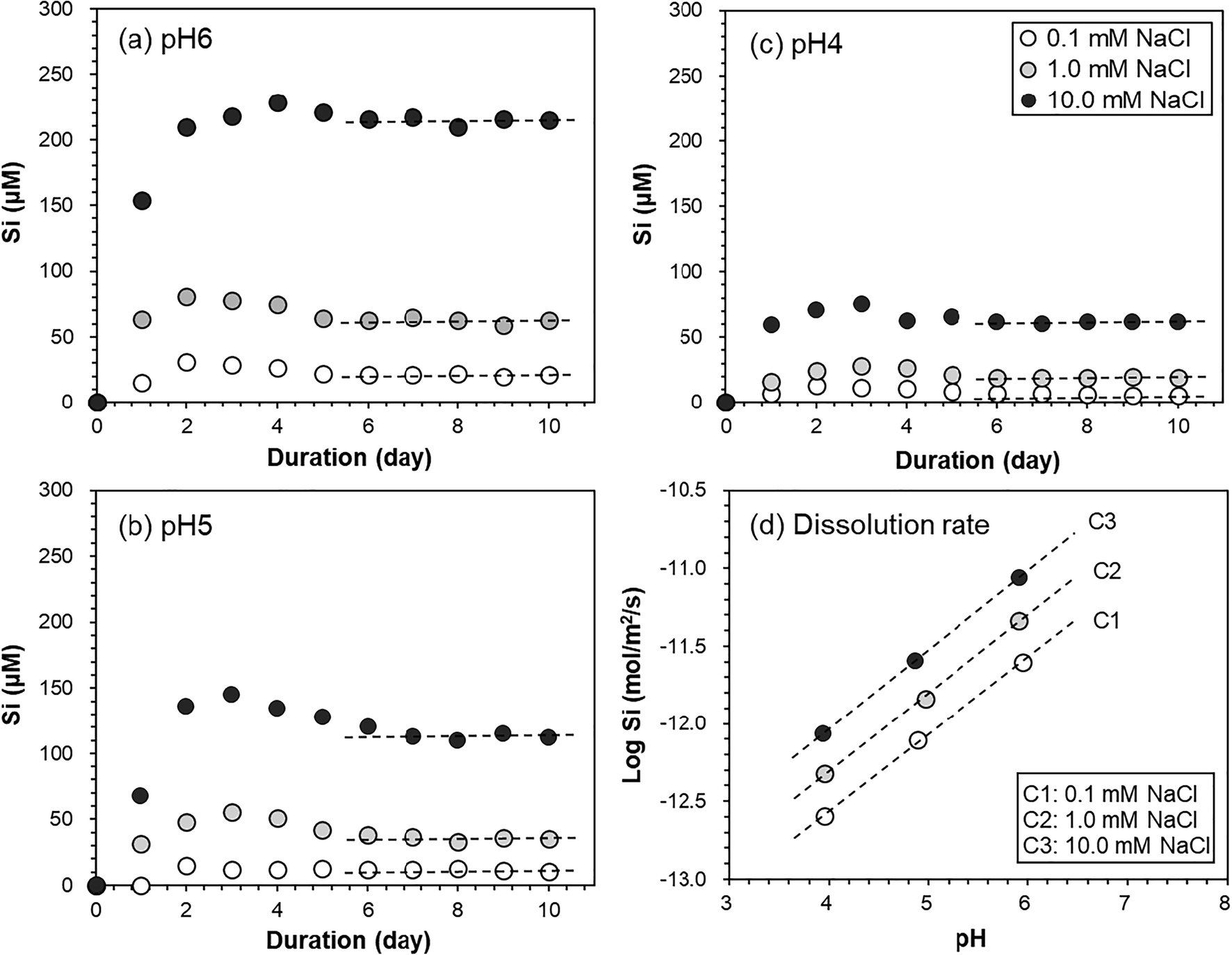
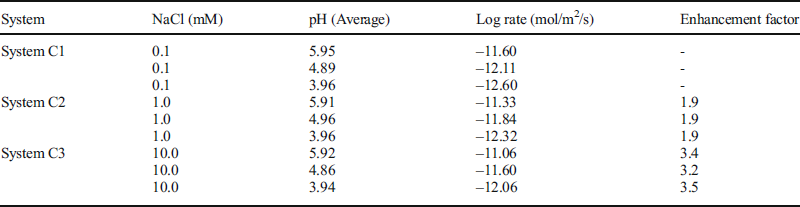
The dissolution experiments in the control system (systems C1, C2, and C3) confirmed that the solution pH remained almost constant at initial values of ~6, 5, or 4 in each system for 10 days. The Si concentrations tended to increase with time for the first few days, then began to decrease slightly around 5 or 6 days, and finally remained constant after 6 days. In particular, the Si concentrations increased significantly with increasing NaCl concentration at each pH condition, and also with increasing the solution pH (Figs 3a, b, and c). These results indicated that the dissolution rates of amorphous silica were heavily dependent on both the NaCl concentration & the solution pH, as is well known (Barker et al. Reference Barker, Fontes, Gasse and Druart1994; Kawano & Hwang Reference Kawano and Hwang2010a, Reference Kawano and Hwang2010b), and confirmed that the dissolution reached a steady state after at least 6 days of reaction. The dissolution rates of amorphous silica were calculated using the average Si concentrations during the steady state for 6 to 10 days (Table 2), and were plotted on a logarithmic axis against the corresponding average pH values as shown in Fig. 3d. The rates yielded in this control system increased linearly at a slope of 0.5 with respect to the solution pH, and also increased with enhancement factors of 1.9 and ~3.2–3.5 as Na+ concentrations increased to 1.0 and 10 mM, respectively, which led to the following rate equations:


Concentrations of Si during the dissolution of amorphous silica in control systems at pH 6 (a), 5 (b), and 4 (c), and their dissolution rates plotted as a function of solution pH (d). The dotted lines C1, C2, and C3 indicate the dissolution rate of amorphous silica in the control systems C1, C2, and C3 which contain 0.1, 1.0, and 10.0 mM NaCl, respectively.

Dissolution rates of amorphous silica in the control system.

These results are very similar to data obtained previously in batch dissolution experiments using the same NaCl concentrations as in the present study (Kawano & Obokata Reference Kawano and Obokata2007).
Dissolution Rates in the Organic System
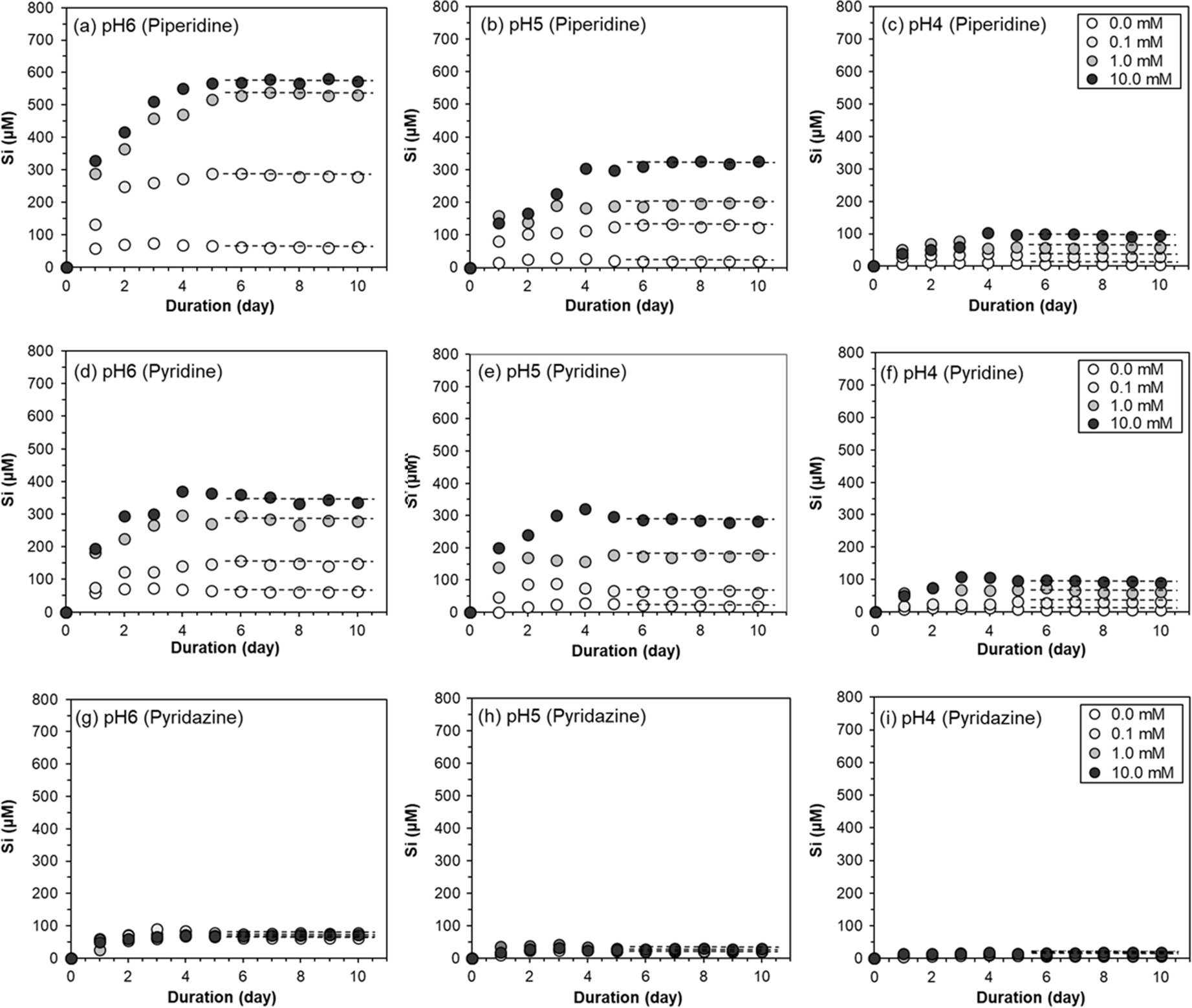
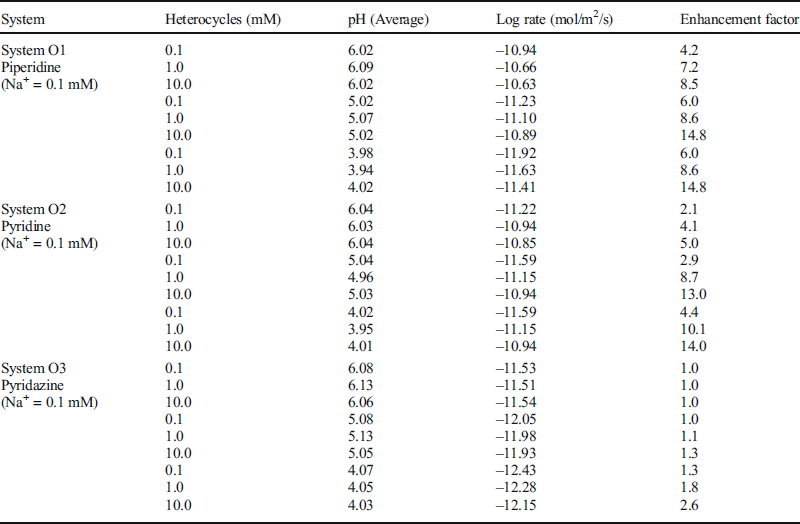
The dissolution experiments in the organic system (systems O1, O2, and O3) demonstrated that the Si concentrations increased in the initial stages within 5 or 6 days depending on the species of the heterocyclic compounds, their concentrations, and the solution pH. Subsequently, the Si concentrations remained almost constant for reaction periods up to 10 days as well as in the control system (Fig. 4). Notably, the Si concentrations in the system O1, which contained piperidine, increased significantly with increasing piperidine concentrations and also with increasing solution pH, indicating that piperidine greatly enhanced the amorphous silica dissolution depending on its concentrations (Figs 4a, b, and c). The system O2, which contained pyridine, showed slightly smaller increasing trends of the Si concentrations than those in system O1, indicating that pyridine exhibited slightly less enhancement of the dissolution compared with piperidine (Figs 4d, e, and f). In the case of system O3, the Si concentrations did not increase by as much even at a pyridazine concentration of 10 mM with solution pH of 6, 5, or 4 (Figs 4g, h, and i). The dissolution rates of amorphous silica in these organic systems were determined using the average Si concentrations at a steady state for 6 to 10 days (Table 3). Figure 5 illustrates the dissolution rates of the organic systems on a logarithmic scale against the corresponding solution pH. The dotted lines represent the dissolution rates of amorphous silica in control systems C1, C2, and C3 containing 0.1, 1.0, or 10.0 mM NaCl with no heterocyclic compounds, respectively. This plot showed that the dissolution rates of amorphous silica in system O1 significantly increased up to the enhancement factors of 8.5 (pH 6), 14.8 (pH 5), and 14.8 (pH 4) with increasing piperidine concentrations of 10.0 mM (Fig. 5a). Likewise, the dissolution rate of system O2 tended to increase up to the enhancement factors of 5.0 (pH 6), 13.0 (pH 5), and 14.0 (pH 4) with increasing pyridine concentrations of 10.0 mM, which are slightly less than those of system O1 (Fig. 5b). While, the dissolution rate of system O3 increased less significantly with enhancement factors of 1.0 (pH 6), 1.3 (pH 5), and 2.6 (pH 4) at pyridazine concentrations of 10.0 mM (Fig. 5c). These results revealed that the heterocyclic compounds have significant enhancement effects on the dissolution rate of amorphous silica in the following order: piperidine > pyridine > pyridazine, which is probably due to their adsorption affinity for the amorphous silica surface. Furthermore, results confirmed that the enhancement effect of the heterocyclic compounds on the dissolution rate of amorphous silica increased as the pH decreased.
Concentrations of Si during the dissolution of amorphous silica in organic systems O1 (a, b, and c), O2 (d, e, and f), and O3 (g, h, and i) at pH conditions of 6, 5, and 4. The systems O1, O2, and O3 contain 0.0, 0.1, 1.0, and 10.0 mM piperidine, pyridine, and pyridazine, respectively.

Dissolution rates of amorphous silica in the organic system with their enhancement factors.

Dissolution rates of amorphous silica in organic systems O1 (a), O2 (b), and O3 (c) plotted as a function of solution pH. The dotted lines indicate the dissolution rates of amorphous silica in the control systems C1, C2, and C3.

Adsorption of Heterocyclic Compounds
Adsorption experiments with the heterocyclic compounds on the surface of amorphous silica were performed to verify the adsorption affinity of the heterocycles for the amorphous silica surface. The results showed that the adsorption amounts of the heterocyclic compounds on the amorphous silica surface were remarkably smaller in the acidic region, and exhibited different adsorption behaviors depending on the compounds with increasing solution pH (Fig. 6). Specifically, the adsorption of piperidine increased successively up to ~0.25 mmol/g at pH 10 with increasing pH. The adsorption of pyridine on the amorphous silica surface also tended to increase up to ~0.06 mmol/g as the pH increased to 8, and then decreased gradually at pH > 8. For pyridazine, a very small adsorption amount of ~0.002 mmol/g was occurred at about pH 4, and little or no significant adsorption was observed at other pH conditions. These results indicated that the order of adsorption affinity of the heterocyclic compounds for the amorphous silica surface was as follows: piperidine > pyridine > pyridazine, which was consistent with that of the enhancement effects on dissolution.
Adsorption of the heterocyclic compounds on the surface of amorphous silica as a function of solution pH

Discussion
Experiments on the dissolution of amorphous silica in the control system containing no heterocyclic compounds confirmed that the dissolution rates of amorphous silica increased with increasing NaCl concentrations. Such enhancement of an amorphous silica dissolution by interaction of inorganic cations including Na+ ions is well known to occur during dissolution processes involving alkali and alkaline earth cations such as Na+, K+, Li+, Ca2+, Mg2+, and Ba2+ (Barker et al. Reference Barker, Fontes, Gasse and Druart1994; Seidel et al. Reference Seidel, Löbbus, Vogelsberger and Sonnefeld1997; Icenhower & Dove Reference Icenhower and Dove2000; Kawano & Obokata Reference Kawano and Obokata2007). Although the molecular-level mechanism of this enhancement of amorphous silica dissolution has not been well elucidated, it is widely accepted that these cations can adsorb electrostatically on the surface of amorphous silica as the surface is negatively charged over a wide range of pH conditions with a point of zero charge at pH ~2.0 (Dove & Rimstidt Reference Dove, Rimstidt, Heaney and Prewitt1994). This adsorption weakens Si–O–Si bonds of the framework structure and makes the hydrolysis reaction easier.
In contrast, the organic system containing piperidine, pyridine, and pyridazine demonstrated that the dissolution rates increased significantly with increasing concentrations of the heterocyclic compounds compared with the control system C1 containing 0.1 mM NaCl. In addition, results confirmed that the magnitude of the enhancement varied greatly depending on the heterocyclic species in the following order: piperidine > pyridine > pyridazine. These findings imply that the heterocyclic compounds have a remarkable enhancement effect on the dissolution rate of amorphous silica, which may be controlled by the chemical structure of each compound. Similar enhancements of amorphous-silica dissolution were reported to occur during experimental dissolution in systems containing various biological organic molecules including monomer to high-molecular weight organic molecules such as basic amino acids, proteins, and bacterial cells (Bidle & Azam Reference Bidle and Azam1999; Kawano & Obokata Reference Kawano and Obokata2007; Kawano et al. Reference Kawano, Hatta and Hwang2009; Kawano & Hwang Reference Kawano and Hwang2010a). The basic amino acids (histidine, lysine, and arginine) and proteins (bovine serum albumin: BSA) are capable of adsorbing to the negatively charged surface of amorphous silica, because these molecules can carry a positive charge or have positively charged sites at the surface of their polymeric structure due to the protonation of amino groups and additional basic functional groups such as imidazole and guanidine in a wide range of pH conditions. This adsorption contributes to a greater enhancement of the dissolution rates of amorphous silica, depending on the magnitude of the adsorption affinity of these molecules for the amorphous silica surface. Bacterial cells also have various proteins on the cell surface or as the major constituents of the extracellular polymeric substances (Wingender et al. Reference Wingender, Neu and Flemming1999; Seltmann & Holst Reference Seltmann and Holst2002), thus they exhibit significant adsorption affinity for the amorphous silica surface, leading to the enhancement of the amorphous-silica dissolution. For heterocyclic compounds used in this study, adsorption experiments demonstrated that they tended to adsorb significantly on the amorphous silica surface, and revealed the following order of adsorption affinity: piperidine > pyridine > pyridazine. This is consistent with the order of enhancement effects of the heterocyclic compounds on the amorphous silica dissolution. Therefore, the dissolution of amorphous silica appeared to be greatly enhanced by interactions with the heterocyclic compounds exhibiting greater adsorption affinity.
The adsorption affinity of biological organic molecules for the mineral surfaces may be affected by various factors such as degree of ionization, charge density, molecular size, stereochemical geometry, and flexibility of the molecules (Parida et al. Reference Parida, Dash, Patel and Mishra2006). The heterocyclic compounds used in this study were six-membered ring heterocycles exhibiting very similar structure but with significantly different pK values. Thus, the degree of ionization of these heterocyclic compounds can be considered to be the most important factor affecting their adsorption affinity for the surface of amorphous silica. Figure 7 shows the concentrations of cationic species of piperidine, pyridine, and pyridazine in a 1.0 mM solution of each heterocyclic compound as a function of solution pH calculated by the geochemical code ChemEQL (Müller Reference Müller1996), using their pK values for protonation. These calculations indicated that piperidine was fully protonated and mostly present as a cationic species in the range of an approximate pH < 9. Thus, piperidine exhibits much greater adsorption affinity for the negatively charged surfaces of amorphous silica at solution pH ~6–4, which probably contributes to the greater enhancement of amorphous silica dissolution; while the concentrations of cationic species of pyridine were reduced to ~0.22 mM at pH 6 and to ~0.97 mM at pH 4. These slightly smaller concentrations of cationic species of pyridine may reduce its adsorption affinity. Therefore, the enhancement effect of pyridine on the amorphous-silica dissolution is relatively small compared with that of piperidine. Comparing the enhancement effect at solution pH 6 and 4, the enhancement effect of pyridine is much greater at pH 4 than pH 6 due to higher concentrations of cationic species at pH 4. Pyridazine showed much smaller concentrations of cationic species at ~0.02 to 0.0002 mM at pH 6 to 4, respectively, resulting in a smaller enhancement effect in this pH range. A relatively greater enhancement effect at pH 4 compared with pH 6 was also observed, which was the same trend as pyridine. These positive relationships between the enhancement effect of heterocycles on the amorphous silica dissolution and their concentrations of cationic species can be clearly seen in Fig. 8. This plot indicated that the enhancement effect of the heterocycles appeared at cationic species concentrations of >~10–5 M, which increased progressively more than 10 times with increasing concentrations of >10–3 M. Consequently, the heterocyclic compounds clearly can enhance amorphous silica dissolution through electrostatic complexation of their cationic species with the negatively charged surface sites of amorphous silica.
Concentrations of cationic species of the heterocyclic compounds as a function of solution pH calculated with the geochemical code ChemEQL

Variations in enhancement factors of dissolution rates of amorphous silica as a function of logarithmic concentrations of cationic species of the heterocyclic compounds

Six-membered ring heterocyclic compounds comprise the main component of DNA as constituents of nucleotides, and are found as side-chain components of some amino acids such as phenylalanine, tryptophan, and tyrosine. These heterocyclic compounds transfer into the soil and aquatic environments during degradation processes of biological residues including microbes and plants, and then react with the mineral surface. Piperidine, pyridine, and pyridazine are not abundant, but are widely present in the Earth's surface environments mainly as N-containing constituents of soil organic matter and also as biological products of some microbes and plants (Schepers & Raun Reference Schepers and Raun2008). The previous study using some five-membered ring heterocyclic compounds (imidazole (pK = 6.99), pyrazole (pK = 2.61), and pyrrole (pK = 0.4)) reported an increase in the dissolution rates of amorphous silica up to ~6 times compared with heterocycle-free controls depending on the adsorption affinity of each compound, due to complexation of their cationic species with the negatively charged >SiO– sites of amorphous silica (Kawano & Hwang Reference Kawano and Hwang2010b). The current study confirmed that the six-membered ring heterocyclic compounds were also capable of enhancing the dissolution of amorphous silica, depending on the adsorption affinity of the molecules.
Conclusions
Experiments on the dissolution of amorphous silica in solutions which contain piperidine, pyridine, or pyridazine demonstrated that these heterocyclic compounds enhance the dissolution rate of amorphous silica in the following order: piperidine > pyridine > pyridazine. Namely, the dissolution rates of amorphous silica increased with increasing concentrations of the heterocyclic compounds up to enhancement factors of ~6.0–14.8, ~5.0– 14.0, and ~1.0– 2.6 at 10.0 mM piperidine, pyridine, and pyridazine, respectively, in the pH range of ~6–4. Moreover, the enhancement effects of the heterocyclic compounds tended to be much greater at pH 4 than with pH 6. The adsorption experiments indicated that the heterocyclic compounds can adsorb on the amorphous silica surface with the following order of adsorption affinity: piperidine > pyridine > pyridazine. The geochemical calculation confirmed that this order of enhancement effect and adsorption affinity was consistent with concentrations of cationic species of the hetero-cyclic compounds at corresponding pH conditions. Therefore, the electrostatic complexation of the cationic species of heterocyclic compounds with the negative >SiO– sites on the amorphous silica surface probably contributed to the enhancement by a mechanism of ligand-promoted dissolution.
Acknowledgments
This work was supported financially by the Japanese Ministry of Education, Science, Sport, and Culture (No.17K05711). The authors are grateful to the two anonymous reviewers and editors for their useful comments and suggestions.