Introduction
The relationship between Islam and music is an unresolved and perhaps problematic one, with discourses spanning the gamut of conservative to liberal interpretations. Prominent among them is Adebayo’s position that music and other arts are not inherently evil but their usage and the utterances of those who practise them make it lawful or unlawful (2000:19). These debates extend to questions of what constitutes music and the boundaries of music performance. In this vein, Malm suggests that “the official attitude of Islamic religious leaders to music has always been negative hence, the Quran chants and call to worship, both of which are performed in Islamic music style are not considered to be music” (Reference Malm1967:14). Ikibe contradicts Malm’s claim and asserts that “Islamic worship makes use of music when one considers the rhythm, tempo and melismatic pitches manipulated by Imams during the recitation of Quranic texts and call to prayer” (Reference Ikibe2011:30). Further, scholars such as Neubauer and Doubleday claim that “there is no statement in the Holy Qur’an explicitly condemning music and that evidence in the Traditions of the Prophet Muhammad (SAW), Hadith, clearly demonstrates that on occasions, he listened to music with pleasure and that these texts are open to many interpretations” (Reference Neubauer and Doubleday2005:7). According to Al Faruqi (Reference Faruqi1985:8), Hadiths are open to interpretation, and music might be condemned in one Hadith and approved of in another. However, Adegbite (Reference Adegbite1989) and Erol (Reference Erol2011) argue that orthodox Islamic thought tends to regard all music with suspicion and permits only those genres that are performed in a religious context. They further argue that “there is no singular Islamic position toward Islamic pop music (dance music), just as there is no united Islamic position toward a variety of other issues, such as whether to allow a woman to be president, or whether to implement Islamic law” (Adegbite Reference Adegbite1989; Erol Reference Erol2011). This article, however, does not aim to contest the place of music in Islam or adjudicate the position of scholars on this issue for which robust literature exists.Footnote 1 Rather, our article seeks to understand the perspectives of Muslim musicians and community members on why they continue to thrive in these areas despite the opposition of an orthodox form of Islam to dance music.
In this article, we ask: In what ways are Muslim musicians contesting Islamic orthodoxy and negotiating some form of liberalism in dance music? What form of liberalism might this be? Is it Eurocentric, which takes liberalism as a social imaginary based on the idea of autonomous individuals freely engaging with one another in an egalitarian public sphere (see Pier Reference Pier2016:37), or Afrocentric, which emphasises the communal feeling? What factors may have instigated these liberal tendencies, and how do these forms of liberalism redefine Islam in Africa and contribute to the sustenance of music traditions?
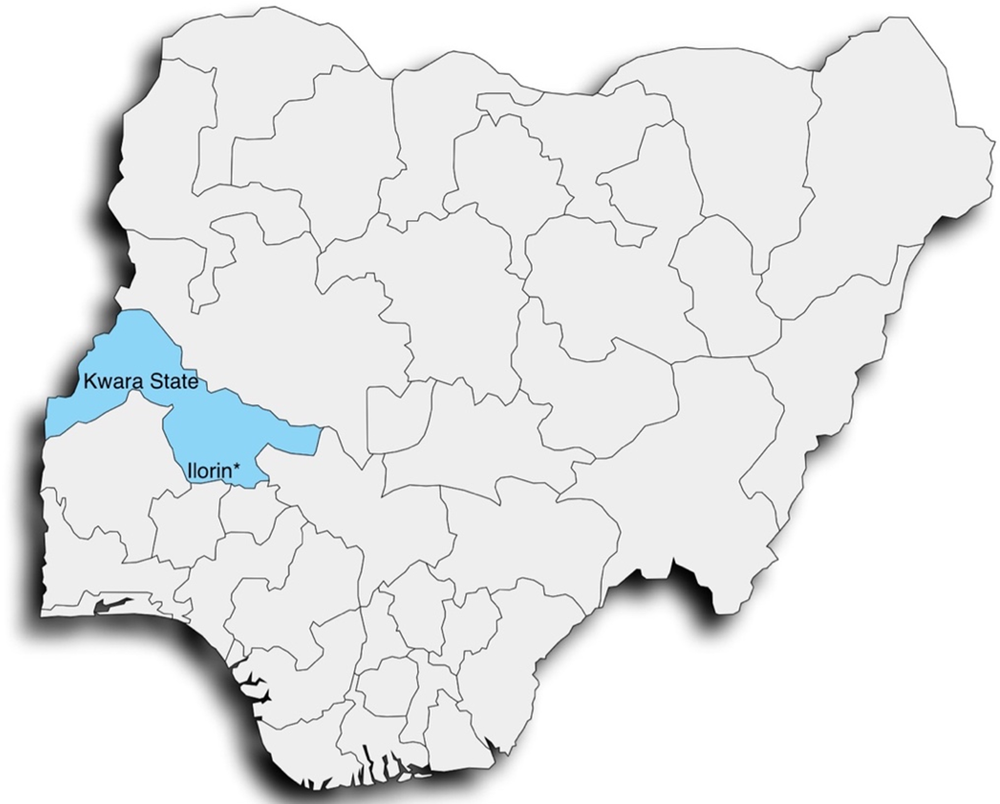
Two communities where both authors have spent considerable time schooling, working, and researching were chosen as case studies. They are Ilorin, the capital of Kwara State in north-central Nigeria (Research Site I), and Auchi in Edo State in south-south Nigeria (Research Site II). Within the two communities, we focused on two musicians through purposive and convenience sampling methods. They are Alhaja Iya Aladuke in Research site I and Alhaji Waziri Oshomah in Research site II. As an ethnography, our methods of data gathering braid observation, oral interviews, personal communication, and media analysis of audio-visual materials. The fieldwork in Ilorin took place between September 2012 and January 2015, with follow-up research at various times from January 2016 until November 2019. The field research braided observation and analysis of Alhaja Iya Aladuke’s live performances and recordings, interviews, and informal discussions with her, along with members of her Senwele group, community members, and audiences at her performances. Based on our research, coupled with our lived experiences in Ilorin between 1984 and 2018, this article downplays the subjectivities of being non-Muslim/non-native musicians in a predominantly Muslim community in favour of objective rationality, which scholarship of this nature requires.
For Auchi, the research took place first between 2011 and 2012. The research was for a post-doctoral fellowship awarded by the American Council of Learned Societies, New York. This research focused on ethnic-based dance bands in some parts of Edo State, including Auchi. Further fieldwork took place between 2016 and 2017 and was funded by Afropop Worldwide, New York. Unlike Ilorin, where Islamic/Arabic influences were very evident in the singing and compositional styles, dance bands in these Muslim communities used Western compositional styles and accompaniment. Playing in the current of West African highlife music by dance bands such as that of Waziri is largely influenced by Western harmonic principles and popular music from the Americas, as can be seen in the musical excerpts in Figure 1.Footnote 2
(a & b) Sample chord progressions reflecting Western harmonic principles. Scores courtesy of Samuel Agyare.

The case of Auchi provides a sharp contrast with that of Ilorin in terms of musical identity. While in the case of Ilorin, the Islamic/Arabic influences can be seen both in the texture of the music (see Figure 6) and in the identity of the musician, in Auchi, the musician maintained only his Muslim identity, while the music did not reflect an Islamic/Arabic identity as can be seen in the musical excerpts above. In both communities, there were different approaches to contesting orthodoxy and negotiating liberalism.
Background of the Research and Research Sites
Ilorin as shown in Figure 2 was the northernmost Yoruba settlement in the seventeenth century, administered by a military lieutenant, Afonja, under the authority of the Alaafin, or king, of the Oyo Empire between 1650 and 1831. A series of secessionist and expansionist ventures would lead to a tussle over the leadership of Ilorin in which Afonja was killed, eventually culminating in the establishment of the emirate system in Ilorin in the 1800s.Footnote 3 Today, what was once a Yoruba administrative outpost of the old Oyo Empire is now an emirate affiliated with the Sokoto Caliphate and a multi-ethnic settlement reflecting the diversity of the Nigerian people.
Research Site I—Ilorin, Kwara State. Map created by Austin Emielu using paintmap.com.

Central to the history of Ilorin and its traditional music soundscape is the introduction of Islam. A key figure in the establishment of Islam as a dominant religion in Ilorin was a Fulani–Islamic scholar, Sheikh Salih Ibn Janta, popularly identified as Shehu Alimi. Alimi, also recognised as a progenitor of Fulani hegemony in Ilorin, contributed to the spread of Islam in some parts of Yorubaland until his death in 1820. Alimi had a large following of Jaama’as (congregation of followers) and was highly respected for his religious piety, Islamic scholarship, and efficacious spirituality. The recognition of Ilorin as an emirate was consolidated with the installation of the first Emir of Ilorin and son of Shehu Alimi, Shehu Abdul-salami, who reigned between 1816 and 1842. Over the years, Ilorin has evolved into a prominent centre for Islamic and Arabic education.
While the traditional political framework of Ilorin is based mostly on the emirate system, some research suggests a total Islamisation of the city and its culture, save for a few aspects of the cultures of the ethnic groups who brought Islam to Ilorin (for example Hausa, Fulani, Gobir, and Nupe) (Na’Allah Reference Na’Allah1988:12). However, there remains a significant Yoruba population and resilience of Yoruba culture in Ilorin. This claim is substantiated by the pervasiveness of Yoruba as a language of communication, Yoruba arts and crafts such as metal casting, pottery, Aso-oke textile industry, tie and dye, the use of Yoruba musical instruments, and the persistence of Yoruba names and/or OrikiFootnote 4 combined with Muslim names in Ilorin (Njoku Reference Njoku2022:6). Thus, our discussions on the musical practices of Muslims in Ilorin are subsumed under a broader framework of Yoruba Islam and Muslim identities.
Drawing from our extended stay in Ilorin, we consider the socio-cultural life of the Indigenous Ilorin community as existing in a state of liminality, with music-making constituting a site for negotiating what is considered Ilorin (Yoruba) music and culture. This sense of “in-betweenness” elicits a complex and contested cultural identity that affirms either Yoruba, Hausa–Fulani, or both identities. To the Yoruba, Ilorin is Ilorin Afonja (Ilorin, Afonja’s city), while to some Muslim communities, it is Ilorin Garin Alimi (Ilorin, Alimi’s city) (Jimoh Reference Jimoh1994:58). Further corroborating this cultural complex is the absence of sculptures and traditional festivals that are characteristic of many Yoruba societies, and the multivalent reference to the Ilorin people as northerners by those from the south of Nigeria, while northerners do not accept or recognise them as part of them (Usman and Falola Reference Usman and Falola2019:7). As a cosmopolitan city and a melting point for various ethnic groups in recent history, our reference to Ilorin in this article is mostly focused on the indigenous Ilorin population, who are predominantly Muslims.
Ilorin is composed of a thriving musical scene with a variety of music genres, such as Fuji, Were, Senwele, Apala, Dadakuada, and Baalu, mostly performed by Yoruba Muslims. These musical genres are a blend of Arabic melismatic singing styles and Yoruba indigenous socio-musical resources. Their musical resources feed into each other drawing from a common pool of Yoruba traditional musical instruments and performance styles. Their stylistic boundaries are therefore largely amorphous to an outsider. Among these styles, Fuji played mostly by male musicians, has become a cosmopolitan and international genre that is very popular in the Lagos area, while others like Baalu and Apala remain localised in specific places by specific musicians. Were, on the other hand, had its origin in songs performed to wake up Muslims during the period of Ramadan but later crossed over to become a social music, while Senwele is a female musical genre with origins in Ilorin. Musicians and musical styles in Ilorin can be broadly stratified into four main groups: Islamic gospel music; Yoruba traditional music such as Apala, Senwele, and Dadakuada mentioned above; popular music such as Fuji; and an amorphous group that integrates traditional, popular, and Islamic/Arabic-influenced religious songs as seen in the works of Ameerah Ajao (also known as Obirere), a young woman and Islamic musician in Ilorin. Since dance music is not allowed in Islamic worship, Yoruba Muslims have developed a rich tradition of socio-religious music that integrates Yoruba drumming traditions and oral poetry, as well as oriental vocal modes with distinctive melismatic and micro-tonal glides. The socio-religious category animates several social and socio-religious functions outside the mosque, including the Wolimat (Qur’anic graduation ceremony), Suna (naming ceremony), and Nikah (marriage ceremony), as well as during Muslim festivals such as Id el-Kabir and Eid ul-Fitr. Although the socio-religious music category is produced by Muslim musicians, its patronage is however not limited to Muslims. This is evidenced by their broad clientele at social events such as political rallies and social ceremonies, as well as the language and content of the songs. This is exemplified in the song texts below from the VCD recording Transformation by Ameerah Ajao (Reference Ajaon.d.):
Not only Muslims listen to Ameerah’s songs,
Even those who do not understand our language dance to the beat…
My music is meaningful percussion,
My songs are sensible lyrics,
That’s why the entire world wants us to hear Obi Re Re’s music,
Because it is danceable.
Iya Aladuke and her Senwele Music
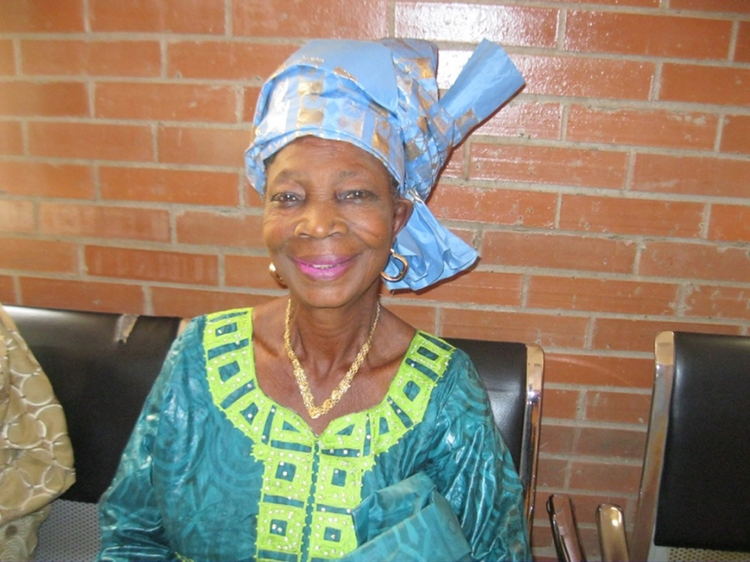
AlhajaFootnote 5 Hawawu Aminulahi Adisa, more popularly identified as Iya Aladuke (shown in Figure 3), is a Muslim woman musician and major exponent of Senwele music. Born into a devout Muslim family in Ilorin, Alhaja Iya Aladuke’s interest in music and rise to professional fame can be traced to her engagement in communal music making, such as Orin-Kengbe (calabash music)Footnote 6 as a young girl. Although she continued to perform music from a young age, her pioneering music career only took flight much later after marriage and childbearing. Also, the later development of her career may have been partly influenced by her father’s initial resistance to her pursuing music as a profession. The intricacies surrounding engagement in music professionally would later represent an important marker of her illustrious career. Although Alhaja Iya Aladuke’s career started through participation in communal music-making and her early performances were mostly within Ilorin, where she received invitations to perform at social events, including burials and celebrations commemorating the return of hajj pilgrims from Mecca, she has over time honed her craft beyond Ilorin, reaching audiences nationally and internationally.
Alhaja Iya Aladuke during a performance at Kwara State University, Malete in 2016. Photo by Austin Emielu.

An analysis of Alhaja Iya Aladuke’s identity as a Muslim woman and decades-long successful music career within a largely conservative Islamic environment lends to feminist discourses of women in Africa. Veering from Western feminist paradigms, which have been criticised for overlooking subjectivities of class, religion, and race (Spelman Reference Spelman, Bowie, Michaels and Solomon1995), feminism in Africa and many other non-Western societies has been conceptualised through Indigenous feminist perspectives such as stiwanism (Ogundipe-Leslie Reference Ogundipe-Leslie1994), Nego-feminism (Nnaemeka Reference Nnaemeka2004), snail-sense feminism (Adimora-Ezeigbo Reference Adimora-Ezeigbo2015), Afro-ecofeminism (Tamale Reference Tamale2020), motherism (Acholonu Reference Acholonu1995), and Islamic feminism (Mernissi Reference Mernissi1987).
Although Iya Aladuke does not explicitly identify as a feminist, her resilience as an established Muslim woman musician in a largely conservative Ilorin society, her style of music and dance, the agency she possesses by her elevated status as an Alhaja, and her influence on other Muslim women musicians such as Ameerah Ajao (Obirere) locates her in some locus of feminine authority and advocacy. In this position, Iya Aladuke’s feminist leanings can be mapped along Islamic feminism— a brand of feminism grounded in an “authentic” egalitarian Islam (Ahmad Reference Ambar2015) and is advanced through an equitable re-reading of the Quran and other religious texts and differentiation between Islam and Indigenous cultural practices. Also, at the core of Islamic feminism is the religious principle of absolute equality (al-musawa) of human beings (insan) (Badran Reference Badran2010: 2) and the right to engage in interpretation (ijtihad) that advances gender equality, supports new roles for women in religious rituals and practices, and encourages reforms in penal and family law and legal and political practices (Abdallah Reference Abdallah2013).
By decades of her sustained performance of Senwele music in and outside Ilorin, Alhaja Iya Aladuke engages in a subtle form of resistance against certain prescriptions of Islamic orthodoxy for women in many Islamic societies, such as dichotomies of the public and private sphere and notions of sanctity. Similarly, an analysis of many Senwele song texts that satirically highlight themes, such as sexual agency for women or implications of polygamy and adultery, lends further credence to her feminist expressions. While many Muslim women artists struggle to reconcile their music careers with their Muslim identity (Chan-Malik Reference Chan-Malik and Joseph2011), Alhaja Iya Aladuke believes that there is a place for religion and a place for social life. She notes, “I am a strong Muslim. I say my prayers five times daily as commanded by Prophet Muhammed. However, that does not hinder my career as a musician. There is room for religion alongside social life; they can complement each other” (interview, 2 July 2014). Over the years, Iya Aladuke has through an ongoing dialogical process between self and surrounding external influences, integrated her multiple identities as a Muslim woman, wife, mother, and commercial artist. With a discography of approximately twenty-one music albums, Alhaja Iya Aladuke has paved the way for the emergence of other women Muslim musicians in Ilorin, including Senwele-inspired artists across secular and religious music spheres, such as Senwele Jesu (a Christian brand of Senwele music) and Mukaila Senwele, a male Senwele artist.
Research Site II: Auchi, Edo State
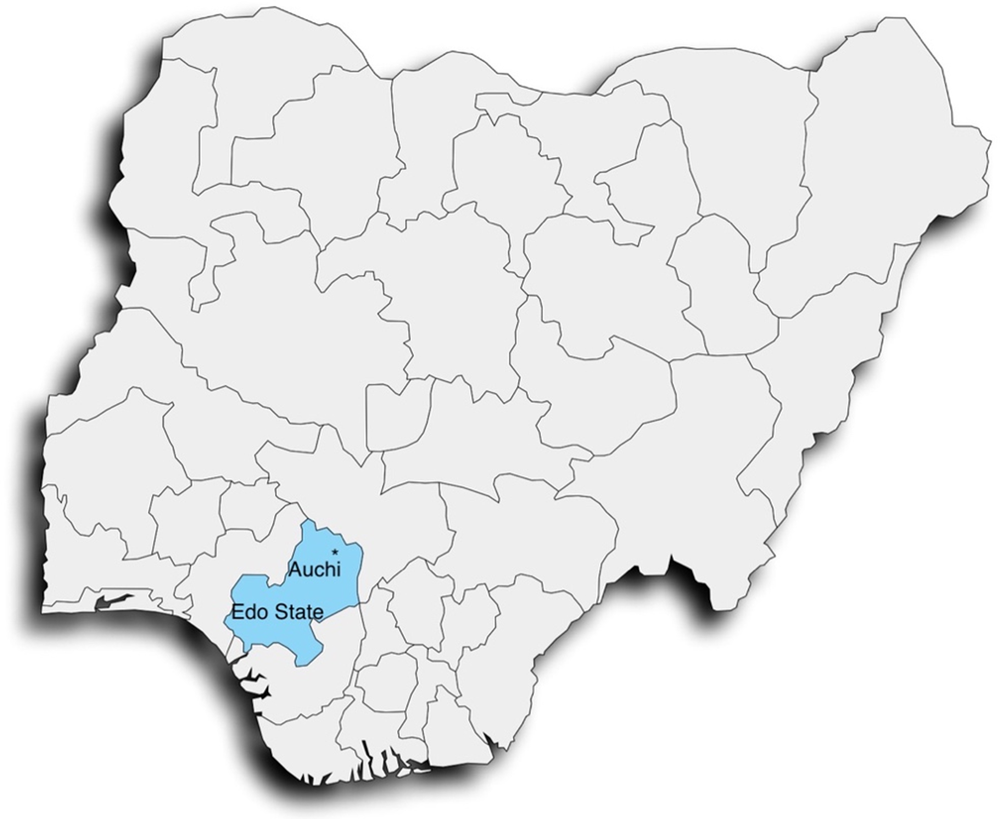
In addition to the Edo people, Edo State is home to the Bini, Owan, Etsako, Esan, and Akoko-Edo ethnic groups. Benin City is the administrative capital of Edo State, while Auchi (see map in Figure 4) is the local government headquarters of Etsako. According to the 2006 national census (quoted in Igbinovia Reference Igbinovia2010:56), the population of the Etsako people (also referred to as Afemai people) is estimated to be 440,538, with a majority Muslim population spread across three local government areas inhabiting the northern part of Edo State (see Figure 4).
Location of Edo State in the Map of Nigeria. Map created by Austin Emielu using paintmap.com.

The Edo people practise three main religions: African Traditional Religion, Christianity, and Islam. Before the advent of Christianity and Islam, Indigenous religious practices, which had no written codes but were embedded in oral traditions expressed through songs, folklore, proverbs, pithy sayings, myths, etiology, and liturgies, were dominant among the Edo (Alamu Reference Alamu2008:152). For instance, the Afemai proverb O vba bu mhe lo etse ekpe, which our informant Zakariya Oseni translated as “it is never sufficient for me, usually results in disaster” teaches people that greed is a vice. Similarly, the proverb Ai gb’omo be ya translated as “a delinquent child should not be killed” stresses the virtues of love and tolerance.Footnote 7 Additionally, the belief in a supreme God as the centre around whom the universe revolves, the belief in destiny as the divine ordering of things, as well as a strong belief in what Alamu (Reference Alamu2008) refers to as Arialusi, a religious concept akin to the law of karma in Eastern religions, are important and recurring thematic motifs in Edo musical compositions, regardless of the musicians’ religious leanings. This rootedness in cultural practices offers a strong platform for Muslims in these communities to negotiate some form of Islamic liberalism to sustain cultural practices such as music and dance, which are indispensable to community life. As is evident here, such liberalism is the African type, which emphasises the collectivist/communal orientation as opposed to the European-typed individualism.
Etsako people love music, and this love finds expression in numerous traditional entertainment forms spread across age and gender divides in the community. There are also various festivals that provide forms of entertainment, social interaction, and participation by community members. According to Omo Ojior, “Each of these festivals has its dances and songs, including the time of its celebration, practices, and its own cultural and social significance among the people … The festivals serve as a means of controlling the peoples’ emotions, conduct or behaviour” (2001:47–48). Islam became the official religion of Auchi in 1910 during the reign of Otaru Momoh. Since then, many traditional festivals have either been merged or replaced with Islamic ones. Several traditional festivals, such as Ithua and Ivbovbo have been merged with the Id-el-Kabir and Ashura Islamic festivals, respectively. Ivbovbo, also known as Tsakatsiki festival is celebrated to mark the New Year, while Ithua festival is used for age-grade initiation in Auchi. This notwithstanding, many traditional music forms are either still in existence or have been modernised. Such traditional forms include Agbi (modernised by Alhaji Waziri Oshomah), Umhomhe dance in celebration of manhood among various age groups, and Atsamukhokho, a music/dance performance by older women. In our study of the Etsako people, we focused primarily on Alhaji Sir Waziri Oshomah, the most prominent Muslim musician in Etsako, following in the footsteps of his mentor, the late Chief Anco Momodu, who was also a Muslim.
Alhaji Sir Waziri Oshomah and the Modernisation of Agbi Traditional Music
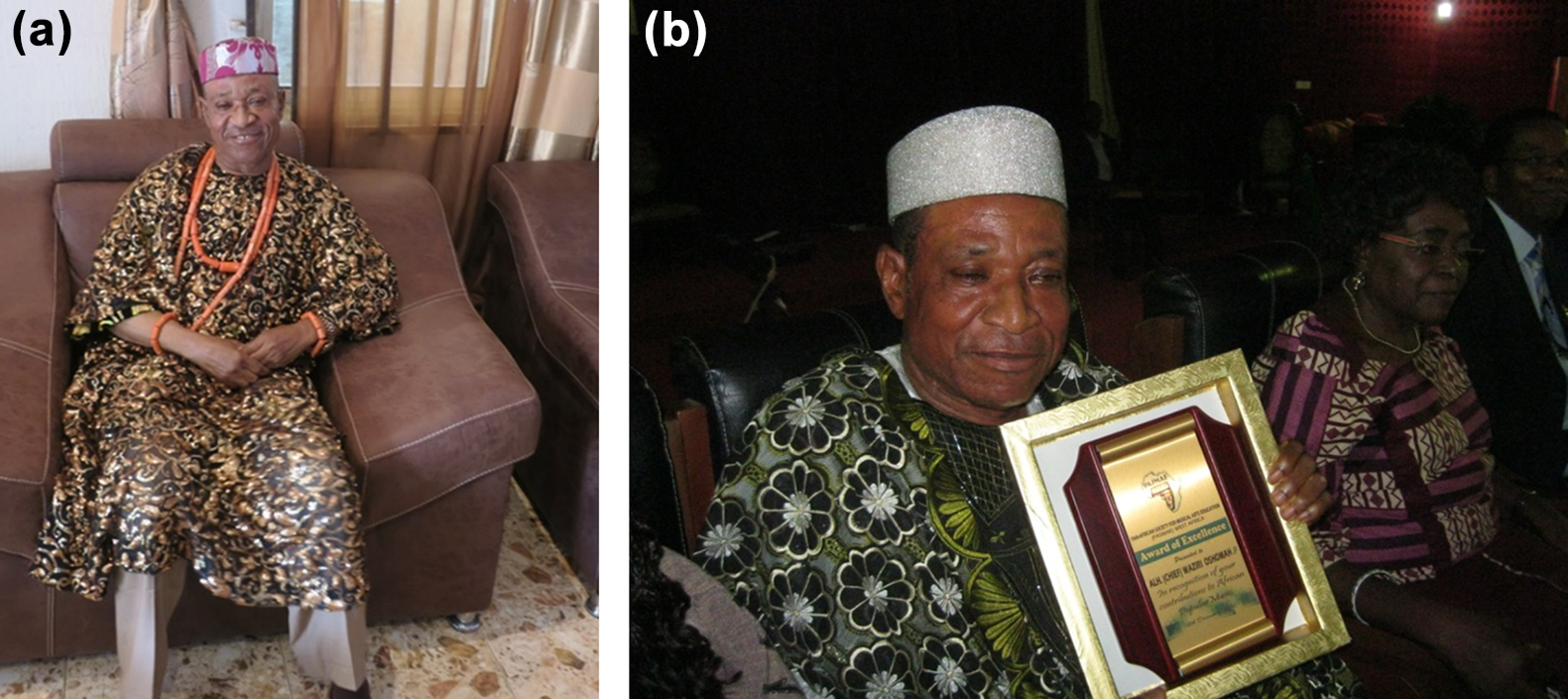
Born on 17 February 1948 into a Muslim family in his hometown, Osomegbe, Etsako Central, Alhaji Sir Chief Isah Waziri Oshomah JP (shown in Figure 5a,b) attended St. Mary’s Catholic School Osemegbe from 1955 to 1960. He continued his studies at St. Andrew’s Secondary School, Fugar (1960–1965), and Unewa Technical College, Uromi (1965–1966). After school, he worked as a gauge reader at the Ministry of Water Resources and Hydrology, Arugungu, Kebbi State in northwestern Nigeria. He also worked as a storekeeper and sales representative for Nigerian Tobacco Company Ltd. in Auchi and as a Tax Officer in the local government of Estako. He resigned in 1973 to pursue a career as a professional musician.
(a) Alhaji Waziri Oshomah, (Photo by Austin Emielu). (b) Alhaji Waziri Oshomah and his award by Pan-African Society for Musical Arts Education at the University of Benin, Benin City. Photo by Austin Emielu.

Waziri Oshomah began his musical career playing Agbi traditional music in the mid-1960s. Describing Agbi as a traditional form of music used to reflect societal events, both positive and negative, he explained that during the harvest season, elderly men would gather with drums and percussion, alongside a lead singer and a large chorus: “I modernised Agbi music” (Interview, 5 July 2011). The theme of “modernisation” was recurrent in our interactions with other musicians in Edo.Footnote 8 The claim to modernisation is based on the incorporation of Western musical instruments, particularly the guitar and later others like wind instruments and the keyboard into otherwise traditional ensembles. The synthesis of traditional music resources with Western melodic and harmonic principles resulted in a new sound which was considered modern as opposed to the original sound. Since modernity was a buzzword in the colonial and post-colonial eras, any musician who introduced Western ideas into traditional music was regarded or regarded himself or herself as the “moderniser”; the one who elevated the status of the music from its original native sound. It is along this line that Waziri Oshomah organised his first group, Waziri Oshomah and the Traditional Sound Makers, as a traditional orchestra, as he calls it, using mainly acoustic musical instruments including the acoustic guitar. In 1973, Waziri Oshomah came to prominence with a song which means, “The hunter does not narrate whatever he sees during hunting.” Another popular song, which was also a successful hit, was “Zonuze,” which he explains as: “In this life, if you choose to work hard, Insah Allah, then success will follow” (interview, 26 December 2016). Waziri Oshomah’s early recordings were classified as native blues by Decca (West Africa), a foreign recording company that marketed his music. Decca and its subsidiary Afrodisia were very active in Nigeria from the 1970s where they promoted indigenous music and musicians. Waziri later changed the name of his band to Oyoyo Sound International. According to him, Oyoyo means the best. This name was borrowed from a masquerade in his area called Oyoyo who usually performs last at a local festival and is usually considered the best of all the masquerades. Waziri is also credited with the revitalisation of many folk songs of the Etsako people that were nearly extinguished by orthodox Islam. Today, Alhaji Waziri Oshomah (as he is now known) has about one hundred music albums to his credit, a chain of national and international awards, and several traditional chieftaincy titles. This is based on his outstanding contributions to the sustenance and promotion of traditional music and dance practices, as well as selfless service to various communities in Etsako. Alhaji Waziri Oshomah is a practising Muslim and is married, with wives, children, and grandchildren.
Contesting Orthodoxy and Negotiating Islamic Liberalism in Africa
In this section of the article, we first consider Loimeier’s (Reference Loimeier2013) question about whether there is an “African Islam.” We consider that this question and the perspective that Loimeier provides are fundamental to any discussion on Islamic liberalism in Africa in relation to music and dance practices. Then, we identify and discuss specific ways Muslim musicians and their patrons contest orthodoxy and consider the factors that may have instigated liberal tendencies to sustain indigenous music traditions.
Loimeier makes several fundamental assertions in his work which we interrogate here against the backdrop of our research. First, is the assertion that it is possible to find the concept of an African Islam and that this African Islam is presented as peaceful and syncretistic, accommodating, and less orthodox than militant forms of Islam (Loimeier, Reference Loimeier2013). We do know that Islam was introduced to northern Nigeria by Berber and Arab traders as well as during the Moroccan invasion in the eleventh century (see Omojola Reference Omojola2012:204). While we do not have sufficient evidence to confirm or negate the militancy of Islam, as Loimeier suggests and based on our fieldwork, Islam was very accommodating in the areas where we conducted our research. We can also confirm the relatively peaceful co-existence among adherents of different religions and ethnic groups in both research sites. However, the situation in northern Nigeria, with several incidences of religious violence and extremism since the 1980s and the lingering saga of Boko Haram, bandits, and terrorists, now differs significantly from that in southern Nigeria. In the south, Islam was introduced in the nineteenth century through people of diverse ethnic origins, and it has remained largely peaceful. Despite contrasting approaches to Islam, there is a robust practice of music-making both in the north and in the south. Many notable Muslim musicians such as Dan Maraya Jos, Alhaji Shetimma, and others from the north are leveraging indigenous music traditions, though sometimes not without resistance. What this suggests in the context of this article is that Islam in Africa accommodates many local factors in the receiving cultures, and this becomes the basis for contemplating the idea of an African Islam, a re-evaluation of Islamic orthodoxy, and articulation of Islamic liberalism in Africa. Soares argues for an approach to the study of Muslim societies in Africa that views their practices as a “discursive tradition at the intersection of the local and supra-local and where the articulation of a local Muslim identity within the larger global or supra-local Muslim world becomes a central concern” (quoted in Mclaughlin Reference McLaughlin2011:73). The idea of a local Muslim identity has a strong cultural resonance within the community, and this becomes a basis for contemplating some form of liberalism.
A contextualisation of the supra-local Muslim dynamics in Nigeria can be deduced from broad commonalities that moderate the practice of Islam, such as the belief in prayer (salah), the declaration of faith (shahada), almsgiving (zakat), fasting (sawm), and pilgrimage (hajj). Along these commonalities are nuances that shape a localised practice of Islam, including the existence of diverse Islamic sects (Sunni and Shia) and doctrines, multiple authorities in Islamic scholarship, subjective interpretations of the Hadith and Quran, as well as varying dispositions towards Islamic puritanism and liberalism, within the context of specific cultural factors. Particularly, the local Muslim identity in Ilorin is further cognisant of the process of Islamisation, the geographical location of Ilorin as a gateway to both northern and southern Nigeria, and the status of Ilorin as a former Yoruba frontier town and now part of a northern emirate. A compendium of these factors added to Marloes’s observation that the Yoruba seem to attach more value to common culture and ethnicity than to religious affiliation (Reference Marloes2020:421), eliciting religio-cultural tension where spectrums of orthodoxy and liberalism or heterodoxy are negotiated.
Indexing this sense of religio-cultural tension are various events such as the dispute around and subsequent cancellation of the 2023 Isese festivalFootnote 9 in Ilorin following opposition by a Muslim group, Majlisu Shabab li Ulamahu Society (Alabi Reference Alabi2023), the prevalence of Sharia Law in many northern states and its rejection in the southwest (Balogun Reference Balogun2022:712), and the initial resistance to the spread of the popular charismatic Muslim organisation, Nasrul-Lahi-il Fathi Society of Nigeria (NASFAT), from Yoruba Muslims to the Muslims in the north. Although the formation of NASFAT was limned as a response to the Pentecostal surge in Nigeria (Obadare Reference Obadare2016) and an “aspiration to conformity to modernity” (Marloes Reference Marloes2020:419), some northern Muslims perceived it as a form of Islamic syncretism and Yoruba Islamic cultural nationalism (Adeniyi Reference Adeniyi, Adogame and Shankar2013). While the above discussions yet evince a complex Ilorin Muslim identity, the city remains a pivotal centre for Islam in Nigeria, the blending of Islam and ethnic identification, and the reification of Islamic orthodoxy and liberalism.
The experience of Alhaji Waziri Oshomah also lends credence to this religio-cultural complex: “I was born into a family of Islam…My parents did not allow me to go into music, thinking that if I go into music, I would not follow the Muslim way [i.e., global or supra-local Muslim identity], but I assured them that even though I play my music, I will still serve my God the Muslim way [i.e., local Muslim identity]” (interview, 26 December 2016). Similarly, tracing the trajectory of Senwele music and Alhaja Iya Aladuke’s career reveals such religio-cultural negotiations. In addition to the initial resistance Iya Aladuke faced at the start of her professional music career, Senwele music, originally a Yoruba social music genre has evolved into a socio-religious music form, expanding its performance boundaries to adapt to occasions such as the Sabaka night—a post-hajj (holy pilgrimage) thanksgiving night celebration. This adaptation includes the incorporation of Islamic linguistic infusions such as Insha Allah, Allahu Akbar, cantillations, and Quranic verses in Senwele performances. In terms of compositional resources, Islamic influences are visible in the melismatic and monodic vocal style, as well as shared compositional elements between Yoruba and Arabic/Islamic music, including short repetitive melodies and rhythms, common intervallic ranges, repetitive cycles, and prevalent monophonic texture. (For example, see the melody excerpt of the song, “Ajekun Iya ni oje” by Iya Aladuke (2013) in Figure 6).
Melodic Excerpt from Ajekun Iya Ni Oje. Score by Obianuju Njoku.

Further illustrating the religio-cultural interplay in Senwele music is the blend of Yoruba and Islamic aesthetics in Alhaja Iya Aladuke’s performance attire. This typically includes the traditional Yoruba iro, buba, and gele Footnote 10 blended in some instances with the hijab. These aesthetic representations are significant not only as costumes or for adding aesthetic enrichment to music performance but as a crucial means of reinforcing identity and, according to Rabine (Reference Rabine2015), producing ideologies that reinforce or challenge the status quo.
The second and third points that Loimeier makes connect extensively with our discussions above. The second point is that any discussion on Muslim societies and Islam in Africa must take into consideration that there is no uniform and singularly orthodox form of Islam in Africa or elsewhere in the Islamic world. The third point is that the continent of Africa is too vast and its historical experiences with Islamisation too diverse to harbour or support only one continental expression of Islam (Ibid.:12). Loimeier then advances the concept of unity within diversity where “the process of Islamisation has to be understood as one of localisation, in which elements of the faith and religious practice were incorporated into a multitude of local contexts and thus came to form local traditions of Islam” (Ibid.:18). This idea is symptomatic of the gatekeeping processes of African cultures where outside resources are selectively adapted or harnessed to enrich rather than destroy inside resources, creating in the process, a new and improved local tradition, as seen in our study. Loimeier, however, agrees that Muslim societies share one single concept of the prophetic time that unites Muslims across continents and through times.
Tomaselli (Reference Tomaselli2003) argues that there is no single Africa and that thousands of culturally different and interacting societies live on the African continent. This cultural diversity justifies the use of such terms as Yoruba Muslims, Yoruba Islamic popular music, Hausa Muslims, and Senegalese Islam/Senegalese Sufism.Footnote 11 The fact that Africa is not a culturally homogenous entity has also instigated the development of diverse musical traditions. The phrase “unity in diversity” coined by Nehru Jawaharlal in his work, Discovery of India (Reference Jawaharlal1959), has become a convenient theoretical framework for the study of African music. This point is very important considering that Islam spread far and wide through culture brokers of diverse ethnic nationalities. In Auchi, for example, Islam came through Hausa, Nupe, Igala, Yoruba, and Fulani cross-cultural contacts. In Ilorin, Islam came mainly through the Fulani. There is a mix of cultures that allows some form of syncretism of both local versions of Islam brought by culture brokers and the cultural practices of the carriers. The point to be made here is that it is very difficult to separate the true religion from the culture of those who spread the message of Islam. For example, because Islam was first introduced to Hausa–Fulani communities in northern Nigeria, its spread not only brought Islam to southern Nigeria but also enabled the spread of Hausa–Fulani cultures in the south. This aligns with one fundamental statement that was made by one of the presenters at an international workshop in Israel, which is: “There is the religion as revealed by God to man and there is the religion as understood by man.”Footnote 12 The workshop focused on the theme “Rethinking Islam at the Turn of the 21st Century: Liberal Trends, Agents of Change and Reassessments of Islamic Traditions.” The above submission at the workshop sheds light on the fact that humans interpret and make sense of divine revelations according to their peculiar circumstances and culture; an important point that aligns well with our argument in this paper.
From our discussion so far, we can safely conclude that it is the diverse socio-historical experiences of Africa, the diverse processes of Islamisation (as can be seen from the study areas represented in this article), the interpretation, appropriation, and enforcement of the large expanse of materials of the Islamic tradition across diverse geographical, cultural, and social spaces along a historical continuum that has drawn the line between orthodox and liberal Muslims. This may have provided the headroom within which many Muslim societies, particularly outside the Middle East, continue to contest orthodoxy and negotiate liberalism in different geo-cultural contexts.
Sustenance of Music Traditions in Ilorin and Auchi
The submission that orthodox Islam associates music with paganism, immorality, drunkenness, sexuality, and gambling and is directly linked with the devil (Adegbite Reference Adegbite1989) played itself out when Islam became the official religion in Auchi as Harunah, an indigene observes:
…Islamic culture[in Auchi] was interpreted to be totally against traditional songs and dances. The early Islamic preachers who brought the religion to Auchi saw to the annihilation of the traditional songs and dances in their erroneous belief that they were immoral and against the teachings of Islam. (Harunah Reference Harunah2010:249)
After several years, this orthodox position had to be challenged and renegotiated because the people’s cultural practices were dying, and there was a great concern among community elders and the king. In the case of Auchi, the Islamic tradition which condemned music and dance practices had to be re-interpreted by eminent local Mallams (Islamic teachers or scholars). The Otaru (King) of Auchi A.G. Momoh, Ikelebe II charged his subjects to revive Auchi songs and dance styles and to retrieve the people’s lost glory for onward transmission to posterity (Harunah Reference Harunah2010:249).
It is this resistance to orthodoxy and the liberal platform provided through the re-interpretation of orthodox doctrines by local Islamic scholars that musicians such as Chief Anco Momodu and, his protégé, Alhaji Waziri Oshomah leveraged. Within the Etsako community, these two musicians are revered as cultural heroes. Waziri Oshomah is highly successful and wields much influence in Etsako, as evidenced by the string of chieftaincy titles he has received from local communities. Waziri Oshomah, like his late master, Anco Momodu, does not play Islamic or Arabic-influenced music. Rather, he plays social dance music drawing on local traditions and Western-derived popular music, particularly West African highlife.
According to Oshomah, “My music appeals to everybody whether Christian or Muslim… Some are attracted to the message while others to the dance rhythms” (interview, 5 July 2011).
According to the Chief Imam of Auchi, “Etsako people love music, and the musicians are well accepted by society, especially the way the songs speak to the people…people buy [their albums] because they are repositories of our culture” (Zakariya Oseni, interview, 17 September 2011). The Chief Imam of Auchi is a great lover of music. It was through him we gained introductions to many of the popular musicians in this area. He also introduced us to the Otaru (King) of Auchi Kingdom. As a flutist in a local orchestra during his younger days, the king was very enthusiastic about our research.
In our research, we also came across interesting perspectives on music and dance practices in Muslim communities. First, we posed this simple question to one of our respondents in Ilorin: “What is the place of dance music in Islam?” His response was simple: “We look at it in two ways: religion and culture. Religion, no; culture, yes” (Alhaji Lawal, pers. comm., 28 October 2017). He explained that Islam as a religion abhors dance music but because it is inherent in African culture (in our case Ilorin/Yoruba culture), it cannot be easily ignored. We also came across terms such as “Muslim fanatic,” “social Muslim,” and “culture die-hard.” “Muslim fanatic” is not to be understood in terms of extremism in its core context but in terms of orthodoxy; those who stick to the message of Islam as delivered by the preachers who converted them and are unwilling to accommodate changes. On the other hand, “social Muslim,” a term used by Waziri Oshomah in one of our interviews, refers to a form of liberalism where the individual is a Muslim by faith and at the same time, not a social misfit. The “culture die-hard” phenomenon refers to the resilience of indigenous traditions to which Christianity and Islam were introduced. As we have seen in Ilorin, notwithstanding its popularity and patronage, Senwele music crystallises a form of religio-cultural ambivalence largely based on the existence of two primary groups of Ilorin Muslims: the Yoruba Muslims and the Fulani Muslims. In addition, these groups include the Ilorin Muslim purist, who believes in an orthodox form of Islam that is considered to be in opposition to the sustenance of local music traditions. The second group is the Ilorin Muslim liberalist, who believes there is a place for culture in religion and therefore advocates for its sustenance through the patronage of local music and dance practices.
Factors that Instigate Liberalism and Contribute to the Sustenance of Music Traditions
In our study, we identified four factors that have instigated and continue to instigate Islamic liberalism and, in the process, have been instrumental to the sustenance of music traditions: (1) the agency of Muslim musicians; (2) the fundamental roles music plays in community life; (3) the resilience and resistance of indigenous cultures to total assimilation; and (4) economic factors.
Agency of Muslim Musicians
Alhaji Waziri Oshomah was determined to be a musician despite being a Muslim and his parents’ opposition to his musical career. However, he was mindful of the wishes of his parents for him to live a good life both as a Muslim and a member of the community. He realised that their objection to a career in music was due to preconceived or perceived notions of musicians as people who never do well and engage in immorality, which Islam forbids. He was, therefore, determined to prove them wrong. Rather than disobey his parents, which his culture frowns at, Waziri appealed passionately to his parents: “I told them that although I will be playing music, I will still serve my God in the way my parents have taught me” (interview, 26 December 2016).
Today Waziri is highly successful, happily married, has educated his children, and has become a source of pride to his parents, community, and Muslim youths. To this end, he was proud to say to us: “I have a mosque in front of my house and my family observe five times prayer per day… I went on hajj to Mecca in 1981…” He concludes that: “whatever one decides to do, you may not think about what people will say, no parent can dictate to any child what to do” (ibid.).
This sense of career agency also ties up with the strong belief in predestination in our research communities—what the Yoruba refer to as Ayomo or Kadara. The excerpt below from the song, Eda ko le kpa by Iya Aladuke (2013) lends credence to this:

Similar to the experiences of Waziri, Alhaja Iya Aladuke’s decision to become a professional musician was not without its hurdles but also strongly instigated by agency.
Music in Community Life
Next to agency is the fundamental role that music plays in community life. Music punctuates the life of the African from cradle to the grave. There is hardly any social or community event where music is not present. Here are two field experiences. On 26 December 2016, we were at Iluoke, a small community near Auchi. It was an age-grade ceremony where young men are initiated into their next age bracket and assigned new roles in the community. This all-important event attracted members of the community and many others from far and near: Muslims, Christians, and adherents of other faiths; natives and non-natives like us sharing in the communal experience and consolidating social networks, sustaining group identities, and contributing to their cultural memory and heritage. As is typical of such events, there was a strong sense of bonding and tolerance, where all religious differences dissolved in a pool of communality and where music-making and dancing provided the stimulants or driving forces for the entire event. The music at this event was provided by King Benji Igbadumhe and his Okeke Sounds, himself a Christian.
Commenting on the impact of Islam on Etsako culture, the Chief Imam of Auchi argues that “Islam did not come to upturn everything about the people’s culture… what Islam considers good is retained and others, modified or rejected outrightly.” He further affirms that:
“Etsako people love music, and the musicians (dance bands) are well accepted, especially the way their songs speak to society…The musicians preach what the Imam and pastors preach in their sermons, hence their acceptability… Most of them talk sense, while the rhythms are quite appealing” (Zakariya Oseni, interview, 17 September 2011). Other informants from Warrake, a small Muslim community near Auchi, had this to say about dance bands:
They sing with our lyrics and we hear what they are saying…They use folklore to reflect what is happening in society and the rhythm is danceable for all ages…I like the music, particularly as music is a way of interpreting what is happening in society; music is supposed to interpret what is happening in society… (Abeni Mohammed, interview, 6 July 2011). Generally, we are happy with their music because they tell us either what is happening or has happened in the past (Yusuf M.B., interview, 6 July 2011.)
Warrake, despite being an entirely Muslim community, had local orchestras that played the drums, flutes, or trumpets (known as poporipo in local parlance), which provided popular entertainment in the 1960s.
Akin Euba underscores the significance of music in the social life of the Yoruba. He observes that “Yoruba Islamic community use ‘orthodox Arabic music’ during worship but perform traditional Yoruba music for social activities as well as Muslim festivals” (Euba Reference Euba and Wachsmann1971). Similarly, Trimingham argues that “When Islam is adopted, the community does not suddenly change its social patterns but remains a unity distinguished by its patterns of custom. In time, Islam becomes intertwined with community life without disintegrating its basic structure” (Reference Trimingham1959:125). To test the validity of these claims made several decades ago, we attended a marriage ceremony of a Yoruba Muslim couple on 10 and 11 February 2017 in Ilorin. The first day of the ceremonies, as in Yoruba custom, was for traditional engagement. Here, families of the bride and groom meet officially, give their blessings to the couple, and exchange the bride price and other items as requested. The audience was mixed but predominantly Muslim. There was a non-Muslim Disc Jockey and a dance band that provided music for the ceremony to which everyone danced and enjoyed themselves. The second day was the Nikah (marriage ceremony) and reception ceremonies. Again, there was a Disc Jockey and another dance band. When we asked the band leader what kind of music his band would play considering that this is primarily a Muslim gathering, he told us, “I will play social dance music, nothing religious.”
Resilience of Indigenous Cultures
Culture has been described as a combination of values, customs, beliefs, and practices that make up the lifestyle of a specific group. In other words, it is the practice of experiencing, interpreting, and making sense of a society, group, or class itself (Eagleton Reference Eagleton2005:46). To give up one’s culture and replace it with one from outside may lead to what Yerima describes as a “defenceless and isolated entity, a ‘new man’ cut off from his roots and his social and communal foundations” (Reference Yerima2001:3). This may explain in part why despite a seemingly hegemonic imposition of Islam and Christianity on the African people, depriving them of their cultural practices, it was not long before they began to contest their cultural deprivations and found a way around it. This cemented their faith in the God of the new religion in which they believed and simultaneously retained their cultural practices as much as possible.
Commenting on his contributions to Auchi culture, Alhaji Waziri Oshomah’s public relations document reads as follows: “Alhaji Waziri resurrected along with his creations, many of Afemai’s (Etsako) near-extinct folk songs, adapting them dexterously to suit modern concepts while retaining their lyrical purity…”Footnote 13 Building his dance band music on indigenous music and dance tradition known as Agbi also testifies to the resilience of culture.
Economic Factors
Robinson et al observe that “when music, as any other art form is inscribed within a system of commoditisation, the influence of the market—what will sell—is important in shaping the content and form of the musical product” (Reference Robinson, Elizabeth and Marlene1991:238). The preceding quote connects well with Islamic liberalism instigated by economic factors, as evident in the following point by Waziri Oshomah:
Victor [referring to the legendary Sir Victor Uwaifo] is my mentor; he put so much respect into music; he is educated and rich. I use music to do so many things; I train all my children and because of that many of our youth like to play music because there was success in my music… My records are selling because they have religious [philosophical] proverbs that correct the ills of society. I caution [my listeners] that God forbids this, forbids that (interview, 26 December 2016.)
As can be seen from the above, the socio-economic status of the musician is crucial to the perpetuation of musical traditions. Similarly, in Ilorin, the socio-economic status of musicians was once a deterrent to going into music as a full-time profession. Explaining this view and reflecting on her process of becoming a musician, Alhaja Iya Aladuke notes that:
Music in those days was not a profession you would like to hand over to your children. Can anyone give birth to a child and send him to choose commercial driving as a profession? The plan of every parent was for his or her children to go to school to study and become lawyers, engineers and doctors (Interview, July 8 2018.)
For Islamic women musicians such as Iya Aladuke, this occupational or career complex is heightened by societal perceptions of women musicians as “women of the night.”Footnote 14 However, the ability of this Ilorin musician to achieve commercial success and fame confers an elevated status and propels changes in their economic circumstances. In the instance of Alhaja Iya Aladuke, the release of her first record, Won lasewo ni wa (They say we are whores, 1990), catalysed the commercial turn of Senwele music, propelling it from a local to a trans-local music form, with patrons outside its community of origin, Ilorin. The widespread commercial success of Senwele is evident through multiple albums and pioneering international performances by Alhaja Iya Aladuke and her band in countries such as the Republic of Benin, Togo, Ghana, Ivory Coast, and the United States. Also enabling the commercialisation of Senwele and its attendant socio-economic agency have been musical collaborations between Alhaja Iya Aladuke and mainstream musicians, such as Pasuma, Wasiu Ayinde, and Saheed Osupa.Footnote 15 Extending the frontiers of Senwele and the socio-economic agency Alhaja Iya Aladuke enjoys, is what she describes as her “connection to the low and mighty.”Footnote 16 By this, Iya Aladuke refers to the social capital, economic mobility, and widespread endorsement that stems from the popularity of Senwele performances in Ilorin as well as her performances for the ranks of the “high and mighty” figures in Nigerian politics, such as the former Governors of Lagos and Osun states, Asiwaju Bola Ahmed Tinubu, Rauf Aregbesola, and former Senate President, Bukola Saraki.
Conclusion
Negotiating Islamic liberalism has been crucial to the sustenance of music traditions in our research sites. Both musicians and their audiences have leveraged deep-seated age-long cultural beliefs to strike a delicate balance between religious faith and community-based socio-cultural practices. However, this form of Islamic liberalism is not the Eurocentric form, which takes liberalism as a social imaginary based on the ideal of autonomous individuals freely engaging with one another in an egalitarian public sphere. Rather, it is an African-centred type that emphasises the communal “we feeling,” based on the African dictum “I am because we are and because we are, therefore I am.” It is a form of liberalism where cultural sensibilities and dictates become the principal catalysts, allowing individuals to simultaneously stand out and still fit into community life as we observed with Waziri Oshomah in Auchi and Iya Aladuke in Ilorin. Our research has also signposted the resilience and gatekeeping processes in African cultures where outside cultural resources are selectively harnessed to enrich rather than destroy inside cultural resources. However, while our study highlights the multivalent dispositions of music and Islam and the ambivalences and contestations that may arise, we do not intend to suggest that Muslims in the areas studied do not have a deep regard for Islam as a religion, nor are they unfaithful to the tenets of Islam. Overall, one can find conscious efforts by the people in these areas to strike a delicate balance between orthodoxy and liberalism. Considering that many African cultures are on one hand resilient and on the other dynamic, it is problematic to contemplate a rigid religious orthodoxy, especially in this age of cultural globalisation, hence the sustenance of these music traditions in contemporary Nigeria.