



Introduction
In recent years, the microwave passive circuits are being considered as one of the crucial research areas for advanced handset applications. Recently, the microwave filters and multi-band circuits were realized by using different technique [Reference Song, Zhu, Zhao, Fan and Fan1–Reference Chen, Song, Hu and Fan10]. Today, much research is interested on the realization of multiplexer modules with multichannel, small size/volume and low cost by embedding passive components into PCB substrates. The most well-known method to design the planar diplexers is to combine the bandpass filters (BPFs) with an associated matching circuit. By using this method, many diplexers and multiplexers are designed [Reference Hammed11–Reference Dong, Li and Yang20]. It is getting challenging as the channel number increases. To reduce circuit size, in paper [Reference Hammed11], a design technique of high performance diplexer for multi-wireless networks based on multilayered U-shape resonators was presented. In paper [Reference Bavandpour, Roshani, Pirasteh, Roshani and Seyedi12], a new structure for diplexer was proposed by using T-shaped resonator, ring resonator, and meandered lines. A high-isolation microstrip duplexer designed for radio occultation systems for future planetary systems was presented in paper [Reference Upadhyaya, Pabari, Sheel, Desai, Patel and Jitarwal13]. In paper [Reference Hong and Chang14], a six-channel multiplexers have also been developed. In paper [Reference Tu and Hung15], eight-channel diplexer based on stepped impedance resonators and common-input port coupling distribution has been developed. However, the design of planar diplexers with reduced size and wide stopband remains challenging. In this paper, compact microstrip eight-channel diplexer based on quad-band BPF is presented. The proposed diplexer is operating at 2.5/3.3/5.2/6.57 GHz with 3-dB fractional bandwidth of 3/4.5/4/4.6%, respectively, are for channel 1, 2, 5 and 7, respectively, and 3.9/4.65/5.6/7.2 GHz with 3-dB fractional bandwidths of 3/6/4/5%, respectively, are for channel 3, 4, 6 and 8, respectively. The proposed diplexer is based on two quad-band BPFs. Analysis based on even-and odd-mode equivalent circuit is used to determine the fundamental resonant frequencies of quad-mode stepped impedance resonator (QMSIR). Two second-order quad-band BPFs are constructed in order to be combined together with distributed coupling matching circuit for one planar eight-channel diplexer. Compared with the previous works, the proposed diplexer has the reduced number of resonator due to the multimode resonant presented by the resonator, the smaller size (0.083λ 2) and the larger fractional bandwidth (97%). This concept has been verified by experimental results.
Design procedure of diplexer
Figure 1(a) shows the layout of the proposed eight-channel diplexer, which is based on the QMSIR. The structure of the proposed QMSIR is shown in Fig. 2. Figure 1(b) represents the coupling routing diagram of the proposed, where R represents a resonator and the solid-lines between notes represent the direct coupling path and the dash-lines between source-load represent the indirect coupling path. S and L denote the input and output ports, respectively. As it can be seen, the diplexer is formed by two quad-band filters (BPFI and BPFII), where the BPFI operates at f 1, f 2, f 5, and f 7, i.e. the center frequencies of the channels 1, 2, 5, and 7, respectively and the BPFII operates at f 3, f 4, f 6, and f 8, i.e. the center frequencies of the channels 3, 4, 6, and 8, respectively.
(a) Configuration of the proposed eight-channel diplexer. (b) Its coupling routing topology.

Structure of the proposed QMSIR.

Characteristics of QMSIR
Figure 2 shows the reported QMSIR with transmission line model (TLM). Its corresponding electrical lengths θ 1, θ 2, θ 3, and θ 4. The design conditions are assumed to be (θ 1 + θ 2) > (θ 3 + θ 4). The reported resonator is symmetrical, analysis based on even-/odd-mode method is employed. Its corresponding even-/odd-mode equivalent circuits are given in Fig. 3, respectively. At the resonance frequencies, the input impedance (Z in) of each mode will be equal to zero. When plane A-A′ is applied the resonant frequencies can be derived as
 \begin{equation} \tan\theta_{2}\tan\theta_{1} - R_{\text{Z1}} =0\to f_{1}\end{equation}
 \begin{equation} R_{\text{Z1}}(\tan \theta_{4}+R_{\text{Z3}}\tan{\theta}_2)-\tan \theta_{1}(\tan \theta_{2}\tan\theta_{4}-R_{\text{Z3}})=0\to f_{2}\end{equation}
Even-/odd-mode equivalent circuits. (a) and (b) Odd-/even-mode equivalent circuit, respectively, when plane A-A′ is applied. (c) and (d) Odd-/even-mode equivalent circuit, respectively, when plane B-B′ is applied.

Similarly, when plane B-B′ is applied, the resonant frequencies are derived as
 \begin{equation}\tan\theta_{3}\tan\theta_{4} - R_{\text{Z1}} =0\to f_{3}\end{equation}
 \begin{equation}R_{\text{Z2}}(\tan \theta_{1}+R_{\text{Z4}}\tan{\theta}_3)-\tan \theta_{4}(\tan \theta_{1}\tan\theta_{3}-R_{\text{Z4}})=0\to f_{4}\end{equation}
where R Z1 = Z 1/Z 2, R Z2 = Z 4/Z 3, R Z3 = Z 4/Z 2, and R Z4 = Z 1/Z 3 are the impedance ratios. By defining δ 1 = |f 2 − f 1| and δ 2 = |f 4 − f 3|, the mode splitting is studied as shown in Fig. 4. As it can be seen in Fig. 4, δ 1 decreases and δ 2 increases as θ 1/θ 4 is increased. At θ 1/θ 4 equals zero, δ 1 tends to large number and δ 2 becomes zero. It suggests that the two resonant frequencies of a f 3 and f 4 will merge. At θ 1/θ 4 tends to large number, δ 1 becomes zero and δ 2 tends to large number. It suggests that two resonant frequencies of a f 1 and f 2 will merge. At point S, δ 1 and δ 2 are equal. By adjusting θ 1/θ 4, the quad-mode SIR can provide more freedom to exhibit different characteristics for quad-mode designs. The solutions for θ 1, θ 2, θ 3, and θ 4 are dependent on the choice of impedance ratios R Z1 and R Z2, and electrical ratios β 1 = θ 2/θ 1 + θ 2 and β 2 = θ 3/θ3 + θ 4. By properly choosing β 1 and β 2, θ 2 and θ 3 become a function of θ 1 as illustrated in following expressions
 \begin{equation}\theta_{2}=\frac{\beta_{1}}{1-\beta_{1}}\theta_{1}\end{equation}
 \begin{equation}\theta_{3}=\frac{\beta_{2}}{1-\beta_{2}}\theta_{1}\end{equation}
Variation δ 1 and δ 2 with different electrical length ratio θ 1/θ 4 under the condition of θ 2 = 11.6°, θ 3 = 27.2°, R Z1 = 5.95, and R Z2 = 5.25.

By normalizing the f 2 to the f 1 and f 4 to the f 3, two normalized resonant frequencies of the QMSIR are obtained as
 \begin{equation}\frac{f_2}{f_1}=\frac{\theta_{1}+\theta_{2}+\theta_{4}}{\theta_{1}+\theta_{2}}\end{equation}
 \begin{equation}\frac{f_4}{f_3}=\frac{\theta_{1}+\theta_{3}+\theta_{4}}{\theta_{3}+\theta_{4}}\end{equation}
By introducing the electrical ratios β 1, β 2 and α = θ 1/θ 4 in equations (7) and (8), the normalized resonant frequencies f 2/f 1 and f 4/f 3 become the function of β 1, β 2, α, R Z1, and R Z2 as shown in Fig. 5. As it can be seen in Fig. 5, when the electrical lengths (θ 1 and θ 4) are fixed, varying the impedance ratios (R Z1 and R Z2) and electrical ratios (β 1 and β 2), the resonant frequency ratios (f 2/f 1 and f 4/f 3) decrease as the electrical length ratios (β 1 and β 2) and impedance ratios (R Z1 and R Z2) increase. Based on these characteristics of quad-mode SIR, the design procedures to obtain the quadruple-mode of quad-mode SIR are summarized as follows: (1) Fix the electrical ratio α. (2) Choose the electrical length ratios β 1 and β 2 according to the resonant frequency ratios (f 2/f 1 and f 4/f 3) and determine the impedance ratios (R Z1 and R Z2). (3) Fix the value of θ 1 to compute θ 2, θ 3, and θ 4 using equations (5), (6) and electrical length ratio α = θ 1/θ 4. Then the electrical length parameters are found.
Normalized resonant frequencies of QMSIR against impedance ratios: R Z1 with varied β 1 and R Z2 with varied β 2. α is fixed to 1.2.

Design of quad-band BPFs
Based on the above analysis, two second-order quad-band BPFs are designed according to the configuration and coupling routing topology shown in Fig. 6. Multiple coupling technique is employed to implement the four passbands. The couplings  ${{ \theta }}_2^1$,
 ${\text{ Z}}_1^1$, and
 ${\text{ Z}}_1^1$ are used to generate the passbands f 1 and f 2 while the couplings
 ${\text{Z}}_2^1$,
 ${{\theta }}_4^1$, and
 ${{\theta }}_3^1$ are used to generate the passbands f 3 and f 4. By considering f 11 = 2.5 GHz, f 21 = 3.3 GHz, α = 1.2, and β 1 = 0.1, with f 21/f 11 = 1.32 and R Z11 = 3.3, and f 31 = 5.2 GHz, f 41 = 6.57 GHz, α = 1.2, and β 2 = 0.2 with f 41/f 31 = 1.26 and R Z21 = 5.1 for the first quad-band BPF, and f 12 = 3.85 GHz, f 22 = 4.65 GHz, α = 1.2, and β 1 = 0.1 with f 22/f 12 = 1.21 and R Z12 = 7.9, and f 32 = 5.6 GHz, f 42 = 7.2, α = 1.2, and β 2 = 0.2 with f 42/f 32 = 1.28 and R Z22 = 5.5 for the second quad-band BPF, the initial electrical length parameters of the two quad-band BPFs are determined as: (1) for the first quad-band BPF, by taking
 $\theta _1^1 = 90^\circ $ with
 $R_{{\text{Z1}}}^1 = 3.3\Omega $, the initial values are
 $\theta _2^1 = 10^\circ $,
 $Z_1^1 = 87.5\Omega $,
 $Z_2^1 = 26.5\Omega $,
 $\theta _4^1 = 75^\circ $ and
 $\theta _3^1 = 18.75^\circ $,
 ${\text{ Z}}_1^1 = 105.8\Omega $ and
 ${\text{ Z}}_2^1 = 20.75\Omega $. (2) For the second quad-band BPF, by taking
 $\theta _1^2 = 87.3^\circ $,
 $R_{Z1}^2 = 7.9\Omega $, the initial values are
 ${{ \theta }}_2^2 = 9.7$,
 $Z_1^2 = 82.99\Omega $,
 $Z_2^2 = 10.5\Omega $,
 ${{ \theta }}_4^2 = 72.75$,
 ${{ \theta }}_3^2 = 18.18$,
 ${\text{ Z}}_1^2 = 114.61\Omega $, and
 $Z_2^2 = 20.83\Omega $. The required coupling coefficients and the external quality factors for BPF I and II are listed in Table 1. Figures 7 and 8 show the coupling coefficient and external quality factor for four passbands of the BPFI and BPFII, respectively. The coupling coefficients and external quality factors are determined by the parameters of the resonators and feeding lines. As it can be seen in Fig. 7, the coupling coefficient decreases as the spacing S 1 and S 2 increase. At a fixed coupled length L C3, the stronger the coupling leads to mode splitting when the spacing S 1 is smaller as shown in Fig. 7(a) and (c). The larger spacing S 1 makes proper coupling for the passbands corresponding to
 ${\text{ M}}_{12}^{1,{\text{I}}}$,
 ${\text{ M}}_{12}^{2,{\text{I}}}$,
 ${\text{ M}}_{12}^{1,{\text{II}}}$, and
 $M_{12}^{2,{\text{II}}}$. At a fixed length L C4, the weaker the coupling leads to mode splitting when the spacing S 2 is larger, as shown in Fig. 7(b) and (d). The small spacing S 2 makes proper coupling for the passbands corresponding to
 ${\text{ M}}_{12}^{3,{\text{I}}}$,
 $M_{12}^{4,{\text{I}}}$,
 ${\text{ M}}_{12}^{3,{\text{II}}}$, and
 ${\text{ M}}_{12}^{4,{\text{II}}}$. As it can be observed in Fig. 8, by setting the widths of feeding lines for BPFI and BPFII to 0.3 mm and 0.2 mm, respectively, Q e for four bands will be increased as the coupled lengths L C1 and L C2a increase. For the coupled length L C2b, Q e for passband 3 will be increased as the L C2b increases while Q e for passband 4 will be decreased as L C2b increases. As shown in Fig. 9, simulation results of the two quad-band BPFs are obtained. The simulation of the two quad-band BPFs were carried out using Taconic RF-35(tm) tangent of 0.0018. The simulation results for the two substrate with a thickness of 0.508 mm, relative dielectric constant of 3.5, and loss tangent of 0.0018. The simulation results for the two quad-band BPFs show that each quad-band BPF presents four passbands and eight transmission zeros. According to the standard design procedure given in paper [Reference Denis, Song and Zhang16], the four transmission zeros (TZ2, TZ3, TZ4, and TZ5) are created due to the coupling coefficients MSL1 and MSL2 while the four transmission zeros (TZ6, TZ7, TZ8, and TZ9) are created due to the coupling coefficients MSL3 and MSL4. The extra transmission zero TZ1 in lower stopband is created due to S 4 and L 5. It is easy to see that around 7.5 GHz, BPF1 has an excess parasitic passband, since the proposed four-bandpass filter BPF1 is based on a cascade of two QMSIRs, it may generate a parasitic passband due to inappropriate size design. However, the filter size is optimized based on the frequency of the four passbands, so the parasitic passband of BPF1 is difficult to eliminate. However, the parasitic passband is eliminated after the cascade of two four-BPFs, mainly because the passband is slightly offset after the cascade, and the overall size is optimized again, thus eliminating the excess parasitic passband.
(a) Configuration quad-band BPF using TLM and (b) coupling schematic topology of quad-band BPF.

Coupling coefficient BPF I and II. (a) and (c) are coupling coefficients for passband 1 and 2. (b) and (d) are coupling coefficients for passband 3and 4.

External quality factors of BPF I and BPF II (a) for passband 1 and 2, (b) for passband 3 and 4 with L c2a, and (c) for passband 3 and 4 with L c2b.

Simulated quad-band bandpass filters (a) for BPF I and (b) for BPF II.

Design coupling coefficients and external quality factors for BPF I and BPF II

Design of eight-channel diplexer
Based on the results from the simulation of the two quad-band BPFs, an eight-channel diplexer is realized as shown in Fig. 1(a). The proposed diplexer consists of a distributed coupling feeding line (port 1), two pairs of resonators (R 1 to R 4), and output feeding lines (port 2 and port 3). Basically, there are two unit cells in the proposed diplexer, and each unit cell is a quad-band BPF. The center frequencies of the signals filtered out by each output port are 2.5/3.3/5.2/6.57 GHz and 3.9/4.65/5.6/7.2 GHz for port 2 and port 3, respectively. Each four channels are controlled by a quad-band BPF. The parameters of the proposed diplexer are shown in Table 2. More precisely, design procedures for the proposed diplexer are given as: (1) two quad-band BPFs are designed according to the given passband’s specifications. (2) By properly locating the resonators with respect to the distributed coupling feeding line and output feeding lines, the harmonic passband of each quad-band BPF is effectively suppressed to achieve good isolation. (3) Design is finished with some final adjustment in a full-wave simulation. The electrical lengths and impedances of the four parts of the microstrip resonators become asymmetrical after final adjustment to get a good match for the diplexer.
Circuit dimensions for diplexer

Experimental results
A planar eight-channel diplexer is designed and fabricated on Taconic RF-35(tm) substrate with a thickness of 0.508 mm, relative dielectric constant of 3.5, and loss tangent of 0.0018. The photograph of the fabricated eight-channel diplexer is shown in Fig. 10(b). The measured insertion (|S 21| and |S 31|) and return (|S 11|) losses of the fractional bandwidths of 3/4.5/3/6/4/4/4.6/5%, respectively. The measured insertion losses, including the losses from SMA connectors, are less than 2/2.6/2.3/1.4/3.9/2.6/1.4/2 dB, respectively, while the measured return losses are greater than 16/10/14/12/15/14/15/14 dB, respectively. The measured isolation |S 32| between the passbands is better than 20 dB as shown in Fig. 10(c). Table 3 gives the performance of the proposed diplexer and the previous works. The proposed circuit achieved eight channels, and shows the advantages of compact size and flexibility design with reduced number of resonators in comparison with the previous works shown in Fig. 10(b). The measured insertion (|S 21| and |S 31|) and return (|S 11|) losses of the fractional bandwidths of 3/4.5/3/6/4/4/4.6/5%, respectively. The measured insertion losses, including the losses from SMA connectors, are less than 2/2.6/2.3/1.4/3.9/2.6/1.4/2 dB, respectively, while the measured return losses are greater than 16/10/14/12/15/14/15/14 dB, respectively. The measured isolation |S 32| between the passbands is better than 20 dB as shown in Fig. 10(c). Table 3 gives the performance of the proposed diplexer and the previous works. The proposed circuit achieved eight channels, and shows the advantages of compact size and flexibility design with reduced number of resonators in comparison with the previous works.
Simulated and measured results of the eight-channel diplexer: (a) and (b) magnitude of S-parameters, and (c) isolation.

Comparison with the previous works
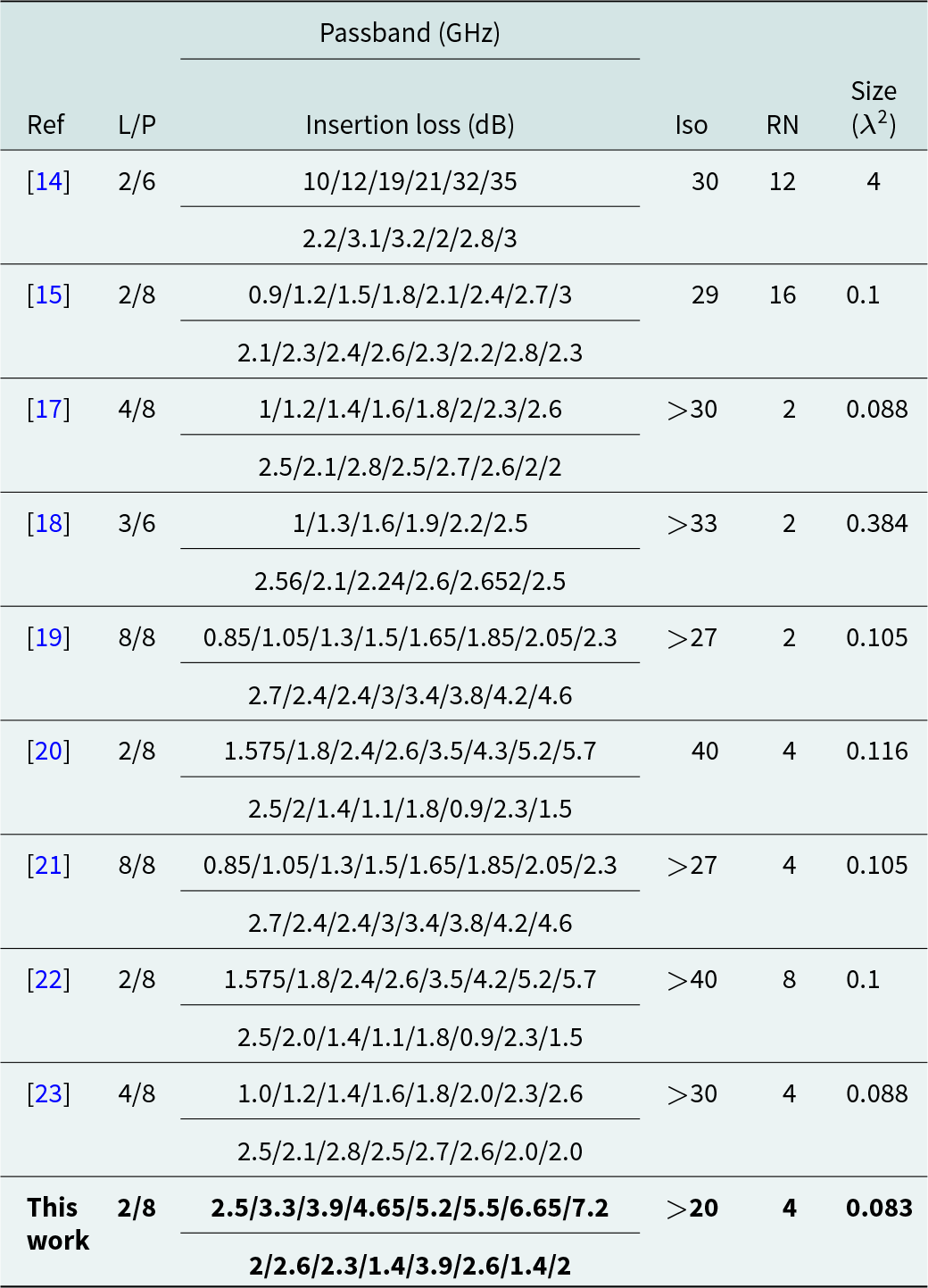
Note: L = load; P = passband number; Iso = isolation; RN = resonator number.
Conclusion
A compact eight-channel diplexer based on QMSIR is designed and fabricated. The eight-channel diplexer is achieved due to the two second-order quad-band BPFs. It is worth noting that the size of the design (0.083λ 2) is smaller than previous ones, which is more conducive to assembly and integration in microwave systems. And the proposed diplexer has reduced number of resonators and larger fractional bandwidth (97%) than previous designs. Good agreement between the simulated results and measured results validates the performance of the proposed diplexer. The proposed compact eight-channel diplexer is particularly suitable for multi-band applications in wireless communication systems.
Data availability statement
All the materials used in the study are mentioned within the article.
Author contributions
Conceptualization, Song K; methodology, software, validation, formal analysis, investigation, resources, and data curation, Fang L; writing – review and editing, visualization, supervision, project administration, and funding acquisition, Zhou Y, Qian Li, and Yong Fan. All authors have read and agreed to the published version of the manuscript.
Funding statement
The work was supported in part by National Natural Science Foundation of China (Grant No: 62171097).
Competing interests
The authors declare no conflicts of interest.

Kaijun Song (M’09-SM’12) received the M.S. degree in radio physics and the Ph.D. degree in electromagnetic field and microwave technology from the University of Electronic Science and Technology of China (UESTC), Chengdu, China, in 2005 and 2007, respectively. Since 2007, he has been with the EHF Key Laboratory of Science, School of Electronic Engineering, UESTC, where he is currently a full Professor. From 2007 to 2008, he was a postdoctoral research fellow with the Montana Tech of the University of Montana, Butte, USA, working on microwave/millimeter-wave circuits and microwave remote sensing technology. From 2008 to 2010, he was a research fellow with the State Key Laboratory of Millimeter Waves of China, Department of Electronic Engineering, City University of Hong Kong, on microwave/millimeter-wave power-combining technology and ultra-wideband (UWB) circuits. He was a senior visiting scholar with the State Key Laboratory of Millimeter Waves of China, Department of Electronic Engineering, City University of Hong Kong in November 2012. He has published more than 90 internationally refereed journal papers. His current research fields include microwave and millimeter-wave/THz power-combining technology; UWB circuits and technologies; microwave/millimeter-wave devices, circuits and systems; and microwave remote sensing technologies. Prof. Song is the reviewer of tens of international journals, including IEEE Transactions and IEEE Letters.

Lele Fang was born in Henan, China, 2000. He received the B.Sc. degree in Industrial Engineering from the Zhengzhou University in 2023. Now he is trying to obtain his master degree in electrical engineering in University of Electronic Science and Technology of China (UESTC). His current research interests include microwave/millimeter-wave power-combining technology and micromillimeter-wave techniques with a focus in RF/microwave passive circuits and systems.

Qian Li was born in Hefei, China, in 1995. She received the B.Sc. degree in Electronic Science and Technology from the Anhui University in 2018. She is currently pursuing the Ph.D. degree in the University of Electronic Science and Technology of China. Her current research interests include microwave power dividers/combiners and reconfigurable circuits.

Yong Fan received a B.E. degree from Nanjing University of Science and Technology, Nanjing, Jiangsu, China, in 1985, and a M.S. degree from University of Electronic Science and Technology of China, Chengdu, Sichuan, China, in 1992. He is a senior member of Chinese Institute of Electronics. From 1985 to 1989, he was interested in microwave integrated circuits. Since 1989, his research interests include millimeter-wave communication, electromagnetic theory, millimeter-wave technology, and millimeter-wave systems. He has authored or coauthored over 90 papers, 30 of which are searched by SCI and EI.



