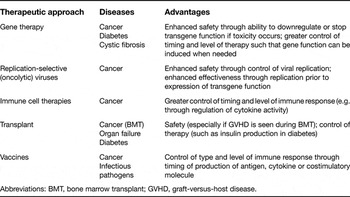
An ever-increasing number of therapeutics are being developed that incorporate expression of exogenously added genetic material in order to produce clinical benefits. These include classical gene therapy approaches (such as delivery of therapeutic genes within nonreplicating viruses, virus-like particles or microbubbles) (Refs Reference Taylor1, Reference Jennings and Bachmann2), oncolytic (replication-selective) viruses (Ref. Reference Guo, Thorne and Bartlett3), cell-based therapies [including immune cell or stem cell therapy (Refs Reference Dudley and Rosenberg4, Reference Penn5) or bone marrow transplants] as well as many vaccine approaches (Ref. Reference Rice, Ottensmeier and Stevenson6). In addition, our preclinical understanding of many diseases has been advanced greatly by the availability of transgenic mouse models with deletion or selective expression of native or foreign genes (Refs Reference Thomas and Capecchi7, Reference Bradley8). In all of these examples an ability to externally regulate the function of the gene product could be an advantage as this might allow a better understanding of the protein's function in a preclinical setting, or may provide an increase in safety or therapeutic benefit for a clinical application (Table 1).
Diseases and therapeutic approaches that may benefit from regulated protein function

Abbreviations: BMT, bone marrow transplant; GVHD, graft-versus-host disease.
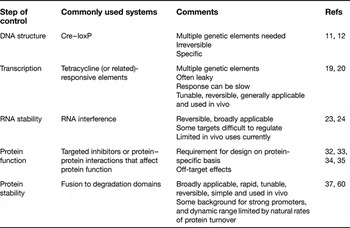
A variety of technologies exist to exert control over a protein's function, including: directly altering the chromosomal DNA in a controlled or global fashion; modifying the promoter, or engineering enhancer elements within the promoter region, to control gene expression; exerting control at the level of mRNA stability; or controlling the stability or function of the protein itself (Table 2). Here I focus primarily on novel technologies that have been developed to exogenously control protein stability. The review includes comparisons with other systems, and highlights potential and demonstrated uses of this technology in a therapeutic setting, with a particular focus on the potential advantages of applying such control of protein stability in the development of oncolytic viruses.
Common means to regulate the function of a protein

Approaches to regulating the function of a protein
A variety of technologies exist to control the level of functional protein within a cell, tissue or host at any time. Control can be applied at almost any stage of the process of protein production, or on function or stability, and different approaches have unique advantages and limitations. For potential incorporation into a biological therapy, any approach would ideally possess several key features, including: (1) extrinsic control – that is, an ability to apply external effectors to rapidly up- or downregulate the levels of functional protein; (2) reversibility, to allow protein function to be switched on or off as needed; (3) tunability, such that external control can regulate the absolute levels of protein function; (4) specificity, such that other natural processes within the host organism remain unaffected; (5) general applicability, so that any protein of interest can be easily targeted for exogenous control and a protein of interest's function can be regulated within any tissue or organ in a host; and (6) simplicity, ideally avoiding complex multistep processes requiring multiple genetic manipulations. The following sections compare the suitability for incorporation into a therapeutic platform of different approaches used preclinically for manipulating the function of a protein of interest.
Control of DNA structure or arrangement
Although some small molecules, such as histone deacetylase inhibitors (Refs Reference Stimson9, Reference Cang, Ma and Liu10), can alter the packaging of chromosomal DNA, and so influence which genes' promoters are accessible for transcription initiation, these treatments are nontargeted and global in their influence on protein expression patterns within an organism. This lack of specific control over any protein of interest and the pleiotropic effects within the cell mean this is not a viable approach for control of a biological therapy.
By contrast, the Cre recombinase system provides very precise control over a specific DNA rearrangement (Refs Reference Ryding, Sharp and Mullins11, Reference Kuhn12). In this system, the gene encoding Cre recombinase is driven by an inducible or tissue-specific promoter, such that its expression can be controlled in a condition- or tissue-specific manner. The Cre recombinase protein, when expressed, recognises loxP sequences, which can be inserted to flank a selected region of DNA (floxed), resulting in recombination between the loxP sites, and removal of the intermediary DNA. In this way, a gene of interest can be placed between the loxP sites so that the induction of expression of Cre recombinase protein will remove the gene and thus irreversibly knock out its protein function. Alternatively, a transcription stop site might be placed between the loxP sites, and this loxP-stop-loxP sequence placed between the promoter and a gene of interest, such that induction of Cre recombinase expression will lead to removal of the stop sequence, and so permit expression of the gene of interest. This system can therefore be used to specifically and irreversibly switch any gene either on or off. The Cre system (used in conjunction with a loxP-stop-loxP sequence downstream of a reporter gene) has proven to be a powerful tool for helping to detect when a cell has been transiently exposed to a stimulus or stress or when a gene has been transiently expressed (such as during a developmental process). It has also been used extensively for the creation of induced or conditional gene knockouts, usually in transgenic mouse models, such as for the study of the effects of gene deletion in a specific tissue or at a specific stage in development, or to activate an oncogene in certain spontaneous tumour model systems (Ref. Reference Kuhn12). However, because it is complex (requiring several components, including a means to control Cre recombinase expression), and irreversible, it has not been incorporated into any biological therapy platforms to date.
Control of transcription
Perhaps the most commonly used method to modulate the function of a therapeutic protein is to apply control at the level of transcription. This can be achieved through the incorporation of natural promoter systems into a therapeutic, or through engineering of response elements into a promoter. For example, the tissue specificity of many cancer gene therapies and oncolytic viral therapies has been achieved by placing the gene for a protein of interest under the control of a tissue-specific promoter [such as promoters from the genes encoding alphafetal protein (Ref. Reference Li13), prostate-specific antigen (Ref. Reference Chen14), carcinoembryonic antigen (Ref. Reference Mullen and Tanabe15) or mucin 1 (Ref. Reference Kurihara16)] or a ‘condition’- or ‘stress’-specific promoter [such as the transcription factor E2F promoter (Ref. Reference Johnson17) or hypoxic-response element (Ref. Reference Post and Van Meir18)]. However, this approach does not allow external control over protein function, and so could not be used to rapidly downregulate protein function in the case of an adverse event or to delay induction of protein function after the therapy has reached its target.
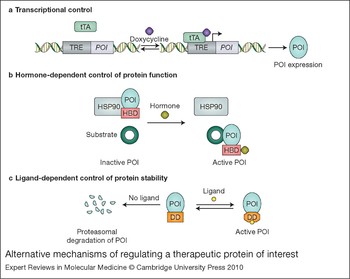
Alternatively, one of the most commonly used research tools to apply exogenous control over a particular protein's function is that of the tetracycline-responsive transcriptional activator or repressor system (Refs Reference Furth19, Reference Gossen and Bujard20) (Fig. 1a). The system uses exogenous addition of the antibiotic doxycycline (a tetracycline derivative) or a related small molecule to bind a fusion protein known as the tetracycline transactivator (tTA). In the Tet-off system, doxycycline binding prevents the tTA from binding tetracycline-responsive elements (TREs) [containing multiple tetracycline operator (tetO) sequences] inserted into the promoter driving expression of the gene of interest, and so blocks gene expression. In the Tet-on system, the tTA has been engineered such that binding to the TRE (and so gene expression) occurs only in the presence of the antibiotic (doxycycline). In this way, the function of any protein can be controlled exogenously through the insertion of elements within its promoter. This powerful system is reversible, tunable and generally applicable to any protein, and has been demonstrated to function in culture as well as in complex living organisms. However, it is often leaky (allowing a background level of gene expression), it is complex (requiring the insertion of multiple genetic elements into any biological therapeutic), and it is dependent on natural protein turnover to regulate protein function (i.e. for very stable proteins it may take several days or more before a reduction in gene expression translates into loss of protein function). Despite the fact that tetracycline-controlled transcriptional activation was first described over 15 years ago, and the use of doxycycline would not in itself present any clinical difficulties, this system has not yet been successfully developed into any clinical therapies, highlighting the hurdles faced during the clinical translation of cell and gene therapies.
Alternative mechanisms of regulating a therapeutic protein of interest. (a) Constitutively expressed tetracycline transactivator (tTA) is induced to bind to tetracycline-response elements (TREs) within the promoter of a protein of interest (POI) when doxycycline is present (in the Tet-on system), leading to transcriptional control of the protein. (b) A hormone-binding domain (HBD) controls the activity of a fused POI by concealing its active site when bound to heat shock protein 90 (HSP90). Activity of the POI is restored when the HBD is released from HSP90 binding in a hormone-dependent fashion. (c) An unstable degradation domain (DD) targets the POI for proteasomal inactivation unless a small-molecule ligand is bound.

Related systems have also been described incorporating the MMTV-LTR (mammary tumour virus long terminal repeat) promoter, which can be regulated by steroid-receptor proteins (Ref. Reference Gunzburg and Salmons21), and the ‘ecdysone’ system. In the ecdysone system, adapted from a Drosophila moulting hormone, a chimeric receptor consisting of the VP16 transactivation domain fused to the ecdysone receptor is regulated by addition of the ligand 20-hydroxyecdysone, resulting in binding to, and activation of, ecdysone enhancer binding sites placed within the promoter of a protein of interest (Ref. Reference No, Yao and Evans22). Although this system is more tightly regulated than the tetracycline system, the lack of readily available ligand makes long-term activation difficult.
Control of mRNA stability
A more recently described powerful tool to control a protein's function is through modulation of the stability of its mRNA. This can be done through RNA interference (RNAi) with the use of naturally occurring microRNA (miRNA) or engineered short hairpin RNA (shRNA) or short interfering RNA (siRNA) (Refs Reference Kelly and Russell23, Reference Elbashir24). These short RNA sequences bind to the mRNA of specific proteins and so target it for rapid destruction or translational repression (Ref. Reference Lee, Feinbaum and Ambros25). The exogenous addition of shRNA or siRNA creates a tunable, reversible and generally applicable system for the control of a target protein's function (Ref. Reference Elbashir24), and their use has been demonstrated in vivo for biological therapeutics (Ref. Reference Wang26).
Theoretically, if the gene sequence encoding a protein of interest is known, it is possible to design short RNA sequences capable of catalysing the degradation of the mRNA encoding that protein. Despite this general utility, RNAi is not ideal for all therapeutic applications. Some aspects of the silencing mechanism are poorly understood, complicating the design of appropriate silencing RNA elements, with some genes proving more difficult to silence. Diced pools (i.e. pools of siRNAs produced by incubation of double-stranded RNAs with an endoribonuclease such as Dicer) improve the ‘hit rate’ of silencing, but also increase the occurrence of off-target effects. Once an effective RNA sequence has been identified, the extent of mRNA degradation can be variable, and in many cases significant amounts of protein expression are maintained. Reliably introducing RNA into cells is also not trivial, and populations of cells that have been transfected with a silencing RNA typically show heterogeneous responses. As with tetracycline-response systems, RNAi on occasion requires some time to reduce protein levels below a functional threshold. The efficacy of the chosen silencing RNA element towards its target message plays a role in this equation, but the major determinant affecting the rate of knockdown is again the half-life of the protein of interest (Ref. Reference Raab and Stephanopoulos27). Because siRNA is unstable and is unable to naturally cross membranes (and so biodistribute throughout a host organism), exogenous systemic delivery in vivo is challenging. This can be partially overcome through use of the more stable shRNA form or with expression of RNAi sequences from the biological therapeutic itself (Refs Reference Harper28, Reference Chang, Elledge and Hannon29); however, it is likely that this approach would be more effective at controlling or downregulating a host cell protein (for example, to prevent antiviral defences from being activated in tumour cells) than controlling the function of a therapeutic gene product. Nevertheless, combination systems incorporating both shRNA- and tetracycline-based regulation have been described (Ref. Reference Deans, Cantor and Collins30). Although offering very tight control of protein expression, these systems require multiple genetic elements, and so are more suited to in vitro and transgenic systems than therapeutics.
Alternatively, the incorporation of natural miRNA target sequences (miRTs) into the mRNA sequence of a transgene may result in tissue-specific (or cancer-specific) regulation of the protein function (Ref. Reference Kelly and Russell23). This approach has been used to prevent production of essential viral proteins in certain tissues (e.g. central nervous system or brain), so preventing oncolytic viruses from causing toxicity in these tissues (Ref. Reference Kelly31), but does not allow external regulation of protein function. One advantage of applying regulation at the level of mRNA (or protein itself, see below) is that control at the DNA level is not possible in RNA viruses.
Control of protein function or stability
Another approach is to target the protein product itself, using small-molecule activators or inhibitors of protein function (Refs Reference Liu32, Reference Brown33, Reference Sabatini34, Reference Mayer35), or through regulation of protein stability. Although regulators of function of a variety of proteins have been described (such as some tyrosine kinase inhibitors), the discovery process is usually arduous, and many of these small molecules lack specificity and so also target a variety of similar proteins (Refs Reference Godl36, Reference Stankunas37, Reference Liu38). An alternative is to specifically engineer protein domains and coupled small-molecule effectors in order to control protein function or stability (Ref. Reference Banaszynski and Wandless39). Several novel approaches have recently been described to regulate protein function at the level of protein stability and these are the focus of the remainder of this review.
These approaches typically involve the fusion of a small destabilising peptide sequence to the protein of interest, which misfolds and so targets the protein for rapid proteasomal destruction – unless an exogenously applied small molecule binds and shields, or refolds, this sequence and so stabilises the protein, allowing it to function normally. This approach therefore has the advantages that it is rapid, reversible, tunable, generally applicable, functions in vivo and is highly targeted. It is also very simple, requiring only a single small DNA insertion, and may be applied to DNA as well as RNA viral therapies. The dynamic ranges of these systems are often dependent on the protein itself, with proteins that are naturally turned over very rapidly often limited to about tenfold increases in protein level upon exogenous stabilisation, while more stable proteins may exhibit over 10 000-fold changes in protein level upon protein stabilisation (Ref. Reference Banaszynski40). Because the proteins are always being synthesised before being processed, a background level of protein within the host cell may be expected. However, this is dependent on the strength of the promoter used (with stronger promoters leading to higher background levels of protein), and even strong viral promoters result in only minimal background protein levels.
Regulating protein function in preclinical understanding of disease
The genetic manipulation of cell lines in culture and, more recently, the development of transgenic mouse models have greatly advanced our understanding of many diseases (Ref. Reference Bockamp41). Many of the strengths and advantages of incorporating different mechanisms to control protein function in therapies (as described above) can also apply to more basic scientific research of disease mechanisms. Generating knockouts of a specific gene and subsequent monitoring of that perturbation in vivo has proven to be a powerful technique for understanding ways in which specific proteins contribute to complex biological processes. However, in many cases the gene of interest is essential for development, precluding the study of protein function in an adult organism (Ref. Reference Yamada42). Additionally, cellular or molecular compensation during embryonic development can confound interpretation of resulting phenotypes in adult stages (Ref. Reference Poirier and Robertson43). Researchers have therefore applied different strategies to introduce elements of spatial and temporal control over gene expression in transgenic animals (Ref. Reference Lewandoski44). As discussed, the Cre–loxP system offers a method of ablating gene function at specific developmental stages (Ref. Reference Ryding, Sharp and Mullins11), but disruption of target genes can take weeks in mice, and the perturbation is irreversible (Ref. Reference Kuhn12). The tetracycline-responsive transcriptional switch has been used with great success (Ref. Reference Furth19); however, inherent reversibility is dependent upon the stability of the protein product, the degradation of which can take days. The ability to target protein function in vivo at the level of protein stability to allow for not only specific but also rapid, reversible and generally applicable regulation of protein function means it is likely to have many uses in preclinical mouse models where other systems for controlling protein function are not possible or appropriate.
Controlling protein function through varying protein stability
As indicated above, any experimental system used to conditionally control the function of a protein should ideally be applicable to any protein, predictable, easy to apply, rapid, reversible and specific, with little or no off-target activity. Such approaches typically involve the fusion of an active domain to a protein of interest, such that a small, membrane-permeable molecule can bind the active domain, and so affect the activity of the fused protein of interest.
One of the first such systems involved fusing hormone-binding domains (HBDs) to a protein (Ref. Reference Godowski, Picard and Yamamoto45) (Fig. 1b), as demonstrated with the fusion of the MYC protein to an oestrogen (estrogen) receptor domain (MYC–ER) (Ref. Reference Eilers46). In the absence of the hormone oestrogen, the MYC–ER fusion becomes complexed with heat shock protein 90 (HSP90), which acts both to localise the protein to the cytosol and to conceal the active domain of the protein of interest. Although this approach can be limited by the function of the protein of interest, it has proven effective at controlling many DNA-binding and protein–protein interactions (including the activity of transcription factors and kinases) (Ref. Reference Picard47).
An alternative approach is to incorporate a fusion domain whose stability can be conditionally altered. The simplest such system incorporates temperature-sensitive regions such as those based on dihydrofolate reductase (DHFR), where a destabilising arginine residue is incorporated into the N-terminus of the protein of interest. Such proteins are rapidly targeted for proteasomal degradation at 37°C (where the arginine residue becomes exposed), but are stable at 23°C (Ref. Reference Dohmen, Wu and Varshavsky48). Although used to study a variety of proteins (Ref. Reference Kanemaki49), such systems can obviously not be applied to complex living organisms, where large changes in temperature are not feasible. Additional effects produced within the cell by applying temperature stress may also complicate this approach.
A different system was somewhat fortuitously discovered when researchers refined a system of external regulation of protein–protein interactions based on FK506-binding protein 12 (FKBP1A, referred to as FKBP). This was initially achieved through modifying the natural process whereby the immunosuppressive drug FK506 (tacrolimus) heterodimerises FKBP and calcineurin (Ref. Reference Liu32). First, the semisynthetic molecule FK1012 was engineered to dimerise chimeras of FKBP domains fused to proteins of interest and this was used as a means to conditionally control protein–protein interactions, and so some biological processes (Ref. Reference Spencer50); the system was applied as a transcription control (Ref. Reference Ho51), cell-death switch (Ref. Reference Spencer52) or signalling system (Ref. Reference Pruschy53), and provided rapid, reversible and dose-dependent control without complicating intrinsic biological activity. However, homodimer formation could not be prevented, when heterodimers were required between distinct proteins with FKBP-fusion domains. An alternative was to use rapamycin in place of FK1012, which forms a ternary complex by binding both the FKBP domain and a region of the mTOR protein (MTOR; mammalian/mechanistic target of rapamycin) known as FRB (Refs Reference Hay and Sonenberg54, Reference Rivera55, Reference Otto56). However, this approach suffered as a result of the natural perturbation of mTOR by rapamycin (Ref. Reference Hentges57), and so a series of rapamycin analogues were tested for binding to both FRB and FRB mutants. As such, C20-methallyl-rapamycin (MaRap) was found to bind a triple FRB mutant (FRB*) but not natural FRB domains (Refs Reference Stankunas37, Reference Liberles58). It was also coincidentally found that FRB* was unstable, and conferred instability onto any protein to which it was fused, and that this instability could be overcome through binding to MaRap. Therefore, a system was unexpectedly discovered that provided simple, rapid, reversible control over protein stability, with no natural cellular targets. The only problem was that MaRap is difficult and expensive to synthesise and has poor pharmacokinetic properties in vivo (Ref. Reference Bayle59).
A variety of screening and data-driven design strategies were therefore used to produce related systems that could be widely used in vitro and in vivo. These resulted in the finding that a point mutation in FKBP (L106P) conferred instability to any protein onto which it was fused, while an alternative FKBP ligand, known as Shield-1 (a small 750 Da hydrophobic molecule), could bind and stabilise this domain (Ref. Reference Banaszynski60) (Fig. 1c). This system was shown to confer powerful control over the stability of a variety of reporter proteins and functional proteins in cell culture systems, while array analyses demonstrated that Shield-1 had no discernable effects on wild-type cells (Ref. Reference Maynard-Smith61). Because the sequence containing the L106P mutation is relatively short (12 kDa), its fusion to a protein of interest does not usually affect the protein's function, and it can be fused at either the N- or C-terminus or even within the protein sequence while retaining its regulatory effects (so avoiding possible problems with extending specific termini that may be encountered in some proteins).
The combination of genetic manipulation coupled with small-molecule regulation endows this system with the specificity of gene targeting along with the speed, dose response, and reversibility inherent to small-molecule control. Further studies demonstrated the use of this system in living organisms, including zebra fish and mice, and for many different protein types, including reporter, structural, enzymatic and even secreted proteins (Refs Reference Banaszynski40, Reference Herm-Gotz62, Reference Armstrong and Goldberg63). However, although the L106P fusion has been shown to work on some membrane and secreted proteins, possible effects on endoplasmic reticulum or cytoplasmic protein folding still need to be defined. Several important characteristics of the system were confirmed in mouse models that would be necessary for the translation of this approach into a therapeutic. These included the ability of the drug (Shield-1) to spread systemically within the host and reach different tissues, the ability to maintain protein stability for long periods of time through repeat injection with Shield-1 (once every 48 h), and the ability to tune the level of stability (and so protein function) through adjusting the dose of Shield-1 delivered. As expected, no toxicities from application of the Shield-1 were seen (Ref. Reference Banaszynski40).
Therapeutic applications of modulating protein stability
Oncolytic viruses
There are a variety of situations where externally applied and conditional control of a protein's function within the setting of a biological therapeutic, such as an oncolytic virus, would be desirable (Fig. 2). This cancer therapy platform consists of replication-selective viruses, whose replication is restricted to malignant cell types (Refs Reference Guo, Thorne and Bartlett3, Reference Thorne, Hermiston and Kirn64, Reference Kirn and Thorne65). Although selective replication is a power of this platform as the therapy is itself amplified at the location where it is needed, this also makes dosing of these agents arbitrary or complex. Because the therapy will replicate extensively if successful, even a low initial dose may replicate to potentially dangerous levels within a large, susceptible tumour. Furthermore, the antitumour effects of these agents are frequently enhanced through the addition of therapeutic transgenes into the viral genome (Ref. Reference Thorne, Hermiston and Kirn64), and this may cause further difficulties as uncontrolled amplification of these transgenes, and so increased synthesis of their protein products, may also lead to toxicities. The ability to control the functional levels of a transgene product or even viral replication directly (through control of levels of essential viral proteins) is therefore desirable. In this way, any adverse events produced through uncontrolled replication of a virus within a large, susceptible tumour can be limited through rapid control of viral replication, or any toxicity produced through excessive production of a toxic or immunomodulatory transgene may be controlled.
Possible therapeutic advantages of regulating the function of a therapeutic transgene expressed from an oncolytic virus. (a) In an unregulated system, some protein production may lead to off-target toxicities in normal cells, while premature clearance of virus from the tumour may reduce effectiveness. (b) Incorporation of a two-step therapeutic approach (with oncolysis followed by upregulation of transgene function), results in (1) removal of virus from normal tissues due to genetically engineered attenuating modifications in the virus prior to upregulation of transgene function, so reducing toxicity, and (2) a period of unimpeded viral replication within the tumour, allowing initial viral spread and tumour destruction before synchronous transgene upregulation leads to increased transgene product being expressed and enhanced antitumour effects.

In addition to the ability to control viral replication more precisely and to act as a safety mechanism to prevent adverse events, the ability to exogenously regulate a protein's function (as expressed from a therapeutic oncolytic virus, or related gene therapy agent) may also be used to directly enhance its therapeutic potential. For example, any proteins produced by the oncolytic virus within an infected cell that have therapeutic antitumour effects (either directly or indirectly) will likely rapidly destroy the infected cell, or target it for destruction, and so the expressed protein may result in significant reduction in the ability of the virus to replicate within the tumour (through premature destruction of infected cells before viral replication is complete) (Ref. Reference Banaszynski40). As a result, the directly oncolytic potential of the viral therapy will be lost or reduced as the viral infection may be unable to spread effectively within the tumour before it is cleared. One approach that has been shown to overcome this effect is to downregulate the stability of the therapeutic transgene's protein product for a period of time after initial application of the oncolytic viral therapy. This allows the virus to establish an initial infection throughout the tumour, to multiply the therapeutic transgene to higher levels, and to spread within and between tumours before the therapeutic function of the transgene is activated. After this initial ‘oncolytic’ phase, the therapeutic transgene product can then be stabilised (through exogenous addition of the small molecule). The additional and synchronised production of therapeutic protein functionality can ultimately lead to greatly enhanced therapeutic benefit (relative to either a virus without the transgene, or a virus expressing the transgene product with no regulation). This advantage has been demonstrated in preclinical mouse tumour models for oncolytic vaccinia strains expressing both directly cytotoxic cytokines (such as TNF-α/TNF), as well as purely immunomodulatory cytokines (such as IL-2/IL2) (Ref. Reference Banaszynski40).
It is likely this approach could be used to enhance the safety and/or antitumour benefits of the oncolytic virus platform through the conditional regulation of a variety of different viral or expressed proteins. The expression of cytokines, chemokines or other immunomodulatory proteins is a common strategy to increase the therapeutic benefit of these viruses (Refs Reference Kirn66, Reference Thorne67). The ability to externally control when and to what level these proteins function may help safely enhance and direct an appropriate immune response within the tumour. Alternatively, a variety of directly toxic protein products may now be incorporated into these viral agents that would otherwise have been considered too dangerous. In addition, the control of an essential viral protein could allow the reduction or halting of viral replication if an adverse event occurred. This would increase the safety of these agents, and so assist the regulatory approval process.
Other biological therapies
The application of destabilising domains into therapeutic platforms need not be limited to oncolytic viruses; it may benefit a variety of other biotechnologies through increasing safety and therapeutic benefit. These could include any traditional ‘gene therapy’ approach, as well as any adoptive cell transfer (where a therapeutic gene may be incorporated into the adoptively transferred cell population to enhance the therapy or its safety), such as immune cell therapies, stem cell therapies or transfer of other distinct cell subsets (such as islet cells to treat diabetes), or even during whole bone marrow transplants, where it may be necessary to enhance the antitumour effects of the grafted lymphocytes or add a safety mechanism to counter graft-versus-host disease if this occurs. Alternatively, transfection of populations of cells within entire organs during transplant surgery may ultimately allow improved prevention of rejection. Although many of these approaches are currently theoretical, and many safety considerations will have to be addressed, the ability to externally control the function of an adoptively transferred gene's product may greatly enhance a variety of currently experimental or traditional therapeutic approaches. Finally, another potential area that may benefit from regulation of protein function may be in the development of vaccines. Many vaccine approaches also involve the transfer and expression of genes or genetic elements, encoding either particular epitopes or costimulatory molecules, cytokines or chemokines used to enhance the vaccination effects. The controlled regulation of these gene products might be used to enhance the type or level of immune response raised against any particular antigen.
Clinical applications of conditional control of protein function
There are several approaches that incorporate conditional control of a protein function into biological therapies that have entered, or are very soon due to enter, clinical testing, demonstrating proof of principle of the potential of these approaches. Intrexon Corporation's RheoSwitch® Therapeutic System involves regulation analogous to the tetracycline system (Ref. Reference Cress68), and a Phase I clinical trial for the treatment of cancer patients with dendritic cells transduced for inducible expression of IL-12 has begun (Ref. Reference Komita69), although results have not yet been reported.
ARIAD Gene Therapeutics Inc. has also begun clinical testing of inducible systems, including the safety and pharmacokinetic testing of the dimerising drug AP1903, a rapamycin analogue that binds and dimerises FKBP analogue domains (F36V) on fusion proteins but not natural FKBP (Ref. Reference Iuliucci70). This demonstrated the safety of this drug alone. The proposed system, as demonstrated in preclinical models (Ref. Reference Berger71), could be used to transduce T cells with an F36V–FAS-cytoplasmic-domain construct, such that addition of AP1903 would lead to dimerisation of the FAS domains and apoptosis of the T cells. This would allow the in vivo clearance of T cells following bone marrow transplantation in the case of the appearance of graft-versus-host disease.
Although these clinical applications are still at a very early stage, the successful demonstration of regulation of protein function in human subjects will likely lead to the rapid development of inducible versions of a variety of current gene therapy systems for many diseases.
Outstanding research questions
Although a variety of inducible systems to regulate protein function have been clearly demonstrated to provide safety and therapeutic benefits in preclinical animal models, some questions remain about how these approaches can best be translated into successful therapeutics. With the only currently approved gene therapy approach being a p53 (TP53)-expressing nonreplicating adenovirus in the Chinese market (for the treatment of some cancers) (Ref. Reference Roth72), it is unclear whether the more appropriate development would involve conversion of other promising gene therapy approaches into inducible systems, whether entirely novel approaches should be developed de novo, or whether approved therapies (such as bone marrow transplant) that may benefit from addition of inducible control should be targeted. This is an important issue as, despite the potential benefits of incorporating inducible protein function into many therapeutic applications, there is also an increase in complexity that raises many issues for clinical translation. Another ethical issue that will need to be addressed as these approaches develop is their potential to irreversibly introduce foreign DNA sequences into human subjects. The question of altering chromosomal DNA, and the possibility of such alterations being passed down to future generations, is one that gene therapy has had to deal with since its inception, but this may become further complicated if some of the DNA sequences being introduced were not naturally occurring in human or even viral DNA.
From a more basic research perspective, the inducible systems themselves continue to be developed. Many have some background level of protein function, so reduction of this is an important goal. Small-molecule effectors need to be synthesised easily, reliably and to high levels. Another important consideration is whether the small molecule acts as an inducer or repressor of protein function, a question that would need to be addressed on an application-specific basis, dependent on what the protein of interest is and what the desired therapeutic outcome would be. Finally, a great deal of research is also currently being undertaken to allow the regulation of multiple proteins simultaneously. This may involve either multiple related fusion domains that respond in a very specific manner to different small-molecule effectors or fusion domains that respond with the opposite effect (repressor or activator of protein function) in response to the same drug. In this way, it may be possible to more effectively switch an entire system between different states.
It is apparent that the ability to externally apply inducible regulation of a protein function has begun to move out of the arena of being simply a powerful research tool and has begun to be understood as a system that may also be applied to many different therapeutic applications. It is hoped that this will ultimately lead to novel treatment approaches for the benefit of many patients.
Acknowledgements and funding
I thank the peer reviewers for their time and helpful comments. My laboratory is supported by grants from the Alliance of Cancer Gene Therapy, the Hillman Foundation and The Pittsburgh Foundation.