Christiansen & Chater (C&C) succinctly announce the major claim of their article in its title, which we will take the liberty of relettering (changing an a to an i) as: language is shaped by the brain. Our work on sign languages has led us to the broader but more easily verifiable claim that languages are shaped by the human body and its interaction with the world.
The greatest obstacle facing any claim about the relation between languages and the brain is the simple fact that we have precious little access to the inner workings of the human mind/brain and no direct access to the relation between the mind/brain and language. Indeed, C&C do not have much to say concretely about how the human mind/brain actually constrains languages (see sects. 6.2–6.3 of the target article).
But once we extend our purview beyond the brain and understand, as C&C do, that there are “other parts of our body involved in language” (sect. 6, para. 1), especially parts of the body that are visible to the naked eye, then we can literally see ways in which human languages are shaped by the body, not just the mind/brain part of it, and how they differ from the communication of other primates. Here students of sign languages have a great advantage over students of spoken languages, because sign languages, lacking sound, are necessarily fully visible. Concrete evidence for the relation between human languages and the body that engenders them comes from our own research on a number of sign languages, especially two quite recently developed sign languages, Israeli Sign Language (ISL) (Meir & Sandler Reference Meir and Sandler2008) and Al-Sayyid Bedouin Sign Language (ABSL) (Aronoff et al. Reference Aronoff, Meir, Padden and Sandler2008; Meir et al. Reference Meir, Padden, Aronoff and Sandler2007; Padden et al., in press; Sandler et al. Reference Sandler, Meir, Padden and Aronoff2005).
Following Wilson (Reference Wilson2002), we assume that “The mind must be understood in the context of its relationship to a physical body that interacts with the world” (p. 625). We doubt anyone could quarrel with this statement, but it has broad consequences when taken as more than a slogan. We will discuss here two examples, both related to the iconicity afforded by visual language: the use of the hands to create symbols and the role of the body in sign language verb systems.
Sign languages use the hands to shape the often iconic symbols that enter into the linguistic system. No matter how young the language, and even in the absence of a community as in the case of home signers, people spontaneously use their hands and bodies to make symbols that represent other objects and actions – a cup, a flower, to see. This seemingly obvious fact reveals with startling clarity the essential difference between the language of humans and the communication systems of other primates. Nonhuman primates in the wild do use their hands and bodies to gesture, but the literature on their communication systems documents no case where a chimpanzee, bonobo, orangutan, or other primate relative uses its hands to represent a termite or a banana or any object other than its hands (Call & Tomasello Reference Call and Tomasello2007). The use of the body to represent the world symbolically in sign language provides compelling evidence for the view put forward by Deacon (Reference Deacon1997) and others that symbolization is a more basic feature of language than arbitrariness (Sandler, in press). C&C “suggest that language does not involve any qualitatively different mechanisms compared to extant apes” (sect. 6.5, para. 3). Visual human languages call that suggestion into question.
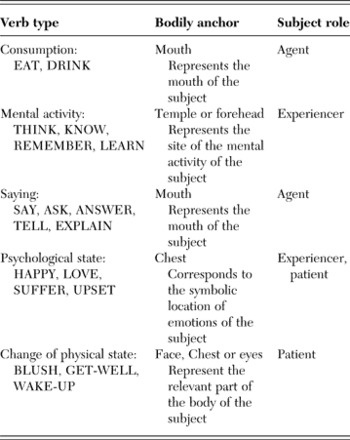
The body interacts with the linguistic system separately from the hands in a complex way in the representation of the meanings of signs denoting states of affairs (verbs) in all sign languages that we know of (Meir et al. Reference Meir, Padden, Aronoff and Sandler2007). In what are called body-anchored verb signs, the signer's body consistently represents one argument of the verb, the subject, whereas the hands, moving in relation to the body, represent all other components of the event, including all other arguments. For example, the sign EAT is signed in all known sign languages by moving the hand towards the body (specifically, the mouth). The body represents the subject of the eating event. The hands represent the object being eaten and aspects of the event itself in EAT signs. This division of labor between body and hands is a clear indication of how the human body helps shape a grammatical system.
Common body-anchored signs in ISL are given in Table 1. These signs are of many different semantic types and the subject argument plays a different semantic role in each type; yet in all semantic types the body corresponds to the subject argument, the argument by which the event is predicted. Iconicity motivates the use of the body in this system, in which the emergent grammatical construct is the notion of subject.
Common body-anchored signs in Israeli Sign Language

The signer's body does not iconically stand for the subject in all verbs in all sign languages. For one, this particular iconic use of the body is typically limited to animate subjects. For another, most sign languages have another major category of verbs, usually called agreement verbs, in which the signer's body plays the role of grammatical first person (Padden Reference Padden1988) and the use of the body to represent first person overrides or blocks the body-as-subject iconicity. Unlike the body-as-subject class, agreement verbs or “verbs of transfer” (Meir Reference Meir2002), such as GIVE, SEND, SHOW, and TAKE, use reference points in the space around the body abstractly to represent syntactic arguments. See Aronoff et al. (Reference Aronoff, Meir and Sandler2005) and Padden et al. (in press) for details.
Observing the emergence of new sign languages in real time allows us to take one step back in the development of language. These languages reveal strikingly the reliance on the body in expressing verbal notions. When they lack grammatical person marking and hence agreement verbs, all the transfer notions that are lexicalized as agreement verbs in established sign languages are lexicalized instead as body-anchored expressions and follow the body-as-subject pattern. We have documented this phenomenon in detail for ABSL and have shown how the emergence of the notion of grammatical first person in the diachronic development of ISL shifted the language from the body-as-subject pattern to the body-as-first-person pattern (Meir et al. Reference Meir, Padden, Aronoff and Sandler2007). The study of sign languages, especially emerging sign languages, teaches us that our species relies on the human body in the creation and structuring of languages when it can.
ACKNOWLEDGMENTS
Our research was supported by the United States–Israel Binational Science Foundation grant 2000-372, Israel Science Foundation grant no. 553/04, and National Institutes of Health grant DC6473. Thanks to Paul Bloom for supporting our participation.