Kashar cheese, which is widely consumed in Turkey, is classified as a semi-hard pasta-filata cheese similar to Mozzarella, Kashkaval, Caciocavallo, Provolone, etc. During the scalding process of these kinds of cheeses, heat treatment is applied to the curd at up to 80°C to provide an elastic structure and ensure safety for consumption. Despite the application of heat treatment, a variety of sources such as handling of the curd, equipment, processing lines or ripening in storage rooms can result in post-processing contamination with a relatively wide range of microorganisms. Simple exposure to the air for a while to form the characteristic yellow colour, texture, and moisture of kashar cheese is known as the main post-processing contamination step before packaging. That being the case, the surface of the cheese is susceptible for contamination by many microorganisms (especially moulds) resulting in quality deterioration and substantial economic losses. Surface application of antimicrobial agents in combination with good manufacturing practices may be used to prevent spoilage. However, negative public reactions to the use of chemicals and the legal restrictions that are in place mean that alternative solutions are needed for controlling the growth of surface microorganisms just before packaging.
In recent years, UV light application has been considered as a promising technology for improving food safety and as an alternative to the use of chemicals (Koca et al., Reference Koca, Urgu, Saatli and Koca2018). Technological improvements have made UV especially useful in developing countries with small scale production facilities due to its low installation and operational costs combined with minimal energy usage and maintenance requirements (Bintsis et al., Reference Bintsis, Litopoulou-Tzanetaki and Robinson2000; Koutchma, Reference Koutchma2009; Cilliers et al., Reference Cilliers, Gouws, Koutchma, Engelbrecht, Adriaanse and Swart2014). On the other hand, because of the low penetration depth of UV light, this technology can usually only be used for the inactivation of surface microorganisms. In dairy plants, the number of microorganisms on the food surfaces, food contact surfaces, and packaging materials can be eliminated by exposure to appropriate doses of UV light (Koca et al., Reference Koca, Urgu, Saatli and Koca2018). The light can be applied to the surface of the solid dairy products such as cheese just before or after the packaging, although the application of light after packaging can have limitations due to the extremely low light transmission through the packaging material. Ha et al. (Reference Ha, Back, Kim and Kang2016) reported that the effectiveness of UV-C light on foodborne pathogens reduced with an increase in the thickness of packaging films used in sliced cheese. In this regard, application just before the cheese packaging would be more effective for avoiding the problems associated with several factors such as transparency, thickness and type of packaging materials. Relatively few researches have focused on UV light application for different kinds of cheeses. A study by Lacivita et al. (Reference Lacivita, Conte, Manzocco, Plazzotta, Zambrini, Del Nobile and Nicoli2016) reported the application of UV light (0, 0.1, 0.6, 1.2 and 6.0 kJ/m2) on the surface of Fiordilatte cheese, which is a brined cheese, and noted 1–2 log germicidal effect on Pseudomonas spp. and Enterobacteriaceae. In another study, pulsed UV light was effective for reduction of Staphylococcus aureus and Escherichia coli O157:H7 in cheese samples (Keklik et al., Reference Keklik, Elik, Salgin, Demirci and Koçer2019). However, there is a lack of knowledge dealing with the application of UV light on the surfaces of various types of cheeses and its relation to the sensorial, chemical and microbiological quality. That is why our objective in this study was to determine the potential usage of UV light just before the packaging of pasta-filata cheese and to investigate the impacts on the chemical and sensorial characteristics, as well as the mould inactivation.
Materials and methods
Cheese samples
Fresh kashar cheese samples were produced from cow milk without adding preservatives in a local dairy plant (Reha Dairy Company, Izmir, Turkey). The production procedure was explained in detail in a study by Koca and Metin (Reference Koca and Metin2004). Following the production, the cheeses were immediately brought to the laboratory in vacuum packages and stored under refrigeration conditions. Cheese production was carried out twice.
Experimental design
After the production, cheese samples were divided into two groups. One group was exposed to the mouldy environment for enumeration of moulds, while another was used without mould contamination to determine the quality changes (composition, lipid oxidation, colour, hardness and sensory evaluation). For both applications, samples were cut at 1 cm thickness from the upper and bottom side of the cheese blocks to eliminate the differences in thickness.
UV light treatment
Kashar cheese slices from each group were placed under a UV-C lamp (Philips, Roosendaal, Holland) in a closed batch-type UV cabinet (UV-Entkeimungsschrank, Ernst Schütt Jun. Laborgerätebau, Göttingen, Germany). The lamp (tube diameter of 2.5 cm, length of 41.3 cm, TUV 15W/G15 T8) was positioned at 4 cm from the surface of the samples. UV-C light intensity which was measured as 32.1 W/m2 using a UVX digital radiometer (UVP, Inc., Upland, CA) was kept constant during all treatments. The doses of the treatments (kJ/m2) were calculated by multiplying the intensity and treatment time. Cheese samples were treated for 10, 30, 60 and 300 s, corresponding to doses of 0.32, 0.96, 1.93 and 9.63 kJ/m2, respectively. Untreated cheese samples were also used as controls for comparison in both mould count and quality analysis. UV light applications were carried out in triplicate for each cheese production.
For the determination of mould reduction
The surfaces of kashar cheese samples were naturally contaminated by creating a mouldy environment to imitate post-processing contamination during kashar cheese production. Preliminary trials were performed to derive suitable conditions for creating a natural mouldy environment. The required level of contamination could be achieved by placing mouldy cheese pieces 4 cm above the surface for one day at 25°C, and this was chosen as the most appropriate way to reach the constant mould level of 104 cfu/g in each trial. Then, the surface of the slices was exposed to UV light at different doses.
Mould count
Each UV-treated cheese slice was mixed with peptone water and homogenized using a Stomacher (BagMixer, France) for 2 min. Then, decimal dilutions were prepared and plated on Potato Dextrose Agar (Merck, Darmstadt, Germany) by using the pour plate technique. The plates were incubated at 25°C for 5 d. The results were expressed as logarithmic colony forming units per gram (log cfu/g). The efficiency of UV light was also assessed by calculating microbial count reductions on UV-treated samples. All tests were carried out in duplicate.
For the determination of quality changes
The natural contamination process was not applied to the samples before the determination of the quality parameters. Cheese slices were directly subjected to different doses of UV light, then composition, colour, hardness, lipid oxidation degree, and sensory properties were carried out for the evaluation of the changes in the quality characteristics.
Composition
The moisture and ash contents of cheese samples were determined by gravimetric method (AOAC, 2007), fat content by Van-Gulik method (ISO 3432, 2008), and total nitrogen content by Kjeldahl method (AOAC, 2007). The protein content was calculated by multiplying the total nitrogen by 6.38. Titratable acidity was expressed as percent lactic acid (AOAC, 2007); pH was measured from with a pH meter (pH 320, WTW, Weilheim, Germany).
Lipid oxidation degree
Peroxide value measurements were carried out according to IDF standard method 74A (IDF74A, 1991).In short, the fat was extracted from the samples with diethylether by using the cold extraction method and dissolved with 7:3 chloroform-methanol (v/v) (Folch et al., Reference Folch, Lees and Sloane Stanley1957). Then, the measurements of peroxide values and preparation of a standard curve were performed according to the reference method. Results were expressed as milliequivalent of oxygen per kg of fat.
The degree of lipid oxidation was also assessed by the thiobarbituric acid method used by Kristensen and Skibsted (Reference Kristensen and Skibsted1999) with some modifications. The absorbance was recorded at 450 nm by using a spectrophotometer (T-60; PG Instruments, Lutterworth, UK). Lipid oxidation of cheese samples was given as absorbance values per 1 g of cheese sample (A 450/g cheese).
Instrumental colour evaluation
The colour of the samples was measured using a Hunter Colour Flexcolourimeter (Hunter Associates Laboratory, Reston, VA) in terms of L* (lightness to darkness), a* (redness to greenness), and b* (yellowness to blueness). Colour differences (ΔE) and chroma (colour intensity) values were calculated as described by Askari et al. (Reference Askari, Emam-Djomeh and Mousavi2008).
Hardness index
A penetrometer (Sommer Runge Model KG PNR6, Berlin, Germany) equipped with a 150 g of cone was used to assess the changes in the hardness values. Four measurements were carried out for each sample. The hardness index was calculated according to Korolczuk and Mahaut (Reference Korolczuk and Mahaut1988) and expressed as g per millimetre (g/mm).
Sensory evaluation
Sensory evaluation was carried out by 8 trained panellists using a scoring test (Koca and Metin, Reference Koca and Metin2004). The samples were kept under refrigeration conditions until the time of consumption and presented to panellists with bread and water. The colour, appearance, texture, flavour and overall impression were evaluated using a score from 1 to 5 (from the worst to the best). The sensory evaluation test was repeated twice.
Statistical analysis
Statistical analyses were performed using SPSS software (ver. 20.0 for Windows, SPSS Inc., Chicago, IL). Significant differences between the means were determined by analysis of variance (ANOVA) and Duncan's multiple range test. Statistical significance was set at P < 0.05.
Results and discussion
Mould inactivation
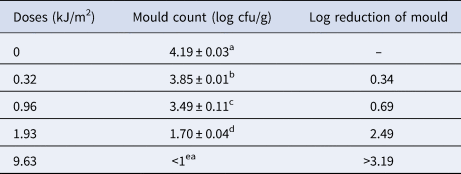
The fungicidal effects of UV light against moulds are given in Table 1. The mould count was 4.19 log cfu/g in the untreated sample, and the levels were significantly reduced by the stepwise increase of UV light doses (P < 0.05). Moreover, the mould count was below the detection limit when the sample was exposed to the maximum UV light dose (9.63 kJ/m2). As compared to control, more than 2 log reduction was achieved for samples treated at UV light doses above 1.93 kJ/m2. Our results showed that UV light treatment to the surface of cheese has a significant impact on the mould reductions. Results agree with literature focused on UV light treatments to cheese surfaces (Can et al., Reference Can, Demirci, Puri and Gourama2014; Proulx et al., Reference Proulx, Hsu, Miller, Sullivan, Paradis and Moraru2015; Lacivita et al., Reference Lacivita, Conte, Manzocco, Plazzotta, Zambrini, Del Nobile and Nicoli2016), although the reduction levels obtained in our study were higher than those reported by Lacivita et al. (Reference Lacivita, Conte, Manzocco, Plazzotta, Zambrini, Del Nobile and Nicoli2016). These authors found a 1–2 log reduction on Pseudomonas spp. after the application of UV light between 0–15 kJ/m2 doses to Fiordilatte cheese, which is likely due to the different characteristics of the cheeses. Soft cheeses with high moisture surfaces may allow a faster penetration and attachment of moulds during inoculation which may cause shadowing effects and limit the efficacy of light whereas when moulds are primarily located on the surface, as with our harder kashar cheese, they can be more directly affected by UV light. Moreover, it has been reported that food characteristics such as physical, compositional and surface properties affect the process efficiency, as well as many other factors associated with the species of targeted microorganisms and inoculation methods (Guerrero-Beltrán and Barbosa-Cánovas, Reference Guerrero-Beltrán and Barbosa-Cánovas2004; Manzocco and Nicoli, Reference Manzocco and Nicoli2015).
Changes in mould counts of kashar cheese after UV-C light treatments

a Under detection limit.
a–eMeans with a different letter in the same column are significantly different (P < 0.05).
Composition and acidity
The average composition of the kashar cheese samples exposed to the different doses of UV light is shown in Table 2. We obtained no significant differences in the fat, protein, ash and pH values between control and UV-treated cheese samples. Although the values of dry matter and titratable acidity were statistically different between the samples, these differences were not meaningful from an industrial point of view. In agreement to present findings, no important changes in pH values of UV-treated cheese were noted by Lacivita et al. (Reference Lacivita, Conte, Manzocco, Plazzotta, Zambrini, Del Nobile and Nicoli2016). Contrary to our results, Keklik et al. (Reference Keklik, Elik, Salgin, Demirci and Koçer2019) found a decrease in pH values of cheeses exposed to pulsed UV light at 123.25 J/cm2 fluence which was related to the temperature increase due to their high light doses.
Changes in chemical characteristics of kashar cheese after UV-C light treatments

a Titratable acidity.
a–cMeans with a different letter in the same column are significantly different (P < 0.05).
Lipid oxidation degree
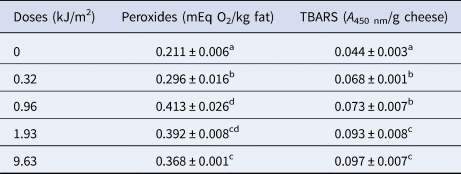
Lipid oxidation can negatively affect the sensorial and nutritional quality of dairy products. Since light exposure is known to trigger lipid oxidation (Mortensen et al., Reference Mortensen, Bertelsen, Mortensen and Stapelfeldt2004), investigation of the change in the oxidative quality of UV-treated cheeses is needed. The primary and secondary lipid oxidation mechanisms were assessed with the analysis of peroxides and TBARS, respectively (Table 3). The peroxide values of UV-treated kashar cheese samples were significantly higher than the untreated control sample. Even though UV light application at 0.96 kJ/m2 dose increased the peroxide levels two-fold compared to the control sample, the accumulation of lipid hydroperoxides did not persist further at higher doses. This could be due to the fact that peroxides are known to be unstable, and can easily be converted to secondary oxidation products in further stages (Frankel, Reference Frankel1991).
Changes in lipid oxidation of kashar cheese after UV-C treatments

a–dMeans with a different letter in the same column are significantly different (P < 0.05).
TBARS values, varied between 0.044–0.097 absorbance/g and gradually increased with the increase in the light doses. Light-induced degradation of lipids may initiate the production of either free radicals or other reactive substances that trigger the lipid oxidation. In our study, the excessive amount of UV light doses could result in the conversion of the peroxides to secondary oxidation products. Previous results showed that TBARS levels increased in both packaged and unpackaged cheese samples treated by pulsed UV light (Can et al., Reference Can, Demirci, Puri and Gourama2014; Keklik et al., Reference Keklik, Elik, Salgin, Demirci and Koçer2019). Also, Matak et al. (Reference Matak, Sumner, Duncan, Hovingh, Worobo, Hackney and Pierson2007) and Bandla et al. (Reference Bandla, Choudhary, Watson and Haddock2012) reported high values of TBARS in milk with increasing doses of UV doses. However, the effects of UV light on the oxidative changes including both peroxide levels and TBARS is not clear in the literature. Our results indicated that the excessive doses of UV light to the cheese surface might be responsible for the lipid oxidation degree which may have major roles in the development of off-flavours.
Instrumental colour and hardness
Visual quality such as colour attributes and surface characteristics can affect consumer acceptability and marketability of cheese. Due to the low penetration depth of UV light, the losses of quality attributes on the surface characteristics such as colour attributes and hardness need to be considered. The hardness and colour parameters of kashar cheese exposed to different UV light doses are presented in Table 4. We observed no significant changes in hardness values among the different levels of application of UV light (P > 0.05). Although UV irradiation is reported to induce softening in the tissues of some foods (lettuce: Allende et al., Reference Allende, McEvoy, Luo, Artes and Wang2006), light exposure could not soften or dry the surface of the cheese.
Changes in colour and hardness features of kashar cheese after UV-C treatments

a Colour difference, with control as reference.
a–cMeans with a different letter in the same column are significantly different (P < 0.05).
The surface colour characteristics, except lightness, were significantly affected by UV light application. There were increases in a* and b* values by exposure to UV light (P < 0.05), whereas L* values remained stable. Also, ΔE values of UV treated samples increased with dose, but the changes were not found significant and did not translate into a perceptible change in colour to the naked eye despite the results obtained from sensorial colour determination. Similar to our results, Can et al. (Reference Can, Demirci, Puri and Gourama2014) stated that the application of extreme pulsed light to packaged and unpackaged hard cheeses could result in significant variations in colour.
Sensory evaluation
Light-induced lipid oxidation is stated to cause sensorial changes depending on the product characteristics and light intensity. It is obvious that the variations in sensorial properties except for flavour and overall impression were not remarkable (Table 5, P > 0.05). Although a* and b* values of the samples slightly increased with an increase in light doses according to the objective colour measurements, panellists did not recognize these differences. The flavour and overall impression scores of the samples treated by UV light up to 1.93 kJ/m2 were similar (P > 0.05), whereas a decrease in the scores was found in samples exposed to higher doses, which is likely due to the off-flavour perception. On the other hand, the scores of the samples exposed to the highest UV light dose (9.63 kJ/m2) was recorded as still acceptable.
Changes in the sensory properties of kashar cheese after UV-C treatments

a–bMeans with a different letter in the same column are significantly different (P < 0.05).
The decrease in the flavour and overall impression scores of the samples exposed to the high doses of UV light is thought to be associated with an increase in TBARS which is known as a standard chemical index of oxidative rancidity in dairy products (Downey, Reference Downey1969). Secondary oxidation products broken down into different volatile compounds such as aldehydes, ketones and esters can be responsible for the development of off-flavour. Off-flavour was recognized only in the sample exposed to the highest UV light dose and described as being akin to burnt feather. Similar to our results, Lacivita et al. (Reference Lacivita, Conte, Manzocco, Plazzotta, Zambrini, Del Nobile and Nicoli2016) observed a lower sensory quality in Fiordilatte cheese treated by the highest UV light due to the perception of burned flavour. It was stated by Azzara and Campbell (Reference Azzara, Campbell and Charalambous1992) that light exposure to dairy products would cause oxidized flavour that could be defined as a burnt feather, cabbage, chemical-like odour and taste on the front of the tongue. Therefore, it can be emphasized from our results that the changes in flavour and overall acceptance scores due to the increase in lipid oxidation levels should be noted as an important matter when high doses of UV light are applied to the surface of the kashar cheese.
In conclusion, the application of UV light at more than 1.93 kJ/m2 doses to the surface of kashar cheese was able to achieve approximately 2–3 log reduction in the mould population. However, exposure to UV light at high doses resulted in photo-oxidation which caused an off-flavour described as burnt feather. Surface application of batch system UV light at a dose of 1.93 kJ/m2 before the packaging of kashar cheese can be suggested as an emerging technology when considering the relation between the mould reduction levels and sensorial impressions. Ongoing and future studies will focus on the continuous type of UV light system to satisfy industrial demands.
Supplementary material
The supplementary material for this article can be found at https://doi.org/10.1017/S0022029920001119
Acknowledgements
The authors are grateful to Ege University Scientific Research Projects Coordination for financial support from the project 14-MUH-075 and Reha Dairy Company (Izmir, Turkey) for providing cheese. The authors are thankful to SimayŞık for supporting the laboratory analysis.