1. Introduction
The general most-favoured nation (MFN) clauses under Article I of the General Agreement on Tariffs and Trade (GATT) 1994 and Article II of the General Agreement on Trade in Services (GATS) form the ‘cornerstone’ of international rules that regulate the world trading system under the World Trade Organization (WTO).Footnote 1 However, the world trading system is undermined by preferential trade agreements (PTAs), which infringe on the general MFN clauses. Although PTAs that meet the requirements of legal defence under GATT Article XXIV or GATS Article V are permitted under the WTO, they nevertheless cause exclusionary effects to trade with third parties.Footnote 2 The exclusionary effect is made worse by PTA MFN clauses in some PTAs, which provide that PTA parties will accord no less favourable treatment to goods and services from each other than to those from third parties. The MFN clauses in PTAs have the effect of entrenching preferential trade liberalization in PTAs because a higher level of trade liberalization with third countries is more difficult to achieve, as trade liberalization to third countries in future PTAs must be accorded to the parties to the existing PTAs with MFN clauses.Footnote 3 The entrenchment of preferential trade liberalization caused by PTA MFN clauses further undermines the WTO's aim of eliminating ‘discriminatory treatment in international trade relations’.Footnote 4
This paper studies the WTO legality of PTA MFN clauses in regional trade agreements (RTAs) under GATT Article XXIV and economic integration agreements (EIAs) under GATS Article V.Footnote 5 Following the introduction, section 2 reviews the general MFN clauses – Article I of the GATT and Article II of the GATS. Then, section 3 introduces the historical MFN clauses in pre-GATT friendship, commerce, and navigation (FCN) treaties and discusses various MFN clauses in the PTAs that are notified to the WTO. The section then further proceeds to examine whether the MFN clauses in RTAs and EIAs conform to WTO law. Section 4 concludes by suggesting how PTA MFN clauses should be brought into conformity with the WTO system.
2. General most-favoured nation treatment
2.1 General MFN for trade in goods
GATT Article I, entitled ‘General Most-Favoured-Nation Treatment’, lays down the most important principle underpinning the multilateral trading system for trade in goods under the WTO. GATT Article I requires that the treatment by a WTO member accorded to goods imported from or destined for any other WTO member should not be less favourable than that accorded to any other country, thus multiplying the effects of trade concessions in goods given to any country to all WTO members. GATT Article I has served the important role of bringing within the GATT system the preferential trade agreements that existed prior to 1948. In comparison to another non-discrimination principle, GATT Article III (National Treatment on Internal Taxation and Regulation), GATT Article I has an elevated status by its inclusion in Part I of GATT 1994, which requires unanimous consent by all WTO members for its amendment.Footnote 6 Notwithstanding the importance of GATT Article I, the GATT system permits a lawful derogation from GATT Article I when WTO members form RTAs.
2.2 General MFN for trade in services
GATS Article II provides the general MFN obligation for trade in services. According to paragraph 1 of GATS Article II, a WTO member should accord to services and service suppliers of any other WTO members treatment no less favourable than it accords to like services and service suppliers of any other country.Footnote 7 As with GATT Article I for trade in goods, Article II of the GATS is the most important principle underpinning the multilateral trading system for trade in services.Footnote 8 In parallel with the GATT, the GATS permits lawful derogations from the MFN principle under GATS Article II when WTO members establish EIAs for trade in services under GATS Article V.Footnote 9 Despite the similarity in the MFN clauses under GATT Article I and GATS Article II, the MFN principle under GATT Article I for trade in goods may not easily transfer to trade in services under GATS Article II.Footnote 10 The difference in the two principles can be found in the fact that GATT Article I is applicable only to the treatment of goods, whereas GATS Article II applies to services as well as service suppliers. Another important contrast is that GATS Article II incorporates ‘built-in’ exemptions from the general MFN principle when a WTO member lists the exempted measures in the Annex on Article II Exemptions of the GATS, whereas GATT Article I does not provide similar exemptions.Footnote 11
3. Legality of MFN clauses in PTAs
3.1 Historical MFN clauses: pre-GATT FCN treaties
MFN clauses in today's PTAs have their historical origin in MFN clauses in bilateral FCN treaties concluded between the United States (US) and its trading partner during pre-GATT years. FCN treaties were ‘the most familiar instruments known to diplomatic tradition’.Footnote 12 In these FCN treaties prior to the establishment of the GATT, incumbent parties to the treaties often provided MFN clauses with respect to the trade in goods to ensure that future trade agreements entered into by their bilateral partner country with third parties would not undermine the preferential benefits they earned through the FCN treaties.Footnote 13 The MFN clauses in the pre-GATT FCN treaties provided at a minimum that the trade between the FCN parties would not be given less favourable treatment than the trade with third countries.
To illustrate an MFN clause in FCN treaties, the Treaty of Friendship, Commerce and Navigation between Argentina and the US in 1853 (US–Argentina FCN Treaty) contains the following MFN provision:
No higher or other duties shall be imposed on the importation into the territories of either of the two contracting parties of any article of the growth, produce or manufacture of the territories of the other contracting party, than are, or shall be, payable on the like article of any other foreign country; nor shall any other or higher duties or charges be imposed in the territories of either of the contracting parties on the exportation of any article to the territories of the other … which shall not equally extend to the like article of any other foreign country.Footnote 14
The MFN clauses in pre-GATT FCN treaties, such as the US–Argentina FCN Treaty, were applicable only to the parties to the FCN treaty. As a result, non-parties to the FCN treaty did not benefit from the preferential treatment exchanged between the FCN treaty parties. Although the FCN treaties during the pre-GATT years were preferential commercial treaties between the parties to FCN treaties, they should be distinguished from PTAs during the GATT and WTO years. In contrast to PTAs during the GATT and WTO years, no question existed about the legal conformity of the pre-GATT FCN treaties to a multilateral system, because they were not operating in a multilateral trading regime that prohibited discriminatory treatment of goods and services from members of the multilateral trading regime. However, during the GATT years, the question was raised as to how the MFN clause in an FCN treaty would operate under the GATT for those FCN treaties in force under the GATT such as the US–Germany FCN Treaty.Footnote 15 To resolve this conflict, the US–Germany FCN Treaty explicitly gave the GATT priority over the provisions of the FCN treaty.Footnote 16
3.2 MFN Clauses in PTAs under the WTO
Why do PTAs under the WTO provide MFN clauses? The answer can be deduced from the fact that PTAs usually do not achieve trade liberalization between the PTA parties to the fullest extent possible. For RTAs, GATT Article XXIV:8 requires that ‘duties and other restrictive regulations of commerce (ORRC)’ with respect to ‘substantially all the trade’ in goods traded between the RTA parties should be eliminated. The rule does not require that ‘all’ duties and ORRC be eliminated. As a result, there is room for additional trade liberalization even after an RTA fully completes its formation in accordance with GATT Article XXIV:8.Footnote 17 For EIAs, similarly, GATS Article V:1 requires that an EIA have ‘substantial sectoral coverage’ and provides for ‘the absence or elimination of substantially all discrimination’ in those sectors between the parties within the meaning of national treatment under GATS Article XVII. A likely result of this requirement is that, even after the intra-EIA trade liberalization meets the internal trade requirement under GATS Article V:1, there is room for additional intra-EIA trade liberalization. The additional room for trade liberalization between the existing PTA parties in most PTAs raises the possibility that a PTA party may accord more favourable treatment to a third party through a new PTA with that party. Therefore, the parties to the existing PTAs have incentive to provide PTA MFN clauses to assure that they will not receive less favourable treatment than that accorded to a third party. In the following, we first provide an overview of MFN clauses in RTAs and EIAs separately and then examine their legality under the WTO law.
3.2.1 MFN clauses in RTAs under GATT Article XXIV
RTA MFN clauses are not universally found in RTAs.Footnote 18 Aside from MFN clauses, some RTAs provide clauses regarding opportunity to negotiate for MFN treatment in the future. In these clauses, whether MFN treatment will be granted will depend on the outcome of the consultation between the RTA parties.
(1) Overview of MFN clauses in RTAs
(a) MFN clauses in US RTAs
The MFN clauses found in the US–Morocco FTA, the US–Peru FTA, and the US–Chile FTA are product-specific MFN clauses that are applicable to a limited number of products.Footnote 19 The MFN clauses impose one-sided MFN obligations on the US's RTA partner but not on the US.
In the US–Morocco FTA, for various rice and barley products falling under HS Code 1006 (rice) and 1003 (barley), the MFN clause provides that, ‘in the event that Morocco applies a mechanism that results in the application of a customs duty to such a good from any trading partner that is below the customs duty set out in the Tariff Schedule of Morocco pursuant to the Agreement, Morocco shall immediately apply the lower customs duty that results from that mechanism to US imports of that good’.Footnote 20 During the staging period of the Tariff Schedule of Morocco, if Morocco applies lower duties on the goods imported from any other country than those applicable to the imports from the US, then Morocco is required to apply the lower duty to the imports originating from the US.Footnote 21
The US–Morocco FTA also provides an MFN obligation for some of Morocco's imports from the US for which tariff-rate quotas (TRQs) are applied. The MFN clause provides that, ‘[i]n the event that Morocco grants or maintains with respect to any other trading partner market access better than that granted to the United States under this Agreement for any good listed … below, Morocco shall immediately grant such better market access to the United States’ (emphasis added).Footnote 22 The use of the term ‘market access’ in the MFN clause brings TRQs within the scope of the MFN clause. In particular, the MFN clause applies to the TRQs for beef products.Footnote 23 Under the MFN clause, if the ‘market access’ accorded to beef products from any other country is more favourable than the TRQs accorded to beef products from the US, Morocco must grant such market access to the US.
The MFN clauses in the US–Morocco FTA referenced above apply to some products in which the US has strong export interests. To protect its export interests, the US tried to ensure that other countries would not receive more favourable access to Morocco's market than the US. To this end, the MFN obligation is triggered in all events where Morocco is giving more favourable treatment to the covered products from a non-party, irrespective of whether the more favourable treatment is granted unilaterally by Morocco or is based on an agreement under GATT Article XXIV or the Enabling Clause.Footnote 24
Similarly, the US–Peru FTA contains an MFN clause with respect to duties applicable to some agricultural products.Footnote 25 The MFN clause applies to situations where third parties are given more preferential treatment in arrangements signed since 7 December 2005, a few months before the signing of the US–Peru FTA.Footnote 26 As another example, the US–Chile FTA provides an MFN clause to some limited categories of agricultural products.Footnote 27 In contrast to the US–Peru FTA, the MFN clause in the US–Chile FTA does not limit its scope to those arrangements by Peru with third countries signed after a certain date.
(b) MFN Clauses in ANZCERTA
The MFN clause in the Australia New Zealand Closer Economic Relations Trade Agreement (ANZCERTA) provides that tariffs on imports of goods originating from the other party shall ‘in no case be higher than the lowest tariff applicable to the same goods if imported from any third country’.Footnote 28 The MFN clause is applicable only to tariffs but not to quantitative restrictions. However, for both Australia and New Zealand, the MFN clause is not applicable when the imports from third countries are from those countries ‘eligible for any concessional tariff treatment accorded to less developed countries’.Footnote 29 The MFN clause in ANZCERTA has the effect of constraining tariff liberalization by both Australia and New Zealand in future RTAs with third countries, because any lower tariffs accorded to any third party must be accorded to ANZCERTA parties.
In addition, ANZCERTA requires that ‘the margin of preference’ – the difference between the preferential tariffs under ANZCERTA and the tariffs that are applicable to goods that are not imported at preferential tariff rates – shall not be reduced ‘wherever practicable’ and that ‘sympathetic consideration’ should be given to maintain the margin of preference of at least at 5%.Footnote 30 The MFN clause and the clause on the margin of preference together will pose barriers to achieving a more enhanced level of tariff liberalization by both Australia and New Zealand in the future on imports from third countries through other RTAs or through multilateral trade rounds, thus causing the entrenchment of the preferential tariff liberalization under ANZCERTA.Footnote 31
(c) Opportunity to negotiate for MFN treatment
Some RTAs provide clauses entitled ‘Most-Favoured-Nation Treatment’, which, however, provide RTA parties opportunities to negotiate in the future for MFN treatment (MFN-consultation clause). An example of an MFN-consultation clause is provided in the Singapore – European Free Trade Association (EFTA) FTA. It provides that, ‘[i]f a Party concludes a preferential agreement with a non-Party under Article XXIV of the GATT 1994, it shall, upon request from another Party, afford adequate opportunity to negotiate any additional benefits granted therein’.Footnote 32 The obligation to accord an opportunity to negotiate MFN treatment is triggered if an RTA party enters into an RTA with a third party under GATT Article XXIV. However, the MFN obligation will not arise, for example, if a party grants preferential tariffs to developing countries under the Enabling Clause.Footnote 33
Similarly, the India–Singapore CECA provides an MFN-consultation clause, which provides that, ‘[i]f a Party concludes a preferential agreement with a non-party, subsequent to the signing of this Agreement, it shall, upon request from the other Party, afford adequate opportunity to negotiate for the more favourable concessions and benefits granted therein’.Footnote 34 The MFN-consultation clause makes it clear that the obligation is triggered by any ‘preferential agreement’ entered into by an RTA party with a non-party. The term ‘preferential agreement’ encompasses RTAs under GATT Article XXIV and the Enabling Clause, allowing the possibility that India may enter into an RTA with a developing country under the Enabling Clause.Footnote 35
The rationale for MFN-consultation clauses in Singapore's RTAs can be found in the fact that Singapore eliminates tariffs on all tariff lines while its RTA partners leave a significant percentage of tariff lines at positive levels under the RTA. In the India–Singapore CECA, Singapore eliminates tariffs on 100% of tariff lines on imports from India, whereas India eliminates tariffs on only 23.6% of tariff lines on imports from Singapore. In the Singapore–EFTA FTA, Singapore eliminates tariffs on 100% of tariff lines on imports from the EFTA, whereas the EFTA eliminates tariffs on 88% of tariff lines on imports from Singapore.Footnote 36 Singapore accepted the asymmetric exchange of tariff concessions in return for the promise that its RTA partners would provide adequate opportunity to renegotiate the deal with Singapore if they were to give more favourable concessions to a third party in future RTAs.
(2) Legality of MFN clauses in RTAs
MFN clauses in RTAs are inconsistent with GATT Article I, as they accord less favourable treatment to products from third countries with whom the RTA parties have not entered into other RTAs.Footnote 37 As measures taken by the RTA parties, the MFN clauses must fulfil the requirements of the legal defence under GATT Article XXIV in order to be consistent with the WTO law.Footnote 38 To determine whether a measure taken under an RTA meets the requirements under GATT Article XXIV, the WTO Appellate Body in Turkey–Textiles laid down a two-pronged test.Footnote 39 The first prong of the test requires that ‘the measure at issue is introduced upon the formation of a customs union that fully meets the requirements of sub-paragraphs 8(a) and 5(a) of Article XXIV’.Footnote 40 The second prong of the test – the necessity test – examines whether the formation of an RTA would be prevented if the RTA party were not allowed to introduce the challenged measure.Footnote 41 The necessity test will not be met if a ‘reasonable alternative’ to the challenged measure is available to the RTA party.Footnote 42
Under the first prong of Turkey–Textiles, the ‘timing’ and ‘legality’ elements must be met.Footnote 43 The ‘timing’ element requires that the measure coincides with the formation of the RTA. The ‘legality’ element has two parts: the internal trade requirement under GATT Article XXIV:8 and the external trade barrier requirement under GATT Article XXIV:5. The first part of the legality element requires that ‘duties’ and ORRC be eliminated in ‘substantially all the trade’ (SAT) of goods originating in the RTA parties; the second part of the legality element prohibits RTA parties from taking measures that raise barriers to trade with third parties after the formation of an RTA as compared to before.
Under the timing requirement of the first prong of Turkey–Textiles, the issue is whether the measures based on RTA MFN clauses are ‘introduced upon the formation of’ an RTA. According to GATT Article XXIV:5(c), an RTA completes its ‘formation’ by transitioning from an ‘interim agreement’ to a final RTA within ‘a reasonable length of time’. A reasonable length of time is viewed as exceeding ten years only in exceptional cases.Footnote 44 If the measures based on an MFN clause are taken during the implementation of the interim agreement and before the formation of an RTA, the timing requirement is satisfied because the measures are introduced upon the formation of an RTA.Footnote 45 The ‘timing’ requirement has an additional wrinkle. The WTO panel in US–Line Pipe ruled that the measure in the case met the timing requirement as long as the basis of the measure – the safeguard provisions – was provided in the RTA.Footnote 46 As applied to RTA MFN clauses, even if the measures based on the RTA MFN clauses were adopted after the formation of an RTA, the timing requirement under Turkey–Textiles is deemed to be satisfied as long as the MFN clauses are included in the RTA upon its formation.
In addition to the timing element, the legality element must be satisfied under the first prong of the Turkey–Textiles test. The test requires that the RTA must conform to the internal trade requirement under GATT Article XXIV:8 and the external barrier requirement under GATT Article XXIV:5. The internal trade requirement is determined by the extent of the elimination of duties and ORRC between the RTA parties. Hypothetically, an RTA may exist where the internal trade liberalization, without taking into account the additional trade liberalization induced by the RTA MFN clause, may be insufficient to meet the GATT Article XXIV:8 requirement. This can happen, for example, when a ‘major sector’ of traded goods is excluded from trade liberalization.Footnote 47 The major sector may be added to the trade liberalization later based on the RTA MFN clause after the formation of the RTA.
If the elimination of duties and ORRC on goods traded between the RTA parties has yet to occur, the agreement is still an ‘interim agreement’ necessary for the formation of an RTA.Footnote 48 An interim agreement should include a plan to complete its formation ‘within a reasonable length of time’ according to GATT Article XXIV:5(c).Footnote 49 However, since the intra-RTA trade liberalization based on the MFN clause is conditioned on the treatment of goods from a third party, the GATT Article XXIV:8 condition will not be met, because there can be no plan to complete the formation of an RTA ‘within a reasonable length of time’.Footnote 50 Therefore, the MFN clause should not be considered part of the measures to fulfil the internal trade liberalization requirement under GATT Article XXIV:8. In addition to the above reason, the trade liberalization based on the RTA MFN clauses in the US FTAs and in ANZCERTA discussed before should not be considered part of GATT Article XXIV:8 trade liberalization, because they do not require ‘elimination’ of duties and ORRC. The RTA MFN clauses result in reduction, but not necessarily elimination, of the intra-RTA trade barriers.Footnote 51
The MFN clauses in RTAs must also satisfy the external trade barrier requirement under GATT Article XXIV:5 that ‘duties and other regulations of commerce’ that are ‘in respect of’ trade with third parties or ‘applicable’ to the trade of third parties shall not be ‘higher or more restrictive’ after the formation of an RTA than before the formation of an RTA.Footnote 52 This is an ‘economic test’ of determining whether the trade barriers with third parties after the RTA have become more restrictive in comparison to those before the RTA.Footnote 53
The MFN clauses in the previously discussed US RTAs on agricultural products and the MFN clause in ANZCERTA apply to goods from the RTA parties, not from third parties. The RTA MFN clauses are not ‘duties or other regulations of commerce’ that are ‘in respect of’ trade with third parties or ‘applicable’ to the trade of third parties. The ordinary meaning of the terms ‘in respect of’ and ‘applicable’ do not cover those measures that indirectly affect trade with third parties.Footnote 54 Therefore, the measures based on the RTA MFN clauses in the above RTAs do not infringe on the external trade barrier requirement under GATT Article XXIV:5 as they are not ‘in respect of’ trade with or ‘applicable’ to the trade of third parties.
Now, under the second prong of Turkey–Textiles, the RTA MFN clauses must satisfy the necessity test. The MFN clauses in the US RTAs illustrated before permit further trade liberalization in some limited scope of agricultural products when the MFN obligation is triggered. However, the preferential trade liberalization in the RTAs causes exclusionary effects on goods imported from third parties.Footnote 55 The exclusionary effects arise because imports from third parties are subject to higher trade barriers in comparison to imports from the RTA parties even if the RTA parties do not change external tariffs applicable to third parties.Footnote 56 Similar exclusionary effects are caused by the intra-RTA trade liberalization required by GATT Article XXIV:8, but they are necessary for the formation of an RTA. In contrast, the exclusionary effects caused by the MFN clauses in the RTAs discussed above cannot be considered an inherent consequence of forming the RTAs, because the measures based on the RTA MFN clauses are not part of the elimination of the intra-RTA trade barriers under GATT Article XXIV:8.
Instead of providing the RTA MFN clauses, which increase the burden on the trade with third parties, reasonable alternatives are available to the RTA parties. One reasonable alternative is for the RTA parties to incorporate the trade liberalization anticipated by the RTA MFN clauses as part of the unconditional elimination of duties and ORRC between the RTA parties under GATT Article XXIV:8.Footnote 57 Another reasonable alternative is to provide an MFN-consultation clause that will be effective from the beginning of an interim agreement until the formation of an RTA. The trade liberalization resulting from the MFN-consultation clause must be implemented before the RTA completes its formation. The MFN-consultation clause leaves open the possibility of negotiating for additional market access during the formation of an RTA if imports from third parties are accorded with more favourable treatment by the RTA partner. It provides the opportunity for the RTA parties during the formation of an RTA to renegotiate the remaining above-zero tariff lines and other market access barriers instead of agreeing to an MFN clause without a time limit. The alternative measures would remove the contingent nature of the trade liberalization induced by the RTA MFN clauses. Since reasonable alternatives to the RTA MFN clauses are available, the RTA MFN clauses fail the necessity test under Turkey–Textiles. In sum, the RTA MFN clauses fail the requirements of GATT Article XXIV defence because they are not considered necessary for the formation of the RTAs.
An MFN-consultation clause in an RTA does not in itself raise questions about its legal consistency with the WTO law, because the RTA parties are not bound to adopt market access measures based the MFN-consultation clause. However, a WTO consistency issue may arise if the parties enter into an agreement to accord additional market access based on an MFN-consultation clause after the RTA has completed its formation or ten years after the adoption of an ‘interim agreement’.Footnote 58 If agreements to accord additional market access are enacted after the formation of the RTA, they should be considered new agreements that are distinct from the original RTA with the MFN-consultation clause.
3.2.2 MFN clauses in EIAs under GATS Article V
The general MFN clause under GATS Article II for trade in services under the WTO is a less onerous obligation than GATT Article I because GATS Article II permits exceptions more liberally than GATT Article I.Footnote 59 An exception from GATS Article II is permitted ‘provided that such a measure is listed in, and meets the conditions of, the Annex on the Article II Exemptions’.Footnote 60 For those services included in the Annex on Article II Exemptions, WTO members are not obligated to accord the MFN treatment under GATS Article II. In addition to the built-in MFN exemptions, GATS Article V permits exceptions from GATS Article II when WTO members form EIAs.Footnote 61
The development of EIA MFN clauses can be attributed to the liberal exceptions permitted under GATS Article II. In view of the possibility of discriminatory treatment in services trade permitted under the GATS, a WTO member is guaranteed that its services and service providers will be accorded treatment no less favourable from its EIA partner country than treatment accorded to those from third countries through the MFN clauses provided in its EIAs.
MFN clauses in EIAs vary widely in their coverage of situations that trigger MFN obligations.Footnote 62 In particular, variations in EIA MFN clauses are observed with respect to the scope of exemptions from the coverage of EIA MFN clauses. Some EIA MFN clauses exclude from their scope those measures that are exempted from GATS Article II.Footnote 63 Other EIA MFN clauses provide separate MFN exemption lists, which exclude the listed sectors from the coverage of the EIA MFN clauses. In addition, certain measures, such as subsidies granted by the parties are entirely excluded from the scope of the EIA.Footnote 64
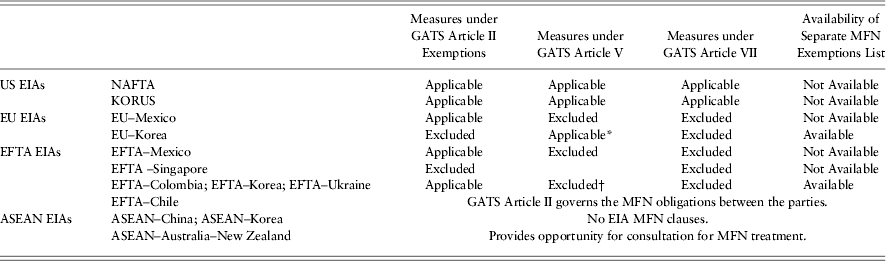
In the following, we review MFN clauses in EIAs concluded by the US, the European Union (EU), the EFTA, and the Association of Southeast Asian Nations (ASEAN). At one end of the spectrum, the US EIAs provide MFN clauses with little limitation on their scope. At the other end of the spectrum, some ASEAN EIAs do not provide MFN clauses in order to protect the differential treatment agreed to in the EIAs untouched by other services market concessions.
(1) Overview of MFN clauses in EIAs
MFN clauses are provided in the trade in services chapters of US FTAs concluded with its trading partners.Footnote 65 For example, North American Free Trade Agreement (NAFTA) provides an MFN clause in its trade in services chapter, which states that ‘[e]ach Party shall accord to service providers of another Party treatment no less favourable than that it accords, in like circumstances, to service providers of any other Party or of a non-Party’.Footnote 66 Similarly, the MFN clause in the cross-border trade in services chapter of the Free Trade Agreement between the US and the Republic of Korea (KORUS FTA) provides that ‘[e]ach Party shall accord to service suppliers of the other Party treatment no less favourable than that it accords, in like circumstances, to service suppliers of a non-Party’.Footnote 67 The EIA MFN provision in NAFTA is distinct from those in other US EIAs, because it also requires that a NAFTA party shall not discriminate between the service providers of other NAFTA parties.Footnote 68
The MFN clauses in NAFTA and in the KORUS FTA do not exclude from their scope the discriminatory measures permitted under the Annex on Article II Exemptions of the GATS.Footnote 69 For example, the US included in its list of the Annex on Article II Exemptions an entry regarding more favourable market access to Canadian small businesses for ‘simplified registration and periodic reporting forms with respect to their securities’.Footnote 70 Under the EIA MFN clauses in NAFTA and in the KORUS FTA, the US is obliged to provide the same market accesses to small businesses from Mexico and Korea with respect to simplified registration and periodic reporting forms for its securities.
In addition, the MFN clauses in NAFTA and in the KORUS FTA are applicable to discriminatory measures adopted by the EIA parties when they form new EIAs with non-parties pursuant to GATS Article V. As a result of the inclusion of GATS Article V measures within the scope of the EIA MFN clauses, the MFN clauses are likely to ‘entrench’ the preferential trade liberalization in the EIAs because the parties in new EIAs will be less likely to offer each other market accesses in services greater than those accomplished in the existing EIAs with MFN clauses.
(b) MFN clauses in EU EIAs
The EU entered into EIAs that provided MFN clauses. The scope of MFN clauses in EU's EIAs varied significantly across the EIAs. The EIA MFN clause in the EU–Mexico FTA provides that the parties’ treatment accorded to ‘services suppliers of the other Party shall be no less favourable than that accorded to like services suppliers of any third country’.Footnote 71 The EIA MFN clause does not exclude from its scope those measures taken pursuant to the entries in the list of the Annex on Article II Exemptions of the GATS. Therefore, a more favourable treatment of services from third countries based on the Annex on Article II Exemptions will give rise to the EIA MFN obligations in the EU–Mexico FTA.
Two exceptions from the EIA MFN clause should be noted. First, the MFN clause will not cover differential treatment deriving from the harmonization of regulations for mutual recognition based on an agreement concluded by either Mexico or the EU with a third country in accordance with Article VII of the GATS.Footnote 72 Second, the MFN clause will not apply to more favourable treatment granted to a third country based on another EIA concluded between the EU or Mexico with a third country pursuant to GATS Article V.Footnote 73
To examine situations in which the EIA MFN obligations may arise under the EU–Mexico FTA, each EIA party's GATS Article II Exemptions list must be examined. Mexico has listed only two measures in its Annex on Article II Exemptions list: first, a measure permitting the supply of road transport service by US suppliers into and across the territory of the US; second, a measure based on a bilateral agreement between the US and Mexico, which grants tax deductions to individuals attending business conventions in the other party's territory.Footnote 74 Under the MFN clause of the EU–Mexico FTA, if Mexico provides preferential treatment to the service providers from the US as permitted under the Annex on Article II Exemptions of the GATS, Mexico will be obliged to provide no less favourable treatment to the service providers from the EU. Specifically, Mexico must permit service providers from the EU to operate the road transport service in Mexico. In addition, Mexico must grant tax deductions to Mexican citizens attending business conventions in the EU.
In contrast to the entries in Mexico's GATS Article II exemptions, the EU had significantly greater number of 28 entries in its schedule of GATS Article II MFN exemptions.Footnote 75 A significant number of these measures reflect preferential treatment based on historical, geographical, or cultural proximity.Footnote 76 For example, for citizens of British Commonwealth members, if a grandparent of the citizen is born in the United Kingdom (UK), the UK will waive the requirement for a work permit in all service sectors.Footnote 77
Some of the EC's other Article II MFN exemptions are applicable to all WTO members but are subject to a condition of reciprocity. For example, market access in France for press agency services is granted to all WTO members on a condition of reciprocity.Footnote 78 Therefore, in accordance with the EIA MFN clause, the EC will be required to provide market access for press agency services in France to Mexican press agency service providers if Mexico reciprocally provides the same market access to French press agency service providers.Footnote 79
The EIA MFN clause in the EU–Korea FTA is significantly different from the MFN clause in the EU–Mexico FTA in its scope of measures covered under the MFN clause.Footnote 80 The most significant difference is that the MFN clause in the EU–Korea FTA covers those future measures adopted by one of the parties with third parties under other EIAsFootnote 81 ‘signed after the entry into force’ of the EU–Korea FTA.Footnote 82 The MFN clause does not apply to those measures listed in the GATS Annex on Article II Exemptions. The MFN clause in the EU–Korea FTA also raises the issue of the entrenchment of preferential trade liberalization through the EIA, as it includes those measures adopted in the context of the formation of other EIAs within the scope of the EIA MFN clause. The automatic extension of the preferential trade liberalization to the EU and Korea through the EIA MFN clause will reduce ‘the value of preferences, and thereby the willingness of countries to strike reciprocal bargains’ in new EIAs.Footnote 83
However, even if a measure is based on an EIA, the MFN clause excludes from its coverage the preferential treatment of third parties if the treatment is granted under EIAs that stipulate ‘a significantly higher level’ of obligations in service liberalization.Footnote 84 A significantly higher level of obligations is defined as the creation of an ‘internal market on services and establishment’Footnote 85 or ‘both the right of establishment and the approximation of legislation’ as defined in Annex 7-B of the EU–Korea FTA. Annex 7-B of the EIA states in its footnote that, at the time of the conclusion of the agreement, the European Economic Area (EEA) was the only example of an internal market with third countries of the EU on services and establishment meeting the definition provided in the annex.Footnote 86 Thus, the services liberalization under the EEA does not give rise to the EU's MFN obligation to services and services suppliers from Korea.
In addition, the MFN clause of the EIA explicitly removes from its scope those measures for mutual recognition that are ‘in accordance with Article VII of GATS or its Annex on Financial Service’ and measures ‘under any international agreements or arrangements relating wholly or mainly to taxation’.Footnote 87 In addition to the above exclusions, the EIA adopts its own list of MFN exemptions. The measures covered by the entries in the MFN exemption list in Annex 7-C of the EU–Korea FTA are excluded from the EIA MFN clause.Footnote 88
Adding more complexity to the Annex 7-C exemption lists, the exemption lists for the EU and Korea list measures applicable to all sectors that provide differential treatment based on the ratchet clauses provided in the EIAs to which the EU or Korea is a party. A ratchet clause permits the party to an EIA to ‘amend any measure only to the extent that the amendment does not decrease the conformity of the measure, as it existed immediately before the amendment, with obligations on market access, national treatment and most-favoured nation in these economic integration agreements’.Footnote 89 The aim of this exemption from the EIA MFN clause is to ‘to protect differential treatment deriving from ratchet clauses’.Footnote 90
(c) MFN Clauses in EFTA EIAs
The MFN clause in the EFTA–Mexico FTA excludes from its scope any preferential treatment granted under EIAs pursuant to Article V of the GATS.Footnote 91 In addition, the MFN obligation will not arise if the preferential treatments to third parties derive from harmonisation of regulations based on mutual recognition agreement in accordance with Article VII of the GATS.Footnote 92 However, the MFN clause in the EFTA–Mexico FTA does not exclude from its scope those measures taken pursuant to the entries in the list of the Annex on Article II Exemptions of the GATS.Footnote 93 In addition, the EIA does not adopt its own list of measures that are excluded from the EIA MFN clause. In addition to the MFN clause, the EFTA–Mexico FTA includes an MFN-consultation clause.Footnote 94
Similarly, the MFN clause in the EFTA–Singapore FTA, excludes from its scope any preferential treatment granted through EIAs under Article V and Article V bis of the GATS.Footnote 95 As with the EFTA–Mexico FTA, the EFTA–Singapore FTA excludes those measures based on a mutual recognition agreement under Article VII of the GATS from the scope of the EIA MFN clause.Footnote 96 In addition to the MFN clause, the EFTA–Singapore FTA includes an MFN-consultation clause.Footnote 97
In contrast to the EFTA–Mexico FTA, the EFTA–Singapore FTA even excludes those measures listed in the Annex on Article II Exemptions of the GATS.Footnote 98 Moreover, the EIA does not separately adopt its own list of measures that are excluded from the EIA MFN clause. Because of these exclusions, the MFN obligation in the EFTA–Singapore FTA is likely to arise in narrow circumstances in which the preferential treatment of a third party by the EIA party is in violation of GATS Article II without being exempted under the Annex on Article II Exemptions, GATS Article V, or GATS Article VII.
Among the remaining EIAs concluded by the EFTA, the EFTA–Korea FTA,Footnote 99 the EFTA–Colombia FTA,Footnote 100 and the EFTA–Ukraine FTAFootnote 101 adopt the same template. The EIA MFN clauses exclude those measures based on GATS Article V or Article V bis and those measures taken for mutual recognition under GATS Article VII.Footnote 102 However, the measures taken pursuant to the Annex on Article II Exemptions of the GATS are not excluded from the scope of the MFN clauses. Instead, the EIAs permit their own lists of MFN exemptions.Footnote 103
Among the MFN clauses in the EIAs into which the EFTA entered into, the MFN clause in the EFTA–Chile FTA is distinct, as GATS Article II is incorporated in the EIA as the EIA MFN clause. The EIA provides that ‘[t]he rights and obligations of the Parties with respect to the most-favoured nation treatment shall be governed by the GATS’.Footnote 104 The interpretation of the provision is unclear, however, because an EIA by definition derogates from GATS Article II as a result of its formation. A GATS Article II obligation is a multilateral obligation, which cannot apply only between the EFTA countries and Chile. Therefore, it is not clear what MFN obligation arises between the EIA parties. In addition to the MFN clause, the EIA also adds an MFN-consultation clause.Footnote 105
(d) MFN Clauses in ASEAN EIAs
The ASEAN entered into three EIAs in trade in services: the ASEAN–China FTAFootnote 106 , the ASEAN–Australia–New Zealand FTAFootnote 107 , and the ASEAN–Korea FTA.Footnote 108 None of the three EIAs provides an EIA MFN clause. Instead, among the EIAs, the ASEAN–Australia–New Zealand FTA provides a distinctive MFN-consultation clause. Article 7 of the EIA provides for consultations ‘to discuss the possibility of extending’ MFN treatment if a party enters into an agreement that provides more favourable treatment to services and service suppliers of a non-party.Footnote 109 There are two exceptions in the MFN-consultation clause. The obligation to consult does not arise if the agreement with a non-party includes an ASEAN member country or ASEAN member countries.Footnote 110 In addition, the MFN consultation obligation does not arise when the more favourable treatment to a third country is based on an agreement that went into force before the enactment of the ASEAN–Australia–New Zealand FTA.Footnote 111
An important observation has been made that some EIAs provide services trade liberalization commitments that result in ‘negative preferences’ in comparison to the parties’ commitments under the GATS.Footnote 112 ‘Negative (GATS-minus) preferences’ mean market access or national treatment disciplines less liberal than those concessions under the GATS or sectoral scope narrower than that provided for in a party's GATS schedule.Footnote 113 For example, under the ASEAN–China FTA, where the national treatment disciplines and sectoral scopes committed by China and some ASEAN members are less than the parties’ GATS commitments.Footnote 114 In the presence of the negative preferences, if an EIA MFN clause were provided in the service chapter of the ASEAN–China FTA, then it would erase the negative preferences by restoring the GATS market access commitments.Footnote 115 Though the EIA MFN clauses may neutralize the ‘negative preferences’, the question still remains whether the EIA MFN clause is legal under WTO law.
The negative preferences as provided in the ASEAN–China FTA between the EIA parties are inconsistent with the ASEAN countries’ GATS schedules.Footnote 116 Since they roll back the trade liberalization between the EIA parties, the intra-EIA trade liberalization requirement under GATS Article V:1 is not likely to be met. They also detract from the aim of an EIA ‘to facilitate trade between the parties to the EIA’ under GATS Article V:4. Therefore, the inconsistency of the negative preferences in the ASEAN–China FTA with the GATS schedule of commitments is likely to fail the legal defence under GATS Article V.
The negative preferences raise the possibility of conflict between the ASEAN–China FTA and the GATS.Footnote 117 While lawful under the China–ASEAN FTA, the negative preferences will be inconsistent under the GATS because of the failure to meet the GATS Article V defence. The conflict is not clearly resolved because the ASEAN–China FTA does not explicitly state that it is in pursuant to GATS Article V.Footnote 118 Nevertheless, since the parties to the China–ASEAN FTA later notified the agreement to the WTO as an EIA pursuant to GATS Article V:7(a), the GATS rights and obligations should take precedence over the GATS-minus provisions in the China–ASEAN FTA.Footnote 119
Scope of EIA MFN clauses
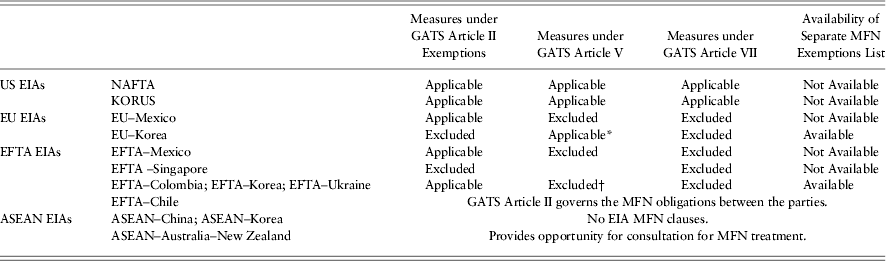
Notes: *Applicable to measures under future EIAs only. The measures under the EEA and the measures based on the ratchet clauses in EIAs with third parties are not covered.
† Measures under GATS Article V bis are also excluded from the EIA MFN clauses.
(2) Legality of MFN clauses in EIAs
EIA MFN clauses result in GATS Article II (Most-Favoured Nation Treatment) violations. The measures taken by the EIA parties accord more favourable treatment to services and service providers from the EIA parties to whom the MFN obligation is owed than to those from third countries with whom the EIA parties have not entered into EIAs with MFN clauses. The measures will be inconsistent with the GATS unless they fulfil the requirements for legal defence under GATS Article V.Footnote 120
The requirement of GATS Article V will be interpreted in light of the purpose of an EIA as set forth in GATS Article V.Footnote 121 The purpose of an EIA is ‘to facilitate trade between the parties to the agreement and shall not in respect of any Member outside the agreement raise the overall level of barriers to trade in services within the respective sectors or subsectors compared to the level applicable prior to such an agreement’.Footnote 122 The first part of this purpose – the internal trade requirement – provides that the PTA parties should facilitate the internal trade between the PTA parties through the PTA. The second part of the purpose – the external trade barrier requirement – provides that PTA parties should not raise the ‘overall level of barriers’ to trade in services with third parties through the PTA. In view of the fact that the purpose of an EIA as provided in GATS Article V:4 is largely identical to that of an RTA under GATT Article XXIV:4, the two-pronged test under Turkey–Textiles, which decided a challenged measure under GATT Article XXIV, should also inform our interpretation of GATS Article V to test the legality of the EIA MFN clauses.
The first prong of Turkey–Textiles under GATS Article V, which is analogous to that under GATT Article XXIV, provides the timing and legality elements. However, the timing element under GATS Article V for EIAs diverges from that of GATT Article XXIV for RTAs. The timing element for an RTA under GATT Article XXIV provides that GATT violating measures should be introduced upon the formation or adoption of an interim agreement for the formation of an RTA.Footnote 123 In contrast to GATT Article XXIV, GATS Article V does not explicitly provide for a de jure ‘interim agreement’ leading to a formation of an EIA. Nevertheless, paragraph 1 of GATS Article V leaves open the possibility of a de facto interim agreement, stating that ‘[t]his Agreement shall not prevent any of its Members from being a party to or entering into an agreement liberalizing trade in services between or among the parties to such an agreement’ (emphasis added).Footnote 124 Therefore, the intra-EIA trade liberalization under GATS V:1 should be implemented ‘either at the entry into force of that agreement or on the basis of a reasonable time-frame’.Footnote 125 The MFN Clauses should be provided in the EIAs at the time of their enactment or provided on the basis of a ‘reasonable time-frame’. As long as this requirement is met, the MFN measures that are applied later should be deemed to be in conformity with the timing requirement.Footnote 126
In addition to the timing requirement, the legality element also can be uncovered from the provisions of GATS Article V. The legality element test whether the EIAs meet (1) the internal trade requirement under GATS Article V:1, and 2) the external trade barrier requirement under GATS Article V:4. The test focuses on the EIAs, not the EIA MFN clauses. The internal trade requirement under GATS Article V:1 has two operational elements: ‘substantial sectoral coverage’ under GATS V:1(a), and ‘absence or elimination of substantially all discrimination in the sense of Article XVII’ under GATS V:1(b).Footnote 127 The first element, ‘substantial sectoral coverage’, is understood to mean that the ‘number of sectors, volume of trade affected and modes of supply’ should all be considered, and there should be no ‘a priori exclusion of any mode of supply’ according to the footnote to Article V.Footnote 128 The second element, ‘absence or elimination of substantially all discrimination in the sense of Article XVII’, requires the EIA parties to accord national treatment to services and service suppliers of the other party.Footnote 129 The criterion is analogous to GATT Article XXIV:8, which requires RTA parties to eliminate duties and ORRC with respect to ‘substantially all the trade’ in products originating between the RTA parties. Both GATT Article XXIV and GATS Article V obligate the PTA parties to eliminate ‘substantially all’ intra-PTA trade barriers, albeit with ‘some flexibility’ in meeting the requirements.Footnote 130
In reviewing whether the EIAs conform to the first element of the internal trade requirement, the question is whether the trade liberalization due to the EIA MFN clauses should be accounted for in assessing the ‘substantial sectoral coverage’ element under GATS V:1(a). The answer is that the trade liberalization based on an EIA MFN clause should not be deemed as part of the liberalization under GATS V:1(a), because it is contingent on a favourable treatment to a third party. The trade liberalization may not be realized ‘either at the entry into force of that agreement or on the basis of a reasonable time-frame’.Footnote 131 Therefore, the inclusion of additional services sectors for trade liberalization through an EIA MFN clause should not be taken into account in assessing whether the EIAs fulfils the ‘substantial sectoral coverage’ element under GATS V:1(a).
Similarly, under the second element of the internal trade requirement under GATS V:1(b), the question is whether the trade liberalization based on an EIA MFN clause can be characterized as trade liberalization in the sense of national treatment as required under GATS Article XVII. Two aspects of an EIA MFN clause lead to a negative conclusion. First, the trade liberalization that is based on an EIA MFN clause is contingent in nature; it takes place only when the EIA parties accord more favourable treatment to services and service suppliers from third parties. Second, the measures based on the MFN clause often may not amount to ‘national treatment’ within the meaning of GATS Article XVII, as is the case if the treatment to services and services suppliers of a third party is less trade-liberalizing than the national treatment under GATS Article XVII. This may well be the case if the preferential trade liberalization to a third party is based on the Annex on Article II Exemptions of the GATS instead of another EIA under GATS Article V with a third party. Since the trade liberalization based on an EIA MFN clause cannot be considered part of the trade liberalization to eliminate discrimination in the sense of GATS Article XVII (national treatment), the EIAs must meet the internal trade requirement irrespective of the intra-EIA trade liberalization resulting from the EIA MFN clause.
Next, under the external trade barrier requirement of the first-prong of Turkey–Textiles, the EIAs must not ‘raise the overall level of barriers to trade in services’ with respect to third parties as compared to the level applicable prior to the agreement. This is an economic test to examine the effect to third parties arising from the challenged measures that are adopted in the course of forming EIAs.Footnote 132 In contrast to GATT Article XXIV:5, the external trade barrier requirement under GATS Article V:4 is not provided as a separate operational criterion but is stated in combination with the other aim of an EIA, which is to ‘facilitate trade between the parties to the agreement’.Footnote 133 The aim of facilitating the intra-EIA trade liberalization should be considered as the context for interpreting the external trade barrier requirement. In view of this context, the measures to enact intra-EIA trade liberalization required by GATS Article V:1 do not fail GATS Article V:4 requirements.
However, the trade liberalization based on an EIA MFN clause at issue is not required by GATS Article V:1. The trade liberalization based the EIA MFN clause provides durable advantages to the service providers from the EIA parties and excludes the service providers from third countries from the EIA party's market.Footnote 134 Since the EIA MFN clause ‘raise the overall level of barriers to trade in services’ with third countries compared to the level applicable prior to the formation of an EIA through the exclusionary effect, the EIA MFN clause infringe on the external trade barrier requirement. Therefore, the EIA with MFN clauses do not accord with GATS Article V:4 requirements.
Last, under the second prong of Turkey–Textiles, EIA MFN clauses should satisfy the ‘necessity’ requirement.Footnote 135 With respect to the necessity test, the Appellate Body's reasoning in Turkey–Textiles should again inform our interpretation of EIA MFN clauses, as the objectives of an RTA under GATT Article XXIV and an EIA under GATS Article V are identical.Footnote 136 According to Turkey–Textiles, if a reasonable alternative to the challenged measure exists, the challenged measure will not be deemed necessary for the formation of an EIA.Footnote 137 If this standard is applied here, reasonable alternatives to the challenged EIA MFN clauses can be found. Instead of providing an EIA MFN clause, the EIA parties can choose the reasonable alternative of incorporating the anticipated future trade liberalization to a third party as intra-EIA market access commitments. The reasonable alternative is no longer contingent upon the EIA parties’ treatment of third parties. Therefore, it will be considered an inherent part of the market access commitments required by GATS Article V:1, thus conforming to the external trade barrier requirement under the first-prong of Turkey–Textiles. Another reasonable alternative is to provide an MFN-consultation clause that is effective only within ‘a reasonable time-frame’ after the enactment of the EIA and that results in trade liberalization during that time-frame.Footnote 138 In view of the availability of these reasonable alternatives, the EIA MFN clauses fail the Turkey–Textiles necessity test. In sum, the measures based on EIA MFN clauses cannot be exempted from the obligation under GATS Article II, because they fail to meet the requirements of legal defence under GATS Article V, in particular, the external trade barrier requirement and the necessity test as laid out in Turkey–Textiles.
4. Conclusion
The world trading system today forebodingly exhibits some resemblance to the trading system before the establishment of the GATT in 1948.Footnote 139 The MFN clauses in PTAs – similar to MFN clauses in bilateral FCN treaties during the pre-GATT years – illustrate the erosion of multilateralism under the WTO. The MFN clauses in PTAs fail to conform to WTO law, because they do not satisfy the requirements for legal defence under GATT Article XXIV or GATS Article V for their violations of the general MFN clauses under GATT Article I or GATS Article II. The measures based on the PTA MFN clauses increase the burden on the trade with third parties.Footnote 140 As a result, the PTA MFN clauses do not satisfy the necessity test under Turkey–Textiles, as reasonable alternatives to the PTA MFN clauses are available. One reasonable alternative is for the PTA parties to replace the PTA MFN clauses with unconditional market access commitments, which will substitute for the conditional market access that may result from the PTA MFN clauses. Another reasonable alternative is to replace the PTA MFN clauses with MFN-consultation clauses that would result in increased market access for the duration of the interim agreements for RTAs or within ‘a reasonable time-frame’ for EIAs.Footnote 141
The MFN clauses in PTAs entrench the preferential trade liberalization between the PTA parties, as the trade liberalization in future PTAs with third parties is constrained by the extent of trade liberalization in the existing PTAs with MFN clauses.Footnote 142 Thus, PTA MFN clauses detract from the WTO's aim of expanding the trade in goods and services in the world through the elimination of discriminatory treatment in international trade relations.Footnote 143
To bring PTAs into conformity with the world trading system, PTAs under the WTO should not include PTA MFN clauses. For those products or services subject to the existing PTA MFN clauses, any preferential liberalization based on the PTA MFN clauses should be accorded non-discriminatorily to all WTO members in accordance with the general MFN principles under GATT Article I and GATS Article II.