



Māshā'allāh (d. c.815), a court astrologer of the Abbasid dynasty, is reported to have written a number of works on astrology.Footnote 1 Only a few of them are extant in Arabic, but we have several Latin translations attributed to him,Footnote 2 one of which is Liber de orbe.Footnote 3 It should be noted that its main topic is not astrology, but cosmology, including the theory of the four elements, meteorology, geology and astronomy.Footnote 4 This Latin translation was made in the 1130 s, and became one of the earliest Latin sources of Aristotelian physics. In fact, William of Conches (1090–after 1154)Footnote 5 and the anonymous author of De secretis philosophie,Footnote 6 a twelfth-century cosmography, utilized and paraphrased a part of it to compose their physical and cosmological sections.
Today the Latin Liber de orbe is found in two versions: the longer version consisting of forty chaptersFootnote 7 (henceforth LL) and the shorter version consisting of twenty-seven chapters (henceforth LS). As for the Arabic original, its existence is confirmed by the fact that Maimonides (1138–1204) took an example from it;Footnote 8 however, no one had been able to locate it in Arabic works. Recently, when cataloguing volumes of Arabic manuscripts on exact sciences from around the world, under the supervision of Professor F. Jamil Ragep (McGill), I identified two manuscripts of it; that is, Berlin, Staatsbibliothek zu Berlin, Ms. or. oct. 273 (henceforth MS B), and Philadelphia, Pennsylvania University Library, MS LJS 439 (henceforth MS P).Footnote 9 Now I am preparing an edition of the Arabic Liber de orbe based on them.
Despite of the importance of the Latin Liber de orbe as one of the earliest works on Aristotelian physics in Latin, this work has not been sufficiently examined until now. That is because it does not have enough information about its authorship and date, so scholars could not situate it firmly in the history of science. In this paper, I will show that these two manuscripts contain the Arabic original of the Latin Liber de orbe. Then I attempt to determine the date of composition of this Arabic work, as well as its authorship, by analysing its contents. The result of my paper will provide its profile, so that the Liber de orbe becomes in reality a precious source in Arabic as well as in Latin for the history of science.
Description of the Arabic manuscripts and the relationship between them and the Latin Liber de orbe
Since analysis of the contents is required to collate the two Arabic manuscripts, I will first describe their details. In the course of the description, I will compare their contents with the Latin Liber de orbe to prove that they contain the Arabic text of this Latin work.
Description of MS B
Berlin, Staatsbibliothek zu Berlin, Ms. or. oct. 273 (=Ahlwardt no 5654).Footnote 10 Two initial flyleaves, sixty-six leaves, and one final flyleaf (folios i–ii, 1a–66b, and iii).
Beginning (folio 1b, lines 1–3):Footnote 11
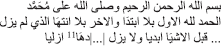
By the name of God, merciful and compassionate, and God bless Muḥammad. Praise be to God, the first without beginning and the end without termination; who exists eternally before things and exists eternally after them …
Ending (folio 66a, lines 13–14):

The book ends by the help of God and His power. God bless Muḥammad and his companions, and He save [Muḥammad].
The copy is unnamed and undated. Ahlwardt estimates the date of its copying as around 600 H/AD 1203.Footnote 12 On the front page (folio 1a), the copyist wrote the following note about the content of this codex:Footnote 13

Codex containing a summarized configuration [hay'a] [of the orbs].
Above this, another hand wrote the title and author as follows:

Summary of the Almagest by al-Khwārizmī [c.780–c.850].
In the middle of the page, the third hand wrote the title and author as follows:
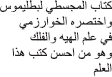
Book of the Almagest by Ptolemy, and al-Khwārizmī summarized it on the science of configuration and the orb, which is the most excellent book of this science.
The copyist collated the copy with the exemplar. While he entered some notes in the margin (on folios 4a, 10b, 12b, 25b, 30a and 31b), he emended quite a few words and sentences by crossing out wrong words and writing the correction after them. The following are a few examples:Footnote 14
B: 3a, 9–10:

Cf. P: 21, 15:

Stars which we already knew would depart from us
B: 11b, 14–15:

Cf. P: 39, 3:

the midheaven of the people in the city
However, many miscopies and misdotted words are found in it. I list a few examples, as follows.
B: 3b, 1:

Cf. P: 21, 18–19:

according to different shapes and contrary figures
B: 5b, 12–13:Footnote 15

Cf. P: 2, 13–14:

when we are in contact with it [i.e. moisture or dryness], its substances do not affect us
As for the contents, this copy contains an introduction and thirty-nine chapters. The introduction (folio 1b) only offers laudation to God in nine lines without any suggestion about the author. We must note that whereas LS omits it,Footnote 16 LL has a literal translation of it, but this part in LL is followed by a brief description of the aim and structure of the book, which cannot be found in the Arabic text.
In both MS B and MS P, each chapter has the heading without numbering. For the sake of convenience, I number and list them with English translation as well as with the corresponding Latin headings,Footnote 17 as follows.Footnote 18
Chapter 1: Discourse on the fact that the orb is managed and created (B: 1b, 10)

[MS P lacks this chapter heading.]
LL: Quod firmamentum est creatum et gubernatum
LS: Caput I. Est sermo in hoc quod orbis est praescitus creatus
Chapter 2: Discourse on the four elements and how their Creator arranged them (B: 3b, 14; P: 22, 7–8)

LL: Tractat secundum capitulum de IIIIor elementis et de locis eorum et quomodo disposuit ea creator suus
LS: Caput II. Est sermo in elementis quatuor quae sunt ignis aer aqua terra et in locis eorum et qualiter creavit ea creator eorum
Chapter 3: Discourse on motions (B: 4a, 8; P: 1, 1)

LL: Tertium capitulum est de motibus et naturis
LS: Caput III. Est sermo de motibus
Chapter 4: Discourse on the natures and the motions (B: 5a, 15; P: 2, 5)

LL: Quartum capitulum est de naturis et motibus
LS: Caput IIII. Est sermo super motus et naturas
Chapter 5: Account of the fact that earth, water, air, fire, and the orb are spherical (B: 7a, 4; P: 27, 17)

LL: Quintum capitulum docet terram et aquam aerem et ignem rotunda esse
LS: Caput V. Est sermo quod terra aqua aer et ignis et orbis sunt sphaerica
Chapter 6: Account of the opposition of the four elements (B: 8a, 1; P: 28, 16)

LL: VI capitulum agit de discordia IIIIor elementorum
LS: VI. Est sermo in contrarietate quatuor elementorum
Chapter 7: Discourse on the rotation of the Earth and the knowledge of night and day (B: 9a, 1; P: 36, 1)

LL: Septimum capitulum de rotunditate terre et de scientia noctis et diei loquitur
LS: [omitting this chapter]
Chapter 8: Discourse on the alteration of seas and rivers and the difference of the earth and mountains (B: 12b, 6–7; P: 46, 3)

LL: Octavum capitulum est de mutatione marium et fluminum et de diversificatione terre et monitum
LS: [omitting this chapter]
Chapter 9: Discourse on the difference of water in the earth and [on] earthquakes (B: 14a, 3–4; P: 48, 1)

LL: De diversitate aquarum que sunt in terra et de terre motibus IX
LS: [omitting this chapter]
Chapter 10: Discourse on volcanoes in RomeFootnote 19 and Sicily (B: 16a, 1)

[MS P lacks this chapter.]
LL: X capitulum de duobus montibus ardentibus Ethna in Sicilia Vesano in Apulia
LS: [omitting this chapter]
Chapter 11: Discourse on the flow and ebb of the sea by the Moon and its action on moisture (B: 16b, 1)

[MS P lacks this chapter.]
LL: XI capitulum est de accessu et recessu maris per lunam et de operibus ipsius in rebus humidis
LS: [omitting this chapter]
Chapter 12: Discourse on the food of the Nile in Egypt (B: 18b, 11–12)

[MS P lacks this chapter.]
LL: XII. De incremento Nili in Egipto
LS: [omitting this chapter]
Chapter 13: Discourse on the rotation of the orb and its motion and nature (B: 21b, 6; P: 29, 16)
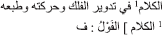
LL: De rotunditate firmamenti et de motibus et naturis suis XIII
LS: Caput VII. Est sermo in rotunditate orbis et motu, ac natura eius
Chapter 14: Account and discourse on the revolution of the orb and the Sun (B: 24b, 4)

[MS P lacks this chapter.]
LL: De volutione firmamenti et solis XIIII
LS: [omitting this chapter]
Chapter 15: Discourse on the fact that any change does not reach the orb in its essence and in its motion (B: 29b, 4–5; P: 24, 5)

LL: Quod nulla mutatio firmamentum nec in se nec in motibus suis insequatur XV
LS: [omitting this chapter]
Chapter 16: Discourse on circles, chords and points (B: 32b, 7)

[MS P lacks this chapter heading.]
LL: De circulis et lineis et punctis XVI
LS: Caput X. <Est> sermo de circulis et cordis ac punctis
Chapter 17: Discourse on the difference of the Sun's rising and setting in [various] countries (B: 34b, 1–2; P: 40, 2)

LL: De solis diversis ascensibus et occasibus super diversas regions XVI
LS: [omitting this chapter]
Chapter 18: Account of the knowledge of the Sun's magnitude (B: 35b, 1–2)

[MS P lacks this chapter.]
LL: De scienda solis magnitudine argumento inevitabili et ratione necessaria XVIII
LS: Caput VIII. Est sermo in scientia magnitudinis solis
Chapter 19: Discourse on the Moon's borrowing of the Sun's light (B: 38a, 1)

[MS P lacks this chapter.]
LL: Qualiter luna a sole lumen recipiat XIX
LS: Caput IX. Est sermo in hoc quod luna mutuatur lumen a sole
Chapter 20: Discourse on lunar eclipses (B: 40a, 1)

[MS P lacks this chapter.]
LL: De lunaris eclipsis occasione agit XX
LS: Caput XI. Est sermo de eclipsi lunae
Chapter 21: Discourse on stars' borrowing of the Sun's light (B: 41a, 1–2)

[MS P lacks this chapter.]
LL: In titulo vicessimo primo arguitur quomodo sidera a sole illuminantur
LS: Caput XII. Est sermo in hoc quod stellae mutuatur lumen a sole
Chapter 22: Discourse on the cause of solar eclipses (B: 42b, 1; P: 11, 1)

LL: Solaris eclipsis occasionem apperit XXII
LS: Caput XIII. Est sermo in causis eclipsis solis
Chapter 23: Discourse on why the Moon becomes visible to some people and does not become visible to others and why it appears small or large (B: 44a, 5–6)

[MS P lacks this chapter.]
LL: Qua de causa lunam alia gens videat alia non et cur illa prima nunc magna nunc parva appareat
LS: Caput XIIII. Est sermo in luna. Quare fit quod quidam vident eam, alii non vident eam, et quare magna et parva interdum appareat
Chapter 24: Account on the difference of the Moon's light and stars' light in [various] cities (B: 44b, 10–11; P: 9, 5–6)

LL: XXIIII agitur de diversitate lucis lune et siderum super diversas civitates et de ipsius diversitatis causa
LS: Caput XV. Est sermo de diversitate luminis lunae et aliarum stellarum super civitatem
Chapter 25: Discourse on the number of the Moon's orbs (B: 46a, 1; P: 13, 1)
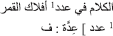
LL: XXV speras lune computat
LS: Caput XVI. Est sermo in numero orbium lunae
Chapter 26: Discourse on the two orbs of the Sun (B: 47a, 1; P: 14, 1)

LL: De duarum sperarum solis ostensione XXVI
LS: Caput XVII. Est sermo in numero orbium solis
Chapter 27: Discourse on the number of the orbs and their motions (B: 48a, 1; P: 17, 2)

LL: Universas speras et earum motus computat XXVII
LS: Caput XVIII. Est sermo in numero orbium et motuum ipsorum
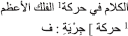
Chapter 28: Discourse on the motion of the greatest orb (B: 50a, 3; P: 8, 3)
LL: Maxime spere motum pandit XXVIII
LS: Caput XIX. Est sermo in motu orbis magni
Chapter 29: Discourse on the orb of the zodiacal signs (B: 50a, 13; P: 8, 21)

LL: Zodiaci motus declaratur XXIX
LS: Caput XX. Est sermo de orbe signorum
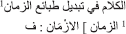
Chapter 30: Discourse on the alteration of the natures of a season (B: 51b, 5; P: 4, 12)
LL: De diversitate naturarum et temporum XXX
LS: Caput XXI. Est sermo in permutatione naturarum temporum
Chapter 31: Discourse on the orbs of Saturn (B: 51b, 13; P: 4, 21)

LL: Saturni reliquorumque planetarum speras computat XXXI
LS: Caput XXII. Est sermo in orbibus
Chapter 32: Discourse on Saturn's retrogradation and its returning into that from which it has left among the zodiacal signs (B: 53a, 11–12; P: 15, 5–6)

LL: Causam discutit cur Saturnus ceterique planete ad ea signa unde processere retro gradiantur XXXII
LS: Caput XXIII. Est sermo in retrogradatione Saturni et conversione ipsius ad signum in quo erit
Chapter 33: Discourse on the orb of the fixed stars (B: 54b, 1; P: 19, 12)

LL: De spera fixorum siderum XXXIII
LS: Caput XXIIII. Est sermo de orbe stellarum fixarum
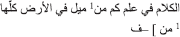
Chapter 34: Discourse on the knowledge of how large the whole Earth is in miles (B: 54b, 7; P: 41, 1)
 LL splits this chapter into Chapters 34 and 35:
Quot miliaria circa terram sint XXXIIII;
De diversitate horarum in terra noscend[a] XXXV
LS: [omitting this chapter]
Chapter 35: Discourse on the climates of the Earth (B: 55b, 13–14; P: 43, 5)

LL: Septem climata computat eorumque naturas aperit et que gens in unoquoque habitet climate quidve sol in singulis oper[e]t XXXVI
LS: [omitting this chapter]
Chapter 36: Discourse on the two places where night or day continues during a whole day (B: 59a, 10–12)

[MS P lacks this chapter.]
LL: Indicat loca in quibus annus unius diei tantum et noctis est XXXVII
LS: [omitting this chapter]
Chapter 37: Discourse on winds (B: 60b, 7; P: 19, 18)

LL: Quid venti sint aut unde veniant queve eorum nature sint aperit XXXVIII
LS: Caput XXV. Est sermo de ventis
Chapter 38: Discourse on clouds, rain, thunder and lightning (B: 62b, 8–9; P: 31, 15–16)

LL: De tonitruis de nubibus de pluviis et de fulgoribus et fulminibus agit XXXIX
LS: Caput XXVI. Est sermo in pluviis et fulguribus tonitruis et fulminibus
Chapter 39: Discourse on plants (B: 64a, 7–8; P: 34, 4)

LL: De animatis insensibilibus XL
LS: Caput XXVII. Est sermo de plantis
The above list shows that although Chapter 34 is divided into two, LL contains the entire chapters of MS B in the same sequence, and LS also follows the same chapter order, but omits several chapters. On the other hand, LL sometimes paraphrases the Arabic chapter headings, while they are literally translated in LS. For example, the chapter heading of Chapter 39 ‘on plants’ is translated accurately in LS, but LL renders it ‘on insensitive creatures’.Footnote 20
The main texts of the LL and LS have the same characteristics as the headings. For example, at the middle of Chapter 3, the author introduces a figure to explain the motions of the four elements, as follows (B: 4b, 15; P: 1, 13–14):Footnote 21

So we draw a figure in which what we said can be seen, if God the Sublime will.
This Arabic text is translated literally in LS without the reference to God, as follows:Footnote 22
Et formemus ad illud figuram ut uideatur quod dicitur sensibiliter.
LL has a paraphrased version:Footnote 23
Ad quod declarandum figuram faciam que huius vim sermonis exprimat.
To show that [topic] I will make a figure which expresses the meaning of this account.
Needless to say, detailed analysis of the relationship between the Arabic and the Latin should wait for a critical edition of the Latin Liber de orbe (LS and LL), but the above preliminary comparison obviously establishes that these two Arabic manuscripts contain the Arabic original of this Latin work, and that LS is a truncated version of it, while LL is paraphrased from it. Moreover, the variant readings in the above list of the chapter headings reveal that sometimes MS P has a different reading against MS B and the Latin. To clarify the characteristics of its variation, I will describe MS P in detail.
Description of MS P
MS P: Philadelphia, Pennsylvania University Library, MS LJS 439. One initial flyleaf, twenty-five leaves, and one final flyleaf (folio i, pp. 1–50, and folio ii).
MS P has page numbers written by a modern hand at the upper left corner. The chapters are not numbered. Comparison between MS B and MS P shows that MS P is misbound. The correct page sequence is as follows:
pages 21–23: middle of Chapter 1–Chapter 2;
pages 1–2, 27–30 and 23–26: Chapters 3–6, Chapter 13, and Chapter 15 (incomplete);
pages 35–48: middle of Chapter 16, Chapter 7, Chapter 17, Chapters 34–35, Chapter 8, and Chapter 9 (incomplete);
pages 11–12: Chapter 22;
pages 9–10: middle of Chapter 23–Chapter 24;
pages 13–14, 17–19, 7–8, 3–6, 15–16, 19–20, 31–34, and 49–50: Chapters 25–33, and Chapters 37–39.
Thus the beginning is at page 21 and the ending is at page 50.
Beginning (page 21, line 1)

into air and descending into earth and its taking in longitude and latitude …
Ending (page 50, lines 12–13)

The book is completed. Praise without limit be to the Donor of the intellect and gratitude without end.
Then follows an Arabic verse written by another hand in six lines.
The copy is unnamed and undated. The library cataloguer estimates the date of its copying around the year 14 CE.Footnote 24
Due to the lack of several leaves, including the first, it does not have a note on the title and author as well as the introduction, and, among thirty-nine chapters of MS B, it transmits twenty-five complete chapters (Chapters 2–8, 13, 17, 22, 24–35 and 37–39) and four incomplete chapters (Chapters 1, 9, 15 and 16).Footnote 25 Most leaves have severe erased parts on the surface, so that quite a few sentences are unreadable. The copyist collated it with the exemplar. He entered several corrections in the margin (sometimes with the mark  ‘corrected’).
As for the contents, it is remarkable that the chapter order in MS P is not the same as in MS B and in the Latin Liber de orbe, and some chapter headings are different from those in MS B and LS (for example Chapters 22, 26 and 28). In the main text, we find many additions and modifications against MS B and LS. For example, Chapter 39 begins as follows (B: 64a, 8–12; P: 34, 5–8):Footnote 26

Then we say: the earth grows everything without a sower and a planter, because we find kinds of fruits in deserts and the peaks of mountains. Thus the [fruit] which grows in an inhabited place is good and fine, and the [fruit] which grows in a desert is not good, even if a thing is grown only in a place where it is fine and the air is suitable for it.
LS:
Et dico quod terra producit omnem rem sine seminatore et sine plantatore. Nos enim invenimus in desertis cacuminibus montium species fructuum. Quod ergo ex eis nascitur in deserto, non est bonum quamvis nihil nascatur nisi in loco in quo sit bonum, cui convenit aer eius et quod nascitur in eo, quod habitatur fit bonum et utile.
This part of Chapter 39 contains several examples, despite being a few lines:
Example 1
B:

without a sower and a planter
P:

without a sower, a planter and a watering person
Example 2
B:

kinds of fruits
P:

kinds of fruits, palm leaves and seeds
Example 3
B:

in a place where it is fine and the air is suitable for it
P:

in the places where it is fine and the air of that place is suitable for it
In the last example,  ‘a place’, is rendered into the plural form
 ‘the places', in MS P; however, a redactor forgets to change
 ‘in it’, into
 ‘in them’, so that this sentence contains a grammatical mistake.
On the other hand, MS B has no additional reading against MS P and LS in this part, whereas it contains miscopies, such as  instead of
 In fact, we find only a few examples of modification in MS B against MS P and LS throughout the whole text. One of them is found in Chapter 13:
B: 22a, 13–15

The motion of the orb has no slowness and no weakness [in motion]; I mean slowness and weakness never occur to it. That is because the motion of the right orbFootnote [27] is the same …
P: 30, 10–11:

The orb has no slowness and no weakness [in motion] in its nature. That is because the right orb is in the same motion …
LS:
Et in motu quidem orbis non est tarditas neque levitas, quoniam orbis recti motus est unus …
This example shows that MS B has an additional explanation beginning with ‘I mean’; this phrasing suggests that MS B also contains a later addition, although we cannot completely deny the possibility that this is the text by the author.
Analysis of the textual relationship reveals that MS P transmits this work after a redaction by a later scholar, so that it has a different chapter order with contamination of quite a few additions and modifications. Thus, when editing the Arabic Liber de orbe, I will follow MS B, which contains the complete set of the chapters with minor modification, and emend its scribal errors by comparing it with MS P and LS.
Based on the above description, I begin to consider the authorship of the Arabic Liber de orbe (henceforce ArLO) and the date of its composition. First, I will outline its contents to obtain clues to the author and the date.
The contents of the Arabic Liber de orbe
As already described, the introduction of ArLO only has laudation to God in nine lines, so the author does not give any information about why and how he composed this work. After praising God, he suddenly begins the first chapter. In each chapter, he first states his argument, and proves it frequently with diagrams. He sometimes mentions several contrary opinions and disputes them rationally.
The argument of Chapter 1 is the regularity of the circular motion of the orb bestowed by God, and then in Chapters 2–4 and Chapter 6 he introduces the Aristotelian theory of the four elements constructing the sublunar world,Footnote 28 where he explains the orb as a distinct entity because of its circular motion opposed to the rectilinear motions of the four elements. Thus it is clear that he suggests another element for the orb, the so-called fifth element, although he does not explicitly call it so.
Whereas he contrasts the four elements with the orb according to their motions, he declares in Chapter 5 that they all constitute concentric spheres. That is because, he says, the orb and earth are spherical in nature, and the middle elements, namely fire, air and water, follow the shape of these two. For example, he explains the reason for the sphericity of fire as follows (B: 7b, 9–12; P: 28, 10–12):Footnote 29
[Fr. 1]

In fact, the surface of fire which is next to the contact of the Moon's orb becomes spherical, being the end of moving bodies' proceeding from the middle, so the contact of fire with the surface of the Moon's orb which is next to us is formed with respect to the shape of the Moon's orb which meets it. So fire is also spherical.
Then, in Chapters 7–12, he illustrates geological and meteorological phenomena, such as the transformation of oceans and mountains, the different tastes of water and the occurrence of earthquakes, volcanoes in Rome and Sicily, the relationship between the tidal ebb and flow and the Moon, and the flood of the river Nile, by using the theory of the four elements. For example, he explains in Chapter 9 the occurrence of earthquakes (B: 14a, 12–14b, 2; P: 48, 7–11):
[Fr. 2]

Coldness is sometimes confined inside the earth and is imprisoned in a place, and the solidness of the earth prevents it from departing, so that it is confined in that [place] and is gathered, and its power becomes great. If heat enters it, it strongly contradicts it, so it [i.e. coldness] cracks a solid part of the earth, and departs from inside the earth, so that it tears it [i.e. the earth]. Then wind emerges from it [i.e. the earth] with a sound heard by people. As a result the earth is shaken in that [condition], and then it trembles in that [condition].
Here he explains that the qualitative opposition between heat and coldness makes the earth cracked, and wind from the earth shakes it; however, he does not elucidate why wind emerges from the earth under this condition. Aristotle, who is the main source for ArLO about natural philosophy, describes the process whereby moistened earth is heated and dissolves dry exhalation, which turns into wind.Footnote 30 Thus the above quotation suggests that while focusing on the contradiction of the two qualities, the author does not give details about exhalation.
Following this is described (B: 14b, 5–7; P: 48, 12–14) another phenomenon caused by this wind:Footnote 31
[Fr. 3]

As a sign of an earthquake, the Sun is sometimes seen muddy in colour without clear light, because the wind departs from inside the earth and it lifts vapour and dust into the air.
In a similar way to this example, he explains in six chapters a variety of geological occurrences rationally with recourse to the Aristotelian theory of the four elements.
After discussing phenomena in the sublunar world, he focuses on the nature of the orb in Chapters 13–15, where he confirms repeatedly that the orb consists of an element other than the four elements. Then he describes the structure of the superlunar world by using the orb in Chapters 16–34. First, in Chapter 16, he explains the main components of the orb; that is, three circles, seven points and three chords. Before introducing them, he states the aim of this chapter (B: 32b, 8–11):Footnote 32
[Fr. 4]

Know – May God honour you – that a person who understands these circles, points and chords according to sense perception understands how the orb is. That is because, by understanding these circles, points and chords, the figure of the orb is shaped in the mind, and when it occurs in the mind, it occurs in the intellect.
Here he declares that these components are the basis of cosmology. Then he introduces the three circles (B: 32b, 11–33a, 5):
[Fr. 5]
The first circle is drawn from the east, to the midheaven, to the west, to the lowest heaven of the Earth's orb, and to the east. This is called the east–west circle, which is also called the equator line, because when the Sun rotates on this circle, the night and the day are equal to each other in all climates. The second circle is drawn from the north point, to the midheaven, to the south point, to the lowest cupola of the orb under the Earth, and to the north point, which is the northern pole. This circle is called the south–north circle. The third circle is drawn from the east point, to the south point, which is the southern pole, to the west, to the north and to the east. This circle is called the circle of horizons.
Given that the east–west circle corresponds to the equator line, the author obviously explains these main components in the case of the equatorial region, so that the south–north circle is the meridian circle. Following the three circles, the three chords are described (B: 33a, 5–9):
[Fr. 6]

As for the three chords, a chord is drawn from the east, to the centre of the Earth, and to the west; the second is a chord drawn from the midheaven, to the centre of the Earth, and to the lowest cupola of the orb; the third is a chord drawn from the north point, to the centre of the Earth, and to the south point. These are the three chords.
Then he lists the seven points; that is, the centre of the Earth (nuqṭat al-arḍ), the east point (nuqṭat al-mashriq), the midheaven (wasṭ al-samā’), the west point (nuqṭat al-maghrib),Footnote 33 the point of the lowest cupola of the orb (nuqṭat asfal qubbat al-falak), the north point (nuqṭa fī al-shamāl, i.e. the northern equatorial pole) and the south point (nuqṭa fī al-janūb, i.e. the southern equatorial pole).
After setting the main components of the orb, he explains in Chapters 17–24 how lunar and solar eclipses occur, how all stars borrow solar light, and how to determine the Sun's magnitude. Then, in Chapters 25–33, he presents the cosmos as a combination of concentric orbs, and describes planetary motions by epicycle–eccentric models. What is remarkable about his cosmology is that the cosmos is thought to consist of ten orbs, not of the standard nine orbs (namely the greatest orb, the orb of the fixed stars, and the seven planets' orbs). That is because in ArLO the orb of the zodiacal signs is a separate starless orb (the ninth orb), which is divided into twelve zodiacal signs, and the fixed stars themselves are on the orb of the fixed stars (the eighth orb), which is under the ninth orb.Footnote 34 In Chapter 29, he explains the motion of precession as follows (B: 50b, 9–51a, 5; P: 3, 9–20):Footnote 35
[Fr. 7]
This orb [i.e. the orb of the zodiacal signs] is that about which one says, ‘Saturn is in such-and-such a degree of Aries and Taurus’, but the orb of the zodiacal signs is not the [orb] at which we point and say, ‘Aries, Taurus, Gemini, Cancer, and so on’; however, we say that we call them by these names only according to the shape of their constellations formed in it, and we cannot call it the orb of the zodiacal signs, since it [i.e. the orb of the zodiacal signs] has no figure because it is starless, while all stars are below it; surely you see that, we say, if you say that Cor Leonis, Cor Scorpionis, Vulture, and Pisces were in such-and-such degree of the orb of the zodiacal signs in the time of Flood, they are in more than these degrees, and the equation of a star of them in an astronomical table is completed only by the equation of Cor Leonis and the [place] at which it arrives among Leo according to the starless orb of the zodiacal signs. These observed stars are only fixed stars, which cut the orb of the zodiacal signs according to the amount of what they run in their orb.
Here he notes that owing to this motion the eighth orb has no star in the place corresponding to that of a zodiacal sign in the ninth orb. This quotation impresses on us that he strives to examine the reality of zodiacal signs, one of the basic elements of astrology.
Further down, in Chapters 34–36, the author treats topics of geography, including how to determine the Earth's magnitude, the climate divisions and particular places where it stays bright all day without the arrival of night or vice versa. Chapters 37–38 are on meteorology: on wind, and on thunder, clouds, rain and lightning. Finally, the last chapter of the book, Chapter 39, covers topics on plants.
As is clear from the above overview, ArLO gives us a comprehensive account of phenomena in the sublunar world as well as in the superlunar world. To structure his arguments, the author describes the mechanism of sublunar phenomena with recourse to the theory of the four elements, and explains superlunar phenomena with geometrical explanation using plenty of diagrams. The reason for his thoroughly logical explanation of all phenomena lies in his ambition to show how rational the construction of the world is, which in turn proves that its creation was impossible except by the wisest God.
His intention is most apparent in Chapter 14. First, he proposes the argument that if God is the wisest, He will make the motion of the orb the perfect motion; that is, circular motion. Then he states the reason why, if the motion of the orb increased or decreased, daytime would also increase or decrease, which should affect tremendously the living beings on the earth. At the end of this discussion (B: 28b, 8–9), he quotes the following verse of Qur’ān [iii.191]:Footnote 36
[Fr. 8]

They reflect upon the creation of the heavens and the earth: ‘Our Lord, Thou hast not created this for vanity. Glory be to Thee! Guard us against the chastisement of the Fire’.
This is the only quotation from the sacred texts in ArLO. This stanza makes it clear that his main objective is to prove the thesis of ‘the aimed creation of the world by the one God’.
We must remark that whereas the author shows the physical aspect of the cosmos in detail with a number of geometrical diagrams, he does not mention how to calculate astronomical quantities using them. The only exception is the calculation of the Earth's magnitude in Chapter 34, where he presents the process of determining the circumference of the Earth. First, he explains how to determine one degree of the Earth's circumference by using the astrolabe. Then he gives the result that one degree is 66⅔ miles, and calculates the circumference, namely 24,000 miles (=66⅔ ×360).
Excepting this example, the author never presents quantitative determination when describing astronomical phenomena. In fact, at the end of Chapter 20, he remarks the absence of quantitative description in this book, as follows (B: 40b, 2–4):
[Fr. 9]

If we only aim in our book to explain the cause by which the Moon is eclipsed, we do not describe the necessity of its eclipse according to what is in zījs.
This note shows that he concentrates on the qualitative features of the cosmos, intentionally skipping astronomical quantitative determination usually written in zījs, namely astronomical handbooks with tables.Footnote 37 In the Islamic world, this genre of works specializing in the qualitative account of the cosmos came to be known as ‘books on ‘ilm al-hay'a [science of the configuration of the orbs]’ after the appearance of Ibn al-Haytham's (965–c.1040) On the Configuration [hay'a] of the World. Footnote 38ArLO is distinctively characteristic as an ‘ilm al-hay'a work, because whereas books of this genre normally exclude subjects on physics and meteorology, it covers more comprehensive topics about the cosmos to show ‘the creation of the cosmos by the one God’.
This author's thesis is also evident from counterarguments he refers to. For example, in Chapter 1 he refutes the view of those who believe in the eternity of the world (that is, dahrīyasFootnote 39), as follows (B: 3a, 1–5; P: 21, 10–12):
[Fr. 10]

If the orb and stars were affecting creatures and were creating things as dahrīyas – May God stay away extremely highly from that [sect] – think, they would bring opposite matters and different motions; and they would bring a day whose length is an hour, and bring a day whose length is a year, and night would be like that …
Since the dahrīyas were one of the dominant opponents of this thesis, the denial of their doctrine results in better support for it.
What should be noted is that the dahrīyas in his version adopt one of the main principles of astrology, namely the effect of celestial entities upon the sublunar world. Although he does not give any view on astrology in this chapter, his attitude towards it is suggested in Chapter 29 (Fr. 7), where he examines the reality of zodiacal signs. In fact, his obvious refutation of astrology is found in Chapter 14.
In this chapter, the author proves the eternal circular motion of the orb and the Sun endowed by God with recourse to the theory of the four elements and the existence of another element constructing celestial entities, and then he quotes the mentioned Qur'anic verse (Fr. 8). At the end of this chapter, he criticizes astrological concepts (B: 28b, 9–29b, 2):Footnote 40
[Fr. 11]
However, if someone says and claims that the orb has the four natures, many predecessors on astronomy and our contemporary scholars who demand astronomy say about the twelve zodiacal signs, ‘Aries, Leo and Sagittarius are in the same nature of the fiery zodiacal signs, [namely] hot and dry; Taurus, Virgo and Capricorn are in the same nature of the earthy zodiacal signs, [namely] cold and dry; Gemini, Libra and Aquarius are in the same nature of the airy zodiacal signs, [namely] hot and moist; and Cancer, Scorpio and Pisces are in the same nature of the watery zodiacal signs, [namely] cold and moist’. They also say, ‘Some of them are tropical; some of them are fixed; some of them are bicorporeal; some of them are masculine; and some of them are feminine’, and [say], ‘some of them are luminous, and some of them are dark’, and [say], ‘some of the five planets are benefic; some of them are malefic; some of them are benefic when they are accompanied with benefic [planets], and they are malefic when they are accompanied with malefic [planets]’.
Indeed, we see the Sun being blackened, burnt and dried; if the Sun were not hot in itself in actuality, it could not do that, because just as we see fire being burnt and blackened by its heat in actuality, the Sun is like that. We see the Moon being moistened and putrefying; if that [i.e. the Moon] were not like that in its nature, it could not do that.
Then we say: as for the matter about the zodiacal signs and stars that you describe, if this is said about them, they are neither hot in themselves nor cold nor wet nor dry nor light nor heavy nor benefic nor malefic, even if they [i.e. these scholars] say these concepts when manifesting relationships of them [i.e. the zodiacal signs and stars], what they indicate by a different relationship, and what [ordinary] people receive from them.
We will give an explanation about each of them [i.e. the astrological notions] and its characteristics, and we will tell the reason why they mention them, in great details in a more specific place, if God – may He be exalted – will.
As for what they are in their essences, they are, as I taught you, neither beneficent nor maleficent, since the element is the same; I mean that they are of the same nature.
Here he is clearly addressing the astrological notions of ‘triplicities’ and ‘beneficence and maleficence of the planets’.Footnote 41 As already seen, he considers superlunar objects as consisting of the fifth element, and as having no quality existing in sublunar objects. Thus it is not surprising to find him refusing to assign any qualities to superlunar entities. In this quotation, he explains that many scholars use this concept as a metaphor to convince ordinary people, and he ends this section with a promise to explain astrological concepts in a later section; however, we cannot find a relevant section in ArLO.
Although the author refutes astrological accounts, Fr. 11 undoubtedly shows that he gives a privileged position to the Sun and the Moon. In Chapter 19, he plainly declares as follows (B: 38b, 2–3),
[Fr. 12]

We say: the body of the Sun is luminous in nature from its essence, and the Moon is dark, polished, and like iron.
Then he demonstrates with a diagram the Moon's reception of the Sun's light based on the lunar phases. In Chapter 11, he quotes the following statement by ‘the philosopher’ (B: 16b, 2–3):
[Fr. 13]

The philosopher said: one of the natures of the Moon is to move seas in its arriving at the height of the orb.
Then he explains the relationship between the tidal ebb and flow and the Moon's motion.
However, it is evidently problematic to support the two notions, of the specific position of the Sun and the Moon, and of the existence of the fifth element,Footnote 42 but in ArLO the author does not state the reason why the Sun and the Moon have these special qualities. Instead he seems to think it satisfactory to merely show that the statements about the nature of the Sun and the Moon, including the one by ‘the philosopher’, correspond to daily observations.
As in this example, the author brings up the opinions of predecessors several times, but his sources are not clear. For example, in Chapter 18 (B: 35b, 9–36a, 1) he clearly mentions his source as Ptolemy's Structure of the Orbs (Kitāb tarkīb al-aflāk) in determining the Sun's magnitude, and describes how Ptolemy demonstrated the Sun to be larger than the Earth by examining the shadow of the Earth. At the end of this chapter, he gives the datum of its magnitude, 166⅜, without the calculation behind it. This title, Structure of the Orbs, suggests that he might have referred to Ptolemy's Planetary Hypothesis, but we cannot find in this work a demonstration using the Earth's shadow. It is remarkable, however, that the datum 166⅜ in ArLO is more exact than the 166⅓ in the Planetary Hypothesis, and the 170 in the Almagest.Footnote 43 Thus it seems reasonable to assume that the author uses something other than the Ptolemaic works, but attributes its source to Ptolemy intentionally or unintentionally.
Chapter 27 has another quotation from Ptolemy's work. When the author describes the proportionality of the rotation period of a planet and the size of its orb, he quotes Ptolemy's explanation utilizing layers of different pulleys (baraka). However, since Ptolemy never adopted such proportionality, this quotation cannot come from Ptolemy.Footnote 44
In both of them, the author obviously does not use Ptolemy's works, but other Greek astronomical sources.Footnote 45 This fact suggests that ArLO was written before Ptolemy's works were canonicalized in the Islamic world, although Ptolemy's authority was already recognized. That is to say, ArLO was written fairly early as a book on the ‘ilm al-hay'a.
Chapter 34 has information which suggests the date when this work was written. In the latter half of this chapter, the author explains the time difference of the beginnings of a solar or lunar eclipse at different places. To show this, he recommends recording the starting times of an eclipse in several places, and gives the following example of a solar eclipse (B: 55b, 9–12; P: 43, 3–4):Footnote 46
[Fr. 14]

The Sun has been eclipsed in al-Andalus after two hours from the day on Friday of Ramadan of the year 327 H (i.e. AD 938), and that eclipse was seen later in Baghdad in that day after returning of the Sun [i.e. midday].
With a computer program, we can confirm the occurrence of this solar eclipse. Since the author uses this incident as an example to support and vivify his explanation, it must still be a fresh memory for his readers. Hence I would assume ArLO to have been composed not too long after this eclipse.
This date proves the early composition of ArLO, but then contradicts its attribution to Māshā'allāh.Footnote 47 This attribution is doubtful also from the fact that the author of ArLO rejects the qualities of stars, whereas Māshā'allāh accepts them. Hence there emerges a question about its authorship, which is the main topic of the next section.
The authorship of the Arabic Liber de orbe
The above information about the solar eclipse also indicates that this book was written in or near the Andalusia region, since it was recorded in al-Andalus. Furthermore, the following features of ArLO are suggestive of the place of its composition:
1 In Chapter 17 the author gives an example of comparison between the Ifrīqīyya (i.e. Tunisia), Egypt and Iraq.
2 The entirety of Chapter 12 is devoted to the flood of the river Nile.
3 Chapter 10 is on volcanoes in Rome and Sicily.
These clues lead us to a tentative conclusion that it was written around AD 940 in the Andalusia–Maghreb area, especially a region close to Egypt and Sicily; that is, in the Ifrīqīyya.
At that time, the Ifrīqīyya was the capital of the Fatimid dynasty, a scholastic centre of the Maghreb.Footnote 48 One of the most prominent scholars was Isaac Israeli (c.855–c.955), a Jewish physician and philosopher in the Fatimid court.Footnote 49 What is remarkable is that he had a disciple well versed in astronomy: Dūnash ibn Tamīm (d. after 955).Footnote 50
Biographical information on Dūnash is very scarce, but two of his works have descended to us, namely Treatise on the Armillary Sphere, and Commentary on the Sefer Yezira. The Treatise on the Armillary Sphere is extant only in Istanbul, as Ayasofya MS 4861 (henceforth MS A).Footnote 51 In this work, he describes in great detail how to construct and operate the armillary sphere, an astronomical instrument consisting of rings. Thus its contents confirm his specialism in astronomy. We are also informed from the Commentary on the Sefer Yezira that he wrote other astronomical works.
The Sefer Yezira, or ‘Book on Creation’, is a Hebrew esoteric book on cosmogony, and several scholars wrote commentaries on it.Footnote 52 Among them, the earliest extant is the Arabic commentary by Saadia Gaon (884–942), a contemporary of Isaac Israeli.Footnote 53
Dūnash wrote the next-earliest commentary in Arabic. However, we do not have a complete Arabic manuscript of it. Fortunately, about 75 per cent of the text was salvaged by George Vajda and Paul Fenton from Judaeo-Arabic documents, and the whole text is transmitted in several Hebrew versions.Footnote 54 Because it was written fairly early as a commentary on the Sefer Yezira, it is an important source to explore the early stage of the reception of the Sefer Yezira.
In this work, Dūnash comments on the passages of the Sefer Yezira one by one. In the course of the commentary, he mentions and criticizes Saadia's comments several times. We must remark that he gives some information about himself, especially in the commentary on 1.5,Footnote 55 which is only extant in the Hebrew translations.Footnote 56
At the beginning of this part, Dūnash comments on the passage ‘the limit of beginning, the limit of end’. He interprets it as ‘the limit of the creation and termination of the world’, and explains that this limit can be perceived by human beings through their rational faculty as well as through traditional stories. As for the rational perception, he notes that they can realize the existence of the Rotator, namely God, by observing the eternal rotation of the orb. On the other hand, he gives Genesis as an example of the traditional accounts of God's creation of the world. When describing the details of Genesis, he mentions his current date: 344 H (=955–956).Footnote 57 This date was almost at the time when ArLO was being written.
Next, Dūnash moves to the passage ‘the limit of good and the limit of bad’, and remarks that good and bad are not substances but attributes, and he declares the oneness of God. Then he refutes the dualists who believe the existence of the good and the bad as the light and the dark, by using the example of lunar phases which show that light is produced by the Sun and dark occurs when something blocks the light. This example is concluded by the following note:Footnote 58

We have already explained this [i.e. lunar phases] and have put diagrams about it in our book which we composed and sent to Abū Yūsuf Ḥasdāy [c.915–c.975] to reply to questions which reached us from the city of Constantinople. It consists of three parts: the first part is on the science of the configuration of the orbs; the second part is on the knowledge of the orb according to calculation; and the third is on the judgement of stars [i.e. astrology].
In this note, he explicitly mentions one of his astronomical works containing a section on the ‘ilm al-hay'a, a section on astronomical calculation, and a section on astrology.
Afterwards, Dūnash comments on the passage ‘the limit of east and the limit of west’. Here he focuses on the unreality of the east and the west, because there are unlimited terrestrial points, each of which has east and west. Then he adds the following remark:Footnote 59

Therefore, we have said in our treatise entitled ‘on the weakness of the principles of the judgement of stars [i.e. astrology]’: As for constellations determined among stars, the truth cannot be found in them. Even if a scholar on geometry and the science of the orbs draws a horoscope according to a place and it is adjusted in detail, the east cannot be set according to the region of this horoscope because of various reasons, and surely if one wants to know the region of this place and its east. This subject is that which is in this treatise, namely, if it were repeated here, it would become long. This treatise is the second section of our Book on the Configuration of the Orb, which we have written for al-Manṣūr Ismā’īl ibn Qā'im.
In this note, he tells us that he explained the unreality of the determination of constellations (i.e. zodiacal signs) in the treatise on the weakness of the principles of astrology, which is the second chapter of Book on the Configuration of the Orb dedicated to the third Fatimid Caliph, al-Manṣūr (r. 945–952). As is evident from its title, this book is also a work on the ‘ilm al-hay'a.
These quotations show that around AD 940 Dūnash wrote at least two books containing the ‘ilm al-hay'a. Moreover, what is remarkable is that the contents of his comments on 1.5 indicate Dūnash's sharing of some distinctive opinions with the author of ArLO:
1 Dūnash defends ‘the creation of the world by the one God’ and rejects opinions contrary to his thesis, such as dualism; this is also the main thesis of ArLO.
2 He has explained lunar phases with a diagram in one of his books on the ‘ilm al-hay'a; ArLO also has a section (Chapter 19) on lunar phases with a diagram.
3 He is sceptical about astrology, and his remark on ‘the unreality of constellations’ is comparable to Fr. 7 of ArLO, where the author describes that the places of the zodiacal signs in the orb of the zodiacal signs are not actual.
As is clear from the above comparison, Dūnash is a promising candidate for the author of ArLO. To confirm this possibility, I will further analyse the contents of Dūnash's two works.
Dūnash's Treatise on the Armillary Sphere
Before beginning to examine the contents of the Treatise on the Armillary Sphere, I will describe MS A itself.Footnote 60
Description of MS A
Istanbul, Ayasofya MS 4861, folios 1a–60a. Two initial flyleaves and sixty leaves (folios i–ii, and 1a–60a).
Beginning (folio 1b, lines 1–5):
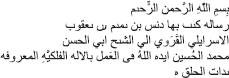
By the name of God, merciful and compassionate
Treatise written by Dūnash ibn Tamīm ibn Ya‘qūb al-Isrā'ilī al-Qarawī for Abū al-Ḥasan Muḥammad al-Ḥusayn – May God strengthen him – on the operation of the astronomical instrument known as the armillary sphere
Ending (folio 60a, lines 13–15):
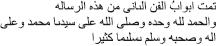
The chapters of the second part of this treatise end.
Praise be to God himself, God bless our master Muḥammad and his family and companions, and grant [them] great salvation.
Colophon (folio 60a, lines 15–19):
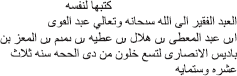
It [the copy] was written for himself by a servant needy of God – Praise Him Exalted – ‘Abd al-Qawī ibn ‘Abd al-Mu‘ṭī ibn Hilāl ibn ‘Atīya ibn Tamīm ibn al-Mu‘izz Bādīs al-Ansārī, on 9th dhū al-Hijja 613 H.
The colophon shows that this copy was completed on 613 H/1216 by ‘Abd al-Qawī ibn ‘Abd al-Mu‘ṭī for personal use. The title and the author are given at the beginning of the treatise, as already described. They are also noted by the copyist on the front page (folio 1a, lines 5–7):
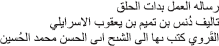
Treatise on the Operation of the Armillary Sphere
A work by Dūnash ibn Tamīm ibn Ya‘qūb al-Islā'ilī al-Qarawī, who wrote it for the chief Abū al-Ḥasan Muḥammad al-Ḥusayn
The copy has been collated with the exemplar. The copyist entered corrections in the margins (sometimes with the mark ‘correct’ –  or
 ).
The Contents of the Treatise of the Armillary Sphere
The Treatise of the Armillary Sphere consists of an introduction and two Parts  In the introduction (folios 1b–3b), Dūnash explains the reason why he composed this treatise.Footnote 61 Then Part 1 contains the following three topics preliminary to the operation of the instrument:
folios 3b–5b: main components of the orb;
folios 5b–9b: the nine rings of the armillary sphere;
folios 9b–11a: the sphericity of the orb, the Earth and the three elements.
Part 2 in forty-three chapters shows how to operate the instruments, as well as how to show celestial phenomena by using it (Chapters 23, 28, 29, 39, 40 and 41).Footnote 62 Although this treatise is technical on the operation of the armillary sphere, it contains three examples to be compared with ArLO.
Example 1
At the beginning of Part 1, Dūnash introduces the main components of the orb, as follows (folio 3b, lines 12–16):Footnote 63

I say – success by God Who is called upon for help – For those who want the ‘ilm al-hay'a after in the two sciences which are before this science in nature – that is, arithmetic and geometry – the first thing necessary to know is that the orb has three belts, three chords and seven points.
Then he enumerates the following components as the main parts:
The first belt: the equator [minṭaqat mu‘addal al-nahār];
The second belt: the meridian [minṭaqat niṣf al-nahār];
The third belt: the horizon [minṭaqat al-ufq];
A chord from the midheaven [wasṭ al-samā’] to the cupola of the orb [qubbat falak al-arḍ];
A chord from the northern pole point [nuqṭat al-quṭb al-shamālī] to the southern pole point [nuqṭat al-quṭb al-janūbī];
A chord from the east point [nuqṭat al-mashriq] to the west point [nuqṭat al-maghrib];
The east point [nuqṭat al-mashriq], the west point [nuqṭat al-maghrib], the north point [nuqṭat al-janūb], the south point [nuqṭat al-shamāl], the midheaven [nuqṭat wasṭ al-samā’], the cardine of the earth [nuqṭat wataḍ al-arḍ], and the centre of the Earth [nuqṭat markaz al-arḍ].
Dūnash clearly lists the same components as in ArLO, Chapter 16 (=Fr. 5 and Fr. 6). Furthermore, we must remark that as does the author of ArLO (Fr. 4), Dūnash presents them as the basis on which to understand the orb.
Example 2
At the end of Part1, Dūnash explains the sphericity of the orb, the Earth and the three elements (folio 9b, line 16–10a, line 10):
Before beginning that [i.e. the section on the operation], it is necessary for us to impress on our intellects with manifestation of our knowledge and prove that the Earth is spherical and the orb is spherical; and that the elements are spherical, since they are bodies between the orb and the Earth. That is because a body between two spherical bodies is only spherical when there is no space below the orb; if a body has angles, there is necessarily a space; if it has no angle, it is inevitably spherical. Thus it is necessary for you to know that the Earth is extended inside the orb and is attached in its middle, and that water and air encompass it from any direction, and that it [the Earth] is in the middle of the Whole as the yolk is in egg white, and that the body of fire encompasses air and water, and that the body of the orb encompasses the Whole …
Here Dūnash describes the cosmos as concentric orbs. According to his explanation, the reason for the sphericity of water and air is that they are between the two spheres; that is, the Earth and the orb. His cosmology and the reasoning of the sphericity of the elements are strikingly similar to ArLO, Chapter 5 (Fr. 1).
Example 3
In Part2, Chapter 28, ‘on the knowledge of the climates and their notions’, he calculates the circumference of the Earth (folio 34a, lines 1–13). He uses the magnitude of one degree taken by the predecessors – that is, 66⅔ miles – and he calculates the circumference as 24,000 miles (=66⅔ × 360). This calculation is the same in ArLO, Chapter 34, which I have mentioned.
The above three examples illustrate that Dūnash and the author of ArLO share specific topics and opinions. Next, I will examine the contents of the Commentary on the Sefer Yezira.
The Arabic original of the Commentary on the Sefer Yezira
In Dūnash's commentary on the Sefer Yezira 1.5, we have found several striking similarities to ArLO. However, this part has the significant discrepancy that Dūnash calls the greatest orb the ninth orb, whereas in ArLO it is the tenth orb, but we should consider the fact that the comment on 1.5 is left only in its Hebrew translations. As Vajda elucidates,Footnote 64 the Hebrew versions sometimes deviate from the Arabic original; for example, some Hebrew translators make Dūnash's criticism against Saadia Gaon milder. Thus it is possible that in some of the Hebrew translations ‘tenth’ has been changed to ‘ninth’ to accommodate Dūnash's cosmology into the nine-orbs system, a more generally accepted model. Therefore the part of the commentary extant in the Judaeo-Arabic documents, namely the portion after the commentary on 1.6, is important to comprehend Dūnash's thought directly.
Throughout the text, we notice that Dūnash tries to explain the Sefer Yezira's three-elements (fire, air and water) theory by employing the four elements.Footnote 65 In the comment on 2.5b, ‘He [God] finds that all the creatures are produced in one name’,Footnote 66 he explains how the four elements were produced:Footnote 67

That means that the body of earth and the body of the orb are carried on air, and the body of air cannot be grasped. That is because air is spherical encompassing earth, and the orb is spherical encompassing air, and air is the stuffing between the edge of earth and the hollow of the orb. Owing to the continuous motion of the orb, air next to it [i.e. the orb] is heated, so it becomes fire. Owing to the continuous heating of earth, air next to it [i.e. earth] is cooled, so it becomes water. Then fire is dry air, and water is cold air.
In this comment, he presents the four elements as concentric orbs, just as the author of ArLO does in Chapter 2. We must note that although the process of their generation is never mentioned in ArLO, it is explained here. In the comment on the Sefer Yezira 1.11 – ‘Three: Water from Air. He engraved and hewed out through it Emptiness and Void, Mud and Mire. He engraved it like a kind of garden bed; He raised it like a kind of wall, He surrounded it like a kind of ceiling’Footnote 68 – Dūnash has already elucidated the transformation of the elements with respect to God's creation:Footnote 69

He [God], mighty and great, created water from air, and made tōhū and bōhū, which mean the stuffing of atmosphere. That is because the space between the orb and earth is called atmosphere, which is the world of air adjacent to the world of fire … Therefore the predecessors of philosophers enumerated each two elements of these four as a sphere according to the swiftness of the eternal transformation of one into the other partially, not totally: the sphere [i.e. the element] of air is transformed into fire, and the sphere of fire is transformed into earth, and the sphere of earth into water. Thus abundant air occurs inside the Earth, so it is a cause of earthquakes and eclipses.
What is remarkable about this quotation is that he mentions geological phenomena caused by huge wind, such as earthquakes and eclipses, namely the Sun's darkening. This description clearly matches ArLO, Chapter 9 (Fr. 2 and Fr. 3).
The above examples of Dūnash's views on the sublunar world and the four elements bear a strong resemblance to the corresponding contents of ArLO. As for Dūnash's attitude toward the superlunar world, it is worth noting that in the comment on the Sefer Yezira 6.4 –
Seven: three opposite three and one is statute balancing the scales between them. Twelve: stand in battle, three love, three hate, three preserve alive, and three kill. Three love: the heart and the ears, Three hate: the liver and the gall and the tongue, Three preserve alive: the two apertures of the nose, and the spleen. Three kill: the two orifices and the mouth …Footnote 71
– he discusses the natures of the zodiacal signs:Footnote 72
As for the statement by the author of the book about the twelve as a number and the opposition which he described among them [the twelve], he brought great information in that [statement]. However, you see that, when the predecessors and the scholars taught that the orb has twelve zodiacal signs and there are four opposite natures as we explained, three of the twelve zodiacal signs are described as fiery, three are watery, three are airy, and three are earthy, and then the fiery [signs] are Aries, Leo, and Sagittarius, the three watery are Cancer, Scorpio, and Pisces, and the three earthy are Taurus, Virgo, and Capricorn, and the three airy are Gemini, Libra, and Aquarius. According to this [way], he [i.e. the author of the Sefer Yezira] said: ‘three hate, three love’ as those which are blamed and opposed, so that he says, ‘Twelve: stand in battle’. Here he explained that [notion] in an interpretation accessible to the ordinary intellects. It [i.e. the interpretation] is true, since every prophet speaks to ordinary people from the viewpoint which they can accept.
Here he refers to the notion of ‘triplicities’, which is used in Chapter 14 of ArLO, and then explains that the author of the Sefer Yezira utilized this notion towards ordinary people. The example and reasoning Dūnash presents is very similar to that in ArLO.
Since the above comparison between ArLO and Dūnash's two works gives us enough evidence about authorship, we can fairly conclude that the author of ArLO was Dūnash. Then, by using some clues, we will identify ArLO among his works.
Conclusion: the identification of the Arabic Liber de orbe
Coming back to the account on astrology in Chapter 14 of ArLO (Fr. 11), we are reminded that this book does not have the section on astrological notions which was promised by its author in this chapter. This is unusual for ArLO, because the author explains all the topics he promises to describe afterward. This anomaly leads us to think that ArLO is a part of a large work, lacking a section on astrology. This possibility is congruent with its imperfect introduction, only having the laudation to God; for the original introduction could have become inappropriate after the extraction of ArLO from the larger work. Finally, given that the only sacred phrase in ArLO quoted to verify the main thesis is from the Qur’ān (Fr. 8), this work was probably written for Muslims. Consequently, the above analysis gives us promising candidates for the author and the title of ArLO – Dūnash ibn Tamīm, Book on the Configuration of the Orb (dedicated to al-Manṣūr) – although it lacks the astrological section ‘on the weakness of the principles of astrology’.
The identification of ArLO reveals its importance in the history of astronomy as well as in the history of philosophy. If it is correct, this work is definitely one of the earliest works on the ‘ilm al-hay'a, which provides us with valuable materials for investigating the formation of the ‘ilm al-hay'a tradition in the Islamic world before the time of Ibn al-Haytham. As a philosophical work, it is also a precious textual source disclosing the development of Isaac Israeli's philosophical system, which was immensely influential on the Latin Aristotelianism. It is to be hoped that my critical edition of ArLO will profit both fields.
 .
 , so that this word looks like a semi-duplicate of
 .
 MS B;
 MS P;
 (crossed out in);
 (unreadable);
 (margin). Note that, as will be explained later, MS P does not have the entire text, so it lacks some chapter headings.
 ‘bi-l-rūmīya’. Al-Rūmīya means Rome as well as Greece. In this context, this term denotes Rome.
 with the same sigla defined in note 18 above.


