1. Introduction
In late October 2016, it was revealed that then South Korean President Park Geun-hye's aide, Choi Soon-sil, had used her position to seek financial donations from several chaebols, such as Samsung, Hyundai, Lotte, and the SK Group. Moreover, Park had allowed Choi, who had no official position in the government, to wield inappropriate influence over state affairs. During the ensuing corruption scandal, even conservative news media such as Chosun Ilbo turned against Park. However, citizens reacted in a highly polarized manner, sparking many protests and counter-protests over Park's impeachment.
At first, the Candlelight Revolution – a series of protests against the former president – swept throughout the country from October 2016 to March 2017, until the Constitutional Court gave its final ruling on Park's impeachment; major newspapers said more than 17 million people, right from children to the elderly, had participated in this Revolution (Korea Herald 10/16/2017; Hankyoreh 11/14/2017).Footnote 1 While the initial demonstration had a small number of protesters,Footnote 2 tens of thousands more took to the streets later on and expressed their anger against the corruption scandal.
In response to the Candlelight Revolution, Park's supporters held a series of pro-Park protests – called the Taegukgi rallies. After Parliament approved Park's impeachment motion on 9 December 2016, in particular, pro-president rallies grew substantially in number and mobilized hundreds of thousands of protesters. The Taegukgi rallies attracted not only Park's loyalists, mostly older conservatives aged 50 and above, but also other people who shared the opinion that South Korea's progressive groups were too sympathetic toward North Korea. Thus, the expanding conflict divided the nation between pro-Park and anti-Park rallies (Lee, Reference Lee2018).
Despite the substantial evidence that Park was an accomplice in this corruption scandal, some citizens still attribute the scandal to opposition parties, news media, or North Korea, as opposed to Park herself. Why do some Koreans still support a corrupt former president? How does an individual's news exposure shape his/her perception of corruption? For this study, we assume that Park was a corrupt leader in that she misused public office for private gain.
While democratic citizens are expected to punish a corrupt politician through an election and other political procedures (Ferejohn, Reference Ferejohn1986; Przeworski et al., Reference Przeworski, Stokes and Manin1999; Crisp et al., Reference Crisp, Olivella, Potter and Mishler2014), sometimes, citizens may tolerate a politician's alleged corruption according to the individual or contextual factors, such as informational asymmetries (Chang et al., 2000), political partisanship (Anduiza et al., Reference Anduiza, Gallego and Muñoz2013), and economic conditions (Klašnja and Tucker, Reference Klašnja and Tucker2013; Zechmeister and Zizumbo-Colunga, Reference Zechmeister and Zizumbo-Colunga2013). This study mainly focuses on the level of news exposure to account for South Koreans' tolerance of their president's corruption. In particular, our empirical analysis deals with the public's attitudes toward a corrupt president in three stages of perception of corruption, as suggested by De Vries and Solaz (Reference De Vries and Solaz2017): information acquisition, blame attribution, and behavioral response.
This paper is structured as follows: the next section introduces existing literature on public tolerance for corrupt politicians. Then, we focus on the news exposure to the president's corruption scandal in South Korea. In the following sections, we present our empirical findings on the above-mentioned three stages. Finally, we conclude by summarizing our main results.
2. Citizens' tolerance for corrupt politicians
Conventional wisdom suggests that an elected official caught in a corruption scandal negatively affects the public's assessment of his/her performance, thereby decreasing the likelihood of such an official's political survival (Dimock and Jacobson, Reference Dimock and Jacobson1995; Funk, Reference Funk1996; Fischle, Reference Fischle2000; Abramowitz, Reference Abramowitz2001; Goren, Reference Goren2002). Scholars have found that corruption scandals may lead to a decline in an incumbent's approval rating and parties' vote shares in various political contexts (Peters and Welch, Reference Peters and Welch1980; Brody and Shapiro, Reference Brody, Shapiro and Long1989; Brody, Reference Brody1991; Welch and Hibbing, Reference Welch and Hibbing1997; Clark, Reference Clark2009; Praino et al., Reference Praino, Stockemer and Moscardelli2013). In the context of Japanese politics, Anderson and Ishii (Reference Anderson and Ishii1997) have found a negative association between parties' corruption and their vote shares. According to Clark (Reference Clark2009), many parties in nine Western European countries also have suffered a loss of votes due to their corruption scandals.
Likewise, many studies on corruption often assume that citizens negatively assess and interpret a corruption scandal in a relatively uniform manner. However, the effect of a politician's corruption scandal on his/her political survival may be moderated by some individual and contextual factors (Anduiza et al., Reference Anduiza, Cristancho and Sabucedo2014; Klašnja et al., Reference Klašnja, Tucker and Deegan-Krause2016). Recently, scholars have attempted to examine why and when some citizens may tolerate political corruption. Previous literature on corruption mainly focuses on an individual's political disposition, economic condition, and political information to understand why citizens differ in how they hold their corrupt incumbent accountable.Footnote 3
First, elements of an individual's political disposition, such as partisanship and political ideology, may influence his/her perception of a corruption scandal. Partisanship often drives fundamental biases in perceptions of political events. Thus, partisans are more likely to tolerate their favored party's corruption (Anderson and Tverdova, Reference Anderson and Tverdova2003; Blais et al., Reference Blais, Gidengil, Fournier, Nevitte, Everitt and Kim2010; Anduiza et al., Reference Anduiza, Gallego and Muñoz2013) while being more critical of other parties' corruption (Davis et al., 2004). Similarly, citizens may discount the corruption of an elected official whose political ideologies resemble their own (Rundquist et al., Reference Rundquist, Strom and Peters1977; Peters and Welch, Reference Peters and Welch1980; Charron and Bågenholm, Reference Charron and Bågenholm2016). Myerson (Reference Myerson1993) also points out the same – that the public may tolerate an electoral candidate's dishonesty if they perceive the candidate's ideology as close to their own.
Second, economic benefits may account for an individual's support for a corrupt politician. Given that citizens are willing to trade off political corruption for economic well-being, a corrupt politician is more likely to survive when s/he demonstrates the capacity to provide material benefits to the citizens (Manzetti and Wilson, Reference Manzetti and Wilson2007; Winters and Weitz-Shapiro, Reference Winters and Weitz-Shapiro2013). Citizens may overlook an incumbent's corruption particularly when s/he is more likely to deliver public works, economic growth, or other public goods. In good economic times, citizens' perceptions of corruption have weaker electoral consequences. Conversely, unemployed or low-income citizens may be more sensitive to an incumbent's corruption scandal.
Finally, citizens often elect to not punish a corrupt politician simply because they have insufficient information about the corruption scandal in question. Given that the public's political awareness is often low and highly changeable (Campbell et al., Reference Campbell, Converse, Miller and Stokes1960; Converse, Reference Converse and Apter1964; Delli Carpini and Keeter, Reference Delli Carpini and Keeter1996), many researchers find that a citizen's exposure to scandalous information is critical to the political punishment for corrupt politicians. Citizens with low awareness may compensate for the lack of information by using various heuristics, such as cues from reference groups (Lupia, Reference Lupia1994; Lupia and McCubbins, Reference Lupia and McCubbins1998) or simple retrospective judgments of an incumbent's performance (Fiorina, Reference Fiorina1981; Sniderman et al., Reference Sniderman, Glaser, Griffin, Ferejohn and Kuklinski1990). Thus, low-awareness citizens are less capable than high-awareness ones of differentiating between corruption scandals and negative campaigning (Kuklinski and Quirk, Reference Kuklinski, Quirk, Lupia, McCubbins and Samuel2000; Luskin, Reference Luskin and Kuklinski2002).
In line with this reasoning, scholars have focused on the media's role in controlling and revealing corruption. Given that elected officials have strong incentives to hide information about their corrupt activities, these scholars examine the impact of exposure to news about corruption on individuals' perceptions of corruption (Ferraz and Finan, Reference Ferraz and Finan2008; Chang et al., Reference Chang, Golden and Hill2010; Klašnja et al., Reference Klašnja, Tucker and Deegan-Krause2016). However, providing information about corruption does not always increase the likelihood of political punishment. According to Klašnja and Tucker (Reference Klašnja and Tucker2013), citizens in countries with high corruption may experience corruption fatigue: information about one more case of corruption in these countries may not influence the public's perceptions of corruption.
Given that not all citizens punish corruption, we need to specify more systematically the conditions under which information about a politician's corruption may influence his/her political survival. De Vries and Solaz (Reference De Vries and Solaz2017) suggest three stages for a systematic analysis of the political consequences of corruption: information acquisition, blame attribution, and behavioral response. In the first stage, citizens may not recognize it when a corrupt incumbent tries to hide information about his/her corruption. In the second, citizens attribute responsibility for corruption; Taylor and Doria (Reference Taylor and Doria1981) argue that blame attribution is often influenced by group-serving biases. In the final stage, citizens need to consider whether corruption is salient and critical in terms of their behavioral choice.
In this study, we examine the impact of exposure to news about corruption on the political consequences of corruption through these three different stages. We offer a case study of the 2016–2017 South Korean corruption scandal, which is salient to the relationship between information about corruption and a corrupt politician's survival for two reasons. First, while the existing literature on corruption mainly deals with the public's overall evaluations of corrupt politicians or parties in general, the South Korean scandal is about an incumbent in the ‘imperial’ presidential system. Second, during the scandal, information about the president's role in it was relatively consistent. Even the conservative news outlets, such as Chosun Ilbo, JoongAng Ilbo, and Dong-a Ilbo, portrayed the conservative president's scandal negatively. Although they differed in tone, most major news outlets turned against the incumbent president.
3. News exposure to the president's corruption scandal in South Korea
Over a short period of time, from late 2016 to early 2017, Seoul attracted a lot of attention from international media over Park's corruption scandal. The scandal showed that there was still widespread collusion at the highest level of politics and business. Interestingly, as the scandal unfolded, almost all major news outlets, including the conservative ones, reported that Park, in collusion with her friend Choi, abused her power by pressuring and extorting money from businesses.
In fact, Choi was at the heart of the scandal. Park was accused of colluding with her to secure millions of dollars in bribes from the country's largest enterprises, and allowing Choi to meddle in state affairs and wield improper influence. Choi reportedly benefited from lucrative side contracts for companies owned by her and her friends. Other accusations that outraged the public were that Choi used her presidential connections to gain admission for her daughter in a prestigious university and that Park was negligent in handling the 2014 Sewol ferry disaster that killed over 300 people, many of whom were high school students.
The widespread media coverage of the corruption scandal sparked many anti-Park protests across the country. On 9 December 2016, the National Assembly voted to impeach Park. Thus, as the Constitutional Court's final ruling on the vote was pending, Park was stripped of her presidential powers, and Prime Minister Hwang Kyo-ahn became acting president. The organizers of pro-impeachment rallies planned to continue the weekly protests until the Constitutional Court confirmed Park's removal. While these organizers comprised of over 1,500 civic groups and labor unions, most protesters were unaffiliated citizens who voluntarily participated in these rallies (Korea Herald 1/4/2017).Footnote 4
On 10 March 2017, the Constitutional Court's ruling confirmed that Park had not only conspired with her longtime friend Choi to extort money from several conglomerates but had also attempted to hide her wrongdoing. Thus, Park became the first president of South Korea to be ousted from office by the Constitutional Court. Table 1 provides a detailed timeline of Park's impeachment, including the fact that Park repeatedly apologized to the citizens for her role in the scandal, at least before the National Assembly voted to impeach her.Footnote 5
Detailed timeline of former President Park's impeachment

Despite the widespread media coverage of the corruption scandal and Park's repeated public apologies, hard political divides surfaced as a result of the scandal. Even in the face of substantial evidence that Park was an accomplice in the corruption, the public reacted in a highly dichotomous manner. Indeed, Park retained many loyal supporters even after the scandal broke. They stood by her because of her tough stance against North Korea and fond memories of her father, former dictator Park Chung-hee who ruled for 18 years from 1961. Many anti-impeachment demonstrations were also held across the country before, and even after, the Constitutional Court's ruling. Every week, there were huge counter-protests in favor of Park. While Park's opponents put around 2 million citizens on the streets against her, the pro-Park forces had roughly a million in their largest protest (Straits Times 3/14/2017).Footnote 6
During the corruption scandal reportage, many of Park's supporters discounted mainstream news reports on her alleged involvement as fake news. Unable to express their views via traditional news outlets, they used social media as an alternative source of information, which allowed Park's supporters to form personal networks and circumvent what they perceived as the national media's ignorance. For example, a YouTube channel called ‘Divine Move’ endorsed Park's supporters' view of reality, often featuring live updates from anti-impeachment protests (Korea Exposé 3/9/2017).Footnote 7 In particular, the hardline pro-Park protest organizers claimed that media reports on the corruption scandal were biased against her and her Saenuri Party, and were at the behest of opposition groups to topple Park (Voice of America 2/14/2017).Footnote 8
In the face of the widespread media coverage, Park adopted a strategy of attempting to circumvent political punishment by manipulating information or emphasizing other dimensions to divert the public's attention from the corruption scandal (Eggers, Reference Eggers2014; De Vries and Solaz, Reference De Vries and Solaz2017). Park proposed a constitutional amendment, calling South Korea's current 5-year, single-term restriction on presidents outdated, on 24 October 2016. However, many opposition leaders immediately accused her of making the surprise proposal to divert attention from a worsening corruption scandal (New York Times 10/24/2016).Footnote 9 In addition, in October 2016, the ruling Saenuri Party accused Moon Jae-in, former head of Minjoo Party of Korea (MPK) – the main opposition – and the current president of South Korea, of playing a part in contacting North Korea and receiving feedback that influenced the South Korean government to abstain from the 2017 UN resolution on North Korea's human rights abuse.Footnote 10 Choo Mi-ae, head of the MPK, then hit back that the ruling party should stop trying to hide its corruption by attacking Moon (Yonhap News 10/19/2016).Footnote 11 Since both the liberal and conservative news outlets had criticized Park over the corruption scandal, it became hard for her government to withhold or manipulate information about her involvement.
Given that the conservative news media had also criticized her, Park eschewed major newspapers and broadcasters, and instead opted, on 25 January 2017, to defend herself in an interview on Jung Kyu-jae TV, an internet broadcast run by conservative commentator Jung Kyu-jae. During the interview, Park denied all allegations and raised suspicions of a conspiracy against her. Thus, we can see that exposure to corruption news reported by the conventional news media was an important tool for citizens to acquire more information about the magnitude of the corruption scandal.
4. Materials and methods
For our empirical analysis, we use the survey data ‘The 2017 Public Attitudes Toward Political Parties and Social Integration’ (2017 PAPPSI) collected from 1,000 randomly selected citizens in South Korea by the survey firm Hankook Research.Footnote 12 The 2017 PAPPSI is uniquely valuable because it was conducted in March 2017, days before the Constitutional Court's final impeachment ruling. Thus, an individual's survey response was not affected by confounding factors, such as the Constitutional Court's ruling.Footnote 13 These survey data also capture, in a timely manner, the public's perceptions of and behavioral responses to the corruption scandal.
Our empirical analysis mainly deals with the impact of a citizen's exposure to news about a corruption scandal on his/her attitude toward a corrupt president. We also examine whether the impact of news exposure is conditioned by a citizen's selective (or balanced) news consumption.Footnote 14 Following De Vries and Solaz's (Reference De Vries and Solaz2017) three stages – information acquisition, blame attribution, and behavioral response – that account for the political consequences of corruption, we use three dependent variables to capture the impact: (1) individual awareness of political affairs, including the president's corruption scandal, (2) perception of the president's, presidential aides', or opposition parties' responsibility for corruption, and (3) participation in impeachment-related rallies.
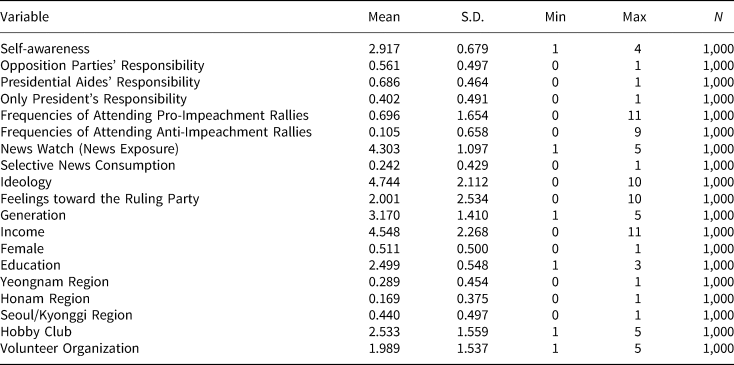
In our empirical model, a key independent variable is the level of news exposure to a corruption scandal. Since the objective measure of political information about a corruption scandal may be our best tool to identify levels of political awareness related to a corruption scandal, an individual's level of exposure to political news is used as a proxy for the level of political information about a corruption scandal.Footnote 15 Table 2 describes key independent variables and control variables used in the empirical models as well as summary statistics for all the variables.
Summary statistics

5. Results and discussion
For a systematic analysis of the effects of social tolerance on corruption, we first examine how an individual's news exposure affects his/her awareness of political affairs (‘information acquisition’). Second, our empirical analysis focuses on how much individuals with more news exposure attributed responsibility for the corruption to Park (‘blame attribution’). Finally, we analyze whether an individual's exposure to news about corruption affected his/her decision to participate in either pro-impeachment or anti-impeachment rallies (‘behavioral response’). We also examine whether the effect of news exposure is dependent on an individual's balanced (or selective) news consumption.
5.1 Information acquisition
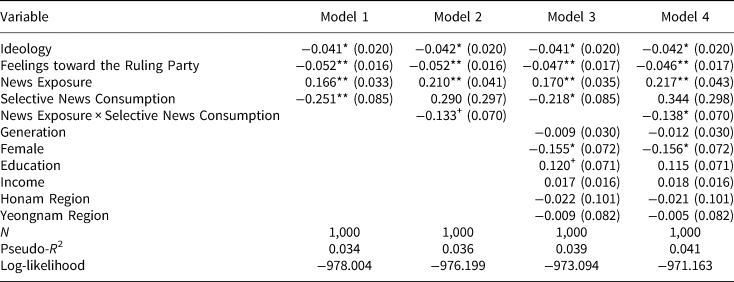
Table 3 shows how the levels of news exposure affect a citizen's self-awareness of a corruption scandal.Footnote 16 In Table 3, the ordered probit model is employed because the level of awareness is an ordinal dependent variable (4-point scale). In all models in Table 3, news exposure has a positive impact on political awareness. The results support our argument that news media such as newspapers or television may promote information acquisition about corruption scandals. In South Korea, audiences of mainstream news sources have often fragmented across partisan lines. While conservatives tend to favor Chosun Ilbo, JoongAng Ilbo, or Dong-a Ilbo, liberals read Hankyoreh or Kyunghyang Shinmun. With respect to Park's corruption scandal, however, most mainstream news outlets portrayed it in a negative manner. Thus, with even conservatives more exposed to negative news about the corruption scandal, this news exposure helped lessen their confirmation biases – an automatic tendency of people to start looking for what's wrong with information that contradicts their beliefs – by providing more information about the scandal.
Level of news exposure and self-awareness of a corruption scandal (information acquisition)

Note: The ordered probit model is used to estimate all models in Table 3. The dependent variable is an individual's awareness of political affairs (4-point scale).
**P < 0.01, *P < 0.05, +P < 0.1 (two-tailed test).
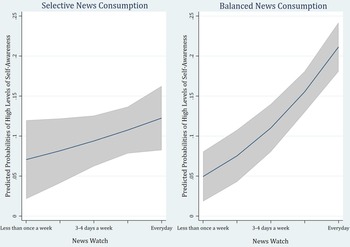
Relatedly, selective news consumption has a negative impact on political awareness in models 1 and 3. The results show that citizens who were not willing to watch news presented from other perspectives had low awareness of the corruption scandal. While news exposure made much of a difference for a citizen's self-awareness of a corruption scandal, would there be a less discernible effect among people who are selectively exposed to political information? To find out, we have included an interaction between news exposure and selective news consumption. According to models 2 and 4 in Table 3, the interaction estimate is statistically significant at the 10 and 5% levels, respectively. Figure 1 shows how much citizens who only consume news that matched their own political dispositions differ with regard to how well news exposure predicts citizens' high levels of self-awareness of the corruption scandal. Given that some individuals watch political news almost every day, the likelihood of having high levels of self-awareness of the corruption scandal is much lower among those who engage in partisan selective exposure.
Impact of balanced news consumption and news exposure on self-awareness of a corruption scandal.

On the other hand, an individual's ideology and party preference affect his/her awareness of a corruption scandal. In all models, ideology has a negative relationship with self-awareness of political affairs, which means conservatives were less aware of the corruption scandal. Similarly, in all models, an individual's preference for a ruling party is negatively related to his/her self-awareness. These results show that individuals who favored the ruling party had low awareness of Park's corruption scandal.
Finally, we found a significant effect of an individual's gender on his/her self-awareness of the corruption scandal at the conventional level, while income, generation, and region variables did not affect this awareness. The effect of education variable on self-awareness is also weakly statistically significant in model 3. Taken together, the results in Table 3 show that exposure to corruption news reported by the conventional news media was an important tool for citizens to acquire more information about the magnitude of the corruption scandal. The results also suggest that the effect of news exposure is dependent on whether individuals watch news presented from other perspectives.
5.2 Blame attribution
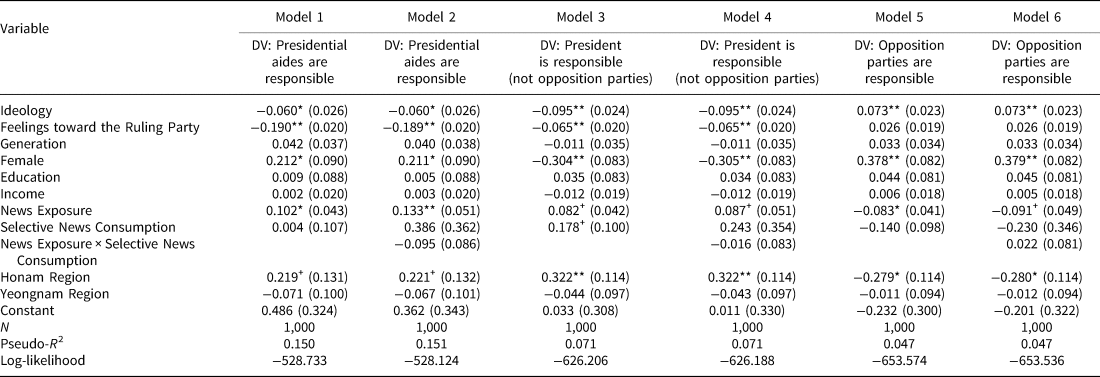
On the other hand, Table 4 shows how much individuals with more news exposure attributed responsibility for the corruption to Park and her aides.Footnote 17 The results in Table 4 show that individuals with more news exposure perceived Park and her aides as responsible for the corruption scandal. In models 1 through 4, the news exposure variable has a positive, albeit modest, relationship with our dependent variables. The results in models 5 and 6 show that individuals considered the opposition parties less responsible for the corruption scandal when they watched more news about it.
Level of news exposure and perception of responsibility for a corruption scandal (blame attribution)

Note: Binary probit models are used to estimate all models. Here, the dependent variables are an individual's perception of the responsibility of presidential aides, President Park, and opposition parties for a corruption scandal (binary scale).
**P < 0.01, *P < 0.05, +P < 0.1 (two-tailed test).
As in Table 3, an interaction term between news exposure and selective news consumption is used to capture the conditional effect of the former in models 2, 4, and 6. However, the interaction estimate is not statistically significant. We believe there was no moderating effect because almost all major news outlets including the conservative ones had criticized Park and Park's aides over the corruption scandal. In addition, selective news consumption on its own had no meaningful impact except for the result in model 3. The result in model 3 suggests that people who are selectively exposed to political information considered Park more responsible for the corruption scandal.
In all models in Table 4, political ideology has a negative relationship with Park's and her aides' perceived responsibility for the corruption scandal, and a positive relationship with the same of the opposition parties. This means that conservative citizens consider Park and her aides less responsible and opposition parties more responsible for the corruption scandal. Similarly, an individual's preference for the ruling party negatively influenced his/her perceptions of the president's and her aides' responsibility. Taken together, the results in Table 4 suggest that supporters of a ruling party or conservative citizens heavily discount corruption allegations against their preferred politician.
In Table 4, we also control for an individual's generation, education, income, and regional background variables. Interestingly, the female variable has a negative relationship with the president's perceived responsibility but a positive one with that of her aides' and opposition parties'. This means that female citizens have more sympathy for the first female president. Further, people in the southwestern (Honam) region are more likely to hold Park and her aides responsible for the corruption scandal. On the other hand, generation, income, education, and the Yeongnam region do not affect citizens' blame attribution regarding the corruption scandal.
5.3 Behavioral response
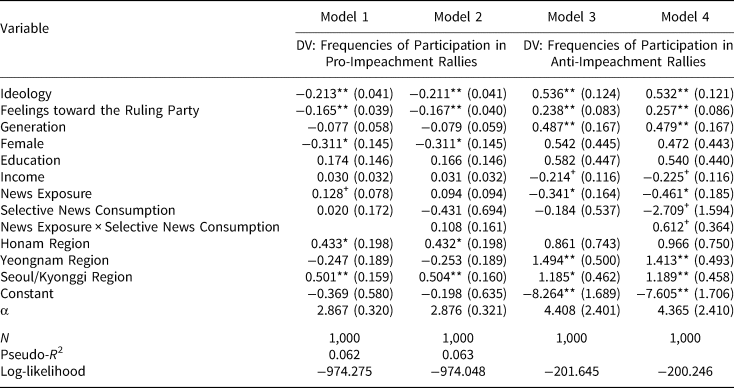
Finally, Table 5 shows the effect of news exposure on the public's participation in either pro-impeachment or anti-impeachment rallies.Footnote 18 As our dependent variables here are the total frequencies of participating in anti-Park rallies in models 1 and 2 and pro-Park rallies in models 3 and 4, we employ a negative binomial model to estimate models 1 and 2. Given that only 42 out of 1,000 citizens participated in anti-impeachment rallies, a zero-inflated model is used in models 3 and 4.
Participation in rival protests (behavioral response)

Note: The dependent variable is the frequency of participation in rival protests. While a negative binomial model is used to estimate models 1 and 2, a zero-inflated model is used in models 3 and 4.
**P < 0.01, *P < 0.05, +P < 0.1 (two-tailed test).
As seen in Table 5, the news exposure variable increased the frequencies of participation in pro-impeachment rallies and decreased the same in anti-impeachment rallies during the corruption scandal except for the result in model 2. That is, individuals with more news exposure were more likely to have participated in anti-Park rallies and less so in pro-Park ones. While individuals' perceptions of corruption may be affected by external factors such as their characteristics and local conditions, the results in Table 5 show that exposure to corruption news reported by the conventional news media possibly served as an important tool for the public to gather more information about the magnitude of the corruption.
The results in Table 5 also show that both ideology and party preference variables significantly influenced participation in impeachment protests and counter-protests. In models 1 and 2, the ideology and party preference variables have negative coefficients, which means that liberal citizens and citizens who disliked the then ruling party (Liberty Korea Party) participated more frequently in pro-impeachment rallies. In models 3 and 4, the ideology and party preference variables' positive signs show that conservative citizens or those who supported the then ruling party were more likely to have attended pro-Park protests.
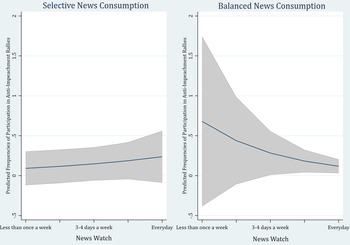
As in the previous models, an interaction term between news exposure and selective news consumption is used in models 2 and 4. However, the interaction estimate is significant at 10% only in model 4. This result shows that the impact of an individual's news exposure on his/her participation in anti-impeachment rallies was conditional, depending on whether he/she watches news presented from other perspectives. According to Figure 2, given that some citizens watched more political news, they were less likely to participate in pro-Park rallies unless they select confirmatory information by watching only partisan media.
Impact of balanced news consumption and news exposure on participation in anti-impeachment rallies.

In Table 5, we also control for female, an individual's generation, education, income, and regional backgrounds, such as Honam, Yeongnam, and Seoul/Kyonggi. First, the generation variable significantly affected the total frequencies of attending pro-Park rallies, in models 3 and 4. Park still commands a loyal following among the older generation. Park's supporters had attended anti-impeachment protests to support her during the corruption scandal. Second, the female variable has a negative relationship with the total frequencies of attending pro-impeachment rallies, in models 1 and 2. As in Table 4, the results in Table 5 show that female citizens were less likely to have participated in pro-impeachment rallies in that they were more sympathetic toward Park, the first female president of South Korea. Third, the income variable also has a significant effect on the total frequencies of attending anti-impeachment protests, in models 3 and 4. This means that citizens with low income were more likely to have attended pro-Park protests. Finally, the Honam variable significantly influenced the participation in pro-impeachment rallies in models 1 and 2 and the Yeongnam variable significantly influenced the participation in anti-impeachment rallies, in models 3 and 4, at 95%. The results show that people living in the Honam region were more likely to have attended anti-Park protests and people living in the Yeongnam region participated more frequently in pro-Park rallies.Footnote 19 In addition, the Seoul/Kyonggi variable is significant in all models. As many impeachment-related protests took place in Seoul, people who lived in Seoul and Kyonggi province were more likely to have attended either pro-Park or anti-Park rallies. However, the education variable did not significantly influence participation in rival protests.
5.4 Robustness checks
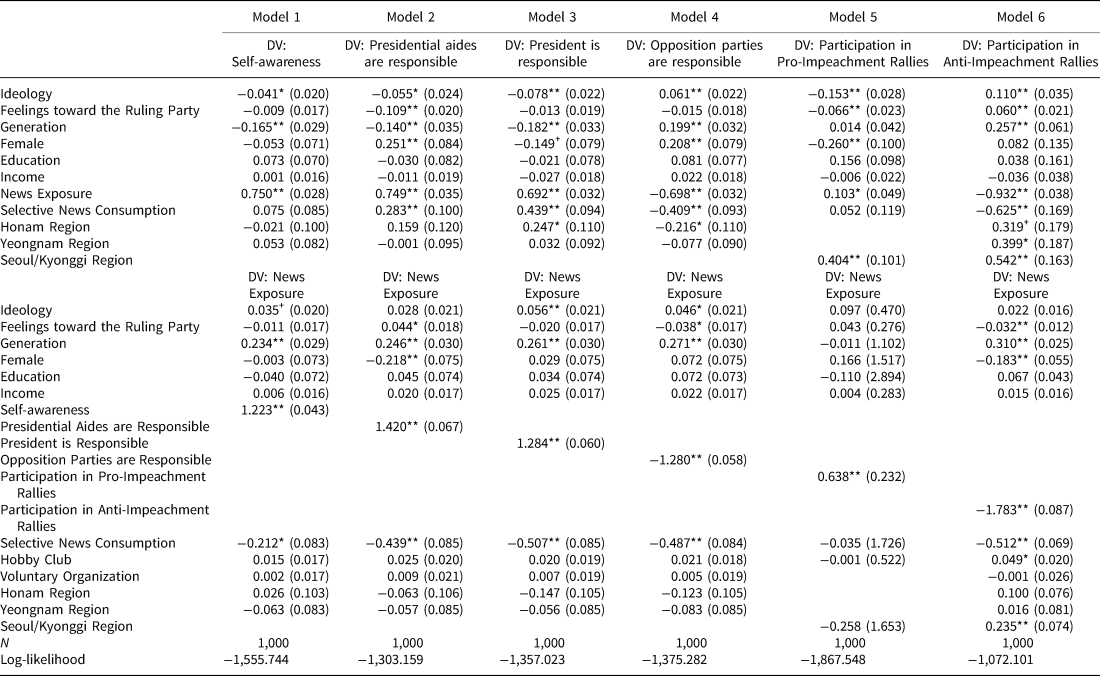
The statistical results in Tables 3–5 provide some evidence in support of our main argument. To further address the concerns about the causal process connecting each dependent variable to a citizen's news exposure, we use the conditional mixed-process (CMP) recursive estimator (Roodman, Reference Roodman2011). The CMP is a seemingly unrelated regression estimator that allows us to add different types of response variables (ordered for news exposure and self-awareness, dichotomous for blame attribution and participation in anti-impeachment rallies,Footnote 20 and continuous for participation in pro-impeachment rallies). In Table 6, the CMP estimator predicts citizens' attitudes in the three stages and news exposure with a common error term.
News exposure and self-awareness, blame attribution, and participation in rival protests (CMP recursive regression)

Note: A CMP recursive model is used to estimate all models.
**P < 0.01, *P < 0.05, +P < 0.1 (two-tailed test).
Table 6 reports the results of the CMP recursive regressions models. First, we predict the covariates of news exposure. We control for selective news assumption, ideology, party preference, generation, gender, income, region, hobby club, and voluntary organization.Footnote 21 Interestingly, the results suggest that people who had high levels of self-awareness of the corruption scandal, considered the president and the presidential aides more responsible for the corruption scandal, or participated more in pro-impeachment rallies spent more time watching political news during the corruption scandal. On the other hand, given that even conservative news outlets reported Park's corruption scandal in a negative manner, citizens who attributed Park's corruption to opposition parties and attended anti-impeachment rallies did not want to watch political news.
Next, we assess the impact of news exposure on the likelihood of an individual's awareness of the president's corruption scandal (model 1), perception regarding who is responsible for the corruption scandal (models 2–4), and participation in impeachment-related rallies (models 5 and 6). Consistent with our main findings, the results in Table 6 suggest that greater news exposure affects citizens' attitudes in the three stages: awareness of the president's corruption scandal, attribution of responsibility for the corruption, and participation in impeachment-related rallies. Thus, our findings survived robustness checks.Footnote 22 Taken together, the results show that news exposure could reduce the perception and behavioral gap between different partisans during the corruption scandal, given that most major news outlets had turned against the incumbent president.
6. Conclusion
In this study, we examined citizens' responses to a president's corruption scandal and why some people still support a corrupt former president. Our study of the 2016–2017 corruption scandal in South Korea suggests that citizens' news exposure affects their attitudes and behaviors toward a corrupt president, whereas citizens' political dispositions or local conditions may bias their perceptions of presidential corruption. During the corruption scandal in South Korea, exposure to news may have lessened some citizens' confirmation biases through the mere provision of political information about the scandal.
For a systematic understanding of corruption dynamics, our empirical analysis deals with the public's attitudes toward a corrupt president through the three stages of perception of corruption suggested by De Vries and Solaz (Reference De Vries and Solaz2017): information acquisition, blame attribution, and behavioral response. First, our empirical analysis suggests that news exposure increases an individual's level of self-awareness of a corruption scandal. News media such as newspaper or television promotes information acquisition about the president's corruption scandal. In addition, news exposure influences individuals' perceptions of political actors' responsibility for a corruption scandal. Despite sufficient information, citizens might not attribute blame correctly due to their political biases. According to our empirical analysis, however, citizens considered the opposition parties less responsible and Park and her aides more responsible after being exposed to more news about the scandal. Finally, even if the information is sufficient and blame is attributed correctly, citizens may not punish a corrupt president. However, our empirical analysis shows that news exposure helped reduce any potential political risks by showing many participants in the anti-Park protests – individuals with more news exposure attended pro-impeachment protests more frequently and anti-impeachment ones less frequently.
In this paper, we also examine whether the impact of an individual's news exposure differs according to his/her selective (or balanced) news consumption. The impact of news exposure on citizens' levels of self-awareness of the corruption scandal was much stronger when they consumed political news in an unbiased manner. We also found that citizens more exposed to political news were less likely to participate in pro-Park rallies when they often watched news presented from different perspectives. However, we found no consistent and significant moderating effect in all three stages. This might be due to the lack of variation in news reporting between conservative and progressive media during the corruption scandal.
In fact, media content itself might bias the public's perceptions of corruption. Given that the conservative news media also had turned against Park, South Koreans became well informed about the magnitude and detailed stories of the corruption. To summarize, this study suggests that there will be fewer differences in political perceptions between citizens with different political beliefs but high levels of political information. More news exposure increases the amount of information that citizens with different political dispositions have in common. The more their sets of political information overlap, the closer their perceptions of a corruption scandal are likely to be. To what extent do our findings generalize beyond the South Korean case? How variations in information sources, news reporting, electoral systems, or anti-corruption salience matter for the domestic punishment of corruption are important areas for future study.
Supplementary material
The supplementary material for this article can be found at https://doi.org/10.1017/S1468109922000305 and https://dataverse.harvard.edu/dataset.xhtml?persistentId=doi:10.7910/DVN/DASEON