Background
Dementia is a national priority for many countries worldwide with national strategies and plans in place in countries such as Australia, France, Norway, England, and Scotland (Department of Health and Ageing, 2006; Norwegian Ministry of Health and Care Services, 2008; Department of Health, 2009; Scottish Government, 2010). Lobbying is underway for strategies in other countries such as Canada (Alzheimer Society of Canada, 2010; Rockwood et al., Reference Rockwood, Bergman and Hogan2010). Dementia has been recognized as a public health priority in Northern Ireland policy documents since 1995 (Department of Health and Social Services, 1995). In 2010, a public consultation was undertaken in Northern Ireland as part of the process of developing a Regional Dementia Strategy (Department of Health, Social Services and Public Safety, 2010). This led to the launch of the Regional Strategy in 2011 (Department of Health, Social Services and Public Safety, 2011). This reflects a global demographic change taking place that poses significant challenges for countries worldwide who will need to provide care and support for people with dementia and their families (Harvard School of Public Health and Alzheimer Europe, 2011). The economic costs of dementia are significant (Knapp and Prince, Reference Knapp and Prince2007) as are the costs to families (O'Shea, Reference O'Shea2007).
This paper reports on the findings from a survey of the general public in Northern Ireland. Surveys attempting to gather views about dementia have tended to be undertaken with specific population groups or in restricted geographic areas. Previous research has explored the views of professionals (Cahill et al., Reference Cahill, Clark, O'Connell, Lawlor, Coen and Walsh2008; Ayalon et al., Reference Ayalon, Arean, Bornfield and Beard2009) and family carers (Chung, Reference Chung2000; Zarit et al., Reference Zarit, Femia, Kim and Whitlatch2010), and in more recent years the views of those diagnosed with dementia (Wilkinson, Reference Wilkinson and Wilkinson2002; Innes et al., Reference Innes, Kelly and Dincarslan2011). However, the views of the general public have been largely under researched, and such studies are often restricted to knowledge or awareness of symptoms (Bond et al., Reference Bond, Stave, Sganga, Vincenzino, O'Connell and Stanley2005; Arai et al., Reference Arai, Arai and Zarit2008; Low and Anstey, Reference Low and Anstey2009; Carpenter et al., Reference Carpenter, Zoller, Balsis, Otilingam and Gatz2011). Crisp et al. (Reference Crisp, Gelder, Rix, Meltzer and Rowlands2000) examined stigmatizing attitudes toward dementia as part of a survey examining stigmatizing attitudes toward seven mental illnesses in Britain. A recent five-country telephone survey examining public perceptions and awareness of Alzheimer's disease (Harvard School of Public Health and Alzheimer Europe, 2011) included a question on attitudes.
Given the level of policy interest, the global concern with the costs of providing care, and the growing number of people upon whom dementia impacts, it is timely to examine not just the views of those concerned with dementia due to personal or work commitments, but also the views of the general public who may in future experience dementia within their families and who also face the challenge of paying for, and providing, care. The exploration of attitudes and knowledge of dementia within the 2010 Northern Ireland Life and Times (NILT) Survey reflects national coverage of this major public health concern. Therefore, this paper reports not only on the first data gathered from the general public in Northern Ireland, but also presents one of the first analyses of knowledge and attitudes of the general public conducted worldwide.
Methods
The Northern Ireland Life and Times Survey is a nationally representative social attitudes survey. This annual survey began in 1998 with the aim of monitoring the attitudes and behavior of people in Northern Ireland to a range of social issues. The questionnaire consists of four modules, each focusing on a particular social policy topic. The survey provides a public resource for academic and policy analysis and debate. (For further information, see Devine, Reference Devine2011.) In 2010, the survey included a module on knowledge of dementia and attitudes to people with dementia, which was funded by the Atlantic Philanthropies.
The questions were designed by the NILT survey team (including author PD) in partnership with a PhD student and supervisor (authors PMcP and AI) and stakeholders within the field of dementia services and carers’ organizations. Standardized tests, such as the Alzheimer's Disease Knowledge Scale were not appropriate for this study, as the inclusion of a 30-item scale would unreasonably increase the burden on the survey respondents. The team devised a short set of questions to test general knowledge of dementia as well as questions testing if a respondent's attitudes toward someone with dementia varied according to length of time since diagnosis. The instruments explored attitudes on participation and interaction of people with dementia within society in general, and also identified which of a set of positive and negative personality characteristics and emotions were ascribed to someone with dementia. Because the data collection module was incorporated into a general attitudes survey, great care was taken to ensure that questions should be understood clearly by survey respondents. In particular, specialist and medical terminologies were avoided. The majority of attitude questions were measured on a standard 5-point Likert scale. The response options for the knowledge questions were either true or false. For all questions, respondents were able to answer that they did not know and a consistently low percentage of respondents selected this option across the module. A pilot survey was carried out with 60 respondents and positive feedback was received on the dementia module. One question was considered ambiguous by respondents and was therefore removed. Note that this paper does not explore responses to all questions within the module.
The NILT surveys adults aged 18 years or more. The 2010 survey had a 58% response rate (n = 1,204). In order to estimate non-response bias, a comparison of demographic characteristics of NILT respondents was carried out with those from a large-scale government survey (2009/10 Continuous Household Survey), which did not indicate any concern with the NILT sample (see Devine, Reference Devine2011). A stratified random sampling strategy was employed to ensure correct geographical coverage. This is standard practice in Northern Ireland social surveys (Devine, Reference Devine, Lloyd, Devine, Gray and Heenan2004). The data are weighted to adjust for differential household sizes. People living in institutions (though not in private households in such institutions) were excluded from the survey. The survey consisted of a main questionnaire that was undertaken using Computer Assisted Personal Interviewing (CAPI) as well as Computer Assisted Self Interviewing (CASI). The data were analyzed using SPSS (Version 19). Descriptive and summary statistics were produced. A series of categorical bivariate relationships were tested (χ2) and tests of association (Cramer's V) were reported. The datasets and associated documentation can be obtained from www.ark.ac.uk/nilt.
Results
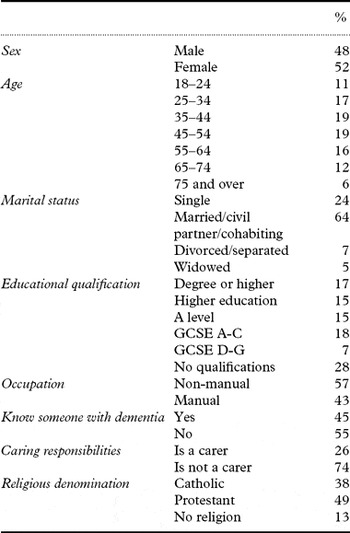
Of the 1,204 respondents, 52% were female and 48% male. Age groups ranged from 18–24 years to 75 years and more, and 64% of the respondents were married. Despite considerable immigration throughout the previous decade, ethnic diversity is not a major feature of the population within Northern Ireland: 98% of the NILT respondents classified themselves as ‘‘white’’, and 5% said that they would consider themselves to be a member of an ethnic minority community. Thus, it is not appropriate to undertake analysis by ethnic group.
Table 1 presents full details of the respondents’ characteristics. Forty-five percent (45%) of the respondents knew someone with dementia. This figure is lower than that recorded in a recent survey across Europe and the USA (Harvard School of Public Health and Alzheimer Europe, 2011). As might be expected, figures were lower among younger age groups: for example, 23% among those aged 18–24 years compared with 56% of those aged 55–64 years. Of those who knew someone with dementia, 56% identified a family member, 21% a friend, and 23% an acquaintance.
Respondent characteristics

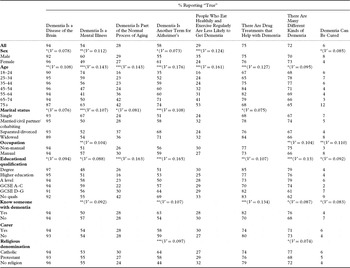
Respondents were initially asked to respond “true”, “false”, or don't know to a series of statements designed to examine knowledge about dementia (Table 2). While most respondents were aware that dementia was a disease of the brain (94%), 54% viewed dementia as a mental illness, and 28% believed that dementia was part of the normal aging process. A high percentage of respondents were aware that there are drug treatments to help with dementia (75%). This is higher than in other parts of Europe where the figures ranged across countries from 27% to 63% (Harvard School of Public Health and Alzheimer Europe, 2011). However 64% of respondents were unaware that diet and exercise may have a preventative effect on the likelihood of developing dementia.
Respondent's knowledge of dementia

*p < 0.05, **p < 0.01, ***p < 0.001.
Cramer's V in parentheses.
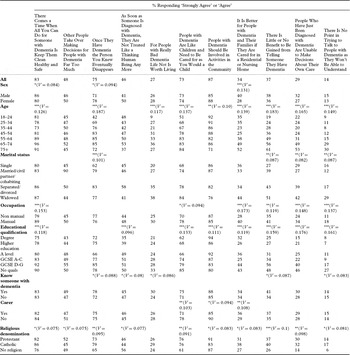
As can be seen in Table 3, a large proportion of those surveyed (83%) responded that there comes a time when all you can do for someone with dementia is to keep them clean, healthy, and safe, and 75% agreed that once they have dementia the person you knew eventually disappears. While a relatively low percentage of people agreed with the idea that life is not worth living for people with really bad dementia (27%), just over half of those surveyed disagreed with this statement (53%).
Attitudes toward people with dementia and their care

*p < 0.05, **p < 0.01, ***p < 0.001.
(Cramer's V in parentheses).
In terms of care, 73% agreed that people with dementia are like children and should be cared for as you would a child. While 34% of respondents agreed that it is better for people with dementia to be cared for in a residential/nursing home, almost the same percentage (33%) neither agreed nor disagreed, suggesting a recognition of variance in the situations of people living with dementia. On the issue of diagnosis, 37% responded that there was little or no benefit in telling someone that they had dementia.
Themes of independence for people with dementia were also explored (Table 4). The questions were asked first in the context of someone who had just been diagnosed with dementia and then in the context of someone who had been living with dementia for a long time.
Attitudes towards independence

*p < 0.05, **p < 0.01, ***p < 0.001.
Cramer's V in parentheses.
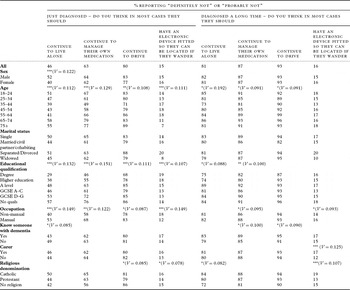
For people who had just been diagnosed with dementia, 46% of those surveyed responded that people should not continue to live alone. Sixty-three percent responded that people should not continue to manage their own medication, and 80% said they should probably or definitely not continue to drive. Respondents were also very supportive (64%) of fitting electronic tags so that someone could be located if they wander. When asked about people who have lived with dementia for a long time, 81% of people responded that they should probably or definitely not live alone and 87% responded that they should not continue to manage their own medication. Almost all of those surveyed (93%) responded that they should not continue to drive and 69% of people agreed that someone who had dementia for a long time should probably or definitely have an electronic device fitted.
We undertook a series of bivariate analyses in order to explore attitudes and knowledge across a range of demographic groups, which have proved to be significant among attitudinal research in Northern Ireland (see for example, Lloyd et al., Reference Lloyd, Devine, Gray and Heenan2004). The key independent variables used in this paper are gender, age, marital status, education, knowledge of someone with dementia, and religion. Given the paucity of public attitude research on this topic, this analysis was exploratory. Gender differences in level of knowledge have not been generally identified. However, Arai and colleagues (Reference Arai, Arai and Zarit2008) found that females had more knowledge about dementia than did males among a study of the Japanese general public, and hypothesized that this may be due to women being more involved in care-giving. The pattern of knowledge among different age groups has been inconsistent, and Arai et al. (Reference Arai, Arai and Zarit2008) found a non-linear relationship with age. Carpenter et al. (Reference Carpenter, Zoller, Balsis, Otilingam and Gatz2011) found that greater knowledge about dementia was associated with having family members with dementia.
Gender
Gender was significant across some but not all of the responses to knowledge statements (Table 2) although the associations were weak. Significantly more men than women (35% compared with 24%) agreed that “people who eat healthily and exercise, are less likely to get dementia.” Significance was evidenced against only three of the attitude statements (Table 3). A higher proportion of males (86%) compared with females (80%) agreed that there comes a time when all you can do for someone with dementia is to keep them clean, healthy, and safe (p = 0.01), and 78% of females compared with 71% of males agreed that “once they have dementia the person you knew eventually disappears.” Males were more inclined to support nursing home or residential care (40% compared with 28%). In terms of independence, males were significantly less supportive of people with dementia who had just been diagnosed continuing to live alone. For other scenarios, responses between males and females were similar to each other.
Age
Age was significant when tested against all knowledge statements (Table 2), although the patterns are non-linear and any association was found to be weak. Almost double the percentage of respondents aged 65 years or more (71%–74%) regarded dementia as another term for Alzheimer's disease compared with 35% of 18–24 year olds. A similar pattern was found in support of the statement that people who eat healthily and exercise are less likely to get dementia (46% and 16%, respectively). Those in the older age group (75 years or older) were more likely to say that dementia is a mental illness, think that dementia can be cured, and to recognize the preventive effects of healthy diet and exercise. Conversely, this group was less likely to know that there are drug treatments that help with dementia. In response to measures of attitude (Table 3) the most significant differences occur between the youngest age group (18–24 years) and the older age groups, most noticeably the 55–64 years category and the 65 years or above categories. As we noted above, this may reflect the increased likelihood that people in the older age groups will know or have known someone with dementia. In response to the statement “once someone has dementia, the person you knew eventually disappears,” almost twice as many of those aged 45 years and above (81%–86%) agreed compared to 42% of the 18–24 year age group. The vast majority (83%–84%) of those above 55 years agreed that “people with dementia are like children and need to be cared for as you would a child” compared to 51% of 18–24 year olds.
Analysis was undertaken to explore if there were differences within the oldest age group, namely between those aged 65 to 74 years, and those aged 75 years or above. The younger group (65–74 years) was significantly less likely (p < 0.05) than the older group (75 years or over) to hold what might be described as paternalistic attitudes. Specifically, the former group was more likely to disagree that there was little or no benefit in telling someone that they had dementia, that people who had been just diagnosed with dementia were unable to make decisions about their own care, and that there was no point in trying to talk to people with dementia as they would not be able to understand. However, the association was relatively weak (V = 0.21 through V = 0.31).
When it came to attitudes toward independence, the most notable differences were again between the youngest and older age groups. For those just diagnosed, only 7% of 18–24 year olds and 10% of the over 75 year olds felt that people with dementia should continue to live alone. The percentage across other age groups ranged from 16% to 24%. The highest level of support for electronic tagging was in the 65–74 year age group, with little distinction being made between those just diagnosed and those living with dementia for a long time: 80% and 79%, respectively.
Marital status
In terms of knowledge, there were some statistically significant differences according to the marital status of respondents. This is based on a four-category classification (single, married, separated/divorced, and widowed). In particular, respondents who were widowed were the least likely to think that dementia was a disease of the brain (89%, compared with 95% of those who were married). Conversely, respondents who were single were least likely to think that dementia was a normal part of aging (24%, compared with 37% of those who were separated, divorced, or widowed).
There also appeared to be some variation in attitude (Table 3) according to the respondent's marital status. For many statements, respondents who were widowed expressed views which were different to those who were single or married/cohabiting. The attitudes of those who were separated or divorced were often similar to those who were widowed, but this was not the case for all statements. For example, 42% of those who were widowed and 39% of those who were separated or divorced agreed that people just diagnosed with dementia were unable to make decisions about their own care, compared with 27% of those who were married, and 29% of those who were single. In addition, 29% of those who were widowed agreed that there was no point in trying to talk to people with dementia as they would not be able to understand, compared with 12%–17% of the other three marital status groups.
Education
Table 2 shows that in terms of education a statistical significance is recorded against most knowledge statements, but again the association is weak (Cramer's V < 0.2). A much higher percentage of those with no qualifications saw dementia as a normal part of aging (42%) compared to those with a degree (26%) and almost twice the percentage of the former thought dementia could be cured compared with those with higher levels of education. A significantly lower proportion of those with GCSE grades D-G and no qualifications knew that there were many different kinds of dementia (p < 0.001).
Education proved significant for some but not all measures of attitude (Table 3) and levels of association were generally relatively weak. A general pattern can be seen indicating that the groups with lowest or no qualifications held very different views to those in the highest levels of education. Around one-third (33%) of those with no qualifications supported the statement “for people with really bad dementia life is not worth living,” compared to 22% of those with a degree or higher (p < 0.05). This contrast continues with the groups with lower levels of qualifications indicating a more paternalistic attitude to people with dementia and being much less convinced of the benefits of telling people they have dementia, compared to those respondents with a degree. The proportion of those with no qualifications feeling that there was no point in talking to someone with dementia as they would not understand was three times higher than the proportion of those with higher education who felt this way.
In response to the measures examining attitudes toward the independence of people with dementia (Table 4) education also proved significant. In considering people who had just been diagnosed, approximately twice as many respondents with higher education or a degree supported the idea that they should continue to live alone, manage their own medication, and continue to drive, compared with those with no qualifications. This latter group was most likely to support having an electronic device fitted.
A similar impact can be seen in the context of a person who has been living with dementia for a long time, with respondents with no qualifications being less likely to support this group living alone, managing their own medication or continuing drive, than those with a degree.
Knowing someone with dementia
Knowing someone with dementia had a significant impact on knowledge (Table 2) with 63% compared to 54% describing dementia as another term for Alzheimer's disease. This group was also more aware that there were drug treatments to help and less likely to think that dementia could be cured. In terms of attitudes toward people with dementia (Table 3), a higher percentage of those who knew someone with dementia agreed “once they have dementia, the person you knew eventually disappears” (78% compared with 72%). The greatest difference in these two groups was in their attitude to telling someone their diagnosis with 41% of those who knew someone with dementia feeling there was no benefit compared to 34% of those who did not know someone with dementia. There was also greater support for tagging (Table 4) among those who did not know someone with dementia, both for those just diagnosed (66% compared with 62%) and for those living with dementia for a long time (70% compared with 67%).
Religion
There were some differences in the type and levels of knowledge (Table 2) according to the religion of the respondents. Sixty-four percent of Catholic respondents said that dementia was another name for Alzheimer's disease, compared with 44% of those with no religion. In addition, while 77% of Catholics thought there were many different types of dementia, a lower proportion (68%) of Protestants thought this. Levels of association were weak.
Some statistically significant differences in attitudes (Table 3) according to religion are evident, although the low values of Cramer's V indicate a weak association. In general, respondents of no religion exhibited less paternalistic attitudes. Thus, while 26% of respondents in this group thought that there was little or no benefit to be gained from telling someone they had dementia, the figure for Catholics and Protestant respondents was much higher (37% and 40%, respectively).
Other demographic variables
While the variables discussed above emerged as most significant, other variables were also considered. NS-SEC classification of social class was recorded for respondents, but given the strong correlation between social class and education, this analysis did not provide us with significant extra information. The impact of the respondent being a carer was also examined but had little significant impact on outcomes. Carers were less supportive of people with dementia being involved in activities in the community, more inclined to agree that people with dementia should be cared for in a residential or nursing home and less supportive of electronic tagging.
Discussion
The results indicate that the general public in Northern Ireland have a reasonable knowledge of dementia. In terms of public health and awareness perhaps one of the most significant findings is that a low percentage of people overall (29%) are aware of the link between diet, exercise, and prevention, with the percentage even lower among younger adults (16% of the 18–24 age group). Over a quarter of those surveyed (28%) viewed dementia as a part of the normal process of aging and this percentage rose according to the age of participants (42% in 65+ age groups). These older age groups are most at risk in terms of dementia and a belief in dementia as a normal part of aging impacts on those seeking support and the potential for early diagnosis. This is an important factor in targeting public awareness and in the delivery of services.
Attitudinal results indicate the existence of deeply stigmatizing attitudes toward people with dementia. Old stereotypes of the “disappearing person” or the “living shell” (Woods, Reference Woods1989) continue to exist. The data also suggest a paternalistic attitude toward people with dementia rather than a view of the person with dementia as an equal citizen in society (Kelly and Innes, Reference Kelly and Innes2012). People with dementia were viewed as those we should take care of, as we would a child, with the resulting infantilization of the person (Kitwood, Reference Kitwood1997). There is evidence of a stereotypical view of the person with dementia with little difference made between a person who has recently been diagnosed and a person who has been living with dementia for a long time. The attitudes held by members of the public appear to be in line with the most degenerative images of dementia.
These bivariate results indicate some differences between different demographic groups and, in general, they reflect some of the findings of Arai et al.'s (Reference Arai, Arai and Zarit2008) in relation to gender and age. However, Cramer's V indicates that many of these relationships are weak. The experience of knowing someone with dementia did prove significant in terms of knowledge (Carpenter et al., Reference Carpenter, Zoller, Balsis, Otilingam and Gatz2011) but, contrary to what one might expect, it was not a strong indicator of a more positive attitude. However, the limitation of bivariate analysis must be acknowledged. In particular, the association with religion or marital status may be due to the age distribution of particular groups; for example, single people tend to be younger than those who are widowed. Approximately one-third of the Catholic respondents or those with no religion (32%) were aged less than 35 years, compared to 20% of the Protestant respondents, and so the association of attitudes with religion may be an artefact of age. To establish these relationships, multivariate analysis is appropriate. A qualitative exploration of the values and beliefs underlying the attitudes expressed would also be appropriate, and this work is being undertaken in the form of focus groups and interviews as part of the lead author's PhD study.
Conclusions
This NILT module makes an original contribution by providing a unique source of data on knowledge of, and attitudes to, dementia. A key strength is that the survey provides statistically representative data with national level coverage, and as a data resource it is currently unmatched. We anticipate that it will make an important contribution to understanding the general public's knowledge and attitudes toward dementia, given that dementia is such a global, national, and regional concern (Alzheimer's Disease International, 2011). On its own, the module on dementia knowledge and attitudes will support a range of possible analyses, which are widened because the module is located within a more general social survey, which includes other pertinent social policy issues (such as informal caring). This paper provides an initial exploration of the data at bivariate level; however, further analysis will incorporate comprehensive multivariate statistical analysis. We anticipate that the measures collected suit data reduction techniques and approaches appropriate to analyses of attitudes as well as the testing of interaction effects. We cannot foresee any barriers to the module being replicated in either subsequent NILT surveys or other comparable social attitudes surveys. Repeating the module in a cross-sectional survey context is intuitively appealing as it would allow comparisons, and with subsequent replications it would support the analysis of trends. The success of the module leads us to believe that it stands as a blue-print for collecting information on dementia in other social surveys.
Within a Northern Ireland context, the number of people living with dementia is estimated to treble by 2051, which is the fastest expected rate of increase in the UK (Department of Health, Social Services and Public Safety, 2010). The impact of this will present many issues at personal, family, and societal levels. Educational policies to improve public knowledge of the etiology of dementia are pertinent to public health departments as well as to the delivery of health and social services. Identifying patterns in knowledge across groups could be helpful for practitioners and educators in anticipating knowledge needs (Carpenter et al., Reference Carpenter, Zoller, Balsis, Otilingam and Gatz2011). Arai et al. (Reference Arai, Arai and Zarit2008) highlight the need to particularly target dissemination of information to groups who traditionally have had less contact with health and social care professionals, such as men and younger people. Identifying the nature of stigmatizing attitudes toward people with dementia is essential if those affected are to be encouraged to seek help and support. The data could also provide valuable information on the extent and demographic make-up of existing stigma so that the plan to address stigma (Department of Health, Social Services and Public Safety, 2011) can be targeted appropriately. The publication of the Dementia Strategy for Northern Ireland at the end of 2011 indicates the level of government concern, although the lack of funding associated with the strategy limits its power.
There is worldwide recognition that dementia will impact on a rapidly increasing proportion of the population and dementia strategies emphasize the need to improve public awareness. The data gathered through this survey can provide insight on the current knowledge held by the general public and their attitudes toward people with dementia. This information can be used to target public health education policies more effectively and to inform delivery of health and social services.
Conflict of interest
None.
Description of author's roles
Patricia McParland brought the initial idea to ARK, developed the questions, analyzed the data, and wrote the paper. Dr Paula Devine assisted in developing the questions, analyzed the data, and assisted with writing the paper. Professor Anthea Innes assisted with the development of questions, analysis of data, and writing the paper. Professor Vernon Gayle assisted in analysis of data and writing the paper.
Acknowledgments
Atlantic Philanthropies funded the survey module and the data were collected by the Northern Ireland Statistics Research Agency. The authors wish to thank members of the team at Access Research Knowledge (ARK), Northern Ireland, who assisted with the preparation and development of the module.