Introduction
The stress and coping model
As it is widely documented, caring for a person with dementia is associated with negative consequences for the caregiver's physical and mental health (Alzheimer's Association, 2011; Mohamed et al., Reference Mohamed, Rosenheck, Lyketsos and Schneider2010). Considering the heavy demands that caregivers have to cope with, over a long period of time, it is not surprising that dementia caregiving has been considered as a prototypical example of a chronic stress situation, with the stress and coping model adapted to caregiving as the theoretical model mostly being used for understanding caregiving distress (Haley et al., Reference Haley, Levine, Brown and Bartolucci1987). According to this model, although most caregivers face similar situations, they differ from each other in their mental health outcomes (e.g. depression), as the impact that objective stressors (e.g. care-recipient's frequency of disruptive behaviors) have on the caregiver's health depends on modulating variables (e.g. caregiver's appraisals and coping strategies). Social support and coping strategies are among the most widely analyzed modulating variables in caregiving research (Haley et al., Reference Haley, Levine, Brown and Bartolucci1987). The benefits that other psychological variables, such as the caregiver's cognitive and behavioral resources (e.g. caregiver's self-efficacy and leisure activities) have on caregiver's distress have been also reported (Mausbach et al., Reference Mausbach, Roepke, Depp, Patterson and Grant2009; Romero-Moreno et al., Reference Romero-Moreno, Mausbach, Losada, Márquez-González, Patterson and López2011b).
Caregivers' distress over time
Although the vast majority of studies on caregiving distress are cross-sectional, longitudinal support for the negative effects of dementia caregiving on caregivers’ outcomes has also been found, showing that being a caregiver is linked with suffering higher distress than noncaregivers (Joling et al., Reference Joling2010). In addition, studies that have focused on following-up caregiver's distress (e.g. depression) over a specific period of time have shown its stability over time (Gaugler, Reference Gaugler2010; Schulz and Williamson, Reference Schulz and Williamson1991). However, decreases in caregivers’ depression over time have also been reported (Berger et al., Reference Berger, Bernhardt, Weimer, Peters, Kratzsch and Frolich2005). Although women have been found to report higher levels of depression (Schulz and Williamson, Reference Schulz and Williamson1991) than men, men seem to be more likely than women to experience increases in symptoms of depression over time (Schulz and Williamson, Reference Schulz and Williamson1991).
The importance of analyzing caregivers’ depression over time is supported by findings showing that increases in depression are associated with a decline in health status and an increased risk of death or stroke or myocardial infarction (Mausbach et al., Reference Mausbach, Patterson, Rabinowitz, Grant and Schulz2007a). Particularly, it has been found that a 5-unit increase in the CES-D (Center for Epidemiological Studies Depression Scale; Radloff, Reference Radloff1977) was predictive of a 20% increased risk of cardiovascular disease in dementia caregivers (Mausbach et al., Reference Mausbach, Patterson, Rabinowitz, Grant and Schulz2007a). Additionally, it has been found that changes in caregivers' distress over time not only pose negative consequences for caregivers, but also for their care-recipients: increases in caregivers’ depression over time predict significant increases in reported caregivers’ abusive behaviors toward the person they are caring for (Cooper et al., Reference Cooper, Blanchard, Selwood, Walker and Livingston2010).
Predictors of caregivers' depression over time
Longitudinal caregiving studies have focused on analyzing the impact that caregivers’ stressors (e.g. frequency of behavioral problems) have on caregivers’ mental and physical health (Agüera-Ortiz et al., Reference Agüera-Ortiz, Frank-García, Gil and Moreno2010), showing a general negative effect of stressors on caregivers’ outcomes. It has been found that increases in caregivers’ stressors (e.g. caregiving involvement or burden) are associated with increases in caregivers’ distress (e.g. depression), even after controlling for sociodemographic characteristics (O'Rourke and Tuokko, Reference O'Rourke and Tuokko2004). However, no associations between caregivers’ stressors (e.g. frequency of behavioral problems) and their levels of depression have also been reported (Schulz and Williamson, Reference Schulz and Williamson1991), and further research is needed in this regard (Black and Almeida, Reference Black and Almeida2004).
Regarding the analysis of the longitudinal effects of modulating variables on caregivers’ distress, research is sparse. Li et al. (Reference Li, Seltzer and Greenberg1999) found that using problem-focused coping strategies – composed of a summed score of different strategies such as active coping, planning, positive reinterpretation, and suppression of competing activities – significantly predicted reductions in depressive symptoms over time. Cooper et al. (Reference Cooper, Katona, Orrell and Livingston2008) found that using fewer emotion-focused strategies (based on acceptance, humor, positive reframing, and religion scores) predicted higher psychological morbidity (anxiety). With regard to the longitudinal effects of specific modulating variables on caregivers’ distress, available data show that variations in personal mastery, perceived social support, and satisfaction with social support over time were significant and negatively related to caregivers’ depressive symptoms in dementia caregivers (Mausbach et al., Reference Mausbach2007b; Schulz and Williamson, Reference Schulz and Williamson1991).
To our knowledge, no longitudinal studies are available which analyze the impact of specific modulator variables on caregivers’ depression after controlling for key variables (e.g. gender and stressors), and within the frame of the stress and coping model (Haley et al., Reference Haley, Levine, Brown and Bartolucci1987). Specifically, no longitudinal data linking caregivers’ perceived self-efficacy or caregivers’ pleasant activities with caregivers’ depression are available, in spite of the cross-sectional empirical support for the beneficial effects of these variables on caregiving distress (Márquez-González et al., Reference Márquez-González, Losada, López and Peñacoba2009; Mausbach et al., Reference Mausbach, Roepke, Depp, Patterson and Grant2009; Romero-Moreno et al., Reference Romero-Moreno, Mausbach, Losada, Márquez-González, Patterson and López2011b). In this sense, among the different self-efficacy dimensions, self-efficacy for controlling upsetting thoughts has been found to play a moderator role in the relationship between caregivers’ burden and caregivers’ distress (depression and anxiety) (Romero-Moreno et al., Reference Romero-Moreno, Mausbach, Losada, Márquez-González, Patterson and López2011b). Emotion regulation strategies which have been shown to be cross-sectionally related to depression have not been explored as longitudinal predictors of depression. This is the case of cognitive reappraisal, which is the ability to cognitively construct a potentially negative emotion-eliciting situation in a way that changes its emotional impact. Cognitive reappraisal has previously been shown to be a significant cross-sectional predictor of depression in dementia caregiving populations (Romero-Moreno et al., Reference Romero-Moreno, Márquez-González, Losada and López2011a).
The aim of this study was to analyze covariations between caregivers’ depression and three specific modulator variables: self-efficacy for controlling upsetting thoughts, pleasant activities (frequency of leisure activities), and cognitive reappraisal, after controlling for gender and frequency of disruptive behaviors of the care-recipient. Drawing upon the stress and coping model (Haley et al., Reference Haley, Levine, Brown and Bartolucci1987), we hypothesized that increases in stressors and decreases in modulating variables would co-vary with increases in depression over time. Also, we hypothesized that the inclusion of modulating variables into the final model would contribute to a significant increase in the percentage of explained variance of caregivers’ changes in depression over time. Finally, considering previous studies, significant gender differences in depression over time were predicted, with higher scores expected for female caregivers.
Methods
Participants
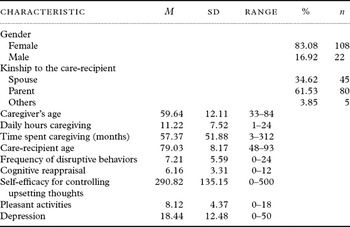
Participants in this study were 130 caregivers of relatives with dementia. All caregivers were caring for older relatives living in the community. The inclusion criteria were: identifying oneself as the main source of help for one's relatives; reporting that more than 1 hour per day was devoted to caregiving duties; providing care for more than three consecutive months; and having a minimum age of 18 years. Baseline characteristics of the sample are shown in Table 1.
Demographic characteristics at baseline

Procedure
This study has been done in the framework of a larger study aimed at both analyzing the influence of psychosocial variables on caregivers’ distress and testing the efficacy of a psychological intervention for the reduction of caregivers’ distress (Losada et al., Reference Losada, Márquez-González and Romero-Moreno2011; Romero-Moreno et al., Reference Romero-Moreno, Márquez-González, Losada and López2011a). The psychological intervention was aimed at training caregivers in techniques and skills to acknowledge, analyze, and moderate maladaptive thoughts that prevented them from self-help activities such as asking for help and doing pleasant activities. Participants were recruited through various social and day care centers in Madrid (Spain) and via announcements in the media. In order to check whether caregivers met the inclusion criteria, participants were initially contacted by telephone. Subsequently, face-to-face interviews were conducted at the different centers involved in the study. Over the course of the study, three assessments were conducted: at baseline, at the 3-month follow-up, and at the 1-year follow-up from baseline. All participants provided informed consent to enter into the study. Both the Spanish Ministry of Education and the Ethical Committee from the Universidad Rey Juan Carlos of Madrid gave their approval for the study.
Variables and instruments
In addition to sociodemographic information at baseline (see Table 1), the following variables were assessed:
Stressors
Frequency of disruptive behaviors. The disruption subscale from the Revised Memory and Behavior Problems Checklist (Teri et al., Reference Teri, Truax, Logsdon, Uomoto, Zarit and Vitaliano1992) was used. It consists of an eight-item subscale that assesses the frequency of disruptive behaviors in dementia patients (e.g. “During the past week, how often did your relative destroy property or threaten to hurt others ?”). Scores range from 0 = “not at all” to 4 = “extremely.” Internal consistency (Cronbach's α) of this subscale in this study was 0.61, similar to the 0.62 reported in the Teri et al. (Reference Teri, Truax, Logsdon, Uomoto, Zarit and Vitaliano1992) study.
Modulating variables
Cognitive reappraisal. This variable was assessed using four items from the Mood Repair subscale from the Trait Meta-Mood Scale (TMMS-24; Salovey et al., Reference Salovey, Mayer, Goldman, Turvey, Palfai and Pennebaker1995), which specifically assess cognitive reappraisal, this is, the cognitive ability to change thoughts in a positive way in order to repair unpleasant moods (e.g. “When I become upset, I remind myself of all the pleasures in life”). Scores range from 0 = “never” to 3 = “always.” The internal consistency (Cronbach's α) of this scale in the present study was 0.84.
Self-efficacy. The self-efficacy for controlling upsetting thoughts subscale from the Revised Scale for Caregiving Self-efficacy (Steffen et al., Reference Steffen, McKibbin, Zeiss, Gallagher-Thompson and Bandura2002) was used. Particularly, the Spanish version of the scale was used (Márquez-González et al., Reference Márquez-González, Losada, López and Peñacoba2009). It consists of five items that assess the confidence with which the caregiver can turn off or get rid of a different type of negative thought when it arises (e.g. “How confident are you that you can control thinking about unpleasant aspects of taking care of ____?”), with scores ranging from 0 = “cannot do at all” to 100 = “am certain can do.” In this study, the subscale presents an internal consistency of Cronbach's α = 0.78.
Pleasant activities. An adaptation of the Leisure Time Satisfaction Measure (Stevens et al., Reference Stevens2004) was used. It consists of six items that assess how often the person engaged in different pleasant events over the past month (e.g. “How often did you go out for meals or other social activities”?). Scores range from 0 “not at all” to 4 “a lot.” In this study, the internal consistency (Cronbach's α) was 0.70.
Outcome variables
Depression. The Center for Epidemiological Studies Depression Scale (CES-D; Radloff, Reference Radloff1977) was used. This scale consists of 20 items assessing the frequency of depressive symptoms over the previous week (e.g. “I thought my life had been a failure”). Scores range from 0 “rarely or none of the time” to 3 “most or all the time.” In the present study, the internal consistency (Cronbach's α) for the scale was 0.90.
Data analysis
In order to examine the correlation of predictors and depression over time, linear mixed models were used. Mixed models analysis allows us to estimate an intercept and slope for each participant based on all available data for that individual, augmented by the data from the entire sample. Hence, as missing data are common at one or more time points in longitudinal studies, the use of mixed models allows individual slopes to be estimated using the available data for that participant.
With the aim of increasing interpretability of regression coefficients and reducing problems associated with multicollinearity, the linear variables (frequency of disruptive behaviors, cognitive reappraisal, pleasant activities, and self-efficacy) were centered at their grand means. The overall model included depression as the dependent variable and stressors (frequency of disruptive behaviors) and modulating variables (cognitive reappraisal, pleasant activities, and self-efficacy) as time-varying covariates. In addition, the model included the time-invariant main effect for gender which was dummy coded as “0” = men and “1” = women.
As mentioned above, all of the longitudinal data were collected as part of a randomized trial examining the efficacy of a psychoeducational intervention (vs. a control intervention) for improving caregiver well-being (see Losada et al., Reference Losada, Márquez-González and Romero-Moreno2011). While the effects of treatment condition on depressive symptoms was not the primary aim of our analyses, we recognize that participation in these interventions may influence depressive symptoms over time. Therefore, in order to account for the effect of treatment condition on depressive symptoms, time, treatment condition, and the “time × treatment condition” interaction were entered in the model. This method of accounting for treatment effects has been used in similar caregiver studies (e.g. Mausbach et al., Reference Mausbach2004). Specifically, time was coded as “0” = baseline scores, “1” = 3 months after (post-treatment), and “2” = 1-year follow-up from baseline. As the treatment condition was coded as “0” = control group and “1” = treatment group, the estimate for “time” represented the slope for caregivers in the control group and the corresponding p value indicated whether this slope was significant. The “time × treatment condition” interaction estimate represented the differential in slope for caregivers in the active treatment condition. Finally, models included random intercepts and random slopes. Akaike's Information Criteria (AIC) was used to compare model fit, with lower values indicating better fitting models.
Results
Dropouts/missing data
Data of at least two assessment phases were available for 130 participants enrolled in the study. Of these, data were available for 116 caregivers (89.23%) at the 3-month follow-up and, at the 1-year follow-up assessment, data were available for 82 caregivers (63.08%). Therefore, 48 participants were lost to the 1-year follow-up assessment (36.92%); 5 due to the death of the care-recipient (3.85%); 14 due to difficulties to localize the participants (10.77%); 11 discontinued participation (8.46%) (4 due to health problems, 7 due to lack of time); 12 refused to continue their participation in the study (9.23%); and 6 were no longer caregivers (4.62%) (2 moved to another city and 4 institutionalized the care-recipient). In order to test if missing data occurred at random, several analyses were conducted. First, in order to analyze differences between those caregivers who missed an assessment and those who did not miss any of the assessed variables, independent samples t-tests were conducted. There were no significant differences between those caregivers who missed the 3-month follow-up and those who did not in their scores on depression (t = −0.53; p = 0.60), frequency of disruptive behaviors (t = 0.10; p = 0.92), cognitive reappraisal (t = 0.66; p = 0.51), pleasant activities (t = −0.93; p = 0.35), and self-efficacy (t = 0.97; p = 0.34); and at the 1-year follow-up assessment on depression (t = 0.70; p = 0.49), frequency of disruptive behaviors (t = 0.79; p = 0.43), cognitive reappraisal (t = 0.28; p = 0.78), pleasant activities (t = −1.26; p = 0.21), and self-efficacy (t = 0.25; p = 0.80). No significant differences were found between caregivers who missed the 1-year follow-up assessment and those who did not in their scores on any of the assessed variables at baseline and at the 3-month follow-up (p > 0.05). In addition, no significant differences were found between caregivers who missed the 3-month follow-up and those who did not in their scores on caregivers’ age (t = 1.70; p = 0.09) and between those who missed the 1 year-follow-up assessment and those who did not (t = −1.00; p = 0.32). Finally, as already mentioned, this study has been done in the framework of an intervention study. We analyzed whether caregivers from the control group (n = 58) were more likely to miss an assessment than caregivers from the intervention group (n = 72). No significant differences were found between caregivers from the control group and the intervention group at the 3-month follow-up (p = 0.67). Results showed that caregivers from the control group were significantly more likely to miss an assessment at the 1-year follow-up (p < 0.01). A post hoc power calculation was conducted and revealed that the study had 87.98% power at a significance level of 0.05 to detect the observed differences between the control and treatment groups.
Change in depression over time
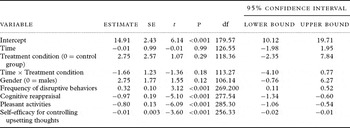
The results of the linear mixed model conducted to analyze the relationship between frequency of disruptive behaviors, cognitive reappraisal, pleasant activities, and self-efficacy for controlling upsetting thoughts and depression are shown in Table 2.
Linear mixed-effects model for depressive symptoms over time

Intercept corresponds to depression for male's caregivers control group at baseline. Gender was coded as 0 = male, 1 = female; treatment condition was coded as 0 = waiting-list group and 1 = intervention group, and time was entered as a linear variable with 0 = baseline scores, 1 = 3 months follow-up and 2 = 1-year follow-up from baseline.
The effect of treatment was not significant (t = 1.07; df = 118.36; p = 0.29), indicating that caregivers in the control group showed no significant differences in mean depression over time compared to those in the treatment group. The estimate for “time” referred to the slope when treatment condition was coded as “0” (the slope for the control group). The coefficient for “time” was not significant (t = −0.01; df = 126.55; p = 0.99), indicating that caregivers in the control group showed no significant changes in depression over time. In addition, the interaction “time × treatment condition” was not significant (t = −1.36; df = 113.27; p = 0.18), indicating that caregivers in the treatment group did not differ in their slope compared to those in the control group.
Because linear independent variables were centered at their grand means, the intercept represents mean depression scores at baseline for male caregivers in the control group with average scores in frequency of disruptive behaviors, cognitive reappraisal, pleasant activities, and self-efficacy for controlling upsetting thoughts. Results showed that the time-varying value for frequency of disruptive behaviors co-varied with depression over time (t = 3.12; df = 269.200; p < 0.001), indicating that those caregivers with higher scores on disruptive behaviors over time also reported higher scores on depression over time. In addition, the time-varying value for self-efficacy for controlling upsetting thoughts was correlated with depression over time (t = −3.60; df = 256.33; p < 0.001), indicating that caregivers with higher scores on this type of self-efficacy over time also had lower scores on depression over time. In a similar way, caregivers who reported higher scores on both pleasant activities (t = −6.09; df = 285.30; p < 0.001) and cognitive reappraisal over time (t = −5.10; df = 277.54; p < 0.001) also reported lower levels of depression over time. Because each of these covariates was time-varying, at assessment times when self-efficacy, pleasant activities, and cognitive reappraisal were higher, depressive symptoms tended to be lower. Similarly, at assessment times when frequencies of disruptive behaviors were higher, caregivers reported higher depressive symptoms.
Finally, the effect of gender was not significant (t = 1.55; df = 106.14; p = 0.12), reflecting that male and female caregivers showed no significant differences in mean depression scores across time.
The overall fit of the model was tested using Akaike's Information Criteria (AIC), representing smaller values on AIC better-fitting models. Because this value is not intrinsically interpretable and it is useful as a way of comparing models, different models were tested. Results showed that the inclusion of modulating variables (self-efficacy, pleasant activities, and cognitive reappraisal) in the final model significantly improved the model beyond that produced by considering treatment effect, gender, and frequency of behavioral problems (χ2 (7) = 2137.82 − 2444.07 = 306.25, p < 0.001). Finally, 60.30% of the between-person variance was explained by the final model.
Discussion
Following the stress and coping model (Haley et al., Reference Haley, Levine, Brown and Bartolucci1987), the purpose of this one-year longitudinal study was to establish whether dementia caregivers’ modulating variables (self-efficacy for controlling upsetting thoughts, frequency of leisure activities, and cognitive reappraisal) significantly co-varied with depression over time, after controlling for gender and caregiver's stressors (frequency of disruptive behaviors).
With regard to gender as a predictor of caregivers’ depression, and contrary to our expectations, results reveal no significant gender differences in mean depression over time, although a trend toward higher scores on depression reported by female caregivers was observed. Consistent with previous longitudinal studies (Agüera-Ortiz et al., Reference Agüera-Ortiz, Frank-García, Gil and Moreno2010), the results suggest that the frequency of behavioral problems predicts caregivers’ depression over time. Specifically, we found that greater frequency of disruptive behaviors over time were associated with increased depression over time. In addition, according to our hypotheses, the results of this study show that modulating variables co-varied with depression scores over time, even after controlling for gender and frequency of behavioral problems. Specifically, the results showed that higher scores in self-efficacy for controlling upsetting thoughts were associated with reduced depression scores over time, which is consistent with previous cross-sectional studies (Steffen et al., Reference Steffen, McKibbin, Zeiss, Gallagher-Thompson and Bandura2002; Márquez-González et al., Reference Márquez-González, Losada, López and Peñacoba2009; Romero-Moreno et al., Reference Romero-Moreno, Márquez-González, Losada and López2011).
In addition, consistent with other cross-sectional studies (e.g. Losada et al., Reference Losada2010), the results of this study showed a positive effect of leisure activities on caregivers' distress over time. This study adds to previous research that increases in caregivers' frequency of leisure activities significantly predicted decreases in their levels of depression. These results seem to be congruent with previous longitudinal data showing that a more frequent use of the coping strategy “maintaining balance” (e.g. “keeping a little free time to myself” or “maintaining interest outside caring”) significantly predicted a decrease in caregiver's distress over time (Knussen et al., Reference Knussen, Tolson, Brogan, Swan, Stott and Sullivan2008), and strengthens the consideration of pleasant activities as a potentially effective strategy to reduce distress (Losada et al., in press). In addition, it would be interesting to analyze if subjective dimensions of leisure (e.g. caregivers' satisfaction with leisure), which have been shown to have significant effects on caregivers' outcomes in cross-sectional studies (e.g. Moore et al., Reference Moore, Harmell, Chattillion, Ancoli-Israel, Grant and Mausbach2011), also predict changes in depression over time.
Regarding the use of the emotional regulation strategy (cognitive reappraisal), this study has found a negative association between this variable and caregivers' depression over time. Specifically, the results showed that greater use of cognitive reappraisal was associated with lower depression across time. This finding is consistent with a previous cross-sectional study (Romero-Moreno et al., Reference Romero-Moreno, Márquez-González, Losada and López2011a), in which the more frequent use of cognitive reappraisal was found to be associated with lower levels of caregiver's distress (depression, anxiety, and anger).
The results of this study provide empirical support for the stress and coping model of caregiving, showing that modulator variables contribute significantly to the explanation of caregivers' depressive symptoms. Specifically, changes in caregivers’ scores on the assessed modulator variables explain changes in their scores in depression in the way that is predicted by the model. Furthermore, our study adds to previous research that the inclusion of time-varying associations between modulating covariates – self-efficacy for controlling upsetting thoughts, pleasant activities, and cognitive reappraisal – and caregivers’ depression increases significantly the percentage of variance in caregivers’ depression explained by gender and frequency of disruptive behaviors.
Even though in a previous study (Losada et al., Reference Losada, Márquez-González and Romero-Moreno2011) a significant reduction was found in depression scores of caregivers who participated in the intervention when comparing baseline data with post-intervention scores, no significant effect for treatment condition was found in this study for the one-year follow-up. However, the results show a trend for caregivers in the intervention group to report lower levels of depression over time, when compared to caregivers in the control group. The significant loss in follow-up data that has been found for the control group may help to explain these results. It may be plausible that non-measured variables that have shown in caregiving literature to play a significant role in explaining caregivers’ distress, both from quantitative (e.g. social support; Clay et al., Reference Clay, Roth, Wadley and Haley2008) and qualitative research (e.g. differences in adaptation to caregiving role; Parveen et al., Reference Parveen, Morrison and Robinson2011) may be having an influence on the reasons for discontinuing the participation in the study.
Several limitations of this study must be acknowledged. Most of the sample consisted of volunteer caregivers recruited through social and day care centers, and so it may not be appropriate to generalize these findings to all dementia caregivers. Also, although the nature of this study is longitudinal, the results should not be taken as a demonstration of causality, and experimental studies are needed to appropriately address this issue. In addition, other potential variables that have not been considered in this study may also have an influence on caregivers' depression over time. For example, Schulz et al. (Reference Schulz2008) found that increases in perceived suffering by dementia patients was associated with increases in caregiver depression, even after controlling for objective stressors (e.g. frequency of behavioral problems). Other caregiving stressors such as limitations in care recipients' functional capacity should be considered by future longitudinal research, although significant associations between changes in functional capacity and frequency of behavioral problems over time have been reported (Jefferson et al., Reference Jefferson2006) and frequency of behavioral problems seems to be the stressor variable most contributing to explain caregivers' distress (Agüera-Ortiz et al., Reference Agüera-Ortiz, Frank-García, Gil and Moreno2010). In addition, it would be interesting to analyze cultural differences longitudinally in the relationship between modulating variables and caregivers’ depression, as cultural differences in caregiver levels of depression over time – with higher levels reported by White caregivers as compared to African American caregivers – have been found (Roth et al., Reference Roth, Haley, Owen, Clay and Goode2001). Although the obtained results show that significant changes in most of the assessed modulating variables predict changes in depression, they do not provide information regarding the mechanisms of action by which these variables influence caregiver's depression. It would be interesting to analyze the mechanisms by which the modulating variables – such as self-efficacy, cognitive reappraisal, and pleasant activities – have an effect on changes in caregivers’ depression, as well as their patterns of interrelations. It may be plausible that the extent to which caregivers see themselves as being able to control their negative thoughts – i.e. by high levels of self-efficacy – lead them to use a more adaptive coping strategy (e.g. engagement in leisure activities and use of cognitive reappraisal) which could have positive consequences on caregivers' depression. Alternatively, it may be caregivers' ability to reappraise negative situations in more positive ways, or to engage in pleasant activities, that leads them to perceive themselves as more capable of controling their negative thoughts. Li et al. (Reference Li, Seltzer and Greenberg1999) carried out a longitudinal study and suggested that caregivers who felt more control over their lives (i.e. who had high levels of mastery) tended to use problem-focused strategies (e.g. positive reinterpretation), which led to decreases in depressive symptoms. Future longitudinal and experimental studies are needed which analyze the direction of the relationships between modulating variables and caregivers' depression. Another limitation of this study is that it has been carried out in a randomized controlled study, with the aim of testing the efficacy of a psychological intervention to reduce caregivers’ distress, and the treatment may have influenced other variables such us behavioral activation or cognitive reappraisal, variables which have been found to predict significantly caregivers’ depression over time. It would be interesting to analyze which modulating variables predict caregivers’ depression over time in caregivers who have not been participating in a psychological intervention. Finally, the small sample size of this study, although similar to other longitudinal studies (e.g. Li et al., Reference Li, Seltzer and Greenberg1999; Mausbach et al., Reference Mausbach2007b), may limit the generalizability of the findings reported in this paper.
The results of this study contribute to the literature on dementia caregiving, providing longitudinal support to the stress and coping model in order to understand caregivers’ distress. Also, this study highlights the importance of considering specific caregivers' modulating variables to predict caregivers' depression over time. Specifically, the results suggest that the modulating variables of self-efficacy for controlling upsetting thoughts, pleasant activities, and cognitive reappraisal have a positive impact on caregivers' symptoms of depression over time, even after controlling for frequency of disruptive behaviors. These results have relevant clinical implications for the design and development of caregiver interventions, as these modulating variables may be modified through teaching and training different skills, such us cognitive restructuring and/or increasing pleasant activities (Losada et al., Reference Losada, Márquez-González and Romero-Moreno2011). Moreover, it is likely that training caregivers in these abilities may also impact on care-recipients, by reducing the frequency of caregivers' abusive behaviors toward them or the desire to institutionalize them, provided that caregivers' depression over time has shown to predict these variables (Arai et al., Reference Arai, Sugiura, Washio, Miura and Kudo2001; Cooper et al., Reference Cooper, Blanchard, Selwood, Walker and Livingston2010).
Conflict of interest
None.
Description of authors' roles
Rosa Romero-Moreno worked on the study implementation, the data analysis, and the writing of the paper. María Márquez-González and Andrés Losada designed the study, carried it out, and helped to write the paper. Brent Mausbach worked on the data analysis and the writing of the paper.
Acknowledgments
The preparation of this paper was supported by grants from both the Spanish Ministry of Education (Grant SEJ2006-02489/PSIC) and the Spanish Ministry of Science and Innovation (Grant PSI2009-08132/PSIC). In addition, this study was supported by a grant from the Community of Madrid (Grant 001340/01/CPI/2007) aimed at analyzing longitudinally the effects of dementia family caregiving on caregivers' distress.