Introduction
Cash-for-care schemes offering cash payments in place of conventional social services to older and disabled people are increasingly commonplace throughout developed welfare states. However, there is little evidence about the impact of such schemes on older people, and less still that gives voice to older people and to their individual experiences of cash-for-care schemes. This paper reports on an evaluation of a recent English cash-for-care scheme, the Individual Budget (IB) pilot projects (the IBSEN study). It highlights the impact and outcomes of IBs for older people through survey data; semi-structured interviews with a sub-sample of older IB users and their proxies; and semi-structured interviews with the IB project lead in each of the 13 IB pilot sites.
Cash-for-care schemes that offer older and disabled people cash payments or access to a specified cash resource, instead of allocations of services in kind, are increasingly common in parts of Europe, Australia, Canada and the United States of America (Da Roit and Le Bihan Reference Da Roit and Le Bihan2010; Doty, Mahoney and Simon-Rusinowitz Reference Doty, Mahoney and Simon-Rusinowitz2007; European Commission 2008; Glendinning and Kemp Reference Glendinning, Glendinning and Kemp2006; Leece and Leece Reference Leece and Leece2006; Lord and Hutchison Reference Lord and Hutchison2003; Timonen, Convery and Cahill Reference Timonen, Convery and Cahill2006; Ungerson and Yeandle Reference Ungerson and Yeandle2007). In some countries, such schemes are available to older people as part of arrangements for funding long-term care; elsewhere cash payments are only available to younger disabled people as part of moves to support independent living; in other countries cash-for-care schemes are open to all user groups. Although often promoted as a means of providing consumer-related choices to older and/or disabled people (Lundsgaard Reference Lundsgaard2005), such schemes may (also) aim to stimulate demand for new services, break provider monopolies, support family care, or combinations of these (Da Roit and Le Bihan Reference Da Roit and Le Bihan2010).
However, there is a dearth of quality empirical data on the impact, experiences and outcomes of cash-for-care schemes on older people. For example, a narrative review of cash-for-care schemes for people of all ages concluded that the breadth and quality of existing research was insufficient and inadequate. The majority of reviewed studies did not compare outcomes between cash-for-care recipients and users of conventional services; most studies suffered from selection effects as users had specifically opted for cash-for-care; most research was dominated by small-scale qualitative studies and lacked validated/standardised outcome measures; few studies had examined the costs and cost-effectiveness of cash-for-care schemes; and studies tended to be cross-sectional rather longitudinal (Arksey and Kemp Reference Arksey and Kemp2008). Research has also focused on the impact of cash-for-care schemes on previously unpaid family carers (Breda et al. Reference Breda, Schoenmaekers, Van Landerghem, Claessens, Geerts, Glendinning and Kemp2006; Glendinning Reference Glendinning, Glendinning and Kemp2006; Ungerson and Yeandle Reference Ungerson and Yeandle2007); feminist concerns about the ‘commodification of care’ work (Jenson and Jacobzone Reference Jenson and Jacobzone2000; Rummery Reference Rummery2009; Ungerson Reference Ungerson and Hudson2000); and the contribution that cash-for-care schemes appear to make to the global migration of care labour (Da Roit, Le Bihan and Osterle Reference Da Roit, Le Bihan and Osterle2007; Ungerson Reference Ungerson2003; Ungerson and Yeandle Reference Ungerson and Yeandle2007).
Evidence of the impact of cash-for-care schemes on older people is more limited. Some small-scale studies have suggested that older people are relatively satisfied with their cash-for-care schemes; consider themselves to be exercising greater choice and control (Ungerson and Yeandle Reference Ungerson and Yeandle2007); and have an improved quality of life, sense of happiness and feeling of being able to do more for themselves (Clark, Gough and Macfarlane Reference Clark, Gough and Macfarlane2004). However, other research highlights older people's concerns about the administrative demands of managing their own support (Barnes Reference Barnes1997); and the need for support to help older people exercise greater choice and control (Clark and Spafford Reference Clark and Spafford2001), particularly older people with cognitive impairments such as dementia (Arksey and Kemp Reference Arksey and Kemp2008). This paper aims to add to the limited evidence base by reporting on the impacts and outcomes for older people of an innovative cash-for-care pilot scheme in England.
The history of cash-for-care schemes for older people in England
Cash-for-care schemes in England aim primarily to promote choice, control and personalised support for older and disabled people and enable them to develop their own support arrangements. Direct Payments (DPs) – cash payments to the value of the social care services an individual had been assessed as needing (Leece and Bornat Reference Leece and Bornat2006) – were introduced for working-age disabled people in 1997 and extended to include older people from 2000 (Glendinning Reference Glendinning2008). DPs were mainly used to employ personal assistants instead of conventional home-care services.
Take-up of DPs varied considerably both between service user groups (Commission for Social Care Inspection 2005; Leason and Sale Reference Leason and Sale2004; Spandler and Vick Reference Spandler and Vick2004, Reference Spandler and Vick2005) and within and between different parts of the United Kingdom (UK) (Priestley et al. Reference Priestley, Jolly, Pearson, Riddell, Barnes and Mercer2006). In general, take-up was particularly low amongst older people, though higher in the wealthier local authorities which could offer more generous support packages (Fernandez et al. Reference Fernandez, Kendall, Davey and Knapp2007). A key policy driver for the establishment of DPs was demands from the disability movement for increased control and independence for people with disabilities (Barnes Reference Barnes1993; Campbell and Oliver Reference Campbell and Oliver1996; Dowling, Manthorpe and Cowley Reference Dowling, Manthorpe and Cowley2006; Glasby and Littlechild Reference Glasby, Littlechild, Leece and Bornat2006; Morris Reference Morris, Glendinning and Kemp2006). These demands may not have been perceived as aligning with the needs and desires of older people in need of social care, which may also help to explain why take-up of DPs among older people was relatively low. The assumptions of care managers, with sometimes overly risk-averse or paternalistic attitudes toward older people and uncertainties about their capacity to manage their own support arrangements, may also have inhibited their promotion of DPs (Commission for Social Care Inspection 2004; Ellis Reference Ellis2007; Fernandez et al. Reference Fernandez, Kendall, Davey and Knapp2007; Hasler Reference Hasler2003; Priestley et al. Reference Priestley, Jolly, Pearson, Riddell, Barnes and Mercer2006; Timonen, Convery and Cahill Reference Timonen, Convery and Cahill2006). Older people who were potential DP users cited lack of information and practical support, anxieties about recruiting and employing personal assistants, and ‘paper work’ (Spandler and Vick Reference Spandler and Vick2004) as reasons for low take-up, despite the (potential) benefits of DPs for increased choice and control (Clark, Gough and Macfarlane Reference Clark, Gough and Macfarlane2004; Clark and Spafford Reference Clark and Spafford2001; Glasby and Littlechild Reference Glasby and Littlechild2009; Leece and Bornat Reference Leece and Bornat2006).
Such concerns reflect critiques of choice and cash-for-care schemes (Stevens et al. Reference Stevens, Glendinning, Jacobs, Moran, Challis, Manthorpe, Fernandez, Jones, Knapp, Netten and Wilberforce2011). First, the need for good information in order to make the best use of choice is likely to favour those with better access to such information, thereby potentially increasing inequality. Second, individualised purchasing may reduce public interest in developing and maintaining an infrastructure of care services. Finally, cash-for-care schemes alter the power relationships between people using services and professionals such as social workers. However, the latter, as agents of local authorities, retain a duty of care and a responsibility to monitor the use of public money, which acts as a constraint to choice and creates a new kind of power dynamic. These factors may all affect the outcomes of cash-for-care schemes at an individual and a wider level.
Although DPs were initiated by a Conservative government, they were further promoted by a Labour government that was keen to modernise adult social care (Clements Reference Clements2008). Partly because of frustration at the low and uneven take-up of DPs, in 2005 the Labour government proposed the piloting of IBs (Department of Health 2005; HM Government 2005; Prime Minister's Strategy Unit 2005) intended to offer greater choice and control to older and disabled adults in receipt of social care services.
Individual Budgets
IBs were piloted in 13 local authorities in England from 2005 to 2007. IBs built on the experiences and methodology of ‘In Control’, a cash-for-care scheme primarily for working-age people with learning disabilities which used a resource allocation system to determine how much money an individual should have available to spend on meeting their support needs (Poll et al. Reference Poll, Duffy, Hatton, Sanderson and Routledge2006). IBs were intended to extend user choice and control beyond people with learning disabilities, and were more holistic than DPs in a number of respects. First, while DPs only included funding for adult social care, IBs aimed to combine resources from several funding streams into one overall budget, thus streamlining the number of assessments and reviews for service users and allowing budgets to be spent more flexibly to meet people's needs and desired outcomes (see Moran et al. Reference Moran, Glendinning, Stevens, Manthorpe, Jacobs, Wilberforce, Knapp, Challis, Fernandez, Jones and Netten2010 for details on the experience of integrating funding streams). Second, IBs encouraged a move towards self-assessment (with support from care managers as appropriate) and introduced a standardised resource allocation system (RAS) which was intended to provide a transparent calculation of the level of the IB, based on relative need rather than the value of currently accessed services (as had been the case with DPs).
Third, while DPs had to be spent on meeting specified needs, primarily personal care, IBs could be spent more creatively in a wide range of ways that the user felt best met their needs and desired outcomes. IBs could be used to purchase support from local authority social services, the private sector, the voluntary/community sector, or from family and friends. For example, hot meals delivered by the local authority could be replaced by a trip to the local café with family, friends or paid carers. Support plans, outlining how the IB would be spent, would be produced by the service user, with help from their care manager, an independent support planning/brokerage agency, voluntary/community group or family and friends. The final plan was checked for any risks and approved by the local authority. It was expected that this greater flexibility would help older people to develop individually tailored support plans to meet their needs and desired outcomes. Fourth, unlike DPs, IBs could be deployed in a variety of ways: as a cash payment held by the service user; an ‘indirect’ payment held by a third-party organisation or individual; managed by the local authority care manager; or held by a service provider. The detailed accounting required in the monitoring of DPs was replaced with lighter-touch monitoring for IBs, where the focus was on whether agreed outcomes had been met. The greater variety of deployment options for IBs was expected to help older people exercise greater choice and control but without the need to manage their own budgets.
Local authorities piloted IBs for different groups of service users (older people, mental health service users, people with learning disabilities and people with physical disabilities). Eight of the 13 sites opted to work with older people, with two of those sites working exclusively with older people. The Department of Health provided resources to support implementation in those sites, but the adult social care contribution to the IBs had to be found from within the local authority's existing adult social care budget.
Research design and methods
A rigorous multi-method evaluation of the IB pilots (Glendinning et al. Reference Glendinning, Challis, Fernandez, Jacobs, Jones, Knapp, Manthorpe, Moran, Netten, Stevens and Wilberforce2008) was commissioned to identify whether IBs improved outcomes for older and disabled people, compared with conventional services and, if so, at what cost. The study design included a randomised controlled trial, where service users were randomly allocated to the IB group (in which case they were offered an IB) or the comparison group (in which case they continued to receive conventional services (or DPs) for six months, after which they could be offered an IB). The randomisation process eliminated the selection effects apparent in other studies of the impact of cash-for-care schemes and enabled the comparison of outcomes between cash-for-care recipients and users of conventional services. Structured interviews which included validated and standardised outcome measures were conducted with both groups six months later. The six-month follow-up period (from randomisation to structured interview) introduced an (albeit short) longitudinal dimension to the study. In-depth semi-structured interviews were conducted two months after randomisation with a sub-sample of 130 older and disabled people who had been offered IBs to explore their experiences of planning how to use their IB. Semi-structured interviews were also conducted with the senior social work staff leading each of the 13 IB pilots, at two separate points in the implementation process. This paper reports on each of these aspects, focusing explicitly on the findings in relation to older people.
Structured interviews with older people using standardised outcome measures
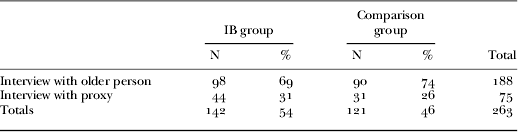
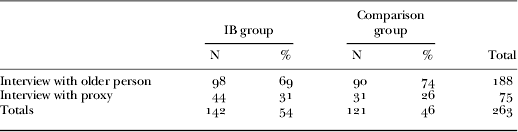
Older people constituted 27 per cent (N=263) of the total sample of 959 service users who took part in the study. Structured outcome interviews were conducted with each of them six months after they had been randomised to the IB group (N=142) or the comparison group (N=121), to examine the early outcomes of IBs. Interviews ran throughout 2007 but were concentrated toward the latter end of the year as a result of implementation delays in the pilot sites. The characteristics of the sample of older people interviewed are illustrated in Table 1.
Characteristics of the sample of older people taking part in the structured interview by age, gender and ethnicity

Notes: N=263. BME: Black and minority ethnic.
The majority of interviews were conducted face-to-face, with a minority conducted over the telephone owing to personal preference or logistical difficulties. Of the 263 interviews with older people, 31 per cent in the IB group and 26 per cent in the comparison group were conducted with a proxy, as illustrated in Table 2.
Breakdown of interviews by Individual Budget (IB) group and use of proxy interviewees
Standardised outcome measures used in the evaluation included the 12-item version of the General Health Questionnaire (GHQ-12) (Goldberg Reference Goldberg1992) to assess psychological wellbeing; a single quality of life question using a seven-point scale (Bowling Reference Bowling1995); the Adult Social Care Outcome Toolkit (ASCOT) which assesses the impacts of social care interventions on an individual's quality of life (Netten, Forder and Shapiro Reference Netten, Forder and Shapiro2006); and a measure of self-perceived health, which has been found to be a reliable predictor of objective health and closely associated with overall wellbeing (Ferraro Reference Ferraro1980; Palmore and Luikart Reference Palmore and Luikart1972) (for full details see Glendinning et al. Reference Glendinning, Challis, Fernandez, Jacobs, Jones, Knapp, Manthorpe, Moran, Netten, Stevens and Wilberforce2008). Analysis of the data compared outcomes between the IB and comparison groups using parametric statistical tests on these outcome measures. The relationships between outcomes and other factors were explored using multivariate analyses.
Semi-structured interviews with older people and their proxies
A sub-sample of 130 older and disabled people (and/or their proxies) in the IB group were interviewed two to three months following the offer of an IB, between February and October 2007. Of these, 40 (the largest group) were conducted with older people or their proxies from across the eight pilot sites offering IBs to older people. The sub-sample of older people who took part in the qualitative interviews consisted of: 14 aged 60–74 years, and 26 aged 75 and over; 25 females and 15 males; six self-defined as from Black and minority ethnic (BME) communities; 30 with physical disabilities, eight with mental health problems, one with a learning disability and one described as ‘vulnerable’. Of the 40 interviews, nine were conducted solely with the older person themselves; 19 were conducted with the older person and their proxy (11 partners; eight sons/daughters/daughters-in-law/granddaughters); and 12 solely with the proxy (nine adult offspring and three partners).
The interviews aimed to explore older people's experiences of planning how to use their IB. The topic guide was semi-structured with open-ended questions. It contained sections on: interviewees' circumstances at the point when they were first offered an IB; their knowledge and understanding of IBs, including anticipated advantages and disadvantages of IBs; experience of the (self-)assessment process; understanding how the IB was calculated; planning how to use the IB, and any help they had received with this; expectations and early outcomes of having an IB; and any anxieties about managing the budget or the services funded from it.
Interviews were conducted face-to-face and recorded with consent. Transcripts were coded using MaxQDA. Three researchers carried out the coding; the coding frame was developed collaboratively and iteratively, guided initially by the interview schedule and latterly informed by the data. Data from the qualitative interviews were analysed using the Framework approach (Ritchie and Spencer Reference Ritchie, Spencer, Bryman and Burgess1994).
Semi-structured interviews with IB lead officers
Senior social work staff leading the IB pilots across all 13 sites took part in face-to-face semi-structured interviews during the early stages of the IB pilots in summer 2006 and again toward the end of the pilots in the autumn of 2007. Interviews with IB lead officers covered their actual experiences of IBs. During the first round of interviews questions to IB lead officers included how they thought older people (and other groups) would fare with an IB compared to conventional social care services. During the second round of interviews IB leads were asked to reflect on their experiences of implementing IBs for older people (and other groups). Interviews were tape recorded (with consent); transcripts were coded using MaxQDA, and were analysed by a single researcher using the Framework approach (Ritchie and Spencer Reference Ritchie, Spencer, Bryman and Burgess1994). This paper reports the findings in relation to older people.
The quantitative findings are presented first as they provide robust outcome data. The two sets of qualitative data are then presented as, despite the time lag between the different sets of data collection, they suggest possible reasons for the quantitative findings (subject to limitations, see the Discussion).
Ethical approval
The research was undertaken before the Mental Capacity Act 2005 was implemented in 2007, and followed the ethical procedures in force at the time in the UK in relation to gaining consent if people were unable to consent for themselves. The research team sought advice from care managers and sometimes family carers about the ability of each older person to consent to, and take part in, the research. Where an older person was not able to take part in the interview directly, even with support, because of severe cognitive or communication impairment, an interview was conducted with a proxy, usually a family member or support worker. However, every effort was made to involve the older person themselves. The study received full ethical approval from a National Research Ethics Service (NRES) Research Ethics Committee and the sponsoring university. It was also supported by the Association of Directors of Adult Social Services (ADASS) Research Committee and was granted Research Governance approval in all 13 pilot sites.
Findings
Quantitative findings from structured interviews with older people and proxies
This section provides a brief overview of the key quantitative findings for older people based on the structured outcome interviews conducted six months after the offer of an IB. There were no statistically significant differences between the IB group and the comparison group at baseline, thus statistically significant differences in outcomes between the two groups could be attributable to the IB.
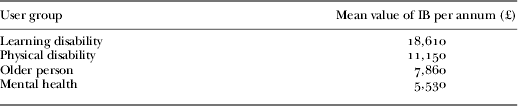
The mean value of an IB for an older person was less than that for working-age people with physical disabilities and much less than for people with learning disabilities, though slightly more than that received by people with mental health problems (see Table 3).
Mean value of the Individual Budget (IB) by user group
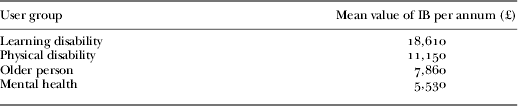
Across both the IB group and the comparison group, the value of the support (either the IB or conventional social care services) received by an older person was consistently less than that received by a younger disabled person with similar activities of daily living (ADL) restrictions.
The most common way that older people chose to receive their IB was in the form of a cash direct payment (just over one-third of older people chose this deployment option). The second most popular option was to have the IB managed by the local authority; the third most popular option was to have payments paid into a joint bank account held by the older person and another person; the least popular option was to have the IB administered through a third party.
The majority of older people (53 per cent) used their IB to purchase conventional mainstream services (including home care, meals, equipment and adaptations, accommodation, short breaks and transport) and personal assistance (41 per cent). Only 15 per cent of older people spent part of their IB on leisure activities. This was a very small percentage in comparison to the younger people in the study, where between 42 and 65 per cent of service users had purchased some form of leisure activity.
Analysis of data on outcomes, collected six months after the offer of an IB, showed poorer results for older people, compared to younger IB holders. The GHQ-12 measure showed that 45 per cent of older people in the IB group scored above the threshold for psychological ill-health compared to just 29 per cent of older people in the comparison group (p<0.05). Older people in the IB group also reported significantly lower wellbeing on the GHQ-12 measure than older people in the comparison group. The ASCOT measure found no statistically significant differences between older people in the IB and comparison groups, suggesting there was no improvement in social care outcomes to older people from IBs. However, additional regression equations showed that IBs were associated with better ASCOT scores for those for whom the IB support plan had been implemented, suggesting potential benefits of IBs for older people. Self-perceived health was worse among older people in the IB group compared to both older people in the comparison group and all other service user groups offered IBs. Finally, conventional support arrangements appeared marginally more cost-effective than IBs for older people based on the GHQ-12 outcome measure. Together these findings suggest no objective collective benefits of IBs for older people, and no benefit to public finances either.
The qualitative interviews with a sub-sample of older people and their proxies conducted earlier in the IB process suggest some concerns that may have contributed to these largely negative findings. Additional factors that may have contributed to these findings were suggested by the IB project leads.
Qualitative findings from semi-structured interviews with older people and proxies
This section reports on in-depth interviews conducted with the sub-sample of 40 older people and their proxies (from this point, the term ‘older people’ includes proxies, unless otherwise stated). It looks at older people's plans for using their IBs, experiences of support planning, (anticipated) advantages of IBs, and concerns about IBs. These interviews were conducted two to three months after the offer of an IB and some four months prior to the structured outcome interviews. Older people mostly talked about the potential benefits and drawbacks of IBs as they were only at the early planning stage; however, a few did have new IB-funded arrangements in place at the time of interview. Although it is not possible to comment on whether anticipated benefits and/or difficulties materialised for these particular sample members, the quantitative findings suggest that for the sample of older people as a whole some of the anticipated difficulties did come to fruition.
Plans for using the IB
Interviewees were asked about their plans for using the IB. In contrast to other user groups offered an IB, older people were more likely to report plans based on personal care and domestic support and less likely to report any wider plans, including leisure and recreational activities that might improve their physical or mental health or wellbeing. The lower levels of IBs awarded to older people typically restricted the ability to use the IB on anything other than personal care and domestic support.
However, where funds did allow, some older people's plans also included using their IB to purchase small pieces of equipment, including rails to aid mobility; bathroom adaptations to make personal care easier; personal alarm systems; adapted footwear; and a special chair – all of which could help to improve safety and quality of life. A few older people planned to use their IB to purchase respite care. Only a small number of older people reported that they would use part of their IB to fund social or leisure activities. One older person discussed plans to:
… get out once a week, either go swimming or [to] a museum or an art gallery, beyond my two hours care worker a week and that made it – well, that was the turning point ‘cause I need to get out, you know, and I thought that was going to help me really, you know, really well.
Other plans for using IBs included transport costs to enable the older person to continue to attend church; money to maintain hobbies and attend related courses; support to attend community activities; and money to purchase a computer and broadband router to enable the older person to retain independence through, for example, shopping via the internet. For some, there were plans to use the IB to pay someone to accompany them on outings; others indicated they would rather spend such times with family or friends and be able to compensate them financially for their assistance (see below). However, only a minority of older people had a large enough budget to enable them to spend any part of their IB on such wider social activities.
Contingency planning was also mentioned by a small number of older people. For example, the husband of one older person reported that he would save a little money from the IB in order to purchase agency care while his wife's personal assistant took holidays. However, the funding would not be sufficient and the husband expressed concern that he would be unable to cope without additional financial support (i.e. a bigger IB).
Support planning
Most older people reported receiving some help with support planning (assistance with planning how to use their IB) from care managers/social workers, independent support planners/brokers, family members or voluntary organisations; but a few reported receiving no help at all. Support was most needed by those who had chosen to take the IB as a cash DP and typically involved identifying the costs of various services or support options, recruiting staff, writing the support plan, and allocating the budget. Help with costing and planning their new support arrangements eased the pressure on both IB holders and their families:
I couldn't fault that, a hundred per cent, it's, you know, and he's [the broker] there on the phone when I'm, you know, ‘cause administrative-wise, you know, with things like holidays and maternity leave and all that sort of thing, so … I couldn't have done that at all, I wouldn't have known.
However, help with support planning was necessary for all IB holders if they were to play a role in planning how their IB was spent, even if they did not hold and manage the budget themselves. For example, an IB holder whose budget was managed by the local authority could state their preference over which care agency was used, what time of day support was provided, whether some of their IB could be spent on tasks or activities other than essential personal care and so on. Thus they also needed access to support and information.
Some older people reported finding the support planning process exciting or rewarding as they felt that they were actually being listened to:
I mean at the present moment I'm sort of just a number. I mean I can't do nothing, I'm more or less a cabbage sat in the chair. I mean I've been trying for two years now and … at last somebody seemed to take notice.
While some found the experience relatively straightforward, others found support planning challenging:
It has been frightening doing it, yeah, very frightening. It could be worked out and it could be made a lot easier, well I think it could anyway. ‘Cos I suffer with my nerves and I'm frightened of things, it's been hard work.
Others reported similar initial fears but overcame their concerns:
The paperwork, it was beginning to addle me brain (laughs). And it was only a couple of days and then I got over it, and after that it's not bothered me since, it was just something that, I suppose in a way, built up, you know, I kept thinking about it and, you know.
Experiences of help received with support planning were overwhelmingly positive, with reports that good support, clear timely advice and information could be very empowering. Good support planning could enable an individual to state both their essential care and support needs and also voice their wishes and aspirations beyond essential care, for example to be supported to attend community activities or go shopping, if there was enough money in their IB to purchase more than essential personal care.
Potential advantages of IBs
In contrast to the sometimes paternalistic assumptions of care managers concerned that older people would struggle to manage their own budgets or support arrangements, some older people themselves could see lots of potential advantages to IBs, primarily greater opportunities for choice and control, compensating family and friends for the help they provided, respite, and improved wellbeing and social participation.
A small number of older people had their IB-funded support arrangements in place at the time of interview and some reported actual benefits of IBs. People valued ‘being able to go to church, having someone come in to make the bed and prepare vegetables for me’. There were also some examples of people getting used to the administration, with it becoming less daunting over time, especially as support was generally freely available to IB users to manage their payroll and paperwork. Those older people with the IB in place reported that help from family members was necessary both during the support planning stage and in actually managing the budget in order to realise the benefits of IBs.
The majority of older people who took part in the semi-structured interviews did not have their IB in place and thus spoke of potential or anticipated benefits. Many older people anticipated greater independence, choice and control as a consequence of having an IB. Although several older people expected to purchase only personal care, they nevertheless anticipated being able to secure some improvements in the quality of that care, for example by employing or requesting one care worker. Building up a relationship with one care worker was expected to promote dignity and privacy, enhance senses of safety and security, and improve the quality of support:
Mum likes to see the same person every time and that appealed to me … we're getting the same person so mum looks forward to it and says ‘Oh, is [care worker] coming today?’
Older people also hoped that being able to specify more convenient times for care would improve their wellbeing:
It's more accommodating, he [older person] can do things when he wants to do them now, yeah he can get up when he wants to get up, he can do his dishes when he wants, you know, when he wants them and he can even have his food prepared for him the way he wants them, rather than eat microwave food every day, yeah … they didn't do his ironing so he used to wear clothes without ironing. So now he's, he's more happy.
Another older person explained that while her existing social care arrangements focused solely on meeting her needs for personal care, she hoped that she could use her IB more flexibly to take care of some of those ‘other things’ – for example, shopping and housework – that could further improve her quality of life:
That's all they recognise, just your personal care, being washed and, and all that and the end of, you know, and other things are so much more important to your wellbeing. It's very frustrating when you can't do these things and you've got to sit and look at them, you know, building up around you, that's not good for you at all. It drags you down even further.
Some older people hoped to be able to use their IB to ‘treat’ or financially compensate family and friends for some of the care they provided, which they also hoped would reduce feelings of guilt and burden. This ranged from employing family members to being able to contribute towards petrol money or give regular ‘gifts’ or small amounts of ‘pocket money’:
… it'd be nice to have a bit of cash to give ‘em [grandsons who provide a lot of help] as a treat.
The potential to employ a family member or a carer of one's own choosing appeared particularly beneficial to BME older people. For example, an older person from Poland employed a Polish live-in carer with whom she had a shared culture and language.
Respite or short breaks were predominantly cited by family carers (proxy interviewees) as a potential advantage of IBs. Some proxy interviewees hoped that, for example, the IB could be used: to pay for somebody other than the family carer to be called out when the older person used their personal alarm; to purchase additional support to relieve pressure on a daughter who was struggling to cope; and to pay somebody other than the family carer ‘to take mum out in the wheelchair for half an hour here or there’, or provide care if the carer was sick or on holiday. These relatively small changes were expected to have a significant positive impact on the health and wellbeing of both the family carer and the older person, by reducing pressure on the former and reducing feelings of guilt or burden among the latter.
A small number of older people hoped that an IB would improve their wellbeing and social participation by enabling them to purchase more support or finance a hobby or activity. These potential benefits were expected to ease family pressures, contribute to a greater sense of independence or self-worth for the older person, and/or provide benefits associated with wider social participation:
Extra finance would mean we could afford more visits from the care [worker].
I've not got a lot of money and this would mean I could buy one tool per week or one ink or one magazine.
The latter interviewee commented that even though he was not yet in receipt of his IB, just the anticipation of using it had already led to an improvement in his mental health.
However, the lower levels of IBs for older people meant that only a small number of older people could actually use their IB to purchase more than basic services and personal assistance and thus could not take advantage of some of the potential benefits of IBs.
Concerns about the IB
Most older people reported concerns about IBs compared with conventional care services. For some older people these concerns dominated their experiences, for others they counterbalanced the more positive expectations of IBs. Older people who had chosen to take their IB as a cash DP raised concerns about the administrative responsibilities associated with managing their budget; employing personal assistants; or over- or under-spending the budget or accidentally spending the budget on inappropriate goods or services. Some felt that the administration was or would be too difficult. For example, the wife and carer of one older IB holder confessed:
I think this will be difficult for, I mean I'm not no paperwork person at all, I think it would be difficult for anybody older …, I mean [husband] wouldn't be able to understand it without me.
While some older people felt able to manage the paperwork and administrative responsibilities, some simply did not wish to have that worry at their time of life:
I understand you have got to start keeping records and you'd have to have receipts and I've done that all my life and don't want to start that again.
Older people also reported anxieties about the management and administration of the budget: ‘What if I overspend?’, ‘I don't want to owe people money’, ‘What if there is no money left?’, ‘What if they cut my budget?’, ‘I can't recruit anyone!’
The possibility of directly employing staff (personal assistants) through an IB also led to anxiety as this was anticipated to carry more responsibility and risk for the user. Several older people reported fears that relationships with directly employed care workers could break down, resulting in (potentially unfair) dismissals, threats of legal action, and older people possibly being left temporarily without care. This was contrasted with situations where, if a relationship with an agency care worker broke down, a replacement would be available.
The lower levels of IBs for older people meant that they had less freedom to choose how to spend the IB. Indeed, many older people reported that their IBs were only enough to fund essential personal care. In such cases the extra responsibility associated with managing an IB was generally felt not to be worthwhile if the IB could only stretch to cover the same type and/or amount of care or support that the older person had been receiving under conventional social care arrangements:
… if she needed constant 24 [hour] attention, it'd be probably worthwhile seriously considering but with the care plan that she's got at the moment, I actually feel it [the IB as a DP], it poses more restrictions than what it gives benefits.
Further, some older people reported that they did not want any changes to their current support services, and did not want the increased responsibility of exercising greater choice or control:
Carers are all laid on for me at the moment and I haven't got the time and I haven't got the brain really to work out financial details or anything like that, and I'm quite happy with the arrangement I've got.
Qualitative findings from semi-structured interviews with IB leads
In interviews during the early stages of the IB implementation process (summer 2006), IB lead officers from each of the 13 pilot sites were asked how they thought each user group would fare with an IB compared to conventional services. Toward the end of the pilots (autumn 2007) IB leads were interviewed about their experiences of implementation amongst each user group. There was a high degree of consistency in their responses relating to older people. Several hypotheses were raised which may help to explain why, on the whole, older people did not appear to benefit from IBs. First, IB lead officers argued that older people were more likely to enter the social care system at a time of crisis, e.g. on discharge from hospital, when their needs were greatest, when there was little time to set up services, and when older people themselves had less energy or capacity for detailed support planning. Second, older people who were eligible for social care services tended to have chronic disabilities and health problems and thus were less likely to feel up to setting up and managing an IB. Third, the current generation of older people was argued to be deferential to welfare professionals (perceived as experts) and lacked the confidence to work out their own support arrangements, employ personal assistants, and manage their own budgets. For example, the IB lead in one site commented:
… people start – especially older people – they don't want to change what they've got; they don't want to – they feel that the Social Worker is the expert and if self-assessment is mentioned to them or doing their own Support Planning, then, you know, they start getting really anxious.
However, some IB lead officers expected this to change if future generations had a more consumerist approach and demanded greater choice and control. Fourth, IB lead officers argued that there was less margin for flexibility with older people's IBs as older people received relatively little to begin with. Consequently, IB leads reported that some older people did not want an IB as the responsibility of managing it may not be outweighed by the few anticipated benefits. This echoes the concerns raised by older people themselves.
Fifth, the majority of IB leads in sites that had offered IBs to older people found that older people's care management teams had struggled most with the concept of IBs and with devolving more choice and control to the user. IB lead officers reported that care managers working with older people tended to be relatively paternalistic, protective and risk-averse, and did not feel that older people could cope with managing an IB and did not want to ‘burden’ them with the extra responsibilities. Sixth, IBs may create additional work and responsibilities for the families/family carers of older people, as in many cases the recruiting of personal assistants, payment of wages and national insurance, arranging cover, etc., was taken on by the typically elderly partners or adult children of the IB user. This was argued to be an additional burden for partners who might also be in poor health or for adult children who worked and had families of their own.
However, IB lead officers also reported two potential benefits of IBs that may be particularly pertinent to older people. First, it was reported that IBs could be especially beneficial to older people with dementia and some other cognitive impairments if the IB could be managed by the local authority or a third party, as the opportunity to employ one care worker or to pay family carers was perceived to be particularly beneficial for those who needed familiarity and routines. This potential benefit was reported by older people themselves.
Second, some IB lead officers argued that the additional work involved with support planning and possibly managing one's own IB (if taken as a DP) could be offset by the potential benefits for all older people. Having control over who provides care meant that older people could request support from those that they already knew and trusted, whether this be a family member, friend, neighbour, or employed personal assistant. Indeed, some IB leads found that, contrary to expectation, a larger than expected percentage of older people had opted to take their IB as a DP and thus to manage the money themselves. IB leads linked this finding to a number of factors: the fact that older people could take a DP without having to be an employer; better ‘marketing’ of DPs by care managers as they gained a stronger understanding of the alternatives; and the fact that individuals could mix and match deployment options and experiment with a DP while having other aspects of their care directly commissioned by their care manager.
Discussion
In summary, the quantitative findings (from data collected six months after the offer of an IB) showed that, on average, older people in receipt of IBs received smaller budgets than other user groups with similar ADL scores, highlighting the continuation of inequitable funding for older people; slightly more IBs for older people were taken as cash DPs compared to other deployment options; most older people spent their IBs on meeting personal care needs, with far fewer older people than other user groups spending any of their IB on wider social or leisure activities. Analysis of the standardised outcome measures showed that older people in the IB group had higher levels of psychological ill-health, lower levels of wellbeing, and worse self-perceived health than older people in the comparison group (see also Netten et al. forthcoming). Overall, older people in the study did not appear to benefit from IBs. Potential explanations for these largely negative findings were raised during qualitative interviews with a sub-sample of older IB users (just two months after the offer of an IB) and also by the IB project lead officers (at the start and end of the IB pilot).
The qualitative interviews with a sub-sample of 40 older people and their proxies found numerous potential advantages of IBs, broadly categorised as greater choice and control; flexibility; respite; and improved wellbeing and social participation. However, interviewees also reported concerns about IBs, in particular the financial and practical management of the IB among those who were considering taking the IB as a cash DP and thus needed to recruit staff; pay wages, tax and insurance; and arrange for cover while the care worker was on holiday. More general concerns reported by older people and by IB lead officers included the lack of flexibility associated with IBs that could only stretch to fund basic personal care, and therefore appeared to offer few benefits.
Some older people reported finding support planning to be very rewarding as they felt that their views and wishes were being listened to. Others found support planning a challenge through fear of ‘getting it wrong’, choosing inappropriate support or, for those receiving their IB as a cash DP, fears of over- or under-spending. Overall it was reported that good support and clear timely advice and information from those assisting with support planning could be very empowering and, budget permitting, could allow IB users to plan to meet some of their wider aspirations as well as their basic care needs. With support, such holistic support planning was possible whether the IB was managed by the older person, a third party or the local authority.
Cash-for-care schemes for older people: lessons to be learned
The findings presented relate to the piloting of a cash-for-care scheme in England. Older people's experiences of this scheme will have been shaped by their previous experiences and expectations of services; and by the organisational frameworks within which IBs were offered, including the expectations of care managers, support planning organisations and provider organisations. However, there are lessons to be learned about the benefits and challenges of cash-for-care schemes for older people from the piloting of IBs.
First, the semi-structured interviews suggested that, for some older people, the responsibilities associated with receiving an IB, especially as a cash DP, and managing their own budget could outweigh the benefits, particularly for those who did not wish to change their support arrangements and those whose IBs were too small to permit any significant changes. Deploying IBs as a cash DP may not be appropriate for those who prefer not to have these financial and other responsibilities. However, although some people may prefer to receive their support in the form of conventional council-provided or -commissioned services, they may still wish to exercise the same level of choice and control as those receiving IBs in the form of a cash DP, for example by choosing what time an agency carer calls to get them dressed. Access to information and informed decision-making is important, irrespective of the deployment mechanism (see also Baxter, Glendinning and Clarke Reference Baxter, Glendinning and Clarke2008). For those who do take their IB as a cash DP, help and advice with advertising, recruitment, payroll and personnel issues, etc., is crucial, particularly for those who are sick, vulnerable or easily confused, including some older people. Earlier research had shown that relatively few older people took up DPs when they became an available option, for many of the same reasons noted here. Until these issues and concerns are adequately addressed, many of the potential benefits of IBs, or personal budgets (IBs consisting solely of adult social care funding), may be lost to older people.
Second, despite the challenges outlined, choice and control over who provides help and support, and when and how this help is provided, are important to older people's quality of life. This was clear from both the structured and the semi-structured interviews. Thus, with enough resources and support, cash-for-care schemes can be beneficial to older people.
Third, the potential benefits of IBs – choice, control, flexibility, etc. – can only be fully realised with a sufficiently large IB. The mean value of IBs was less for older people than for working-age adults with disabilities. This illustrates the inequity in the social care resources available to fund support for older and younger people, which was in turn reflected in the RAS. Older people were also not eligible for some of the other funding streams to be integrated into IBs, which further reduced the average levels of their IBs. Most older people only spent their IB on personal care and domestic support; meeting personal care needs was a priority and there was little spare money once those needs had been met. Given the low levels of IBs for older people, the potential benefits of IBs were often insufficient to outweigh the concerns, and many older people were unable to experience some of the benefits of IBs that were reported by younger disabled people whose IB levels were higher. IBs would be more appealing to older people if the potential benefits could be more fully exploited.
Fourth, the introduction of cash-for-care schemes may involve an element of cultural change, for both older people and professionals. Even with adequate funding, exercising ‘consumer’ choice may not come easily to those accustomed to deference to ‘expert’ welfare professionals. Some older people in particular may also wish to remain with existing services that they know and trust. This may change with future cohorts of older people who are more accustomed to consumerism. However, in order to benefit from such consumer choices, older people need to be offered a sufficient level of resource to enable them to exercise choice and control both in the personal care they need and in any other opportunities to improve their health and wellbeing. Cultural change may also be required among professionals and support agencies working with older people as changes in their attitudes and activities will affect service users' views, experiences and access to cash-for-care schemes (Ellis Reference Ellis2007). The paternalistic concerns of care managers working with older people could partly explain why local authority-managed IBs were more common among older people than among other user groups: care managers were less confident that older people could cope, and want to be bothered, with managing their own budget and/or support arrangements.
Changing political contexts
There has been remarkable consistency in political support for cash-for-care schemes in England. Such schemes have been developed and implemented across three different administrations: Direct Payments were initiated by a Conservative government and implemented by a Labour government; and Individual Budgets (now Personal Budgets) were implemented by a Labour government and continue to be supported by the current Coalition government. Similarly, the Coalition government retained the commitment to carers and to personalisation (Department of Health 2010) that was originally stated in the Labour government's English National Strategy for Carers (HM Government 2008: 61–3). Such relative consistency in UK policy, plus the commitment to cash-for-care schemes in many developed welfare states, suggests that cash-for-care schemes are embedded in adult social care and will remain despite the current economic climate. This highlights further the importance of learning lessons from the IB pilots to improve the impact and outcomes of cash-for-care schemes on older people, their carers (see Glendinning et al. Reference Glendinning, Arksey, Jones, Moran, Netten and Rabiee2009; Moran et al. Reference Moran, Arksey, Glendinning, Jones, Netten and Rabiee2011) and indeed all service user groups.
Limitations of the study
The study overcame many of the limitations identified in Arksey and Kemp's review of cash-for-care schemes (2008). It compared outcomes between recipients of a cash-for-care scheme and users of conventional services; the randomised controlled trial design ensured that the study was free from selection effects; the study utilised well-validated standardised outcome measures in the six-month structured interviews in addition to the in-depth qualitative interviews with a sub-sample of the population; measures of the costs and cost-effectiveness of the IB pilots were included; and the study had a longitudinal dimension as the outcome interviews were conducted six months following randomisation. However, there are limitations to the study. First, the semi-structured interviews with older people were conducted at a different point in time to the structured outcome interviews (at two months and six months after the offer of an IB, respectively). It was not possible to link the anticipated advantages and disadvantages of IBs reported in the semi-structured interviews to individual outcomes in the structured interviews. However, although the semi-structured interviews were conducted before the quantitative outcome interviews, the earlier experiences of older people provide some useful suggestions as to possible reasons for those outcomes, and could provide useful hypotheses for further exploration. The (generally negative) direction of findings from both data sets suggests that the poorer outcomes for older people in the IB group compared to the comparison group may partly be explained by the concerns raised by older people in the semi-structured interviews. The less positive findings were also consistent with the views of IB project lead officers who were able to comment on actual experiences of IBs for older people toward the end of the pilots.
Second, the follow-up period from consent to the collection of outcome data was only six months. In some cases this did not give enough time for the IB and support plan to be in place (or to be in place for long) by the time of the structured interview (see Glendinning et al. Reference Glendinning, Challis, Fernandez, Jacobs, Jones, Knapp, Manthorpe, Moran, Netten, Stevens and Wilberforce2008). However, some older people reported finding the support planning process itself to be empowering and uplifting. Until IB-funded support arrangements were in place, service users in the IB group would be in receipt of conventional social care services or support funded through their existing DPs. This impacted upon the user-level outcomes in the quantitative analysis. For example, regression equations showed that IBs were associated with better ASCOT scores, thus better social care outcomes, for those for whom the IB support plan had been implemented (see Glendinning et al. Reference Glendinning, Challis, Fernandez, Jacobs, Jones, Knapp, Manthorpe, Moran, Netten, Stevens and Wilberforce2008: 103–4). It is possible that the positive (and the negative) outcomes associated with IBs would have been greater if all IB support plans had been in place at the time of the interviews.
Third, the findings are based on the evaluation of pilot projects and thus may reflect ‘pilot effects‘. Early stages of pilots may experience problems that are subsequently overcome, thus there are questions over the generalisability of findings from this pilot study. The 13 local authority pilot sites had purposely applied for pilot status, thus their contextual factors, motivations and priorities may differ to those of other local authorities.
In conclusion, this paper has contributed new empirical evidence – drawn from a robust randomised controlled trial and from the individual experiences of older people – to research on cash-for-care schemes for older people. It has also highlighted some institutional and cultural features that may need to be taken into account if lessons are to be learned and older people are to benefit from cash-for-care schemes. The mixed-methods approach to the study produced rich data which enabled commentary on both the experiences, and the outcomes, for older people of a new cash-for-care scheme in England. It therefore offered a more nuanced account than some previous analyses of cash-for-care schemes. Primarily, the paper gave voice to the aspirations, concerns and experiences of a sample of older people during the early stages of the IB process, and considered potential reasons for the largely negative findings for this user group.
Acknowledgements
The research upon which this paper is based would not have been possible without the help of many people across the 13 Individual Budget pilot sites; within our respective universities and research units; and in the Department of Health. We are grateful to all those service users, their families and carers who agreed to participate in the study; and to the local authority staff at all levels who took part in interviews. We also thank our interviewers, in particular Janet Bower, Judith Argles, Wendy Burt and Brenda Feeney, for their thorough work.