INTRODUCTION
Hosts and parasites exert strong influences on each other. Parasites negatively impact host fitness and can alter a multitude of host traits (e.g. feeding rates; Searle et al. Reference Searle, Gervasi, Hua, Hammond, Relyea, Olson and Blaustein2011, coloration; Bakker et al. Reference Bakker, Mazzi and Zala1997 and anti-predator behaviour; Berdoy et al. Reference Berdoy, Webster and Macdonald2000). Given their impacts on host fitness, parasites can drive evolution of their host populations (Boots et al. Reference Boots, Best, Miller and White2009; Duffy and Forde, Reference Duffy and Forde2009). Similarly, hosts can impose strong selective pressures on their parasites and drive parasite evolution (LoVerde et al. Reference LoVerde, DeWald, Minchella, Bosshardt and Damian1985; Thrall and Burdon, Reference Thrall and Burdon2003). Indeed, parasites often evolve rapidly (reviewed in Ebert, Reference Ebert1998; Altizer et al. Reference Altizer, Harvell and Friedle2003).
Hosts can also influence parasites via phenotypic plasticity (Reece et al. Reference Reece, Ramiro and Nussey2009). Plasticity is common in many organisms, but rarely studied in parasites. However, the rearing environment (the infected host) can potentially shape the phenotype of a parasite. A parasite's phenotype can respond plastically to host age, resource availability, coinfection, and the progression of infection (Reece et al. Reference Reece, Ramiro and Nussey2009; Mideo and Reece, Reference Mideo and Reece2012; Cameron et al. Reference Cameron, Reece, Drew, Haydon and Yates2013; Leggett et al. Reference Leggett, Benmayor, Hodgson and Buckling2013; Cornet et al. Reference Cornet, Bichet, Larcombe, Faivre and Sorci2014). The signature of this plasticity, however, depends on the cause. In successive infections, parasites may respond plastically to better infect their current type of host (e.g. a particular host genotype or species). This ‘parasite memory’ mechanism (coined here; analogous to immunological memory) could benefit a parasite if it frequently infects the same host type over multiple generations (e.g. when hosts have strong social or spatial structure; Sicard et al. Reference Sicard, Pennings, Grandcement, Acosta, Kaltz and Shykoff2007; Craft et al. Reference Craft, Hawthorne, Packer and Dobson2008; Godfrey et al. Reference Godfrey, Bull, James and Murray2009 or when transmission across species is rare; e.g. Begon et al. Reference Begon, Hazel, Baxby, Bown, Cavanagh, Chantrey, Jones and Bennett1999). Experimentally, ‘parasite memory’ should produce a particular interaction pattern where parasites are reared in certain host genotypes (rearing hosts), then used to infect a new set of hosts (exposed hosts). Specifically, with ‘parasite memory’ parasites should best infect the host type in which they were reared, but infect other host types less successfully (yielding a significant ‘rearing host’בexposed host’ interaction). Alternatively, differences in within-host environments may produce generally ‘good’ or ‘bad’ quality parasites. In this case, plasticity most likely results from differences in the quality of the hosts as an environment for the parasite. We describe this pattern of plasticity as ‘host quality’ and predict that it should produce an overall host-rearing effect in factorial experiments as opposed to the interaction described above.
With either mechanism, parasite plasticity remains difficult to quantify. The challenge is that parasites can evolve on very short time scales (reviewed in Ebert, Reference Ebert1998; Altizer et al. Reference Altizer, Harvell and Friedle2003). As a result, it can be hard to quantitatively disentangle phenotypic plasticity from genotypic changes. If it is possible to track relative frequencies of parasite genotypes through time, then we can statistically partition quantitative changes in parasite traits into effects of rapid evolution, environment, or phenotypic plasticity (using the Price equation; Ellner et al. Reference Ellner, Geber and Hairston2011). Alternatively, if we could halt or eliminate parasite evolution in an experimental setting, we could directly quantify host effects on plasticity of parasites.
Here, we employ the latter approach using an unusual parasite that lacks detectable genetic variation. The fungal parasite, Metschnikowia bicuspidata (hereafter: Metschnikowia) commonly infects Daphnia (Cáceres et al. Reference Cáceres, Hall, Duffy, Tessier, Helmle and MacIntyre2006). Previous studies have not detected variation in infectivity or virulence of this parasite when reared in a common environment (i.e. a common host genotype: Duffy and Sivars-Becker, Reference Duffy and Sivars-Becker2007). In addition, the parasite has not responded to selection in laboratory experiments (Duffy and Sivars-Becker, Reference Duffy and Sivars-Becker2007; Auld et al. Reference Auld, Hall, Ochs, Sebastian and Duffy2014). Furthermore, isolates of Metschnikowia collected in North America and Europe have identical genetic sequences at the internal transcribed spacer (ITS) region (Wolinska et al. Reference Wolinska, Giessler and Koerner2009). Such genetic results seem unusual given the high variability of the ITS region in most fungi (Peay et al. Reference Peay, Kennedy and Bruns2008), but we confirm them in the present study using additional isolates. With the combination of common garden studies, selection experiments, and molecular studies indicating little to no genetic variation, plasticity is potentially the major source of phenotypic variation in this parasite. Therefore, this system offers a rare opportunity to quantify ecologically relevant parasite plasticity without confounding effects of host-mediated selection on parasites.
In this study, we quantify parasite plasticity using a suite of experiments to discern between our ‘parasite memory’ and ‘host quality’ mechanisms. Each experiment measures infection prevalence of ‘exposed hosts’ when exposed to infectious propagules (Metschnikowia spores) generated previously in ‘rearing hosts.’ It is common to attribute variation in infection prevalence to genetic variation of hosts or parasites. However, we confirm a lack of detectable genetic variation in our parasite, and account for genetic variation in our host (which is well-documented in previous studies; Duffy and Sivars-Becker, Reference Duffy and Sivars-Becker2007; Duffy et al. Reference Duffy, Ochs, Penczykowski, Civitello, Klausmeier and Hall2012; Auld et al. Reference Auld, Penczykowski, Ochs, Grippi, Hall and Duffy2013) in our statistical models. This leaves us with two other possible sources of variation in infection prevalence: (1) phenotypic plasticity of parasites driven by their ‘rearing host’ and (2) phenotypic plasticity of ‘exposed hosts’ that affects parasite contact rate or per parasite susceptibility. We use an experimental protocol designed to minimize plasticity in exposed hosts. Thus, our experiments focus primarily on the potential for phenotypic plasticity of parasites driven by the ‘rearing host.’ Overall, we found strong evidence for rearing-based plasticity of parasites arising from a ‘host quality’ effect.
MATERIALS AND METHODS
Overview
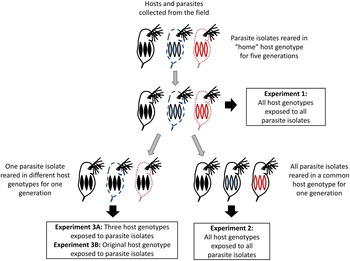
We conducted a suite of experiments that led us to support a ‘host quality’ mechanism of rearing-driven parasite plasticity. The first experiment established the possibility of plasticity due to rearing effects. We collected parasite isolates from different lakes and reared each isolate in a host genotype collected from the lake of origin. The pattern of variation that emerged was consistent with ‘host quality’ (rearing host/parasite isolate effects without interactions). However, this design confounded ‘rearing host’ with identity of the parasite isolate, and therefore did not exclude the possibility that genetic differences among parasite isolates drove variation in infection prevalence. Thus, in our second experiment, we grew those same parasite isolates in one host genotype to remove rearing effects. This common garden experiment showed no variation remaining among parasite isolates (i.e. no variation explained by genetic differences between parasite isolates, as expected). Thus, plastic effects via ‘host quality’ likely drove the rearing host/parasite isolate effect in the first experiment. In a third experiment, we confirmed the ‘host quality’ mechanism and variation driven by parasite plasticity. We induced rearing-based plasticity by growing one parasite isolate in three host genotypes for one generation. After factorially exposing those spores to the same three host genotypes, we found a main effect stemming from ‘rearing host’ with no interactions. A similar trial showed no evidence for plasticity, indicating variation in the inducibility of plasticity. However, our factorial results confirm that rearing-based plasticity of parasites arose from a ‘host quality’ effect. A summary of the pre-exposure parasite conditions for each experiment is shown in Fig. 1 and described below.
Parasite growing conditions for experiments 1–3. Rearing host genotypes are represented by illustrated Daphnia, with different colours and patterns for each genotype. Parasite isolates are represented by oblong shapes inside the Daphnia with different colours and patterns for each isolate. We show three host genotypes and three parasite isolates for illustrative purposes, although the number of hosts and parasites used in each experiment varied (see Methods).

Study system
Our host, Daphnia dentifera Forbes, is a dominant grazer in stratified lakes in North America (Hebert, Reference Hebert1995; Tessier and Woodruff, Reference Tessier and Woodruff2002) and can be maintained asexually in the laboratory. The fungus Metschnikowia is a dominant parasite of D. dentifera (Duffy et al. Reference Duffy, Cáceres, Hall, Tessier and Ives2010; Hall et al. Reference Hall, Smyth, Becker, Duffy, Knight, MacIntyre, Tessier and Cáceres2010b ) and is highly virulent. Daphnia infected with Metschnikowia experience increased predation from fish, reduced fecundity and reduced life span (Ebert et al. Reference Ebert, Lipsitch and Mangin2000; Duffy and Hall, Reference Duffy and Hall2008; Hall et al. Reference Hall, Simonis, Nisbet, Tessier and Cáceres2009). Spores are only released when infected Daphnia die.
Parasite and host collection
Daphnia dentifera and Metschnikowia were collected with plankton nets from lakes in Indiana and Michigan, USA (Supplemental Table 1). We established isofemale lines (hereafter referred to as ‘genotypes’) of D. dentifera by isolating individual females and then rearing them asexually. We did not perform genetic analyses on these D. dentifera genotypes, but each line was isolated from a different lake population (except for H-A43 and H-W5). Since each lake population is re-founded yearly from sexually produced diapausing eggs in the sediments (Cáceres and Tessier, Reference Cáceres and Tessier2004), the host lines used in this study are almost certainly different genotypes. Metschnikowia was isolated by selecting approximately 20 infected D. dentifera from each lake for all isolates. We refer to host genotypes with an ‘H’ before their name and parasite isolates with a ‘P’ before their name (described in Supplemental Table 1). Infected individuals were ground to release spores, and then spores were added to beakers containing the D. dentifera genotype from the same lake as the parasite isolate (e.g. P-Down was reared in H-Down; Supplemental Table 1). After 10 days, infected D. dentifera were collected, ground, and used to expose a new set of hosts of the same genotype. Metschnikowia isolates from different lakes were never mixed or exposed to a host from a different lake prior to the start of our experiments with one possible exception; the origin of H-Std is unknown (Supplemental Table 1). However, the Std host–parasite combination has been used in numerous studies of D. dentifera and Metschnikowia (described as the ‘standard’ host and parasite) since H-Std is highly susceptible to the parasite. Therefore, we include this combination to allow for direct comparisons with other studies (e.g. Hall et al. Reference Hall, Becker, Duffy and Cáceres 2010a , Reference Hall, Becker, Duffy and Cáceresb33 2012; Duffy et al. Reference Duffy, Ochs, Penczykowski, Cáceres and Hall2011; Penczykowski et al. Reference Penczykowski, Hall, Civitello and Duffy2014b ).
Sequencing of parasite isolates
To assess genetic differences among parasite isolates, we sequenced a portion of the internal transcribed spacer ribosomal DNA (ITS rDNA) and a portion of the small subunit ribosomal DNA (SSU rDNA) from 11 parasite isolates, each collected from a different lake in Indiana and Michigan (described above and in Supplemental Table 1). Each lake represents a different population of D. dentifera and Metschnikowia with up to 450 km between them. DNA was extracted using methods from Wolinska et al. (Reference Wolinska, Giessler and Koerner2009) with slight modifications. Briefly, for each parasite isolate, we crushed 10 infected D. dentifera with a pestle after freezing in liquid nitrogen, and then incubated the sample overnight in buffered proteinase K and SDS at 55 °C. After heat inactivating proteinase K for 12 min at 95 °C, DNA was precipitated in isopropanol, dried overnight, and then dissolved in PCR-grade water. We performed separate PCR reactions for each rDNA region using primers developed by Wolinska et al. (Reference Wolinska, Giessler and Koerner2009) that specifically amplify Metschnikowia (Supplemental Table 2). Positive PCR reactions were PCR purified according to the manufacturer's instructions using the QIAquick PCR Purification Kit (Qiagen). All samples were Sanger sequenced by Macrogen USA, manually edited in SeqMan and aligned along with previously sequenced Metschnikowia sequences (GenBank accessions: ITS FJ763558–FJ763572; SSU FJ763541–FJ763557) using ClustalW in Mega (version 5.2.1).
Experiment 1: parasites reared in ‘home’ hosts
Experiment 1 tested for variation in parasite infectivity when isolates were reared in their ‘home’ host genotype (that is, the genotype from the same lake from which the parasite was collected). After initial collection, parasite isolates were reared in their ‘home’ host for five generations with the exception of P-Std, which has been reared in H-Std for many generations (approximately 9 years prior to the start of the experiment). We used a 6 × 6 fully factorial experiment exposing six host genotypes (‘exposed hosts’) to six parasite isolates reared in their home host genotype (‘rearing host/parasite isolate’ treatment). With this design, a significant effect of ‘exposed host’ genotype would indicate variation attributable to host genotype effects. Meanwhile, a significant effect of the ‘rearing host/parasite isolate’ treatment with no interaction would indicate an effect of rearing-based plasticity from ‘host quality’ or an unexpected effect of parasite isolate, since the two sources are confounded here. An interaction between these two terms (‘exposed host’בrearing host/parasite isolate’) could reflect ‘parasite memory’.
This experiment followed a general plan used (with minor variation) in each experiment. Each treatment was replicated eight times. For each replicate we placed six D. dentifera (6–9 days old) into a 150 mL beaker filled with 100 mL media (a 1:1 ratio of filtered lake water and artificial Daphnia media; Kluttgen et al. Reference Kluttgen, Dulmer, Engels and Ratte1994). We created a concentration of 200 spores mL−1 (20 000 spores beaker−1) of the assigned parasite isolate for each beaker. Daphnia dentifera were moved to clean (spore-free) water after 24 h. We fed D. dentifera cells of a nutritious alga (Ankistrodesmus falcatus). They were given less food (5 × 10³ cells mL−1) on the day of parasite exposure to encourage spore uptake, and fed ample food (1 × 10⁴ cells mL−1) on each subsequent day. Experimental animals were moved into clean water midway through the experiment. Animals were kept at 20 °C with a 16:8 light:dark cycle. Ten days after parasite exposure, we inspected D. dentifera under a dissecting microscope and classified each individual as infected or uninfected. Infections are obvious, as they turn the normally transparent host opaque (Green, Reference Green1974) and spores are visible under a dissecting microscope.
Experiment 2: parasites reared in a common host
Experiment 2 was designed to clarify the ‘host rearing/parasite isolate’ effect detailed in experiment 1. In this experiment, we controlled rearing environment by growing each parasite isolate in experiment 1 in a common host genotype (i.e. a common garden). Thus, it eliminated plastic variation due to host rearing effects – any effect of ‘parasite isolate’ now would stem solely from genetic effects of parasite isolate. Parasite isolates were reared in their ‘home’ host for ten generations after field collection (i.e. five more generations than in experiment 1, with the exception of the P-Std as described above). We then reared each parasite isolate in a single ‘rearing host’ (H-Std) for one generation. Using the six parasite isolates reared from this single host genotype, we then infected five of the six genotypes in the ‘exposed host’ treatment. We could not use the Goodman hosts (H-Good) due to poor reproduction. Exposure methods followed those in experiment 1.
Experiment 3: one parasite reared in multiple hosts
Experiment 3 refined our characterization of rearing-based plasticity and clarified its source. In experiment 3, we induced plasticity of one parasite isolate by rearing it in multiple host genotypes (isolating plastic effects of parasites). For our first trial (‘experiment 3A’), we reared a single parasite isolate (P-Std) in three host genotypes (H-Std, H-A43 and H-W5) for one generation. These rearing host genotypes were collected from two lakes in Michigan and H-Std was used in all previous experiments. We then performed a 3 × 3 factorial experiment exposing the parasite reared in different hosts (‘rearing host’) to each of the three host genotypes (‘exposed hosts’). This design allowed us to characterize rearing-driven plasticity of parasites as a ‘parasite memory’ mechanism (indicated by a ‘rearing host’ by ‘exposed host’ interaction) or ‘host quality’ (indicated by an overall ‘rearing host’ effect without interactions). Methods were similar to the previous experiments (6 individuals per beaker), but beakers were now inoculated with a parasite dose of 150 spores mL−1. Additionally, we had a variable number of replicates per treatment (H-A43 = 4, H-Std = 6–7 and H-W5 = 8–9). Exposed hosts were fed 4 × 10⁴ cells mL−1 and checked for infection after 13 days post-exposure. For our second trial (‘experiment 3B’) we reared one parasite isolate (P-Std) for one generation in the same six host genotypes used in experiment 1. Then, we exposed one host genotype (H-Std) to those parasites following methods from experiment 1 but replicated ten times. A significant ‘host rearing’ effect here would demonstrate repeatability of rearing-based plasticity in the infection prevalence ‘trait’.
Statistical analyses
All statistical analyses were performed in R version 2.15.1 (R Core Team, 2012). Generalized linear models (GLMs) were conducted using the lme4 package. If a beaker experienced over 33·3% mortality (more than 2 dead), we removed it from the analyses. This led to us excluding 14 replicates (4·9%) from experiment 1, 37 replicates (15·4%) from experiment 2, 0 replicates (0%) from experiment 3A, and 5 replicates (7·1%) from experiment 3B. For experiments 1, 2 and 3A, we fit GLMs on the proportion of animals that were infected from each beaker. Quasibinomial models were chosen due to overdispersion in our data (Zuur et al. Reference Zuur, Ieno, Walker, Saveliev and Smith2009). For experiments 1 and 2, our predictors were exposed host genotype, parasite isolate (or ‘rearing host/parasite isolate’ for exp. 1) and the interaction term as fixed effects. For experiment 3A, our predictors were exposed host genotype, rearing host genotype and the interaction term. For all models, there were no qualitative differences in our results if we fit models using random effects. Thus, we present the fixed effects model results for simplicity but describe the proportion of variance explained by each factor using random effects models. Additionally, we analysed experiment 1 without the H-Good treatments, which were absent from experiment 2. Since the results did not change qualitatively, we only present results including H-Good for brevity. For experiment 3B, we fit a binomial GLM on the proportion of D. dentifera infected in each beaker with rearing host genotype as our only predictor.
RESULTS
Parasite sequencing
As anticipated based on substantial prior evidence for extremely limited diversity in Metschnikowia (Duffy and Sivars-Becker, Reference Duffy and Sivars-Becker2007; Wolinska et al. Reference Wolinska, Giessler and Koerner2009; Auld et al. Reference Auld, Hall, Ochs, Sebastian and Duffy2014), we found no genetic variation among Metschnikowia isolates. There was no sequence variation after alignment of 379 basepairs (bps) of ITS rDNA sequences for all six isolates of Metschnikowia used in the experiments, as well as five additional isolates from other lakes in the region. These sequences were also identical to all 15 previously published Daphnia-isolated Metschnikowia ITS sequences from Europe and North America (Wolinska et al. Reference Wolinska, Giessler and Koerner2009). Similarly, there was no sequence variation in 676 bps of SSU rDNA sequence for all 11 isolates. These sequences were identical to 18 previously published Daphnia-isolated Metschnikowia SSU rDNA sequences from Europe and North America at 669 of 679 bps (Wolinska et al. Reference Wolinska, Giessler and Koerner2009). Those few sequence differences arose from single nucleotide polymorphisms in the previously published sequences and may represent sequencing errors; this is suggested by the results section of Wolinska et al. (Reference Wolinska, Giessler and Koerner2009), which reported only one sequence variant for each region (ITS, LSU and SSU) in their isolates. Because there was no sequence variation within a locus, we deposited one sequence for each locus in GenBank (Accessions KF658196–KF658217).
Experiments 1 and 2
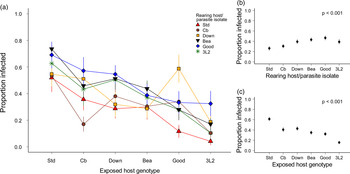
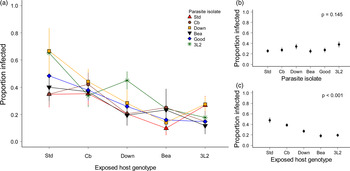
The combination of experiments 1 and 2 supported parasite plasticity driven by the rearing host environment via ‘host quality’. First, however, we should note that both experiments showed the expected ‘exposed host’ effect; host genotypes varied in their susceptibility to infection (Table 1, Figs 2 and 3). In experiment 1, we detected an effect of ‘rearing host/parasite isolate’ when parasite isolates were reared in different host genotypes (Table 1, Fig. 2). There was no significant interaction between ‘rearing host/parasite isolate’ and ‘exposed host’ genotype (Table 1). Thus, the data did not show a signal of host specificity in parasite infectivity (i.e. no evidence for ‘parasite memory’). Nonetheless, even with the ‘host quality’ signal, exposed host genotype explained four times as much variation in infectivity as ‘rearing host/parasite isolate’ (exp. 1; 0·424 vs 0·107). Experiment 1, however, could not distinguish rearing-driven plasticity from the possibility of genetic effects of parasite isolates. In experiment 2, when parasite isolates were reared in a single host genotype (eliminating plastic effects of parasites), they no longer differed in infectivity (Table 1, Fig. 3). Thus, rearing isolates in a common host for just one generation erased the ‘host quality’ signal of rearing-driven plasticity.
Experiment 1: (a) infection prevalence, when parasite isolates were reared in their ‘home’ host genotype (mean ± s.e.). Average, infection prevalence for (b) each rearing host/parasite isolate treatment and (c) exposed host genotype is shown on the right. Both factors were significant predictors of infection prevalence, but the interaction was not significant (Table 1). Points indicate means ± one s.e. See Supplemental Table 1 for abbreviations.

Experiment 2: (a) infectivity of parasites isolates, indexed as infection prevalence, when reared in a common host genotype. Average, infection prevalence for (b) each parasite isolate and (c) exposed host genotype is shown on the right. Exposed host genotype was a significant predictor of infection prevalence, but parasite isolate was not, indicating that parasite isolates do not vary when reared in a common host genotype. Points indicate means ± one s.e. See Supplemental Table 1 for abbreviations.

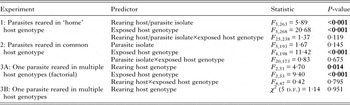
Summary of statistical findings for experimental exposures

Bolded P-values are significant at the α = 0·05 level. In these models, parasite isolate and host genotype were treated as fixed effects. Qualitatively similar results arise from their treatment as random effects.
Experiments 3A and 3B
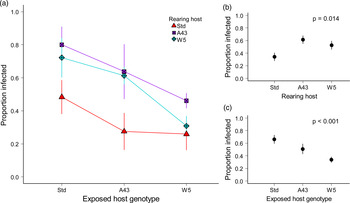
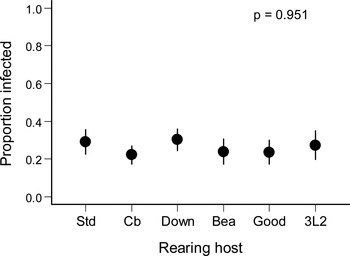
Rearing a single parasite isolate in multiple host genotypes induced parasite variation in one experiment, but not another. In experiment 3A, rearing host affected infectivity of the focal parasite isolate (Table 1, Fig. 4). This result demonstrates that the genotype of the rearing host can induce plasticity in parasite infectivity after just one generation. Furthermore, there was no interaction between rearing host and exposed host genotype (exp. 3A, Table 1); rearing host had only an overall positive or negative effect on parasite infectivity, indicating ‘host quality’. However, as in the previous experiments, exposed host genotype significantly impacted infection prevalence in (Table 1, Fig. 4). We did not find a significant effect of rearing host genotype on parasite infectivity in experiment 3B (Table 1, Fig. 5).
Experiment 3A: (a) infectivity of one parasite isolate (P-Std) reared in multiple host genotypes, then exposed to three host genotypes. Average infection prevalence for (b) each rearing host and (c) exposed host genotype appears on the right. Both factors were significant predictors of infection prevalence indicating that parasite variation can be induced by the rearing host genotype. However, no interaction between rearing and exposed host genotype occurred. Points indicate means ± one s.e. See Supplemental Table 1 for abbreviations.

Experiment 3B: infectivity of one parasite isolate (P-Std) reared in multiple host genotypes, then exposed to its original host (H-Std). Infection prevalence did not differ among rearing hosts. Points indicate means ± one s.e.

DISCUSSION
Hosts can alter parasite fitness in multiple ways. However, due to rapid evolution of parasites, it can be challenging to partition these host-mediated influences into evolutionary (genetic) vs plastic effects. It is even harder to determine the causes and magnitude of parasite plasticity. Here, we could demonstrate host-mediated (rearing-based) plasticity with a parasite that lacks detectable heritable variation. With evolutionary response of the parasite controlled, we could attribute differences in infection prevalence among parasite isolates to plastic effects of host rearing. In experiments, infectivity of a given isolate of the parasite varied when reared in different host genotypes (exp. 1 and exp. 3A). However, this rearing-based variation disappeared when we grew different isolates in one host genotype (i.e. a common garden) for just a single generation (exp. 2). Further, we induced rearing-based plasticity by growing a single parasite isolate in different host genotypes for just one generation (exp. 3A). The rearing effect of host genotype created generally ‘good’ or ‘bad’ parasites without an interaction between ‘rearing host’ and ‘exposed host’ genotypes. Thus, these results signalled the ‘host quality’ mechanism rather than the ‘parasite memory’ mechanism. We should note that we also observed a strong signal of differences in susceptibility among host genotypes (‘exposed hosts’), but this is not the focus here. In aggregate, these experiments illustrate parasite plasticity driven by the rearing environment of host genotype.
The ‘parasite memory’ vs ‘host quality’ pattern of plasticity logically follows the natural history of this host-parasite system. Through ‘parasite memory,’ plasticity could enable a parasite isolate to better infect the genotype in which it was reared (a form of genotype-specific infectivity). This scenario seems most likely to occur when parasites frequently encounter the same type of host for multiple generations (e.g. hosts that form social groups or that are spatially aggregated; Lively, Reference Lively1989; Craft et al. Reference Craft, Hawthorne, Packer and Dobson2008; Godfrey et al. Reference Godfrey, Bull, James and Murray2009). In these cases, parasites would benefit from ‘parasite memory’ plasticity. However, in our system, there is high genetic diversity of D. dentifera hosts within a lake (Duffy et al. Reference Duffy and Hall2008, Reference Duffy, Ochs, Penczykowski, Civitello, Klausmeier and Hall2012; Auld et al. Reference Auld, Penczykowski, Ochs, Grippi, Hall and Duffy2013), so it is unlikely that a parasite would infect the same host genotype in successive generations. Thus, there is no benefit for a parasite to alter its phenotype to exploit a particular host genotype. Instead, our experiments showed ‘host quality.’ This form of plasticity likely arises due to variation in the within-host environment among rearing hosts. Therefore, the type of plasticity that occurs in a host–parasite system may be influenced by the heterogeneity of its hosts.
Rearing host can drive plasticity of parasites through a number of mechanisms. For example, availability of within-host resources can influence the reproductive and transmission rates of parasites (Pulkkinen and Ebert, Reference Pulkkinen and Ebert2004; Tschirren et al. Reference Tschirren, Bischoff, Saladin and Richner2007; Reece et al. Reference Reece, Ramiro and Nussey2009; Cameron et al. Reference Cameron, Reece, Drew, Haydon and Yates2013). Therefore, differences between rearing host genotypes in feeding rate (as seen in Daphnia: Hall et al. Reference Duffy, Cáceres, Hall, Tessier and Ives2010 a) might influence the resources available to the parasite. Faster growing Daphnia host genotypes produce more Metschnikowia spores (Hall et al. Reference Hall, Becker, Duffy and Cáceres2010a appendix; Hall et al. Reference Hall, Becker, Duffy and Cáceres2012) and future work should examine whether growth rate-induced spore yields correlate positively or negatively with per spore infectivity (Supplemental Fig. 1). Induction of plasticity likely depends on context, however; we induced parasite variation in experiment 3A (Fig. 4) but not in in experiment 3B (Fig. 5). These experiments provided different contexts, as they used different rearing host genotypes, exposure dose, food availability for the host, water source and duration. While these different protocols may have led to different outcomes, at present, we cannot identify the cause of the discrepancy between these two experiments. Plasticity of parasites produced by hosts may stem from fixed and plastic aspects of rearing environment.
These rearing-based plasticity results have important implications for how we design and interpret experiments to detect variation in infection success of parasites. We found phenotypically induced variation in infectivity when we reared parasite isolates in different host genotypes, an analogue to collecting parasites from the field (exp. 1). This result means that variation observed from field-collected parasites may overestimate genetic variation unless we account for phenotypic differences from the within-host environment. Thus, ideally, isolates of parasites should be propagated in a common rearing environment (e.g. a common host genotype; Auld et al. Reference Auld, Hall and Duffy2012, or artificial medium; Kaltz et al. Reference Kaltz, Gandon, Michalakis and Shykoff1999; Berger et al. Reference Berger, Marantelli, Skerratt and Speare2005) to control for plastic effects on phenotypes before measuring variation. Due to potential maternal or grandmaternal effects (which can occur in many organisms, including Daphnia; Lynch and Ennis, Reference Lynch and Ennis1983), parasites should ideally be propagated in a common environment for at least three generations. However, in some systems there may be tradeoffs between controlling for plasticity and imposing selection upon parasite isolates; three generations in a common environment may be long enough to impose parasite selection, leading to underestimates of genetic variation. Additionally, particular aspects of parasite biology may constrain experimental design. For instance, some parasites are difficult to propagate in controlled environments. In these cases, experiments might need to use parasites collected directly from the field (e.g. Louhi et al. Reference Louhi, Karvonen, Rellstab and Jokela2013) or passaged for a just single generation (e.g. Lively, Reference Lively1989; Lively and Dybdahl, Reference Lively and Dybdahl2000). Additionally, sometimes it may be necessary to propagate parasites in different hosts due to specificity of parasite infectivity (Ebert et al. Reference Ebert, Zschokke-Rohringer and Carius1998; Carius et al. Reference Carius, Little and Ebert2001). Thus, care must be taken to tease apart host-driven plastic effects from genetic differences among parasites.
Our findings also challenge the common prediction that parasites vary more – genetically or phenotypically – than their hosts (Kaltz and Shykoff, Reference Kaltz and Shykoff1998; Greischar and Koskella, Reference Greischar and Koskella2007). Daphnia genotypes vary substantially in infection risk (‘exposed host’ results), shown here and previously (Figs 2–4; Duffy and Sivars-Becker, Reference Duffy and Sivars-Becker2007; Duffy et al. Reference Duffy, Ochs, Penczykowski, Civitello, Klausmeier and Hall2012; Auld et al. Reference Auld, Penczykowski, Ochs, Grippi, Hall and Duffy2013). In contrast, Metschnikowia isolates showed much less phenotypic variation in infectivity, even with plasticity from ‘host quality’ (exp. 1), and no detectable genetic variation (exp. 2, Fig. 3, ‘parasite sequencing’ results; Duffy and Sivars-Becker, Reference Duffy and Sivars-Becker2007; Auld et al. Reference Auld, Hall, Ochs, Sebastian and Duffy2014). The lack of detectable sequence variation echoes previous analyses of rDNA sequences of Metschnikowia isolated from infected Daphnia from the United States and Europe (Wolinska et al. Reference Wolinska, Giessler and Koerner2009). We recommend further investigation into genetic variation of this parasite, since sequence variation may lie at other loci across the genome. However, the combination of undetectable sequence variation found here (at commonly variable loci; Peay et al. Reference Peay, Kennedy and Bruns2008), lack of phenotypic variation in a common environment, and non-responsiveness to selection (Duffy and Sivars-Becker, Reference Duffy and Sivars-Becker2007; Auld et al. Reference Auld, Hall, Ochs, Sebastian and Duffy2014) suggests extremely limited diversity in Metschnikowia.
Why does the parasite exhibit so little genetic variation? In principle, such low genetic variation may arise following severe bottlenecks, selective sweeps or recent invasions (e.g. Tsutsui et al. Reference Tsutsui, Suarez, Holway and Case2000; Wootton et al. Reference Wootton, Feng, Ferdig, Cooper, Mu, Baruch, Magill and Xu2002; England et al. Reference England, Osler, Woodworth, Montgomery, Briscoe and Frankham2003; Dlugosch and Parker, Reference Dlugosch and Parker2008). However, at present, there is no evidence for these processes occurring in Metschnikowia. The parasite is widespread (Hall et al. Reference Hall, Smyth, Becker, Duffy, Knight, MacIntyre, Tessier and Cáceres2010b ; Penczykowski et al. Reference Penczykowski, Hall, Civitello and Duffy2014a ). Moreover, if the lack of variation in our study was due to a recent invasion, bottleneck, or selective sweep, we could expect limited variation only in the United States. However, an earlier study found identical genetic sequences of isolates from multiple host species and locales in Europe (Wolinska et al. Reference Wolinska, Giessler and Koerner2009, ‘parasite sequencing’ results). Thus, at present, the mechanism for this apparent lack of genetic variation is unknown.
We demonstrate that phenotypic plasticity of a fungal parasite can be induced by the within-host rearing environment. Specifically, rearing host genotype influenced future infection via effects on parasite infectivity. Thus, rearing host genotype can affect both the quantity (e.g. Woolhouse et al. Reference Woolhouse, Dye, Etard, Smith, Charlwood, Garnett, Hagan, Hii, Ndhlovu, Quinnell, Watts, Chandiwana and Anderson1997; Lloyd-Smith et al. Reference Lloyd-Smith, Schreiber, Kopp and Getz2005; Hall et al. Reference Hall, Becker, Duffy and Cáceres2010a ) and quality (this study) of parasites produced from an infection. While many organisms exhibit plasticity, studies focusing on plasticity of parasites remain rare. Inclusion of parasite plasticity in epidemiological models is even less common. However, host-driven plasticity caused by ‘host quality’ adds a mechanism by which the composition of hosts could alter transmission and virulence of parasites in natural communities. How important is plastic vs genotypic variation in parasite infectivity among various host–parasite systems? The answer to this question awaits further research.
Supplementary material
To view supplementary material for this article, please visit http://dx.doi.org/10.1017/S0031182015000013.
ACKNOWLEDGEMENTS
The authors would like to thank R. Penczykowski, S. Hernandez, S. Duple, P. Lee, G. Davis, A. Koss, A. Copper, T. Holda and Z. Brown for their assistance with this project. We appreciate the cooperation of S. Siscoe (Division of Forestry) and R. Ronk (Division of Fish and Wildlife) at the Indiana Department of Natural Resources for access to field sites. The authors thank two anonymous reviewers for their comments on an earlier version of this manuscript.
FINANCIAL SUPPORT
This project was funded by the National Science Foundation (DEB-1305836 to MAD, DEB-0841817 to SRH, DUE-112918 to Z. Rapti, CEC et al. and DEB-1120804 to CEC) and the Georgia Institute of Technology.