Fear has a high adaptive value both for the person experiencing it, facilitating a defensive response, and for the person perceiving it in the other person’s face, warning of a potential danger (see Öhman, Reference Öhman2002; Öhman & Wiens, Reference Öhman, Wiens, Davidson, Scherer and Hill2003). When facing an unexpected or uncertain stimulus, a facial expression is generated that contains physical features that are common to the expressions of surprise and fear. Specifically, the signs of surprise and fear –as well as those of disgust and anger– may be confused in the early stage of the transmission, and only subsequently, when other action units (AUs) are triggered, will the differences become more apparent. Some scholars therefore contend that primary emotions could be classified according to their adaptive value into four, and not six, categories: Happiness, sadness, fear/surprise, and disgust/anger (Jack, Garrod, & Schyns, Reference Jack, Garrod and Schyns2014; Jack, Sun, Delis, Garrod, & Schyns, Reference Jack, Sun, Delis, Garrod and Schyns2016). According to this perspective, facial expressions transmit signals dynamically and sequentially, thereby constituting a more complex system for communicating successive categorizations within a time continuum in the transmission of a facial expression, which advances with different levels of awareness.
Surprise is a reaction to a new or unknown situation, and it is the briefest of all the primary emotions. Furthermore, it tends to be confused with the expression of fear because they share some of their AUs according to the Facial Action Coding System (FACS) (Ekman & Friesen, Reference Ekman and Friesen1978), such as AU1, AU2, and AU5, as well as AU25, as reported by certain authors (Matsumoto, Keltner, Shiota, Frank, & O´Sullivan, Reference Matsumoto, Keltner, Shiota, Frank, O’Sullivan, Lewis, Haviland-Jones and Feldman2008). Furthermore, they coincide regarding the criteria established by emotional appraisal theories (see Ellsworth & Scherer, Reference Ellsworth, Scherer, Davidson, Scherer and Goldsmith2003), whereby the stimuli eliciting these emotions would be considered unexpected or uncertain (Vrticka, Lordier, Bediou, & Sander, Reference Vrticka, Lordier, Bediou and Sander2014). There is also an overlap between the emotion of surprise and the orientation response, as a way of preparing the organism for the reception and analysis of stimuli, heightening the response of sensitive organs, and optimizing the organism’s receptiveness (Davidson, Sherer, & Goldsmith, Reference Davidson, Sherer and Goldsmith2000; Öhman & Wiens, Reference Öhman, Wiens, Davidson, Scherer and Hill2003). Surprise may help an individual to effectively cope with unexpected changes and their consequences (Izard, Reference Izard1991), amplifying the ensuing affective reaction by increasing activation levels (Zillmann, Reference Zillmann1971), even acting as a “booster” of emotional experience and its learning (Mellers, Schwartz, Ho, & Ritov, Reference Mellers, Schwartz, Ho and Ritov1997). For these reasons, some scholars consider surprise to be a simple cognitive reaction (Spinoza, Reference Spinoza, Boyle and Parkinson1989; cited in Lewis, Haviland-Jones, & Feldman, Reference Lewis, Haviland-Jones and Feldman2008).
These considerations suggest that the expression of surprise may facilitate the discrimination of the expression of fear under certain conditions. This is consistent with the theories of appraisal (see Ellsworth & Scherer, Reference Ellsworth, Scherer, Davidson, Scherer and Goldsmith2003), which consider emotions to be dynamic and adaptive processes involving myriad systems and levels that trigger different emotional episodes through sequential checking. Within the first level of processing related to the event’s relevance (Scherer, Reference Scherer and Shaver1984), the perceived surprise would increase the salience of the facial expression, and tends to be interpreted as negative when the appraisal times are brief and dependent upon the amygdala; nevertheless, when more time is available for appraising the expression of surprise, participating in the regulatory processes dependent on the prefrontal cortex facilitates a bias toward a positive appraisal (Kim, Somerville, Johnstone, Alexander, & Whalen, Reference Kim, Somerville, Johnstone, Alexander and Whalen2003; Neta, & Whalen, Reference Neta and Whalen2011; Tottenham, Phuong, Flannery, Gabard-Durnam, & Goff, Reference Tottenham, Phuong, Flannery, Gabard-Durnam and Goff2013).
Therefore, for brief exposure times the negative bias in the appraisal of surprise facilitates the discrimination of expressions with a similar hedonic tone displayed immediately after the expression of surprise, as has been verified in different studies in which the emotional congruence between prime and target facilitated the latter’s appraisal (e.g., Hermans, De Houwer, & Eelen, Reference Hermans, De Houwer and Eelen2001); it has also been noted that the consistency or similarity between the prime and target stimulus facilitates the target’s subsequent appraisal (see Fazio, Reference Fazio2001; Klauer & Musch, Reference Klauer, Musch, Musch and Klauer2003). According to these assumptions, and considering that the initial moments in the transmission of expressions of surprise and fear lead to major consistency in the AUs they share, it is to be expected that the expression of surprise with short exposure times would only facilitate the discrimination of the expression of fear (negative hedonic tone and high activation), and not that of other types of facial expressions with high activation and a similar hedonic tone (e.g., anger) or a different one (e.g., happiness). In short, the effect of priming could be used to test the supposed continuity between surprise and fear under certain appraisal conditions.
Regarding the duration times of the prime-surprise that would be determining the minimum threshold between automatic and controlled processing, and which would explain the priority involvement of the amygdala and prefrontal cortex, respectively. The exposure time below which the facial expression is processed automatically varies depending on the type of emotion expressed; specifically, and for the recognition of surprise and happiness, between 10 and 20 ms; for sadness and disgust, between 70 and 200 ms, and for fear and anger, between 100 and 250 ms (Du & Martínez, Reference Du and Martínez2013). Nevertheless, this would not mean that the controlled processing of information is fully conscious -the subject is capable of saying they saw an expression of surprise- but instead would give rise to different degrees of awareness in the perception of the expression of surprise.
As this research uses time intervals of between 50 and 250 ms, it should be described as controlled processing, although one should consider a continuum between the unconscious and the conscious that would be determined by the duration of the stimulus appraised. It may therefore be accepted that a stimulus presented for 50 ms has been processed with a lower attentional level than another presented for 250 ms. The time span used in this experiment (50–250 ms) would reflect the level of attention with which the stimulus has been processed, and therefore constitute a suitable representation of the unconscious-conscious continuum as a reflection of the amygdala-prefrontal cortex’s involvement in the appraisal process.
The purpose of this research, therefore, was to analyze the role of the expression of surprise in a task involving the discrimination of the expression of fear, taking into account the prime duration of the expression of surprise prior to the display of the expressions of fear, happiness and anger. Brief exposure times for the expression of surprise are expected to have a facilitating effect on the discrimination solely of the expression of fear, and not on the discrimination of other expressions with a similar hedonic tone (anger) or a different one (happiness), (H1). If this priming effect occurs solely for the discrimination of fear with brief exposure times, one might consider the relationship between surprise and fear as involving parts of the same continuum within the appraisal process with a clear adaptive value. On the other hand, a reduction in response times is expected to be accompanied by a reduction in the discrimination rate, insofar as speed would prevail over accuracy (H2). This would be consistent with the bias toward the negative described by certain authors (Kim et al., Reference Kim, Somerville, Johnstone, Alexander and Whalen2003; Tottenham, Phuong, Flannery, Gabard-Durnam, & Goff, Reference Tottenham, Phuong, Flannery, Gabard-Durnam and Goff2013) regarding the processing of expressions of surprise by the amygdala, which could lead to more false positives because they would be appraised as negative/danger stimuli that require a rapid response, and would therefore increase the probability that expressions of happiness or anger preceded by an expression of surprise would be identified as expressions of fear (false positive).
Method
Participants
The sample consisted of 202 students (73.27 % females) from the Zaragoza Faculty of Higher Studies (Mexico), with ages ranging between 17 and 28 (M = 20.08, SD = 2.02), who gave their informed consent when they volunteered for the experiment.
Instruments
The task’s programming involved the use of E-prime software, and the stimuli were displayed on a 15” screen, at a distance of approximately 50 cm from the participants. The 50 expressions used were prototypes of fear, anger, happiness, surprise and neutrality, which were taken from the NimStim Face Stimulus Set (Tottenham et al., Reference Tottenham, Tanaka, Leon, McCarry, Nurse, Hare and Nelson2009). The facial expressions used in the test phase were provided by 10 models (five men and five women). In addition, a model was included whose five facial expressions were used solely in the training phase.
Procedure
One by one, all the participants passed through the following stages:
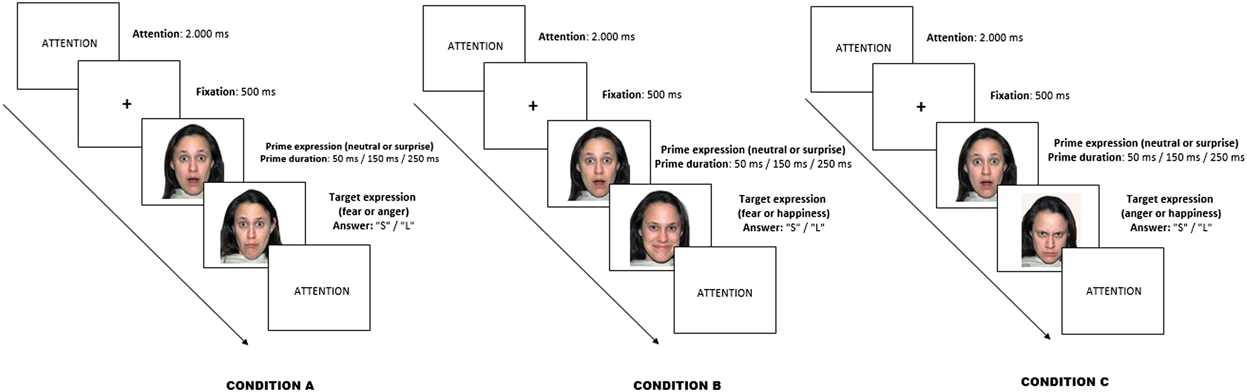
The facial expressions were displayed following the sequence shown in Figure 1. First up was a prompt sign (2,000 ms), followed by a cross to fix the person’s attention on the center of the screen (500 ms). Next up was the prime expression (neutral expression or one of surprise) with a prime duration that could be 50 ms, 150 ms or 250 ms, followed by the target stimulus (expression of fear, anger or happiness), which remained on the screen until the subject responded (see Figure 1). Out of the 202 subjects taking part, 62 were randomly selected for condition A, 77 for condition B, and 63 for condition C. The subjects were given written instructions whereby as soon as they saw a facial expression, which could be of fear or anger (condition A); fear or happiness (condition B); anger or happiness (condition C), they were to respond as quickly as possible by pressing on “S” if the expression was one of fear, and on “L” if it reflected anger (e.g., condition A). Each subject had a different association between the key (“L”, “S”) and the type of expression (anger, fear) (see figure 1).
Tasks used during the Experiment in which the Type of Target Stimulus Varied, which Could be Fear or Anger (Condition A); Fear or Happiness (Condition B); Anger or Happiness (Condition C).

Data analysis
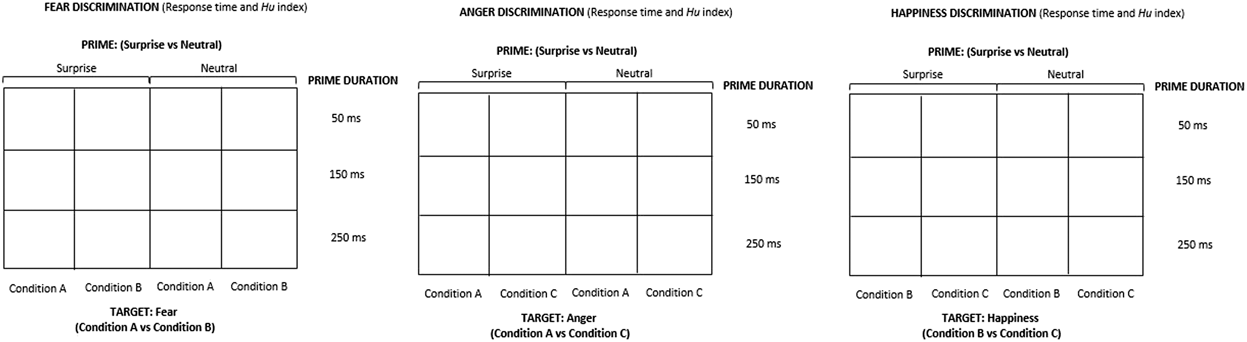
The data gathered under experimental conditions were used to separately analyze the discrimination of the expressions of fear, anger and happiness. This meant a total of three analyses, using a 2 x 2 x 3 mixed ANOVA with the inter-group variable target expression, with two levels corresponding to the type of facial expression that appeared together with the analysis expression (fear discrimination: anger [condition A] and happiness [condition B]; anger discrimination: fear [condition A] and happiness [condition C]; happiness discrimination: fear [condition B] and anger [condition C)]). For example, in order to analyze the discrimination of the expression of fear, the two levels of the target variable were determined on the basis of the measures obtained in the subjects’ response to the expression of fear when the other response option was an expression of anger (condition A), and when it was an expression of happiness (condition B). The intra-group variables were prime expression, referring to the type of facial expression displayed prior to the presentation of the target (neutral and surprise facial expression) and prime duration (50 ms, 150 ms, and 250 ms). Finally, the dependent variables considered were reaction times (RTs) and discrimination rate (Hu index) (Wagner, Reference Wagner1993) (see Figure 2).
Description of the Experimental Design (2 (Prime) x 2 (Target) x 3 (Prime Duration).

Results
Analysis of fear response
Analysis of reaction times (RTs)
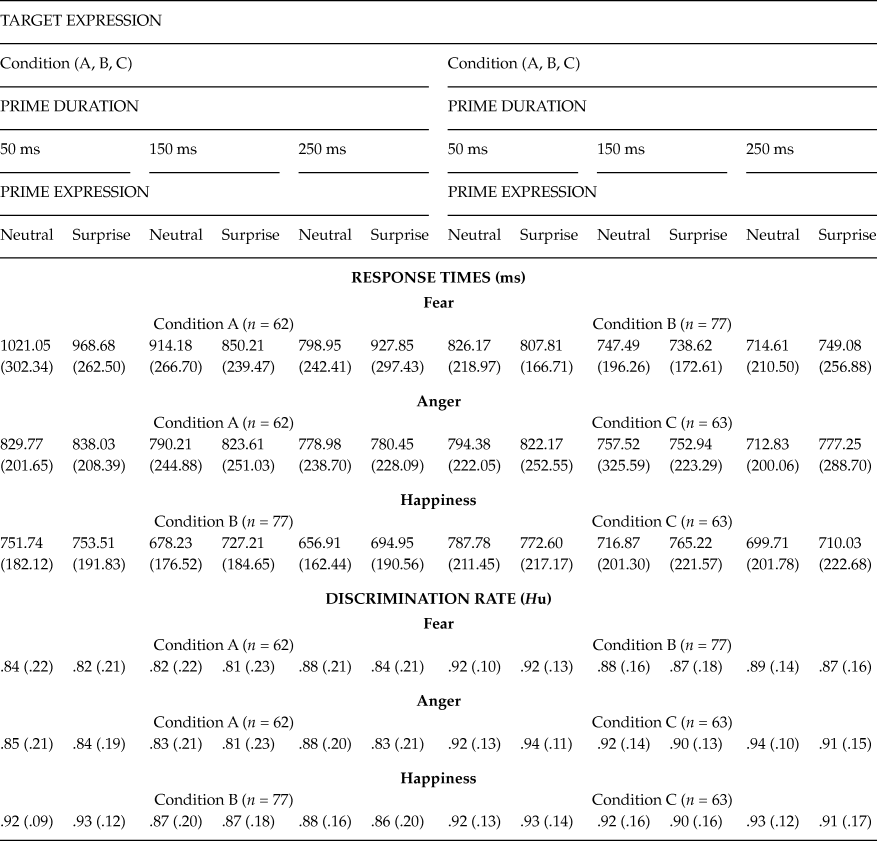
The mixed ANOVA did not reveal a significant effect for the factor prime expression, F(1, 137) = .28, p = .596, η2 p = .00, P = .08, but it did so for target expression, M anger = 913.49, SE = 27.03; M happiness = 763.96, SE = 24.25; F(1, 137) = 16.96, p < .0001, η2 p = .11; and prime duration, F(2, 274) = 72.76, p < .0001, η2 p = .35. A simple effects analysis (Bonferroni method for controlling the error rate) showed that differences were recorded between the prime duration of 50 ms, M = 905.93, SE = 19.18, and the prime duration of 150 ms, M = 812.63, SE = 17.77; M i–j = 93.30, SE = 9.41, p < .0001, and 250 ms, M = 797.62, SE = 19.99; M i–j = 108.30, SE = 10.04, p < .0001. The interaction between target expression and prime expression was not significant, F(1, 137) = .20, p = .886, η2 p = .00. The interaction between target expression and prime duration was significant, F(2, 136) = 3.18, p = .045, η2 p = .05, as well as for the interaction between prime expression and prime duration, F(2, 136) = 15.90, p < .0001, η2 p = .19, and between target expression, prime expression and prime duration, F(2, 136) = 5.92, p = .003, η2 p = .08.
As regards the interaction between prime expression and prime duration, a simple effects analysis revealed that the differences in RTs between the neutral prime expression and the surprise prime expression were recorded for a prime duration of 50 ms, M i–j = 35.37, SE = 13.40, p = .009; 150 ms, M i–j = 36.42, SE = 11.03, p = .001; and 250 ms M i–j = –81.69, SE = 15.67, p < .0001. The data indicate a reversal of the effect for a longer prime duration. As regards the interaction between target expression and prime duration, a simple effects analysis revealed that the differences in discrimination rate were recorded between the target expressions of anger and happiness for a prime duration of 50 ms, M i–j = 177.88, SE = 38.36, p < .0001; 150 ms, M i–j = 139.14, SE = 35.54, p < .0001; and 250 ms, M i–j = 131.56, SE = 39.99, p = .001. Finally, regarding the third-order interaction between target expression, prime expression and prime duration, the Bonferroni analysis showed that the differences in RTs between the levels of prime expression, similar to those obtained in the second-order interaction, were recorded solely within the level of the target expression of anger, with prime duration levels of 50 ms, M i–j = 52.37, SE = 19.94, p = .010; 150 ms, M i–j = 63.97, SE = 16.42, p < .0001; and 250 ms, M i–j = –128.90, SE = 23.32, p < .0001 (see Table 1 and Figure 2).
Descriptive Statistics Obtained in the Different Levels of the Independent Variables for each one of the Dependent Variables

Note: Standard deviation featured between brackets.
Analysis of the discrimination rate (Hu)
The mixed ANOVA revealed a significant effect on discrimination rate of the factor prime expression, M neutral = .87, SE = .01; M surprise = .86, SE = .02; F(1, 137) = 7.74, p = .006, η2 p = .05. Target expression M anger = .83, SE = .02; M happiness = .90, SE = .02; F(1, 137) = 5.04, p = .026, η2 p = .04. And prime duration, F(2, 274) = 6.80, p = .001, η2 p = .05. A simple effects analysis showed differences between the prime duration of 150 ms, M = .85, SE = .02, and the prime duration of 50 ms, M = .88, SE = .01; M i–j = –.030, SE = .01, p = .009, and 250 ms, M = .87, SE = .02; M i–j = –.022, SE = .01, p = .008. The interaction between target expression and prime expression was not significant for discrimination rate, F(1, 137) = 1.53, p = .218, η2 p = .01; or for the interaction between prime expression and prime duration, F(2, 274) = 1.08, p = .343, η2 p = .01; or between target expression, prime stimulus and prime duration, F(2, 274) = .13, p = .880, η2 p = .00; but the interaction was significant between target expression and prime duration, F(2, 274) = 7.79, p = .001, η2 p = .05. A simple effects analysis revealed that the differences in discrimination rate were recorded between the target expression of anger and happiness for a prime duration of 50 ms, M i–j = –.094, SE = .026, p < .0001; and 150 ms, M i–j = –.064, SE = .032, p = .044 (see Table 1).
Analysis of anger response
Analysis of reaction times (RTs)
The mixed ANOVA did not reveal a significant effect on the RTs of the factor target expression, F(1, 123) = .94, p = .335, η2 p = .01; but it did for prime expression, M neutral = 777.28, SE = 20.06; M surprise = 799.08, SE = 19.42; F(1, 123) = 6.80, p = .01, η2 p = .05. And prime duration, F(2, 246) = 16.25, p < .0001, η2 p = .12. A simple effects analysis revealed differences between the prime duration of 50 ms, M = 821.09, SE = 18.88, and the prime duration of 150 ms, M = 781.07, SE = 21.54; M i–j = 40.02, SE = 10.43, p = .001. And 250 ms, M = 762.38, SE = 20.17; M i–j = 58.71, SE = 10.71, p < .0001. The interaction between target expression and prime expression was not significant for the dependent variable RTs, F(1, 123) = .79, p = .377, η2 p = .01; or for the interaction between target expression and prime duration, F(2, 122) = .81, p = .449, η2 p = .01; between prime expression and prime duration, F(2, 122) = .31, p = .736, η2 p = .01; or between target expression, prime expression and prime duration, F(2, 122) = 1.53, p = .220, η2 p = .02 (see Table 1 and Figure 2).
Analysis of the discrimination rate (Hu)
The mixed ANOVA revealed a significant effect on the Hu rate of the factor target expression, M fear = .84, SE = .02; M happiness = .92, SE = .02; F(1, 123) = 9.36, p = .003, η2 p = .07, P = .86. Prime expression, M neutral = .89, SE = .01; M surprise = .87, SE = .01; F(1, 123) = 12.69, p = .001, η2 p = .09. And prime duration, F(2, 246) = 5.38, p = .005, η2 p = .04.12, P = .84. A simple effects analysis showed differences between the prime duration of 150 ms, M = .86, SE = .02; and the prime duration of 50 ms, M = .89, SE = .01; M i–j = –.019, SE = .007, p = .019; and 250 ms, M = .89, SE = .01; M i–j = –.024, SE = .008, p = .012. The interaction between target expression and prime expression was not significant for discrimination rate, F(1, 123) = 1.94, p = .166, η2 p = .02; or for the interaction between target expression and prime duration, F(2, 246) = 1.21, p = .299, η2 p = .01; between prime expression and prime duration, F(2, 246) = 3.05, p = .049, η2 p = .02; and between target expression, prime expression and prime duration, F(2, 246) = .299, p = .742, η2 p = .00 (see Table 1).
Analysis of happiness response
Analysis of reaction times (RTs)
The mixed ANOVA did not reveal a significant effect for the factor target expression, F(1, 138) = 1.07, p = .302, η2 p = .01; but it did for prime expression, M neutral = 715.21, SE = 14.95; M surprise = 737.25, SE = 16.36; F(1, 138) = 9.52, p = .002, η2 p = .07. And for prime duration, F(2, 137) = 47.78, p < .0001, η2 p = .41. A simple effects analysis showed differences between the exposure time of 50 ms, M = 766.41, SE = 16.34; and the prime duration of 150 ms, M = 721.88, SE = 15.42; M i–j = 44.52, SE = 6.75, p < .0001; and 250 ms, M = 690.40, SE = 15.55; M i–j = 76.01, SE = 7.76, p < .0001; and between 150 ms and 250 ms, M i–j = 31.48, SE = 6.26, p < .0001. The interaction between prime expression and target expression was not significant, F(1, 138) = 1.12, p = .293, η2 p = .01; or for the interaction between target expression and prime duration F(2, 137) = .46, p = .632, η2 p = .01; or between target expression, prime expression, and prime duration F(2, 137) = .44, p = .644, η2 p = .01; but it was for the interaction between prime expression, and prime duration, F(2, 137) = 7.17, p = .001, η2 p = .10. As regards the interaction between prime expression and prime duration, a simple effects analysis revealed that the differences in RTs between the neutral prime expression and the surprise prime expression were recorded for a prime duration of 150 ms, M i–j = –48.66, SE = 12.17, p < .0001; and 250 ms, M i–j = –24.18, SE = 10.80, p = .027 (see Table 1 and Figure 3).
Differences in Response Times (RTs) depending on the Prime Expression Factors (Neutral, Surprise) and Prime Duration (50 ms, 150 ms, 250 ms) in the Discrimination of the Expressions of Fear, Anger and Happiness. Error Bars are Standard Errors of the Mean. *p < .05, ** p < .01, ***p < .0001.

Analysis of discrimination rate (Hu)
The mixed ANOVA did not reveal a significant effect for the factors prime expression, F(1, 138) = 3.57, p = .061, η2 p = .03; and target expression, F(1, 138) = 1.50, p = .223, η2 p = .01; but it did so for prime duration, F(2, 137) = 7.90, p = .001, η2 p = .10. A simple effects analysis showed differences between the prime duration of 50 ms, M = .93, SE = .01; and the prime duration of 150 ms, M = .89, SE = .01; M i–j = .034, SE = .01, p < .0001. And 250 ms, M = .90, SE = .01; M i–j = .028, SE = .01, p = .006. The interaction between target expression and prime expression was not significant for discrimination rate, F(1, 138) = .23, p = .634, η2 p = .00). Neither was the interaction significant between prime expression and prime duration, F(2, 276) = 2.53, p = .082, η2 p = .02; or between target expression, prime expression and prime duration, F (2, 276) = .67, p = .514, η2 p = .01; but it was for the interaction between target expression and prime duration, F(2, 276) = 4.63, p = .011, η2 p = .03. A simple effects analysis revealed differences in discrimination rate for a fear level of target expression between the prime duration of 50 ms and 150 ms, M i–j = .050, SE = .012, p < .0001 (see Table 1).
Discussion
The aim of this research was to analyze the effect of the expression of surprise on RTs and the discrimination rate of the expression of fear, as well as study the modulating role of prime duration (50 ms, 150 ms, and 250 ms) on that effect. The hypothesis formulated is that short prime duration facilitates a swifter response (H 1). The results support the hypothesis insofar as times of 50 ms and 150 ms gave rise to shorter RTs when the prime expression was one of surprise compared to a neutral one. Furthermore, these effects were recorded solely for the discrimination of fear. Nevertheless, no significant effects were found for discrimination rate (H 2), probably because the task was so simple and, although in the instructions the subjects were asked to answer as quickly as possible, no time limit was placed on their response, so there could have been a ceiling effect.
The results reveal a facilitation of surprise in the discrimination of fear with brief exposure times (50–150 ms), which might be evidence of continuity between the expressions of surprise and fear arising from the physical characteristics and hedonic tone they share. From a developmental perspective, perceptual systems are designed to identify dangers, and so a defensive response will be effective provided it is triggered quickly. This means that a stimulus is sometimes appraised as being dangerous when this is not in fact the case (false alarm), although in adaptive terms this would obviously come at a lower cost than the other way round (Davidson et al., Reference Davidson, Sherer and Goldsmith2000). This bias fulfils an adaptive function that is consistent with the emotional processing pathways propounded by LeDoux (Reference LeDoux, Lewis, Haviland-Jones and Feldman1993). Surprise would therefore be modulating the speed of emotional processing, whereby an exposure time for surprise of more than 250 ms triggers a response that is determined to a greater extent by the primary path (thalamus-cortex), whereas shorter times (0–150 ms) trigger a response that is determined to a greater extent by the secondary path (thalamus-amygdala).
On the other hand, and according to the results obtained here, with an exposure time of 250 ms the expression of surprise could be processed with higher levels of awareness, and the subject would therefore be more likely to perceive it as a different expression to the one of fear, losing its facilitating role and increasing response times. What’s more, the expression of surprise does not play the same facilitating role on another negative expression such as anger because they are significantly different in their physical characteristics, despite both having a negative hedonic value. The same explanation might apply for the expression of happiness, which in some physical aspects coincides with fear, but differs in hedonic value. The expression of surprise would be appraised as negative under the processing of information with low levels of awareness (50 and 100 ms), and would also have physical similarities with the expression of fear. These two aspects would be indicating that the facilitating effect of surprise applies solely in the discrimination of the expression of fear.
Different meta-analyses with neuroimaging studies confirm the consistency of the relationship between the emotion of fear and the amygdala (e.g., Vytal & Hamann, Reference Vytal and Hamann2010), and between the emotion of surprise and the amygdala (e.g., Posamentier & Abdi, Reference Posamentier and Abdi2003); nevertheless, the amygdala has also been associated with other negative emotions, positive information, and even neutral stimuli (e.g., Cunningham & Brosch, Reference Cunningham and Brosch2012; Pessoa & Adolphs, Reference Pessoa and Adolphs2010; Vrticka et al., Reference Vrticka, Lordier, Bediou and Sander2014). Based on the data obtained in this research, one might think that surprise would play a key role in the fast lane, giving specificity and speed to the processing of the expression of fear. The amygdala has a documented bias toward the negative in the perception of the expression of surprise (Tottenham et al., Reference Tottenham, Phuong, Flannery, Gabard-Durnam and Goff2013), which would explain the facilitation of the discrimination of the expression of fear when it is preceded by one of surprise. Moreover, and according to the findings made in this research, this bias toward the negative is embodied in the emotion of fear, which is not the case when compared with other emotions that maintain a similar hedonic tone (anger) and with those with a different hedonic tone (happiness). The close relationship between the expressions of surprise and fear have an important adaptive value in that the discrimination of the expression of surprise would permit physiological and attentional pre-activation, in both the emitter and the perceiver, with a negative bias that would favor a rapid response over efficacy, whereby the defensive response would have begun even before the stimulus’s danger had been confirmed, increasing the subject’s probabilities of survival.
The results obtained here reveal a facilitating effect of the expression of surprise in the discrimination of fear. Considering that priming occurs though the physical and evaluative similarities between these two expressions, it may be inferred that the expression of surprise could be perceived as part of the expression of fear; that is, as an initial phase in the development of the dynamic expression of fear. Understanding the expression of surprise to be a perceptive component of the expression of fear would cast doubt, at least regarding the perception of emotions, on the category of surprise as a basic emotion that is different to that of fear. Accordingly, Mellers et al. (1997) already posited the stimulating value of surprise and expressed their doubts about its definition as a basic emotion, with these doubts subsequently being shared by other authors (e.g., Öhman & Wiens, Reference Öhman, Wiens, Davidson, Scherer and Hill2003). The definition of surprise as a basic emotion stems largely from the identification of a specific facial expression, yet note has already been taken of the significant degree of communality that this facial expression has with the one of fear (Matsumoto et al., Reference Matsumoto, Keltner, Shiota, Frank, O’Sullivan, Lewis, Haviland-Jones and Feldman2008), as well as with some of its components of appraisal (Ellsworth & Scherer, Reference Ellsworth, Scherer, Davidson, Scherer and Goldsmith2003). This is the same line of thinking followed by Jack et al. (Reference Jack, Garrod and Schyns2014), reducing the primary emotions to four (happiness, sadness, surprise/fear, and disgust/anger), specifically assuming that surprise and fear belong to the same category in the initial moments of the transmission of the emotion through facial expression.
In sum, the results obtained here allow questioning the definition of surprise as a primary emotion, considering it instead as a modulator of the continuum of emotional reactivity within the assessment processes developed in appraisal theories (Ellsworth & Scherer, Reference Ellsworth, Scherer, Davidson, Scherer and Goldsmith2003). One might say that when the expression of surprise is processed with low levels of attention (brief duration of the expression of surprise), and to a greater extent dependent on the amygdala, there is a facilitating effect of surprise on the discrimination of the expression of fear, with the clear adaptive advantages of reducing response times. This facilitating effect would be determined by the similarity in the hedonic tone and physical characteristics (AUs) between surprise and fear, which would not be the case between surprise and all the other emotions, leading one to wonder whether under these conditions it is appropriate to think of two different emotions or two phases of the same continuum. On the other hand, this research has focused on emotional discrimination processes through the eye of the beholder. It is worth considering that from the perspective of the person experiencing the emotion, which would also involve the facial expression modulating the beginning and development of the affective experience (Reisenzein & Studtmann, Reference Reisenzein and Studtmann2007), there is a continuum between surprise and fear that is similar to the one considered in this research.
Regarding this work’s limitations, it would have been preferable to use a within-subjects design, although having three target stimuli would have compromised the accuracy of the response times. Future research should explore the effects found here with exposure times shorter than 30 ms (automatic processing), and which may further explain the univocal relationship between surprise and fear. Further study should be made of the relationship between the emotions of disgust and anger in order to analyze whether, as Jack et al. (Reference Jack, Garrod and Schyns2014) contend, they are part of the same emotional category in the same sense considered here for the emotions of surprise and fear.