Introduction
‘Sounds, Words, Aboriginal Language and Yarning’ (SWAY) is an educational programme for children in preschools and the first year of formal schooling, within rural NSW communities (Royal Far West School, 2015). It aims to strengthen and support the skills of educators to improve children's oral language and early literacy skills through culturally responsive and evidence-based strategies. The school-based programme, based on Aboriginal stories, knowledge and culture, was developed collaboratively by an interprofessional team from Royal Far West School (RFWS), Manly, New South Wales (NSW), Australia. SWAY was designed to be culturally appropriate for Aboriginal children within an inclusive context; hence, both Aboriginal and non-Indigenous children participate in the programme. It consists of six units of learning: Me and My Body, My Family My Home, My School My Community, My Culture My History, My Land My Australia and Our Journey. The contents of each unit have been planned within the context of the Early Years Learning Framework (Department of Education and Training, 2009), and incorporate the components of sounds (speech sound awareness), words (vocabulary and sentence construction), Aboriginal Language (local words) and yarning (storytelling skills). The programme has a key focus on building the capacity of educators through training and mentoring, and features small group speech-language pathology (SLP) intervention sessions delivered remotely via telehealth. This paper discusses strategies for developing culturally responsive oral language and early literacy programmes using interprofessional collaboration among educators and speech-language pathology (SLP); and reports the perceptions of those involved in implementing the SWAY programme.
Supporting the language and literacy development of Australian Aboriginal children
Culturally responsive language and literacy programmes, like SWAY, are designed to support the oral language and early literacy development of Indigenous children (Scull, Reference Scull2016). Such programmes may contribute to reducing the gap in school-based language skills experienced by Aboriginal students in the early school years, compared to non-Indigenous peers (Australian Early Development Census, 2016). Language and literacy development in Australian Aboriginal children is potentially influenced by the language spoken at home (Webb and Williams, Reference Webb and Williams2017). It is estimated that 80% of Australian Aboriginal people, predominantly those living in rural and remote communities, speak a dialectal variation of English known as Aboriginal English, with some additionally speaking one or more traditional languages (Webb and Williams, Reference Webb and Williams2017). Linguistic and cultural differences may thus impact negatively on progress with early literacy skill development for many Australian Aboriginal students (Lloyd, Lewthwaite, Osborne and Boon, Reference Lloyd, Lewthwaite, Osborne and Boon2015; Webb and Williams, Reference Webb and Williams2017).
Culturally responsive teaching strategies for Australian Aboriginal children are proposed throughout the literature, which may be synthesised into nine principles: (a) encourage the use of home language/s in the classroom to ensure maintenance and development (Silburn et al., Reference Silburn, Nutton, McKenzie and Laundrigan2011; Lloyd et al., Reference Lloyd, Lewthwaite, Osborne and Boon2015; Scull, Reference Scull2016); (b) connect the curriculum to community knowledge and experiences (Silburn et al., Reference Silburn, Nutton, McKenzie and Laundrigan2011; Lloyd et al., Reference Lloyd, Lewthwaite, Osborne and Boon2015); (c) use materials and resources grounded in lived experiences (Silburn, et al., Reference Silburn, Nutton, McKenzie and Laundrigan2011; Lloyd et al., Reference Lloyd, Lewthwaite, Osborne and Boon2015); (d) create learning environments which acknowledge and celebrate culture (Silburn et al., Reference Silburn, Nutton, McKenzie and Laundrigan2011; Lloyd et al., Reference Lloyd, Lewthwaite, Osborne and Boon2015); (e) create positive relationships with the students, their families and community (Silburn et al., Reference Silburn, Nutton, McKenzie and Laundrigan2011; Lloyd et al., Reference Lloyd, Lewthwaite, Osborne and Boon2015); (f) consider the voices and perspectives of Indigenous students, their families and community (Silburn et al., Reference Silburn, Nutton, McKenzie and Laundrigan2011; Lloyd et al., Reference Lloyd, Lewthwaite, Osborne and Boon2015); (g) utilise Aboriginal educational officers (AEOs) and community members in teaching culture at school (Silburn et al., Reference Silburn, Nutton, McKenzie and Laundrigan2011; Lloyd et al., Reference Lloyd, Lewthwaite, Osborne and Boon2015); (h) acknowledge the importance of quality teaching and participation in professional development for educators and (i) invest in quality programmes and participate in research to improve their effectiveness (Scull, Reference Scull2016).
Further drivers for the provision of culturally responsive teaching strategies come from the NSW Department of Education's Aboriginal Education Policy (NSW Department of Education, 2017). The department promotes community partnerships, and supportive and culturally inclusive learning environments for Aboriginal students. At a national level, culturally responsive teaching is referenced in Standards 1 and 2 of the Australian Professional Standards for Teachers (Australian Institute for Teaching and School Leadership: AITSL, 2017). Standard 1 requires teachers to ‘know the students and how they learn’, including their diverse linguistic, cultural and religious backgrounds. Standard 2 requires teachers to ‘know the content and how to teach it’, including ‘broad knowledge of, understanding of and respect for Aboriginal and Torres Strait Islander histories, cultures and languages’. It is therefore essential that culturally responsive programmes embed quality teaching practices, as advocated by Aboriginal parents and students (Lewthwaite et al., Reference Lewthwaite, Boon, Webber and Laffin2017).
A review of the literature revealed that few oral language and early literacy programmes delivered to Indigenous children embed the above-mentioned culturally responsive teaching strategies. Cowey (Reference Cowey2008) reports on the National Accelerated Literacy Program, a literacy programme implemented in remote Australian communities, particularly Indigenous communities in the Northern Territory. While this paper describes aspects of teaching and implementation, it does not describe the strategies that were embedded to ensure the programme was culturally responsive for Indigenous populations. Comparatively, the Australian Literacy and Numeracy Foundation (ALNF) website describes how their language and literacy programmes embed culturally responsive teaching strategies. Specifically, their Early Language and Literacy (EL & L) Program aims to build the capacity of educators, parents and community members to develop foundational language and literacy skills of their children in order to improve their overall literacy and numeracy outcomes (The Australian Literacy and Numeracy Foundation, 2017a). Consistent with the above-mentioned strategies, the EL&L Program, delivered in both urban and remote regions, adopts a whole-of-community approach in its implementation and is offered in both English and Aboriginal or Torres Strait Islander languages (The Australian Literacy and Numeracy Foundation, 2017a). Furthermore, the ALNF provides First Language literacy programmes that aim to provide literacy instruction in one's first language as well as assist in developing connections and comparisons to English language and literacy development (The Australian Literacy and Numeracy Foundation, 2017b). Similarly, the ALNFs three interrelated First Language programmes embed several of the above-mentioned strategies, specifically: encouraging the use of home language/s; celebrating culture; collaborating with Indigenous elders and including community members in teaching.
The website for the aforementioned SWAY programme (Royal Far West School, 2015) specifically reports: the embedding of Aboriginal knowledge, culture and stories; use of evidence-based teaching strategies and the provision of training and mentoring to build teaching staff capacity. Educators are invited to integrate the SWAY programme into their regular curriculum. The developers (J. Blackbourn, E. Kalucy, & L. Birk, personal communication, 29th March 2017) further describe how the programme embeds culturally responsive teaching strategies, revealing that seven of the nine previously identified culturally responsive teaching strategies are directly embedded within it. Two strategies are embedded indirectly as the programme content does not specifically target engagement with families, as distinct from community.
Contributions to oral language and literacy development within schools
Educators hold primary responsibility for the learning of every student in the class (Australian Institute for Teaching and School Leadership: AITSL, 2017). They have a critical role in developing students' speaking, listening, reading and writing skills. Educators are expected to provide students with structured opportunities to learn language skills and strategies in order to communicate in meaningful ways, as well as to foster future literacy development. This can be seen in the Australian Curriculum, Assessment and Reporting Authority's (ACARA, n.d.) literacy progressions, with the elements of speaking and listening being one of three elements that reflect aspects of literacy development necessary for successful learners in everyday life.
SLPs contribute specialist knowledge of oral language and its relationship with early literacy development to school-based literacy development teams, particularly in the preschool and early school years, which are critical periods for oral language and early literacy development (Speech Pathology Australia, 2011a, 2011b, 2011c, 2016). In addition to providing direct assessment and intervention, SLPs may collaborate with educators to develop classroom-based educational programmes for oral language and early literacy, and deliver professional development for educators (Speech Pathology Australia, 2011c). SLPs have been urged to support educators to develop and support high quality adult-child and peer-to-peer interactions, children's storytelling skills and explicit literacy instruction (El-Choueifati et al., Reference El-Choueifati, Purcell, McCabe and Munro2012).
Formal training programmes present one strategy for knowledge and skill transfer between educators and SLPs. They can facilitate development of shared understandings between SLPs who may focus on individual children with spoken language concerns and educators who focus on classroom cohorts and broader learning concerns (El-Choueifati et al., Reference El-Choueifati, Purcell, McCabe and Munro2012). However, educators report limited training opportunities to access specialist knowledge in oral language and early literacy (El-Choueifati et al., Reference El-Choueifati, Purcell, McCabe and Munro2012; El-Choueifati et al., Reference El-Choueifati, Purcell, McCabe, Heard and Munro2014; Scarinci et al., Reference Scarinci, Rose, Pee and Webb2015). Evidence suggests educators are highly satisfied with SLP training, and the positive impact it has on their skills and consequently on student oral language and early literacy outcomes (Mroz, Reference Mroz2006; Girolametto et al., Reference Girolametto, Weitzman and Greenburg2012; McDonald et al., Reference McDonald, Proctor, Gill, Heaven, Marr and Young2015; Milburn et al., Reference Milburn, Hipfner-Boucher, Weitzman, Greenburg, Pelletier and Girolametto2015; Namasivayam et al., Reference Namasivayam, Hipfner-Boucher, Milburn, Weitzman, Greenburg, Pelletier and Girolametto2014; Rezzonico et al., Reference Rezzonico, Hipfner-Boucher, Milburn, Weitzman, Greenburg, Pelletier and Girolametto2015; Scarinci et al., Reference Scarinci, Rose, Pee and Webb2015). Yet, while the development of some Australian early literacy programmes has involved SLPs as well as educators, few published sources report perceptions about the benefits of training or the ease of implementing new programmes within schools (Cowey, Reference Cowey2008; RFWS, 2015; The Australian Literacy and Numeracy Foundation, 2017a, 2017b, 2017c).
Furthermore, access to SLP services in rural and remote schools has increased with the advent of communications technology, known as school-based telehealth, which has contributed to improved oral language and early literacy skills of students (Crutchley et al., Reference Crutchley, Campbell and Christiana2012; Speech Pathology Australia, 2014; Fairweather et al., Reference Fairweather, Lincoln and Ramsden2016). Evidence suggests school-based telehealth is practical, convenient and highly accepted by SLPs, parents, educators and school principals (Lincoln et al., Reference Lincoln, Hines, Fairweather, Ramsden and Martinovich2014; Hines et al., Reference Hines, Lincoln, Ramsden, Martinovich and Fairweather2015; Fairweather et al., Reference Fairweather, Lincoln and Ramsden2016).
Purpose and aims
Three critical gaps emerged from review of the literature. Firstly, published reports of the SWAY programme are absent from the literature. Secondly, SLPs' role in the collaborative development and implementation of culturally responsive oral language and early literacy programmes for Australian Aboriginal children is rarely documented and limited to unpublished sources. Thirdly, there is little evidence regarding the benefit of SLP training for educators to support the oral language and early literacy development of Australian Aboriginal children. Therefore, the purpose of this study is to explore the perceptions of those who have implemented the SWAY programme.
Specifically, this research aims to answer the following questions:
(1) What are the educator perceptions of the training and mentoring received to support their implementation of the SWAY programme?
(2) What are the educator perceptions of their confidence and skills implementing the SWAY programme?
Methodology
This study used a mixed methods design and included both retrospective and concurrent data collection. Analysis was largely qualitative, utilising a thematic analysis. Ratings were analysed quantitatively. Prior to commencement of this research, ethical approval was granted by the Australian Catholic University (ACU) Human Research Ethics Committee (2016-192HI), NSW Department of Education (2016266) and NSW Catholic Schools Office. Written letters of endorsement were also obtained from the participating schools local Aboriginal Education Consultative Groups.
The SWAY programme
Further information about the SWAY programme was gathered from the developers (J. Blackbourn, E. Kalucy, & L. Birk, personal communication, 29th March 2017). The SWAY programme was developed by an interprofessional team including a speech pathologist, a teacher and an Aboriginal education officer. This team contributed expert knowledge in their fields to collaboratively develop and support the implementation of the programme. Interprofessional collaborative practices recommended by the World Health Organisation (WHO, 2010) were thus valued (Speech Pathology Australia, 2016) and conducive to incorporation of culturally responsive practices, inclusive education and quality teaching (Boon and Lewthwaite, Reference Boon and Lewthwaite2016; Lewthwaite et al., Reference Lewthwaite, Boon, Webber and Laffin2017).
The programme applies the pedagogy of establishing respectful and caring relationships with students, families and community. This pedagogy ensures that learning experiences are constructed relevant to the children's local context as described in Belonging, Being and Becoming: The Early Years Learning Framework for Australia (Department of Education and Training, 2009). More specifically, the programme incorporates both Aboriginal and speech pathology pedagogies. Within Aboriginal culture, yarning (storytelling) is integral to life and learning (Geia et al., Reference Geia, Hayes and Usher2013; Lewis et al., Reference Lewis, Hill, Bond and Nelson2017) and is thus incorporated into the SWAY programme. Educators are responsible for incorporating contextual relevance through connections with local community and country. Speech pathology language learning strategies were drawn from a documented emergent literacy programme (Girolametto et al., Reference Girolametto, Weitzman and Greenburg2012), a questioning framework (Blank et al., Reference Blank, Rose and Berlin2003), the Interaction, Communication and Literacy Skills Audit (El-Chouiefati et al., Reference El-Choueifati, Purcell, McCabe and Munro2012) and modelling and recasting techniques (e.g. Cleave et al., Reference Cleave, Becker, Curran, Van Horne and Fey2015).
The training programme was delivered by an interprofessional team over 3 days at RFWS (Manly, Australia) early in the year. It included practical exploration of programme components and information about how to use specific language learning strategies. Training was followed-up with mentoring sessions held at least once a term via an online audiovisual meeting tool. Mentoring sessions provided opportunity for educators to discuss student learning, share ideas, ask questions and provide feedback.
Participants
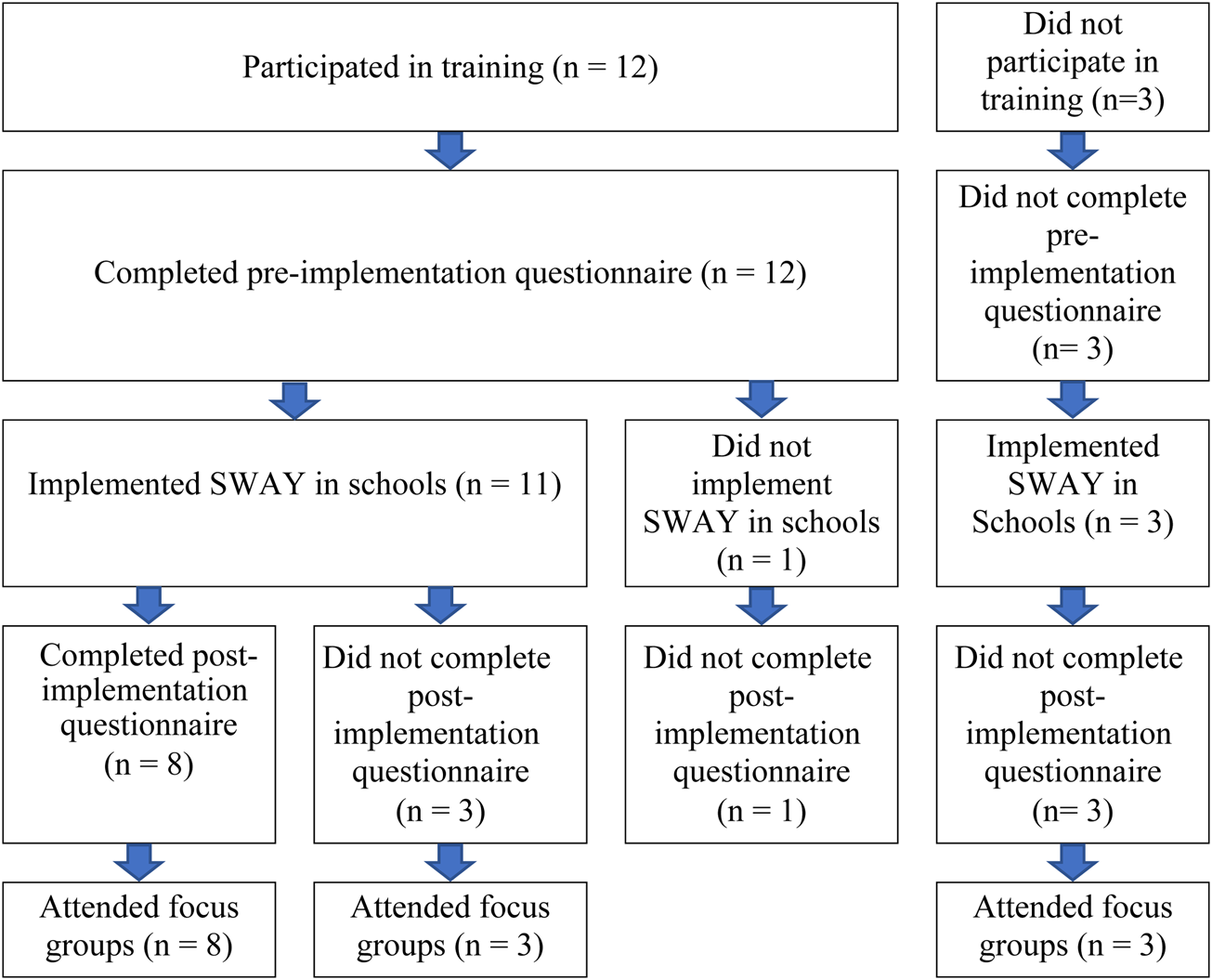
Purposive sampling was used to include participants already engaged with the SWAY programme. Participants were educators that attended SWAY training in January 2016 and/or implemented SWAY in the classroom throughout 2016. Initially, 12 educators from four rural NSW schools were recruited by the third author. Educators included five classroom teachers, three instructional leaders, two teacher aides, one Aboriginal language teacher and one Aboriginal education assistant. One educator was male, and the remaining 11 educators were female, reflecting the demographics of early education staff. Further demographic information was not requested to minimise demands on educator's time. Three additional participants, who did not participate in training, supported delivery of the SWAY programme in their schools and participated in the focus groups. Information letters and consent forms were emailed to participants, with all 15 participants consenting to release of data from RFWS to the research team. Participation in each component of the study is reported in figure 1.
Participant involvement flow chart.

Tools
Three tools were used to gather data. Firstly, The Interaction, Communication and Literacy Skills Audit (ICL; El-Choueifati et al., Reference El-Choueifati, McCabe, Munro, Galea and Purcell2011) was used as a self-evaluation tool to measure educator skills in ‘supporting the interaction, communication and literacy of children’ (El- Choueifati et al., Reference El-Choueifati, McCabe, Munro, Galea and Purcell2011, p. 3). Two parts of the ICL were administered: Skill Area 1 (developing positive and responsive adult and child interactions) and Skill Area 2 (explicit literacy instruction). Each skill area consists of different elements, which were comprised of both confidence and specific behaviour ratings. Confidence was rated on a 1–5 scale ranging from ‘not at all confident’ to ‘very confident’. Similarly, the frequency with which educators believed they demonstrated specific behaviours was rated on a 1–5 scale ranging from ‘never’ to ‘all the time’. Secondly, an additional questionnaire developed by the SWAY development team more specifically investigated educators' confidence and experiences embedding Aboriginal perspectives. It consisted of four open-ended questions and one confidence rating scale. Thirdly, a semi-structured interview guide was developed by the authors to explore educator perceptions of the SWAY training, mentoring and implementation. Questions addressed: their thoughts regarding the structure and delivery of training and mentoring; the value of training and mentoring and how it supported the implementation of SWAY; the level of support received from Aboriginal members of the school and local community; participant's knowledge, skills and confidence embedding local Aboriginal language and culture in the classroom; and the perceived change in their student's engagement and learning.
Procedure
Data were collected by RFWS in February 2016 prior to implementing SWAY, and between December 2016 and April 2017 after implementing SWAY over the course of the year. Data were released to the authors for the purpose of this study in April 2017.
Twelve participants who attended SWAY training completed the ICL and SWAY questionnaires pre-implementation; however, only eight completed both questionnaires post-implementation. Three sets of post-implementation responses were not returned and one participant did not complete post-implementation responses as she did not implement SWAY upon return to her school. The participants then partook in 45-min audio-recorded focus groups post-implementation, held by the third author via phone or web-based video (Adobe Connect). In total, 14 educators were involved in four school-based focus groups, each focus group consisting of two to seven educators. This included 11 of the 12 educators who attended training, excluding the participant that did not end up implementing SWAY, as well as three additional educators that did not attend training, but implemented SWAY in the classroom. Despite not attending training, the additional participants were included due to their involvement implementing the programme. Details about how many participants were involved in each step are shown in figure 1.
Analysis
The audio-files for the educator focus groups were transcribed verbatim and de-identified by the third author. They were then thematically analysed, by the first author, using steps proposed by Braun and Clarke (Reference Braun and Clarke2006). This involved the following processes: (1) the first author read and re-read transcripts to become familiar with the data and form initial interpretations, (2) the first author inductively generated approximately 160 codes to describe the data and capture emerging ideas, (3) the first author collated codes to formulating tentative themes, (4) the first author gathered all data related to potential themes, (5) the first and second authors revised and modified the developed themes to ensure they were reflective of the data and (6) the first and second authors defined and named each theme.
Constant comparison was made within and across the four transcripts to capture similar and contrasting perspectives amongst participants. The process was reiterative and involved triangulation among researchers to ensure trustworthiness: the thematic analyses were reviewed and verified by the first author, second author and another academic with experience in qualitative research. The transcripts and thematic analyses were circulated for member-checking to ensure information shared by the participants had been accurately interpreted (Creswell, Reference Creswell2014), however no educators responded. The pre- and post-responses to the RFWS questionnaire were then reviewed and analysed to determine their consistency with the emerging themes from the focus groups.
The pre- and post-SWAY questionnaires were reviewed and analysed by the first author, to determine their consistency with the emerging themes from the educator focus groups. Lastly, ICL pre- and post-rating scales were analysed using descriptive statistics.
Results
Qualitative results from the focus groups are presented first, followed by quantitative results from the ICL.
Qualitative analysis of educator focus groups and SWAY questionnaires
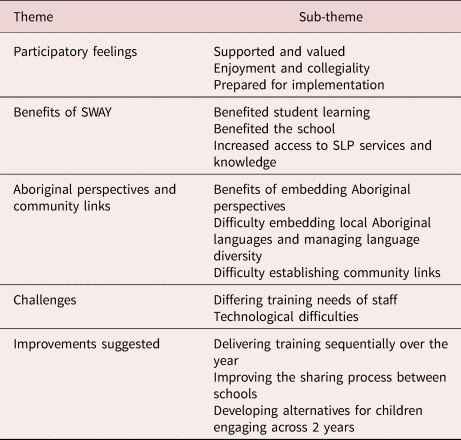
Thematic analyses of the four educator focus groups (FG1–4) revealed five themes and 14 sub-themes common amongst participants. Table 1 provides an overview of the identified themes and sub-themes, and a more in-depth analysis follows. Analysis of the SWAY pre- and post-questionnaires revealed consistency between the questionnaire responses and the thematic analyses.
Overview of themes and sub-themes

Staff expressed a variety of feelings regarding their participation in SWAY
Felt supported and valued
Most participants felt supported by the SWAY developers, particularly during ongoing mentoring sessions, and felt that their feedback was valued. Participants stated, ‘always felt very well supported’ (FG4) and ‘I felt that… whatever we said was really listened to and I felt like my input was really valuable on how to improve the program’ (FG1).
Felt enjoyment and collegiality
Most participants enjoyed their involvement in SWAY and expressed feelings of collegiality. Participants commented, ‘I really enjoyed the training… I especially loved the collegiality we had when we were doing the training… both there during the three days and ongoing’ (FG1) and ‘It was really nice to hear about how SWAY could fit in with the other school settings … I think that was just a nice perspective having other schools there’ (FG2).
Felt prepared for implementation
Following training, most participants had a thorough understanding of SWAY and felt prepared to implement it in the classroom. A participant commented, ‘I thought it pretty much covered what we needed to be able to implement the program’ (FG1). This was largely influenced by the practical nature of training, with a participant stating, ‘I also found doing the activities that were in the SWAY units before teaching them helped me to prepare for them better in my classroom… so it was really worthwhile having a hands-on experience’ (FG2).
Staff described many benefits of being involved in SWAY
Sway benefited student learning
Participants noted that students demonstrated increased confidence and improved oral language and early literacy skills. Participants stated, ‘It's been a great boost for them in personal confidence and the way they express themselves and just in their general learning’ (FG1) and ‘Our kids have shown some real growth this year in their language development’ (FG2). Some participants questioned whether these gains could be attributed to the impact of the programme or were a result of maturation. A participant commented, ‘How much do you attribute to you know everything that's going on and how much do you attribute to one aspect of the program’ (FG3).
SWAY benefitted the school
Most participants described how SWAY aligned with their school's needs and strategic direction. A participant stated, ‘I could see the connection very much during training how it would fit in with our scope and sequence’ (FG2). Participants also described how knowledge learnt from SWAY was easily transferable and could benefit other educators and students who were not involved in SWAY. A participant commented, ‘I would really like to do some training with my other teachers… develop some units of work or some resources that support the learning in a SWAY style for other children in our school’ (FG1).
SWAY increased access to SLP services and professional knowledge
Participants described how involvement in SWAY increased access to SLP services that would otherwise be limited. A participant commented, ‘Our (school) speech pathologist only works with Kindergarten in terms 2 and 4 so it was good having speech all year round’ (FG2).
Participants also noted how increased access to SLP expertise improved their ability to support oral language and early literacy development. A participant stated, ‘I really enjoyed with [name of speech pathologist] in the training and sounds component because it helped me to introduce sounds to my students better… I think that was some really great professional development’ (FG2).
Staff expressed a range of perspectives about embedding Aboriginal perspectives and creating community links
Staff described benefits of embedding Aboriginal perspectives in the curriculum
Embedding Aboriginal perspectives in the curriculum had numerous benefits, for both students and staff. Participants noted increased student engagement and connection to country. Participants stated, ‘I think the yarn was the most engaging part of SWAY and helped the children to connect… it was quite personal, and they could relate their experience to it’ (FG2) and ‘The students have a better understanding of country and culture’ (FG4). Participants also reported an increase in their knowledge, skills and confidence embedding Aboriginal language and culture in the classroom. A participant stated, ‘I feel that it's given me ideas of how to embed the language and culture… It was really helpful for my own learning’ (FG1).
Some staff experienced difficulty embedding local Aboriginal languages and managing language diversity
Some participants experienced difficulty embedding local Aboriginal language/s to contextualise SWAY. Participants explained, ‘There's sometimes a couple of different words… so I still wasn't sure if I was keeping the right one’ (FG1) and ‘There have been discussion whether or not you actually need to complete the training to be able to teach it in schools… so given that contention it was sort of a bit uncomfortable for us to be incorporating language into our teaching’ (FG2). Some participants also experienced difficulty managing language diversity. Participants stated, ‘People don't always pronounce it the same way… we got to allow for other language groups to come in… because there's six or seven language groups in the area’ (FG4) and ‘Because of the sound system that we have, you know a completely different sound system… we have words that start with ng… and stuff like that so a little bit difficult for the children to be able to say them’ (FG3).
Some staff described difficulty establishing links with the local Aboriginal community
Some participants experienced difficulty establishing links with the local Aboriginal community and described how this impacted their ability to deliver SWAY. Participants stated, ‘Some of the outside community links are a bit fractured… it's a very difficult and tricky to maybe work as we would like to work’ (FG1) and ‘In terms of you know a general community for supporting education as a whole, that's not particularly strong’ (FG3).
Staff described several challenges that arose during SWAY
Differing training needs of staff
Participants revealed different training needs and preferences. Some participants felt that training was too detailed, with a participant stating, ‘If there was less of anything it would have been going through the program… for me being a teacher I probably didn't need to go through every unit’ (FG3). However, some participants felt the level of detail was beneficial. A participant commented, ‘I thought the training was really thorough and very well resourced, that was really important’ (FG2). Some participants did not feel that training was necessary to implement SWAY with a participant stating, ‘If we had just been given the program I think we probably would've been okay’ (FG3). Conversely, a participant commented, ‘If I hadn't gone through the training it would have been hard to pick up the program and sort of go along with it’ (FG4).
Technological difficulties
Participants highlighted that technological difficulties created a challenge during mentoring and remote SLP intervention sessions. Participants commented, ‘Technical difficulties that we had really did make sharing with the other schools quite difficult’ (FG2) and ‘One day our VC [video conferencing] didn't work… then we couldn't hear last week… and they had trouble dialing in’ (FG3).
Staff made several suggestions to improve the future delivery of SWAY
Delivering training sequentially over the year
Some participants suggested that training would be best delivered sequentially over the course of the year. Participants stated, ‘I did think there was a lot in three days… I do remember thinking at the end of training, oh gosh’ (FG2) and ‘If maybe training was delivered sequentially throughout the year… you can go back and implement it in a shorter time frame, everything will be fresh in your head and you'd be able to do every unit justice’.
Improving the sharing process between schools
Some participants suggested that the sharing process between the schools be improved. Participants commented, ‘I think a way we could improve is to improve that process of sharing between schools… we didn't really have any idea of what we were doing so it would have been nice to have more sharing opportunities’ (FG2) and ‘It would have been good to connect with some of the other schools’ (FG3).
Developing alternatives for children engaging in SWAY across 2 years
Some participants suggested alternatives for students participating in SWAY in both preschool and Kindergarten. Participants suggested, ‘Having out a year one and a year two cycle because the children who have done SWAY in preschool… they will do those same units of work again and may not engage with them at such a deep level’ (FG1) and ‘Implementing of SWAY on a two-year cycle’ (FG2).
Analysis of the interaction, communication and literacy skills audit (ICL)
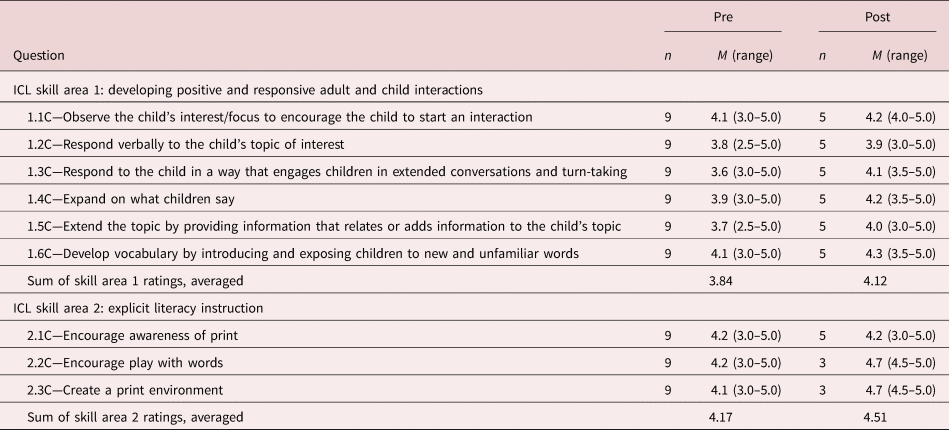
The ICL results included self-ratings for both confidence and behaviours (skills). Results for the confidence ratings analyses are reported in Table 2. While most participants completed pre-training confidence ratings (n = 9), fewer participants completed post-training confidence ratings (n = 3–5). Mean pre-training ratings were high, ranging from 3.6 (for element 1.3C) to 4.2 (for 2.1C and 2.2c). Mean post-training ratings were mostly higher than the average pre-training ratings, ranging from 3.9 (for 1.2C) to 4.7 (for 2.3C). The rating range extended down to 2.5 for pre-training ratings and down to 3.0 for post training ratings, and up to 5.0 for both pre- and post-training ratings across all elements. All confidence ratings increased following training for all elements except for 2.1C (encourage awareness of print) which remained the same.
ICL confidence ratings: self-reported confidence in demonstrating skills

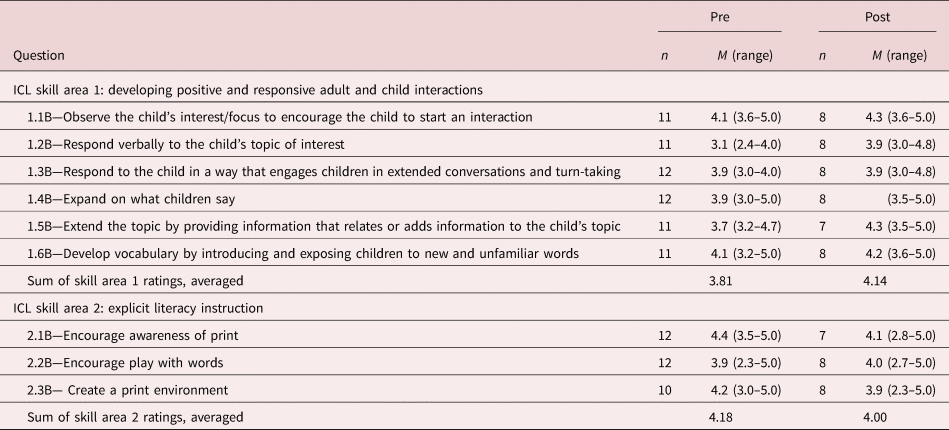
Results from the behaviour ratings analyses are reported in Table 3. Most or all participants completed the pre-training behavioural ratings (n = 11–12) and more than half the participants completed the post-training behavioural ratings (n = 7–8). Mean pre-training ratings were high, ranging from 3.1 (for 1.2B) to 4.4 (for 2.1B). Mean post-training ratings were also high, ranging from 3.9 (for 1.2B) to 4.3 (for 1.1B). The rating range extended down to 2.3 for pre-training ratings and up to 5.0 for both pre- and post-training ratings, but not for all elements. All behaviour ratings increased following training for ICL skills area 1 (developing positive and responsive adult and child interactions) but two elements for ICL skills area 2 (explicit literacy instruction) decreased (encouraging awareness of print and create a print environment) while the other increased only slightly (encourage play with words).
ICL behaviour ratings: self-reported frequency of behaviours demonstrated

The sum of ratings was calculated and averaged for each ICL skill area for both confidence and behaviour ratings (seen in Tables 2 and 3). This facilitated some comparison across components of the ICL both pre- and post-training. The averaged sum of ratings was higher for ICL area 2 (explicit literacy instruction) than for ICL area 1 (developing positive and responsive adult and child interactions) for both confidence and behaviour ratings pre-training. Post-training, the ICL area 2 averaged sum of ratings was higher for the confidence ratings but slightly lower for the behaviour ratings.
Discussion
This study is unique, as it is the first published report of SWAY. Programme development and implementation utilised many culturally responsive teaching strategies and interprofessional collaborative practices among educators, SLPs and Aboriginal education officers. Educators valued the training and mentoring provided and perceived an overall increase in their confidence and skills. The following discussion addresses the research questions and then explores embedding of Aboriginal perspectives before describing implications and limitations of the research. Qualitative findings from the focus groups and quantitative findings from the ICL questionnaire will be integrated throughout the discussion.
Perceptions of SWAY training and mentoring
Educators thought the SWAY training was practical and facilitated their learning, similarly to a study by McDonald et al. (Reference McDonald, Proctor, Gill, Heaven, Marr and Young2015). They also felt that ongoing mentoring sessions supported their implementation of SWAY. Recognition of the importance of follow-up after training, to ensure participants feel supported and maintain positive change, is consistent with past studies (McDonald et al., Reference McDonald, Proctor, Gill, Heaven, Marr and Young2015; Scarinci et al., Reference Scarinci, Rose, Pee and Webb2015).
Notwithstanding the benefits of mentoring sessions, educators described challenges in the use of technology during mentoring and SLP intervention sessions. Educators had difficulties with sound and vision, connectivity and accessing the web-based interface. Similar difficulties have been reported in past studies (Lincoln et al., Reference Lincoln, Hines, Fairweather, Ramsden and Martinovich2014; Hines et al., Reference Hines, Lincoln, Ramsden, Martinovich and Fairweather2015; Fairweather et al., Reference Fairweather, Lincoln and Ramsden2016). Thus, more explicit support for using technology would enhance the mentoring process. Sequential, distributed delivery of training over the year was suggested as a strategy to reduce mass delivery of information over three consecutive training days. Similarly, past studies recommend several whole day workshops, with time between, as they provide participants with opportunities to try strategies, think about the information and compile questions in between training sessions (Mroz, Reference Mroz2006; McDonald et al., Reference McDonald, Proctor, Gill, Heaven, Marr and Young2015).
Educator confidence and skills for supporting oral language and early literacy development
Prior to implementation of the SWAY programme, educators were mostly confident and evaluated themselves as demonstrating many desired behaviours to support oral language and early literacy development. Nonetheless, educators reported increased knowledge, skills and confidence supporting oral language and early literacy development following training. Data triangulation between the focus groups and ICL validated these findings. Other studies have reported a similar increase in educator skills after SLP training (Mroz, Reference Mroz2006; Girolametto et al., Reference Girolametto, Weitzman and Greenburg2012; McDonald et al., Reference McDonald, Proctor, Gill, Heaven, Marr and Young2015; Milburn et al., Reference Milburn, Hipfner-Boucher, Weitzman, Greenburg, Pelletier and Girolametto2015; Namasivayam et al., Reference Namasivayam, Hipfner-Boucher, Milburn, Weitzman, Greenburg, Pelletier and Girolametto2014; Rezzonico et al., Reference Rezzonico, Hipfner-Boucher, Milburn, Weitzman, Greenburg, Pelletier and Girolametto2015; Scarinci et al., Reference Scarinci, Rose, Pee and Webb2015). Although not statistically significant, it is worth noting that two post-implementation ratings decreased compared to pre-implementation ratings. However, lower post-training ratings may result from participants becoming more aware of specific skills through increased insight (N. El-Choueifati, personal communication, August 2017).
Interestingly, comparison between pre- and post-ICL ratings indicated that involvement in SWAY significantly increased the confidence and behaviours of educators in developing positive and responsive adult and child interactions (ICL Skill Area 1). As Skill Area 1 is linked to oral language, and SLPs have expertise in spoken communication and interaction, it is possible that SLP training had a positive impact on the development of these skills. It is worth noting that two oral language elements in Skill Area 1, that are important for early literacy development (vocabulary development and expanding on what children say), did not significantly increase (National Reading Panel, 2000; Rose, Reference Rose2006). Similarly, an absence of significant change to explicit literacy instruction (ICL Skill Area 2) may suggest educators possessed sound explicit literacy instruction skills prior to training, training had less influence on these skills, or there needs to be more emphasis on this area in training.
Educators also described improved oral language and early literacy outcomes of students. Whilst this was not directly investigated in this study, these findings are consistent with previous studies, which reported the benefits of SLP training for both educators and student outcomes (Girolametto et al., Reference Girolametto, Weitzman and Greenburg2012; Starling et al., Reference Starling, Munro, Togher and Arciuli2012; Milburn et al., Reference Milburn, Hipfner-Boucher, Weitzman, Greenburg, Pelletier and Girolametto2015; Namasivayam et al., Reference Namasivayam, Hipfner-Boucher, Milburn, Weitzman, Greenburg, Pelletier and Girolametto2014; Rezzonico et al., Reference Rezzonico, Hipfner-Boucher, Milburn, Weitzman, Greenburg, Pelletier and Girolametto2015).
Embedding Aboriginal perspectives
Educators reported increased knowledge, skills and confidence embedding Aboriginal language and culture in the classroom following SWAY training. Nonetheless, some educators reported that their ability to embed Aboriginal perspectives was already high prior to engagement in SWAY, so their skill evaluations did not increase following SWAY training. Data triangulation between the focus groups and SWAY questionnaires strengthened these findings. Educators also stated that embedding Aboriginal perspectives was beneficial for student engagement and learning; findings that are consistent with past literature (Silburn et al., Reference Silburn, Nutton, McKenzie and Laundrigan2011; Lloyd et al., Reference Lloyd, Lewthwaite, Osborne and Boon2015; Boon and Lewthwaite, Reference Boon and Lewthwaite2016; Scull, Reference Scull2016).
Conversely, some participants recognised that their ability to embed local Aboriginal perspectives was compromised when links to the local Aboriginal community were not strong. Future SWAY programme participants may need to consider factors suggested by Silburn et al. (Reference Silburn, Nutton, McKenzie and Laundrigan2011) more closely, in order to strengthen links with the local Aboriginal community and improve their ability to embed local Aboriginal perspectives, namely: communicate the school's accessibility and desire to strengthen links; create culturally welcoming places within the school where community members feel safe; participate in community initiated activities; acknowledge AEOs as significant contributors to the school and school-community relationships and be approachable and listen to concerns of the community.
Implications
This study highlights the importance of: collaborative programme development involving SLPs, educators and consultation with the local Aboriginal community; using an evidence-based approach to oral language and early literacy development; providing practical training and ongoing mentoring to guide implementation and forming links with the local Aboriginal community. Findings suggest that SWAY developers should continue to keep training practical, provide ongoing mentoring, and facilitate the sharing process between schools implementing SWAY. However, it could be beneficial to distribute SWAY training sequentially over the year and provide more explicit training and support for use of technology. Future research should explore the application of SWAY in a broader range of contexts and verify findings by exploring the perception of educators from a larger number of schools. The impact of SWAY on student outcomes and specific changes to educator skills, according to educator position and level of experience, would also be important to investigate. Future research could also explore variations in the delivery and content of SWAY training, to determine which features were most beneficial.
Findings also provide a model to guide the future development and implementation of culturally responsive oral language and early literacy programmes. To ensure SWAY is delivered to its full potential, schools are encouraged to form strong links with the local Aboriginal community and involve families and community members in the programme's implementation. However, findings suggest that greater connections with families and local communities during the preparation, adaptation and implementation stages may be required to ensure sound reciprocal relationships, as well as culturally responsive and quality teaching practices in each locality where the programme is implemented. Hence, schools may need higher levels of support to achieve community engagement. SWAY training could thus include more comprehensive exploration of strategies to involve families and community members.
Lewthwaite et al. (Reference Lewthwaite, Boon, Webber and Laffin2017) suggested that there is a collective lack of knowledge amongst Aboriginal parents, students and their teachers around quality teaching practices and that more dialogue is needed. Yet, community links provide a source of support and knowledge for schools when embedding local Aboriginal languages and culture, managing language diversity and connecting to country. Educators can play an important role in initiating and supporting dialogue and reciprocal knowledge exchange. Future research using in-depth interviews may explore barriers and facilitators to community engagement from the perspective of Aboriginal community members.
Limitations
Findings from this study are limited by several factors. Firstly, this study used a small, purposive sample so caution should be exercised when applying the findings to other programmes and populations. Secondly, demographic data were not collected from participants. More comprehensive demographic data such as length of time teaching in rural contexts or experience working with Aboriginal communities could contribute to understanding of confidence and perceptions of training and programme implementation. Thirdly, findings from the ICL are limited by missing data. As educators lived in rural NSW, post-training data were collected at a distance, which may have contributed to non-return of several post-ICLs and SWAY questionnaires. Also, numerous confidence ratings, in both pre- and post-ICLs, were left incomplete. It is possible that the formatting of ratings on the form may have made the confidence ratings less salient, contributing to missing data.
Conclusion
Positive findings from this study encourage and support the future delivery of SWAY. The programme was well received by the educators and had a positive impact on their confidence and skills both implementing oral language and early literacy strategies and embedding Aboriginal perspectives in the classroom. Furthermore, findings reinforce the benefits of culturally responsive programme development and quality teaching practices which can guide future development and implementation of oral language and early literacy programmes in a range of contexts. Specifically, this research also highlights the value of collaborative development involving educators and SLPs, and consultation with the local Aboriginal community.
Taneal Norman is a new graduate speech language pathologist, who recently completed a Bachelor of Speech Pathology (honours) at the Australian Catholic University, North Sydney. She is currently working both in schools and at a private clinic in Western Sydney. Taneal enjoys providing assessment and intervention to paediatric populations, and school-based service delivery. She is passionate about research, with ambitions to further her research in the future.
Wendy M. Pearce is Course Coordinator for the Speech Pathology programme on the North Sydney campus at Australian Catholic University. She coordinates the Allied Health Honours programme and is actively involved in incorporating Indigenous Australian perspectives into the speech pathology curriculum at ACU. Wendy's experience has primarily focused on assessment and intervention for children with speech and language disorders. Her recent research interests focus on expanding knowledge of the language skills of Indigenous Australian children. She is also interested in service delivery approaches for children with speech and language disorders, particularly in schools and early childhood settings.
Fiona Eastley is a speech pathologist and project officer employed by the NSW Department of Education. She works at the NSW Centre for Effective Reading. She is passionate about providing speech pathology services to rural and remote students via telehealth. She also enjoys working with teachers to integrate communication goals within the classroom curriculum.