We make and break our Gods daily, and consequentially are the Masters and Inventors of what we Sacrifice to.
Willem Bosman, New and Accurate Description of the Coast of Guinea (1704)
1. JUST-SO STORIES
Precious is a very young girl from Benin City. Three years ago she was found lying outside a hospital in Turin, where her madam had ‘dumped’ her. She had been scalped, and one of her ears bitten off. She could not walk, because she had deep wounds on her knees that had become infected and were suppurating. To rebuild the skin on her skull she had to undergo surgery several times. She was finally sent to the Frantz Fanon Centre in Turin for psychological support.
In my therapeutic workFootnote 1 with Precious I tried to make her talk about her body, to allow her to find her place in a register of signification. We spent our first meeting looking together at a picture-book on African rites of passage, Babatunde: life born again (Castiglioni, Castiglioni and Salvioni Reference Castiglioni, Castiglioni and Salvioni1988), that I often use in my courses on cultural anthropology for undergraduate students. Precious saw the book on the table while walking into the room and started browsing it without saying anything, but she asked what the pictures were about. She pointed at the scarified stomachs of the mothers, at the newborn babies already ‘worked on’ by the ‘culture’, the cutting of the umbilical cord, the genital organs cut off or circumcised, the sacrifices, the blindage (marking the screening or ‘closing’ of the healed body against any future attack), et cetera. She touched with her finger the points of the photographs that interested her (a scarified forehead, a tattooed stomach) and then she touched her own body. She immediately added, in a broken but incisive Italian, that she did not know what those signs meant, and asked me to explain what the pictures were about. Then she laughed, and said, ‘It's true.’
Did she want to provoke me, and see how much I knew about such worlds and such practices, of such a use of the body and the written memory, which, since it is written, is indelible? Slowly, Precious began showing her own body to me. The social worker who brought her to the appointment was surprised. She had not shown her wounds and scars to anyone before – except to one or two persons at the community home where she lived, in the privacy of her own room. She tentatively tried to make distinctions between the signs left on her body.
Many anthropologists, especially those not familiar with places of healing, will interpret such utterances as attempts by the patient to try and return to some sort of ‘culture of origin’. Rather, the aim is that of creating spaces where a narrative is possible. If someone had watched us from the outside – even if he or she took part in the scene, following the most sophisticated ethnographic method of investigation, participant observation – he or she would have thought that we were reifying notions, representations or practices that even in Africa are not carried out in that way. Nonetheless, my years spent doing fieldwork in Cameroon with some healers taught me the importance of such ‘stage work’ in order to establish a healing relationship (see Taliani Reference Taliani2006; Reference Taliani and Beneduce2008). Even if it may sound inappropriate to use such an expression in this context, I think that only an improvisation that is based on the cultural challenge of alterity can recreate the world of Nigerian immigrant women, whose physical pain has destroyed their own world (and has been a world-destroying experience).
Over the course of the meetings that I had with her as a psychotherapist, Precious gradually told me about the loneliness she felt after her mother died; about the kindness of her father's second wife, who brought her up; about her father's determination in sending her to Europe, while she did not really want to come; about the ‘gift’ received from the woman who raised her, a gift related to some prophetic dreams that she claims to have. Precious once talked about this gift as something that she had received mouth to mouth from her mother (her father’s second wife). Precious no longer recognized that phrase as hers, but then the cultural mediatorFootnote 2 Grace Aigbeghian explained to me that ‘the phrase mouth to mouth means that her mother chewed her food and then gave it to her to wean her. This way she got the ability to see the future.’ When we finally put that phrase back in context, Precious could talk about some recurring dreams she had had in a sequence of nights before our meeting. It was those dreams that had led her to ask for the psychological help offered at our meeting, but now she was no longer afraid that the dreams were messages of death (at first, she had even thought that it was her madam who had sent the dreams to her after the scalping and her hospitalization).Footnote 3 She also talked about the rites in which she had taken part in Nigeria before coming to Italy, and the economic and symbolic debt she was in; she told me about this unpaid debt and that she was determined to repay it.
I asked her repeatedly why she was so obstinate in her decision to repay this debt after all that had happened to her. My questions led her to express her gratitude towards her madam. ‘She brought me here to Italy, I will always be grateful to her for that. I would not be here without her.’ On the contrary, she was very angry with her father. One day, Precious stood up and shouted against her father, who had sacrificed her to her destiny. The cultural mediator, who was present at these meetings, translated in this way: ‘She resents her father for all this, she cannot understand why he sent her to Italy.’
Jane is not young any more, but she has the body of a teenager, a body swollen by months of psychiatric drugs and four admissions into psychiatric wards. While she was lying in hospital in a delirious state, she told me that she felt a spirit pulling on her tongue (which prevented her from praying). She saw her uncle's face come out of her vagina, lie down on her belly and call her: bitch. The spirits tormented her, with the voices of her father (who tried to protect her) and her uncle (who treated her like those women working on the streets). For the first time in the five years I had been seeing her, I could almost touch the origin of her suffering. Until then she had been radically silent about her migration experience and the cause of her pain could only be hypothesized. Thanks to the delirium, the presence of the spirits and the voices, her attitude changed. I supported and listened closely to this vocabulary of possession, rich in details about her bodily feelings, as well as her relationships with others. Once dismissed from hospital, she could talk about her experience: her mother's brother made her come to Italy with the promise to study. Once arrived, he had instead used her as a helper in a Pentecostal Church where people prayed for Nigerian women headed for prostitution. Jane too had a debt with her uncle to repay (the amount she remembers is €4,000). When she asked her mother in Nigeria for help, she told her: ‘Don't think you are different from the other women and do what you uncle says.’ Jane got furious with her mother, ignored her advice and instead rebelled and fought with her uncle. ‘We have fought many times,’ she says, and points out a significant difference – for her – between ‘fight’ and ‘hit’. The former verb means that she actively defended herself and attacked, while the latter implies a passive role. Paradoxically, after escaping from her uncle and being admitted into a community home for foreign women victims of human trafficking, she started developing the dangerous symptoms of a historically true delusion: fears of a mystic poisoning, spiritual attacks to parts of her body (her tongue, navel, vagina), fears of death by witchcraft, the terror of being prey to a demonic possession. Finally, the fear of being tested by God: the fear that God was testing her spiritual strength and her will to resist temptation.
These observations are drawn from field work that I have been carrying out since 1997 in Turin. My work consists in meeting Nigerian immigrant women who have shown psychological and/or psychiatric disorders and are victims of human trafficking and sexual exploitation. Italian legislation defines as victims of human trafficking for the purposes of sexual exploitation those immigrant women who file criminal charges against their exploiters – their madams and ‘trolleys’ (those who arrange and supervise their journeys to Italy).Footnote 4 Following their report to the police, these women are placed in a protection and social reintegration programme.
If we are to speak about these women we must recognize the multiple layers of domination in which they were placed, and in which they placed – and still place – themselves, both in their country of origin and in the host country. We must also put in a historical perspective the symptoms that often cause their admission into psychiatric hospitals. These symptoms are connected to voodoo rites,Footnote 5 and are often classified as magic-religious delirium and persecutory delusions in the language of psycho-pathology.
Nigerian women use references to voodoo in telling of their migration experiences. These references require a twist in the discourse so as to avoid any dichotomy, such as the one that opposes victims (Aghatise Reference Aghatise2005)Footnote 6 to actors who can make a choice, or have some control, over their own destiny (Guillemaut Reference Guillemaut2006; Reference Guillemaut2008). Etic interpretations that impose such dichotomies risk removing the forms of subjectivation hidden in these new forms of ‘life on loan’. An ethic of participation (Solinas Reference Solinas and Solinas2007),Footnote 7 inherent both in the logic of debt and in the scene of the rite, accompanies the experience of migration, with a double interpellation. Nigerian women ‘are summoned’ by at least two ‘voices of authority’: the first is European law, in this specific case Italian law, with its bureaucratic language and its investigative mandate; the second is the customary local law, with its familiar vocabulary (familiar in both senses of the word: because it concerns the rules of the family, and because it is better known, since it is the one they grew up with). The place where these two systems of authority collide – the body of these young women – is the place where their identities took shape, were maintained and, sometimes, transformed in a radical bodily form (cuts, bites, rapes). One of the tasks that ethnopsychiatry and more generally anthropology should undertake is that of understanding how these subjects choose between conflicting interpellations – between the individualism and the idea of justice promoted by the programmes of protection that the state offers, and the ties, beliefs and customs that the family imposes on them. If, as Roberto Beneduce reminds us, psychological suffering is a form of implicit criticism of the social order (2007; 2008a; 2008b; see also Beneduce and Martelli Reference Beneduce and Martelli2005), then in the case of these Nigerian women there is an implicit criticism of two contexts and legal and political systems, corresponding to the two power relationships and the two forms of violence to which they are summoned. Their answers are often disjointed, fragmentary. It could be said of these fragmentary subjects that they are trying not to answer either of the two ‘summons’. They are trying not to turn round (the trope of Judith Butler), with all the suffering this provokes: hence the ambivalences, or what some health and social workers see as lies and manipulations (they tell several versions of their stories; there is no single version of the events). One of the most frequent questions from social and health workers who have to care for these women concerns the relationship of strong subordination these women have with voodoo or juju. The question is: how can these girls be so afraid of an object, a mere single object, made during the rite and vulgarly called ‘voodoo’ or ‘juju’? So afraid as to make it impossible for them to break the circle of exploitation in which they are trapped? So afraid as to block their parents from reporting their situation to the police, and, on the contrary, make them advise their own daughters to pay their debts, no matter what the cost?
The goal of this work is to start a discussion about two anthropological notions with a rich literature – namely voodoo and fetishes (see Pouillon Reference Pouillon1975; Agamben Reference Agamben1977; Bazin 1986; Bonnafé Reference Bonnafé1985; Colleyn Reference Colleyn1985; de Surgy Reference de Surgy1985, Reference de Surgy1994; Latour Reference Latour1996; Tonda Reference Tonda2005). More precisely, I intend to discuss these notions in the context of the local Italian scenario, inside those institutions charged with recognizing and taking care of Nigerian women in Italy. Finally, a more general goal is to ask if and how new types of subjectsFootnote 8 are emerging in these contexts of oppression, exploitation and coercion, because these women are subjugated and at the same time on the path towards subjectivity, within conflicting economic, social and cultural discourses.
2. DEBT AND ITS CONSEQUENCES
Hannah is a really nice IshanFootnote 9 girl, twenty-five years old. In November 2009 she denounced an older Nigerian woman and since then has been in a social integration programme. From 2006 to 2008 she worked as a prostitute in a rich province of northern Italy, to pay the debt that she incurred in Nigeria (€45,000). She was born in the city of Uromi, and grew up between Ubiaja, Benin City and Warri, because her father moved a lot for work. She is the fourth of eight children of a wealthy family. She tried to enter university after getting a high school diploma when she was nineteen. During the entrance exam in 2006, a friend of hers told her about the possibility of going to Italy, where she could find a job as a shop girl. Without asking for her father's advice or permission, she accepted her friend's invitation and left after a few days for Lagos in the company of the same friend and a man (‘a very rich businessman’, she says, considering how fast he could get the necessary false documents). She arrived in Italy on a direct flight from Nigeria. She was accompanied by another Nigerian man: they travelled together through some cities of the North and for the first two weeks she was a guest in the house of some countrymen. She was then contacted by her madam.
After paying part of the debt, she continued to prostitute herself until the autumn of 2009, keeping most of her earnings for herself and her family, while continuing to pay the price of the joint (workplace) to another Nigerian woman, whom she did not ever meet (once a month Hannah sent €150 directly to Nigeria). Meanwhile another young woman came back ‘changed’ after spending a year in Nigeria. She became violent with Hannah and other girls who worked on the streets and started asking them to pay her for a joint (€200 per month). One day in November, after numerous fights and some severe beatings that she received because she had refused to make this payment, Hannah decided to rebel, and made a threat. This new madam (she was indeed very young, and she and Hannah had been ‘friends’ because they were both, at the beginning, forced to prostitute themselves for a third Nigerian woman) assaulted her with a razor blade and slashed her face deeply. The scar runs across her left eye from side to side, and widens in the lower part of the face, going down towards the cheek like a tear. The police intervened after a caller reported the brutal fight, and, after Hannah reported the assault, arrested the madam.
During our first meeting (8 June 2010) Hannah talked about the symptoms that troubled her. While telling me some nightmares – two black women touch her, they raise their hands above her (and she mimics the gesture) – she burst out crying. She switched from Italian to English. In a rapid outpouring, she said that she had been poisoned at night. ‘You know, such spiritual things.’ Then, calmly, she went on: after she went to the hospital and the doctors told her that she was in excellent health, she felt even more anxious. ‘I called my mother.’ She told her mother that something was disturbing her and that the ‘white’ doctors could not see it. Hannah lowered her eyes. Then she went on: her mother had consulted the pastors of two different churches (Pentecostal and Evangelical), and then told her the response that both gave: ‘poisoning’.Footnote 10
I pressed her on the act of believing, wanting to understand better her relationship with this and other beliefs about evil and illness, assuming the materiality of believing itself (in the actions, rather than in its representations: de Certeau Reference de Certeau1981).
ST: Did you eat anything in your dream? Did those women offer you anything to eat?
[Hannah nods. She does not remember what she ate, but is sure she ate something, she says.]
ST: Do you know whether your mother went to a native doctor?
H: No, my mother is a simple person. She does not go to native doctors. I would never allow her.
[I press her to give me a less rigid answer.]
ST: Have you ever been to a native doctor?
H: No [Silence]. Yes. When I was small, my mother took me to them sometimes. Then, before the trip, they took me to a native doctor before leaving for Italy. But I must not talk about these things, they told me I should not talk about them with anyone.Footnote 11
In our second meeting (21 June 2010) Hannah entered alone. After a moment of ‘reciprocal repositioning’, we took up where we had left off.
ST: In front of which shrine did you take your oath before coming to Italy?
H: I don't know the shrines.
ST: It was the shrine of Ṣango, Ogun, Olokun …?
[Hannah laughs vigorously. She lifts her hand to her mouth and leans forward.]
H: Do you know these names? [She then turns serious again.] It was certainly a shrine, but I don't know to which god. I don't believe in juju. I did not care to find out which shrine it was, I don't want to have a shrine at home, it is hard to have a shrine at home.
I made her repeat several times that she ‘did not believe’ those things, even though I thought that we were – so to speak – up to our necks in them. I tried to make her sway between the two ways I know of talking about these beliefs: the serious and the humorous. Our dialogue then touched on the material and symbolic forms of her immigration experience, an experience marked by the rules of the sex trade, and the induction into prostitution to pay off her debt. In telling her story, Hannah can also be critical and polemical. The figure of Olokun becomes a central point of our discourse, because the mother of her first madam told her by phone one day: ‘You are the daughter of Olokun, don't forget it.’ Just a moment before, talking about her first madam, Hannah had said that that woman ‘was afraid’ of her. ‘She never beat me, or threatened me. She was afraid of me.’
3. POEMS OF LIBERATION
Every psychologist, psychiatrist or medical anthropologist who has worked with these immigrant women knows only too well that their submission to forms of symbolic violence and acts of physical coercion produces a type of suffering that does not have a clear, well-defined shape. Quite often, the forms of this suffering are metonymic, since the language of the patient is polysemic, polymorphic and very difficult to define precisely, especially without a detailed knowledge of the ‘code’ of communication of both the forms of domination, and the idioms of suffering.
‘Dispossession’, ‘deliverance’, ‘debt’, ‘bondage’, ‘wound’, ‘redemption’, ‘challenge’, ‘madams’, ‘chief’, ‘lord’: these are just some of the most common words used by these women in their tales, both during their delusions and in their more lucid narrations. These terms reveal a permanent contamination of different registers, a ‘confusion of genres’ (Beneduce Reference Beneduce2002). These terms are simultaneously economic, magic-religious, psychological and moral. They are economic, since they describe the exploitation of the women, the circulation of money, and the bond established through the oath. They are magic-religious terms because they talk about the spiritual relationship between what is human and the Other, or the super-human,Footnote 12 as well as the bond between the human and the invisible; such terms are also very common in the context of the Pentecostal churches attended by many of these women. The terms also have a psychological meaning since they describe the border between a liveable life and an unacceptable state of suffering, between a possible life and a deadly existence. Finally, they are moral: these terms are actually emic interpretations used to understand the falls, the crises, the collapse of a world of shared values, the attribution of guilt, and the responsibilities of those who created damage, pain and disgrace.Footnote 13 If we try to impose some kind of lexical coherence on these stratified meanings, we inevitably misunderstand, by simplifying them, the complexities of these stories.
The meetings with Hannah, viewed as a single, present scene, represent the best way to see ‘at work’ these multiple lexical contaminations and this vast confusion of registers. During our first meeting I translate ‘something moves inside’ by using the etiology of ‘worms’,Footnote 14 and she nods in agreement, saying that that is what she also thought. In an ethnopsychiatric context such an etiology makes it possible to talk about the exteriority of the body, the mobility or fixity of its exposed parts (the face, but also nails, hair), and also about the social imaginary meanings that produce dependency, exploitation, violence, death (the body that eats something/that is eaten by something). While the scar on Hannah's face that her last madam gave her is indelible, some parts of her body are detachable,Footnote 15 such as the ones that were removed during the voodoo ritual in Nigeria before leaving, and that were given to her last madam. Finally, her organs and the orifices of her body are contaminable (that is, prey to viruses and infections – including HIV and hepatitis – which, in biographies of this type, are similar to the ghosts of a witchcraft attack).
Again, she talks about ‘dreams that don't let her sleep well’ and in Nigeria the pastors her mother talked to translated her difficulties in the terms of a mystic poisoning: the one that still binds her to the persons that brought her to Italy. The spiritual world in this case can be used to talk about ‘what those women still want’. I exploit these metonymic meanings, that quickly switch the discourse from one register to the other, and I ask Hannah if she has paid all her debt. Hannah says ‘no’, but adds that she has paid ‘enough’ and that she does not want to pay more. She claims that the debt was based on a lie (‘they told me about another job’) and that this deceit – in which she feels like the naïve protagonist – makes her free to establish the amount of money to give back. In this context, ‘I have given enough’ means that the girl is trying to overturn the balance of power, that she is no longer dependent, that she can now establish her own terms to end her ‘working relationship’, that she is no longer a debtor, but a free woman. These attempts at subjectivation are still very tentative: Hannah still does not feel well, can neither work nor sleep, cannot manage minimal relationships between peers, because she talks inappropriately, talks too much, is too aggressive when she talks. All this makes me think of a subjectivation that goes round and round endlessly, and is therefore unhealthy.
Finally, the image of Olokun points to silenced and secret memories concerning her first madam. Moreover, these memories are linked to her mother, through whom she received a kind of knowledge and power out of the ordinary. Once again the discourse turns upside down, and Hannah turns from victim, debtor and dependent into someone stronger than her madam, a real menace for this woman (which might explain why the first madam never beat her nor asked Hannah or her family for the whole agreed sum). If she is ‘the daughter of Olokun’, neither her mother nor her grandfather (a well-known healer), could have ignored it. The discourse turns from external relationships to issues dangerously familiar, which concern her own maternal lineage and the destiny of her family.
The metaphors content/container, internal/external, visible/invisible collect fragments of discourses that move between economy and medical health, politics and aesthetics, mysticism and morality, society and those figures that always exceed it (witches, healers, sons or daughters, wives or husbands of gods). On the basis of my ethnographic encounters I cannot share the classificatory obsession of a certain anthropological tradition that cannot free itself from dichotomies – tradition versus modernity; ethnocentrism versus culturalism – as if these labels had any ethical meaning or explanatory power in the face of such mobile and precarious identities, ‘troubled by uncertainty and ambiguity’ (Tonda Reference Tonda2002: 21). In my opinion, these academic disputes say more about the researchers' classificatory anxiety than the topic under analysis (Geschiere Reference Geschiere2000: 28). When we talk about Mami Wata or Olokun, witchcraft or voodoo rites, are we inside a social and cultural construction, a material and symbolic construction which is ‘neo-traditional’,Footnote 16 ‘modern’ or ‘re-traditionalized’? Are we facing the reinvention of a tradition or the looking back of a modern condition?Footnote 17
4. A SPLUTTERED AND BABBLED SPEECH
All the Nigerian girls I have met in thirteen years talked about voodoo, or, rather, said in a very fragmentary way that some ritual had taken place in Nigeria and then again in Italy. Why ‘fragmentary’?
In my experience, these girls do not master at all the emic notions they talk about: they know only a little, do not know it well, and what little they know they learned from tales and ‘hearsay’, or just because they took part in a rite. The rite itself was just an experience, and nothing more: their ritual experience is not part of a larger pedagogic system, a wider transmission of knowledge, a legacy. We are not dealing with healers or soothsayers, people who possess a ‘traditional’ knowledge, or a whole ‘modern’, coherent and complex knowledge.Footnote 18
We are talking to young women, who in turn talk about water spirits (Mami Wata), voodoo deities (Olokun, Ṣango, Ogun), juju, witchcraft substances (azen), demons (Evil, Satan), and they talk about them in a very imprecise, tentative, spluttered and babbled way. The cases in which the patients know what they are talking about are rare. In these contexts of healing, the voodoo becomes an explanation prêt-à-porter (Zémpleni Reference Zémpleni1988), an interpretative passe-partout (Geschiere Reference Geschiere1995), or even a precarious translation (again Geschiere Reference Geschiere2000), similarly to what happens to other emic notions. The girls use it with the intention of making clear to the Europeans what they are talking about. It is their way of talking with whites about certain ‘things’. The most adventurous among them even say, ‘Voodoo is a word that you use, not us.’
Of course, it still is a term rich with anthropological implications, and it makes it possible to understand what happens in the encounters between these girls and the social workers of those institutions tasked with their healing and care. It represents, no less than other notions that were translated in colonial times (witchcraft, sorcery, possession, and the rest), an occasion to think, in anthropological terms, about what happens in the meetings with alterity, about all the good and bad – so to say – that happens in these meetings. Quite often, these cultural productions – which are the result of contamination and conflict – seem to irritate those who only see them as reifications of the culture of origin or stereotypes of the Other. I think that, on the contrary, the notion of ‘voodoo’ says as much about ‘us’ as it says about ‘them’. More precisely, this notion has to do with the processes of comprehension, decoding and translation that such encounters produce.
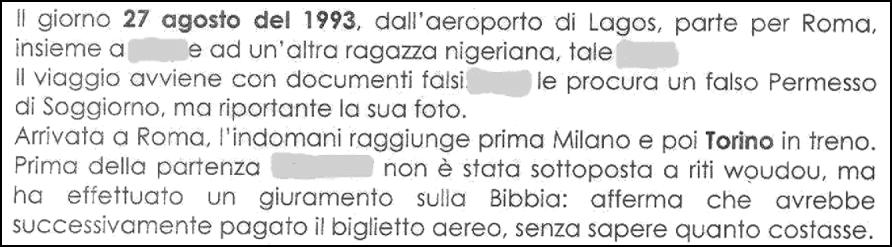
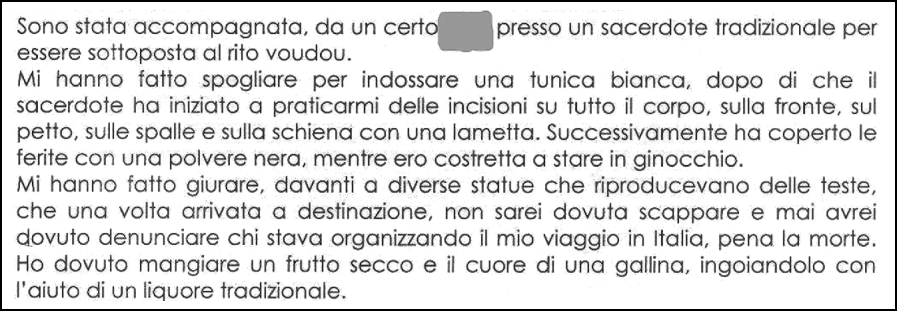
In this respect, it is very interesting to read some complaints filed by these women in police stations (reported here in Figures 1–5 below),Footnote 19 as they allow us to understand how the stories of these girls, especially the parts concerning the rites, are translated within such institutions by Italian policemen, social workers and cultural mediators. The reference to voodoo is indeed constant in all complaints, even when the woman says that it was not practised on her. The word is transcribed in different ways: woudou (Figures 1, 2 and 3), woodoo (Figure 3), voudou (Figure 4), vodou (Figure 5).Footnote 20
A woman from Auchi, born in 1972, who has left in Nigeria a daughter, born in 1988
[Complaint made in 2009] On 27 August 1993, [the woman] leaves Lagos for Rome, together with [blanked out] and another Nigerian girl [blanked out].
They travel with false documents. [blanked out] gives her a false residence permit, but with her picture on it.
They arrive in Rome, and the next day leave by train for Milan and then Turin. Before leaving, [blanked out] has not been subjected to woudou rites, but has sworn on the Bible: states she has subsequently paid the air ticket, without knowing its cost.

Ishan woman, born in 1982, has left a child in Nigeria, born when she was nineteen
[Complaint made in 2009] On 18 June 2004 I arrived in Benin City, and after two days have been subjected to the woudou rite, which was watched by this man and the ‘native doctor’.
The rite cost 1,500,000 naira, around 800 euros. We went into the woods near the house of the ‘native doctor’: they made me eat the heart of a chicken, I had to pick it up with my lips from a cup full of blood and other mixtures. Then I had to drink a glass of whisky.
They made me promise that when I arrived in Europe I would pay the debt of my journey, which they said amounted to 45,000 euros; if I reported the madam to the police or ran away before I finished paying off my debt, I would be killed. I hadn't any idea and didn't know how much 45,000 euros were, and have accepted for the sake of my child, so that I can help him through regular economic support.
[Her mother in Nigeria intervenes and speaks directly to the family of the madam.]
My first woudou was cancelled and after the phone call from my mother, my madam had become [a different woman].
For more or less seven months, I didn't go to work in the street, but [blanked out] always called me to convince me to prostitute myself again. Luckily, she never came at home.
In October 2005, [blanked out] called me and we met in her house, out of [blanked out]. Unfortunately, I cannot indicate the address or the area where we met, because I've been there only once.
On that occasion my new madam took locks of my head, armpit and pubic hair. She did not make me drink anything.
She asked me the amount of my debt with [blanked out]. My answer was sincere, I said 45,000 euros. I had already given 8,600 euros to [blanked out].
On that occasion [blanked out] established that I had to give her 35,000 euros. Of this amount I paid back 31,200 euros.
After this agreement with [blanked out], I started again to prostitute myself in [blanked out], and I continued to live with other girls in [blanked out]'s house.

Woman from Benin City, born in 1984
[Complaint made in 2010] [The girl is not subjected to any ritual in Nigeria, because the contact is not directly with her, but with her mother, who was approached by a neighbour.]
I have not been subjected to any woudou ritual, because my madam assured me that I would never work on the streets and that only girls who prostitute themselves had to swear in front of the ‘native doctor’ in Nigeria.
I spoke with my family and my mother made it clear to me that she could never accept that I prostituted myself in Italy.
[As soon as the young woman arrives in Italy she is met at the railway station by the madam and another girl.]
The madam, in the company of another Nigerian girl named [blanked out], leads me into the bathroom of the railway station, explaining that she has to take from me the parts needed for the woodoo ritual, which I had not done in Nigeria before leaving, and that these organic fragments would then be shipped to Nigeria.
The madam cuts a lock of hair from both the front and the back of my head, takes a part of my fingernails and toenails and with a razor blade makes some cuts on my wrists, chest and ankles.
She wipes with a handkerchief the blood coming out from the cuts and in the end takes my pants and immediately puts them into her bag.
She informs me that if I did not pay off my debt, I would die along with all the members of my family.
After the rite, she gives me some information about my job on the streets, and says that I also have to follow precisely the directions given to me by [blanked out].
She adds that I should repay the debt as quickly as possible so that she could make my younger brother come to Italy.

Woman from Benin City, born in 1983
[Complaint made in 2010] I was accompanied by one [blanked out] to a traditional priest for the voudou rite.
I was made to strip and wear a white robe, then the priest began to make cuts with a razor blade all over my body, on my forehead, chest, shoulders and on my back. He then covered the wounds with a black powder, while I was forced to sit on my knees.
I was made to swear, in front of several sculptures of heads, that once arrived at my destination I would not flee, and I would never denounce those who were organizing my journey in Italy, under penalty of death. I had to eat a dry fruit and the heart of a chicken, and swallow it with the help of a traditional alcohol.

Woman from Benin City, born in 1984
[Complaint made in 2010] [In 2008, the wife of a maternal uncle pushes the girl to leave for Italy. But once in Italy the young woman is subjected to the rite.]
The day after, she was awoken by [blanked out]. The madam subjects her to the vodou ritual: she takes parts of her fingernails and toenails, pubic and armpit hair and some blood from the fingertip. As a Christian the woman didn't hide her disappointment.
On this occasion the madam reveals the amount of her debt, namely 50,000 euros. In the ritual there are no oaths of any kind.
[The woman] reiterates that this was not what was agreed upon with her great-aunt in Nigeria, before leaving. [Blanked out] answers that she has been in Italy for ten years now and she knows that prostitution is the only job the girl must expect.
A few days after she arrived in [blanked out], [blanked out] forced the woman to apply for a residence permit citing political asylum. She explained that a Nigerian man would resolve this problem. He downloaded a story from a website and asked for 20 euros in payment. The story was an implausible tale of persecutions and escapes that she had to memorize and rewrite.
[The girl goes to the town hall to make the application in April 2008. After a few months of working as a prostitute, she manages to call her mother who, in turn, informs her father. Her parents, especially her father, try to mediate, without success.
In November the madam calls her mother several times. She threatens the woman and reminds her of the rite. If her daughter does not pay off her debt she will go crazy.
The girl has her asylum application rejected twice. Still hounded by her madam, after numerous attempts to escape, and with no hope of legalization through political asylum, she turns to a community home.]
From 7 October 2010 [blanked out] is housed in a community home for women victims of trafficking and sexual exploitation.
The girl is aware of the need to denounce her madam, but she asks to wait a little because she is too afraid of the woman's threats and of any retaliation on her family at home.
[She will flee right after filing the complaint.]

From the numerous complaints I have collected it emerges that the tales of these women about the rite do not follow a predetermined and fixed pattern: the rite can be done in Nigeria (Figure 4) or in Italy (Figure 3), or first in one country and then in the other (Figure 2), depending on the girl's commitment to honour her debt. The rite may require the eating of sacrificed animals (Figures 2 and 4) or not (Figure 3); an oath on the Bible (Figure 1) or at the altar of a god object (Figures 2 and 4). Similarly, the threat may target the victim's health in various degrees: disease, madness, death (Figure 5). Finally, the relationship with the parents has persecutory overtones: their support is, in most cases, precarious (Figures 2 and 5).
The voodoo that is being evoked by Nigerian women today is an excellent living metaphor of a new form of accumulation of wealth and social power, or, vice-versa, of failure and defeat. It is the only way to talk about the tie that is created when an economic debt is irrevocably incurred through a ritual action (about which we shall now say something more). It is a ‘gate-keeping concept’ (Appadurai Reference Appadurai1986: 357), which is by now understood by everybody, natives and foreigners, us and them, and is used to talk about the weird symbolic efficacy of the rite, a rite that can make you at the same time a subject and an object.
The voodoo these young women talk about is both a ritual action and the object produced during the action itself. This object has the function of a logical operator but it doubles its function when it acts: it is a fetish object that produces fetish bodies. When it works it makes it possible to traffic in women as if they were ‘sex bodies’ (Tonda Reference Tonda2005), things, or rather, pawns.Footnote 21 They are then shipped to a Europe eager to enjoy fast and easily accessible intercourse. When the voodoo works, it supplies a hyper-capitalist economy where the production of surplus value is out of control.
The voodoo or juju these girls talk about, in their slurred speech, is an ‘imaginary’ reality, in the sense in which Deleuze defined the imaginary, and in the sense used today by authors such as Bayart, Tonda and Beneduce. The imaginary works thus: you do not know whether it is real or unreal; its status coincides with a state of indecision and an impossible position. Participation in the ritual is an experience both real and dreamlike. The madams themselves belong to the register of the imaginary: even though they are women of flesh and bones, they are ‘witches’ with metamorphic powers, who can take the shape of a ‘cat’ (in a delirium) or ‘Mami Wata’ (in dreams). The girls are afraid of them because the madams can burn their bellies or their scalps with a hot iron and at the same time ‘mystically work’ their clothes and photographs, their menstrual blood and the food they offer to poison them in the world of the night. At this stage, psychological states of denial and despair – and a sort of ‘agonizing reappraisal’ (Lewis Reference Lewis1975)Footnote 22 – emerge that help the violence of the imaginary (Tonda Reference Tonda2005) proliferate, in the knowledge that the blows will be hard and given in broad daylight. In these stories, in fact, power relations are not hidden, and we can easily recognize the agent of violence, even though this recognition belongs to different registers of experience. In the case of Jane, whose story was briefly told at the beginning of this article, this agent was and still is her maternal uncle who is a pastor of a church and a nocturnal cat that slips into her bed and a head-spirit that comes out of her vagina. In the bodies of these girls – taken as fetish objects, corps-sexe – the economic and the psychic dimensions intersect at a right angle, but not in the way Marx and Freud proposed. In this case, in fact, the social relations of domination are not just masked but are created through the very fetish object produced during the ritual with the parts and remains of the girl's body. The ritual produces states of power and inequality that feed predatory and individualistic economies. Moreover, this kind of fetish does not protect the psyche thanks to a compromise aimed at repairing the fracture of the ego (as Freud claimed). On the contrary, it exposes the creative and desiring subject to deadly states of denial and despair: no compromise is possible for the person, who literally lets herself die.
While the fetish remains the object of belief par excellence, as stressed by Freud, in this case the fetish supports an economy of desire organized around a ‘negative’ psychic surplus (disease, madness and death). The logic of a ‘symbolic violence’ and those of a ‘violence of the imaginary’ precipitate together and in turn precipitate the subject in a mixture of scenes lying between the dreamlike, the delusional and the damn real.
5. THE EFFICACY OF RITES: VOODOO AS AN EXOTIC SET?
What makes rites so efficacious as to generate a state of moral panic in the women who are the victims of the sex trade? What generates such an intense fear of dying, as pointed out in 1942 by Cannon, who talks of ‘voodoo death’?
There is one aspect that emerges forcefully and points to a structural difference, so to say, between these voodoo practices and other rites, one that makes me question the generic, current use of the notion of symbolic efficacy, as proposed by Lévi-Strauss and re-proposed in these contexts (for instance, with the assumption that the rituals of the voodoo are efficacious: Calderoli Reference Calderoli and Solinas2007). Lévi-Strauss (Reference Lévi-Strauss1958) introduced the notion of symbolic efficacy to describe a scene of healing in which a Kuna curandero helps a patient to abreact an intense emotion of pain and fear: through the belief in the god Muu, both curandero and patient bind themselves to the belief, inside a general consensus; the scene thus opens up towards childbirth, birth, cure. When Nigerian girls talk about the rites they were subjected to before leaving and on arrival, it does not seem possible to apply the same interpretative pattern: belief–consensus–abreaction–cure. In these rites the initiate is led to re-live an intense experience of terror and fright; there is no abreaction of emotion but rather the incitement towards suspicion, fear, the unexplainable; words are said not to be understood, nor to be thinkable, in particular those concerning the conditions of the ‘pact’ (‘you will pay back 80,000 or 120,000 Euros’ are words that are not understood or thinkable until the arrival in Europe, and the difference in value between the naira and the euro becomes clear), and this increases the cognitive confusion of these young women.Footnote 23
Georgia was a very young girl who left Benin City while still a minor: leaving was for her a way of escaping from a relationship of dependency inside her family, because she was the skivvy of her maternal aunt in Benin City, the apprentice handy-girl, who had to work from morning till evening for little money and without any hope of finding something better. During one of our meetings she told me: ‘80 Euro … no, sorry, 80,000 Euro. Or was it 80? Oh, I do not know, I do not remember. I thought it was not a huge sum when the healer told me how much I had to give back … 80 or 80,000? I don't remember.’ (In other contexts she had talked about 60,000 Euros). Her arrival in Italy was likewise a form of accepting new bonds, but this time outside of the family network, with complete strangers.Footnote 24 Georgia's confusion showed itself also in another way, symptomatically: during our meetings her body did not stay still for a second (she rubbed her eyes, stretched her back, threw her arms forwards and sideways, as if she wanted to disjoint them from the head of the humerus, then she started again: incessantly). Trapped in her deepest fears, she did not remember what had happened during the rite. A few days after our first meeting, she started feeling warm on her chest, like waves of heat at the height of the breastbone: then, to alleviate this feeling, she would undress and lie on the floor to refresh the upper part of her body. The educators who followed her in the community home were alarmed.
When I asked her to tell me what had happened during the rite she told me that the obo threw some flames on her chest, by drinking some petrol and spitting it on the fire towards her body, as often happens in this type of ceremony (in front of a Ṣango shrine). During these rituals, acts and words receive a symbolic value aimed at reiterating a social norm that is common and widely shared in the cultural and historical context of the Edo, Ishan and Urhobo groups: the domination of the junior individual by a more senior one.
If, then, some aspects are shared by both ritual contexts (the Kuna in Panama, and the Edo in Nigeria), the direction of the act is exactly opposite: we are not dealing with the same form of subjectivation. All the social aspects of the rites of voodoo show it to be an action aimed at turning an arbitrary social difference into a natural one: the difference which sees the senior figure controlling and literally managing the life of the junior. We therefore have to turn to the notion of symbolic efficacy as it has been developed by Pierre Bourdieu (Reference Bourdieu1998; Reference Bourdieu2001), since in this case the rite legitimizes, reiterates and naturalizes an arbitrary social difference: there is no cure, but only the request to adhere to a form of domination (manipulating the representation of reality to change reality itself, as Bourdieu explains when he defines what symbolical efficacy is). The rite creates (licenses, reinforces) a relationship of domination. I believe that in the Nigerian context the rites of departure and arrival are intended to make the initiated incorporate (epidermise, said Fanon) the generational hierarchy, making the junior subject to the senior (low eyes, low voice, never say ‘no’, et cetera), and, in particular, the young woman subject to the older one. The symbolic violence and the form of physical coercion that keep reappearing, in the case of Precious and the other young women I met, see the mature, older woman as the unchallenged protagonist of a complete rule over women younger in age, a rule carried out with force and anger. Bourdieu talked about the ‘somatization of social relationships of power’ in order to produce a social artefact, the woman. In this case, I think that another social artefact is more relevant: the figure of the junior, in particular the subjugated junior woman.Footnote 25
The rite is therefore ‘efficient’ rather than ‘efficacious’. Since it does not have any therapeutic, abreactive, cathartic goal, the voodoo is in this case only used to subjugate some subjects looking for subjectivation. It feeds on the process of subjectivation of the initiate in order to subjugate her better to a common and consolidated form of domination. The ultimate aim is to start a new form of accumulation of capital that will never be universally extended or equally distributed. The power of the rite is such that it can even reverse the (natural) generational order, and turn a young woman into a ‘mother buttocks’ (iye onisan is the Edo expression to indicate the madam) who can bring to Europe and control other ‘girls’ older than she (and who are called ovbiye: ‘daughters of the same mother’). Here we observe a peculiar relationship between the logic of kinship and that of allegiance. It looks as if the two discourses precipitate, in a chemical sense, into each other. The hierarchy among these women is sanctioned by the Edo words for ‘mother/daughters of the same mother’. These women establish at the same time an almost matrimonial relationship through the circulation of money and the power of the debt. The result is a relationship of belonging/dependence which is indicated, in Edo, by the term ẹse: the ‘good’, the ‘favour’, the ‘gift’.Footnote 26 These are the most common translations used by these women to express their gratitude towards their madams.
These ‘carnal economies’ (Liechty Reference Liechty2005) include new forms of inequality and achievement, success and failure. Rites are practised rather systematically before leaving because the prospect of migration implies such radical changes (both internal and external) that the rite is used (by the group) to fix as long as possible the individual to the laws, the norms and the customs of his or her cultural and social system, and to prevent, but especially to postpone, a change that is known to be inevitable. In this way the rite seems to maintain intact one of its main features, namely the ability to put on stage what cannot be said otherwise: here, the voodoo is open to the paradoxes of migration. For instance, from the tales of the girls it emerges clearly that no madam expects to get back the whole agreed sum, but nonetheless she will try to extort as much money as possible, using violence, as long as the girls' panic is high, even if she knows that the girls will sooner or later wriggle out of the pact and their panic. This happens as soon as the girls realize the historical nature of the domination that subjugates them: many girls do manage to build another life in Italy, after freeing themselves from their madam, when they discover alternative forms of social relationships, emotional ties, and working relationships. Migration is thus an experience that exposes these girls to the historicization of the institutions and the norms, and therefore de-naturalizes what the rite had tried to de-historicize, in a continuous cycle of revelations, between enthusiasms and hesitations. One could say that since migration is such a material border – such a concrete edge to overcome – the decision to embark on it cannot but provoke rites aimed at making these girls incorporate an open secret (in Italian called segreto di Pulcinella): everybody knows the strength of these girls' desire of redemption, the desire to enter alternative anthropologies where gender, generational and family relationships are thought and constructed differently. And for this reason everybody will try to exploit as much as possible the moral panic that persists in the isolation of the migratory experience, when these young women have not yet built their networks and contacts, so that all those that take part in this occult economy (even including the relatives of the girls) might earn something. The process is time-limited, and the rite tries to discipline the moment of breakdown, of separation.
6. THE REALM OF THE SEMIOTIC: ‘CURE’ AS MUCH MORE THAN EMANCIPATION
Just as in colonial times (Taraud Reference Taraud2003), prostitution in the time of migration feeds a sexual economy inside a repressive system, but today this system is run almost exclusively by women.Footnote 27 Men have a secondary role in the economic management of the accumulation of capital, because they are either controllers or clients. This type of repression brings to light a peculiar notion of person (the so-called subjugated junior girl), the processes of foundation and consolidation of this status (the voodoo rites made in Nigeria and in Italy, next to the sexual assaults and the physical violence, which are reiterated daily), and the sites where this process takes place (the shrines, the houses of the madams, together with the marginal neighbourhoods of our cities and villages). The ethnicization of work (Balibar and Wallerstein Reference Balibar and Wallerstein1991) translates in this case into the figure of the immigrant Nigerian prostitute, thereby establishing a very close correlation between the zone of origin and the type of work, as if a Nigerian woman were by her own nature (that is, origin), condemned to no other occupation than prostitution in our job market (‘race’, class and gender issues collapse once again in the register of repression). If migration represents today for women (and not only for men), a strategy of economic survival and a form of emancipation, then the global market, in Italy as well as in Europe, leaves to immigrant women those few jobs that cannot be outsourced abroad (Falquet et al. Reference Falquet, Hirata, Kergoat, Labari, La Feuve and Sow2010). Among them, the most common are domestic work and the different forms of prostitution (in the club, on the street, at home, et cetera). The international sex trade satisfies this need of the West's social production and exploits several forms of discrimination and otherness: younger and younger girls, from the most rural zones of Nigeria, often illiterate or with few years of schooling, from broken, problematic or marginal families, identified with minority social groups, as compared to the Edo of Benin City and other majority groups. The trade is an economic system that racializes a peculiar type of work which cannot be outsourced, clandestine but at the same time easily accessible, because the young girls on the street are clearly visible and their number increases yearly, and because they are those whose sexual performances are remunerated at the lowest rates by Italian or immigrant clients, because ‘they are niggers’.
Any cure should (try to) reverse this process of domination. Bourdieu reminds us that it was Melanie Klein who first called on psychoanalysis to resume this task, and to carry out, within the space of listening and cure, the opposite of what the operation inside the ritual does (Bourdieu 1988: 43). Indeed, the processes of healing found within local medical systems are opposed to the rituals charged with maintaining domination, and reproducing it.Footnote 28
But what form of care, which forms of affiliation and socialization, what kind of relationship with ‘things and the world’ can we put in place within a therapeutic process if the only materials to build on and the only possibilities that these patients have to make a living are carnal economies of violence run by other countrywomen (a case of all-female violence)? Moreover, these young women have to face parental desires of accumulation and exploitation on one hand, and the structural violence of the Italian institutions on the other. These institutions turn out to be places of social death for these non-citizen women: they can live in community homes for years without getting definite answers about their residence permits, without the possibility of getting a job, and therefore without the possibility of renting a house, and so on.
How is it possible to cure within these scenarios of violence? How can we put together the fragments of a psyche that feeds on a culture going adrift, on social relations without rules and affected by a kind of déparentalisation (Tonda Reference Tonda2005)? These women have a ‘compromised future’ (Fanon Reference Fanon2004: 184), not because of an unfortunate fate, or because nature has not been generous with them (their abortions are not spontaneous miscarriages, but are almost always induced by someone else or the girl herself, so that she can continue working on the streets, and making money). In the case of these women, we are really facing History, and the arbitrariness of biopolitics. These vast issues must be traced, in all their depth, inside and beyond the features of psychopathology and the wounds of a psychological distress that is difficult to classify.
From my point of view, the symptoms displayed by these young Nigerian women are linked to two main factors: (1) the police report that the Italian state requires in order for them to get humanitarian protection often implies the public accusation of a close relative (a sister, a brother, an uncle) or a neighbour who is still in contact with the relatives of the patient (this type of migration directly involves families); and (2) any reconciliation is difficult and unlikely, given our social and clinical tools, since there is no way to ‘summon’ relatives, to mediate conflicts, to discuss the more obscure and violent aspects that concern the families and their ‘cursed’ choices. In my experience, the increase in the strength of symptoms, and the numbers of hospitalizations, is directly linked to the type of family relationship that exists between the madam (or trafficker) and the patient.
All these symptoms show in the body of the immigrant woman, and in its individual parts. For this reason, in the therapeutic process, the therapist should develop a special sensitivity for the body – both in its absence (the ‘dead’ parts of the body that were detached to take on life elsewhere: in the fetish-object) as in its presence (its wounds, scars, burns, sutures).Footnote 29
Concerning the body as presence, we have to retrace these signs one by one, recognizing them and naming them (within the space of all possible meanings: as in the case of Precious and Hannah). In order to reach this goal within an ethnopsychiatric setting, we should follow these bodily (and colour)Footnote 30 lines. Any process of individuation and identity formation is born from the possibility of occupying a space (physical and/or metaphorical). Their body is for each of these women the space to (re)occupy, the ‘land’ on which to impress their new form of life. In order to do this, I think we have to go through the ‘dominant signifier’ that these women themselves have ascribed to the experience written on their bodies: this is the only way to multiply, later on, the imaginable meanings, and produce new, original, significations on these written marks and memories. It is perhaps this ‘double time’ of the therapy that leads some authors to consider ethnopsychiatry a culturalist technique or an act that fixes the patient to his/her own culture of departure or origin (see Giordano Reference Giordano2008).
As for the body in its absence, there is no possible action in the realm of the real: although the object exists somewhere, we will never have to deal with it in the cure, because we do not know who owns it, preserves it, works it. For these young Nigerian immigrant women the voodoo or juju is a fetish object that they themselves accepted when they decided to make the trip to Europe. This fetish object literally terrifies them when they find out that its goals, intentions, duration and violence are beyond their control, beyond their desire: all these variables become independent of their original purpose. The autonomous life of this manufactured object takes them into a whirlwind of anxiety, nightmares, ghosts. One could say that in these cases the fetish is that object whose special status and relationship with human beings expose them to psychic risks. The fetish object establishes a balance of power, and that balance is the foundation of the rebuilding of the subject, the object and their mutual relationship. But once control is lost on the balance of power that was initially set up, the fetish becomes an object to be afraid of: something that frightens, paralyses, makes you uneasy. These women would all like to get back those things that have taken on a form of life: they would like to be again the owners of that thing which they are: ‘their’ tufts of hair, of pubic and armpit hair; ‘their’ drops of menstrual blood, and ‘their’ fragments of nails. Instead, that thing has remained in the hands of someone who can continue to shape it, transform it, finish it, infuse in it other powers, goals, intentions, forces.
‘Who’ has been left in the hands of the madam? How can we transfer this fear into the healing process? Where can we move it? What kind of substitute can we build (if this question did not sound terribly embarrassing in the therapeutic process), to snatch the girl from the states of denial and despair she has fallen in?
If we are to ask ourselves these questions without resorting to the mysterious, the supernatural, or the ridiculous (slaughtering black and white chickens in sterilized, aseptic surgeries), we must investigate the relationship that the subject has with an object that has become, in fact, a ‘fetish’: that is to say, an object that exceeds the subject and has a life of its own. It has lost the status of object as something other than oneself, the status of an external and inanimate thing. We must then understand how to ‘interpellate’ such subjects/objects in the healing process in order to move elsewhere the fear they generated or – when this is possible at all – in order to give the object a new way to be a thing. New forms of subjectivity can take shape, then, if it is possible to (re)transform the fetish into an object: just a thing and, as such, less disturbing.
On the basis of my clinical and research experience, I think I can put forward the following consideration: these women change the initial value attached to the object and to the rite according to the moment in history in which are found their daily efforts, their failures and defeats, their disappointed expectations. Any anthropology of belief must take into account the structural metonymy of belief itself, with the awareness that when we talk with these women (or make them talk) in a clinical context about water spirits, Mami Wata, juju, voodoo (exploring their innumerable names: Maupoil has claimed that they cannot be counted), we are developing together with them a moral discourse about actions and human relationships. These appear to be women who try to create among the cracks of a fiction stories (or pieces of stories) of experiences that have historically happened but cannot be otherwise told; or rather, that can be narrated only through continuous switches of registers. If patients are afraid of emic representations of suffering, this is so because these representations speak very clearly of forms of domination, of the balance of power, of oppressions (most of the time, family oppressions) to which they have been forced while looking for autonomy, social advancement and success – in their pursuit of a desire of change.
To talk with these women about all this, through Mami Wata and the uncountable spirits that culture produces, implies the construction of a clinical and anthropological approach that no longer follows in the footsteps of the dichotomies (victim/social actor, subjugation/emancipation, beliefs/trauma), but tries instead to see these categories together, one next to the other, in their mirroring each other, in their always possible overturnings, in the common search, together with the patient, for a life that can be lived, that can be continued. As stressed by Eric de Rosny (Reference de Rosny1981) it is all about giving back life to someone: to lay the conditions so that a life can continue, somehow.
Today Precious is a beautiful girl and has a boyfriend and a job; and Hannah too. Georgia is more restless, and has missed a job opportunity. She told me recently in a meeting: ‘The madams are offices.’ ‘What do you mean?’ I asked. ‘They sit all day comfortably behind a desk, in a nice office and wait for people to bring them money.’ After a pause she added: ‘It's nice to be an office. I want to be an office.’ Another time she said: ‘A stick is a stick, good to light the fire. They can do nothing with a simple piece of wood.’ The carnal and the spiritual fight between subjects and objects never seems to end. This is the case of Jane, who now lives in a community home for psychiatric patients and, three days a week, works as an apprentice pastor in a Pentecostal church in the city. These subjects at the mercy of compromised desires are still searching to be women in a less dangerous way: not offices, nor bitches; nor simple pieces of wood, moreover.
ACKNOWLEDGEMENTS
I am very grateful to Jean François Bayart, Roberto Beneduce, Eric de Rosny, Peter Geschiere, Beatrice Hibou, Pier Giorgio Solinas and Joseph Tonda for reading the article and making valuable comments and suggestions. I also wish to thank Federico Damonte for the translation, Grace Aigbeghian and the anonymous reviewers from Africa. Their pointed and generous suggestions helped me to better articulate key aspects of my argument. This article is dedicated to Père Eric de Rosny.