Foreign language aptitude generally refers to a set of specific cognitive abilities that enable some individuals to learn additional languages more quickly and efficiently than their peers when all other language learning success factors (e.g., time, quality of instruction, motivation) are equal (cf., Carroll, Reference Carroll, Parry and Stansfield1990; Doughty, Reference Doughty2019). These cognitive abilities may relate to general intelligence but are seen as distinct from it and are specifically relevant to second language learning (Skehan, Reference Skehan1989). Since its inception in the 1950s, foreign language aptitude has been a critical concept in applied linguistics and language education (Carroll, Reference Carroll and Glaser1962; Wen, Reference Wen2012a; Wen et al., Reference Wen, Biedroń, Skehan, Li and Sparks2019). Over the six decades of its development, research into foreign language aptitude has gone through fluctuating cycles of popularity and marginalization until witnessing exponential growth around the turn of the millennium (Vuong & Wong, Reference Vuong, Wong, Wen, Biedroń, Skehan, Li and Sparks2019). As the multiple papers in this present thematic issue of the Annual Review of Applied Linguistics (ARAL) amply indicate, foreign language aptitude is attracting greater interest among educational psychologists, applied linguists, and cognitive scientists (also see chapters in Reiterer, Reference Reiterer2018; Wen et al., Reference Wen, Biedroń, Skehan, Li and Sparks2019).
This reawakening of language aptitude research has been most prominent in the field of second language acquisition (SLA), linking it more explicitly to current theorizing and research (Ellis, Reference Ellis, Wen, Skehan, Biedroń, Li and Sparks2019). A fundamental aspect of this paradigm shift is the move from merely applying language aptitude testing scores to predict success among language learners (the focus of early research; e.g., Spolsky, Reference Spolsky1995) toward a better understanding of the aptitude construct and its constituent components (Wen et al., Reference Wen, Biedroń and Skehan2017; Wen et al., Reference Wen, Biedroń, Skehan, Li and Sparks2019). For example, early research focused on broad macro abilities, often driven by the subtests in aptitude batteries (e.g., grammatical sensitivity from the MLAT; Carroll & Sapon, Reference Carroll and Sapon1959), or sound-symbol association tests, such as in the PLAB (Pimsleur, Reference Pimsleur1966). Now, there is more interest in the details of the microprocesses involved in language acquisition (Skehan, Reference Skehan2015), and the conceptualizations of language aptitude are evolving (Singleton, Reference Singleton2017; Wen, Reference Wen, Mercer and Gregersenforthcoming). The research designs of aptitude studies focus on particular processes such as feedback and how it affects learners differently (e.g., Li, Reference Li and Gurzynski2017; Mackey, Reference Mackey2020). However, aptitude test development, for the most part, has not kept up with these important changes (with the notable exception of the HiLAB; Linck et al., Reference Linck, Hughes, Campbell, Silbert, Tare, Jackson and Doughty2013).
However, there may be a danger of fragmentation within the field as studies focus on increasingly specific aspects of language aptitude. Thus, this present paper seeks to synthesize these findings and to broaden the view of the nature of language aptitude and its measurement. To achieve this, we first explore the relationship between two frameworks for characterizing language aptitude: the Stages Model and the P/E Model, the former being an approach grounded in SLA perspectives of language aptitude (Skehan Reference Skehan, Granena, Jackson and Yilmaz2016, Reference Skehan, Wen, Skehan, Biedroń, Li and Sparks2019) and the latter emphasizing human memory, particularly working memory, as a central component of language aptitude (Wen Reference Wen2016, Reference Wen, Wen, Skehan, Biedroń, Li and Sparks2019). By comparing and integrating these two theoretical approaches, we argue that both language (as emphasized by the Stages Approach) and memory (as advocated in the P/E Model) are fundamental to understanding and characterizing the nature of language aptitude.
Above all, we argue that there are significant advantages to this synthesis, namely exploring how an acquisition-oriented approach makes assumptions about memory and vice-versa and whether these assumptions are justified. Investigating these connections should strengthen both approaches and lead to a greater understanding of the nature of language aptitude. Most importantly, it could also lead to insights regarding the development of new aptitude subtests that are more theoretically grounded and empirically effective—one of the greatest challenges facing the field of language aptitude research (DeKeyser, Reference DeKeyser, Wen, Skehan, Biedroń, Li and Sparks2019; Robinson, Reference Robinson2005).
Before developing a detailed comparison, we describe each of the two approaches to provide an adequate foundation for the paper's major parts.
The Stages Approach to Language Aptitude
Carroll's (Reference Carroll, Parry and Stansfield1990) four-factor account provided the basis for the “classic” approach to conceptualizing aptitude. In developing his four factors of aptitude, Carroll considered what learners do when learning a language and generated aptitude subtests based on a “job sample” approach. This approach was buttressed by statistical analysis of aptitude subtest performance and interpretation of the basic set of distinct abilities that emerged (i.e., phonetic coding ability, grammatical sensitivity, inductive language learning ability, and rote memory). Building on this foundation, Skehan (Reference Skehan, Granena, Jackson and Yilmaz2016) argued an alternative approach should capitalize on insights about SLA that had emerged since the development of the MLAT (Carroll & Sapon, Reference Carroll and Sapon1959). To this end, Skehan (Reference Skehan, Granena, Jackson and Yilmaz2016) proposed exploring whether there is a sequence of stages in the course of interlanguage development (Klein, Reference Klein1986). This alternative method of conceptualizing aptitude provides a basis for hypothesizing whether individual differences exist in a particular development stage and if they can be used for prediction purposes. If so, a battery of subtests linked to different stages could be more effective at predicting development than a global aptitude test and would have the benefit of not being tied to any particular view of foreign language instruction. Therefore, it might prove to be more wide-ranging in terms of its domain of application.
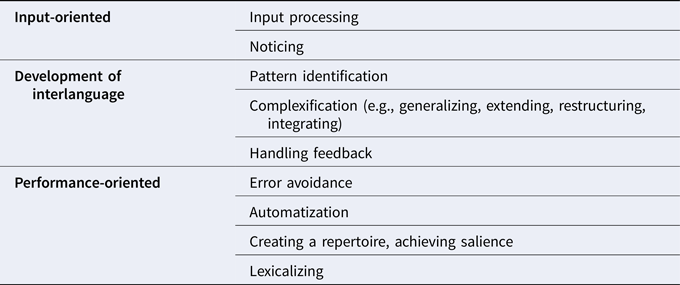
Skehan (Reference Skehan, Gass and Mackey2012, Reference Skehan, Granena, Jackson and Yilmaz2016, Reference Skehan, Wen, Skehan, Biedroń, Li and Sparks2019) proposed nine language acquisition stages drawn from the psycholinguistic processes postulated to underlie interlanguage development. The proposed stages are listed below, in Table 1, though given the complexity of language learning, the sequence may vary among learners.
The Stages Approach's Stages of Language Acquisition

Among these stages, the first two stages are input-oriented, and the next three are focused on interlanguage development. The subsequent stages (error avoidance to lexicalization) are more focused on performance and how an underlying system may facilitate that performance with greater proceduralization. Though important, these final four stages are beyond the scope of this present paper, as they do not have a comparable equivalent in the P/E Model.
In this synthesis approach, the first stage to consider is input processing and handling sound. At this stage, the challenge is to hold input material in the phonological buffer while analytic processes operate. The analytic processes involve segmenting the speech stream into units then analyzing these units to extract meaning, drawing upon long-term memory. If these processes are successful, then the buffer can be cleared, and the listener can move on to new input (Clark & Clark, Reference Clark and Clark1977). The next stage, noticing, concerns how some aspect of the material held in the buffer is extracted and focused on with greater attention (Schmidt, Reference Schmidt1990). The drivers of noticing could be salience, identification of something that recurs, or something highlighted through feedback (Skehan, Reference Skehan1998). Whatever is noticed at this stage is not analyzed deeply. The noticed element is merely recognized as worthy of attention and could become the trigger for later interlanguage development, drawing on explicit or implicit processes.
Beyond noticing, there are a set of stages concerned with the processing of patterns in language. At the simplest level, this could involve only pattern identification itself. Examples of noticed elements could be word order regularities, a repeated function for intonation, or agreements between elements. The point is that what was previously only noticed as perhaps curious is now put into an organizational frame, a process referred to in Table 1 below as complexification. Complexification processes can include generalizing (e.g., case marking with noun morphology; Kempe & Brooks, Reference Kempe, Brooks, Granena, Jackson and Yilmaz2016), extending, restructuring, or integrating what were seen as two smaller-scale systems into one larger-scale system.
Linked to all these stages is the role of feedback as learners engaging in interaction are provided with information, explicitly or implicitly, relevant to what they have said. Feedback may relate to errors, a gap in interlanguage, or any other feature of what the learner has said. Such feedback, as we will see, is particularly relevant when comparing this Stages Model to the P/E Model.
So far, we have considered processes that support the interlanguage system's development. As mentioned above, these processes (noticing, complexification, and so on) operate upon specific aspects of the system at different times. Thus, at any particular time, noticing may occur and become the focus for subsequent pattern identification. In any case, the important point is that we are dealing with an underlying system, explicit or implicit, and not primarily with performance. The focus is on the reception stage—on input, not production. To address production, we also need to consider processes such as automatization, and how what may be initially fragile insights are converted over time into fluent performance with progressively fewer errors. As indicated earlier, we will not pursue these important processes here because they do not relate very naturally to the P/E Model.
In sum, the Stages Approach: (a) proposes a set of stages of acquisitional development, and (b) considers the impact of individual differences in learning's effectiveness at that stage, so that (c) there is a case for aptitude subtest development. For example, a researcher could develop an aptitude subtest to investigate the impact of better input processing skills on some aspect of language development. Each of the stages in Table 1 has the potential for this separately, since each could be the basis for aptitude subtest construction.
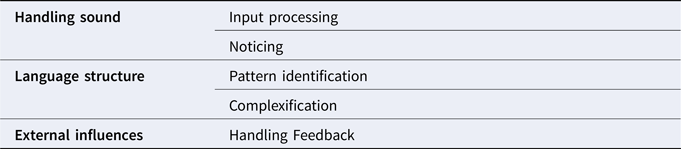
As we turn next to the P/E Model, we will consider just the first five stages from Table 1 and group them into three stages as seen below in Table 2. Input processing and noticing will be considered together, as will pattern identification and complexification. Handling feedback will be retained as it is. The reduction into these three groupings reflects a difference between handling sound, making changes to language structure, and the role of external influences upon that structure. The three more macro stages that emerge will provide a better framework for synthesizing the two approaches discussed here. The three groupings will also provide a better fit with more recent research that has been conducted linking aptitudinal stages with development.
Stages of Acquisition that Relate to the P/E Model

An Outline of the P/E Model of Working Memory
Working memory (WM) refers to our limited cognitive capacity to simultaneously maintain and manipulate a small amount of information in our heads while completing some mental tasks (Baddeley & Hitch, Reference Baddeley, Hitch and Bower1974), such as solving a mental arithmetic problem. WM has been a buzzword in cognitive science since its debut in the 1960s, boosted significantly by Baddeley and Hitch's (Reference Baddeley, Hitch and Bower1974) seminal multicomponent model, followed by the propagation of a multitude of models and perspectives (Baddeley, Reference Baddeley2012; Cowan, Reference Cowan2017; Logie et al., Reference Logie, Camos and Cowan2021; Miyake & Shah, Reference Miyake and Shah1999; Oberauer et al., Reference Oberauer, Lewandowsky, Awh, Brown, Cowan, Donkin, Farrell, Hitch, Hurlstone, Ma, Morey, Nee, Schweppe, Vergauwe and Ward2018). Drawing on emerging insights from WM, particularly the language-related explorations from the two well-established traditions in Europe and North America, Wen (Reference Wen2012b, Reference Wen, Wen, Mota and McNeill2015, Reference Wen2016) proposed the Phonological/Executive (P/E) Model. Based on the extensive research in these two traditions, this model explores the extent to which WM can be considered a language learning device in the second language case, paralleling claims by Baddeley et al. (Reference Baddeley, Gathercole and Papagno1998) for first language learning. The aim of this partial model of language aptitude (Wen, Reference Wen, Wen, Skehan, Biedroń, Li and Sparks2019) is to predict and explain second language acquisitional processes and learning outcomes. As it is still a relatively young model (Wen, Reference Wen, Wen, Skehan, Biedroń, Li and Sparks2019), there is still room for discussion how wide-ranging or limited this model might be.
The construct of WM, as conceived in the P/E Model, can be conceptualized and operationalized from three distinctive yet interrelated levels of analysis (also see Wen & Jackson, Reference Wen, Jackson, Li, Papi and Hiverforthcoming). These comprise from the bottom up (Wen, Reference Wen2016):
(a) its bidirectional relationship and interactions with long-term memory content and knowledge, which can be further demarcated into declarative and procedural memory (Ullman, Reference Ullman, VanPatten and Williams2015);
(b) its multiple components of the phonological loop (phonological memory), the visual-spatial sketchpad, the episodic buffer, and the central executive (Baddeley, Reference Baddeley2003, Reference Baddeley, Wen, Mota and McNeill2015; Baddeley, et al., Reference Baddeley, Hitch, Allen, Logie, Camos and Cowan2021); and
(c) its finer-grained subprocesses and executive functions subsuming information, updating, task switching, and inhibitory control (Miyake & Friedman, Reference Miyake and Friedman2012).
In line with these distinctive perspectives are a host of well-established WM measures from cognitive psychology and neuroscience (e.g., Conway et al., Reference Conway, Kane, Bunting, Hambrick, Wilhelm and Engel2005). This broad range of memory span tasks reflect the different emphases implicit in each, including the conception of WM as (a) a single pool of cognitive resources or limited capacity, (b) consisting of multiple components and embedded mechanisms, or (c) finer grained subprocesses that can be operationalized and measured independently (Wen, Reference Wen2016; Wen & Jackson, Reference Wen, Jackson, Li, Papi and Hiverforthcoming; Wen et al., Reference Wen, Juffs, Winke, Winke and Brunfaut2021).
More specifically, the “P” part of the P/E Model refers to the phonological component of WM (sometimes referred to as phonological short-term memory, or PSTM), which can be further divided into a short-term phonological store and an articulatory rehearsal mechanism, following the seminal multicomponent model by Baddeley and Hitch (Reference Baddeley, Hitch and Bower1974). Given its instrumental and facilitative roles in the storage, chunking, consolidation, and retrieval of newly acquired phonological forms, phonological WM is positioned by the P/E Model as a language learning device (following Baddeley et al., Reference Baddeley, Gathercole and Papagno1998; see Papagno, Reference Papagno, Schwieter and Wenforthcoming for an updated review). Drawing on previous research (Gathercole, Reference Gathercole2006; Gathercole et al., Reference Gathercole, Willis, Baddeley and Emslie1994), the P/E Model posits that simple versions of storage-only memory span tasks (e.g., the letter span, and the nonword repetition span) provide an appropriate measure of phonological WM. Conceived this way, phonological WM is likely to underlie the acquisitional and developmental aspects of language domains, such as the acquisition and development of lexis or vocabulary (e.g., Atkins & Baddeley, Reference Atkins and Baddeley1998), phrases or formulaic chunks (e.g., Martin & Ellis, Reference Martin and Ellis2012), and grammatical structures or morphosyntactic constructions in both L1 and L2 alike (see Wen, Reference Wen, Wen, Mota and McNeill2015, Reference Wen2016 for reviews).
In contrast, the “E” part of the P/E Model refers to the attention control and executive functions of WM (i.e., executive WM) as articulated and investigated by many North America-based cognitive psychologists such as Cowan (Reference Cowan, Miyake and Shah1999) and Engle (Reference Engle2002). At a greater level of detail with these executive aspects of WM, finer-grained subprocesses are proposed and are gaining increasing credence in recent years, such as information updating, task-switching, inhibitory control (Miyake & Friedman, Reference Miyake and Friedman2012). As such, the P/E Model postulates that executive working memory (EWM) serves to constrain and modulate selective processes during L2 comprehension (input) and production (output) as well as L2 interactions (of corrective feedback or recasts). Following well-established procedures in cognitive psychology, EWM is normally measured by more complex (storage-plus-processing) versions of WM span tasks such as the seminal reading span task (Daneman & Carpenter, Reference Daneman and Carpenter1980) and its refined-scoring version (Waters & Caplan, Reference Waters and Caplan1996), as well as the domain-general variant of the operation span task (Turner & Engle, Reference Turner and Engle1989; Unsworth et al., Reference Unsworth, Heitz, Schrock and Engle2005). Recent years have seen the growing popularity of finer-grained dynamic memory span tasks being implemented in SLA, examples of which include the running memory span task (Bunting et al., Reference Bunting, Cowan and Saults2006) and the N-back task (Gajewski et al., Reference Gajewski, Hanisch, Falkenstein, Thönes and Wascher2018). These are claimed to approximate the updating and inhibitory control functions of WM, respectively (discussed in Wen et al., Reference Wen, Juffs, Winke, Winke and Brunfaut2021).
Recent book-length research syntheses (Schwieter & Wen, Reference Schwieter and Wenforthcoming; Wen et al., Reference Wen, Mota and Mcneill2013, Reference Wen, Wen, Mota and McNeill2015) and large-scale meta-analytic studies (e.g., Li, Reference Li and Gurzynski2017; Linck et al., Reference Linck, Osthus, Koeth and Bunting2014; also see Wen & Jackson, Reference Wen, Baddeley and Cowanforthcoming) have accumulated empirical support to establish and strengthen the hypothetical links constituting the intricate and complex WM-SLA nexus (Wen, Reference Wen2012b, Reference Wen2016) depicted by the P/E Model. Couched within the benchmarks proposed by Snow (Reference Snow1992) to construct an aptitude theory (consisting of testing, theory construction, and application), the P/E Model envisions WM as a central component of language aptitude to enhance its explanatory power in accounting for individual differences in second language processes and learning outcomes (Wen, Reference Wen2016, Reference Wen, Wen, Skehan, Biedroń, Li and Sparks2019; Wen & Skehan, Reference Wen and Skehan2011; cf., Miyake & Friedman, Reference Miyake, Friedman, Healey and Bourne1998). Overall, the underlying assumption of the P/E Model lies in its postulation of WM limitations as part and parcel of the language acquisition device (LAD; Gómez-Rodríguez, et al., Reference Gómez-Rodríguez, Christiansen and Ferrer-i-Cancho2020; Lu & Wen, Reference Lu, Wen and Schwieterforthcoming; Wen, Reference Wen, Wen, Skehan, Biedroń, Li and Sparks2019; as opposed to Chomsky, Reference Chomsky1965, who suggested otherwise), thus shaping and constraining human language design and communication, bilingual acquisition, and processing, as well as language evolution and long-term development (Wen et al., Reference Wen, Mercer and Gregersenforthcoming). It is upon these emerging insights that we build in the present paper.
Comparing and Synthesizing the Stages and P/E Approaches
The next section brings the two approaches together to explore the contributions they can make to one another. The section is organized following the stages that have been outlined in Table 2 from the Stages Approach. There will be three sections, as indicated earlier. The first section will focus on the input processing and noticing stages, the second section will explore pattern identification and complexification, and the third section will be concerned with feedback. The broad aim in each section is to explore interconnections and cross-fertilization. Each section will follow a common format. First, the section will be contextualized and related to the two approaches. Then, previous aptitude work will be surveyed, followed by coverage of recent research that impacts the area. The results will be employed in the section exploring the relevance of each approach and trying to bring out the major areas of agreement about the stage's functioning. Finally, where appropriate, we will explore implications for aptitude theory and the development of future aptitude tests.
Input Processing and Noticing
We start by considering the two approaches and how they can be related. The Stages Approach has a vital role in the input processing and noticing stages. We start from an analysis based on first language processing, which assumes that input needs to be held in a temporary buffer as processing proceeds. Rapid automatized phonological processing takes place on the material in this buffer, leading to some level of segmentation of elements of the incoming message. It is assumed that the segmented elements are then parsed, and meaning is extracted. This process is vital, because it enables the temporary buffer to be purged to handle the next chunk of input. In the first language case, it is assumed that these processes take place so quickly that processing problems do not occur. But clarifying the stages with first language users draws attention to the way second language speakers might encounter problems. The buffer that is available is limited. Problems might occur early on since segmentation could be difficult because phonological skills are not well-developed, potentially leading to poorer quality representations of the sound. As a result, the parsing and meaning-extraction processes that operate upon the material held in the buffer cannot proceed so efficiently. The disruption that follows from these problems may mean that the buffer becomes overloaded, and attention has to be directed not to parsing and meaning-extraction but instead to work with the less-processed phonological material. When we turn to explore the later stage of noticing, further problems occur. Noticing presupposes that something is extracted from the material held in the input buffer (through salience or readiness in relation to emerging interlanguage), and then what is noticed is related in some way to long-term memory so that there is some sort of registration. What is registered may not be adequately analyzed, but it does need to be given special status for later processing. We could conclude from this analysis that the phonological buffer and the operations on the material in that buffer are vital. As a first reaction, we can say in relation to potential aptitude that the greater size of the buffer, the greater ability at the phonological processing that takes place, and better connections with LTM would be candidates for aptitude subtest development.
This analysis has been driven by accounts that have argued for the central role of input and noticing in second language acquisition, from Krashen (Reference Krashen1985), VanPatten (Reference Van Patten2004), Gass (Reference Gass1997), to Schmidt (Reference Schmidt1990). Nevertheless, the links to the P/E Model are also striking. The emphasis on phonological processes in this model is very closely related to the importance of a phonological buffer in the above account and the buffer location (phonological, visual-spatial) in the Baddeley model (Reference Baddeley2003, Reference Baddeley, Wen, Mota and McNeill2015). The P/E Model also has suggestions regarding the measurement of this buffer. In addition, though the ‘E’ component within the model has strong connections to the operations that take place on the material held in that buffer, they are portrayed with terms like information updating, attention and task switching, inhibitory control, and LTM activation, but these are, up to a point, alternative labels for similar processes referenced within the Stages Approach. So, we see that the two approaches have considerable overlap, and this provides the basis for the claim that WM can be considered to be language aptitude, or at least, an important part of it (Wen & Skehan, Reference Wen and Skehan2011).
It is essential to explore how these analyses relate to existing aptitude work. We will consider the oldest comprehensive battery, the MLAT (Carroll & Sapon, Reference Carroll and Sapon1959), and the most recent, the HiLAB (Linck et al., Reference Linck, Hughes, Campbell, Silbert, Tare, Jackson and Doughty2013), in this regard. The relevant construct from Carroll's (Reference Carroll and Glaser1962) work with the MLAT is phonetic coding ability. He described this as the capacity to code unfamiliar sound so that it is retained. Essentially, he provided an account (before the term “working memory” was widely used!) of very similar processes to some interpretations of what is discussed through the P/E Model. The focus is on sound, and unfamiliar sound at that (cf., Baddeley et al., Reference Baddeley, Gathercole and Papagno1998). Besides, a central feature is that some sort of coding (i.e., analysis) takes place, and this is viewed as the basis for better retention. In a nutshell, therefore, Carroll offers a prescient interpretation (using different words) of the phonological component in WM (the ‘P’ part) and operations within the executive component (the ‘E’ part). As exemplified within the MLAT, this construct is often interpreted simply as the way sound processing is represented in the battery. The analysis we have just presented, though, suggests that an interpretation of WM was also involved.
In contrast, with the HiLAB we see a more varied view of WM components within an aptitude battery. Some subtests focus on updating (the running memory span test), inhibitory control (the antisaccade test, the Stroop test), task switching (the task switching numbers test), and PSTM (the letter span test, the nonword span test). This variation provides a differentiated and wide-ranging sampling of WM components and processes. These tasks represent a major commitment, within the test battery, to measuring WM, and, as a result, exploring the findings for effective input processing and noticing. Taken together, the batteries show major connections to the P/E Model.
There is some recent research that is highly relevant to this discussion, with some researchers taking a different approach to investigating what a “good ear” for language might consist of. Recalling that sound discrimination in itself has been explored as a potential aptitude component and not proved particularly effective (Carroll, Reference Carroll and Glaser1962; Skehan, Reference Skehan1982), Saito and colleagues (Saito, Kachlicka, et al., Reference Saito, Sun and Tierney2020; Saito, Sun, et al., Reference Saito, Kachlicka, Sun and Tierney2020) have nonetheless returned to exploring what might be considered a more basic capacity to handle sound and then examined its relationship to language learning success. For example, in Saito, Kachlicka, et al. (Reference Saito, Kachlicka, Sun and Tierney2020), sound discrimination was not based on minimal pairs, the approach typical in many previous studies. Instead, these researchers electronically manipulated sounds by making changes to the second formant in speech-generated soundwaves and then required participants to decide if the presented sounds were similar or different. In one study, they showed that greater ability to make correct decisions with such formant-manipulated material correlated with production scores in an L2 some nine months later. They argued that the results showed a greater capacity to process sound endures in its effects over a substantial period. It seems connected not only with the ability to process sound receptively but also with production connections. These findings question a common assumption in current aptitude work—that it is not merely a capacity to process sound that is important. This ability needs to be linked in some way to other processes, such as memory. We will return to this below.
To summarize, both the Stages account and the P/E Model are highly relevant to input processing and noticing. They each have their different emphases, but there is also a strong argument that they are sometimes labelling broadly similar operations in different ways that reflect their contrasting orientations/origins. The research by Saito, Sun, et al. (Reference Saito, Kachlicka, Sun and Tierney2020) modifies this situation slightly, since it puts much greater emphasis on rather basic sound processing abilities, without so much reference to coding processes, storage, or operations on what is stored. Thus, it might be more accurate to talk about:
• basic sound processing
• coding ability and retention of phonological material
• operations upon the material held in WM
There appear to be implications for aptitude testing that come from this analysis. We have aptitude tests that target the second and third of these bullet points above, but no tests are directly concerned with the first point. Nor do we have aptitude tests that go beyond this more fractionated view and attempt to measure all of these features within one test. There is considerable scope for progress to be made here.
We conclude the section with one additional discussion point—the issue of domain specificity versus domain generality. The Stages Approach emphasizes that input processing has a linguistic base: what is being processed is language, and what is noticed is some aspect of language-as-pattern. Carroll's account of phonetic coding ability focuses on unfamiliar sounds, with the assumption that these sounds are linguistic in nature. The P/E Model takes a different approach. There is a role within WM measurement for the use of linguistic material, for example, in the form of nonword repetition, with Chan et al. (Reference Chan, Skehan and Gong2011) even arguing that nonwords could be based on the phonology of the (target) language to be learned. But much of WM theorizing and research is not focused on language, particularly where this concerns operations within WM (the ‘E’ part of the model), and it is commonplace for measurement procedures not to use linguistic material (as in the operation span task). So, there is a tension here between a concern for domain specificity (the Stages Approach) and domain generality (the P/E Model and much of WM research). Interestingly, Saito, Sun et al. (Reference Saito, Kachlicka, Sun and Tierney2020) present their research as domain general in nature. However, as we have seen, they use linguistic material (formant manipulated material) in their assessment of phonological skills, so it could be argued that their approach, too, is domain specific. This is an intriguing and unresolved issue, and it recurs in a later section.
Pattern Identification and Complexification
The heading for this section comes directly from the Stages Approach, so it is clear that the different processes described there are highly relevant. It is worth pointing out, though, that there is something of a split between pattern identification and the other complexifying processes that are discussed—generalization, integration, restructuring, and so on. The first process is closer to input and the surface of language. The other processes are broadly concerned with how greater levels of complexity are achieved. Basically, the relevance of a Stages Approach is something of a given. The situation with the P/E Model is rather different. When one is dealing with pattern identification, phonological memory and some degree of executive function are very important. More material in the phonological buffer means that the span available within which patterns can be discerned is greater. But then, with more complex processing, the emphasis switches to the way WM material relates to LTM. Perhaps now, the focus is more on activated elements in LTM (Cowan, Reference Cowan, Miyake and Shah1999, Reference Cowan2005, Reference Cowan2015) and the way material held currently in WM can interact with declarative long-term memory. One might propose the generalization that, while WM still has importance, this role is not quite as prominent as it was with input processing and noticing.
Most aptitude batteries include subtests targeting morphosyntax. The MLAT contains the grammatical sensitivity subtest (identify the functions that words fulfill in sentences). The PLAB (Pimsleur, Reference Pimsleur1966), the York aptitude test (Green, Reference Green1975), the DLAB (Petersen & Al-Haik, Reference Petersen and Al-Haik1976), and Llama (Meara, Reference Meara2005) all contain subtests focusing on inductive language learning. The HiLAB (Linck et al., Reference Linck, Hughes, Campbell, Silbert, Tare, Jackson and Doughty2013), in contrast, does not emphasize this area. It is striking that, although there is overlap between such inductive language learning tests and the Stages Approach, the relationship is indirect and often of a chance nature. If there were a more direct relationship, one would expect to see a sampling frame for aptitude tests that tries to build in the different processes from the Stages Approach, such as pattern identification, restructuring, generalizing, complexifying, etc. On the whole, this has not happened systematically, particularly for the more complex language-based processes in the Stages Approach. Pattern identification and generalizing have been included in most of the tests just mentioned, but not systematically, though see Chan et al. (Reference Chan, Skehan and Gong2011) for an attempt to draw upon Pienemann's Processability Theory (Reference Pienemann1998) as a sampling frame for test generation, which does involve a wider range of processes. The P/E Model is not so clear in its role on morphosyntax with previous aptitude batteries. There is a general relevance in many of the batteries, but not particularly to subtests that focus on language structure.
When we turn to more contemporary research, there are a number of relevant studies relating to the Stages and P/E approaches. We can discuss studies that explore more extended, general instructional interventions and also more focused, experimental studies. Erlam (Reference Erlam2005) and De Graaf (Reference De Graaf1997) compared explicit and implicit teaching approaches regarding general instruction. Erlam (Reference Erlam2005) included aptitude and WM measures in a classroom-based study of L2 French in New Zealand, focusing on direct object pronouns. She reported little effect for either aptitude or WM with the explicit method, but the aptitude measures had an impact on the implicit conditions. She suggested that explicit instruction may have the effect of neutralizing aptitude and that aptitude (but not memory) has an effect when instructional material is more challenging. De Graaf (Reference De Graaf1997) explored the learning of Esperanto. He used a design where simple and complex conditions applied to both syntax and morphology conditions in the study. He reported that aptitude measures (no WM measures were included) correlated with the performance for both implicit and explicit conditions. O'Brien et al. (Reference O'Brien, Segalowitz, Collentine and Freed2006) examined the relationship between a nonword recognition measure and performance after a two-semester French course. They report significant effects, and they suggested that the phonological (working) memory measure was more important with lower proficiency students.
There have also been experimental studies that have explored the contribution of WM (though without any inclusion of aptitude measures). Zalbidea (Reference Zalbidea2020) used the operation-span task in a study with beginners that explored task complexity (Robinson, Reference Robinson and Robinson2011) and modality (speaking versus writing). Modality proved to be an important influence on performance, while task complexity did not have strong effects. WM (a version of EWM) did not show clear relationships with performance. Zalbidea et al. (Reference Zalbidea, Issa, Faretta-Stuttenberg and Sanz2020) used phonological and visual as well as EWM measures with beginners, also contrasting spoken and written modalities, focusing on grammatical salience. The phonological and visual measures correlated with speaking performance, while the executive measure did not. Sanz et al. (Reference Sanz, Lin, Lado, Stafford and Bowden2016) in a brief (two-week) study compared two approaches to teaching Latin. One was an explicit approach, and the other emphasized task essential input with both conditions also having feedback. EWM did not show any correlations with learning in the explicit condition but did show a small relationship with learning in the implicit condition.
Though not extensive, these studies offer some insights regarding the Stages Approach and the P/E Model and may also be relevant to assessing language-oriented and memory-oriented aptitude tests more generally. Each study is clearly relevant to pattern identification and complexification. However, WM shows clearer connections with morphosyntactic performance at lower proficiency levels, suggesting that the memory burden here has a greater impact and that this burden is reduced at higher proficiency levels. The more language-oriented aptitude tests have a wide-ranging role across proficiency levels. There is also the suggestion of an interaction between aptitude and learning context, as shown by Erlam's (Reference Erlam2005) insight that higher aptitude for morphosyntax might compensate for more difficult learning conditions.
We conclude this section by considering two underlying issues in foreign language aptitude. The first issue continues from the previous section—domain generality versus domain specificity. The Stages Approach takes a strong domain-specificity approach. The different substages considered here (pattern identification and so on) are concerned with language patterns and focus. Theoretically, one could imagine inductive learning tests based on nonlanguage patterns. The Stages Approach assumes that this would be less effective, and almost all aptitude batteries have a similar orientation. The exception is HiLAB, which does not have a strong emphasis on language per se (Linck et al., Reference Linck, Hughes, Campbell, Silbert, Tare, Jackson and Doughty2013). As noted in the previous section, WM approaches (and the HiLAB includes such measures extensively) do not automatically focus on language, and the P/E approach does reflect this somewhat (in the ‘P’ part). So here, the two approaches contrast somewhat. The other issue concerns whether explicit or implicit processes are involved with language aptitude. Most aptitude tests of grammatical sensitivity or inductive language learning are seen as having an explicit emphasis. The processes outlined in the Stages Approach, on the other hand, could have explicit or implicit interpretations. We have also seen that the trend with aptitude measures is toward incorporating tests of inductive language learning rather than grammatical sensitivity. Although these tests might be regarded as explicit (e.g., Granena, Reference Granena2020), it might be that drawing more on the P/E Model here could be instructive. Most aptitude tests of this sort are power tests in nature; it is not time pressure that is the issue but rather the level of difficulty that can be achieved. If, however, the speed of these tests is increased, as with the York test (Green, Reference Green1975), the role of memory and particularly of WM might push the tests to draw more on implicit learning. This would bring the two approaches closer together and possibly modify what aptitude tests measure.
Feedback
Both approaches covered here, Stages and P/E, relate very naturally to the provision of feedback. The Stages Approach focuses more on microprocesses that underpin interlanguage development. Each of these microprocesses—pattern identification, generalizing, and restructuring—represents the way learners form hypotheses, often tentative, about the language being learned. It is unlikely that first attempts will be correct, or at least, completely correct, and so the provision of feedback is vital to the way that they might proceed successfully. The P/E Model is also highly relevant. A learner needs available WM capacity to notice the feedback (and to recognize that feedback is indeed feedback), retain what they said, relate the feedback to it, and make links to LTM and make LTM changes. Doughty (Reference Doughty, Doughty and Long2001) argues that when WM resources can handle all these tasks near simultaneously, then the conditions for effective feedback are ideal. This information links nicely to the P/E Model. There is a strong phonological buffer component to this interpretation. However, it seems clear that executive function is also vital in relating elements to one another within WM and in activating relevant long-term memory. One could argue that the Stages Approach provides a framework for the sorts of processes that are important in interlanguage development, but the P/E Model clarifies the psycholinguistic foundation that enables this to happen.
While the importance of feedback in second language acquisition is widely accepted, the impact on aptitude testing and the Stages Approach has not been extensive. If there are individual differences in the capacity to profit from feedback, one can argue that this is an important component of aptitude. This could involve a greater ability to recognize feedback as feedback when it occurs, or even a greater readiness to link feedback to existing interlanguage at whatever point that feedback arrives. We are possibly moving toward dispositions to input, which are simply psycholinguistic in nature and implicate personality factors such as openness and flexibility (Jackson, Reference Jackson, Granena, Jackson and Yilmaz2016). In this interpretation, the P/E Model may have a greater contribution to make in understanding how feedback operates. The HiLAB, for example, includes many aspects of WM that could potentially connect with efficient processing and incorporation of feedback. So far, reflecting its origin and name, the emphasis with the HiLAB has been on aptitude-for-selection at higher levels of proficiency. It might be that there is scope to relate the sorts of subtest contained in this aptitude battery to more detailed processes of interlanguage development, following the newer microtradition of aptitude research (Skehan, Reference Skehan, Granena, Jackson and Yilmaz2016). The range of executive WM operations may clarify much more clearly how feedback can be used effectively and related to individual differences.
Interestingly, although feedback research findings have not much influenced aptitude testing itself, several research studies into feedback have been done with existing aptitude measures built into the research design. There are four studies to consider (also see Mackey, Reference Mackey2020). Mackey et al. (Reference Mackey, Philp, Egi, Fujii, Tatsumi and Robinson2002) report that where feedback was targeted at a particular linguistic area, question formation, there was an association between WM scores and reports of noticing and that participants with higher WM were more likely to report noticing if they were at a developmentally lower level. In a study of L2 Chinese learning, Li (Reference Li2013) focused on the effect of explicit and implicit feedback in relation to classifiers in Chinese. He reported that WM measures predicted greater effects with explicit feedback and that language analytic ability was more predictive with implicit feedback. This finding is consistent with a study by Trofimovich et al. (Reference Trofimovich, Ammar, Gatbonton and Mackey2007), who explored the effects of implicit feedback (recasts). They reported that WM was not predictive with such a feedback type, as with Li (Reference Li2013). However, language analytic ability and an attention control measure correlated with the positive impact of recasts. Each of the studies mentioned above was conducted with intermediate level learners. In contrast, Yilmaz (Reference Yilmaz2013) worked with beginners. Similar to Li (Reference Li2013), he contrasted explicit with implicit (recast) feedback. Examining Turkish locative and plural morphology, he reported that language analytic ability and WM were associated with greater effects for explicit feedback (contrary to Li, Reference Li2013 and Trofimovich et al., Reference Trofimovich, Ammar, Gatbonton and Mackey2007), and that recasts, the implicit form of feedback, did not relate to language analytic ability or WM.
These studies demonstrate that feedback research might be revealing about the way the Stages and the P/E Model interrelate. Feedback presupposes the interaction of adequate WM resources (to store and manipulate material) and language analytic abilities to extract the potential that feedback provides. The two cognitive abilities need to work together for feedback that leads to change and development. Even so, there is a need for further research. There are suggestions that language analytic ability is more effective in relating to performance after implicit feedback. In contrast, WM seems to relate to explicit feedback. Even so, there are many research gaps here, as for example, relating to different proficiency levels. The Yilmaz (Reference Yilmaz2013) study with beginners suggests that, at this level, implicit feedback may be difficult for learners to process, even if they have stronger WM or language analytic ability.
Perhaps the most striking aspect to emerge from this review is the greater direct relevance of the P/E Model for feedback. It may not speak to the content that motivates the feedback or to the course of interlanguage development; however, it does provide an excellent account of the psycholinguistic mechanisms which need to operate if the feedback is to be effective.
Conclusions
Research into foreign language aptitude has seen considerable activity in recent years, with aptitude measures incorporated in many acquisition-oriented studies. Underlying conceptualizations of aptitude, though, have not seen much change. The approach outlined by Carroll (Reference Carroll and Glaser1962) of four factors, implicating sound processing, language analysis (i.e., grammatical sensitivity and inductive language learning), and associative memory, is still the most influential and comprehensive account of language aptitude. More recently, SLA and cognitive psychology developments, especially with WM, have raised additional possibilities for aptitude (Wen, Reference Wen2016; Reiterer, Reference Reiterer2018; Wen et al., Reference Wen, Biedroń, Skehan, Li and Sparks2019). These developments present a risk of a certain degree of fragmentation as the different perspectives have sometimes taken parallel, and even contradictory, paths.
The present paper has explored whether there are possibilities for synthesis to combat the tendency towards fragmentation. Broadly, an attempt was made to compare influences from SLA and influences from cognitive psychology to determine whether they make complementary or contrasting contributions in explaining a talent for language learning. More specifically, the paper examined particular examples of each, the Stages Approach that represents SLA and the P/E Model representing cognitive psychology and WM. Three stages in the acquisitional sequence, derived from the Stages Approach, were discussed to organize the Stages Approach and the P/E Model's contributions. In the three stages of input processing and noticing, pattern identification and complexification, and feedback, we have related each account of the Stages Approach and the P/E Model to the SLA stage in question and existing aptitude tests. Then, more recent relevant research was surveyed and concluded by assessing each approach for each particular stage. Wider issues were explored within aptitude research, namely the tension between domain-general and domain-specific accounts and between explicit and implicit processes.
We argued that, at the input processing and noticing stage, both approaches make major contributions. The P/E Model provides a framework within which all psycholinguistic processes operate, addressing issues of storage and, in fine detail, analysis and operations upon stored material and connections with LTM. The P/E Model also offers many measurement options. An aptitude-based approach draws upon these WM insights and findings. In general, it has a more prominent role for the processing of specifically linguistic material, linking the capacity to code such material with memory that is more than fleeting. In many ways, the two accounts of the Stages Approach and the P/E Model, while distinct, are also using different terminology to refer to the same things. But, in addition to this synthesis, we recognized the importance of recent research by Saito, Sun, et al. (Reference Saito, Kachlicka, Sun and Tierney2020), which suggests that specific linguistic abilities to process sound may underlie most other aspects of input processing. These findings represent a major issue that emerged in the paper: the tension between domain-general and domain-specific processes.
With pattern identification and complexification, we argued that, while WM contributes to this stage, it is essentially facilitative and provides an arena for other, more language-oriented processes to operate. However, its contribution is clearly more important at lower proficiency levels, where holding the material in WM while higher-level processes operate is a more demanding challenge. With more language analytic aptitude, it is clear that there are connections with microprocesses within acquisition and that higher aptitude is often associated with greater success in focused microstudies. It is also worth noting that there has been a growing tendency for language analytic ability to mean inductive language learning rather than grammatical sensitivity.
The roles of language analytic ability and WM seem to be slightly reversed as far as feedback is concerned, since it is the latter that assumes greater importance. In this case, a more analytic ability does have importance in relation to the detailed impact of the feedback that is being provided. It was also argued that there might be personality linkages here (Jackson, Reference Jackson, Granena, Jackson and Yilmaz2016) in relation to individual differences in terms of openness to feedback. WM, though, is pervasive in its influence, since feedback presupposes storage pressure as well as linkages being made between current WM and long-term memory. Size and speed of WM may assume a major role in this case (Wen & Jackson, Reference Wen, Jackson, Li, Papi and Hiverforthcoming).
Two major theoretical issues have emerged from the Stages-P/E comparison, or more broadly, the language ability and WM contrast. First, there is the issue of domain generality versus domain specificity. We found that the input processing and noticing phase led to contrasting analyses from the two approaches. The Stages Approach emphasizes domain specificity. Carroll (Reference Carroll and Glaser1962) proposed phonetic coding ability, which focuses on coding unfamiliar sound so that it can be more easily retained, to be relevant here. The nature of the coding is assumed to be linguistic, so that a form of domain-specific analysis is the key to retention. Through recent research (Saito, Sun, et al. Reference Saito, Kachlicka, Sun and Tierney2020), we also saw that there seems to be something special about a skill to process auditory contrasts that are particularly relevant for language. This issue is, perhaps, less contrastive at the pattern identification stage, to the extent that there is little proposed in aptitude research regarding nonlinguistic patterns as a basis for aptitude testing (unless one considers general intelligence tests). Most aptitude tests (HiLAB excluded) contain prominent subtests requiring some degree of language analysis. Finally, the general-specific issue does not figure prominently when discussing the feedback stage—again the assumption is that feedback is specifically linguistic but enabled by general cognitive structures and processes.
The second issue, implicit versus explicit processes, has something of a reverse emphasis. It does not figure prominently at the input processing stage but becomes more important with pattern identification, complexification, and feedback. Aptitude has generally been assumed to emphasize explicit processes, yet we have seen examples of research where aptitude works in implicit instructional contexts. We need further research to establish the basis for associations between explicitly oriented aptitude tests and implicit learning. It may be the aptitude tests in question need to tap into implicit processes. The subtests of implicit learning, in the HiLAB, have considerable potential for resolving this issue.
Acknowledgments
We would like to thank the anonymous reviewers from the Annual Review of Applied Linguistics and Editor-in-Chief Alison Mackey for their useful and constructive comments on the earlier versions of the manuscript. We also acknowledge our sincere gratitude to Richard Sparks and Tim Keeley for their proofreading and constructive comments on the final draft. Needless to say, all remaining errors and limitations are our own responsibility. Corresponding Author: edwardwen@ipm.edu.mo.