Minor neurological abnormalities, sometimes referred to as “soft signs,” occur in a substantial proportion of people with schizophrenia (Chan, Xu, Heinrichs, Yu, & Wang, Reference Chan, Xu, Heinrichs, Yu and Wang2010). Typically considered nonlocalizing, these neurological abnormalities tend not to be linked to impairment of a specific brain region or be a part of a well-defined neurological syndrome (Chan & Gottesman, Reference Chan and Gottesman2008). Neurological soft signs that are commonly observed in adults diagnosed with schizophrenia include motor incoordination, motor sequencing impairment, sensory integrative dysfunction, and eye movement abnormalities (Bachmann, Bottmer, & Schröder, Reference Bachmann, Bottmer and Schröder2005; Boks, Russo, Knegtering, & van den Bosch, Reference Boks, Russo, Knegtering and van den Bosch2000; Bombin, Arango, & Buchanan, Reference Bombin, Arango and Buchanan2005) and are in some cases thought to reflect a genetically transmitted biological marker of risk for schizophrenia (Erlenmeyer-Kimling et al., Reference Erlenmeyer-Kimling, Rock, Roberts, Janal, Kestenbaum and Cornblatt2000). As technology advances, more recent imaging studies have begun to suggest that these markers are more localized than originally thought (Zhao et al., Reference Zhao, Li, Huang, Yan, Dazzan and Pantelis2013).
Dyspraxia (also referred to as perceptuo-motor or developmental coordination disorder) is a developmental disorder characterized by a difficulty with coordinating and performing a wide range of skilled purposeful movements with normal accuracy (Hertza & Estes, Reference Hertza, Estes and Davis2011). Dyspraxia disrupts daily functioning by impairing both gross and fine motor skills, motor planning, and the organization of movement, speech, and language. Given its mechanistic overlap with other minor neurological abnormalities of interest, dyspraxia may represent a relatively unexplored biological marker of risk for schizophrenia and other related disorders.
Although dyspraxia is more commonly associated with autism (McNeil & Mostofsky, Reference MacNeil and Mostofsky2012) and has been the focus of recent comorbidity research among children with attention-deficit/hyperactivity disorder (Williams, Omizzolo, Galea, & Vance, Reference Williams, Omizzolo, Galea and Vance2012), some proximal functions have also been shown to be affected in children at high genetic risk for schizophrenia. Although not following participants to adult diagnostic outcome, an Israeli and Danish study of high-genetic-risk children and controls found multiple signs of discrete neurological dysfunctions associated with genetic risk (Mednick, Mura, Schulsinger, & Mednick, Reference Mednick, Mura, Schulsinger and Mednick1971). Several longitudinal cohort studies have demonstrated links between childhood motor coordination and adult schizophrenia outcomes (population-based cohort study, Rosso et al., Reference Rosso, Bearden, Hollister, Gasperoni, Sanchez and Hadley2000; high-risk cohort study, Schiffman et al., Reference Schiffman, Walker, Ekstrom, Schulsinger, Sorensen and Mednick2004, Reference Schiffman, Sorensen, Maeda, Mortensen, Victoroff and Hayashi2009). In a study of individuals at genetic high risk, some of whom had experienced psychotic symptoms, Lawrie et al. (Reference Lawrie, Byrne, Miller, Hodges, Clafferty and Owens2001) found “sensory integration abnormalities” to be more frequent in participants at high risk than in healthy controls, but there were no reliable differences between high-risk participants with and without psychotic symptoms. Collectively, these studies point to markers of neurological dysfunction as important indicators of vulnerability in line with the neurodevelopmental model of schizophrenia. To date, however, there has been to our knowledge no focused investigation of dyspraxia in this regard.
Dyspraxia, reflecting an immaturity of neuronal development in sensory and motor systems, is particularly relevant given the importance of the emerging disconnectivity hypothesis of schizophrenia (Friston, Reference Friston1999). More specifically, because symptoms of dyspraxia are believed to reflect delayed or abnormal development in distinct brain circuits including the cortico–striatal–pallido–thalamic–cortico and cortico–cerebellar–thalamic–cortical (CCTC) loops, it is possible that these neurological vulnerability markers actually indicate a global decrease of connectivity involving widespread neuronal networks (i.e., aberrant functional connectivity of the brain). Despite the promise of an aberrant connectivity hypothesis for schizophrenia (Garrity et al., Reference Garrity, Pearlson, McKiernan, Lloyd, Kiehl and Calhoun2007; Konrad & Winterer, Reference Konrad and Winterer2008; Lynall et al., Reference Lynall, Bassett, Kerwin, McKenna, Kitzbichler and Muller2010), to date there have been no investigations examining this notion within a neurodevelopmental context, or utilizing biomarkers to test the theory.
The current study examines the relation between childhood dyspraxia and adult psychiatric outcomes among a subgroup of participants in the Copenhagen Perinatal Cohort (Golembo-Smith et al., Reference Golembo-Smith, Schiffman, Kline, Sørensen, Mortensen and Stapleton2012; Mednick et al., Reference Mednick, Mura, Schulsinger and Mednick1971). This sample, which includes dyspraxia variables from a standardized neurological examination of 244 children followed over 48 years, provides a unique opportunity to examine potential associations among genetic risk for schizophrenia, childhood dyspraxia, and psychiatric trajectory over time. We hypothesize that dyspraxia in childhood will predict eventual development of nonaffective–psychosis-spectrum disorders, over and above the effects of genetic risk status.
Methods
Participants
Participants in the current study were recruited from the Copenhagen Perinatal Cohort, which included 9,125 individuals born between 1959 and 1961 at Rigshospitalet, in Copenhagen, Denmark (see Schiffman et al., Reference Schiffman, Sorensen, Maeda, Mortensen, Victoroff and Hayashi2009). In 1972, researchers recruited 265 members of this cohort to participate in the “OB Project,” a high-risk longitudinal study. At the time, the OB Project represented one of only a few high-risk projects, and it was the only one that was population based in design. Because the project is only one of a small number of prospective high-risk projects that cover the lifespan (i.e., from the prenatal period to middle adulthood), the present study has significant potential to provide a unique and methodologically sound perspective (i.e., not limited by retrospective bias and rater bias confounds) of how early neurological vulnerability plays a role in the pathophysiology of schizophrenia. Recruitment, psychiatric evaluations, and neurological assessments were carried out by researchers and clinicians associated with the Institute of Preventive Medicine in Copenhagen (previously Psykologisk Institut). Families received a description of the study and provided written informed consent.
Determination of risk groups
Every child within the Perinatal Cohort who had an identified biological parent with schizophrenia was recruited to form the high-risk subgroup used in the current study. Parents' psychiatric status was determined through hospital record reviews and clinician interviews in order to ascertain participants' level of genetic risk. Based on this information, participants were categorized into three genetic risk groups: children whose mother or father had a psychiatric hospital diagnosis of schizophrenia (“high risk”); children with a parent with a psychiatric record of hospitalization for a nonpsychotic disorder (“other risk”); and children with parents without records of psychiatric hospitalization (“low risk”). In 1992, 207 mothers and 172 fathers were administered the Structured Clinical Interview for DSM-III-R (Spitzer, Williams, Gibbon, & First, Reference Spitzer, Williams, Gibbon and First1992). An additional Central Registry scan was performed in 2007 to further validate parental diagnoses. Of the 244 participants with available diagnostic outcome data, the final risk groups were as follows: n = 94 high risk, n = 84 other risk, and n = 66 low risk. In the initial study design, control subjects were matched to high-risk subjects on the basis of race, gender, socioeconomic status, and parents' age. The final (2007) risk groups did not significantly differ with regard to these demographic characteristics. All participants were Caucasian.
Outcome diagnoses
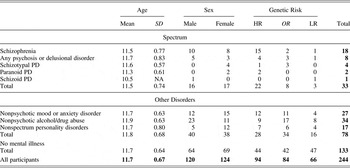
Participants participated in diagnostic interviews to ascertain psychiatric outcomes in 1992, when they were between 31 and 33 years of age. A psychiatrist administered the Structured Clinical Interview for DSM-III-R and the psychosis section of the Present State Examination (Wing, Nixon, Mann, & Leff, Reference Wing, Nixon, Mann and Leff1977). In addition, Danish psychiatric hospital records of all participants were examined. In 2007, the Danish Psychiatric Central Registry was rescanned in order to consolidate and update diagnostic information (see Schiffman et al., Reference Schiffman, Sorensen, Maeda, Mortensen, Victoroff and Hayashi2009). The registry scan was conducted using methodology validated by previous research utilizing hospital database diagnoses (Löffler et al., Reference Löffler, Häfner, Fätkenheuer, Maurer, Riecher-Rössler and Lützhøft1994). On the basis of the interviews and/or hospital records, adult diagnostic outcome data was available for 92% of the participants (244 of the 265). Thirty-three participants were diagnosed with a nonaffective–psychosis-spectrum disorder, 78 were identified as having a nonpsychotic disorder, and 133 had no identified mental health diagnosis. The nonaffective–psychosis-spectrum group included participants with diagnoses of schizophrenia (n = 18), psychosis not otherwise specified or delusional disorder (n = 8), and schizotypal, paranoid, and schizoid personality disorders (n = 7). This grouping is broad and inclusive of disorders that have mixed evidence of genetic associations with schizophrenia (American Psychological Association, 2000; Baron et al., Reference Baron, Gruen, Rainer, Kane, Asnis and Lord1985; Kendler, McGuire, Gruenberg, & O'Hare, Reference Kendler, McGuire, Gruenberg and O'Hare1993; Tienari et al., Reference Tienari, Wynne, Läksy, Moring, Nieminen and Sorri2003). Additional information regarding outcome diagnoses is provided in Table 1.
Primary diagnosis by age, sex, and genetic risk status of subjects

Note: HR, High risk; LR, low risk; PD, personality disorder.
Childhood neurological examination
An experienced pediatric neurologist at the Psykologisk Institute in Copenhagen examined children when they were 10 to 13 years old. The examiner was blind to parents' psychiatric status. The examination consisted partly of subtests drawn from traditional adult neurological examinations, as well as standardized subtests from pediatric neurological examination procedures (Touwen & Prechtl, Reference Touwen and Prechtl1970). The neurological examination was constructed to yield two kinds of information: data that would reveal deviance known to be related to structural or physiological abnormalities of the central nervous system; and data that would yield a functional description of the motoric abilities likely influenced by multiple central nervous system domains (Mednick et al., Reference Mednick, Mura, Schulsinger and Mednick1971). The dyspraxia scale was considered in the latter category and consisted of seven items. The examining neurologist provided a score of zero (normal) or one (impaired) for each item. The items were as follows: right dyspraxia of face/head and left dyspraxia of face/head, which were measured by having the participant close one eye (the left, then the right) and then sniff, nod, and shake the head; ideomotor dyspraxia, which was assessed by having the participant brush crumbs from the table, brush teeth, and comb hair; tongue diadochokinesis, which was assessed by having participants move the tongue in opposite directions; an evaluation of dressing and undressing skills; general oral articulation through pronouncing words; and assessing the ability to lick the upper lip. The items evaluated in this study differed relative to other relevant studies that focus more specifically on coordination and neurological soft signs (e.g., Rosso et al., Reference Rosso, Bearden, Hollister, Gasperoni, Sanchez and Hadley2000, finger–nose, finger pursuit, heel–knee, rapid alternation, rapid finger movement tasks, and activities such as buttoning and writing; Schiffman et al., Reference Schiffman, Sorensen, Maeda, Mortensen, Victoroff and Hayashi2009, left diadochokinesia, right diadochokinesia, left finger opposition test, right finger opposition test, left speeded finger opposition test, right speeded finger opposition test, right index finger and right foot tap, right and left index finger and right foot tap, and right hand left hand opens–closes).
Two data cells out of a total 1,708 were missing (0.1%). These included one missing from the ideomotor dyspraxia variable for a participant in the other disorder group, and one missing from the dressing dyspraxia variable for a participant in the no mental illness group. Using within-group mean substitution for the two missing cells, a sum of the seven variables was used as the predictor variable in the final model, with higher scores representing dyspraxia.
Participants underwent a neuropsychological assessment consisting of the Wechsler Intelligence Scale for Children (Sørensen et al., Reference Sørensen, Mortensen, Schiffman, Ekstrøm, Denenney and Mednick2010; Wechsler, 1949). The Wechsler Intelligence Scale for Children provides a measure of verbal, performance, and full-scale intelligence quotients, with a theoretical population mean of 100 and a standard deviation of 15. Subscales included in this assessment were similarities, vocabulary, block design, and maze. Each subscale provides a scaled score based on normative data, with a mean of 10 and a standard deviation of 3.
Socioeconomic status was also obtained from an interview conducted at Rigshospitalet 1 year after participants were born. Socioeconomic status was based on information about breadwinner's occupation, breadwinner's education, type of income, and quality of housing. Social status was analyzed as a quantitative 8-point continuous variable. Analyses of variance did not reveal statically significant differences in socioeconomic status by risk group (diagnosis of parent) nor by outcome group.
Statistical analyses
Analyses of variance and Pearson correlations were conducted to examine potential associations between dyspraxia scores and sex, genetic risk, socioeconomic status, and IQ. The primary analysis was a multinomial logistic regression used to assess the predictive relation of genetic risk and childhood dyspraxia to diagnostic outcomes. Genetic risk and dyspraxia were entered into the model simultaneously as the predictor or independent variables. Due to the small number of low-risk participants who developed a spectrum disorder (n = 3), “low” and “other” genetic risk groups were combined to create a dichotomous predictor.
The dependent variable was diagnostic outcome. Spectrum diagnoses were designated as the “reference group”; that is, the regression modeled the strength of the predictor variables to differentiate spectrum from other disorders and spectrum from no mental illness outcomes. Regression coefficients provide specific weights, indicating the strength of each predictor to differentiate between paired group outcomes (e.g., “no mental illness” vs. “spectrum”). An identical model was run using “other disorders” as the reference category, in order to examine the ability of the model to predict nonpsychotic versus no mental illness outcomes.
To examine a possible moderation effect, the regression was rerun including an interaction term (Risk × Dyspraxia score) as a predictor. Analyses were conducted using SPSS 20.
Results
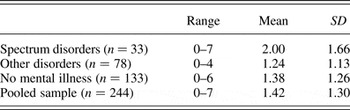
Dyspraxia scores ranged from 0 to 7. The range, mean, and standard deviation of the dyspraxia scores for each outcome group are presented in Table 2. Kurtosis (1.55) and skewness (1.04) were within acceptable ranges for parametric analyses. Dyspraxia scores did not vary significantly by genetic risk, t (242) = –1.56, p = .121, or sex, t (242) = 0.03, p = .975, nor did the dyspraxia score significantly correlate with socioeconomic status (r < .01). Dyspraxia demonstrated a small, negative correlation with IQ (r = –.19).
Dyspraxia scores by psychiatric outcome groups

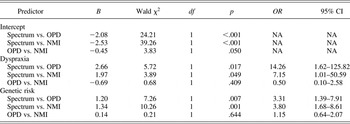
Using multinomial logistic regression analysis, we tested our primary hypothesis that childhood dyspraxia and genetic risk would predict psychiatric outcomes. The model was significant, χ2 (4, 244) = 18.61, p < .001; Nagelkerke pseudo R 2 = .09. Both genetic risk and dyspraxia showed significant main effects with regard to differentiating spectrum disorders from no mental illness and other psychiatric outcomes. The predictor variables did not significantly differentiate other psychiatric disorder from no mental illness outcomes. Regression coefficients and odds ratios for the main effects model are presented in Table 3. Controlling for main effects, an interaction term (Risk × Dyspraxia score) did not significantly predict outcomes, χ2 (2, 244) = 0.13, p = .936.
Multinomial logistic regression predicting diagnostic outcome

Note: Variable coding for outcome: Spectrum, nonaffective-psychosis spectrum disorder = 3; OPD, other psychiatric disorder = 2; NMI, no mental illness = 1. Variable coding for genetic risk: no/other risk = 0; high-risk = 1. Variable coding for dyspraxia: higher scores represents more dyspraxia (greater impairment).
Discussion
In line with previous research supporting the association between pediatric motor abnormalities and delays with adult-onset psychosis, our findings suggest that dyspraxia in childhood may be a vulnerability indicator for later development of a nonaffective–psychosis-spectrum disorder. The risk of developing a nonaffective–psychosis-spectrum disorder was modestly linearly associated with increasing score on the dyspraxia scale and remained significant after considering genetic risk.
Generally, there is variation in the typical progression of childhood motor development, and as a result, abnormal behaviors or delays indicative of putative vulnerability for psychosis are difficult to distinguish from healthy child development. Further, dyspraxia, which occurs in a substantial proportion of children (2%–6%; Dewey, Reference Dewey1995; Lingam, Hunt, Golding, Jongmans, & Emond, Reference Lingam, Hunt, Golding, Jongmans and Emond2009), involves delays across developmental milestones in infancy (e.g., crawling, walking, talking, and potty training), and then is characterized by more complex difficulties ranging from problems with performing subtle movements (e.g., doing buttons when getting dressed), to processing thoughts, concentrating, writing, and/or learning age-appropriate skills in early childhood. As a result of this heterogeneous presentation, developmental dyspraxia has been discussed in the scientific literature for almost 100 years, but there is poor consensus regarding the definition, description, and etiology (Middleton & Strick, Reference Middleton and Strick2000). Within this framework, it is noteworthy that the present study provides a unique opportunity to examine how these collective symptoms specifically predict adult psychiatric illnesses. This in turn may provide a unique perspective on the etiological origins of these abnormal characteristics as well.
The current findings suggesting symptoms of dyspraxia in childhood predict adult diagnostic status are consistent with a rich body of literature suggesting several other movement categories, as well as broader motor dysfunction, reflect an early organic vulnerability for nonaffective–psychosis-spectrum and related disorders. Fish, Marcus, Hans, Auerbach, and Purdue (Reference Fish, Marcus, Hans, Auerbach and Purdue1992) proposed that “pandysmaturation,” or disorganized motor and sensorimotor development, reflects vulnerability during the first 2 years of life and can, therefore, serve as an early marker. In a long-term prospective study of a small group of high-risk offspring (Fish Reference Fish1987, Fish et al., Reference Fish, Marcus, Hans, Auerbach and Purdue1992), Fish and colleagues found pandysmaturation in infancy and early childhood to be predictive of subsequent schizophrenia spectrum disorders. Further support for a relation between early motor abnormalities and schizophrenia has been provided by Jones, Rodgers, Murray, and Marmot (Reference Jones, Rodgers, Murray and Marmot1994), who found motor dysfunctions and delays in early childhood (up to approximately 2 to 3 years of age) among children who later developed schizophrenia.
In addition to diffuse motor abnormalities, there has been some evidence to suggest that children who later develop schizophrenia show dyskinetic movements. In a landmark study, Walker, Savoie, and Davis (Reference Walker, Savoie and Davis1994) used home movies taken during childhood to compare children who later developed schizophrenia as adults with their healthy siblings, children who later developed affective disorders, the healthy siblings of participants with affective disorder, and participants from families with no mental illness. Results of the study indicated that children who later developed schizophrenia were significantly differentiated from controls on a number of motor dysfunctions, including a variety of dyskinetic signs (e.g., motor overflow and “associated” involuntary movements), possibly reflective of striatal vulnerability.
Although our understanding of dyspraxia has been limited to date, there is some supporting evidence from studies that included coordination-related items from neurological soft-sign inventories. In a large prospective birth-cohort study, Rosso et al. (Reference Rosso, Bearden, Hollister, Gasperoni, Sanchez and Hadley2000) observed that unusual movements during childhood (including items related to coordination at age 7) were predictive of adulthood schizophrenia onset, but the authors also noted that the childhood movements did not predict unaffected sibling status; this unique perspective indicates that movement abnormalities may be specific to high-risk individuals who develop the actual clinical phenotype. In addition, a study using a national child development birth cohort observed that the presence of broad neurological signs, including motor coordination, in the general population increased the odds of adult-onset schizophrenia or affective psychotic disorders (Leask, Done, & Crow, Reference Leask, Done and Crow2002). Our study expands these findings through the inclusion of items more specific to dyspraxia that tap into a breakdown of action or inability to use voluntary motor abilities effectively in all aspects of life, from play to structured skilled tasks (Bowens & Smith, Reference Bowens and Smith1999). As defined in the current study, the dyspraxia construct is similar to prior studies in that it involves coordinated movement, but it is different in that it measures purposeful movement required for day-to-day functioning (e.g., speech, tasks of daily living, and performing verbally requested tasks). In addition, by assessing participants when they were older, we captured dyspraxia during an age range where motor milestones are met, and there is significantly less variability in healthy motor functioning (Gessell, Amatruda, Knobloch, & Pasamanick, Reference Gesell, Amatruda, Knobloch and Pasamanick1974; Stengel, Attermeier, Bly, & Heriza, Reference Stengel, Attermeier, Bly and Heriza1984; Zabala Reference Zabala, Robles, Parellada, Moreno, Ruiz-Sancho and Burdalo2006).
As assessed presently, ideomotor dyspraxia (a difficulty performing motor tasks when requested to do so verbally or by using visual imitation), oral/facial dyspraxia (a difficulty in making and coordinating precise articulatory movements required to produce clear speech), and dressing dyspraxia (an inability to dress due to impaired orientation, sequence, and fine motor skills) reflect diffuse neurological dysfunction involving distinct mechanisms including frontal-striatal and CCTC circuits (Blanchard et al., Reference Blanchard, Jacobson, Clarke, Connor, Kelleher and Garavan2010; Garrity et al., Reference Garrity, Pearlson, McKiernan, Lloyd, Kiehl and Calhoun2007). It is very unlikely that a single structure (e.g., the cerebellum) can account for these symptoms; this is supported by findings that coordination (a cerebellar specific variable examined in our earlier research in this group) is only partially correlated (r = .30) with the dyspraxia summary scores in the present study. However, findings of broad dysfunction in multiple networks are highly consistent with emerging conceptions of schizophrenia etiology. Specifically, these results support a theory suggesting that a dysfunctional integration among neuronal systems (at both a structural and a functional level) may account for the range of symptoms and characteristics observed in psychosis (Friston, Reference Friston1999; Garrity et al., Reference Garrity, Pearlson, McKiernan, Lloyd, Kiehl and Calhoun2007; Konrad & Winterer, Reference Konrad and Winterer2008; Lynall et al., Reference Lynall, Bassett, Kerwin, McKenna, Kitzbichler and Muller2010). Given the emerging prominence of an aberrant connectivity hypotheses, the present findings are particularly striking because results may suggest that a decrease of neuronal connectivity involving widespread neuronal networks is present long before the adolescent “prodromal” high-risk period or the onset of schizophrenia. Furthermore, although relatively common, this early vulnerability appears to hold predictive significance specific to nonaffective–psychosis-spectrum disorders. Although this notion needs to be further evaluated utilizing multimodal imaging (i.e., resting-state functional imaging and diffusion tensor imaging), the findings provide a novel perspective that has important ramifications for neurodevelopmental models of schizophrenia and perhaps related disorders. Taken together, this conception could in part account for how a heterogeneous series of neurological vulnerability characteristics studied here in a pediatric population would specifically predict nonaffective–psychosis-spectrum disorders, but not other disorders, in adults.
The current findings also provide a potentially important addition to our understanding of genetic and environmental influences on early neurological vulnerabilities signaling risk for nonaffective–psychosis-spectrum disorders. Preterm cohort studies have shown that neonatal prematurity is associated with abnormal neural development (Allin et al., Reference Allin, Matsumoto, Santhouse, Nosarti, Al-Asady and Stewart2001), but when individuals at genetic risk are exposed to obstetric complications, they express even greater levels of neurological abnormalities, suggesting a gene–environment interaction (Cantor-Graae, Ismail, & McNeil, Reference Cantor-Graae, Ismail and McNeil2000). However, evidence suggests that the environment in and of itself is also important because individuals with schizophrenia have more neurological signs than their unaffected first-degree relatives (Kinney, Yurgelun-Todd, & Woods, Reference Kinney, Yurgelun-Todd and Woods1999) and monozygotic twins (Torrey, Taylor, Bracha, & Bowler, Reference Torrey, Taylor, Bracha and Bowler1994). The present results, suggesting that genetic risk and dyspraxia appear to provide independent predictions of nonaffective–psychosis-spectrum disorders, and do not seem to significantly interact to do so, provide a heretofore-unavailable prospective view of developmental dyspraxia. It is important to highlight, however, that our failure to find a significant interaction between dyspraxia and genetic risk could be due to lack of statistical power. Nonetheless, taken together, these findings tentatively suggest that genetic risk did not significantly alter the magnitude of the association between dyspraxia and later psychiatric diagnoses, suggesting that environmental factors may play a role in early childhood neurodevelopment that has later implications for mental health outcomes.
The current study includes formal, highly structured, hands-on examinations performed by a pediatric neurologist. This assessment was conducted blind to risk status and blind to future outcome, and prior to any potential effects of treatment or symptoms associated with nonaffective–psychosis-spectrum disorders (e.g., antipsychotic medications and disorder-related factors that could impact motivation). The unique methodological advantages incorporated in the present long-term longitudinal prospective study increase confidence in the conclusion that higher levels of dyspraxia antedate the development of nonaffective–psychosis-spectrum disorders with some specificity.
Limitations
This study also suffers from some notable limitations. Despite a 92% retention rate over a 38-year high-risk project and a relatively large number of individuals who developed a nonaffective–psychosis-spectrum disorder compared to other longitudinal high-risk projects, the raw number of people in this group limits statistical power for some analyses. This becomes particularly relevant for our ability to make inferences about subgroups within our nonaffective–psychosis-spectrum group, which is heterogeneous in terms of clinical presentation, etiology, and genetic associations. Although exploratory analyses did not reveal significant differences, we were underpowered to meaningfully assess possible differences in dyspraxia between different subgroups within our nonaffective–psychosis-spectrum group. It might also be the case that a diagnosis made earlier in life could have implications for our results. It is possible, for instance, that differences over time between diagnostic systems or conceptualizations of disorders in our nonaffective–psychosis-spectrum group impacted categorization such that a participant diagnosed earlier in life would have a different diagnosis than if diagnosed later. Related, given findings suggesting greater genetic loading among those with earlier onset (e.g., Alda et al., Reference Alda, Ahrens, Lit, Dvorakova, Labelle and Zvolsky1996), it is possible that those diagnosed earlier in our study were different in a variety of ways than those diagnosed later. Although difficult to parse out these possibilities, within our relatively small sample, many of the participants in our broad spectrum group who had multiple diagnostic follow-ups across time showed consistency in terms of remaining in the spectrum, suggesting diagnostic stability in our sample. Further, our broad spectrum group composed of a wide range of psychosis-related illnesses protects us somewhat from any potential diagnostic-specific instability.
In addition, we chose to create a hierarchy of diagnoses that prioritized nonaffective–psychosis-spectrum disorders. If an individual had a different diagnosis at an earlier time point, that participant would be reclassified into the nonaffective–psychosis-spectrum group for our final analyses, and therefore our study may miss the implications of that previously diagnosed, comorbid condition. Another concern shared by all high-risk research is the issue of generalizability to those individuals who develop a spectrum disorder but who do not have a parent with schizophrenia. It is likely, however, that genetic influences play a role in many cases of spectrum disorders, even if the parents fail to manifest the disorder phenotypically.
Given the longitudinal nature of the study, the neurological assessment was limited by the knowledge of the time; however, many of the measures of dyspraxia are still used currently (e.g., Miller, Chukoskie, Zinni, Townsend, & Trauner, Reference Miller, Chukoskie, Zinni, Townsend and Trauner2014), and there is conceptual and item overlap between the present battery and noted commonly used tests (e.g., Movement Assessment Battery for Children, Henderson & Sugden, Reference Henderson and Sugden1992; Kaufman Speech Praxis Test, Kaufman, Reference Kaufman1995). Unfortunately, for the purposes of interrater reliability, only one neurologist performed the evaluation of dyspraxia. He was, however, well trained in assessment, and having a single rater of neurological and/or motoric function is not uncommon in longitudinal studies such as this (e.g., Fish, Reference Fish1987; Rosso et al., Reference Rosso, Bearden, Hollister, Gasperoni, Sanchez and Hadley2000). In addition, although not specific to our sample, several sources report high interrater reliability for other measures used to assess aspects of dyspraxia (Bruininks, Reference Bruininks II1978; Henderson & Sugden, Reference Henderson and Sugden1992; Kaufman, Reference Kaufman1995). Further, that we found an association between our scale assessed in childhood before any overt symptoms expression and blind to risk status speaks to the quality of the scale. In addition, the current dyspraxia evaluation was only administered at a single time point, limiting the extent to which this study can inform a more comprehensive developmental window.
Further directions for research
Because these finding are novel, there is a need for replication in independent samples. We speculate that a developmental disorder involving dyspraxia may be a vulnerability indicator that could be further examined within a diathesis–stress framework. Because the children were examined at the average age of 12 years, a time when motoric functioning and coordination tend be fairly stable (de Boer, Peper, & Beek, Reference de Boer, Peper and Beek2012), and because other measures of coordination deficits have been shown to be relatively stable over time (e.g., Losse et al., Reference Losse, Henderson, Elliman, Hall, Knight and Jongmans1991; Michel, Roethlisberger, Neuenschwander, & Roebers, Reference Michel, Roethlisberger, Neuenschwander and Roebers2011), it is possible that a high level of dyspraxia may be a more stable (rather than a transient) vulnerability indicator; future research tracking the stability of dyspraxia may be of value. We further speculate that in the context of environmental stressors, further exacerbation of preexisting vulnerability indicators might result in a self-sustaining, and perhaps progressively detrimental, process leading to psychosis. A general population-based study suggests that poor school performance in sports and handcrafts appears to be a risk factor for schizophrenia (Cannon et al., Reference Cannon, Jones, Huttunen, Tanskanen, Huttunen and Rabe-Hesketh1999). Collectively, these findings support some dysfunction of neural networks and processes (e.g., CCTC dysfunction) early in life well before the onset of more downstream hallmark symptoms of nonaffective psychosis spectrum. Future research utilizing structural and functional neuroimaging at several key developmental time points (as opposed to only one time point as in the current study) will be necessary to definitively test the notion that dysfunctional connectivity underlie symptoms of dyspraxia. In addition, a comprehensive battery of dyspraxia symptoms will be important for providing a more complete perspective. It is also possible that specific items within our scale may be more predictive of future nonaffective–psychosis-spectrum disorders than others. Although our power to detect effects at the item level was limited, this may be a fruitful future pursuit using larger samples.
Given the strengths and uniqueness of this study, the findings advance the understanding of the development of nonaffective–psychosis-spectrum disorders in several ways. Applying what is known about the mechanisms of dyspraxia to the etiology of these disorders might offer possible clues into early neural deficits mediating the development of the disorder.