


INTRODUCTION
In this paper, the in vitro chemotactic effect of L-alanine, L-cysteine, L-methionine, L-glutamic acid, L-glutamine, L-proline and L-tryptophan was investigated in Leishmania. These amino acids (AAs) were chosen as they play fundamental roles in the biology of Leishmania, including metabolism, osmoregulation and protection against oxidative stress. Protozoa have a limited capacity to synthesize de novo their own AAs; these are normally obtained as free AAs from the environment, as is the case for aromatic AAs (phenylalanine, tyrosine or tryptophan) or by proteolysis of exogenous proteins. Furthermore, proline constitutes an important energy substrate for Leishmania in the mid-gut of the fly vector (Opperdoes and Michels, Reference Opperdoes, Michels, Fasel and Myler2008). On the other hand, Leishmania promastigotes accumulate a large intracellular pool of free AAs (≈300 mm), including alanine (50–70 mm) and glutamate (14 mm) (Paes et al. Reference Paes, Daliry, Floeter-Winter, Galvez and Ramírez2008). This internal pool is used for osmoregulation, alanine being the major contributor to the so-called Regulatory Volume Decrease phenomena, in which the release of AAs, including the zwitterionic and anionic AAs alanine, hydroxyproline, glycine and glutamic acid is stimulated by hypo-osmotic conditions (Vieira et al. Reference Vieira, Lafuente, Gamarro and Cabantchik1996). Additionally, in both dividing and non-dividing promastigotes there is a high metabolic activity, including glucose and AA consumption (Hart and Coombs, Reference Hart and Coombs1982). Finally, precursor AAs for the synthesis of glutathione comprises methionine, cysteine, glutamate and glycine. In trypanosomatids, glutathione is used, together with spermidine, for the synthesis of trypanothione. This unique thiol accomplishes many of the protective, metabolic and antioxidant functions of glutathione in other eukaryotes and constitutes an essential molecule for defence against chemical and oxidant stress in Leishmania (Opperdoes and Michels, Reference Opperdoes, Michels, Fasel and Myler2008).
Taxic responses are fundamental for differentiation and endurance in the ever-changing environment where the parasite survives. For example, factors released by immune cells in the skin modulate parasite motility, promoting invasion and infection of the host cell (Peters et al. Reference Peters, Ansel, Ericson, Hordinsky, Hosoi, Paus, Scholzen and Seiffert2006). On the other hand, although male sand-flies feed on plant juices, female sand-flies need blood feeding for the maturation of their eggs (Santos et al. Reference Santos, Araujo, Machado, Pereira and Gontijo2008). While nourishing from an infected host, phlebotomine females ingest the amastigote form of the parasite, which differentiate into the flagellated promastigotes in the sand-fly gut lumen (Santos et al. Reference Santos, Vale, Silva, Nascimento, Saab, Soares, Michalick, Araujo, Pereira, Fujiwara and Gontijo2014). In this environment, Leishmania promastigotes further develop into infective parasites, probably interfering with the sand-fly physiology (Santos et al. Reference Santos, Nunes, Pereira and Gontijo2011). Alkalinization and modulation of the level of proteases in the mid-gut – after a blood meal – as well as the decrease in the level of proteolytic activity, seem to promote the development of promastigotes in the gut of sand-flies. This all means that the dynamics of growth and differentiation within the sand-fly is linked to changes in pH, sugars, and among others, AA levels (Santos et al. Reference Santos, Nunes, Pereira and Gontijo2011, Reference Santos, Vale, Silva, Nascimento, Saab, Soares, Michalick, Araujo, Pereira, Fujiwara and Gontijo2014). Free AAs, at the concentrations found in blood, seem to be ineffective to induce the alkalization of the gut needed for the development of the parasite (Santos et al. Reference Santos, Nunes, Pereira and Gontijo2011). However, chemotaxis might be a key element involved in all these events, and free AAs may play a role in the process of – within the sand-fly gut – parasite differentiation into infective form, and its migration from preceding gastro-intestinal portions into the cardio-oesophagic valve (Dillon et al. Reference Dillon, Ivens, Churcher, Holroyd, Quail, Rogers, Soares, Bonaldo, Casavant, Lehane and Bates2006).
Therefore, given the importance of chemotactic phenomena in parasite survival, differentiation and successful interaction with the host cell, this study focuses on the in vitro chemotactic effect of slight variations in the concentration of AAs on the migratory behaviour of promastigotes of Leishmania spp. Additionally, since the parasites transit between environments where acute changes in osmolarity may occur, the study analyses the morphological changes (cell area and flagellar length) produced in promastigotes exposed to both acute changes in osmolarity and chemotactic concentrations of the tested AAs. Our findings would be helpful to better understand the sensory mechanisms that might orientate the parasite's behaviour through its path towards a successful infection, and thus to design better ways for controlling the disease it causes.
MATERIALS AND METHODS
Strains and culture conditions
The reference strains Leishmania (Viannia) braziliensis (MHOM/BR/LTB300) and Leishmania (Leishmania) amazonensis (MHOM/BR/77/LTB0016) were kindly provided by Dr Noris Rodríguez (Universidad Central de Venezuela) and by Dr Lionel Schnur (University of Jerusalem), respectively. Leishmania promastigotes were grown at 26 °C in semisolid blood agar supplemented with glucose–NaCl medium [glucose 1·5%, NaCl 0·85% (w/v)] until used.
Promastigotes at late log-growth phase were collected by centrifugation at 125 g for 10 min at room temperature (RT). The medium was decanted and the cells were suspended in buffer A: Hepes 10 mm (pH 7·3), NaCl 132 mm, KCl 3·5 mm, CaCl2 1 mm and MgCl2 0·5 mm, 288 mOsm kg−1. The cells were centrifuged again and the buffer was discarded; the cells were washed again twice using the same procedure, and finally were suspended in buffer A up to the desired cell density.
Chemotactic effect of AAs on Leishmania spp.
The chemotactic response of Leishmania promastigotes to monocarboxylic aliphatic, dicarboxylic, heterocyclic and sulphur-containing AAs was determined by a modification of the vertical two chamber capillary assay (Kőhidai et al. Reference Köhidai, Csaba and Lemberkovics1995; Diaz et al. Reference Diaz, Köhidai, Ponte-Sucre, Ríos and Vanegas2011). Briefly, the tips of an eight-channel micropipette were used as the inner chamber and the wells of a 96-well plate were used as outer compartments of the two-chamber system. The tips were filled with a solution containing aliphatic, monocarboxylic, dicarboxylic, heterocyclic and sulphur-containing AAs (100 µL) dissolved in buffer A, at increasing concentrations (10−12–10−6 m). Tip number one was used as control and was filled with buffer A alone. The wells were filled with the Leishmania suspension (200 µL, 4 × 10⁷ cells mL−1) prepared in buffer A. The cells were incubated for 30 min at RT to guarantee chemotactic and not chemokinetic responses (Diaz et al. Reference Diaz, Köhidai, Ponte-Sucre, Ríos and Vanegas2011). At the end of the incubation time, the cells that migrated into the inner chamber were fixed in 2% formaldehyde in PBS (phosphate buffer 0·05 m, pH 7·2; NaCl 0·9 m). The cells that migrated into the inner chamber were then counted in a haemocytometer.
Effect of AAs on Leishmania spp. morphology
Once AA concentrations that elicited a significant migratory response were determined, the morphology of promastigotes was evaluated in aliquots (50 µL) of parasites that migrated into the inner chamber in assays performed at the selected AA concentrations. Each sample was placed on a slide, allowed to dry at RT, fixed for 5 min with 100% methanol (Sigma-Aldrich) and stained under standard conditions in a 10% Giemsa solution (Sigma-Aldrich). The slides were then washed with distilled water and left on the bench until dry. One hundred parasites of each stained slide were analysed by light microscopy at 1000× magnification (Axioskop 40 microscope; Zeiss). As Leishmania promastigotes have a fusiform body and a flagellum, the measured dimensions were: body length excluding the length of the free flagellum (membrane distance from the anterior to the posterior end), kernel-level maximum (outer membrane distance through the centre of the karyosome) and length of the free flagellum (from the end attached to the body of the parasite to its free end).
Effect of osmolarity on Leishmania spp. morphology
The effect of osmolarity on the morphology of Leishmania spp. was assayed in a 200 µL aliquot of a cell suspension (4 × 10⁷ cells mL−1) of either L. braziliensis or L. amazonensis promastigotes. The parasites were suspended in buffer A modified to fulfil the desired osmotic conditions: (a) iso-osmotic (288 mOsm kg−1), (b) hypo-osmotic (145 mOsm kg−1) or (c) hyper-osmotic (445 mOsm kg−1). To assess the hypo-osmotic stress, 1 mL of distilled water was added to 1 mL of 288 mOsm kg−1 solution. To assess the hyper-osmotic stress, 1 mL of mannitol (600 mm) was added to 1 mL of the 288 mOsm kg−1 solution. Afterwards, the chemotactic effect of the selected AAs at their effective concentrations was assayed, as previously described. The morphology of the promastigotes was studied using a calibrated optical microscope after 30 min incubation.
Data analysis
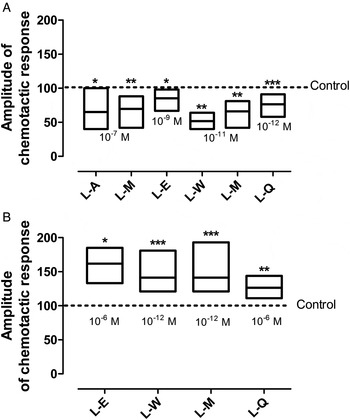
Data on chemotaxis are expressed as the percentage of the number of cells that migrated to the inner chamber at each AA concentration in comparison to the control condition (100%, at least five experiments). The amplitude of chemotactic response, at the effective AA concentrations is expressed as a floating bar (Fig. 1) or as a box-and-whisker (Fig. 2) plot (Motulsky, Reference Motulsky1995). In Fig. 1, the data span from the minimum to the maximum value obtained for each AA; in Fig. 2, the line inside the box illustrates the median of the values, while the top and bottom whiskers represent the superior and inferior ranges, respectively, for each AA. The area of the promastigotes is plotted in Fig. 3 as the median of the values, with the top and bottom whiskers representing the superior and inferior range, respectively; finally the length of the flagellum is expressed as the mean ± s.e.m. For the area and flagellum length data a population of 100 parasites (each for control and experimental conditions) were evaluated in three independent experiments performed for each experimental condition. Statistical significance was evaluated by the Student's t-test. Differences were considered significant, if P < 0·05. The analysis and presentation of the data have been performed using Graph Pad Prism®, 6 software version.
Amplitude of chemotactic response of assayed amino acids (AAs) in Leishmania. Leishmania parasites were incubated for 30 min at room temperature (RT) in capillary contact with tips containing increasing concentrations (10−12–10−6 m) of aliphatic, monocarboxylic, dicarboxylic, heterocyclic and sulphur-containing AAs. Capillary tip number one was used as control. At the end of the incubation time, the cells that migrated into the inner chamber were counted. The amplitude of chemotactic response achieved by the parasites was evaluated in the presence of L-alanine (A), L-glutamine (Q), L-glutamic acid (E) for L. braziliensis and L-methionine (M), L-trypthophan (W) for L. amazonensis. The amplitude of chemotactic response is represented as a floating bar. The data span from the minimum to the maximum value obtained for each AA. Differences between experimental and control conditions were considered significant if P < 0·05. The analysis and presentation of data have been performed using Graph Pad Prism®, 6 software version (A) AAs acting at chemo-repellent concentrations; (B) AAs acting at chemo-attractant concentrations. *P < 0·01, **P < 0·005, ***P < 0·001.

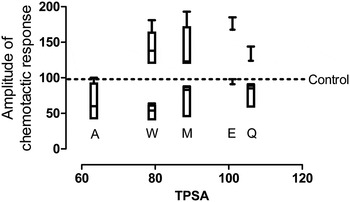
Relationship between topological polar surface area (TPSA) and the amplitude of chemotactic response of assayed AAs in Leishmania. Relationship between the amplitude of chemotactic response and the TPSA of L-alanine (A), L-glutamine (Q), L-glutamic acid (E) for Leishmania braziliensis and L-methionine (M), L-trypthophan (W) for Leishmania amazonensis. The parasites were incubated in the presence of effective concentrations of the AAs, similarly as for Fig. 1. In the box and whisker plot, the line in the middle represents the median of the data while the top and bottom whiskers represent the superior and inferior ranges, respectively. The data represent five to eight samples each.

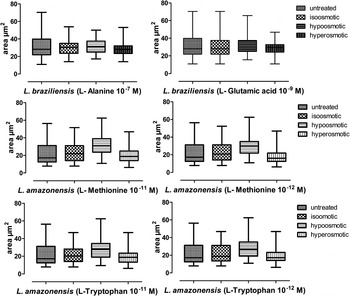
Effect of aliphatic, monocarboxylic, dicarboxylic, heterocyclic and sulphur-containing AAs on the body area of Leishmania spp. Leishmania braziliensis and Leishmania amazonensis parasites were incubated in the presence of effective concentrations of L-alanine (A), L-methionine (M), L-trypthophan (W), L-glutamic acid (E), similarly as for Fig. 1. At the end of the incubation time, the body area of parasites that migrated into the inner chamber was evaluated. The area of the promastigotes is plotted as the median of the values, with the top and bottom whiskers representing the superior and inferior ranges, respectively. A population of 100 parasites (each for control and experimental conditions) was evaluated in three independent experiments performed for each experimental condition. Statistical significance was evaluated by the Student's t-test. Differences between experimental and control conditions were considered significant if P < 0·05.

RESULTS
Chemotactic effect of AAs on Leishmania spp.
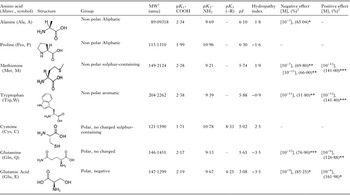
The chemotactic effect of selected AAs on Leishmania spp. promastigotes is listed in Table 1. For this aim, we used representatives of non-polar-aliphatic [L-alanine (A) and L- proline (P)], non-polar-sulphur-containing [L-methionine (M)], non-polar-aromatic [L-trypthophan (W)], polar-non-charged-sulphur-containing [L-cysteine (C)], polar-non-charged [L-glutamine (Q)] and polar negative [L-glutamic acid (E)] AAs, at increasing concentrations (10−12–10−6 m). Table 1 also summarizes, the main chemical properties of the used AAs (Voet et al. Reference Voet, Voet and Pratt2007), and additionally, the effective concentrations that produced either the chemo-repellent or chemo-attractant effect.
Physical-chemical properties of the assayed amino acids (AAs) (Voet et al. Reference Voet, Voet and Pratt2007), effect on chemotaxis. Leishmania promastigotes were incubated in the presence of increasing concentrations of AAs and their negative or positive effect on chemotaxis was evaluated

1 MW: molecular weight in atomic mass units (amu).
2 Most effective chemo-repellent and chemo-attractant concentrations of AAs tested in Leishmania and degree of effect compared with control in parenthesis.
*P < 0·01, **P < 0·005, ***P < 0·001
The results suggest that compared with control conditions, L-alanine (10−7 m) significantly inhibits migration of L. braziliensis into the inner chamber, while L-proline did not affect its migratory response at any tested concentration. L-methionine had a dual effect on L. amazonensis, increasing migration into the inner chamber when assayed at 10−12 m, while inhibiting migration when assayed at 10−11 and 10−7 m; in the same way, L-tryptophan had a dual effect on L. amazonensis migration, promoting it at 10−12 m and inhibiting it when assayed at 10−11 m.
For the polar AAs, the data suggest that L-cysteine did not affect L. braziliensis cell migration. On the other hand, L-glutamine had a dual effect, increasing the number of migrating L. braziliensis cells into the inner chamber when assayed at 10−6 m, while decreasing the number of migrating cells when assayed at 10−12 m. Finally, L-glutamic acid at 10−6 m increased the number of L. braziliensis migrating cells, while at 10−9 m decreased the number of cells that migrated into the inner chamber.
Amplitude of chemotactic response of assayed AAs
From these data we calculated the amplitude of chemotactic response, defined as the magnitude of the effect achieved by the parasites at the effective AAs concentrations. The results are depicted in Fig. 1. In this figure, the data span from the minimum to the maximum value of the chemotactic effect obtained for each AA. The non-polar-aliphatic AA L-alanine, gave the widest chemo-repellent amplitude of chemotactic effect. On the other hand, and in good agreement with the literature (Köhidai et al. Reference Köhidai, Bösze, Hudecz, Illyés, Lang, Mák, Sebestyen and Sóos2003) the non-polar (L-methionine and L-tryptophan), the polar-non-charged (L-glutamine) and the polar-negative (L-glutamic acid) AA, gave dual responses and their corresponding amplitudes of chemotactic effect were narrower when they acted as chemo-repellent stimuli than when they acted as chemo-attractant molecules.
The topological polar surface area (TPSA) of a molecule can be defined as the sum of the molecular surface area over all polar atoms, mainly oxygen and nitrogen, but also including their attached hydrogen molecules (Pajouhesh and Lenz, Reference Pajouhesh and Lenz2005). Thus, we plotted the relationship between the amplitude of chemotactic response and the AA TPSA. The results are depicted in Fig. 2. In this figure, the data are displayed as a box-and-whisker plot. In each case, the line inside the box illustrates the median of the values, while the top and bottom whiskers represent the superior and inferior range, respectively, for each AA. The data show that the relationship that exists between amplitude of chemotactic response of tested AAs and their predicted TPSA, if any is minimal.
Effect of osmolarity on Leishmania spp. morphology, AA effect
To gain insight into the results just described, we evaluated the effect of osmolarity in the morphology of the parasites, by measuring their length and width, and calculating their body area for all the tested conditions. This was initially performed on parasites incubated under iso-osmotic conditions (288 mOsm kg−1), that migrated to the internal chamber. The mean body area of control parasites was 30·58 ± 1·162 µm2 for L. braziliensis and 22·41 ± 1·216 µm2 for L. amazonensis. Then, the chemotactic effect was evaluated in parasites incubated under hypo-osmotic (145 mOsm kg−1) and hyper-osmotic (445 mOsm kg−1) and exposed to the effective chemotactic AA concentration. L-glutamine (Q) was not further assayed due to its instability in liquid media and accumulation of toxic ammonia in culture systems (Jagušić et al. Reference Jagušić, Forčić, Brgles, Kutle, Šantak, Jergović, Kotarski, Bendelja and Halassy2015). The area of the promastigotes is plotted in Fig. 3 as the median of the values, with the top and bottom whiskers representing the superior and inferior range, respectively. The data illustrate that neither the AAs, nor the osmotactic conditions affected the parasite body area. These results thus suggest a stable structural intracellular organization, fundamental for survival and differentiation within the gut of the sand-fly.
Effect of osmolarity and effective AA concentration on Leishmania spp. flagellum length
The ingestion of a blood meal by the sand-flies induces the secretion of proteolytic enzymes. The activity of digestive enzymes affects Leishmania development (Dostálová and Volf, Reference Dostálová and Volf2012). However, it is not known whether the expected changes in AA concentration in the gut modulate the migratory potential of the parasite.
Initially, we studied whether changes in the osmolarity of buffer A affects the length of the flagellum in parasites that migrated to the internal chamber. The results are summarized in Table 2. The mean length of the flagellum in untreated parasites was 20·09 ± 0·47 µm for L. braziliensis and 18·36 ± 0·47 µm for L. amazonensis. Hypo-osmotic conditions did not affect the flagellum length; however, the length of the flagellum of L. braziliensis, but not of L. amazonensis, decreased significantly when incubated in hyper-osmotic conditions.
Effect of osmolarity on the Leishmania spp. flagellum length. Leishmania braziliensis and Leishmania amazonensis parasites suspended in buffer A modified to fulfil iso-osmotic (288 mOsm kg−1), hypo-osmotic (145 mOsm kg−1) or hyper-osmotic (445 mOsm kg−1) conditions were incubated similarly as for Fig. 1. At the end of the incubation time, the flagellum length was measured

* P < 0·05 vs flagellum length in control parasites.
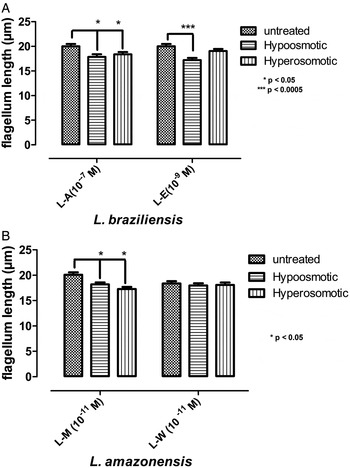
Then, we evaluated the effect of AAs at their effective chemo-repellent concentrations upon the flagellum length of parasites being subjected to osmotic stress. The data, expressed as the mean ± s.e.m. of the flagellum length are summarized in Fig. 4. L-alanine (10−7 m) decreased the flagellum length of L. braziliensis incubated under hypo- and hyper-osmotic conditions. On the other hand, L-glutamic acid (10−9 m) significantly decreased the length of the flagellum of L. braziliensis incubated under hypo-osmotic, but not under hyperosmotic conditions. Finally, L-methionine (10−11 m) decreased the flagellum length of L. amazonensis incubated either in hypo-osmotic or hyper-osmotic conditions.
Effect of aliphatic, monocarboxylic, dicarboxylic, heterocyclic and sulphur-containing AAS on the length of the flagellum of Leishmania spp. Leishmania braziliensis and Leishmania amazonensis parasites were suspended in buffer A modified to fulfil iso-osmotic (288 mOsm kg), hypo-osmotic (145 mOsm kg−1) or hyper-osmotic (445 mOsm kg−1) conditions. Afterwards, parasites were incubated in the presence of effective concentrations of L-alanine (A), L-methionine (M), L-trypthophan (W), L-glutamic acid (E), similarly as for Fig. 1. At the end of the incubation time, the length of the flagellum was measured in parasites that migrated into the inner chamber. The length of the flagellum is expressed as the mean ± s.e.m. of a population of 100 parasites (each for control and experimental conditions) evaluated in three independent experiments performed for each experimental condition. Statistical significance was evaluated by the Student's t-test. Differences between experimental and control conditions were considered significant if P < 0·05.

DISCUSSION
Leishmania faces gradients of molecules in the gut of the vector (metabolites) and in the – injured by the bite – skin (diverse signals) before being engulfed by its host cell. Chemotaxis guides the parasite through these steps. We analysed the tactic response of Leishmania to selected aliphatic, monocarboxylic, dicarboxylic, heterocyclic and sulphur-containing AAs, and determined the effect of their effective concentrations on the morphology of the parasite.
Our results indicate that (1) none of the tested AAs properties guarantee their full chemo-attractant or chemo-repellent character; (2) chemotaxis in Leishmania is a highly complex phenomenon influenced by multiple biological, physical and chemical factors; (3) we propose that AAs besides being metabolic fuels might have functional roles, helpful for Leishmania to cope with the ever-changing environment of the vector gut, depending on their concentration, and on the state of the receptors expressed on the cell membrane.
In Tetrahymena, chemotactic properties of AAs (L-isomers) depend on their physicochemical characteristics (Köhidai, et al. Reference Köhidai, Bösze, Hudecz, Illyés, Lang, Mák, Sebestyen and Sóos2003). In Leishmania, the chemotactic responses might be related to AA size and /or molecular weight (MW, see Table 1). That is, L-alanine (MW = 89·09 g mol−1) elicited only chemo-repellent responses, while L-methionine (MW = 149·21 g mol−1), L-tryptophan (MW = 204·22 g mol−1), L-glutamine (MW = 146·15 g mol−1) and L-glutamic acid (MW = 147·13 g mol−1) elicited a dual response. Finally, AAs with intermediate MW, such as L-proline (MW = 115·13 g mol−1) and L-cysteine (MW = 121·16 g mol−1), did not elicit chemotactic responses. The AAs that produced a dual response included in their structure either linear R chains, or an aromatic ring, or a sulphur atom (see Table 1). Contrary to what occurs in Tetrahymena (Köhidai et al. Reference Köhidai, Bösze, Hudecz, Illyés, Lang, Mák, Sebestyen and Sóos2003), there is no clear relationship between high pK values of N-terminus and being chemo-attractant, or the negative hydropathy indices of chemo-attractant AAs. However, as in Tetrahymena (Köhidai and Csaba, Reference Köhidai and Csaba2003), the aromatic character of L-tryptophan (10−11 m) determines its chemo-repellent character. Finally, although TPSA has been useful in Tetrahymena to determine the tactic character of a molecule according to their capacity to cross cell membranes (Szemes et al. Reference Szemes, Lajkó, Láng and Kőhidai2015), in Leishmania only a slight association could be seen between the tactic character of AAs and their predicted TPSA values. All in all, differing from mono and disaccharides, which constitute potential fuels ready to be used by the motile cell; AAs are used both as metabolic fuels and building blocks. Thus, their tactic behaviour might definitively differ from that of carbohydrates. We have herein analysed a rather limited number of AAs. However, it might be possible that the investigation of the whole set of standard AAs would provide a better overlapping between the chemoattractant character of AAs and their predicted TPSA.
Trypanosomatidae maintain large cellular proline and alanine pools that serve as alternative carbon sources and reservoirs of organic osmolytes. The haemolymph of their insect vectors is exceptionally rich in these two AAs (Barros et al. Reference Barros, Gontijo, Melo and Oliveira2006). Thus, their levels in the gut may modulate the physiology of the parasite. Alanine affects swelling, whereas proline influences the rate of volume recovery. A neutral AA transporter seems to be the sole supplier for the intracellular pool of proline and alanine in Leishmania donovani (Barros et al. Reference Barros, Gontijo, Melo and Oliveira2006; Inbar et al. Reference Inbar, Schlisselber, Suter Grotemeyer, Rentsch and Zilberstein2013). This transporter is essential for cell volume regulation and controls the transport and homoeostasis of glutamate and arginine, none of which are its substrate. Our results suggest that L-alanine, but not L-proline, elicit chemo-repellent responses in Leishmania. Whether or not this chemo-repellent behaviour to toxic agents like alanine, orientates promastigotes towards the anterior regions of the vector gut, improving their probability of being transmitted to the vertebrate host (Barros et al. Reference Barros, Gontijo, Melo and Oliveira2006) is a query, still to be answered.
Sand-flies feed on sugar (fruit juice, plants, etc.), but their females require a blood meal for the full development of the eggs (Santos et al. Reference Santos, Araujo, Machado, Pereira and Gontijo2008). Promastigotes living in the gut are long and slender (14–20 µm long and 2–4 µm wide, Atías, Reference Atías1998), with similar length for flagellum and body (Botero and Restrepo, Reference Botero and Restrepo2003). Growth and differentiation within the sand-fly is a dynamic process linked to variations among others, in AA levels. These changes might play a role in the process of parasite differentiation from non-infectious (procyclic) to infectious (metacyclic) promastigotes and in their migration from preceding gastro-intestinal portions into the cardio-oesophagic valve. In fact, alkalinization, as well as modulation of the level of proteases and osmotic pressure, occurs in the intestinal tract of the female sand-fly (Burrows and Blum, Reference Burrows and Blum1991; Santos et al. Reference Santos, Nunes, Pereira and Gontijo2011, Reference Santos, Vale, Silva, Nascimento, Saab, Soares, Michalick, Araujo, Pereira, Fujiwara and Gontijo2014). Herein, we evaluated the morphological changes produced in promastigotes of Leishmania by the chemo-repellent AA concentration at hypo-, iso- and hyper-osmotic conditions. As previously demonstrated in L. major (Darling and Blum, Reference Darling and Blum1990), none of the AAs tested herein caused changes in the shape (area), and probably volume, of L. braziliensis or L. amazonensis promastigotes, suggesting that these parasites either are stable in their cellular structure, or are able to effectively overcome these challenges, by means of cellular mechanisms probably including the synthesis of L-alanine and the consequent increase in intracellular osmolarity that tends to avoid excessive shortening (Lefurgey et al. Reference LeFurgey, Blum and Ingram2000).
The flagellum promotes cell attachment to insect epithelia, plays a key role during translation to the proboscis and survival in the mammalian bloodstream, and guides the interaction of the parasite with its mammalian host cell (Gadelha et al. Reference Gadelha, Wickstead and Gull2007; Rotureau et al. Reference Rotureau, Bastin, Morales and Spath2009; Forestier et al. Reference Forestier, Machu, Loussert, Pascale and Spath2011; Diaz et al. Reference Diaz, Köhidai, Ríos, Vanegas, Silva, Szabó, Mezo, Hudecz and Ponte-Sucre2013). A stimulus orientation is needed. Tactic substances could originate from the insect mouthparts (saliva, food eaten, etc.), be produced in the mid-gut (digestive enzymes, digestion products, e.g. AAs), or be factors released by the parasite (Leslie et al. Reference Leslie, Barret and Burchmore2002; Dillon et al. Reference Dillon, Ivens, Churcher, Holroyd, Quail, Rogers, Soares, Bonaldo, Casavant, Lehane and Bates2006; Bates, Reference Bates2008).
Flagellum length regulation seems to be a simple one-dimensional process (Erdmann et al. Reference Erdmann, Scholz, Melzer, Schmetz and Wiese2006), the tip being the crucial site for assembly and disassembly of the structural flagellar elements. MAP kinases and kinesin, proteins exclusively found in the promastigote stage, promote flagellar remodelling. In fact, deletion mutants of the simple copy gene of L. mexicana MAP kinase LmxMPK9 have elongated flagella; its overexpression produced a subpopulation of parasites with rather short to no flagella (Bengs et al. Reference Bengs, Scholz, Kuhn and Wiese2005). On the other hand, overexpression of kinesin results in flagellar shortening; knockdown of this gene yields parasites with long flagella (Blaineau et al. Reference Blaineau, Tessier, Dubessay, Tasse, Crobu, Page's and Bastien2007).
In our experiments, the flagellum length of L. braziliensis, but not of L. amazonensis, decreased significantly when incubated in hyper-osmotic conditions. More interestingly, L-glutamic acid, assayed at its chemotactic concentration, decreased the length of the flagellum only when incubated at hypo-osmotic concentrations. In contrast, L-alanine and L-methionine decreased the flagellum length at its chemotactic concentration when assayed both at hypo- and hyper-osmotic conditions and L-tryptophan did not shorten the length of the flagellum. Whether or not the function of the previously mentioned proteins might explain the results presented herein, needs further investigation.
Finally, although it is not clear how different AAs would establish gradients in the gut, special systems for their perception and incorporation into the parasite should exist. For example, membrane receptors distributed along the flagellum, including the flagellar pocket, might constitute sensing molecules (Rotureau et al. Reference Rotureau, Bastin, Morales and Spath2009) specialized to detect changes in gradients of key molecules (Handman et al. Reference Handman, Goding, Papenfuss, Speed, Fasel and Myler2008). Expression of receptors with different affinities could explain the chemotactic responsiveness of parasites to different AAs, activated at slightly different concentrations, thus modulating the chemotactic response diversity (Diaz et al. Reference Diaz, Köhidai, Ponte-Sucre, Ríos and Vanegas2011), by the concourse of some – still not known – intracellular mechanisms (e.g. effects on cytoskeleton or metabolic processes). We can suggest that the similar receptor mechanisms are being used and, even more, that the same receptor might be capable of binding a large number of structurally related compounds (Barros et al. Reference Barros, Gontijo, Melo and Oliveira2006). Alternatively the receptors might be similar, but their affinities, interactions with the ligands (AAs), saturation levels, constants, etc. are dissimilar, making signalling unique, even at this low level.
According to Pozzo et al. (Reference Pozzo, Fontes, de Thomaz, Santos, Farias, Ayres, Giorgio and Cesar2009), the parasites must sense the chemical gradient around them through receptors, and direct their movement towards the gradient of attractive chemical substances, and away from repellent toxic substance. He argues that the movement of the parasite under a chemotactic stress is composed by two components (swimming in circles for three to five times followed by tumbling), in contrast with an erratic, non-directional movement under zero chemical gradient. For explaining his point, he used glucose, a chemo-attractant molecule and measured the taxis by optical tweezers, and at two different glucose concentrations. At higher glucose concentrations, the directionality of the movement is more defined and the force response is also higher. Our gradients were far lower than the ones used by Pozzo et al. (Reference Pozzo, Fontes, de Thomaz, Santos, Farias, Ayres, Giorgio and Cesar2009); thus, the explanation of these results must additionally include the presence of alternative mechanisms. For example, the differential response to different AAs might relate to the efficiency with which they are incorporated, or be exploited for energy metabolism: AAs that are more efficiently transported into the cells or metabolized to generate ATP might be more chemotactic – or may simply allow the parasites to move faster. Still additional information is needed to confirm this hypothesis.
During the life cycle of Leishmania, the flagellum changes its length and position, presumably as a response to environmental cues (Rotureau et al. Reference Rotureau, Bastin, Morales and Spath2009). As the flagellum is essential for motility and migration to the anterior portion of the mid-gut in the vector, its function is critical for the efficient transmission to the host (Leslie et al. Reference Leslie, Barret and Burchmore2002). Therefore, AA concentrations that induce shortening of the flagellum could compromise parasite survival because besides metabolic effects, AAs might elicit responses fundamental for understanding the migratory behaviour of Leishmania.
ACKNOWLEDGEMENTS
The authors are grateful to Professor Neira Gamboa and Lucimei Lima for their generosity in donating us some of the amino acids used in this work and to Mrs Pilar López for her technical assistance. Likewise they are grateful for the support granted by the Alexander von Humboldt Foundation, Germany, to Alicia Ponte-Sucre.
FINANCIAL SUPPORT
Council for Research grant, CDCH-UCV PI-09-00-7084-2008 (E.D.); PG-09-00-7378-2008/2 (A.P.S.), Universidad Central de Venezuela, Faculty of Medicine Grant, FAC-MED CI 3/2008 (E.D.), CI 5/2011-1 (E.D.).