The widespread basidiolichen fungus variously known as Cora pavonia (Sw.) Fr. or Dictyonema glabratum (Spreng.) D. Hawksw. was considered one of the best-known lichenized species (Parmasto Reference Parmasto1978; Hawksworth Reference Hawksworth1988; Chaves et al. Reference Chaves, Lücking, Sipman, Umaña and Navarro2004; Lawrey et al. Reference Lawrey, Lücking, Sipman, Chaves, Redhead, Bungartz, Sikaroodi and Gillevet2009; Lücking et al. Reference Lücking, Dal-Forno, Lawrey, Bungartz, Holgado Rojas, Hernández, Marcelli, Moncada, Morales and Nelsen2013, Reference Lücking, Dal-Forno, Sikaroodi, Gillevet, Bungartz, Moncada, Yánez-Ayabaca, Chaves, Coca and Lawrey2014). Lichens previously identified with that name grow abundantly in montane and temperate environments in Central and South America between Mexico and Patagonia and are also known from some Atlantic islands and from Mauritius. Only recently it was shown that this name has been applied to lichen fungi from two distinct genera (Cora and Corella) and a large number of species, with 16 species formally recognized at present in both genera (Dal-Forno et al. Reference Dal-Forno, Lawrey, Sikaroodi, Bhattarai, Gillevet, Sulzbacher and Lücking2013; Lücking et al. Reference Lücking, Dal-Forno, Lawrey, Bungartz, Holgado Rojas, Hernández, Marcelli, Moncada, Morales and Nelsen2013). However, 126 species have been distinguished based on the most recent molecular phylogenetic analysis, and over 400 species have been predicted to exist (Lücking et al. Reference Lücking, Dal-Forno, Sikaroodi, Gillevet, Bungartz, Moncada, Yánez-Ayabaca, Chaves, Coca and Lawrey2014).
In light of these findings, a previous study (Lücking et al. Reference Lücking, Dal-Forno, Lawrey, Bungartz, Holgado Rojas, Hernández, Marcelli, Moncada, Morales and Nelsen2013) attempted to revise the nomenclature in this group with respect to the type collections of the six names that were historically described in the group corresponding to the genus Cora, including the commonly applied epithets pavonia and glabrata. Thus, C. glabrata is currently known with certainty only from its type material from Guadeloupe, whereas the situation in C. pavonia is more complicated. Parmasto (Reference Parmasto1978) cited C. pavonia with Weber and Mohr as basionym authors and with the type originating from St. Helena [1773, Robertson s.n. (BM)], but Lücking et al. (Reference Lücking, Dal-Forno, Lawrey, Bungartz, Holgado Rojas, Hernández, Marcelli, Moncada, Morales and Nelsen2013) pointed out that Weber and Mohr are not the authors of this name, and instead the name must be attributed to Swartz (Reference Swartz1806). In addition, the name does not represent a separate taxon, but is a replacement name for the previously established Ulva montana Sw. (Swartz Reference Swartz1788), a later homonym of U. montana Lightfoot (Lightfoot Reference Lightfoot1777). Nevertheless, the lectotypification of Parmasto (Reference Parmasto1978) was followed, since the original herbarium sheet in BM contained the original identification as Ulva montana (Lücking et al. Reference Lücking, Dal-Forno, Lawrey, Bungartz, Holgado Rojas, Hernández, Marcelli, Moncada, Morales and Nelsen2013).
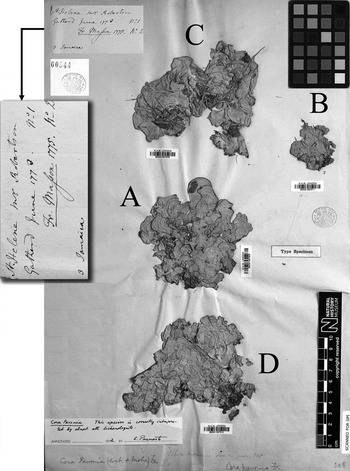
Further revision of the sheet containing the type material, through a larger digitization initiative of lichen types at BM as part of the Global Plants Initiative, revealed that the material is a mixture of specimens from at least two different localities. Of the four separate collections glued to the sheet, two are numbered and the same handwriting for the numbers on the front is also found on the back of the sheet where it was overlooked by Lücking et al. (Reference Lücking, Dal-Forno, Lawrey, Bungartz, Holgado Rojas, Hernández, Marcelli, Moncada, Morales and Nelsen2013). The annotation on the back identifies specimen number 1 as being collected in 1773 by Robertson from St. Helena. A specimen collected by Fr. Masson in 1775 is mentioned with a number 2, but no specimen with this number is present on the sheet; instead, two specimens on the sheet have no numbers and their origin remains unknown. The only specimen which is indicated as being from Jamaica is number 3, which is the smallest collection on the sheet, and has a different morphology compared to the other specimens (Fig. 1).
Sheet with four specimens of Cora numbered A–D (the numbers were added to the figure but are not part of the original sheet). A, specimen from St. Helena (1773, Robertson s.n.; BM001097238); this specimen was designated as type of Cora pavonia by Parmasto (Reference Parmasto1978); B, specimen from Jamaica (Swartz s.n.; BM001097311); this specimen is the correct lectotype of Ulva montana Sw. (≡Thelephora pavonia Sw.); C (BM001097308) & D (BM001097310), two additional specimens with the locality not specified but, based on morphological similarity with specimen A and given the fact that besides Jamaica, only St. Helena is listed as origin of all the collections on the sheet, likely are from that island and are conspecific with specimen A.

Since Thelephora pavonia Sw. is a replacement name for Ulva montana Sw., it is automatically typified by the type of the latter. When describing Ulva montana, Swartz (Reference Swartz1788) gave the Blue Mountains in Jamaica as the origin of the collection. Hence, the specimen from St. Helena cannot be the type of Cora pavonia and instead, given that the origin of two further collections is not specified (but likely they are also from St. Helena, see below), the material from Jamaica has to be chosen as lectotype (see below).
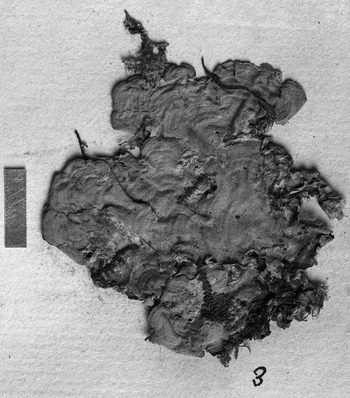
Unfortunately, this changes the interpretation of the name Cora pavonia and of the material identified with that name by Lücking et al. (Reference Lücking, Dal-Forno, Lawrey, Bungartz, Holgado Rojas, Hernández, Marcelli, Moncada, Morales and Nelsen2013), since the specimen from Jamaica is morphologically different from those from St. Helena, with an uneven from shallowly undulate surface and abundantly branched lobes (Fig. 2). This morphology suggests an epiphytic species, whereas the taxon identified with C. pavonia by Lücking et al. (Reference Lücking, Dal-Forno, Lawrey, Bungartz, Holgado Rojas, Hernández, Marcelli, Moncada, Morales and Nelsen2013) grows on the ground between bryophytes. The type of Cora pavonia thus comes close to C. aspera Wilk et al. (Lücking et al. Reference Lücking, Dal-Forno, Lawrey, Bungartz, Holgado Rojas, Hernández, Marcelli, Moncada, Morales and Nelsen2013), but differs in branching pattern and surface structure, as far as can be judged from the material. Consequently, for the time being, Cora pavonia must be assumed to represent an epiphytic species potentially endemic to Jamaica or with a narrow range in the Caribbean and Central America. In turn, the ground-dwelling taxon from Central and South America with large, mostly unbranched lobes and a strongly undulate surface receives the name C. ciferrii (see below), which previously was considered a synonym of C. pavonia (Lücking et al. Reference Lücking, Dal-Forno, Lawrey, Bungartz, Holgado Rojas, Hernández, Marcelli, Moncada, Morales and Nelsen2013).
The lectotype of Ulva montana Sw. (≡Thelephora pavonia Sw.; BM001097311) from Jamaica (specimen B from Fig. 1) enlarged.

The material from St. Helena erroneously designated as the type of Cora pavonia by Parmasto (Reference Parmasto1978) most likely represents an undescribed, endemic species. We also revised a specimen in S (1954, Kerr s.n.), which agrees perfectly with the three larger specimens on the sheet in BM. Both the specimen in S and the upper specimen on the sheet in BM show remnants of grass stems and debris attached to them, suggesting a species growing on grasses close to the ground, but not on soil between bryophytes like C. ciferrii. Since St. Helena is c. 2000 km from the closest continental landmass, more than twice as distant as the Galapagos Islands are from Ecuador, and the two known Cora species from Galapagos are both endemic to that archipelago (Lücking et al. Reference Lücking, Dal-Forno, Sikaroodi, Gillevet, Bungartz, Moncada, Yánez-Ayabaca, Chaves, Coca and Lawrey2014), it is unlikely that the material from St. Helena represents a species that also occurs in Central or South America, or the Caribbean. For the time being, this taxon is left unnamed, while we attempt to obtain fresh material for sequencing to clarify its taxonomic status.
Cora pavonia (Sw.) Fr.
MycoBank No.: MB406945
Basionym: Thelephora pavonia Sw., Fl. Ind. Occid. 3: 1930 (1806); replacement name for Ulva montana Sw., Prodr.: 148 (1788) [nom. illeg., non Lightf. 1777]. Lectotype (here selected: Jamaica, Swartz s. n.) (BM-001097311, marked with ‘3’ on sheet, MBT177912).
Cora ciferrii (Tomas.) Lücking, Grall & Thüs comb. nov.
MycoBank No.: MB808696
Basionym: Wainiocora ciferrii Tomas, Arch. Bot. (Forli), III, 10: 106 (1950).
The systematic work including this study was supported by a grant from the National Science Foundation: Phylogenetic Diversity of Mycobionts and Photobionts in the Cyanolichen Genus Dictyonema, with Emphasis on the Neotropics and the Galapagos Islands (DEB 0841405 to George Mason University; PI J. Lawrey; Co-PIs: R. Lücking, P. Gillevet). The Lichen Types digitization project in BM, during which the lectotype for Cora pavonia (Sw.) Fr. was checked, databased and imaged, was funded by the Andrew W. Mellon Foundation through the Global Plants Initiative.