New guidelines emphasise the likely long-term benefit of early screening and intervention in childhood to prevent prevalent adult chronic diseases such as diabetes and cardiovascular disease.Reference Daniels and Greer 1 In teenagers and adults, digital tonometry has been shown to be a simple and reproducible screening technique to assess the health of arteries.Reference Bonetti, Pumper, Higano, Holmes, Kuvin and Lerman 2 – Reference McCrea, Skulas-Ray, Chow and West 4 With this method, reactive hyperaemia is induced in the fingertip after the temporary occlusion of blood flow with a blood pressure cuff, and proprietary software produces a reactive hyperaemia index from the change in the pulse wave amplitude. When studied in adults, a low hyperaemic response was shown to reflect endothelial dysfunction, defined as an imbalance between vasodilating and vasoconstricting factors produced by vascular endothelial cells. Major contributors to this imbalance are impaired nitric oxide-dependent mechanisms controlling vascular dilation.Reference Nohria, Gerhard-Herman, Creager, Hurley, Mitra and Ganz 5 In adults, a low level of reactive hyperaemia was associated with cardiovascular risk factors,Reference Hamburg, Keyes and Larson 6 coronary disease measured by angiography,Reference Kuvin, Mammen, Mooney, Alsheikh-Ali and Karas 7 and vascular events.Reference Rubinshtein, Kuvin and Soffler 8 , Reference Targonski, Bonetti, Pumper, Higano, Holmes and Lerman 9 In adolescents, reactive hyperaemia was blunted in Type 1 diabetes,Reference Haller, Stein and Shuster 10 , Reference Mahmud, Earing, Lee, Lteif, Driscoll and Lerman 11 obesity,Reference Mahmud, Hill, Cuerden and Clarson 12 – Reference Bruyndonckx, Hoymans and Frederix 14 and insulin resistanceReference Chen, Osika, Dangardt, Gan, Strandvik and Friberg 15 and correlated in the expected direction with several cardiovascular risk factors.Reference Bruyndonckx, Hoymans and Frederix 14 , Reference Chen, Osika, Dangardt, Gan, Strandvik and Friberg 15
Despite the suggestion that digital tonometry may be useful for the assessment of arterial health in older teens and adults, several recent studies that included younger, pre-pubertal normal children revealed a strong, positive relationship between digital reactive hyperaemia and age, height, and pubertal status.Reference Mahmud, Hill, Cuerden and Clarson 12 , Reference Radtke, Khattab, Eser, Kriemler, Saner and Wilhelm 16 – Reference Tryggestad, Thompson, Copeland and Short 18 This is surprising given the strongly positive relationship between age and atherosclerosis from childhood through adulthood.Reference McGill, McMahan and Gidding 19 In two of these studies, however, obese children did not show a relationship between reactive hyperaemia index and age or its correlates.Reference Mahmud, Hill, Cuerden and Clarson 12 , Reference Tryggestad, Thompson, Copeland and Short 18 Recently, it was recommended that the standard automated reactive hyperaemia index produced by the widely used endoPAT digital tonometer be modified in children to reflect large age-specific differences in the time course of reactive hyperaemia.Reference Bruyndonckx, Radtke and Eser 20 , Reference Chen, Dangardt, Osika, Berggren, Gronowitz and Friberg 21 Using this modified index, a positive correlation with age was still found in young, mostly lean, children.Reference Chen, Dangardt, Osika, Berggren, Gronowitz and Friberg 21 The relationship between the modified index of reactive hyperaemia and cardiovascular risk factors has not been reported in young obese children and other children at high risk for endothelial dysfunction and premature cardiovascular disease.
We evaluated the reactive hyperaemia of the fingertip microcirculation of obese children and non-obese, dyslipidaemic children and young adults aged 8–21 years. In each group, the standard index of reactive hyperaemia was modified for the paediatric age range and correlated with age, sex, pubertal status, carotid wall thickness, and multiple other risk factors for premature cardiovascular disease.
Materials and methods
Children and young adults, 8–21 years of age, were recruited from general paediatric, cardiology, gastroenterology and lipid clinics and studied at the Weill Cornell Medical College Clinical Translational Science Center after telephone screening. Two groups were evaluated: obese (body mass index >95th percentile) and non-obese, dyslipidaemic (body mass index >5th and <95th percentiles). “Dyslipidaemia” was defined as the presence of a fasting LDL-C level >130 mg/dl, triglycerides >150 mg/dl, HDL-C <40 mg/dl, and/or lipoprotein (a) greater than two-fold the upper limit of normal. “Dyslipidaemia” was not an inclusion criteria for the obese group, but 12 of 15 subjects had a lipid abnormality: all 12 had low HDL-C, and six of them had other lipid abnormalities. The majority of the non-obese, dyslipidaemic group (20/23) had a lean body mass index (<85th percentile). Exclusion criteria included systemic disorders such as diabetes, which is defined as fasting blood sugar >126 mg/dl twice, or autoimmune disease, medication, and acute illnesses that might affect cardiovascular risk factors or the arteries. Current cigarette smokers or abusers of illicit drugs or alcohol were also excluded. The protocol was approved by the Weill Cornell Medical College Institutional Review Board.
In the morning after an overnight fast, consent and assent were obtained and medical histories were reviewed. Family history of premature heart disease and stroke, diabetes, hypertension, hyperlipidaemia, obesity, and fatty liver in first-degree relatives and grandparents were recorded. Weight and height were measured with digital devices to the nearest 0.1 kg and 0.1 cm, respectively. Blood pressure and pulse were measured with an automated digital device and the appropriate cuff size after sitting for at least 5 minutes. Body mass index was calculated as weight divided by height squared (kg/m2). Body mass index z scores were derived from age- and sex-specific norms. Waist circumference was measured at the umbilicus, and hip circumference at the widest point over the buttocks, to the nearest 0.1 cm. Pubertal stage was classified as pre-pubertal – that is, no pubertal development – pubertal – that is, some development – or post-pubertal – that is, fully developed and, in female patients, having regular menses – after questioning the parent and/or participant.
Digital tonometry was then performed following a strictly standardised procedure as specified by the manufacturer (EndoPAT2000, Itamar Medical, Caesarea, Israel). Participants were advised to clip long fingernails and fast, except for water consumption, for at least 12 hours before undergoing the test. Over-the-counter supplements were not taken at least 2 days before the visit. The designated study room was dimly lit, quiet, and temperature-controlled. For the digital tonometry procedure, the participant lay comfortably supine with finger-cuffs placed on each index finger and attached by cables to the computer. After 5 minutes of tracing the baseline oscillations of blood flow, a blood pressure cuff was inflated to occlude blood flow into the non-dominant arm for 5 minutes. Upon release, tracings were obtained for another 5 minutes. Computerised software with a proprietary algorithm automatically calculated the reactive hyperaemia index from the fold increase in the pulse wave amplitude relative to baseline, corrected for fold changes relative to baseline in the un-occluded arm, during the 90–150-second interval after the release of the blood pressure cuff. However, as reported by others,Reference Bruyndonckx, Radtke and Eser 20 , Reference Chen, Dangardt, Osika, Berggren, Gronowitz and Friberg 21 this interval missed the true peak response in 67% of children in the obese group and in 52% in the non-obese, dsylipidaemic group, and, in the latter, the time to peak was inversely related to age (r=−0.64, p<0.001). For this reason, the true peak response ratio corrected for the ratio in the control arm during the same time interval was calculated for each subject. In addition, the area under the curve was calculated from the peak response ratios in the occluded arm corrected for changes in the control arm over the entire 5 minutes post occlusion using the trapezoid rule.Reference Bruyndonckx, Radtke and Eser 20
After the completion of measurements of digital reactive hyperaemia, blood was sampled and assayed for traditional and non-traditional cardiovascular risk factors. Cholesterol, triglycerides, and glucose were assayed following enzymatic methods. A direct polymer polyanion method to measure HDL-C was followed, using a Beckman Coulter UniCel DXC 800 (Beckman Coulter, Incorporated, Brea, California, United States of America). Lipoprotein (a) was evaluated with a quantitative immunoturbidity assay. Results were not obtained for two samples. Insulin was assayed with a quantitative immunoradiometric assay kit from Millipore (St. Charles, Missouri, United States of America). The intra-assay and inter-assay coefficients of variation were <4.4 and 6.0%, respectively, and the range was 3.125–200.0 µU/ml. Fasting insulin resistance was calculated with the homeostasis model assessment method utilising glucose and insulin values.Reference Matthews, Hosker, Rudenski, Naylor, Treacher and Turner 22 The % haemoglobin A1C was determined with a quantitative monoclonal antibody agglutination reaction kit from Siemens Healthcare Diagnostics, Incorporated (Tarrytown, New York, United States of America). Homocysteine and high-sensitivity C-reactive protein were measured with quantitative sandwich enzyme immunoassay kits from ALPCO Diagnostics (Salem, New Hampshire, United States of America) and R&D Systems (Minneapolis, Minnesota, United States of America), respectively. The intra-assay and inter-assay coefficients of variation were <8.3 and 10%, respectively, and the measurement ranges were 2–50 mol/L and 0.78–50 ng/ml, respectively. The serum concentrations of interleukin-6 and tumour necrosis factor-α were determined using quantitative electrochemiluminescent assay kits from Meso Scale Discovery (Gaithersburg, Maryland, United States of America). The intra-assay and inter-assay coefficients of variation were <4.4 and 2.8%, respectively, and the measurement ranges were from 0.2 to 2500 pg/ml.
On the same morning, the carotid intima-media thickness was measured by a specialised ultrasound technologist using an ultrasound scanner (Acuson Sequoia 512; Siemens Medical Solutions, Malvern, Pennsylvania, United States of America) and a high-frequency 15L8-MHz linear-array transducer by following a pre-determined standardised scanning protocol. The participants were studied in the supine position with the head turned slightly away from the side that was being examined. Images of the arterial wall were obtained from the posterior walls of both common carotid arteries 1 cm below the carotid bulb – that is, bifurcation – during three complete and independent cardiac cycles and were digitally stored. An automated computerised edge detection software package (version 1.0, 2002; Siemens Medical Solutions) was used to determine the carotid wall thickness in the frames of each cycle that depicted the narrowest and widest vessel diameters. The mean and maximum wall thicknesses were calculated for both carotid arteries. All examinations were digitally stored and analysed by the same researcher (A.K.). The coefficient of variation for wall thickness measurements of the carotid artery using the same device and scanning protocol was previously calculated to be 1.3%.Reference Gonzalez, Wood, Dorey, Wren and Gilsanz 23
Data analysis
All results are expressed as mean±standard deviation, except for the peak response, which is presented as median and interquartile range. The group means were compared with Student’s unpaired t-test or the Wilcoxon rank sum/Kruskal–Wallis test for continuous variables or with Fisher’s exact test for categorical variables. Univariate analysis evaluated the correlations between either the peak response or area under the curve and cardiovascular risk variables for each group. The distribution of the peak response was skewed, and values were logarithmically transformed before correlation analysis. Variables that were significantly correlated with outcomes were then included in multiple regression analysis. An association that yielded a p value <0.05 was considered significant. Values less than the detection limit were entered as the detection limit/2. Statistical analysis was carried out with JMP Pro 11 (version 11.0.0, SAS Institute Incorporated, Cary North Carolina, United States of America).
Results
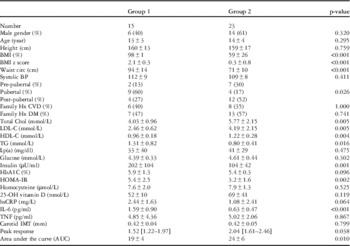
A total of 41 subjects were enrolled, but two were excluded because of the use of metformin and one with a missing reactive hyperaemia index value due to noisy signal from excessive movement. Table 1 shows the subject characteristics of the 38 obese and non-obese, dyslipidaemic subjects included in this report. There were no significant differences between groups in terms of age, gender, and racial/ethnic backgrounds (37% Caucasian, 34% Hispanic, 13% African American, 11% Asian, 5% other). As expected, the obese group had significantly higher levels of triglycerides, lower HDL-C, and lower LDL-C compared with the non-obese group. The majority of the obese group (12/15) had low levels of HDL-C; the majority of the non-obese, dyslipidaemic subjects had high levels of LDL-C (12/23, 10 with a genetic lipid disorder, familial hypercholesterolaemia, and LDL-C ⩾190 mg/dl). The study groups also differed by pubertal status, with a greater percentage of the obese group either pubertal or post-pubertal (87 versus 69%). Markers of insulin resistance – that is, insulin levels and the homoeostasis model assessment score – and inflammation – that is, high-sensitivity C-reactive protein and interleukin-6 – were elevated in the obese group compared with the non-obese, dyslipidaemic group. The mean values for carotid intima-media thickness did not differ between groups and were one standard deviation higher than published values (0.38±0.04 mm) in a large number of lean and obese children, 5–20 years of age, evaluated with the same ultrasound device and scanning protocol.Reference Mittelman, Gilsanz, Mo, Wood, Dorey and Gilsanz 24 Age was not a correlate in this series.
Subject characteristics in obese and non-obese, dyslipidaemic children.

BMI=body mass index; BP=blood pressure; CVD=cardiovascular disease; HDL=high-density lipoprotein; hsCRP=high-sensitivity C-reactive protein; IL-6=interleukin-6; IMT=intima-media thickness; LDL=low-density lipoprotein; TG=triglycerides; TNF=tumour necrosis factor
Digital reactive hyperaemia expressed as the peak response or area under the curve was significantly lower in the obese group compared with the non-obese, dyslipidaemic group (Table 1). Age-specific normal values based on the true peak response have not been established for children; however, our median values for peak response correspond closely to values previously reported in children with a narrower age range (12–18 years): 2.15 for lean children with normal lipid levels and 1.50 for severely obese children.Reference Bruyndonckx, Hoymans and Frederix 14 An overall 33% of the obese group and 9% of the non-obese, dyslipidaemic group had peak responses lower than the abnormal cutoff point of 1.35 proposed for adults.Reference Bonetti, Pumper, Higano, Holmes, Kuvin and Lerman 2 In the non-obese, dyslipidaemic group, the subset with LDL cholesterol levels >190 mg/dl and at extremely high risk for premature coronary artery disease did not significantly differ in terms of the two indices of microvascular function from the other non-obese, dyslipidaemic subjects (1.95±0.53 versus 2.11±0.62, p=0.51 for peak response). This was true despite this subset having a significantly younger age distribution that would lower the reactive hyperaemia index.
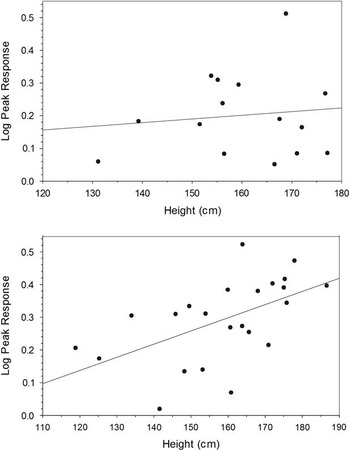
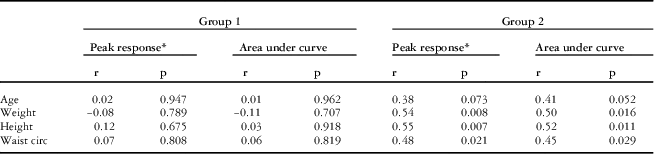
Correlation analysis failed to reveal significant relations in either group between peak response or area under the curve and sex, body mass index z scores, waist/hip circumference ratio, pubertal stage, blood pressure, family history of diabetes or premature cardiovascular disease, or the biochemical cardiovascular risk factors listed in Table 1. Table 2 and Figure 1, however, illustrate the strong, significant, positive relationship between peak response and height in the non-obese, dyslipidaemic group (bottom panel) but not in the obese group (top panel). A similar significant positive correlation was found in the non-obese, dyslipidaemic group for the area under the curve. Less strong positive relationships existed between the two indices and age, weight, and waist circumference that are correlates of height. In the stepwise regression analysis with height, age, weight, and waist circumference as the predictive variables, height was the only significant determinant of both peak response and area under the curve. There were no significant correlations between carotid wall thickness and indices of reactive hyperaemia, height and its correlates, or any of the other tested variables.
Relationships between height and reactive hyperaemia, expressed as the log-transformed reactive hyperaemia index derived from true peak response. Top panel=15 obese (r=0.12, p=0.675); bottom panel=23 non-obese, dyslipidaemic (r=0.55, p=0.007).

Significant correlations between digital reactive hyperaemia and clinical variables in obese and lean, dyslipidaemic children.

* Logarithmically transformed before correlation analysis
Discussion
Endothelial dysfunction occurs early in atherosclerosis and develops in both the large conduit arteries and the microvasculature. Digital tonometry is an attractive non-invasive screening method with the potential to detect endothelial dysfunction early in life and target those who need intensive therapy. In our study of obese and non-obese, dyslipidaemic children with a wide age span, however, two indices of digital reactive hyperaemia adapted for the paediatric age group did not correlate with any risk marker of endothelial dysfunction and vascular disease. Instead, in the group of non-obese, dyslipidaemic children, indices of reactive hyperaemia most strongly correlated with height in a positive direction that was unexpected given the expected progression in atherosclerosis with growth in children with hyperlipidaemia.Reference McGill, McMahan and Gidding 19 The positive relationships between digital reactive hyperaemia and the correlates of growth confirm similar findings by others in normal childrenReference Radtke, Khattab, Eser, Kriemler, Saner and Wilhelm 16 – Reference Tryggestad, Thompson, Copeland and Short 18 and extend it to lean, dyslipidaemic children. The lack of this relationship in the obese group was also reported by others who studied obese children with a wide age distribution using the standard reactive hyperaemia index.Reference Mahmud, Hill, Cuerden and Clarson 12 , Reference Tryggestad, Thompson, Copeland and Short 18
The increase in digital reactive hyperaemia with growth has been attributed to an increase in nitric oxide production during puberty, possibly due to increased oestrogen and dehydroepiandrosterone sulphate levels.Reference Bhangoo, Sinha, Rosenbaum, Shelov and Ten 17 Another possibility is that endothelium-independent factors that contribute to the reactive hyperaemia index vary with childhood development. In adults, an impaired reactive hyperaemic response of the digital circulation is associated with impaired dilation of the coronary arteries after the infusion of acetylcholineReference Bonetti, Pumper, Higano, Holmes, Kuvin and Lerman 2 to stimulate production of nitric oxide. Such studies of the coronaries have not been performed in young children, but flow-induced vasodilation of the brachial artery is blunted in young children with cardiovascular risk factors and not confounded by age.Reference Urbina, Williams and Alpert 25 In adults, however, the agreement between digital reactive hyperaemia and the flow-induced vasodilation of the brachial artery has been inconsistent.Reference Kuvin, Mammen, Mooney, Alsheikh-Ali and Karas 7 , Reference Lee, Bass and Ellis 26 This may be because only 50% of digital reactive hyperaemia could be attributed to nitric oxide when assessed in adults after the infusion of a nitrous oxide synthase inhibitor.Reference Nohria, Gerhard-Herman, Creager, Hurley, Mitra and Ganz 5 The relative balance between vasodilators that increase levels of nitric oxide and vasoconstrictors such as the renin–aldosterone system,Reference Bauer 27 prostaglandins,Reference Sun, Huang and Smith 28 or sympathetic toneReference Thijssen, de Groot, Kooijman, Smits and Hopman 29 may change with normal childhood development. The complex anatomy of the fingertip circulation that includes arterio-venous anastomosesReference Braverman 30 may also differ in young children. For these reasons, digital reactive hyperaemia in children may reflect many growth-dependent factors other than those affecting endothelial function. Our results suggest that these factors and their association with growth may further differ in obese children. Because of these differences, further modifications may be needed in the endoPAT procedure and proprietary algorithms when used in the younger age group.
The strengths of our study include the extensive cardiovascular risk profiles on participants, the carefully standardised measurements of digital reactive hyperaemia and carotid intima-media thickness, and the inclusion of children with severe lipid abnormalities and diverse racial/ethnic backgrounds. A larger number of participants of all pubertal stages, including lean children without lipid abnormalities, would, however, clarify the true relationships between digital reactive hyperaemia and correlates of growth. A professional examination of pubertal stage instead of self-assessment would also improve the accuracy of the analysis.
In conclusion, digital tonometry using methodology developed in adults appears to be useful for stratifying at-risk older post-pubertal adolescents and adults, but the reactive hyperaemic response by this technique is strongly confounded by correlates of growth in younger non-obese children. Whether the same holds true for young obese children requires further study. The physiological changes underlying this “juvenile micro-vascular response”,Reference Radtke, Khattab, Eser, Kriemler, Saner and Wilhelm 16 if it exists, may be relevant to vascular homoeostasis and blood pressure control in general. Additional validation and a better understanding of the endothelium-independent factors controlling the digital microcirculation are needed before the endoPAT technique can be successfully used in childhood.
Acknowledgements
The skilled assistance of nurses, research coordinators, laboratory technicians, statisticians, and the REDCAP database manager of the Clinical Translational Science Center of Weill Cornell College of Medicine is greatly appreciated.
Financial Support
National Institutes of Health Clinical Translational Science Center grant #UL1 TR000457-07, The Starr Foundation (L.H.), and The Sikorski Family (R.C.).
Conflicts of Interest
None.
Ethical Standards
The authors assert that all procedures contributing to this work comply with the ethical standards of the United States 45 CFR part 46 guidelines on human experimentation and with the Helsinki Declaration of 1975, as revised in 2008, and has been approved by the Weill Cornell Medical College Institutional Review Board.