1. URBANISATION AND LODGING
In the nineteenth century most European countries were experiencing rapid urbanisation and industrialisation. The physical environment often went through a considerable transformation because of the influx of new inhabitants. New housing developments saw the light, but older housing stock was also stretched to the limit. By 1900, Berlin had a population of 2.4 million, London of 6.6 and Paris of 3.3 million.Footnote 1 Even in the north the population of Stockholm reached 250,000 and that of Helsinki more than 100,000.Footnote 2 Employment opportunities increased at an explosive rate in textile factories, metalwork, machine industry and the sectors providing urban centres with necessary services and goods. While the century also saw the emergence of migration overseas, migration into towns and cities was often the destiny of young people. In 1910, 67 per cent of the population in Helsinki had been born outside the town and 60 per cent of the female industrial workers in Stockholm were migrants. While assistance between siblings in migration situations has been documented, the existence of a kinship network could not be seen as part of normal life for many of those settling in a new environment.Footnote 3
The late nineteenth-century towns in the Nordic countries, as in the rest of Europe, suffered from a considerable shortage of housing. The wages of workers were sorely stretched and the cost of housing could engulf a large part of their income. As a result, instead of struggling with the rent, the young and unmarried tended to lodge with married couples or widows; sometimes they rented rooms together.Footnote 4 Such solutions were, however, not unheard of even among the higher social strata. Kin, friends and men or women with no suitable relations in town or schoolchildren who were boarded out populated the extra rooms of middle-class families and beds or floors of the working class.Footnote 5
In early twentieth-century St Petersburg, 26 per cent of the population lived as lodgers. The most likely homes where lodgers could be found were those of labourers and craftsmen. The situation was similar in Moscow: ‘We rented three rooms but lived only in the small room and if things got rough we even rented out our room and lived in the kitchen. We cooked and washed for the boarders and cleaned up, for which they paid extra money. Our boarders were workers.’Footnote 6
In nineteenth-century Vienna, the proportion of lodgers varied between 15 and 19 per cent depending on the part of town, with a decrease at the end of the century. The lodgers were of several different kinds; some rented a whole room while others only a bed or a place for a bed. Certain occupational groups were particularly prone to lodging, for example women engaged in textile work or factory work. In general the lodgers tended to be young rather than middle aged or old, reflecting the fact that lodging was connected to the first phase of migration into urban areas.Footnote 7 While the nineteenth-century middle class in Germany viewed lodging as a sign of moral inferiority and organised labour upheld the ideal of the ‘respectable worker’, renting out rooms was an economic necessity for many working-class families.Footnote 8 In spite of the fact that the housing situation improved in German towns in the early twentieth century, we still find in the 1920s that 18 per cent of families with an unemployed head and 5 per cent of those headed by a labourer had a lodger or boarder.Footnote 9
2. THE IDEAL OF DOMESTICITY
As discussed in the introduction to this special issue, in previous centuries the presence of non-family members in the household was seen as perfectly normal and the question of separation of space of little consequence. A household could easily house servants, apprentices and kin and little difference existed between working, eating and sleeping space. In eighteenth-century Britain the presence of a journeyman or apprentice, not to mention servants, was commonplace in the households of tradesmen and craftsmen.Footnote 10
The nineteenth century saw the middle classes starting to enhance social distinctions through the physical separation of the classes. The cult of domesticity was born.Footnote 11 In rural northern Europe such ideas took a longer time to penetrate and despite the domination of the middle classes in the production of conduct books and dissemination of such ideas, the migrant workers of the nineteenth century generally continued to harbour rural attitudes about sharing space with relations and non-relations. The late nineteenth and early twentieth centuries also saw the emergence of surveys and statistics tackling the questions of migration, urbanisation and the shortage of decent-quality housing. Crowding was seen as a double-edged sword with danger both to health and to morality.Footnote 12
The urban middle classes seem to have generally suffered from fear of unregulated working-class sexuality and its consequence, namely the degeneration of society. Coupled with this was a considerable level of ignorance about how members of the working class reasoned, planned or saw the world.Footnote 13 Notions of working-class respectability or of boundaries within this group were unknown. The sharing of sleeping space in farms had never resulted in particularly high illegitimacy ratios, apart from times and places, like the nineteenth-century Germanic Europe and Iceland, where the poor were prevented from marrying unless they managed to get hold of land or capital.Footnote 14 Studies of the problems with working-class housing often tended to focus on lodging as an evil that should be uprooted because it resulted in crowding that was seen as a threat both to health and morals. It would, however, appear that the moral issue was considered of more importance than health, as the squeezing in of a biological family of 10 was not overcrowding but taking in a lodger was.Footnote 15
While the provision of lodging ameliorated the economic situation of working-class families and widows and provided a vital service for lodgers, the capability or suitability of women to run such a service has been questioned by contemporaries and in some cases scholars of subsequent generations.
Leonore Davidoff raised the question of whether the image of the nasty landlady has its roots in the descriptions and the derisions by young literate men of interfering, nosy old women. However, Davidoff also makes the assumption that the relationship between a male lodger and a female landlady could have had a sexual component. Such ideas were indeed raised among Victorian survey makers, but the accuracy of such statements has been questioned by Jeff Meek.Footnote 16 The social historian Heikki Waris, who interviewed people in the 1930s about their memories of late nineteenth-century working-class Helsinki, also made assumptions about landladies. Without any evidence he described the situation of lodgers in a family headed by a married couple as having experienced a ‘protected domesticity’ under the regard of a benign father figure while assuming that women, primarily widows, lacked the capacity to guide youngsters in the right direction and to provide home comforts. These were the landladies, according to Waris, who only kept lodgers for economic reasons and in whose houses alcohol consumption and disorderly life took place and where the young lodgers, male and female, came into contact with moral depravity.Footnote 17
3. QUESTIONS AND DATA
The aim of this article is to analyse who the lodgers were in urban Finland around 1900, and to what extent they varied by gender, age and social class. Was the typical lodger a young man recently arrived in town? What was lodging like? Do we find a uniform story or a lot of variation? We will also question the caricature of the landlady (an interfering busybody or an uninterested money grabber) created by arrogant young men and 1930s male academics. Instead we find a more nuanced image of women generating survival strategies in difficult situations but coping no less well than their male counterparts. The article will also examine lodging in relation to urban rents and income levels. Lastly the issue of female network creation will be discussed as well as the participation of landladies and lodgers in female systems of assistance that have been detected in Nordic urban areas in the late nineteenth and early twentieth centuries.Footnote 18
The primary focus will be on the town of Helsinki in the late nineteenth and early twentieth centuries with comparisons with other towns in Finland and Europe. The datasets originate in surveys about housing, the census and working-class autobiographies.
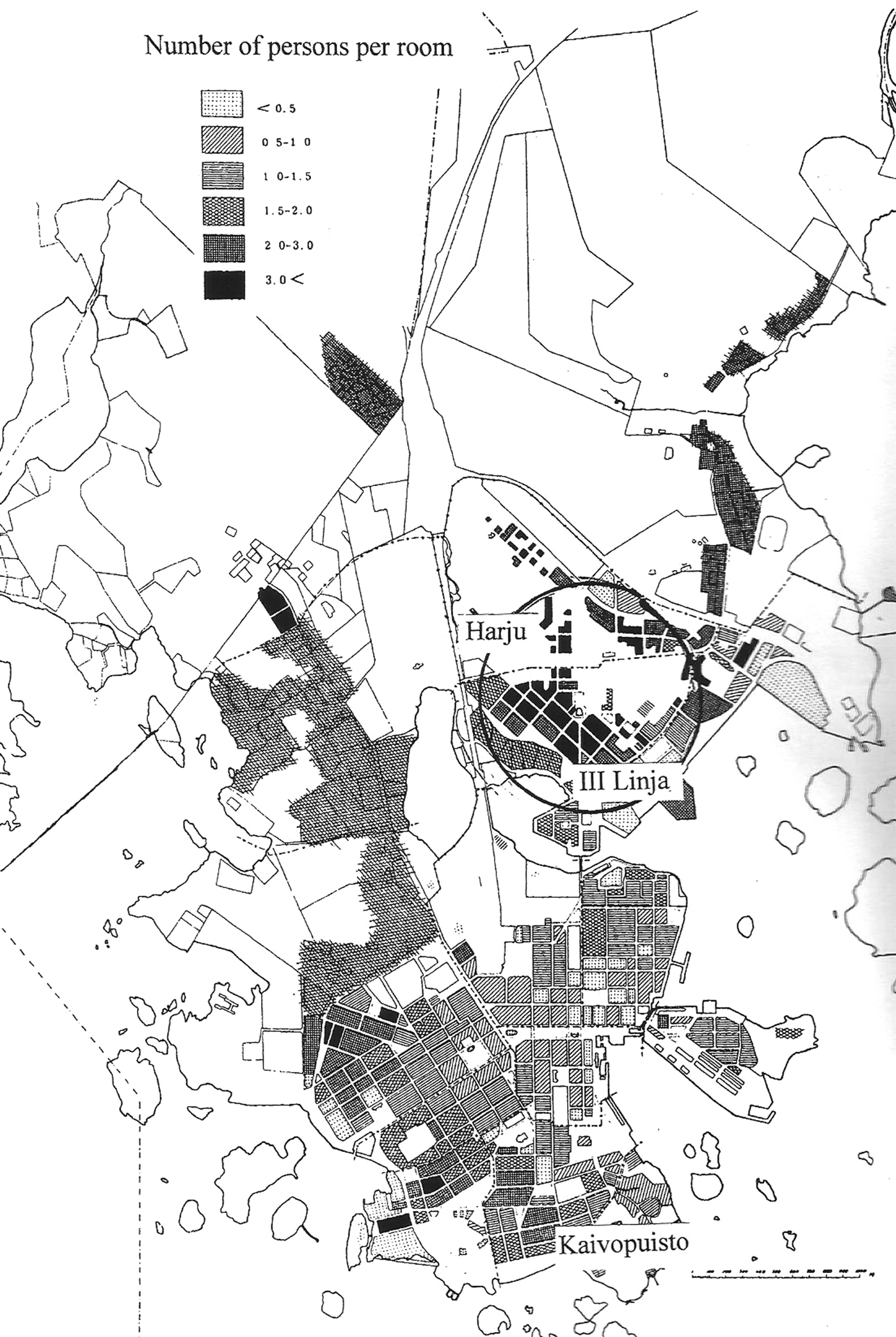
The article uses the original forms of the Census of Helsinki from 1900, for a detailed study of 443 lodgers living in the working-class part of northern Helsinki, some in the hills of Harju, and others in the newly built streets of III and IV Linja closer to the bridge and the marketplace. From the census sheets we extract information about age, occupation and gender and family circumstances of the lodgers. In addition the census will be used to clarify the gender, occupation and family circumstances of the landlords/landladies, the size of their dwellings, their rent costs and the number of lodgers in the household. This article also includes a map of population density, i.e. crowding in Helsinki and the location of some of the areas mentioned in the text (Figure 1).
Population density in Helsinki, 1910. Source: modified from S. E. Åström, ‘Stadssamhällets omdaning’, in R. Rosen, E. Hornborg, H. Waris and E. Jutikkala eds., Helsingfors Stads historia IV:2 (Helsinki, 1956), 7–328, here 145.

Two main surveys about working-class housing and lodging will be used. In the year 1900, Verner Sucksdorff was commissioned by the Board of Health in Helsinki to conduct a survey into working-class housing. In the process 10,000 households in different parts of the town were studied. Information was gathered about the size, condition and location of the dwelling, and access to water, toilets, washhouses, etc. In addition, information was collected about the inhabitants: their professions, family circumstances, presence of lodgers, and economic activity in the home. In 1910, another housing survey was deemed necessary. This time the focus was on the housing needs and family size of working-class families in Helsinki, paying particular attention to the question of lodging. Both the surveys set out to study standards of housing of the labouring classes in Helsinki, paying attention to hygiene, lodging, crowding, rents and dangers to health and morals.Footnote 19
The economic standard of working-class families will be explored using a survey of budgets from 1908 collected by Vera Hjelt for the Industrial Board. Some comparative data on economy and lodging will also be included from the poor relief inspectors' notes on recipients of out relief in Tampere Municipality 1900.Footnote 20 To illuminate the experiences of the families of landlords and lodgers and conditions under which lodgers lived around 1900, an oral history collection of childhood memories by 32 persons born between 1890 and 1920 in Helsinki will be used.Footnote 21 In addition, two volumes of the autobiography by Martta Salmela-Järvinen (born 1892, moved to Helsinki 1900) and the autobiography of Vaino Tanner (born in Helsinki 1881) will be mined for information.Footnote 22 The oral history information also includes narratives collected by Waris in the 1930s in the form of interviews with 101 individuals born between 1830 and 1900. Some of the interviewees were born in Helsinki; others moved there during the second half of the nineteenth century.Footnote 23
4. HELSINKI WORKING-CLASS FAMILIES AND LODGING
The housing survey conducted in 1900Footnote 24 incorporated 17,097 men, 17,369 women, 11,481 children. Of all men, 25 per cent were lodgers, of all women, 13 per cent and of all children, 2 per cent. While it had been known that the working classes provided space for lodgers and that lodging was common in this group, it was a wakeup call to those sceptical about the benefits of lodging to find that no less than 38 per cent of the households in the study kept lodgers (see Table 1). A new survey in 1910 revealed that lodgers were present in no less than 50 per cent of the working-class households.Footnote 25
Survey of housing of the working class in Helsinki, 1900

Source: V. Sucksdorff, Arbetarebefolkningens i Helsingfors bostadsförhållanden, redogörelse för Arbetarebostadsundersökningen ar 1900 (Helsinki, 1904), 33, 244–6.
The survey targeted the working classes; hence the occupations of the male household heads were distributed between skilled and unskilled labourers, factory workers, craftsmen, transport workers and those engaged in petty trade. The female household heads were engaged in textile work, factory work, petty trade, manual labour, washing, ironing and other service work. As space was at a premium it was noted that if a family was able to rent more than one room or a room and kitchen, the second room was almost invariably let out.Footnote 26 In addition to keeping lodgers, the working-class flats were also used for economic activity like carpentry, tailoring, washing and ironing and, of course, textile work.Footnote 27
5. WHY LODGERS?: A QUESTION OF ECONOMIC SURVIVAL FOR THE LANDLORD
Why did people live in only one room? Because they could not afford the rent for many rooms or even for a room and kitchen. A stove uses less wood than a cooker and that way you save on the heating. It was expensive to keep two rooms warm when the wages were low and sometimes there were no earnings at all for several weeks…That meant debt at the shop and going to the pawnbrokers with the few valuables in the house… Mum had work sometimes cleaning schools and washing for wealthy people… When we started renting a room and a kitchen it did not give us any more space because in the kitchen we had a lodger.
This is the explanation for the necessity of keeping lodgers given by the daughter of a stoneworker who grew up in a family with four children in early twentieth-century Helsinki.Footnote 28
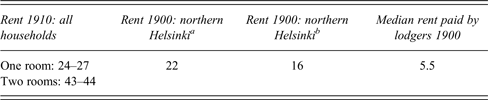
The intense migration into Helsinki increased the demand for housing and inflated the rents. Judging from records of the municipal taxation, only 22 per cent of the inhabitants had registered yearly earnings that exceeded 800 marks and in the lowest taxation bracket, we find the largest proportion of labourers with an average yearly income of 970 marks.Footnote 29 An average rent of 340 marks per year was perfectly normal in the early years of the twentieth century, although in smaller towns and industrial communities it was possible to pay 100 or even 200 marks less.Footnote 30 The rents depended on the size of the flat, the location and to some extent on the size of the family. Landlords saw it as perfectly reasonable to charge more for the same premises if the family had many children as they created more wear and tear. The housing surveys revealed somewhat higher rents than the census depending on which parts of town were included. However, the location of the house and the location of the rooms within the house, in addition to size, could affect the rent. Even in the cheapest parts of the town finding anything for less than 15 marks per month was extremely unlikely (see Table 2).Footnote 31
My father's wages on the railways were 75 marks per month, in addition there was some extra depending on the distance of the trips. The company rent for the flat was 31 marks per month, 40 per cent of the income (for a room and kitchen)… Over time the wages rose to 100 marks but even that did not allow a non-frugal lifestyle… The largest expense was the rent and a room was used for lodgers…. We usually had students who paid 20–25 marks per month. For full board you could charge 80–90 marks. The ones we had took their meals elsewhere because mother did not feel that she could take on the work.Footnote 32
Unlike many working men in 1890s Helsinki the father in the example above had secure employment and reasonable wages. The family had connections to the countryside and the family economy was boosted by bulk provisioning, but even so it was not possible to cover the demands on the income without a lodger.Footnote 33 In other families the employment situation was less secure; for non-skilled labourers and even skilled labourers in the construction trade a period of unemployment was to be expected every year.Footnote 34 The problem for women, however, when faced with the situation of having full and continuous responsibility for the upkeep of a family, was their lower level of earnings. Even in middle-class homes the event of widowhood could necessitate the keeping of lodgers, and restructuring of the living space. When widows and abandoned mothers had to bring up their children on earnings from manual labour or industrial work, the additional income from teenage children was very welcome. Working as a paper boy and running errands were common ways for children to earn small sums of money.Footnote 35 Children's earnings were usually absorbed into a communal economy, and a budget study of 1908 reveals that the children of working-class widows provided nearly one-third of the family income. However, widows with young children also seem to have sought the company of kin or taken in lodgers for the purpose of economic survival or assistance with childcare.Footnote 36
Monthly rents in Helsinki in 1900 and 1910 and rent paid by lodgers (marks)
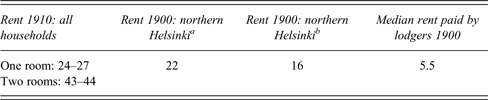
a Mean, northern Helsinki in the vicinity of the marketplace.
b Mean, at a greater distance from the marketplace.
Sources: V. Sucksdorff, Arbetarebefolkningens i Helsingfors bostadsförhållanden, redogörelse för Arbetarebostadsundersökningen ar 1900 (Helsinki, 1904), 255; A. Gauffin, Bostadsbehof och barnantal med afseende sarskildt a inneboendesystemet i arbetarfamiljerna i Helsingfors (Helsinki, 1915), 24–6; The National Archives, Helsinki, Finland, The archive of the Bureau of Statistics, the Census of Helsinki 1900, original sheets.
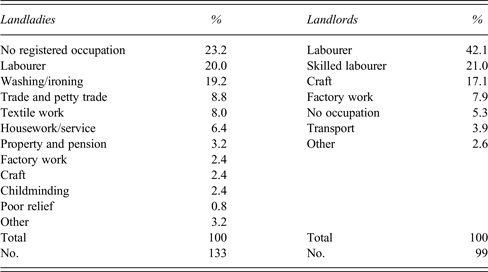
An analysis of the occupational structure of landlords in working-class Helsinki reveals that men represent the occupational categories one would expect. More than 40 per cent of the male household heads were labourers and the rest skilled labourers, craftsmen, factory workers or in transport (the railways or tramways). Interestingly enough, a certain percentage did not declare an occupation, which would indicate that keeping lodgers might have been the main source of income in addition to money earned by other family members (Table 3).
Occupational structure of landlords in working-class Helsinki in 1900 (% of all by gender)
Source: Sample of lodgers, Northern Helsinki, The National Archives, Helsinki, Finland, The archive of the Bureau of Statistics, the Census of Helsinki 1900, original sheets.
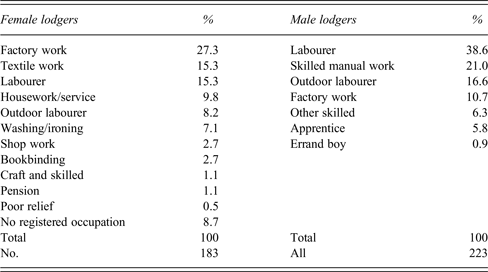
Among the landladies we find an even larger proportion of people with no declared occupation, which would point to having lodgers as an occupation, albeit unofficial. However, there are a couple of instances where the woman declares that her occupation is ‘caring for the young men’. Otherwise, the female household heads with lodgers engaged in activities typical for the female working class in Helsinki, the largest group being labourers. In urban Finland women working on a building site was normal, and certain jobs like mortar carrying were specifically female tasks; the female outdoor workers formed a union of their own that gained recognition in 1906.Footnote 37 Many women were working as laundresses or ran small ironing and starching shops in their rooms.Footnote 38 Others dedicated themselves to petty trade, textile work, housework or service (Table 3). The reason for needing to keep a lodger was obvious. None of the occupations was famous for being remunerative.
In Britain, female earnings in the late nineteenth century have been calculated as representing about 30–50 per cent of male manual workers' earnings, depending on the activity.Footnote 39 A budget study from early twentieth-century Finland indicates that the income opportunities for women might have been slightly better. It would seem that it was not impossible for women to reach earnings similar to those of unskilled males.Footnote 40 However, among the working classes only widows with a good income could afford to live without a lodger or a friend to share the rent, as the frequent presence of lodgers in female-headed households has demonstrated. In mid-nineteenth-century Colchester 19 per cent of the household heads were female, but one-third of the households with lodgers had a female head. In early twentieth-century Helsinki one in three of female household heads gained extra income from lodgers, a rate not dissimilar to that of working-class households in general; however, in certain parts of town as many as two-thirds of the widows had lodgers in their households.Footnote 41
6. RENTS AND LODGING
We moved to a large house with tens of rooms and a lot of inhabitants. We got a room facing the street on the second floor and now we had to take in many lodgers. Maija Salin and her son Bruno moved in with us and soon came the sisters Alina and Selma. There were six of us in a room that would not have been large for two.Footnote 42
According to the 1900 survey of working-class housing conditions in Helsinki the most common rent paid by lodgers varied between 4.5 and 6 marks per month; some paid less and some paid more but the vast majority paid about 5 marks.Footnote 43 With a rent of 20 marks per month (240 marks per year), a contribution of 60 marks or 120, in the case of two lodgers, could mean the difference between keeping the flat through periods of unemployment or not. Elsewhere in Finland the rents were lower and so would the contribution of the lodger be, but the proportion of the contribution was similar. The effect of keeping lodgers on the household income could be considerable. While the mean earned income for female household heads, according to budgets in 1908, was 660 marks, the same budgets reveal that if lodging is taken into account female income rose to 744 marks. Documentation on the economic situation of widows on poor relief in the textile town of Tampere in 1900 has revealed that some of the widows kept lodgers who paid about half of the rent.Footnote 44 In northern Helsinki in 1900, 50 per cent of working-class households had lodgers and 29 per cent had two lodgers or more. Therefore, in 21 per cent of the families an income of at least 60 marks per year would be available and in 29 per cent of the families an additional 120 marks could be expected for the family economy.Footnote 45
If the lodger was not also boarding, early morning coffee on weekdays and dinner on Sunday were usually included in the rent. Other meals would not be included. Some dined on bread and ham while others bought food from a stall.Footnote 46 As in Britain and elsewhere in the Nordic countries, keeping lodgers could vary considerably depending on the conditions. Some women held on to large premises and were running veritable guesthouses providing food, lodging and washing. In such cases the income of the wife could be considerable, compared with that of her husband.Footnote 47 As in the story of the railway worker above, it was possible for the wife to earn almost as much as her husband if a room with all services could be provided for a middle-class student.
The census forms mention lodgers with food and lodging, and budget studies show examples of cooking for lodgers and the lodgers of others. In the cases where schoolchildren or foster children were cared for it is obvious that the undertaking included food and washing.Footnote 48 The income from a working-class lodger wanting board and lodging could vary from 290 to nearly 400 marks per year and even more with additional washing. Family budgets occasionally record that no less than 415 marks were earned by one of the ‘housewives’ from providing meals to people in lodgings.Footnote 49 In some instances services were exchanged; female lodgers provided help in the household or male lodgers repaired shoes in return for having their clothes washed.Footnote 50 Estimating the economic value of some of these services is difficult but one has to assume it created a mutual advantage.
While the economic impact for an individual family could be considerable, women also provided a service to the growing urban community. As this was part of the hidden economy, calculating the total amount of cash changing hands is difficult. A cautious estimate for the year 1919 could perhaps be made, based on the survey of living conditions in Helsinki and a study of income and expenditure the following year. In 1919, the households in central Helsinki included nearly 19,000 lodgers or boarders which would suggest considerable money transfers, depending on the number of boarders and the quality of the lodgings. A cautious estimate assuming an average rent of 300 marks per year would indicate cash transfers of more than 5.5 million marks.Footnote 51
Women played an important part within this section of the grey economy. A detailed analysis of the households of 443 lodgers in the 1900 census has revealed that the prerequisite for keeping a lodger was the presence of an adult woman. The heads of household were couples (100) or females (134), never men only; the woman's touch, whether as provider of food, cleaning or washing, needed to be present.
7. I GUESS THEY WERE RICH AS THEY DIDN'T HAVE ANY YOUNG MEN
7.1 Who were the lodgers?
A common term for lodgers in Helsinki in the early twentieth century was ‘young man’. As a lady interviewed in the 1930s said about a neighbouring family who did not keep lodgers, even though they lived in northern Helsinki in the 1890s: ‘I guess they were rich as they didn't have any young men.’Footnote 52
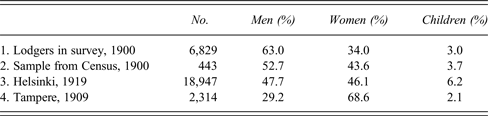
While the majority of the lodgers in Helsinki were men, the presence of women should not be disregarded. The survey of 1900 recorded about 60 per cent men and 30 per cent women (Table 4). The sample of lodgers from northern Helsinki indicates a 50:40 split and by 1919 the difference between adult male and female lodgers seems to have been small if not insignificant. However, in other towns, like Tampere with a high demand for female workers, we find a female dominance among the lodgers. The textile sector offered plenty of work opportunities for women and many of these were young unmarried women on low incomes. For these girls, lodging and sharing with other women on low incomes made sense.Footnote 53 While many lodgers were unmarried, it was not only single and young people who went into lodgings; a large proportion of lodging households consisted of two persons or more. In some cases these were husband and wife or mother and child, in other cases siblings.
Lodgers by gender and age in early twentieth-century Helsinki and Tampere
Sources: 1, V. Sucksdorff, Arbetarebefolkningens i Helsingfors bostadsförhållanden, redogörelse för Arbetarebostadsundersokningen år 1900 (Helsinki, 1904), 33, 244–6; 2, Sample of lodgers in northern Helsinki, The National Archives, Helsinki, Finland, The archive of the Bureau of Statistics, the Census of Helsinki 1900, original sheets; 3, Bureau of Statistics Asuntolaskenta 1919, SVTXXXII (Helsinki, 1921), 479; 4, G. R. Snellman, Tutkimus Vähävaraisten asunto-oloista vuonna 1909: Tampereen kaupungissa sekä viereisissä Pirkkkalan ja Messukylän pitäjäin osissa (Tampere, 1909), 52–3, 56–7.
Depending on the size of the quarters, whole families sometimes rented a room from the landlord and acted as an independent unit.
The room of the flat was suitable for keeping lodgers, and after water and gas were put on in the alcove, it was rented out to a couple that stayed for 13 years (left in 1927). We, a family of four, lived in one room and a kitchen.Footnote 54
Every survey registers a small but continuous percentage of lodger children. These children did not lodge independently but followed their parents, often their mother who was either a widow or unmarried. Naturally, the woman could choose to call herself married with an absent husband, divorced or widowed, if she so wished, in the census; only in other contexts was her marital status probed in more detail. The practicalities of lodging with a child in tow could vary. While the working-class homes in general had simple furnishings, easily fitting on a cart when moving, life for a lodger could be even more Spartan and lacking in comfort. On the other hand, when relations with landlords/ladies were good, they could compensate for a shortage of beds:
Then we moved into the household of a bricklayer called Gronholm. They had one daughter, a girl of my age called Hulda. The flat had only one room and mum and me slept on the floor. Together with the Gronholms we moved to Siltasaari and later to Mariankatu. The last one was an old wooden building but the flat was of a room and kitchen and the yard was beautiful with trees and flowers in the summer.Footnote 55
In this case the mother decided to retain the connection to her landlord and as a group they participated in the mobility so typical of the working class in the search for better accommodation.
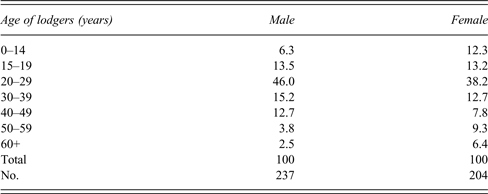
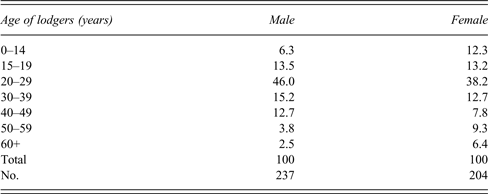
While we find families among the lodgers, it cannot be denied that the ‘young man’, the typical lodger, made his presence felt in Helsinki. The age pyramids of the 1890s and early years of the twentieth century reveal a community with a considerable share of young working-age men and women in the population. A look at the ages of the lodgers in northern Helsinki displays a concentration on the age groups between 15 and 30 years, particularly the 20- to 29-year-olds among males as well as females. No less than 45 per cent of the male lodgers and 39 per cent of the female lodgers are to be found in the age group 20–29 years (Table 5).
Lodgers by age and gender in Helsinki, 1900 (%)
Source: The National Archives, Helsinki, Finland, The archive of the Bureau of Statistics, the Census of Helsinki 1900, original sheets.
This image fits in with studies of lodging in other European urban centres in the early twentieth century: the majority of lodgers were young, more than 30 per cent between 20 and 30 years, but both younger and older lodgers were to be found (Table 5).Footnote 56
While the majority of the lodgers were young, no less than 15 per cent of the female lodgers were over 50 years old. The census does not reveal the economic arrangements between lodger and landlady but a study from Tampere has demonstrated how lodging and sharing were used not only as a means to cover the rent but also as a strategy for mutual assistance among vulnerable women of older ages. For example, a partly paralysed widow was minding the children of the widow with whom she was lodging, thereby making a double contribution to the economy of the household. Widows in their eighties without children in the town used lodging and sharing as a means to cope. The system of lodging added to economic security but it also created a new type of collaborative network for those who had left theirs in the countryside.Footnote 57 Another side to lodging and old age is the lack of information about the duration of the arrangement. Oral history accounts describe a system where the first lodgings of a young person from the countryside were found with a relative or the relative of a neighbour from back home. Once the person had held down a job for some time and found his or her footing in the new environment, lodgings were found through work mates. The following stage was finding your own place and a companion to share the rent and in the end keeping lodgers yourself.Footnote 58 Other collections, however, have revealed long-standing lodging arrangements between women. Therefore it is difficult to tell whether an elderly female lodger actually was a lodger or part of a reconstituted family-like arrangement.Footnote 59
A comparison of the occupations of lodgers with those of the landlords in Helsinki shows a remarkable uniformity. It is obvious that we are dealing with the same social class. The men are labourers, skilled manual workers, factory workers or training for these occupations. The women work in the manual sector, textiles, factories, housework or washing (Table 6). Again, we find a certain proportion of women without a registered occupation; however, with a few exceptions these were the wives of the married male lodgers with families or mothers of young workers. It would seem that the geographic location made its mark. In working-class regions of Helsinki people were working class irrespective of whether they were lodgers or their landlords.
Occupational structure of lodgers over 14 years of age in working-class Helsinki, 1900 (% of all)
Source: The National Archives, Helsinki, Finland, The archive of the Bureau of Statistics, the Census of Helsinki 1900, original sheets.
8. HYGIENE AND MORALS
As keeping lodgers was a common practice in the countryside and among the working classes, the middle class tended to view it as one more example of the immoral and unhygienic behaviour of the lower social orders.Footnote 60 The horror of people of different sexes in the same room seeing each others' bodies was of course a pure fantasy. While the middle classes stripped and put on night shirts for sleeping this was not the case among ordinary people. In rural areas boots and shoes were removed plus, if sleeping in a bed, the outer layers, leaving shifts, smocks, vests and undergarments. If sleeping on a bench or the floor, trousers and skirts often remained on. When migrating to urban areas, many retained this along with many other customs and behaviours. Although because of the weekly trips to the sauna, the naked body was not an object of fear and revulsion as in Victorian Britain, stripping in front of an unrelated man in any other situation was not part of the behaviour of a decent woman.Footnote 61
The question of crowding as a health problem was not unknown among the labouring class; the framework was, however, different. When the first workers' co-operatives started up building projects in Helsinki during the 1890s, a set of rules was also structured for the new inhabitants when the first houses were finished. If a family had six children, i.e. in families of eight, no lodgers could be allowed into the two-roomed flat.Footnote 62
While it cannot be denied that there was variation in the type of lodgings, it seems that the working classes generally created their own rules linked to their family situation and preferences.
Mum had finally got fed up with living in other people's households and rented a room in her own right…Tilda who had already been our roommate in the previous place moved with us. Nobody could afford the rent of a room on their own; everybody had lodgers, either men or women. Mum preferred females. She felt that a lone widow should not have men in the household. Men smoked tobacco and were always drinking. Who would want to attend to the needs of these drunken good for nothings? Women also had the advantage that they brought their own bed linen, and we did not have any to spare. Tilda even had her own (pull-out) bed that she had made herself and it was quite something. Even my uncle said that many a man could not have made one like it. Tilda repaired her own shoes and made us Christmas decorations. She saved money because she had an old father in the countryside that she wanted to bring to town. When her father came Tilda moved away from us and started a cobbler's business with him where they repaired shoes and made boots.Footnote 63
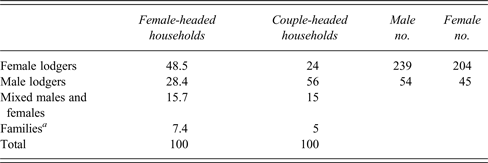
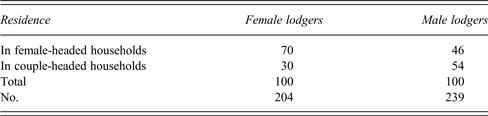
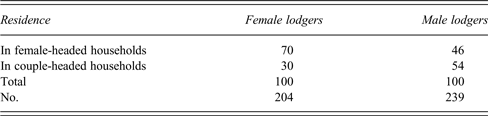
Often female-dominated households only included female lodgers. Widows could lodge with married couples, unmarried women could take lodgings for themselves and their children, but adult males would more often be found in a household headed by a couple than in one headed by a woman. Of the 443 lodgers that have been analysed in detail, 54 per cent were males and 45 per cent females. It would seem that female clustering was in evidence, as 48 per cent of the lodgers in female-headed households were women; in addition, 7.4 per cent of the lodgers were mothers with children, 28 per cent of the lodgers were male and 15 per cent were in households with both male and female lodgers. By far the largest group of lodgers in couple-headed households was that of single males (56 per cent), 5 per cent were men with families, 24 per cent were female and again 15 per cent male and female (Table 7). If the lodgers are only divided into males and females we find that 70 per cent of the female lodgers lived with female landladies while male lodgers were divided more evenly between landlords of different gender (see Table 8). The reasons behind this could be linked to issues of reputation, but could also be purely practical. Male lodgers in Helsinki as in Britain were more likely to want board and lodging or their clothes washed, and for that more space – particularly kitchen space – could be needed.Footnote 64 As cited above, men were also considered to create more work, dirt and trouble because of their life styles.
Lodgers by type, Helsinki, 1900 (%)
a In female-headed households, mothers and children.
Sources: The National Archives, Helsinki, Finland, The archive of the Bureau of Statistics, the Census of Helsinki 1900, original sheets; A. Gauffin, Bostadsbehof och barnantal med afseende särskildt å inneboendesystemet i arbetarfamiljerna i Helsingfors (Helsinki, 1915), 8–10; households with female lodger, 37%; households with male lodgers, 39%; male and female, 24%.
Lodgers by type of residence and gender (%)
Source: The National Archives, Helsinki, Finland, The archive of the Bureau of Statistics, the Census of Helsinki 1900, original sheets.
A female lodger alone, with a friend or with a child, could easily fit into a pull-out sofa in a one-room flat. When the widow had an adult son, however, it was not unusual to find male lodgers in the household; cooking and cleaning for one man or two made little difference: ‘After grandfather died my grandmother moved to live in the house next door with her unmarried son and a friend of his as a lodger.’Footnote 65
Elderly women with adult offspring would not always be in employment but instead devoted themselves to running the household for the children and lodgers. In the female households the lodgers could sometimes be friends or work mates and the co-residence might continue for decades. In these cases the relationship developed into family life rather than an economic arrangement. The proximity and assistance replaced absent kin and created security networks for widows and unmarried mothers.Footnote 66 Kinship contacts with relatives in the countryside were not necessarily lost at the time of migration, children could be sent to relatives for the summer to eat and help with farm work, or food items like potatoes could be sent to relatives in town. In addition, relatives from the countryside or other towns could come to stay for shorter or longer periods.Footnote 67 The definition of lodger was not always clear; in the vernacular ‘lodging with’ meant ‘living in the household of’, with the result that co-resident kin also could be described as lodgers even though the census takers drew a strict dividing line on the basis of kinship.
Mother was a seamstress, cleaned trams at night, father was ill and in hospital outside town in the parish (in which) he was born, then he died. The family regularly had a lodger (as people had, one or more). Often the lodger was one of the young aunts who worked during the day and could be there for the children in the night.Footnote 68
As we can see in this case, the ‘lodger’ was not only a relative but also participating in intra-familial care work.
9. SPACE AND CROWDING
The arguments against lodging progressed along two lines, related to morals and hygiene, the mixing of the sexes and its degenerative influence and the number of people sharing space and air. The pressures on the housing market in growing towns and cities created wonderful times for landlords and property owners. Despite moral indignation about the phenomenon of lodging, little was done to target the owners of properties in working-class areas. The cost of housing depended on the size of the premises, the location of the property and the landlord. Many living quarters in late nineteenth-century industrial towns had four-family houses with shared kitchens. While on average the number of people per room in industrial areas varied between 1.6 and 2.5 persons in 1900, the working-class areas were much more densely populated. A study of the housing conditions of labourers in 1909 in the town of Tampere revealed a situation with a mean of more than three persons per room (see Table 9).Footnote 69
Mean number of inhabitants per room in Helsinki and Tampere 1870–1900

Sources: K. Willgren, ‘Arbetarklassens ekonom iska framatskridande i Finland under de senaste decennierna’, in Ekonomiska samfundet i Finland, föredrag och förhandlingar 5 (Helsinki, 1909), 89; G. R. Snellman, Tutkimus Vähävaraisten asunto-oloista vuonna 1909: Tampereen kaupungissa sekä viereisissä Pirkkkalan ja Messukylän pitäjäin osissa (Tampere, 1909), 56–7.
The situation in Helsinki was fairly similar; the survey of 1900 identified a mean as high as 3.4 persons per room in the working-class parts of town. A study of 1910 located problem areas in the north where one-room flats on average housed 4.2 people and two-room flats housed 5.9 people. This particular survey targeted the issue of overcrowding and quality of housing, not primarily morals, and the desperate situation of large families and their lack of space was on the agenda more than the lodging problem.Footnote 70
The different areas of town demonstrated radical differences in housing between the social classes. The mean number of inhabitants per room was not particularly bad for the whole town but, as Table 9 suggests, the differences between the opulent middle class and the labouring classes were considerable. Crowding was of course not a particularly Finnish problem.Footnote 71 When making international comparisons, particularly with Britain, it is, however, necessary to point out the definition of a ‘room’. In Britain a ‘room’ is a space in a house separated by walls and a door from the rest of the building. Historical and contemporary definitions of a ‘room’ in Finland are a space provided with a heating device and divided by walls and a door from the rest of the building. A space without a heating device is not a room. The spaces defined as ‘bedrooms’ in Britain would be defined as ‘cold attics’ in Finland: a space without a heating device, upstairs, that could be used for sleeping in the summer. Such spaces would not be included in censuses, housing surveys or taxation either in urban or rural areas. However, their presence and use during the warm part of the year were normal, particularly in rural settlements. The urban housing generated by the workers' co-operatives also included attics used in the same way.Footnote 72 The gradual erection of new housing out of stone in many floors created a restriction on this periodic use of space as the cellars and attic areas were structured purely for storage. A re-examination of the housing information in the census might throw some light on the physical status of the housing stock in the northern part of town but at present we are forced to make do with available data. It might, however, be useful to keep in mind that in some cases what we are studying are the ‘winter’ figures.
Despite the options for seasonal increase of living space for some families it cannot be denied that the situation for others could be dire. The worst (absent) slum landlords provided housing no different from the worst lodging houses described by British social reformers.Footnote 73 These unscrupulous individuals were reputed to hire out floor space that the tenant marked out with a crayon. One particular landlord was so notorious that it was reputed that his brother changed his name to avoid any association.Footnote 74 Normal working-class families, even in better conditions, also had to squeeze up:
Father was a tram driver and the family lived in a company flat with a room and kitchen with running water and WC. In the room was a walk-in cupboard where the lodger had his bed with the feet sticking into the room. We usually had young men. In addition our young aunt lived with us for a while.Footnote 75
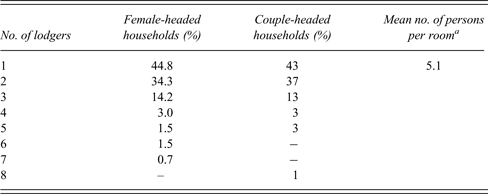
Of the people included in our sample the majority lived in one room and the majority also had only one lodger. A comparison between couple-headed and female-headed households demonstrates that the numbers of lodgers per household were very similar. Widows did not fill their homes with unruly men or large numbers of men and women disregarding propriety and sobriety. On the contrary, they behaved exactly like other working-class families, fitting in lodgers in relation to what was possible (see Table 10).
Number of lodgers in couple-headed and female-headed households, Helsinki, 1900
a All households.
Source: The National Archives, Helsinki, Finland, The archive of the Bureau of Statistics, the Census of Helsinki 1900, original sheets.
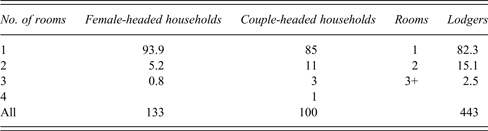
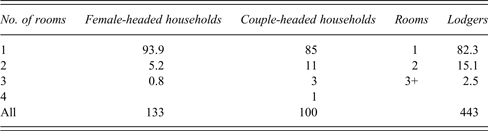
However, flats in working-class Helsinki were far from large and even when the lodging households consisted of families the amount of space was fairly limited. The lodgers in our sample lived in households with an average of 5.1 persons per room. Unfortunately for women, their ability to rent larger flats was more limited than that of men. No less than 93 per cent of the female landladies only had one room while the comparative figure for male-headed households was 85 per cent. This could perhaps be one of the reasons why couple-headed households were more likely to have family lodgers, as a whole room could be at the disposition of such a family. The options for a man to rent a whole room were of course also better because of his higher earnings.
Similarly, the availability of rooms might have affected the higher proportion of the female landladies with female lodgers. They had less space for their lodgers and a higher percentage of their lodgers had to sleep in the same room (see Table 11).Footnote 76
Number of rooms in couple-headed and female-headed households, Helsinki, 1900 (%)
Source: The National Archives, Helsinki, Finland, The archive of the Bureau of Statistics, the Census of Helsinki 1900, original sheets.
Unlike present-day existence the material possessions of ordinary labouring people did not take up a lot of space. When individuals or even families moved, the furniture and household goods usually fitted with ease on a small hand cart. The stability of the home was not necessarily tied to the physical framework, which of course added to the suspicion of the middle class who to an increasing extent identified ‘home’ with bricks and mortar.Footnote 77 In a home with limited resources it was necessary to fit in the essential. The rest you had to do without.
We had one room for the six of us. Next to the door we had a box for crockery and cooking utensils. On top of the box stood a bucket of water, the slops were hidden behind a box by the stove. On one side of the stove was a drop-leaf cupboard where we took turns to have our meals. By the windows were a small table, the sewing machine and a bureau with drawers that did not close properly. We had two pull-out beds one to the side and one from the end, and that was all. In the entrance hall we kept Bruno's fold-up bed. We slept two girls to a bed and the fifth on the wooden sofa-lid perched between two chairs. Our clothes hung on hooks on the wall and mum had made a curtain to cover them. The food was cooked on the primus next to the stove and in the winter on a three legged pot holder in the stove.Footnote 78
There was no possibility of sitting down for a communal meal irrespective of how the household expenses were divided, because there was no room for a dining table. It was common knowledge that there was a problem. However, the socially engaged ladies who deplored the eating habits of the lower orders lobbied for cooking classes for working-class women and girls, not larger flats and proper cooking facilities. It is hardly surprising that some of these initiatives aroused amusement among the female union representatives.Footnote 79
10. EMOTIONS OR MATERIAL INTERESTS
10.1 Relations between landlords and lodgers
In his study of mid-nineteenth-century Preston, Michael Anderson pointed out that while lodging was linked to economic survival it also had other dimensions. The orientation of kin or friends in a new environment was often the result of the relationship between the lodger/migrant and the landlady/friend.Footnote 80
The existence of such relationships has been documented in studies of widows and lodgers in Finland in the early twentieth century.Footnote 81 It is, however, likely that just as the size and structure of families and accommodation varied so did the relationships between landlord/landlady and lodger. When lodgers moved frequently, staying only for a short while, it is unlikely that close relationships could form. Where a separate room was rented out, it is also possible that the relationship could be distant. Keeping the flat when there were employment problems was of course an important reason for many a landlord/lady to add inhabitants to the house. On the other hand, the proximity of origin, the sharing of an occupation or even an employer, not to mention even distant kinship, could bring people together. Finding that day-to-day life was not too bad could encourage people to stay.
Oral history gives examples of distant relationships as well as close ones. The little girl in the stoneworkers' family had a clear image of the lodgers in the ‘spare’ room, but there was no communication between lodger and the family; all the images were visual observations:
In the kitchen we had a lodger. One was a man who worked all day and in the evening he sat around eating fatty bacon. He looked like it too, fat and oily. After the man we had a woman who had layers and layers of clothes on, she was never at home during the day.Footnote 82
On the other hand, children of similar age would naturally play with each other and could link families of landlords and lodgers together. Obviously the personalities of the parties were of considerable importance. If people wanted to be approached, friendly relations could develop.
On Sundays we sometimes went to the zoo, mum, me, Mr Gronholm, his wife, Hulda and sometimes even Uncle Victor and his young fiancée. We were like a family, we brought a coffee pot, made coffee and had sandwiches and hard boiled eggs. Hulda and I had ice cream from the Russian ice cream vendors… sometimes we had a picnic in one of the big parks.Footnote 83
The relations between landlady and lodger could also be quite close if the lodger was a friend and work mate; in some cases the co-habitation could last for decades and take the parties through very difficult times. Services could be exchanged, particularly child-minding, but also help during unemployment or even child-birth.Footnote 84
When they thought I was asleep I heard mother say: “There is no point in crying, I hope Antti keeps his word and sends you the money for a ticket as he has promised. You go when you are able to. When is your time?”…In the morning mum said: “I don't think you should carry mortar anymore, you might have an accident” and Alina laughed and said “Maybe an accident wouldn't hurt.” I did not understand why Mum was worried about Antti going to America rather than being conscripted to the Russian army for five years…
It was close to midsummer when I woke up hearing Alina crying out in pain. All the other women were up and mum was dressed and she and Alina went out. I heard her say: “I hope we're in time. I wonder if we can get a cab this time of night, we can't possibly walk all the way to Kaivopuisto”. Why would Mum and Alina go to Kaivopuisto in the middle of the night? But I soon fell asleep. In the morning I heard mum and Maija say that Alina had a son and that it was a shame Antti was not there to see the bonny boy of almost four kilos. After a week Alina came home with her son and he looked just like the neighbour's baby, a wrinkly face and pitifully small fingers and toes. I heard people say that Alina had had a misfortune and her brother who worked as a smith came to see the boy and was not happy at all but drunk and angry and said “You bring shame on the family making bastards”.Footnote 85
In the autobiography above the girl unwittingly tells the story of how her mother stood by and helped a friend and lodger through pregnancy, childbirth and early motherhood in a situation when the boyfriend had emigrated and the brother had only recriminations for his sister. The group of women bringing in their earnings to keep the flat created a female cluster resistant to economic stress and the family-like structure provided some protection. The nature of the relationship was also documented in a ‘family’ photograph and in a game played by the younger family members:
Sometimes we played that we were a family, mum the master and Maija the mistress and the rest of us their children. The sisters were young and joyful, having recently arrived from the countryside like all of us.Footnote 86
The oral history accounts that describe sharing with work mates are certainly substantiated by an analysis of female landlords and lodgers. Finding several women sharing an occupation is commonplace in female-headed households in the early twentieth century.Footnote 87 In some situations the co-residence lasted for decades with a gradual merging of life and economy:
To start with, we had mostly separate meals, but if one made soup on a Sunday, the other one was given a plateful. Coffee was bought together from the start. Sugar we bought separately. Then we decided to buy everything together, except sugar. When Tilda's teeth got bad, I ate the hard bits of bread and she got the soft ones. We didn't have any problems. Thirty-eight years we lived together. When people wondered how we could get on I said: “Sometimes we argue and then we make up”. All the cooking and cleaning we did together.Footnote 88
Female units exchanging services as well as providing economic input in the form of rent was not exclusive to Helsinki. Similar stories are available from Swedish towns and industrial areas where women could find work.Footnote 89 Women's budgets and industrial surveys reveal co-residence between adult women and their mothers and siblings in widowhood, when abandoned or as single mothers. They also reveal a tendency among daughters to stand by their mothers to a greater extent than sons.Footnote 90 While the typical figure of the lodger as a ‘young man’ most certainly existed, in reality there were also other types of lodgers. Female clusters comprising women and their kin, in combination with female lodgers, are intimately linked to nineteenth-century urbanisation and industrialisation.
11. CONCLUSION
Being a lodger has been viewed as part of the process of urbanisation; when arriving into town you would go into lodgings. The likelihood of adults being born outside Helsinki seems to have been fairly similar between landlords/ladies and lodgers, only the children were born locally.
The image of a lodger has first and foremost been that of a young man. While this image is not incorrect, it is in some need of modification. The gender distribution of lodgers depends on the nature of the economy of the community under study. Where the labour market favoured men they will also be detected among the lodging population; if, however, work is available for women they will also be prominent. Although the young lodger would have been the most representative, with the largest group of lodgers between 20 and 30 years old, other age groups were also represented. The traditional image of the lodger-sharing-householder suffers from a male and also a social bias. While men at marriage tended to set up a new household, women with children, either spinsters or widows, could still remain in lodgings. As has been demonstrated, however, not all men were able to become householders but stayed as lodgers with their wives and children.
While the middle classes in the Nordic countries embraced domesticity, the working class accepted the practicalities of urban life as a necessity that had to be put up with. Crowding was not desired, families rented more rooms when they could, only to find that space was a luxury for the rich. Other considerations were also present; moving to a house with running water or even an indoor toilet was worth the downsides of keeping a lodger.
An analysis of the landlords and landladies to determine whether there is evidence of paternal care in the one instance and money-grabbing indifference in the other has produced little evidence for this statement of Waris. Female- and male-headed households had the same numbers of lodgers and women did not seem to cram in large groups of people of different sexes. On the contrary, it would seem that female landladies dealt with the fact of lack of space by targeting female lodgers. Many households that were female dominated included children of the landlady or the lodger. It cannot, however, be denied that female landladies had fewer rooms at their disposition, with a higher share of women than of couples renting one-room flats, a likely outcome of the difference in wages between men and women.
Because the heart of this study is located in a working-class area it is not surprising that the occupational structure shows certain uniformity. We have found similarities in occupations between landladies and female lodgers and that the male occupations varied little between landlords and lodgers. Manual labour, craft, factory work and textiles figure prominently. It is of course not possible to tell how often the lodger shared the employer of the landlord/lady but it is certainly possible that it sometimes was the case. Although it will remain obscure how frequently landlords/ladies and lodgers formed bonds of friendship of a lasting nature we can fairly confidently say that there are indications to support the view of Anderson that lodging was not only a simple economic arrangement.
Virginia Woolf once defined the necessary requirements for a woman to live a life of fulfilment as ‘money and a room of her own’. Working-class people in the Nordic countries in the years before and after 1900 had neither. Most of them had been born in the countryside where privacy was unknown among ordinary people. You lived not only as part of a family but also as part of a group of people continuously interacting – working together, sharing not just sleeping quarters but often a bed. From a present-day perspective, such a life might seem strange. But we should try to remember that physical closeness also offers consolation and comfort. In our obsession with (or perhaps fear of) sexual tension, we have lost the ability to see the sharing of a bed by two women as a practical solution and a way to combat the dangers of cold winter nights.
The sharing of space was extended into urban life, where numerous people crammed into one room to share rent and heating costs. The crowded room of her childhood described by Martta Salmela, so apparent when all the beds were out, was not, however, a constant phenomenon as some of the household members were engaged in shift work. On the other hand, everybody worked long hours and slept soundly, as the eight-hour work day was but a distant dream. The number of people created a sense of security and when nobody was around the situation could feel lonely and uncomfortable.Footnote 91
Lodging should perhaps not be viewed as a constraint but as a way of life. The people involved were generally poor, they had little property and the only money they could lay their hands on came from physical labour by themselves or their family. In seeking and giving help, bonds could be formed that lasted for decades and made combating the adversities of life more bearable.