Vascular rings are congenital anomalies of the aortic arch that result in encirclement and compression of the trachea and oesophagus, and their true prevalence is estimated to be 1–3% of all cardiac anomalies. Reference Powell and Mandell1,Reference Licari, Manca and Rispoli2 Compression of the trachea usually presents in the first year of life as stridor, barking cough, dyspnoea, apnoea, cyanotic events, wheezing, or recurrent respiratory tract infections. Oesophageal compression usually presents later in life with the transition to solid food and presents as vomiting, dysphagia, or feeding difficulties. Reference Powell and Mandell1–Reference Dodge-Khatami, Tulevski and Hitchcock5
The first operation for the relief of a vascular ring was performed by Robert Gross in 1945, Reference Gross6 As surgical techniques and approaches improved over the years, mortality, morbidity, and length of post-operative hospitalisation lessened. Currently, the mortality of patients undergoing surgery to relieve vascular rings is extremely low. Reference Backer, Mongé and Popescu3,Reference Herrin, Zurakowski and Fynn-Thompson7 Data regarding post-operative mid- and long-term symptoms are scarce, especially regarding the impact of early versus late surgery and the persistence of symptoms related to the type of vascular ring. Reference Turner, Gavel and Coutts4,Reference Herrin, Zurakowski and Fynn-Thompson7–Reference Schmidt, Larsen and Hjortdal9 We herein report our experience with vascular ring surgery and present short- and mid-term follow-up.
Materials and methods
This study is a retrospective review of consecutive patients treated for symptomatic vascular rings at a single institution, Schneider Children’s Medical Center of Israel. Patients who underwent division of a double aortic arch or right aortic arch with aberrant left subclavian artery were identified and a retrospective review of medical records and hospital clinic visits was performed.
The study design and methods were approved by the Institutional Review Board. Informed consent was waived. Demographic, clinical, surgical, and follow-up data were collected on all patients. Demographic data included gender, age, and weight, vascular ring anatomy, concomitant congenital abnormalities, and presenting symptoms at the time of surgery. Vascular ring anatomy was classified based on pre-operative imaging studies and operative findings.
In order to assess patients’ symptoms at mid-term to long-term follow-up, a telephone questionnaire was composed. Parents were asked to grade subjective respiratory and gastro-intestinal symptoms 1 week, 1 month, 6 months, and a year after surgery and to grade severity and frequency of recurrent infections, stridor, bronchodilator treatment, chronic cough, and respiratory exercise intolerance.
Statistical analysis
Statistical analysis was performed using SPSS 20. The unpaired t-test was used to compare continuous variables with normal distribution, and the Mann–Whitney U-test was used to compare nonparametric variables. Categorical variables were compared using the Chi-square test. Statistical significance was defined as p value < 0.05.
Results
Ninety children underwent surgical relief of a vascular ring in Schneider Children’’s Medical Center of Israel. Five patients were excluded: one patient was older than 18 years old, one patient had a symptomatic VSD which necessitated surgical closure, two patients had Di-George syndrome with associated immunodeficiency, and one patient was excluded due to incomplete medical records.
Of the 85 children that composed our study cohort, 51 children had double aortic arch (60%), 31 had right aortic arch with aberrant left subclavian artery (36.5%), and 3 (3.5%) had right aortic arch, mirror image branching with a left ductus arteriosus. Patient demographics are summarised in Table 1.
Demographic and anatomic characteristics of the study population and postoperative results

Thirteen patients (15.3%) had associated anomalies: six (7%) cardiac (three patent ductus arteriosus, two atrial septal defect, and one with ventricular septal defect (VSD)). Seven (8.3%) had non-cardiac anomalies (two horseshoe kidney, one hypospadias, one agenesis of gall bladder, one duodenal atresia, one a solitary kidney, hypospadias and finger anomalies). Two (2.3%) had genetic diagnoses – Down’s syndrome and Dent’s disease.
Preoperative symptoms
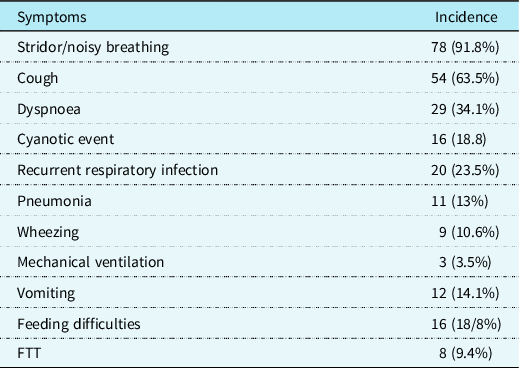
All children were symptomatic with significant respiratory symptoms prior to surgery. The most common symptoms were noisy breathing or stridor (91.8%), persistent recurrent cough (63.5%), and dyspnoea (34.1%). Feeding difficulties, or vomiting,, were documented in 29.4% of the children (Table 2).
Pre-operative symptoms

Workup and diagnosis
Forty-three out of 85 patients (52.4%) had a prenatal diagnosis. All patients underwent bronchoscopy as part of their work-up. Vascular anatomy was imaged in all children by either CT (85.9%), magnetic resonance angiography (21.2%) or both. Fourteen children (16.5%) had upper gastrointestinal imaging. All patients had echocardiography; one patient underwent cardiac catheterisation.
Operative procedure
All patients were operated through a left thoracotomy. Of the 51 patients with double aortic arch, 44 (86.3%) underwent division of the left arch and ligamentum arteriosum, and 5 (9.8%) underwent right aortic arch division. Two patients (3.9%) had similar sized right and left arches. In one, the left arch was divided, in the other, the right arch with the decision based on the side of descent of the descending aorta.
Out of the 31 patients and right aortic arch with aberrant left subclavian artery, in 29 (93.5%) the vascular ring was released by division of a left-sided ligamentum arteriosum. One child (3.2%) had a Persistent Ductus Arteriosus which was ligated and divided. In 17 patients (55%) in which Kommerell diverticulum was significant a posterior aortopexy of the Kommerell diverticulum to the spine was performed. In one patient, the Kommerell diverticulum was resected and the subclavian artery was re-implanted.
Postoperative course
There was no early or late mortality, and 67/85 (78.8%) were extubated in the operating room. Mean duration of ventilation for patients kept intubated postoperatively was 1.2 ± 0.4 days. Hospital stay was 5.64 ± 2.2 days. Chest tubes were removed after an average of 2.3 ± 1.8 days with an interquartile range of 2 days (1–3 days). Six patients (7%) had a clinically significant chylothorax that required a chest drain for 5 days or longer and three required a reoperation for thoracic duct closure. Injury to the recurrent laryngeal nerve occurred in two patients (2.4%).
Time to clinical improvement and medium-long term follow-up
Thirty-eight patients (44.7%) had clinic follow-up at SCMCI, with an average follow-up time of 33 ± 16.7 months. The mean age at last visit was 44.7 ± 18 months,
Parents of 71 (83.5%) children answered the phone questionnaire 57 ± 25.7 months post-operatively. Average age at telephone follow-up was 70 ± 27.5 months.
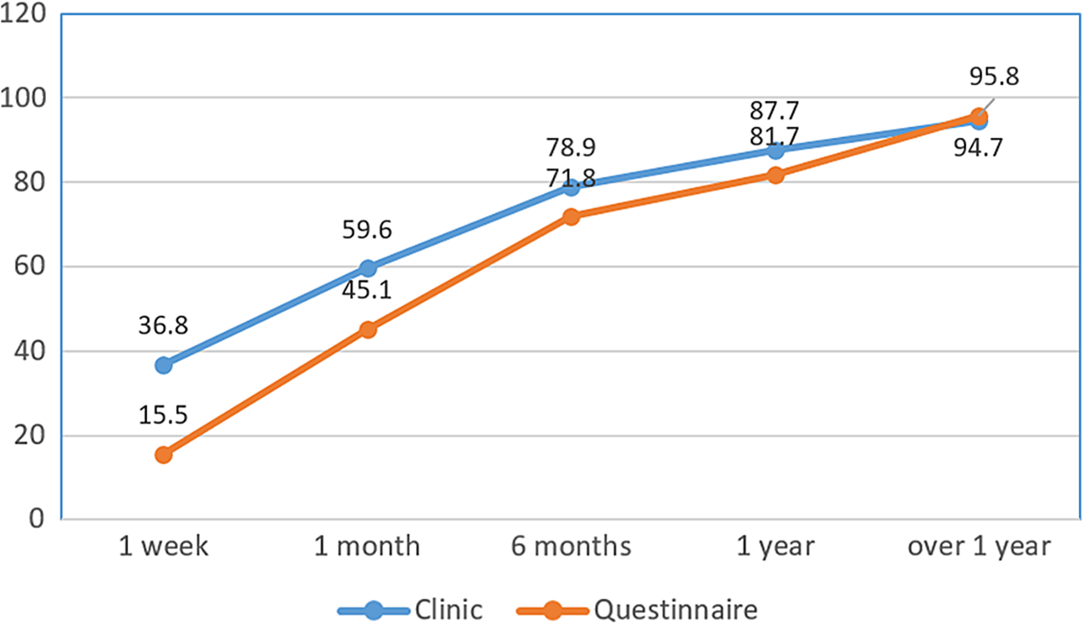
Time from surgery to symptomatic improvement was assessed both from patients’ files and from parental questionnaires (Fig 1). Significant symptomatic improvement occurred within 6 months (78.9% according to clinical follow-up and 71.8% according to questionnaires).
Time to clinical improvement – cumulative percentage.

Clinical follow-up
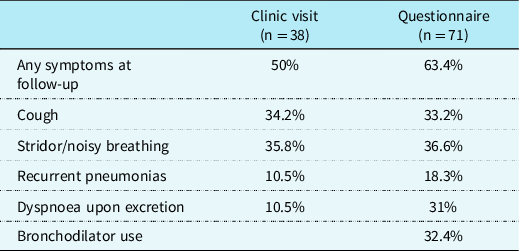
Out of 38 patients with hospital outpatient follow-up by a paediatric pulmonologist, 50% (19 patients) were symptomatic at their last documented visit (Table 3). No swallowing difficulties or other gastrointestinal symptoms were documented. In six patients (15.8%), symptoms persistence leads to an additional bronchoscopy. One child underwent reoperation and an anterior aortopexy was performed.
Symptoms at long-term follow-up

Telephone questionnaire
Most parents (83%) described a significant improvement in their child’s respiratory symptoms, 5.6% and 4.2% of parents described their child’s symptomatic improvement as mild and moderate, respectively. About 4.2% of the parents stated that they have noted no symptomatic improvement.
Totally, 63.4% of these children had residual symptoms at time of filling questionnaires, 32.4% are treated with inhalers or bronchodilators, 18.3% had at least one episode of pneumonia per year, and 5.6% stated they suffer from three or more episodes of pneumonias per year (Table 3). About 31% of children were described as having dyspnoea or respiratory limitation: 12.7% while doing physical activities such as running, 9.9% while walking uphill or climbing stairs, 5.6% while walking on playing, 1.4% while doing daily activities as eating or showering, and 1.4% at rest.
Comparing double aortic arch to right aortic arch with aberrant subclavian artery
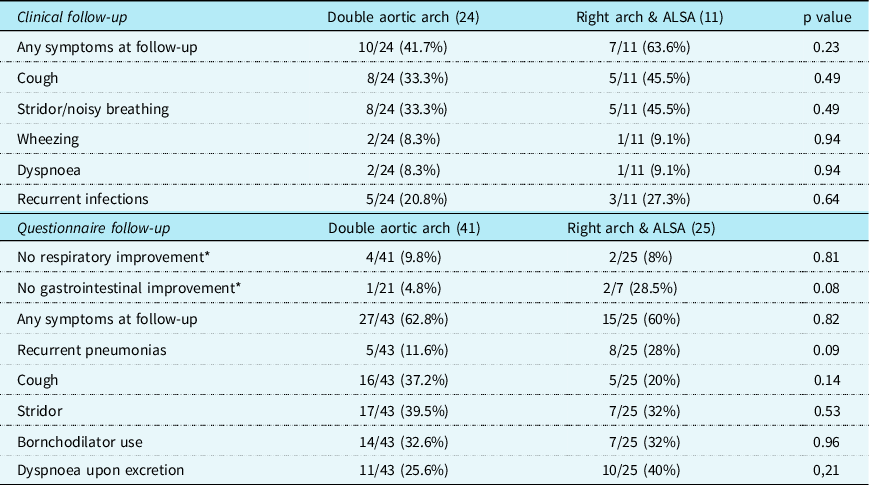
Patients with right aortic arch with aberrant left subclavian artery were operated at an older age (19.7 ± 14.3 vs. 3 ± 1.7 months : p value < 0.001). There was no difference in the incidence prenatal diagnosis. There were no differences in hospital stay, number of ventilated patients, duration of ventilation, chest tube drainage, or surgical complications. By telephonic follow-up, there were no differences in the rate of symptomatic children, clinical improvement, recurrent infections, or the rate of children with dyspnoea at exertion or rest (Table 4).
Long-term follow-up according to vascular ring type

Results according to age at surgery
Patients were divided to two groups ; early surgery (<6 months) and late surgery (>6 months). No association was found between prenatal diagnosis and time of surgery. Children who were operated early were hospitalised 1 day longer, but did not have a higher rate of residual or significant symptoms. Recurrent infections or dyspnoea upon exertion or rest is shown in Table 5.
Long-term follow-up according to age at operation

Discussion
Surgery is the only effective treatment for symptomatic vascular ring’s resulting in symptomatic relief within months following surgery. Reference Powell and Mandell1 Nevertheless, the data regarding patients’ outcome years after surgery are limited. Reference Herrin, Zurakowski and Fynn-Thompson7–Reference François, Panzer and De Groote12 Our series describes in detailed analysis the nature of residual symptoms after vascular ring surgery and demonstrates that many children suffer from respiratory symptoms even years after surgery and at rates higher than previously described. The patients’ families describe a significant general improvement in the well-being of the child in most of the cases. Careful evaluation and specific inquiry about residual symptoms reveal that some patients remain symptomatic.
General symptomatic improvement is apparent in 45–60%, depending on follow-up, within 1 month after surgery and in almost all patients within a year (82–88%). The trajectory of improvement in symptoms from 1 week to over 1 year is quite dramatic, most parents described the improvement in respiratory and gastrointestinal symptoms as substantial. In many cases, the significant improvement was evident from parents’ description, as they used expressions such as ‘‘dramatic improvement” and ‘as if it was a “different child’’. Nevertheless, according to the telephone questionnaire, 63% of children have residual respiratory symptoms nearly 5 years after surgery.
We have analysed and compared our results to the incidence of respiratory symptoms in the general population, as many children in this age group suffer from respiratory symptoms. In total, 14% of children in the United States of America are diagnosed with asthma, and 2.4–37.6% of children 6–7 years old suffer from wheezing. Reference Liu and Kliegman13 In-depth analysis of our cohort revealed that 31% of children were described as having dyspnoea or respiratory limitation while exercising: 12.7% while doing physical activities such as running, 9.9% while walking uphill or climbing stairs, 5.6% while walking on plain, 1.4% while doing daily activities such as eating or showering, and 1.4% complained of dyspnoea at rest.
Due to the high prevalence of respiratory symptoms in children at this age group, the subjective nature of the data that were collected and our estimation that recall bias can skew the result due to over reporting of symptoms, we have decided to analyse the results according to the more significant and functionally impairing symptoms. Children who were reported to suffer from dyspnoea upon exertion (or higher degree of dyspnoea) or suffered from at least one pneumonic episode per year were defined as suffering from significant symptoms. We have found that even according to this classification, 29 of 71 children (40.8%) suffered from significant symptoms. Extrapolating from the total amount of patients (including those lost to follow up), at least 34% of our patients are estimated to be significantly symptomatic.
Literature regarding long-term results of patients that underwent vascular ring surgery is controversial probably due to the criteria and methods used to define symptoms. Some authors report significant residual respiratory symptoms. Humphrey reported results of a questionnaire performed in 38 patients in which 50% had residual respiratory symptoms and 18% had chronic feeding difficulties. Reference Humphrey, Duncan and Fletcher14 In a small series of 23 patients, Schmidt et al Reference Schmidt, Larsen and Hjortdal9 reported that after 3 months only 60% were free of respiratory symptoms and only 50% had normal eating habits. On the other hand, Herrin et al reported a 74% improvement in symptoms at 1 month. Reference Herrin, Zurakowski and Fynn-Thompson7 Similar results have been reported by Fracois et al. Reference François, Panzer and De Groote12
Large series report a low rate of re-operation for vascular ring surgery ranging from approximately 8 to 12% depending on the length of the follow-up. Reference Herrin, Zurakowski and Fynn-Thompson7,Reference Backer, Mongé and Russell15 In our series, six children (7%) required repeated bronchoscopy due to persistence of symptoms. One child required reoperation in which an anterior aortopexy was performed, after which a significant clinical improvement was noted. The gap between the rate of symptomatic patients and the actual need for surgical intervention may be due to the fact that although many children are symptomatic, suffering from residual symptoms does not necessarily imply that there is a structural problem that could be solved surgically. Furthermore, It is also likely that a gradual improvement was noted, an assumption supported by parents’ description.
Assuming the tighter nature of the ring in double aortic arch, where the airway and the oesophagus are compressed by two systemic vascular structures, we hypothesised that this anomaly will have an earlier and more severe presentation and that the long-term outcome might be different. A former study performed in our centre, Reference Razon, Berant and Fogelman16 reviewing data from prenatal diagnosis of vascular rings, demonstrated that all patients with double aortic arch needed surgical relief, compared to a minority of patients with right aortic arch with aberrant left subclavian artery. Our study confirmed that children with double aortic arch are operated at an earlier age, but no long-term difference in residual symptomatology was found between the two groups. The explanation for this finding may stem from the degree of trachea-bronchial compression: significant compression will present with similar clinical symptoms and is likely to experience similar recovery and residual symptoms regardless of the anatomical type of vascular ring.
Looking at our cohort, we did not find any significant difference in residual symptoms when comparing children operated early to those operated later. Humphrey et al reported that 50% of their 38 patients had residual respiratory problems at long-term follow-up and 18% had feeding difficulties, Reference Humphrey, Duncan and Fletcher14 in this cohort patients operated under 6 months of age had 80% residual respiratory symptoms. Patients operated on later, between 3 and 6 months had 15% of residual symptoms. Timing of surgery was determined by the severity of symptoms: the more symptomatic patients were operated earlier. Therefore, young age at surgery is likely a reflection of tighter vascular ring, and this may hamper recovery. On the other hand, one may speculate that early surgery will allow better healing of the compressed trachea. Conversely, children operated later might suffer from a longstanding more significant injury to the tracheobronchial tree and the airways, leading persistence of symptoms. The nature of this finding may be hard to analyse since only patients with significant airways compression causing symptoms were operated. The more prudent conclusion would be that early or late symptomatology does not influence the clinical outcome of surgery. Furthermore, only a controlled double-blind trial of early versus late operation would give us a true indication whether one strategy is beneficial compared to the other.
Can we do better?
Based on our data and previously published literature, it is safe to conclude that surgery greatly improves the clinical status of vascular ring patients, some many patients have residual symptoms. It is not clear whether correctable anatomical factors contribute to the persistence of symptoms implying that modified surgical techniques could improve the results of surgery, or that symptoms are due to Inherent defect in the trachea, bronchial tree, and distal airways.
Kommerell diverticulum is an embryological remnant of the fourth left aortic arch and serves as the base of the subclavian artery. In patients with right aortic arch with aberrant left subclavian artery, it courses behind the oesophagus and partially fixates the right aortic arch to the left. The division of the left ligamentum opens up the space anterior to the trachea and relieves the pressure, but the aberrant left subclavian artery has a “sling like” effect on the right arch keeping the posterior indentation. The Kommerell diverticulum is a space occupying structure behind the oesophagus and trachea. For the last decade, resection of Kommerell diverticulum has been advocated first as a solution for patients with recurrent symptoms Reference Backer, Mongé and Popescu3,Reference Backer, Mongé and Russell15 and most recently as an additive procedure to the primary operation. Reference Luciano, Mitchell and Fraisse11,Reference Backer, Russell and Wurlitzer17 In a recent paper published by Luciano et al, out of 12 patients who underwent resection of diverticulum of Kommarell, 4 (33%) had prolonged pleural effusion, 1 had pneumonia, and 3 (25%) reported residual symptoms. Reference Luciano, Mitchell and Fraisse11 Backer et al reported their experience with primary resection of Kommerell diverticulum, out of 33 patients, 2 had significant chylothorax and none reported recurrent laryngeal injury. Reference Backer, Mongé and Popescu3,Reference Backer, Russell and Wurlitzer17 On the other hand, Naimo et a. reported their experience with 132 patients when only one patient had resection of Kommerell, on an 11-year follow-up only three patients had evidence of posterior tracheal compression. Reference Naimo, Fricke and Donald8
In our series, only one out of the 31 patients with the diagnosis of right aortic arch with aberrant left subclavian artery had resection and re-implantation of Kommerell, alternatively 17 patients had posterior fixation of the descending aorta and Kommerell to the posterior spine, a technique that was previously briefly mentioned, Reference Mascio18 and is seldom used. We find this technique quite effective and perform it under direct bronchoscopic guidance, which demonstrates the effect of the posterior pexy on the trachea and the carina.
It is possible that a significant amount of residual respiratory symptoms are caused by inherent malacia of the airways. If significant disability exists, an extensive workup to evaluate the airway should be performed, Reference Bairdain, Smithers and Hamilton19 and creative airway stabilisation techniques should be considered and employed in order to improve the patients clinical status. Reference Lawlor, Smithers and Hamilton20 It is also prudent to keep in mind that some symptoms will resolve with time, as the child grows.
Conclusions
Surgical division of vascular rings is a safe procedure when performed in an experienced centre and results in a significant clinical improvement within 1 year, The trajectory of improvement in symptoms from 1 week to over 1 year is quite dramatic. Nevertheless, some patients remain symptomatic.. We found no association between the age at surgery or anatomic variant to the presence of symptoms in mid-term follow-up. Further evaluation is warranted to assess the nature of residual symptomatology and explore whether anatomical causes can be identified leading to surgical modifications.
Limitations
Our clinical follow-up is subjected to selection bias due to loss to follow-up, which could result in a higher rate of symptomatic patients in our cohort. Children in these age groups often suffer from respiratory symptoms and illness; therefore, it is hard to assess whether our patients have symptoms more severe than their peers. Questionnaires are based on parent’s answers, memory, and subjective assessment. It is likely that parents to a child with an anomaly affecting the airway and respiratory system would be sensitive in reporting respiratory symptoms, affecting our results. This could be reflected in the discrepancy between the significant improvement reported by most parents and the high degree of symptomatic children reported at late follow-up when challenged by the questionnaire.
Financial support
This research received no specific grant from any funding agency, commercial, or not-for-profit sectors.
Conflicts of interest
None.