The Andalusian coast is located on both sides of the Gibraltar Strait, the geographical border between the Atlantic Ocean and the Mediterranean Sea. This border effect is possibly one of the causes of the high biodiversity found in the area, and is also reflected in the variety of cetaceans recorded. Seventeen marine mammal species were found stranded on the Andalusian coast (unpublished data) by the Recovery Centre of Marine Endangered Species (CREMA), which belongs to the Consejería de Medio Ambiente de la Junta de Andalucía and has operated on the coast of Andalusia since 1994.
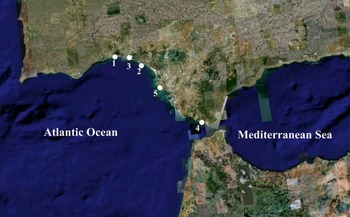
According to data collected by CREMA, 95% of the strandings of marine mammals in Andalusia correspond to four different species of dolphins (family Delphinidae, Gray, 1821). The remaining 5% is divided between species that may be regarded as casual. These are either rare species or species for which Andalusia is at the limit of their distribution, such as the harbour porpoise (Phocoena phocoena, Linnaeus, 1758) found in the Alboran Sea (Bellido et al., Reference Bellido, Castillo, Farfán, Martín, Mons and Real2006) or the hooded seal (Cystophora cristata, Erxleben, 1777) pups entering the Mediterranean (Bellido et al., Reference Bellido, Castillo, Martin, Mons, Farfán and Real2007). It also includes specimens belonging to species with solitary habits or other features which do not facilitate subsequent strandings once dead or diseased. We report here strandings of two occasional species not previously recorded on the Andalusian coast (Figure 1), whose determination was based on the dental formula and the morphometric data.
Geographical location of strandings: 1 Mesoplodon europaeus Huelva 1990; 2 Mesoplodon densirostris Matalascañas 1996; 3 Mesoplodon europaeus (two records) 1997; 4 Mesoplodon densirostris Tarifa 2003; 5 double strandings Mesoplodon bidens Rota 2007.

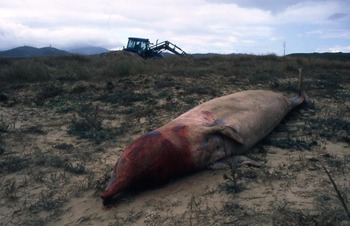
The first species is the Blainville's beaked whale (Mesoplodon densirostris, De Blainville, 1817), with one specimen stranded in Mazagón (37°06′N 6°45′W, Huelva Province) on 20 May 1996 in an advanced state of decomposition. The skeleton of this specimen is housed in the Vertebrate Collection of the Estación Biológica de Doñana (specimen EBD 23813). The other specimen stranded in Tarifa (36°01′N 5°35′W, Cadiz Province) on 17 December 2003, also in an advanced state of decomposition (Figure 2). This specimen was a female with a total length of 414 cm, and was buried in the same beach where it stranded. Only two records of this species had been previously reported in the Iberian Peninsula, one on the coast of Portugal (Reiner, Reference Reiner1979) and another on the coast of Castellon in the Mediterranean (Casinos & Filella, Reference Casinos and Filella1981).
Displaying exemplary Mesoplodon densirostris Tarifa 2003.

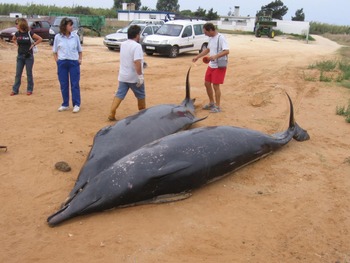
The other species is the Sowerby's beaked whale (Mesoplodon bidens, Sowerby, 1804), with two individuals stranded together on the coast of Rota (36°37′N 6°22′W, Cadiz Province) on 8 September 2007, which were still fresh (Figure 3), which suggests that they died in the previous 12 hours. They had no external lesion and an in situ necropsy revealed no apparent internal damage. They were two males with total lengths of 480 cm and 435 cm, respectively. Their skeletons are kept in the Vertebrate Collection of the Estación Biológica de Doñana (EBD 28806 and EBD 28807), and samples of skin, fat tissue and muscle are kept in the Aula del Mar of Málaga (Spain) under the control of the Consejería de Medio Ambiente de la Junta de Andalucía (Andalusian Government). The Sowerby's beaked whale is a little known species (Ostrom et al., Reference Ostrom, Lien and Macko1993; Hooker & Baird, Reference Hooker and Baird1999; MacLeod et al., Reference MacLeod, Pierce and Santos2004). Specimens of M. bidens live in groups of between 2 and 10 individuals, distributed in the waters of the North Atlantic (Castells & Mayo, Reference Castells and Mayo1990). Until 2002 there was no record of this species in the waters of the Mediterranean (Notabartolo di Sciara, Reference Notarbartolo Di Sciara and Notarbartolo di Sciara2002), but it was later reported in the waters of Greece (Frantzis et al., Reference Frantzis, Alexiadou, Paximadis, Politi, Gannier and Corsini-Foka2003). The only stranding event of this species reported in Spain was a female, on the coast of Santander (northern Spain) in 1980 (Castells & Mayo, Reference Castells and Mayo1990). Therefore, the two individuals stranded on the Andalusian coast represent the first record from this location and the second in Spain and, in addition, represent the first case of a multiple stranding of this species in Spain.
Full view of the two specimens of Mesoplodon bidens stranded in Rota 2007.

Mesoplodon is a little known genus, included within the family Ziphidae (Gray, 1865), and includes a number of very similar species distinguished from each other by tooth formula. These strandings provide new information for these unusual species, which belong to a family with scattered and incomplete information (MacLeod et al., Reference MacLeod, Perrin, Pitman, Barlow, Balance, D'amico, Gerrodette, Joyce, Mullin, Palka and Waring2006). In Andalusia, only a specimen of Gervais' beaked whale (Mesoplodon europaeus, Gervais, 1855) had been previously detected (Valverde & Galán, Reference Valverde and Galán1996). Mesoplodon europaeus is an endemic species from the Atlantic with strandings records from south-east Brazil to the Canaries (MacLeod et al., Reference MacLeod, Perrin, Pitman, Barlow, Balance, D'amico, Gerrodette, Joyce, Mullin, Palka and Waring2006). We also provide three new records of this species in Andalusia (Figure 1). The first stranding occurred in Huelva Province in 1990 and is the most ancient record reported from the Andalusian coast. The other two cases were males that stranded on 17 and 19 September 1997 near the mouth of the River Odiel (37°13′N 6°57′W Huelva Province). Their skeletons are kept in the Vertebrate Collection of the Estación Biológica de Doñana (specimens EBD 26005, EBD 23878 & EBD 23879 respectively).
ACKNOWLEDGEMENTS
Data from strandings have been lent by the Consejería de Medio Ambiente de la Junta de Andalucía (Andalusian Government) and the staff of the Vertebrate Collection of the Estación Biológica de Doñana (EBD).