Introduction
The transition from hunting and gathering to food production has long been associated with the emergence of widespread, persistent economic inequality (e.g. Childe Reference Childe1929, Reference Childe1950, Reference Childe1957; Bar-Yosef Reference Bar-Yosef2001). The archaeological record of Neolithic Western Asia and Europe, however, exhibits scant evidence for lasting and substantial socio-economic differentiation (Belfer-Cohen Reference Belfer-Cohen, Campbell and Green1995; Byrd & Monahan Reference Byrd and Monahan1995; Kuijt Reference Kuijt1996; Bar-Yosef Reference Bar-Yosef, Finlayson and Makarewicz2014). Moreover, ethnographic and archaeological data show that substantial economic disparities are neither absent among hunter-gatherers, nor ubiquitous among farmers (Hayden Reference Hayden1990; Ames Reference Ames, Coupland and Banning1996; Rowley-Conwy Reference Rowley-Conwy, Panter-Brick, Layton and Rowley-Conwy2001; Borgerhoff-Mulder et al. Reference Borgerhoff-Mulder2009; Halstead Reference Halstead2014).
Here, we test the hypothesis that it was not farming per se that fuelled the emergence of persistent wealth inequality in late prehistoric Western Eurasia, but rather specific types of farming, which offer different possibilities for accumulating, storing and transmitting wealth across generations. Wealth is defined as a stock of assets—housing, livestock or land, for example—that yields a flow of income or other contributions to an individual's or family's well-being. We measure wealth inequalities using the Gini coefficient, which can be compared across sites and types of wealth. This indicator, which ranges from zero (complete equality between units) to one (all of the wealth concentrated in a single unit), is based on the extent of wealth differences, relative to average wealth, among all pairs of households in a population (Bowles & Carlin Reference Bowles and Carlin2018; Fochesato et al. Reference Fochesato, Bogaard and Bowles2019).
We test our agronomic hypothesis using a dataset from 39 sites of various dates from the Neolithic to the Iron Age and Roman period (90 site-phases) in Western Asia and Europe spanning 9000 years (later tenth millennium BC to the early first millennium AD). We assess agronomic conditions for these cases using direct evidence of arable land management. Gini coefficient estimates for these cases derive from a related study (see Fochesato et al. Reference Fochesato, Bogaard and Bowles2019) where we take into account:
a) Biases due to small sample sizes.
b) Differing population sizes.
c) Distinct indicators of wealth (such as house size and grave goods).
d) Household composition.
e) Population groups (e.g. slaves) missing from the original data.
Our analysis has implications not only for the development of sustained wealth inequalities in Western Eurasia, but also for other world regions with very different ecologies.
Gini coefficient estimates for Neolithic Western Asia and Europe—revised for comparability (Fochesato et al. Reference Fochesato, Bogaard and Bowles2019)—indicate that early farming economies were often strikingly egalitarian, with low wealth disparities similar to ethnographically documented hunter-gatherer economies (Borgerhoff-Mulder et al. Reference Borgerhoff-Mulder2009). These estimates also indicate examples of substantially greater wealth inequality from the fourth millennium BC onwards.
Our proposed explanation of the emergence of persistent, substantial wealth inequality is a variant of a hypothesis from behavioural ecology, which states that clumped, as opposed to dispersed, resources are the basis of dominance hierarchies in non-human animals (Vehrencamp Reference Vehrencamp1983; Mitchell et al. Reference Mitchell, Boinski and van Schaik1991; Menard Reference Menard, Thierry, Singh and Kaumanns2004). Among humans, the potential monopolisation of clumped valuable resources is not unique to farming, as the case of highly productive and defensible fishing sites exemplifies (Hayden Reference Hayden, Feinman and Price2001). By substantially increasing the productivity of both land and animals, however, food production made land and other concentrated, defensible forms of wealth far more common than the rich resource concentrations upon which hunter-gatherer wealth inequality was sometimes based. We use our estimates of wealth inequality, along with evidence on the nature of farming systems, to develop a clumped-resources narrative describing the emergence of substantial and sustained inequality in Western Eurasia. We also draw upon a classic distinction between hoe farming and plough farming, where the latter is associated with land ownership that becomes the basis of marked economic disparities (Goody Reference Goody1976; Halstead Reference Halstead, Hodder, Isaac and Hammond1981, Reference Halstead2014; Sherratt Reference Sherratt, Hodder, Isaac and Hammond1981, Reference Sherratt, Pétrequin, Arbogast, Pétrequin, van Willigen and Bailly2006). We use the clumped-resources logic to demonstrate how a transformation of farming could support the novel emergence of elevated levels of inequality. We illustrate how this may have occurred in the Western Eurasian late prehistoric archaeological record, providing empirical evidence consistent with previous assessment of the potential impact of animal traction (e.g. by Sherratt Reference Sherratt, Hodder, Isaac and Hammond1981, Reference Sherratt, Pétrequin, Arbogast, Pétrequin, van Willigen and Bailly2006; Bogucki Reference Bogucki1993), but tracing this impact well beyond the Neolithic.
We extend the existing literature in three ways. First, we propose a conceptual economic model that contrasts garden farming systems, in which production is labour-limited (or labour-intensive—we use these terms synonymously), with field-based farming systems that are land-limited (or land-intensive). Secondly, we use archaeobotanical measures to distinguish empirically between these two farming systems. Finally, we use the conceptual model to suggest a process by which labour-limited farming systems with limited inequality could have made a transition to land-limited and more unequal systems.
Cases studies
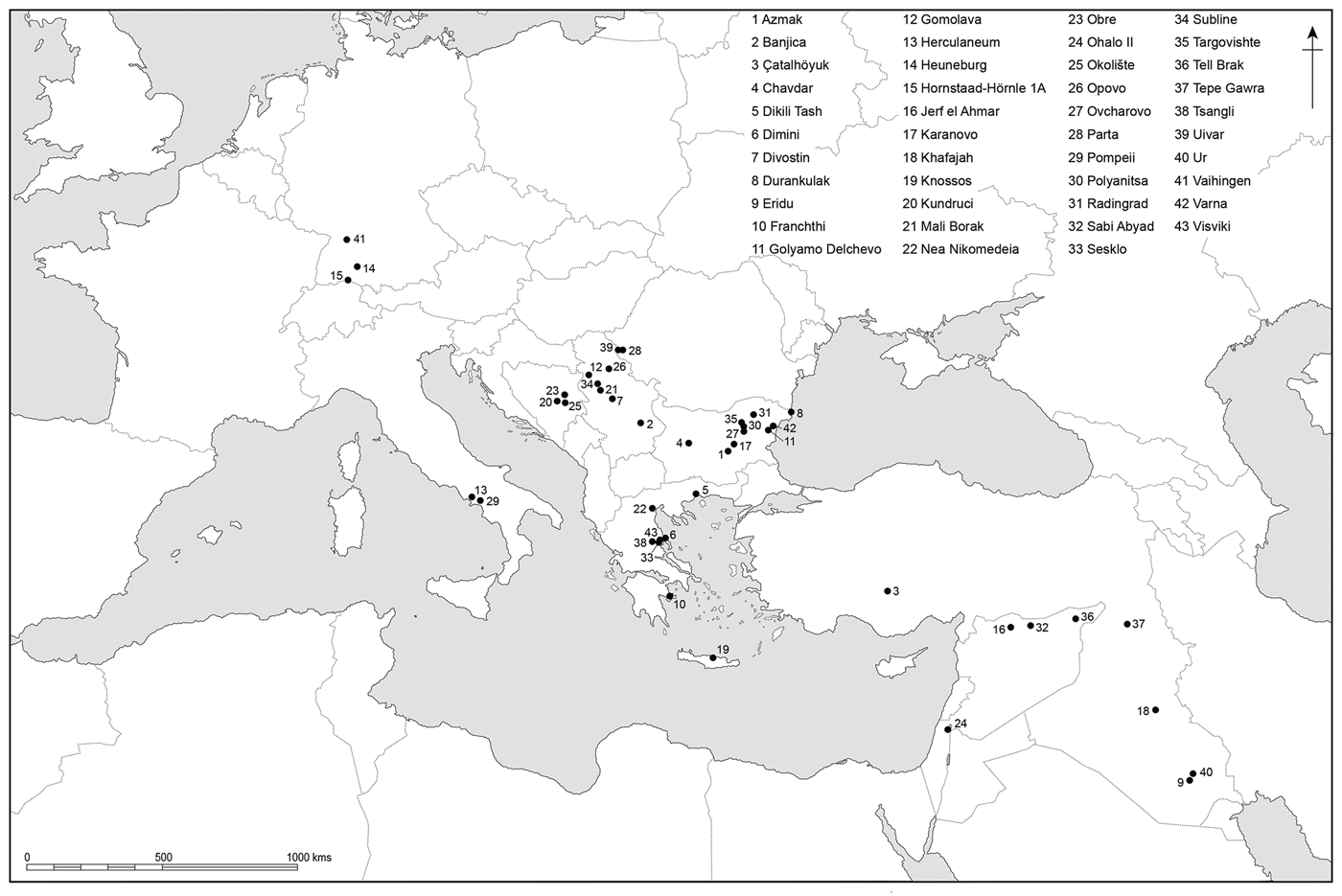
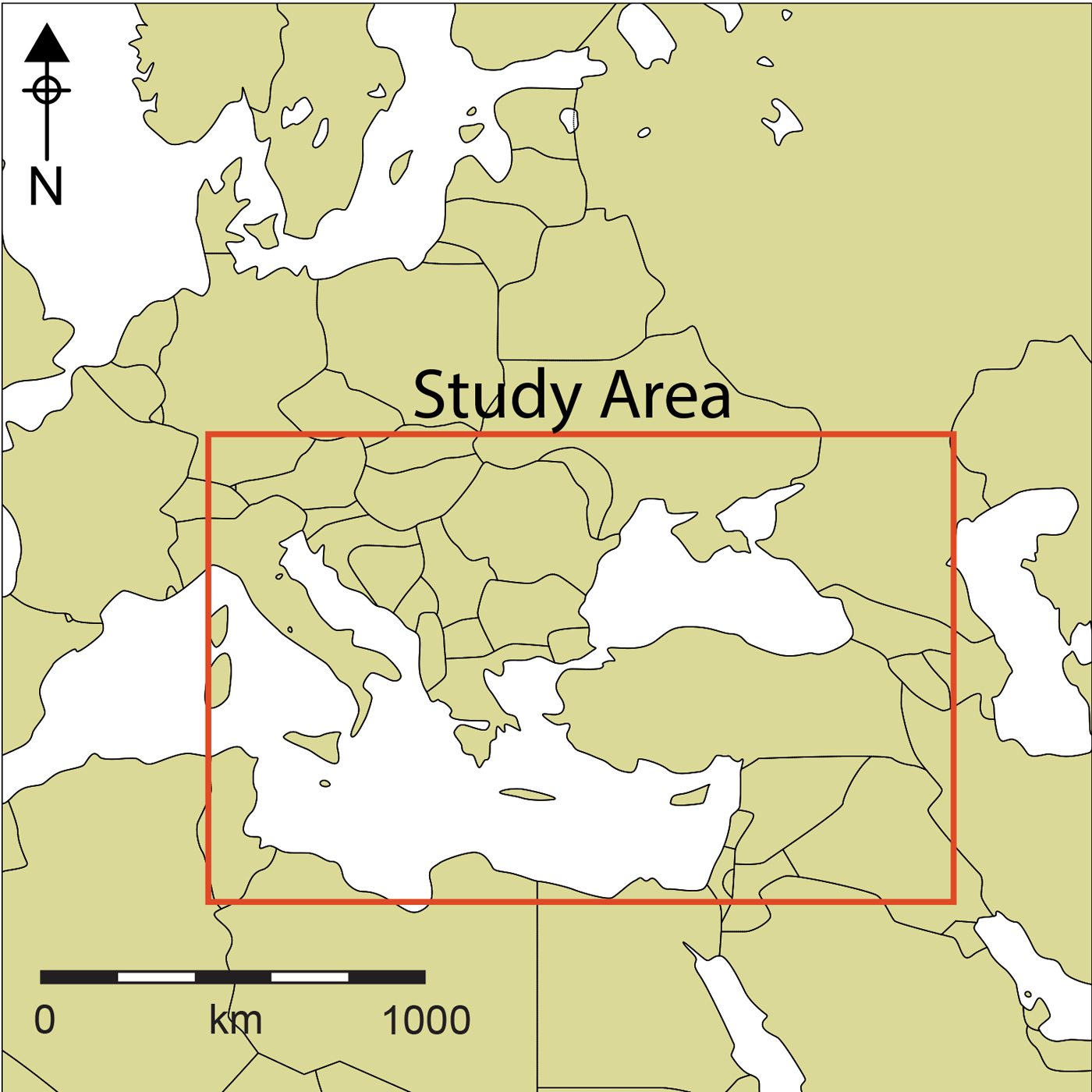
Our dataset builds on recent efforts to quantify wealth inequality in diverse archaeological forager and farming contexts, and exploits a series of archaeological case studies in Western Asia and Europe in which we can also characterise farming regimes in unusual detail, using refined and integrated archaeobotanical techniques for assessing agricultural scale and intensity (Bogaard et al. Reference Bogaard, Hodgson, Nitsch, Jones, Styring, Diffey, Pouncett, Herbig, Charles, Ertuğ, Tugay, Filipovic and Fraser2016, Reference Bogaard, Styring, Ater, Hmimsa, Green, Stroud, Whitlam, Diffey, Nitsch, Charles, Jones and Hodgson2018a & Reference Bogaard, Styring, Whitlam, Fochesato, Bowles, Kohler and Smithb). Figure 1 shows the locations of the relevant sites.
Map showing the archaeological sites included in this study (figure drawn by Alison Wilkins).

Our unit of analysis for assessing wealth distribution is the household: a co-residential group occupying a modular architectural unit with standardised features. While the occupants of multiple units may cooperate as a larger household group, the widespread archaeological observation of modular units with redundant features (e.g. hearths in each house) suggests that these units often acted as the fundamental social agents. Moreover, although wealth may sometimes be shared across households, systematic wealth-sharing takes place within the house, where it is stored (Gudeman & Rivera Reference Gudeman and Rivera1990).
The comparability adjustments underlying our dataset draw upon unusually complete archaeological or ethnographic datasets from diverse cultural contexts. Fochesato et al. (Reference Fochesato, Bogaard and Bowles2019) use various forms of statistical testing to show that these methods are robust and that independent cases provide convergent results.
Labour- and land-limited economies
Farming systems differ in terms of the factors that pose the main limits to production. This difference in limiting factors is key to our argument. We model differences between two ideal types of farming system: system A is labour-limited compared to system B if labour is more valuable relative to land—or other forms of material wealth—in A than in B. This greater relative value is measured by the increase in total output that an additional unit of labour input would allow—its marginal product. In other words, labour is more scarce relative to land in A than in B, where ‘scarcity’ refers to how valuable labour is relative to land (i.e. the relative marginal product of labour is greater than that of land).
The extent to which a production system is labour-limited depends on the goods and services constituting a population's livelihood, the nature of the production processes by which these are acquired and the relative abundance of land, labour and other production factors. Property rights are also important. The possessive and heritable nature of slave labour, for example, makes it economically equivalent to land or other forms of material wealth. Thus, where crops requiring substantial labour input, such as wet rice or cotton, are produced using unfree labour or outright slavery (Scott Reference Scott2009; Beckert Reference Beckert2015), the economy may be material-wealth-limited, rather than (free) labour-limited. Notably, Western Eurasian staple crops, such as wheats and barleys, can be grown under either labour- or land-limited regimes (Bogaard et al. Reference Bogaard, Hodgson, Nitsch, Jones, Styring, Diffey, Pouncett, Herbig, Charles, Ertuğ, Tugay, Filipovic and Fraser2016, Reference Bogaard, Styring, Ater, Hmimsa, Green, Stroud, Whitlam, Diffey, Nitsch, Charles, Jones and Hodgson2018a).
Our hypothesis is that (free) labour-limited farming was associated with modest levels of wealth inequality, while land-limited production was associated with significantly greater levels of wealth inequality. To frame this, we introduce a model that deliberately abstracts from much of the complexity of farming, and allows us to focus on what we regard as the most important aspects for the narrative that we will develop. Halstead's (Reference Halstead2014) recent ethnographic consideration of manual- and plough-based agriculture in Southern Europe represents these differences as a continuum, showing, for example, that ploughing itself did not necessarily involve a radical change in farming practice. This subtlety is crucial to how we assess our hypothesis archaeologically (see below). To clarify the issues involved, however, we first introduce an idealised categorical model with just two types of farming system: labour-limited farming and land-limited farming (the technical details are described in the online supplementary material (OSM)).
In our model, there are four factors of production (inputs): labour, manure, land and animal traction. Land, draught animals and the labour of slaves are forms of material wealth that can be owned, accumulated and inherited. In the model, labour and land inputs are used in both labour- and land-limited farming models, while manure is used only in labour-limited farming, and animal traction only in land-limited farming.
Manure and the labour-limited farming economy
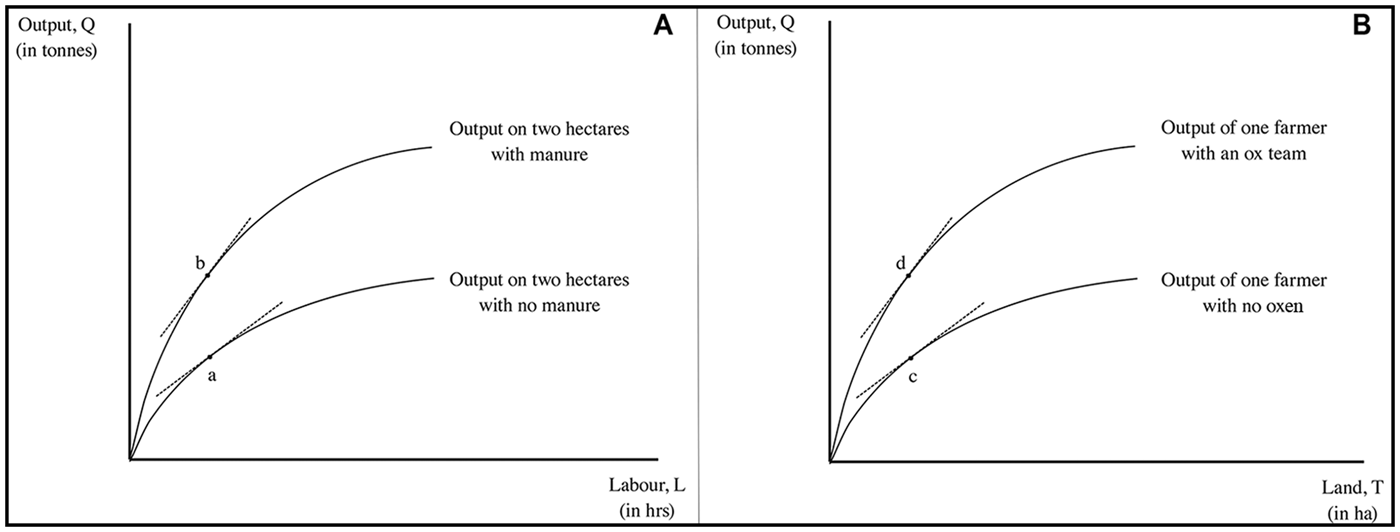
Recent work on the agroecology of early farming in Western Eurasia suggests that manuring could have played a key role (Bogaard et al. Reference Bogaard2013; Styring et al. Reference Styring, Charles, Fantone, Hald, McMahon, Meadow, Nicholls, Patel, Pitre, Smith, Sołtysiak, Stein, Weber, Weiss and Bogaard2017). Manure contributes to what we term the ‘effective supply’ of land, by making each hectare more productive—perhaps by a factor of two or more—depending on soils, intensity of application and other factors (Slicher van Bath Reference Slicher van Bath1963; Station Reference Station1970). This, in turn, raises the marginal product of labour, much as would be the case if the farmer's available land area were doubled (or more) in size. The reason is that a little more labour on 2ha adds more to production than on a 1ha plot. The same is true for a 1ha plot that is manured intensively, compared to the same plot without manuring; the ‘effective quantity’ of land is greater in the former, resulting in greater marginal productivity of labour.
These key ideas are expressed in Figure 2a, where the two curves show the annual output depending on how much labour is applied to cultivation for a farmer with a given amount of land, but under two hypothetical conditions: using or not using manure. The upper curved line represents our model of the Western Eurasian labour-limited economy. The slope of the line is the marginal product of labour, which decreases—the curve becoming flatter—as more labour is applied to the land.
A) The effect of manuring on output with a given amount of land; B) the effect of animal traction on output with a given amount of labour (figure by the authors).

The slope—the marginal product of labour—is greater at point b than at point a, the latter reflecting a hypothetical economy in the absence of manuring. Thus, the application of manure increases the marginal product of labour. Furthermore, as the marginal product of land diminishes with the greater availability of land, it follows that manuring will reduce the marginal product of land as it increases the effective land input. Thus, manuring contributes to the relatively higher value of labour and the lower value of land that is characteristic of the labour-limited economy.
Animal traction and the land-limited farming economy
While manure was an effective land-augmenting input in the Western Eurasian economies under study, animal traction was, in the analogous sense, labour-augmenting. A farmer with an ox team could prepare the same land for cultivation that would have required anywhere from 2–15 hoe-farmers, depending on landscape factors such as soil conditions and topography—but, above all, on the specialised nature (size and maintenance, for example) of the traction animals employed (Halstead Reference Halstead1995). We use the term ‘ox team’ here to refer to those animals specialised for the purpose of field preparation, as opposed to unspecialised animals (e.g. ageing milk cows; Isaakidou Reference Isaakidou, Hadjikoumis, Robinson and Viner-Daniels2011). The introduction of one or more ox teams raised the marginal product of land; the increase in output made possible by access to a little more land was much greater if the farmer also had access to an ox team with which to work it.
Figure 2b illustrates this process, showing annual output depending on the area of land cultivated by a farmer with or without an ox team. The ox team increases both the total output (point d is above point c) and the marginal product of land (the slope is greater at d than at c). Finally, as the use of the ox team is equivalent to an increase in the amount of labour applied to the land, the marginal product of labour will be lower with the ox team. This is why the ox team contributes to the greater value of land relative to the value of labour characteristic of the land-limited economy.
Consequences for wealth inequality
We hypothesise that the emergence of more persistently unequal economies in Western Eurasia took the form of a transition from a labour- (and manure-)intensive system of farming to a land- (and animal traction-)intensive system of farming. Three consequences, which all tend to heighten wealth inequality, follow. First, disparities in land and other forms of material wealth could far exceed the differences in productive human capacities on which economic inequality in labour-limited economies was necessarily based. Abrupt reversals, or ‘shocks’, in the ownership of material wealth, due to theft, the vagaries of weather or disease, also exceed the equivalent shocks to the human capacities of surviving members of a population. Second, in the case of material wealth, these inequalities, including the results of shocks, are transmitted from one generation to the next to a far greater extent than is the case for human capacities, social connections or other determinants of the value of a person's labour (Borgerhoff-Mulder et al. Reference Borgerhoff-Mulder2009). A result is that wealth inequalities in any generation are the cumulative result of shocks over many previous generations.
The third consequence of the greater importance of material wealth is indirect, operating via the cultural and institutional environments that are typically associated with a land-limited economy. In some regions, a long-term trend towards increasingly autonomous households suggests the diminished importance of collective forms of co-insurance and risk pooling (Flannery Reference Flannery2002). The fact that livestock, for example, are both valuable and long-lived provides a form of savings, allowing an extended family practising large-scale herding to buffer shocks and therefore to supplement other resources over time (Hoddinott Reference Hoddinott2006). The increasing feasibility of wealth storage by individual households may have led the more successful families to withdraw from community-based sharing institutions, resulting in heightened wealth inequalities in farming systems that became land-limited.
Inequality in labour- and land-limited farming economies
The diversity of farming systems
It is possible to distinguish empirically between relatively labour-limited and land-limited farming systems in Western Eurasia using evidence for both animal traction and crop-growing conditions, the latter based on direct archaeological evidence of preserved remains of crops and their associated arable weed flora. Recent methodological work has combined functional ecological analysis of weed flora with stable carbon and nitrogen isotope analysis of crops to build a robust assessment of cultivation intensity (Bogaard et al. Reference Bogaard, Hodgson, Nitsch, Jones, Styring, Diffey, Pouncett, Herbig, Charles, Ertuğ, Tugay, Filipovic and Fraser2016, Reference Bogaard, Styring, Ater, Hmimsa, Green, Stroud, Whitlam, Diffey, Nitsch, Charles, Jones and Hodgson2018a). Where possible, we use these results to distinguish between the labour- and land-limited farming cases in our dataset (see Fochesato et al. Reference Fochesato, Bogaard and Bowles2019: OSM_Dataset). In the case of Durankulak (Todorova Reference Todorova2002), we interpret its economy as land-limited, not based on its agroecology but rather on evidence for large-scale salt production along the Black Sea coast, the epitome of a clumped resource (Krauß Reference Krauß2008; Nikolov Reference Nikolov, Alexianu, Weller and Curcă2011, Reference Nikolov, Nikolov and Bacvarov2012; Ivanova Reference Ivanova2012).
The mere potential for animal traction, evidenced by use of animal draught at the relevant site or in the wider region, does not classify a case as land-limited if crop-growing conditions appear to have been labour-intensively maintained (sustained high soil fertility and mechanical disturbance; Bogaard Reference Bogaard, Hadjikoumis, Robinson and Viner-Daniels2011). Where this detailed archaeobotanical diagnosis is not available for an individual site, we turn to regional data from similar sites or to available documentary sources, such as southern Mesopotamian texts (e.g. Postgate Reference Postgate1992).
Extensive irrigation works and terracing are also evidence that an economy is land-limited. The fact that farmers in southern Mesopotamia devoted substantial amounts of labour to the improvement and expansion of available land suggests that land was relatively valuable compared to labour. The case of late medieval Egypt demonstrates this relationship between relative labour abundance and irrigation. Complex irrigation systems required substantial amounts of labour to increase and maintain the amount of production and cultivatable land. After the demographic shock of the Black Death in 1348, the drastic population decline inverted the relative values of labour and land. As the cost of labour increased, irrigation systems rapidly decayed (Borsch Reference Borsch2005). Thus, along with the archaeobotanical evidence, extensive irrigation works or terracing offer evidence of land-limited production systems.
In many agricultural systems, land- and labour-intensive farming were, in fact, part of an agroecological continuum. Halstead's (Reference Halstead2014: 60, 119 & 319) analysis of Aegean Bronze Age farming, for example, contrasts ‘palatial’ strategies—the deployment of specialised plough oxen to produce a narrow range of cereals, as documented in Mycenaean Linear B texts—with more diverse, labour-intensive smallholder farming evidenced in the archaeobotanical record. Such a system was fundamentally land-limited in nature, as elite maintenance of specialised plough animals raised the value of land relative to labour.
Wealth inequalities in two farming systems
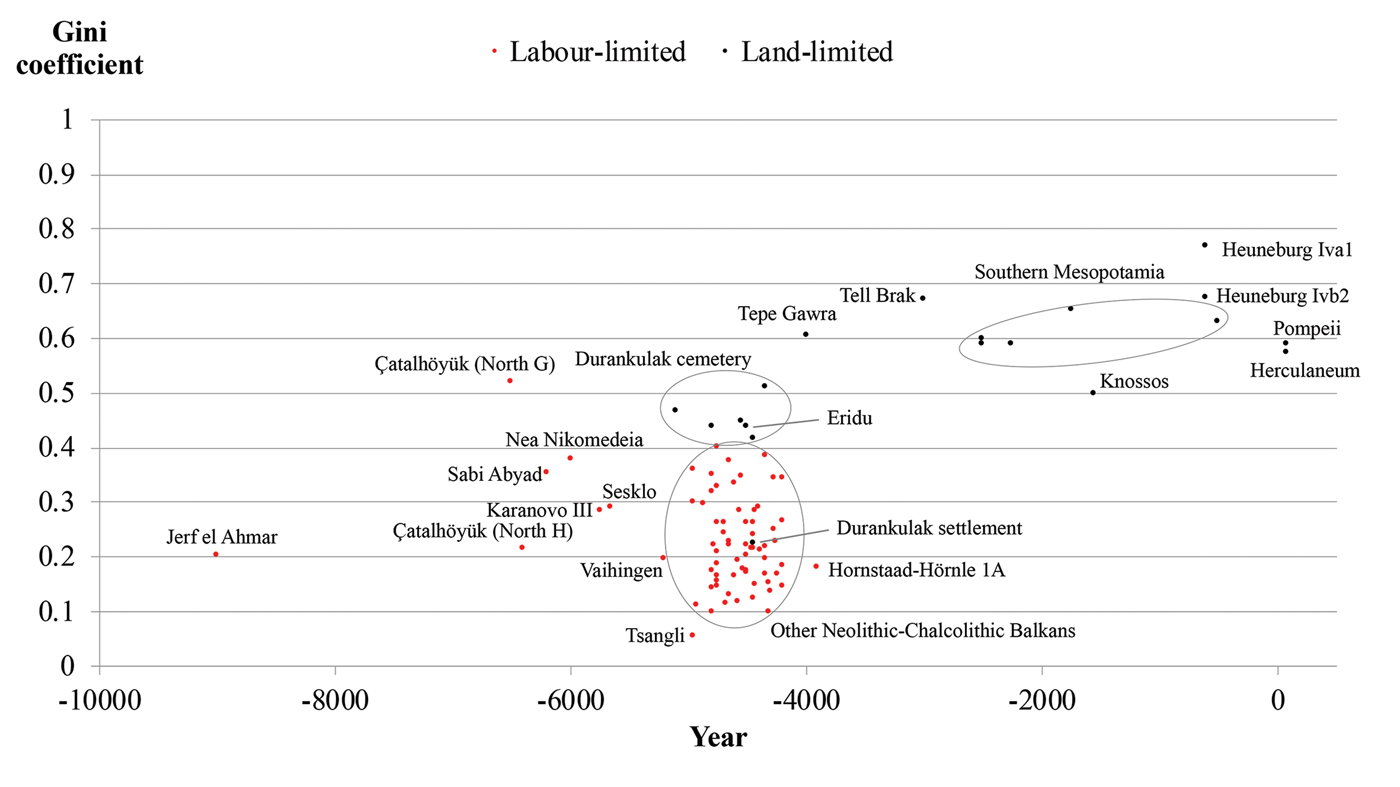
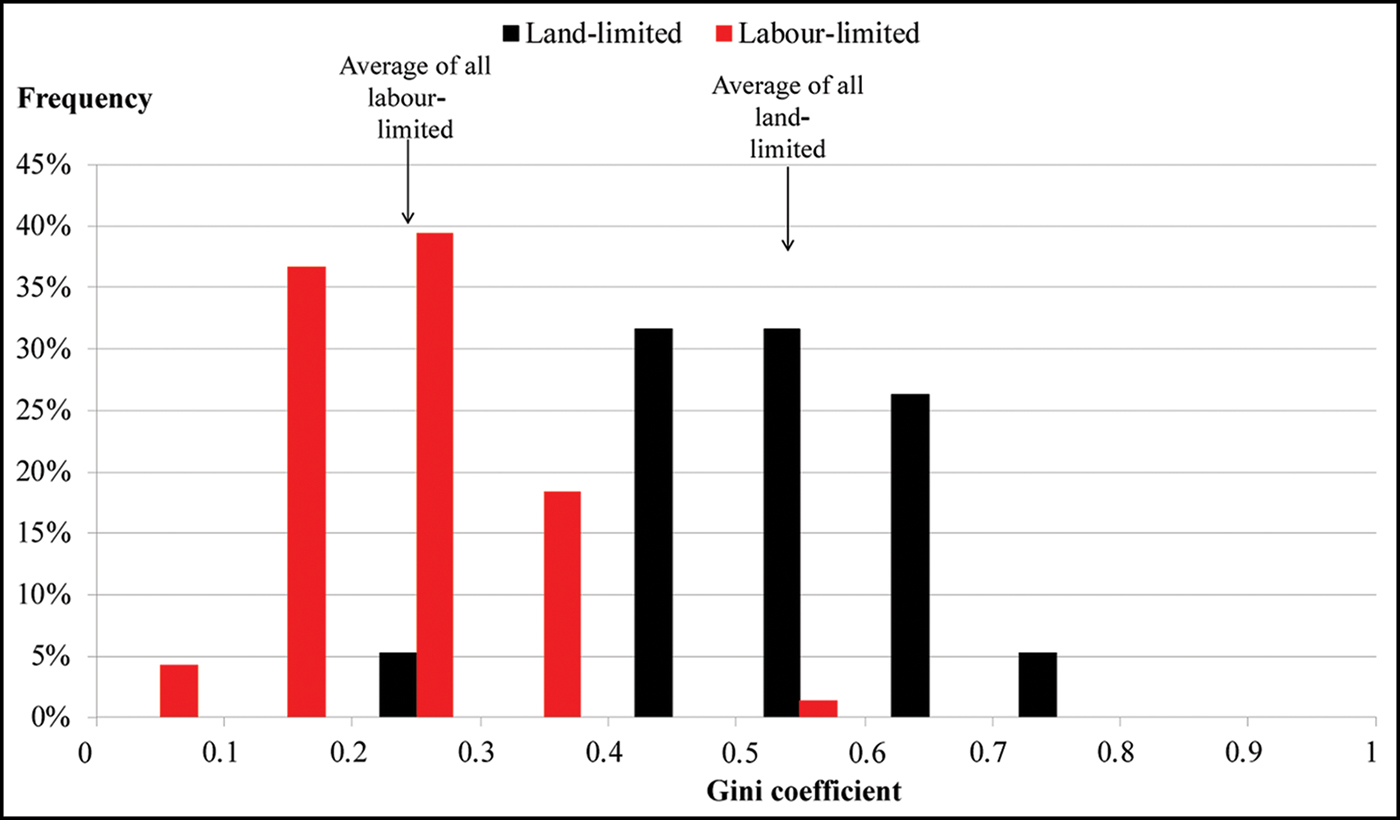
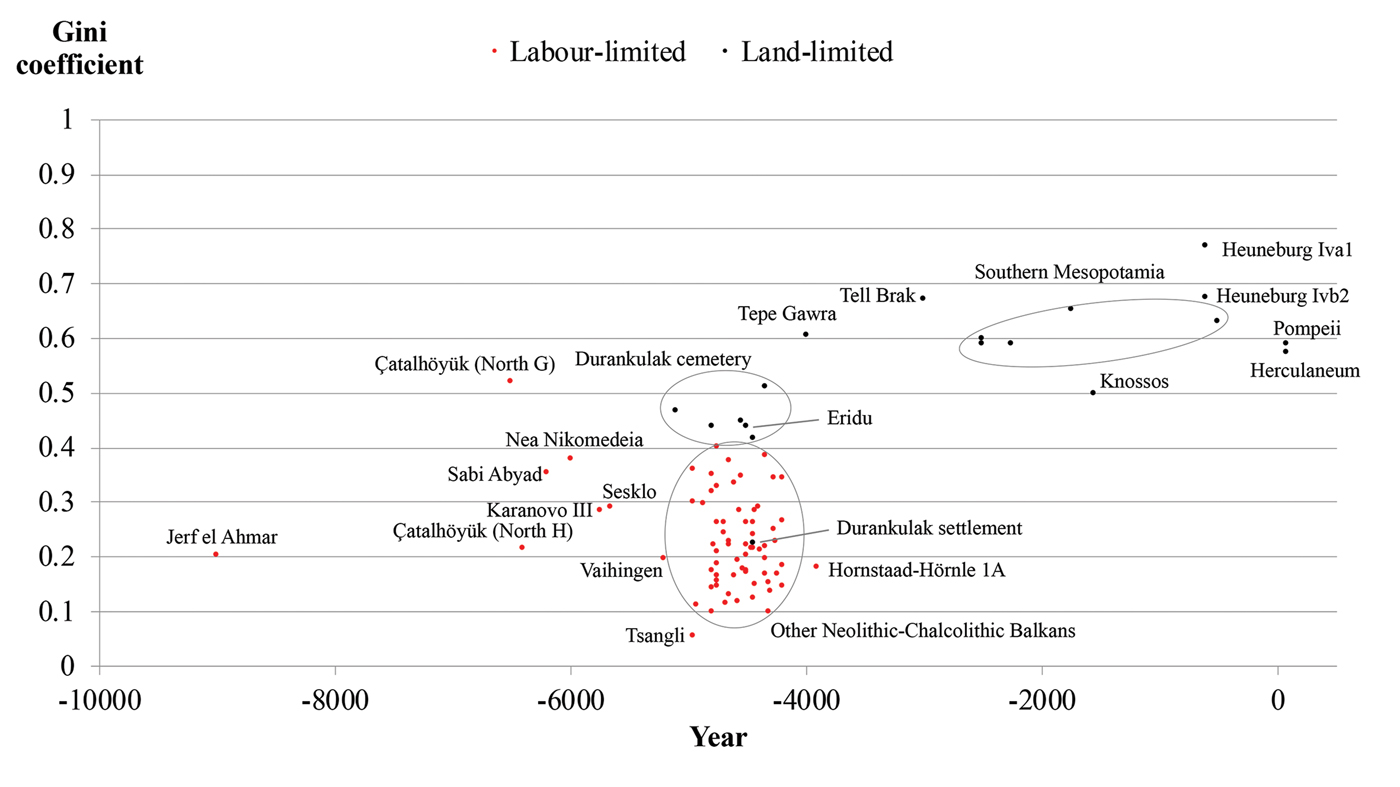
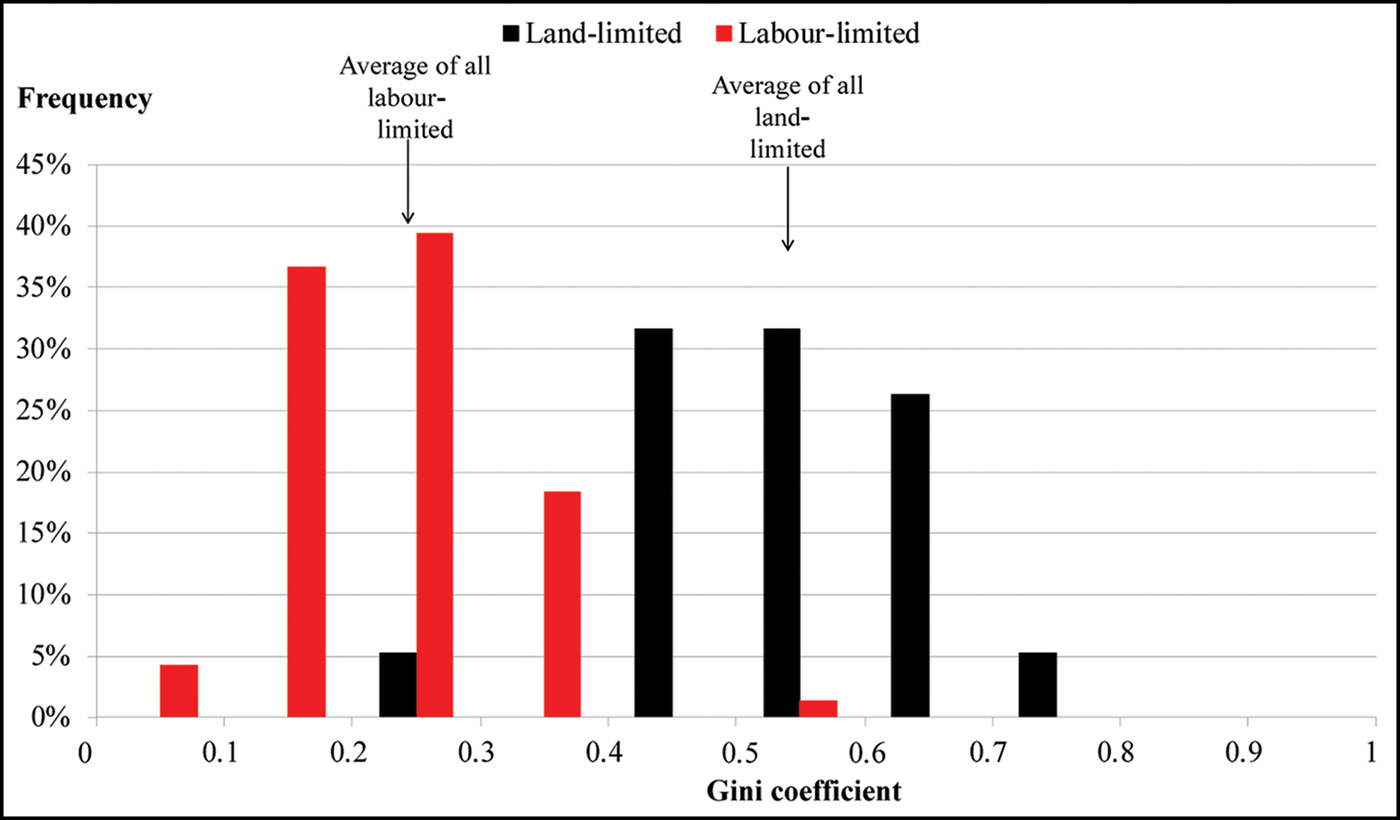
Figure 3 shows the estimated Gini coefficients and the designation of each case as labour- or material-wealth-limited. Figure 4 shows the frequency distribution of Gini coefficients for the two farming systems. The difference between the two distributions is substantial and very unlikely to have arisen by chance. This is also true using the raw (unadjusted) Gini coefficients, when controlling for an exponential (imprecisely estimated) positive time trend, or restricting attention to a 1300-year period, when both of the systems are well represented in the dataset (for all four of these comparisons, p<0.0001—see the OSM).
Wealth inequality in labour-limited and land-limited economies. Estimated Gini coefficients are adjusted for comparability (Fochesato et al. Reference Fochesato, Bogaard and Bowles2019). Date estimates represent the midpoint of the time intervals provided in the original sources (figure by the authors).
The frequency distribution of the Gini coefficients for labour- and land-limited economies. The estimated difference in the means of the two farming systems is 0.316, with a 95 per cent confidence interval of 0.256–0.376 (figure by the authors).
The transformation of an egalitarian labour-limited farming economy
Figure 3 shows that most of the earlier observations are labour-limited, while most of the later ones are land-limited, with substantial overlap between the two systems around the fourth millennium BC. Furthermore, some regional populations made a transition from the former to the latter. Our model and data provide an account of how this could have occurred.
Consider a population engaged in labour-limited farming—similar to point b in Figure 2a. How could a transition to a land-limited system illustrated by point d in Figure 2b occur? We base the answer on two facts. First, by definition, in labour-limited economies, labour is relatively valuable compared to land. Second, wealth disparities, while modest, are far from absent in the labour-limited populations. Even at ‘aggressively egalitarian’ Çatalhöyük (Hodder Reference Hodder2014), by our estimates the wealthiest two households had three times the average wealth than in Level North G. During the Neolithic, these disparities grew significantly in some labour-limited economies. While the evidence is necessarily indirect, it seems probable that over this period, the domain of private household property—the legitimate and effective right to exclude others from the use of the objects one owns—tended to expand (Halstead Reference Halstead2006).
Given this institutional setting and pre-existing wealth inequality in a labour-limited system, there must have been many populations in which some households had access to both the resources for maintaining plough oxen and additional land for expansion (Halstead Reference Halstead1995). If one of the wealthier individuals in the labour-limited economy were to consider acquiring an ox team for their exclusive use, and farming a larger area of land with less intensive labour input, which calculation would enable an assessment of the probable advantages to the household of making this change?
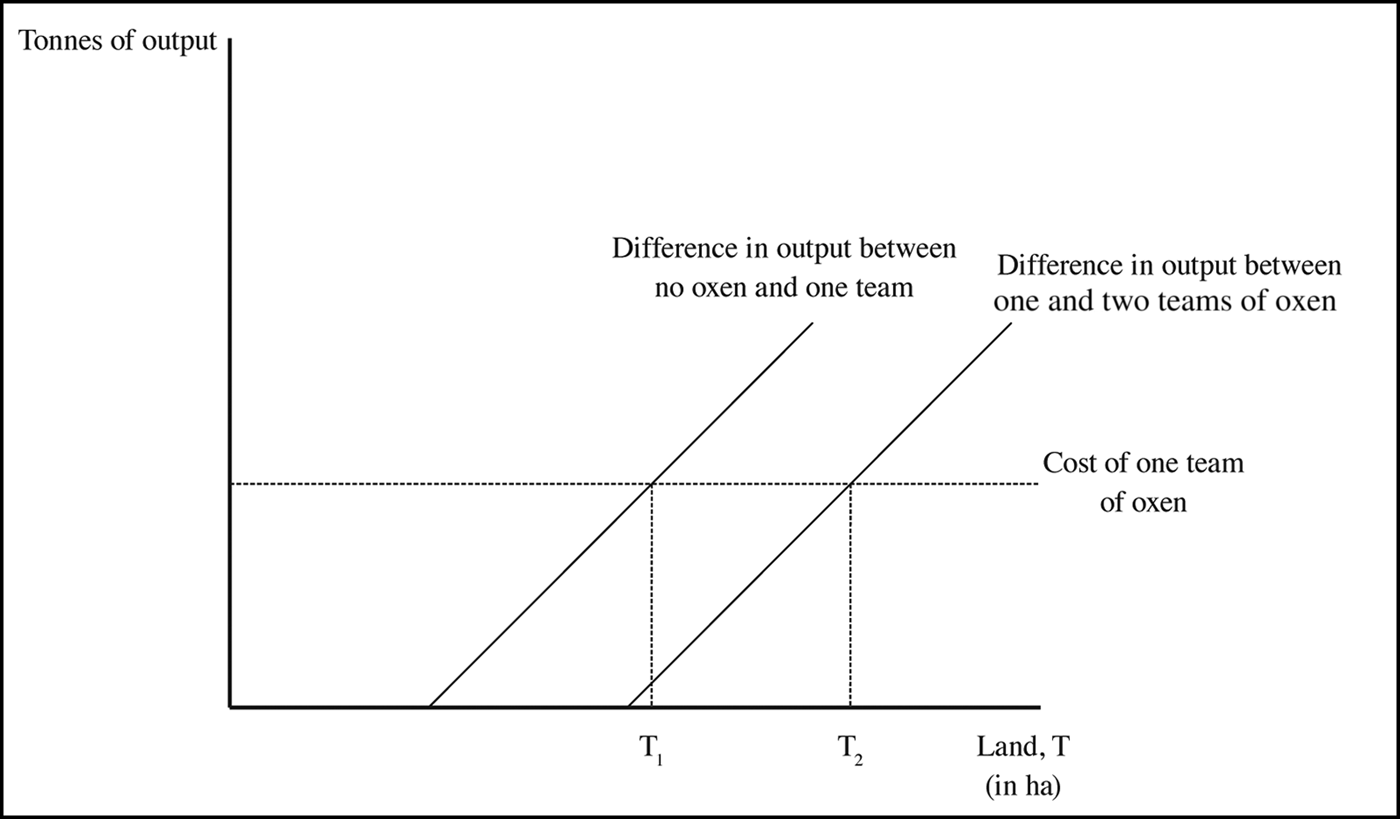
The rising solid line on the left in Figure 5 shows the addition to output made possible by having a team of oxen (with the labour inputs unchanged); this team, however, adds nothing where there is little available land to farm. The contribution of the ox team increases for larger plots, and, as a result, the more land there is available to farm, the more valuable the team of oxen (i.e. the amount of land and the ox team are complements) (Clark & Haswell Reference Clark and Haswell1964).
Conditions under which a formerly labour-limited farmer would take up land-limited farming (figure by the authors).

The dashed horizontal line represents the annual cost of acquiring and maintaining one ox team. For an individual who has, or can acquire, more than T1 units of land, the cost is less than what the team will add to production. That farmer will find it advantageous to maintain one team of oxen. A person with T2 units of land will acquire a second team.
With oxen, the wealthy farmer will seek to acquire more land, as land will now be more valuable to the land-limited farmer-in-the-making than to the other farmers in his community. Moreover, acquiring additional land will be feasible; there will be some mutually beneficial, voluntary transfer of land from the garden farmer to the would-be land-intensive farmer. This is a process of wealth accumulation (i.e. land and oxen) with positive feedbacks, possibly leading to elevated levels of wealth concentration. Rights to farm larger amounts of land may also have been acquired coercively.
The person ‘selling’ or giving up the land might become the tenant or employee of the land-and-ox owner, or part of a growing pool of labour available seasonally at harvest, during the peak labour demand of the extensive farming model. If, in the new economy, other wealthy farmers emulated the oxen-and-land farmer, the value of land would eventually rise, as shown by the steeper slope top curve in Figure 2b. As a result, available land would now be scarce and labour would be abundant.
This situation would create fertile ground for the emergence of sustained inequalities. Bogucki (Reference Bogucki1999: 230) conjectured that “with time, the number of cattle-poor households increased in number, while the number of cattle-rich households forms a progressively smaller proportion of the population”. The population could develop a class structure: some owning a considerable amount of land and one or more teams of oxen, and others working for them under some kind of subordinate relationship as renters, sharecroppers, clients, employees or unfree labour. This narrative, of course, is conjectural, but is consistent with ethnographies of small-scale farmers in the recent past who worked with oxen (Halstead Reference Halstead2014).
Given the limited bargaining power of these newly dependent classes in a labour-abundant economy, it seems unlikely that their consumption levels would have increased proportionately with the increase in average labour productivity—that is, output per worker—made possible by the introduction of animal traction. As a result, the cultivation of larger areas per worker would have provided a surplus capable of supporting a divergence of living standards among the owning class and the rest of the population. Large extended households with complex multi-faceted economies, including animal-traction-based farming, are plausible precursors of temple- and palace-based landholding institutions (Pollock Reference Pollock1999; Ur Reference Ur2014).
The transition to a land-limited economy may therefore have been a step along the way not only to sustained wealth inequalities, but also to the emergence of permanent political inequalities formalised in new structures of governance. This narrative is consistent with the association of cattle traction with social prestige, which emerged around the mid fourth millennium BC in Western Eurasia—the horizon highlighted by Sherratt (Reference Sherratt, Hodder, Isaac and Hammond1981, Reference Sherratt, Pétrequin, Arbogast, Pétrequin, van Willigen and Bailly2006) in his Secondary Products Revolution model. Although we now know that traction per se long pre-dated this horizon (Isaakidou Reference Isaakidou, Serjeantson and Field2006; Helmer & Gourichon Reference Helmer, Gourichon, Vila, Gourichon, Choyke and Buitenhuis2008; Antolín et al. Reference Antolín, Buxó, Jacomet, Navarrete and Saña2014; Gaastra et al. Reference Gaastra, Greenfield and Linden2018), this was the timeframe within which specialised ploughing animals began to be exploited as part of the emerging extensive land-limited farming systems that fed the expanding cities of Mesopotamia (Styring et al. Reference Styring, Charles, Fantone, Hald, McMahon, Meadow, Nicholls, Patel, Pitre, Smith, Sołtysiak, Stein, Weber, Weiss and Bogaard2017). Sherratt's insight was to suggest that Near Eastern urbanisation demonstrated the amplifying effects of cattle traction on production, and prompted a wave of new prestigious and even ritual associations with paired cattle draught across Europe (Hadjikoumis et al. Reference Hadjikoumis, Robinson and Viner-Daniels2011).
Discussion
The evidence of farming techniques and wealth inequality presented here is consistent with the hypothesis that a sustained increase in wealth inequality in late prehistoric Western Eurasia was associated with a transition from labour- to land-limited farming. These new, more unequal economies were characterised by a substantial value of land or other material wealth (including slave labour) that could be accumulated and transmitted across generations. Our analysis also provides one possible process for how a labour-limited farming economy with modest inequality could be transformed into a land-limited system of elevated inequality. This economically driven narrative of the emergence of sustained and substantial inequality does not preclude complementary or competing accounts, in which heightened power differentiation among households and other political developments play a more important or even initiating role.
Our model may also help to illuminate the farming-inequality nexus elsewhere (Kohler et al. Reference Kohler2017; Fochesato et al. Reference Fochesato, Bogaard and Bowles2019). Even where animal traction was absent—as in the Western hemisphere, or in East Asia prior to the second millennium BC (Larson & Fuller Reference Larson and Fuller2014)—substantial levels of inequality may similarly have arisen due to material wealth-limited agricultural production; for example, where the physical supply of land relative to population—and hence labour—was restricted (Moseley & Day Reference Moseley and Day1982), or where slavery made human labour the equivalent of a material form of wealth that could be accumulated and transmitted across generations.
Acknowledgements
We wish to thank Paul Halstead, Rick Schulting, Todd Whitelaw, Chiaki Moriguchi, seminar participants at the Hitotsubashi University Institute of Economic Research, participants of the Oxford short course on long-term inequality, and two anonymous reviewers for insightful comments. We are also grateful to the Dynamics of Wealth Inequality Project, Santa Fe Institute, for support and hospitality.
Supplementary material
To view supplementary material for this article, please visit https://doi.org/10.15184/aqy.2019.105