Stenosis of the Inferior Caval Vein is rarely encountered in the paediatric setting. Stenosis secondary to injury is even more rare in this population and most reported case describe inferior caval vein stenosis discovered in the postoperative period either after congenital heart surgery or liver transplant.Reference Lee, Villavicencio and Kim2–Reference Averin, Bucuvalas and Alonso6 In the Adult a literature, inferior caval vein injury, although rare, is more commonly reported and is typically secondary to penetrating injury requiring surgical management with a high mortality.Reference Okyere, Yorke, Agbeko, Forson and Bonney10 We report a rare case of a 5-year-old male with severe inferior caval vein stenosis secondary to a fall injury successfully treated with transcatheter stent implantation.
Case description
A 5-year-old male sustained severe injuries secondary to a fall from a three story balcony. He was initially pulseless and unresponsive and cardiopulmonary resuscitation was administered by a bystander with spontaneous return of circulation. Upon arrival to the trauma centre, he had spontaneous agonal breathing with hypotension and tachycardia that improved with routine resuscitation resulting in adequate perfusion. He was noted to have several severe injuries including a closed head injury, facial fractures and lacerations, bilateral upper extremity fractures, blunt chest trauma, a pelvic injury, abdominal injuries, and right femur fracture.
He underwent multiple procedures including placement of an extra ventricular drain and intracranial pressure monitor, reconstructive facial surgery, upper and lower extremity orthopedic surgeries, and splenectomy. Exploratory laparotomy demonstrated a severe liver laceration and left kidney laceration with haematoma.
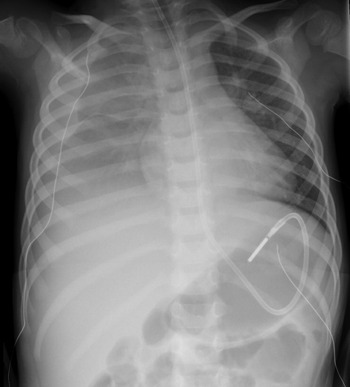
Over the course of his postoperative hospitalisation, he developed extensive lymphatic drainage with chylothorax, chyloperitoneum, and severe abdominal ascitesReference Wang, Liao, Huang and Yeh7–Reference Tieu, Paes, Ahmed, Matino, Chan and Bhatt9 (Fig 1 Chest X-ray). He was initiated on a chylous effusion protocol including pausing all enteral intake, diuretics, and treatment with octreotide and required placement of bilateral chest tubes and an abdominal drain considering his persistent high volume output. Fluid output was replaced with fresh frozen plasma and albumin as needed. Considering persistent high volume chylous output he underwent exploratory right thoracoscopy and right thoracotomy with pleurectomy and subsequently laparotomy with lysis of adhesions and finding of peripancreatic chyle leak. Despite these interventions he continued to have high volume chylous output and severe abdominal swelling and ascites.
Chest Xray demonstrating extensive chylothorax, chyloperitoneum, and severe abdominal ascites.

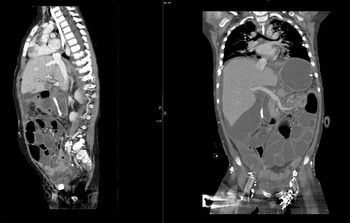
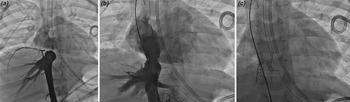
About 2 months following his initial injury, he was noted to have progressively worsening venous congestion with prominent superficial veins appearing over his abdomen and chest.Reference McAree, O’Donnell, Boyd, Spence, Lee and Soong11 Noninvasive imaging including abdominal ultrasonography was initially unremarkable however a follow-up chest computed tomography angiogram demonstrated severe stenosis of his inferior caval vein at the right atrial junction (Fig 2).Reference Kosaka, Eguchi and Hidaka8,Reference Tieu, Paes, Ahmed, Matino, Chan and Bhatt9 The aetiology of the stenosis was thought to be the initial severe abdominal trauma. Considering this finding he was taken to the cardiac catheterisation laboratory. Intubated, and under general anesthesia, femoral arterial and venous access was obtained. Standard biplane angiography was performed in the inferior caval vein demonstrating severe stenosis at the right atrial junction with minimal patency (Fig 3a). The inferior caval vein was noted to be dilated just inferior to the stenosis with a diameter of about 14 mm compared to 10 mm in the more inferior abdomen. The mean inferior caval vein pressure was noted to be elevated to 16 mmHg compared to a mean right atrial pressure of 6 mmHg. There was noted to be collateral venous drainage via the azygos system. Utilising a 10 French 80 cm Flexor sheath (Cook Medical. Bloomington, Indiana, USA) over a 0.035 Ampltaz super stiff wire (Boston Scientific. Marlborough, Massachusetts, USA), a 26 mm EV3 LD Max open cell stent (Medtronic. Dublin, Ireland) mounted on a 14 × 3.5 mm B. Braun Balloon-in-Balloon catheter (B. Braun Medical Inc. Bethlehem, Pennsylvania, USA) was advanced to the level of the inferior caval vein stenosis.Reference Bi, Chen and Ding1 The stent was deployed completely relieving the stenosis with follow-up angiography demonstrating significant angiographic improvement with no evidence of contrast extravasation or stent embolisation (Fig 3b, c).Reference Huber, Hammer and Loss12 There was no residual pressure gradient from the inferior caval vein to the right atrium. The procedure was uncomplicated.
Chest CT angiogram demonstrating severe stenosis of the inferior caval vein at the right atrial junction.

(a) Angiogram demonstrating severe IVC stenosis at the right atrial junction. (b) Angiogram demonstrating relief of stenosis following stent placement with significant improvement of flow and no evidence of contrast extravasation. (c) 26 mm EV3 LD Max open cell stent placed at the level of the IVC stenosis dilated to 14 mm in diameter.

Shortly following stent placement, he had complete resolution of chylous effusions allowing for removal of his chest tubes within 4 days of the procedure. He had significant clinical improvement allowing for transfer to a rehabilitation centre and eventual discharge home. A follow-up echocardiogram was obtained 3 months following stent placement and demonstrates laminar flow across the inferior caval vein stent with no residual obstruction.
Discussion
This report describes successful treatment of severe posttraumatic inferior caval vein stenosis with transcatheter stent implantation in a young child that had sustained severe abdominal injury due to a fall from a three story balcony. In the paediatric population, inferior caval vein stenosis is very rare and more typically encountered following cardiothoracic or abdominal surgeries such as heart or liver transplant.Reference Lee, Villavicencio and Kim2–Reference Averin, Bucuvalas and Alonso6 Our patient developed severe inferior caval vein stenosis following severe abdominal trauma leading to significantly impaired lymphatic drainage and very difficult to manage chylothorax and chyloperitoneum that resolved completely following stent placement. Although off label, bare metal open cell stents, such as the 26 mm EV3 LD Max stent, are commonly use in the field of interventional paediatric cardiology to address congenital and acquired stenosis such as aortic coarctations and branch pulmonary artery stenosis.Reference Kang, Yang and Lee13 The radial strength of the stents typically allow for complete resolution of the obstruction and the open cell design allows for jailing of adjoining vessels without compromising blood flow. In our case, stent implantation resulted in complete resolution of the inferior caval vein stenosis and despite partial jailing of adjoining hepatic veins there was no evidence impaired drainage of the hepatic veins. The nature of the stents also allows for further balloon dilation to expected adult blood vessel diameter in the future should this be necessary to account for somatic growth.
Conclusion
Severe stenosis of the inferior caval vein in the paediatric population is very rare. We present an example of severe posttraumatic inferior caval vein stenosis successfully treated with transcatheter stent placement.
Acknowledgements
None.
Financial support
This research received no specific grant from any funding agency, commercial or not-for-profit sectors.
Conflict of interest
None.