Early Egyptian monasticism is frequently equated with fantastic stories and achievements of the great Desert Fathers. Nathaniel, for example, never left his cell for thirty-seven years, and Dorotheus remained within his cell for sixty years. Both men were demonstrating their commitment to God, their willingness to embrace suffering, and their need to discipline themselves within the confines of the cell.Footnote 1 The tales of mighty battles with demons—most vivid in the Life of Antony—and of austere asceticism—such as that of the young Zacharius who allowed his beautiful skin to be eaten away by natron in order to dispel rumors that he was sexually involved with his father—have become components of the metanarrative of Egyptian monasticism.Footnote 2 Concerns about desire and sexual propriety also indicate that monastic communities were aware of the difficulties of celibacy in such close and intimate quarters.Footnote 3
One place repeatedly recognized as essential for spiritual living was the monastic cell. A story told by John Moschos in the sixth century text, Spiritual Meadow, recalls how a condemned man rebuked a monk for living outside of his cell. The monk thought watching the execution of another human might shock his apathetic heart. The convict asked the monk, “Well now, Abba, have you no cell, sir, nor any work to occupy your hands?” The monk replied that he had both. The convict rebuked the monk, saying, “Go your way, Abba; remain in your cell, sir, and give thanks to God who saved us.”Footnote 4
A story about Nathaniel, who initially failed in his pursuit to remain within the cell, illustrates the importance of the cell for spiritual training and for reflection upon one's spiritual and mental discipline. After his first attempt, Nathaniel built a cell closer to the city and resided there a few months. Then a demon visited him and confessed his victory over him, as he was the cause for the monk's abandonment of the cell. With this admission, Nathaniel vowed to return to his previous residence and embrace a stronger self-discipline.
To spite the demon, as Palladius writes, Nathaniel refused to cross the threshold of his residence for thirty-seven years. Palladius also notes that, according to his guides, Nathaniel was peculiar because of his very long interment in the cell. As a testament to his convictions, Nathaniel refused to go outside his cell even to help a boy who had fallen. Nathaniel suspected that the demon could take on the guise of a human and had tempted him to come out. The monk trusted his instincts and prayed that if the boy was in need then God would protect him through the night. His wisdom was evinced; the next moment the boy transformed, and the demon dissolved into a “storm and into wild asses galloping off and kicking up stones.”Footnote 5
Stories of confinement to the cell and of debasement of other settlements (such as the late antique urban environment and other communities that did not embrace the same angelic life) demonstrate that ordinary spaces were not suitable for monastic living. The closeting or self-immuring within monastic space is significant to understanding that place and space were important for spiritual progress and connectivity with God.
The story of the monk and the convict exhibits the locative value of the cell with desert asceticism within the earliest monastic literature. Like Abba Moses, who told a monk that his cell would teach him all things, the convict reminded the monk that he should remain in his cell no matter what the temptation.Footnote 6 The admonition to pledge one's body within the confines of the monastic cell, regardless of one's personal feelings, was one of the more common correctives for a distracted mind. The importance of a monastic cell for spiritual living is central to understanding the technique for requiring relocation—whether to an enclosed wall community or to a more loosely affiliated place, or topos, among a collection of individual residences.
The literary study that follows takes into account some of the existing archaeological evidence of Egyptian monastic material remains; however, a caveat is needed here to contextualize the importance of the artifactual evidence for my discussion of the monastic literature. The identification of what constitutes a monastic residence is currently a subject for analysis and debate within late antique archaeology in Egypt.Footnote 7 The great diversity in form and structure of the extant archaeological material supports an interpretation that monastic space held spiritual significance as dwellings because they were the abodes for monks.Footnote 8 Ascription of crosses and Coptic prayers indicates that a common set of physical markers was used to equip a space for spiritual living. Yet little evidence suggests one space was used by itinerant monks for longer periods of retreat, such as during a period of extended fasting. By attributing sanctity to monastic spaces, as opposed to non-monastic spaces, the place where monks lived was not just a monastery or a cell; rather, these places were sacred spaces. For both occupants and external observers, monastic space was regarded as a gateway to heaven, to God's angelic kingdom.Footnote 9
The spatial importance of the cell in the early centuries of Egyptian monasticism evolves into the essential location for seeking God, particularly in communities that were composed of monks who elected to live in smaller groupings with a servant or disciple. The literary sources for the fourth and fifth centuries in Egypt attest to a development in thought in which the cell first became the place of spiritual engagement. Within a military ethos, the monks were armed to battle the mysterious demons that had laid claim to the forgotten landscapes of Egypt. A generation later, the cell evolved into the area to fight personal demons of distraction and depression. The dwelling facilitates true monastic work: the cultivation of a self aligned with God and fellow monastics.
The Egyptian monastics, like other late antique holy men and women, used techniques to voluntarily embrace new behaviors and beliefs within an explicitly religious landscape.Footnote 10 The cell assisted the monk in becoming the holy stranger who used the geography of asceticism for greater dissociation from the non-monastic world.Footnote 11 The longer he resided within, the more the cell became a panoptic residence, initially monitored by an elder ascetic philosopher, as we will see with St. Antony.Footnote 12 The spatial configuration of the cell and its value for the religious life of the monk illustrate the need for a spatial turn in the re-reading of early Egyptian monastic literature.Footnote 13
I. Narrating Monastic Geography
I maintain that all of the monastic sources under consideration here speak to three central topics of spatial discourse and the locative value of the cell. The first theme is the cognition of the cell as a realm for teaching and training in the monastic life. In particular, monks learned to regard the built structures of cells, dwellings, and sleeping areas as the unique residence of those committed to a life dedicated to God. Egyptian monastic literature demonstrates that the physicality of space had spiritual significance for monks, especially in their pursuit of union with God. Within these spaces the monks adopted a particular set of exercises, their praxis, for retraining their hearts and minds.
The belief that a lived space, such as the cell, had the ability to shape the monastic individual and his community as a whole is an illustration of Pierre Bourdieu's habitus.Footnote 14 For Bourdieu there is a system of dispositions, or attitudes and behaviors, which create memories within a social space.Footnote 15 The cell provided the central location in which the monastic habitus was created and recreated.Footnote 16 As Bourdieu explains more explicitly, habitus may be changed and modified by lived history and experience.Footnote 17 Monastic adherence to and acceptance of the cell's importance was essential for making progress. The longer one remained within, the greater the cell's locative value. The collective memory was thereby defined by specific behaviors—while inside the cell, a monk weaved baskets, braided rope, recited prayers, and offered hospitality. The cell was equally a social space where one honored guests and managed challenges to one's solitude and routine. Thereby, the cell and its presence within a larger community helped to define the monastic habitus. Anthony Giddens further refines our understanding of how the monks balanced solitude and community through his, like Bourdieu's, structuralist view of space within a community. He considers the community as agents who continually reconstitute spatial organization through social relations.Footnote 18 Giddens would frame the monastic cell as a feature of a much larger communal effort to define a group's identity. By using the cell, which alternates between public and private interactions, the monastic community reaffirmed the values of the community through visitations to cells and assessments of one's ascetic development.
The second theme found in the sources demonstrates the sacrality of the cell as an essential component of the religious geography of Egyptian monasticism. The way in which monastic authors presented the cell, as the special space for the monk, might imply that the cell was reserved only for a solitary. However, most cells as described in the literary accounts are active spaces where visitors and assistants sojourn. The ability to cultivate a mindset that allowed one to welcome the cell and its transformative properties required discipline and continual monitoring. The belief in the sacrality of monastic space laid the foundation for later settlement choices by ascetic communities throughout the Nile Valley.Footnote 19 The development of and elaboration upon the spatial rhetoric concerning the efficacy of the cell—as exhibited by the ways in which cells were marked with iconographic images and dipinto—illustrates that monks believed the physical environment equipped the occupant to encounter the divine.
Henri Lefebvre defines social space as the product of relationships within a space. The individuals who interact with each other in a place are the agents who transform the place into a space.Footnote 20 For Lefebvre places are designed structures or areas such as temples, towns, and dwellings that can be reproduced. These places then become particular spaces only when individuals become engaged with that space, thereby exhibiting some power over or to the space through their actions and beliefs. The cell in monastic literature accords with Lefebvre's consideration that a place gains unique value as a space only when those who interact with the space ascribe locative value to it. The cell is not only a physical structure; it also becomes the essential area for living asceticism, and it is dependent upon the actions performed within it. The geography of monasticism is transformative; the individual creates a space which, in turn, transforms the consideration of the cell within.
Gaston Bachelard reaches a similar conclusion about the cherished nature of intimate spaces associated with one's life. Bachelard understands space as a product. However, the product is not of a public or shared nature as Lefebvre argues. In Bachelard's argument, space is the product of one's own thoughts, memories, and dreams that are nurtured or born within the space. A dwelling, therefore, is a space defined by memories from the past, experiences of the present, and hopes for the future.Footnote 21 Monastic space in late antique Egypt concretely exemplifies several of these theoretical interpretations of space and the community effort to create meaning around that space. For the monks of Egypt, monastic space was built to serve a diversely ascetic community. Monastics practiced a variety of asceticisms as typified by itinerant monks who wandered, eremitic monks who adopted a wide range of seclusion, and monks who sought a formalized community by residing within an enclosed built environment.Footnote 22
The third theme draws upon Bachelard and Lefebvre to consider how monastic authors considered belief and practice as performative rituals that led to an internalization of the cell within the heart and mind of the monk. When the monk understood how to properly use the cell for spiritual battles and God's blessing, he could begin the final step of moving away from dependence upon the physical cell through an awareness that the true cell lay within the monk's own heart. Through both right praxis and proper recognition of the power of the cell as a loosely defined temporal space, the monk was prepared to progress to the final step by completely abandoning a physical definition of the cell. The cell became an image of the interior cell in which God dwelled. Once the monk realized that the cell could refer to an internal and an external cell, the command, “Go, sit in your cell,” attained profound implications. Michel Foucault's vision of a space that confines, monitors, and reforms behavior provides a model for us to consider the panoptic qualities of the cell as a transformative space affected by both the resident and the performance of spirituality. The cell becomes the monastic habitus in my reading. This belief is most fully realized by those like Evagrius and Paul of Tamma, who could move easily between the cell and the church, between intimate and extended communities, and between private and public interactions without harming their apatheia.Footnote 23 Through actions within the geography of the monastic cell, the monks established a social institution created by “concrete acts which, owing to their character of sensuous performance, allow them to appear credible and reliable” for developing a monastic ascetic life.Footnote 24
Despite the awe of visitors and later historians elicited by the Desert Fathers, we now acknowledge that the desert was not as important for the monastic landscape as was the individuals and individual spaces located in it.Footnote 25 As James Goehring demonstrates, visitors to monastic sites were responsible for creating a mythologized desertscape.Footnote 26 Here the construct of the desert and its codification in patristic thought reveal the purpose of an elite minority who attributed uniqueness and power to those who established new communities apart from urban authority. Peter Brown expresses the desertscape myth as “one of the most abiding creations of late antiquity. … To flee ‘the world’ was to leave a precise social structure for an equally precise and, as we shall see, an equally social alternative. The desert was a ‘counter-world,’ a place where an alternative ‘city’ could grow.”Footnote 27 It is also possible that given the location of the cell—as the monk's residence within the desert—it is mythologized as the interior desert—as the alternative, protected space for study and reflection. The literary accounts are profoundly important for reconstructing the history of monastic thought relating to, one, the relationship between the monk and the physical world,Footnote 28 two, the importance of the built environment (such as the construction of cells and dwellings), and three, how to recognize the sacrality of monastic space.Footnote 29 In order to read monastic literature to consider the geography of asceticism, I follow the interpretation that hagiographic narratives are shaped by memories of performative religious rituals. While one cannot argue that these rituals and ideas were followed by all monastics, I maintain the literature represents the importance of visuality and practice in the eyes of the monastic authors and their expectations to emphasize the value of spatial order for lived asceticism.Footnote 30
The literary construction of monasticism by authors such as Athanasius, Evagrius, Palladius, and those who were sources for the History of the Monks of Egypt and the Apophthegmata Patrum, reflects a consciously designed ideal of how one could and should regard the cell and the efficacy of the physical environment. An analysis of the rhetorical expectations and instructions found in the literary sources illuminates the spatial discourse of the first generation of monastics and recounts the codification of daily practice by intellectual elites.Footnote 31 The ascetic lens shapes the narrative geographies of monastic space by prescribing behavior and exercises that could lead to the authors' goal: an internalized cell of tranquility, or apatheia—a place free from distractions.
The Life of Antony laid the foundation for the distinct nature of space occupied by Egyptian monastics. Athanasius used Antony's visitors as evidence that visiting Antony was akin to visiting heaven. Antony, within his monastic landscape, was the embodiment of sacredness. The mobility of Antony, in an altered geography, illustrates Thomas Tweed's notion of the sacroscape, by which Tweed means a religious trail or an echo of religious beliefs that is not tied to a particular building or place.Footnote 32 I find Tweed's rendering of a moveable sacroscape useful in reconsidering how individuals carry sacred identities and participate in, and are acted upon by, transformation in specifically monastic space.
The Sayings Footnote 33 and the History of the Monks,Footnote 34 like the Life of Antony, articulate beliefs in the emerging boundaries that shape the world outside the cell as profane while they cast the space within as sacred. Despite the limitations of the oral tradition and its transmission, these sources resonate with the creation of monastic space by Palladius and Cassian.Footnote 35 The accounts by these two monastic leaders contextualize the behaviors within the cell in ways that Athanasius was incapable of, or uninterested in, incorporating into his biography. The theme of the cell as a training ground is maintained by all the literary sources, and even memory of the first generation affirms the cell as a place to train the body as an athlete would. Finally the examination of the writings by Evagrius and Paul of Tamma, as residents and authors of Egyptian monasticism, reveal the esoteric reading of the built form and how the materiality of the cell maintains spiritual purity and creates a sacred paradise for those able to accept the cell as a sacred realm.Footnote 36 The spatial rhetoric concerned with the monastic ordering of space—whereby the cell is the central focal point of ascetic practice—situates monastic living apart from earlier philosophical endeavors of the Stoics, Epicureans, and Neo-Platonists. The monastic literature articulates how ascetic life should be led as spiritual exercises were confined to the newly conceived and designed monastic geography.
II. The Literary Construction of a New Monastic Landscape
Athanasius's Life of Antony is a literary portrait of nascent monastic practice in Egypt, primarily from the position of an admirer, but not a practitioner.Footnote 37 The biography, as the first formal representation of the monastic life by a Christian theologian, reflects Athanasius's vision of Antony's uniqueness as a role model of deep devotion and as a triumphant hero over paganism and unorthodox beliefs.Footnote 38 Scholars have noted the similarities and obvious parallels between Athanasius's biography and other classical biographies, especially Iamblichus's Life of Pythagoras.Footnote 39 The direct borrowing and mirroring of philosophical texts outside of a Christian setting highlights Athanasius's desire to cast Antony as the ideal philosopher.Footnote 40 It is important to note that Antony was not illiterate, as Athanasius presents him.Footnote 41 While the Life of Antony became a valued text within the early church as an anti-Arian polemic, the Life of Antony is also an important source for identifying themes of monastic living and how religious beliefs were shaped by and within recognized, architectural boundaries.Footnote 42
The Life of Antony describes four different residences occupied by Antony on his journey to perfection. Each relocation is tied to a specific learning outcome, leading to Antony's authority as a monastic model of asceticism. Paralleling the account of Pythagoras's teachings on calming the body and its passions, Athanasius uses Antony's movements throughout Egypt as an illustration of his growing authority over and command of ascetic disciplines.Footnote 43 The imperative to relocate illustrates Athanasius's developing sense of the monastic residence as a performative space—a stage upon which the monk acted out battles and victories as a solider of God.Footnote 44 Émile Durkheim recognizes that actions performed within a space are dramas, and in this case Athanasius presents a religious drama of Antony's call to asceticism.Footnote 45 All actions by Antony are framed by his acceptance of a religious life and by the spaces in which religious rituals are undertaken. Durkheim states that “a special place must be prepared for [religious life], one from which profane life is excluded.”Footnote 46 The Durkheimian life of abstinence encompasses all the components of Antony's asceticism, and to truly embrace this life, Antony withdrew from secular life.Footnote 47 Antony's separated and liminal state was followed by his eventual identification with a community of other monastics.Footnote 48 Antony moved through a new awareness of his need to separate, and he ultimately found his success in a two-stage relocation, first, to a tomb and, second, to an abandoned residence where he engaged in new rituals that led to his eventual reintroduction to a community by the Red Sea. Athanasius's liminal account of Antony is a textual construction of asceticism and signals what will become acceptable monastic behavior. In addition to the importance placed on separation and relocation, we observe the monk's similar need to model philosophical behaviors through separation and his increasing need to be a stranger to his own society, as Brown notes in his study of the Syrian holy man.Footnote 49
Antony's first relocation was a direct response to his decision to adopt an ascetical life. Athanasius is clear that the new location is an appropriate space for Antony. The space frames an area that that spiritually challenged and educated him. Athanasius demonstrates his belief that Antony must reside alone in a space that would further indicate his emerging authority as a founder of proper monastic living. Antony left his teacher's dwelling and traveled to some tombs described as distant from his original residence.Footnote 50 Athanasius does not note why Antony selected one tomb over the others. But due to the ubiquitous nature of the abandoned tombs along the cliffs of the Nile, he would have had several from which to select.
Athanasius implies that Antony knew he would face the devil in the Pharaonic tombs and that this knowledge compelled him to relocate.Footnote 51 In preparation, Antony then adopted a more demanding praxis that provoked the devil, who was determined to defeat the holy man. Athanasius explains that the devil was concerned that Antony might inspire others to fill or occupy the desert or deserted places, which were often regarded as the dwelling places of the demons.Footnote 52 As David Brakke observes, Antony's triumph is essential for demonstrating the power of spiritual discipline and daily martyrdom.Footnote 53 If Antony's lifestyle inspired others to take up new residences in the deserted areas, the demons would have no sacred realm in which to reside. The transformation of Egypt's religious landscape from the realm of the older Pharaonic and Greco-Roman complexes to one dotted with churches was a long and somewhat shadowy process.Footnote 54 Athanasius contends that the way to ensure the transformation was by sending monks who battled demons in their residences, thereby supplanting the old religion with representatives of the new religion.Footnote 55
The popularity of Antony's lifestyle fostered a small following of those who desired to learn from him. The tension reached a climax when a crowd tore down the door to the fortress. Here Athanasius creates a tension in the biography to teach his audience about the importance of the space in which Antony resided. At this point, the Greek version of Life of Antony contains an interesting description that is not preserved in the Coptic version. Antony “came forth as though from some shrine, having been led into divine mysteries and inspired by God.”Footnote 56 The Coptic states more succinctly, “God was with him.”Footnote 57 The description in the Greek Life of Antony presents Antony's residence as a sacred space where he interacted with God.Footnote 58 Antony appeared transformed, suggesting that his twenty years in the desert were spent in close proximity to God. His appearance was so remarkable that Athanasius says the ascetic was perfectly balanced by reason, without blemish, and was completely healthy despite a diet of bread and water.Footnote 59 The equation of perfect health and reason with an ascetic lifestyle was a well-crafted physiological and medical reading of the body in classical and late antique medical treatises.Footnote 60 Antony's life within the fortress was seen as such a transformative experience that when he emerged he could not only teach about the benefits of serving God but he could also heal the sick. From this point Antony became an evangelist for the monastic life. He inspired others to fill monasteries in the mountains and in the desertFootnote 61 Athanasius views the new urban centers as locations where individuals knew they were closer to heaven, indeed, where “they registered themselves for citizenship in heaven.”Footnote 62
At the third residence, Athanasius presents Antony as a public figure whose reputation drew visitors in search of healing. His popularity attracted the sick, who slept outside his dwelling and left healed.Footnote 63 Athanasius emphasizes the potency of Antony's power by equating physical healing with the monk's mere presence. The healing value of the physical threshold illustrates Bachelard's definition that ascribes sacredness to space due to community beliefs. In this example, Athanasius describes Antony's residence as a conduit of healing power.Footnote 64
The final step in Antony's journey to the appropriate space for ascetic living comes when he tired of the interruptions from visitors to his fortress. He decided to move further south to Upper Egypt, but this was not the appropriate choice. Athanasius uses God's intervention to redirect Antony to the further, or inner, desert: “If you truly desire peaceful solitude, go to the further desert.”Footnote 65 The further desert was a three-day journey to the east, and he made the voyage accompanied by Saracens who were traveling with their animals, apparently back toward the Sinai Peninsula. Along the journey, Antony selected a high mountain, Mount Colzim, to reside. There he had a source of water, some date palms, and a small patch of arable land. Antony's final relocation completed his search for the best residence for ascetic living, and Athanasius concludes his dramatic biography with a justification for why monks settle in desert cliffs.
With Antony's new residence, Athanasius explicates the fullest description of what normative monasticism should look like. Antony's discipline included the usual activities of prayer and fasting, but he also worked a small field and wove baskets in exchange for olives, beans, and oil.Footnote 66 Antony lived, not alone, but with two companions on Mount Colzim, and he made frequent trips down the mountain to teach the followers who gathered in a loosely affiliated community to learn from him. While Antony is frequently hailed as the father of eremitic monasticism, he spent the end of his life in association with others. Athanasius's account attests to the process of ascetic training and the importance of different spaces or arenas for spiritual work outside the city or village church.
Evidence of viable locations for monastic habitations, such as those imagined by Athanasius, is visible throughout Egypt. The presence of tomb openings demonstrates the human modification to the desert landscape.Footnote 67 Several Pharaonic tombs at Beni Hasan, Skeikh Said, and Thebes,Footnote 68 and quarries at Deir el DikFootnote 69 and elsewhere, bear signs of Christian modifications, as indicated by the presence of crosses and occasional Coptic inscriptions (see fig. 1).Footnote 70 Frequently these signs are considered indicative of monastic habitation. Yet I believe we must interrogate this evidence of performative religion. What elements would make these physical signs definitively monastic? Are we able to deduce the sex of the inhabitants? Could these markings be signs of Christian families or places of prayer for local communities? What should we expect in the artifactual record of monastic domestic occupation? These questions are important, as the signs of Christianization have been generally interpreted as obvious signs of monastic reuse without much artifactual or documentary evidence to substantiate such claims.
The modification of a Pharaonic tomb with a painted apse, engaged columns, side niches, and accompanying wall paintings with Christian themes is frequently identified as a church. Sheikh Said in Middle Egypt. Date for these alterations is uncertain, although possibly in the eleventh century. (Author's photo.)

Signs of physically claimed space are visible on Pharaonic monuments in the form of prayers (inscribed in Coptic and Greek), instructions, and graffiti. For example, the walls of the temple at Deir el Medina include passages detailing the sizes of liturgical garments, requests for prayers by humble saints, and statements of funerary commemoration.Footnote 71 While it is not possible to characterize the Christian markings as signs of efforts to emulate Antony, we can conclude that the evidence reflects religious behaviors and activities within a landscape thought to be previously inhabited by demons.
Before the introduction of Christianity, Egyptians perceived the desert both as the realm of evil gods, such as Seth, and, equally, as the realm of the sacred.Footnote 72 The mystery of the desert land is found in the adoption of words that mean both “a holy necropolis” and “the desert.”Footnote 73 As early as the Old Kingdom, the necropolis was associated with the sacred or segregated land.Footnote 74 The western bank of the Nile, in particular, was associated with the land of the deceased. This space was hierophantic because the deceased could ascend to heaven from the banks.Footnote 75 The necropolis was associated with death, but it was also an uncontaminated area because it was the space where one encountered the heavenly places. Even for the ancient Egyptians the desert was a passage to life in the next world.
A Syrian text, On Hermits and Desert Dwellers, from the fifth century provides a useful image of how monastic settlement was a form of divinely inspired resettlement within this terrifying but sacred geography. “The desert, frightful in its desolation, became a city of deliverance for them, where the harps resound, and where they are preserved from harm. Desolation fled from the desert, for sons of the kingdom dwell there; it became like a great city with the sound of psalmody from their mouths.”Footnote 76 Here the Syrian text echoes Athanasius's expectation that Antony will indeed be the founder of a new city dedicated to the monastic habitus in a landscape that was forgotten.
There are three observations about space and its meaning in the Life of Antony that elucidate Athanasius's attitude toward the built form and its role in monastic living. First, Athanasius demonstrates that the space where an individual practiced asceticism was just as important as the specifics of the ascetic discipline. Each decision by Antony to deepen his ascetic commitment compelled him to move to a new space worthy, according to Athanasius, of shaping and assisting the monk's pursuit of asceticism. The four locations Antony occupied throughout his monastic life reflect the range of spaces adopted by subsequent generations of monastics: houses on the edge of town, abandoned tombs, abandoned monumental structures (a fortress in Antony's case), and built structures near naturally forming caves.Footnote 77 Second, Athanasius correlates monastic residences with spaces where monks could commune with the Divine and battle demons. Monastic space was thereby a location for spiritual encounters; the fact that the tomb or monastery was a place for both holy and evil beings was anticipated and expected by the occupants. In fact, Athanasius expresses this through his description of Antony's choice to return to the tomb in the hope of obtaining another opportunity to defeat the devil through his persistent asceticism. Third, the Life of Antony illustrates how completely Athanasius presumes others will believe that dwellings were residences of holy individuals. The vivid description of Antony's appearance after twenty years in the fortress conveys how Christians were taught that space, especially monastic space, was transformative.
III. The Cell as the Inculcation of the Monastic Habitus
Early Egyptian monastic authors agree that the cell is the only space in which a monk could learn to live successfully. To locate oneself in the cell is to focus one's attention in a “built ritual environment” where the building “serves as a focusing lens, establishing the possibility of significance by directing attention, by requiring the perception of difference.”Footnote 78 Such a belief implies that the architectural forms themselves were active rather than passive agents and, therefore, shaped spiritual devotion and the monastic habitus. Mark Searle articulates how architecture can be viewed as a teacher when practitioners interact with the space and seek its guidance: “While buildings may be constructed out of dead matter, of wood and stone and brick and concrete, their voice is not a dead letter. Buildings live while they remain in use: they continually speak to those who interact with them… . our buildings are silent messengers of those gods to whose service they are dedicated and whose sundry gospels are proclaimed.”Footnote 79 Taking up residence within a monastic community, regardless of its size, was an action that required great mental discipline and a willingness to submit oneself to the very walls of the cell.
The complexity of living in a new residence is underscored in several monastic descriptions of successes and challenges. Abba Ammonas, for example, recognizes the challenge that residency in the cell held for most individuals. “A person may remain for a hundred years in his cell without learning how to live in the cell.”Footnote 80 Just being in the cell did not make an individual a monk; true monastic practice required learning what the cell offered—time alone with God. The cell was an educative space in both practical and spiritual matters.Footnote 81 When a young monk asked Abba Moses for advice on how to live the monastic life, he replied, “Go, sit in your cell, and your cell will teach you everything.”Footnote 82 These two sayings represent the range of opinions given by authors regarding the ability of monastics to benefit from the inculcation of the monastic habitus through life confined to the cell.
The emphasis upon the individual experience in one's cell suggests that the ecclesiastic structure, and the rituals tied to it, were not as effective in sustaining the ascetic in his spiritual journey as was the cell.Footnote 83 The church was part of the monastic landscape, but in the fourth and early fifth centuries, the church as the space in which spiritual work took place is not well attested. The exception is evident in the writings of Shenoute, the late fourth and early fifth century Coptic writer from Atripe who “incorporated the building into his theology of communal asceticism” through the belief that the “building embodies a theology of the ascetic life in which the monument is the material testimony of the monks' bodies and souls.”Footnote 84 In Canon 7, Shenoute presents his vision of the ways in which the church affirmed and maintained ascetic purity through purity of the church building and the individual monastic.Footnote 85 Caroline Schroeder explains Shenoute's willingness to regard spaces and persons as dwelling places for God as indicative of his adoption of a Pauline interpretative framework. Shenoute believes “that the church and the monk's body possess the same purpose”—to be maintained as sacred bodies untainted by sin.Footnote 86
Residency in the cell is fundamental for the cultivation of healthy asceticism. An anonymous saying states, “Just as a tree cannot bring forth fruit if it is always being transplanted, so the monk who is always going from one place to another is not able to bring forth virtue.”Footnote 87 Such statements adduce the centrality of the monastic residence more forcefully than Athanasius's account of Antony's ascetic relocations. Whether the audience consisted of monastics or non-monastics, the rhetoric sustains the spatial significance of the cell as the only acceptable and effective training area for a monk.
Cassian and Palladius, authors of unified monastic works, explicate the spiritual benefits of labor and its physical ability to retrain the mind. In Cassian's community, a monk could not leave his cell or abandon his work unless directed to do so by his elder.Footnote 88 Illustrating his method for self-control, Palladius recounts how Dorotheus, for example, did not lay on a mat or allow himself to stretch out his body when he slept. When he held all night vigils, he wove date-palm rope and observed a partial fast to stay alert.Footnote 89 The panoptic cell then shows how the physical space may reshape and restructure the impulses of the individual and create a new society based upon monastic values. The behaviors within the ascetic habitus thereby both allow the restructuring of societal relations and emphasize the importance of monastic space for creating a controlled environment for religious praxis.
The tension between following one's own praxis and yearning to know another's was very real. Monastics were admonished frequently to resist comparisons between each other. Even those who sought to hide their methods were accused of unauthentic living. Abba Serinus told Abba Job, “There is no great virtue in keeping to your regimen in your cell, but there is if you keep it when you come out of your cell.”Footnote 90 The cell was a challenging place to live the ascetic life if an individual could not control his thoughts, feelings of listlessness, or depression. Those who remained dutifully in their cells could cultivate a continual encounter with the Divine; however, monastic authors did not agree on how the sacrality of the cell was emplaced within monastic geography.
IV. The Efficacy of the Cell
The second theme of the cell as a sacred space is so prevalent in the travelogues and Sayings that monks preferred to shut themselves up in their cells rather than risk being outside and missing an encounter with God. The description of relationships between the monastic and the Divine inform us of the ways in which space could be produced, as Lefebvre suggests. A monk sat in his cell, and his disciple knocked on the door. The old man said, “Go away, Abraham, do not come in. From now on, I have not time for the things of this world.”Footnote 91 Abba Silvanus had a vision of monks being punished for misconduct committed because of distractions associated with the world, and he decided to remain in his cell. He explained, “Why should I seek to see this earthly light, which is of no use?”Footnote 92 His reaction to the exterior spaces suggests that his cell was of a different nature from the world outside. The monk embraced his cell—for within this space, he believed that a new relationship could be forged to align and retrain his body within a new topography. Therefore, as a result of the beliefs about physical space, the cell was a transformative space wherein relationships could be maintained and cell characteristics reformed.
Athanasius introduced the sacredness of the monastic built forms, drawing upon pagan ideas of sacred space in Egypt.Footnote 93 He did not encourage religious tourism, but the impulse to visit a holy individual was firmly embedded in the rising popularity of monastics as living saints. Some monks, like John of Lycopolis, remained in a cell for thirty years, being cared for by a disciple who brought the necessities of life to a window in his cell.Footnote 94 The locations of seclusion and self-immuring were interpreted as places where holy individuals resided.
The motivation for seclusion stems from the promise of an encounter with God. John the Little said, “Watching means to sit in the cell and be always mindful of God. This is what is meant by ‘I was on the watch and God came to me’” (Matthew 25:36).Footnote 95 The sitting position allowed God to become the focus of all thoughts.Footnote 96 Once in the cell, the monk devoted himself completely to God and took residence in the heavenly realm. The Sayings express the materiality of paradise in stories of monastics who perceived the cells as sacred spaces. The space outside the cell was Mircea Eliade's profane space; it was polluted, dangerous, and needed caution. Venturing outside of the cell was to invite uncertainties that could disrupt the care of one's solitude.
Similarly, one of Evagrius's sayings describes sitting within the cell as behavior that fostered the right environment for remembering God and seeing “the face of God the Father and his Son, the angels and archangels and all the people of the saints, the kingdom of heaven and the gifts of that realm, joy and beatitude.”Footnote 97 The imageless prayer, of which Evagrius speaks, was properly performed within the monastic residence.Footnote 98 If it could be achieved, then Evagrius did not anticipate difficulties in encounters between the monk and others, either in his cell or out in the larger community.Footnote 99
The cell appears as the only place, with the exception of the weekly Eucharist in the church, where prayer and communion with God could be maintained. So crucial was the cell for monastic identity that monks such as Abba Isaac the Theban would flee back to his cell after the weekly service. His fellow brothers joked about his speed, suggesting that he was being pursued by fire; however, what they failed to realize is that Isaac was fleeing them and their conversation. The concern for maintaining one's ascetic purity is found throughout the History of the Monks, the Lausiac History and Cassian's writings. These literary expressions provide further explanation for Athanasius's observation about the differentness of monastic space.
Palladius and the author of the History of the Monks convey their concerns about the damage visitors may initiate within a cell. While demons are the more recognized oppositional forces in Athanasius's understanding of monastic space, Palladius and other monastic authors regard fellow monks and well-meaning Christian visitors with equal concern.Footnote 100 The authors of the History of the Monks and the Lausiac History bear witness to the increasing popularity of visitations to monastic settlements. Moreover, several accounts address problems that arise from continued encounters with visitors. The sacrality of the cell with its power to be a teacher of all things could be threatened by the presence of outsiders who did not share the same concern for the sacrality of the space. The space was not considered sacred because it was a cell; the space became sacred through the activities that took place within that space. The visitor who arrived with a lack of sensitivity could disrupt the monk's mental work. The harmful person or persons were then asked to remove themselves from the space so that the monastic could continue in his mental discipline.
The monk's cell had a defined purpose; embodiment within the cell could profoundly affect that individual. The cell was the realm for performative acts of devotion. However, the sign of true spiritual maturity or perfection was the recognition that the physical cell was a representation of a sacred space to be nurtured within the ascetic. A true mark of wisdom in monastic thought was the recognition that sacralized space could be internalized in one's mental consciousness as the physical cell served as a model of the interior cell. The challenge given to each ascetic practitioner was to learn how to view the physical cell as a model of the interior cell.Footnote 101
Each day as a monastic faithfully embraced the daily activities, he became more completely a citizen of heaven as he was built, spiritually, into “a dwelling place for God” (Ephesians 2:19–22) and, “like living stones,” being “built into a spiritual house” (1 Peter 2:5). Cassian explains how it was possible to visualize oneself as a living stone in the construction of a dwelling for God. The temple of God could not be built of “inanimate stones,” but rather, made of a “congregation of saints.”Footnote 102 The building then became eternal rather than temporal and corruptible. The eternal nature of the building was dependent upon the internalization of a shrine where Christ dwelt. The recognition that individuals were shrines or dwellings for God seemed possible for only the very experienced or spiritually mature monks. For the majority of practitioners, the temptation was very real to conceive of the cell as the only meeting place for God. When Abba Or and Abba Theodore, for example, contemplated that God might visit them, they ran back to their cells in fear that they could miss such an encounter.Footnote 103
Abba Daniel and Abba Ammoes once went on a journey. Ammoes, Daniel's disciple, asked when they would settle down in a cell. Daniel replied, “Who will separate us from God? God is in the cell, and, on the other hand, he is outside also.”Footnote 104 Daniel's answer to this question reveals his ascetical understanding of the cell's sacrality: it was not the only dwelling for God; God, rather, was both inside and outside of the cell. Monks were, however, admonished to observe their praxis both internally and externally, to weep inwardly and outwardly, and to build a cell mentally and physically.Footnote 105 The danger arose when those who left the cell believed that they no longer needed to tend to their hearts and minds. The recognition of the diversity of monastic ascetic practice and the needs of individuals is present in statements that identify the hypocrisy of actions in light of the interiorization of monastic space. Amma Syncletica writes, “There are many who live in the mountains and behave as if they were in the town, and they are wasting their time. It is possible to be a solitary in one's mind while living in a crowd, and it is possible for one who is a solitary to live in the crowd of his own thoughts.”Footnote 106 The Sayings and travelogues elucidate the complexity of spatial thought within the monastic tradition as monks in subsequent generations were urged to visualize the tangible lessons of the cell. The cell, as described in the Life of Antony and in the apophthegms, developed from a sacralized place to become a critical component of successful monastic living. Not only did the cell teach discipline, but it also could model an interior cell that an individual could enter at any time, regardless of place.
V. Interiority and the Embodiment of the Cell
The last theme regarding the spatial configuration of the cell and its relationship to the monastic is the belief that one may embody and interiorize the cell. The geography of lived monasticism within this framework, as found in the writing of Evagrius and Paul of Tamma, suggests that the cell is not just a place, but it is transformed into a space of monastic living that is also moveable. The cell then becomes the monastic habitus and its panoptic qualities, which are used initially to train the body and mind, may then be embodied fully within the person. The development of Egyptian spatial discourse on these ideas of inculcation and re-crafting are most fully developed in texts written by two monks who lived in Egypt and resided in the communities along the Nile and in the deserts. First, the Greek writings of Evagrius serve as an example of monasticism at the large, non-enclosed settlement of Kellia in Lower Egypt.Footnote 107 Second, Paul of Tamma's treatises reflect monastic practices embraced in Middle Egypt and preserve a powerful voice of Coptic monastic thought. His texts are preserved only in Coptic, unlike Evagrius's works, indicating a particularly Egyptian intellectual tradition of how space should be appreciated by the monastic. Additionally, Paul of Tamma's monastic residence is unknown to us, so we do not have the luxury of considering the space in which he resided while we examine his highly sacralized language regarding the monk in his cell.
It was to the famous site of Kellia, or “the Cells,” that Palladius traveled to study with Evagrius Ponticus (346–399).Footnote 108 Evagrius was ordained lector and later deacon by Basil the Great and Gregory of Nazianzus, respectively.Footnote 109 Palladius recounts that Evagrius left Constantinople under a scandal involving an upper-class woman.Footnote 110 He traveled to Jerusalem, somewhat disillusioned, and questioned his commitment to the ascetic life. There he met Melania, who urged Evagrius to reconsider and return to the monastic life.Footnote 111 In 382 he moved to Egypt and lived for almost three years at Nitria as an ascetic before moving to Kellia, where he resided until his death in 399.Footnote 112
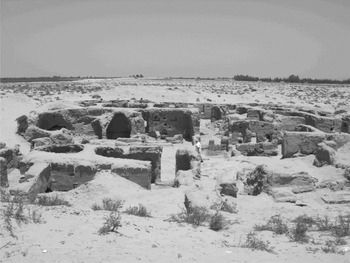
The residences of the monks of Kellia are well known to scholars of Egyptian monasticism. Excavations of many manshubiyyat, or monastic dwellings, reveal a community that spanned an area of over sixteen square kilometers. The excavated material, however, does not date to the residency of Evagrius, but to the two or three subsequent generations of the fifth and sixth centuries. The site of Pherme is located nearby and shares similarities with Kellia, and it was a satellite community with the same architectural traditions of cell and residential designs. A survey of this massive area, from the mid-1960s until the late 1980s, resulted in the identification of at least 1,500 monastic structures—a densely populated community (see fig. 2).Footnote 113 Today the landscape and the encroaching modern agricultural activities mask the closeness of the monastic residences, as if one is walking down the streets of a close-knit neighborhood in an urban setting. The manshubiyyat are clustered into seventeen discernable areas, of which five exhibited a higher percentage of occupation than the others.Footnote 114 The complexes displayed many stages of occupation, remodeling, repairs, and extensions to eventually accommodate several visitors. Given the density of settlement, I contend that the purpose of the cell, in this environment, may have provided the only place to be alone with God.
One of fifty monastic complexes at Kellia-Pherme. The closest manshubiya is only seven meters to the east. (Author's photo.)

Evagrius's writings on ascetic practices are directives in how to understand the use of the cell. First, Evagrius addresses specifically the daily challenge of remaining within the cell in order to abide by one's praxis. In Praktikos 12, Evagrius narrates this challenge:
First of all, he [the demon of listlessness] makes it seem that the sun barely moves, if at all, and that the day is fifty hours long. Then he constrains the monk to look constantly out the windows, to walk outside the cell, to gaze carefully at the sun to determine how far it stands from the ninth hour (3 pm), to look now this way and now that to see if perhaps [one of the brethren appears from his cell]. Then too he instills in the heart of the monk a hatred for the place, a hatred for his very life itself, a hatred for manual labor.Footnote 115
The demon of despondency stirred the monk's emotions to the point of restlessness, longing for a way to escape a space that appeared both physically and mentally stifling. Evagrius correlates the restlessness of the body in the cell with the untrained mind not yet controlled by the monk. The internal manifestations of the undisciplined mind were demonic beings.Footnote 116 The demons did not need bodily form to create the same degree of havoc to which Antony or others were accustomed.Footnote 117 For Bachelard, space is defined by intimate memories that make its worth unique to an individual. Sacredness of space does not, therefore, require the communal identity that is essential for Lefebvre's construction of spatial identity. Evagrius's thought follows Bachelard's description of space as a place for introspection and affirmation of one's identity. When the demon “instills … a hatred for the place” and drives the monk “along to desire other sites where he can more easily procure life's necessities,”Footnote 118 we see the essential connectiveness between one's mind and one's actions. To reject the cell would be tantamount to rejecting the self and all that a monk might hope to accomplish.
For Evagrius, the cell is the contained battleground in which the monk can purify his heart. The physical separation from distractions is only the first step. The real work comes with the psychological discipline that confinement requires. However, Evagrius could see no greater danger to the monastic life than indifference to the importance of the cell. The cell is an extension and reflection of the interior life of the monk. How the cell is used and incorporated into the mental training illustrates the lived asceticism of the monk. The space becomes a physical boundary which defines the mental progress. Evagrius expresses the danger in Praktikos:
One must not quit the cell at the hour of temptations no matter how plausible seem the excuses. Rather one should stay seated inside and be patient and receive nobly the attackers, every one, but especially the demon of listlessness who, because he is the heaviest of all, brings the soul to its most proven point. For to flee such struggles and to avoid them teaches the mind to be unskilled and cowardly and a fugitive.Footnote 119
The rejection of the cell demonstrates a lack of discipline and spiritual maturity in the monk. If he truly knew God, he would willingly remain within the cell. Evagrius suggests that the cell represents not just a temporal location but also a spiritual locale that contains souls. Fleeing from the cell at times of temptation was an admission of weakness since the monk's mind was not strong enough to control his body. Abandoning the cell in body signified an internal defeat to demons. Such a spiritual defeat was marked by disgrace and shame; the physical flight from the cell informed the community that the monk was unable to resist the power of his own thoughts.
Recognizing the need to remain within one's cell, Evagrius suggests prayer is the only way to combat temptations. In Prayer, Evagrius makes several statements that resonate with the value and function of the cell in the apophthegms. In the Sayings, Evagrius offers practical advice regarding how to use the cell and allow it to teach a monk the proper way to regard the spiritual world. He explains:
Sit in your cell, collecting your thoughts. Remember the day of your death. See then what the death of your body will be… . Consider also the good things … confidence in the face of God… . Whether you be inside or outside your cell, be careful that the remembrance of these things never leaves you; thanks to their remembrance, you may at least flee wrong and harmful thoughts.Footnote 120
Evagrius's writings provide a further dimension of interpretation of the meaning of the cell in Egyptian monastic thought. J. Bamberger explains Evagrius's doctrine as a psychological melding of emotions and habits, and here we recall the interplay between the cell as the inculcation of monastic habitus.Footnote 121 Evagrius urges that a monk “must be altered even in the depths of his spirit, where there lie hidden in the furthest recesses of his being unknown images… . Only when these images are healed and restored … is the work of his salvation and his perfection fully realized.”Footnote 122 The necessary cleansing of internal images was the product of the cell's teaching, and its value could not be replaced by the words of an elder or any other combination of activities. The locative importance of the cell for Evagrius was expressed in the transformative expectations. Evagrius lays out the specific activities and the expected results of faithful adherence to one's praxis. When demons tempted monks to devalue the cell, Evagrius reminds his audience that the monk's salvation was intricately tied to whether or not the monk could learn his life-sustaining lessons in the cell. If the panoptic residence was used properly through the adoption of the right actions and habits within, then leaving the cell would not be detrimental to the perfection a monk desired.
Evagrius does not endorse the idea of itinerant monastic living. The desire to leave one's cell was dangerous when the impulse was acted upon and the monk gave into the desire, or longing, to live outside of the cell.Footnote 123 Brakke explains Evagrius's teachings as a guide through which the monk first learned the strategies of the demons who seek to undermine the introspection and progress of monastic discipline. After gaining command of the demons' tricks, the monk was then ready to learn Evagrius's defensive strategies to diminish the power of the demons. The way to manage this ascetic anxiety was to retrain the mind by controlling one's thoughts through physical labor (plaiting rope and weaving baskets, for example) and by physical confinement in the cell. The thoughts gained dangerous momentum if a monk was unable to resist attention to them (as seen in Evagrius's description of the monk who sought any excuse to leave his cell and abandon his seclusion). Moreover, if the demonic thoughts evoked an emotional response, then a monk was ruled not by his mind but by his passions, and the demon succeeded. Evagrius's goal is to heal the “irrational parts of the soul” that tarnish and harm the monk's intellect that once sought only after God.Footnote 124
Purity of thought was developed through the willingness to return and remain within the cell where the monk committed himself to prayer and manual labor. Lefebvre provides a framework for us to consider the contemplative qualities of space as areas in which individuals are actors and not observers. Monastics are aware of their space, but “they do not merely enjoy a vision, a contemplation, a spectacle—for they act and situate themselves in space as active participants.”Footnote 125 Evagrius illustrates how the space of monastic living is a space of activity in which one participates and is not passive:
The time of temptation is not the time to leave one's cell, devising plausible pretexts. Rather, stand there firmly and be patient. Bravely take all that the demon brings upon you, but above all face up to the demon of acedia who is the most grievous of all and who on this account will effect the greatest purification of soul. Indeed to flee and to shun such conflicts schools the spirit in awkwardness, cowardice and fear.Footnote 126
The actual design of the cell was not important in this spiritual context. The central issue was that the cell served as a place where the monk could contain himself and face his spiritual demons. The cell became the monk's area of prayer. Here the monk was able to see God: “By true prayer a monk becomes another angel, for he ardently longs to see the face of the Father in heaven.”Footnote 127 Evagrius points to the value of visualizaton and the cultivation of sight within a monastic geography that supported the efforts of ascetic practice. Here, the architecture becomes important, not for what is looked like, but for what it evoked from the individual. Giddens, in reconsidering Foucault's panoptic structures, casts the disciplinary space as one that is valued not for its physical parts but both for its “relational form” and for how the “farming of space” is essential for retraining.Footnote 128
The relational quality of monastic space and the participatory engagement by the monk within is found also in the writings of Paul of Tamma.Footnote 129 Paul provides a valuable Coptic voice to elucidate the development of monastic ideas of sacrality and the use of space.Footnote 130 Paul's treatises are known only in Coptic and reflect an indigenous Egyptian perspective from Middle Egypt, as Paul was from the Knopolite nome.Footnote 131 Paul's On the Cell is one of two preserved texts primarily dedicated to how one should live life in the cell.Footnote 132On the Cell clearly associates proper praxis within the cell with true spiritual maturity: “Be wise and remain in your dwelling, which is your delight, and your cell will remain with you in your heart as you seek its blessing, and the labor of your cell will go with you to God.”Footnote 133 This opening statement from the treatise demonstrates the convergence of the cell's use with its meaning. Paul follows the tradition first expressed in the Life of Antony and later expanded in the Sayings that the cell's unique role in monastic living was to provide a physical space to train the body and mind in living the holy life. The time in the cell therefore purified the resident through years of discipline. The one who reached a level of spiritual wisdom was able to travel outside the cell without fear of endangering his internal peace.
The cell was clearly set aside for the specific work of fulfilling one's praxis. The cell was “the monk's tester and teacher,” and Paul claims it was the “anchorite's wealth.”Footnote 134 The cell was a healer, the honor of poor men, and a place to fight and overcome the devil.Footnote 135 In the short treatise referred to by T. Vivian as Sitting in Your Cell, Paul elaborates on the proper activities in the cell. These statements reflect the power of the directive found in other apophthegms: “Go, sit in your cell.”
Sitting in your cell do not be idle.
Pay attention to how you sit in your cell. Do not act like farm animals being driven by someone, but act like the person driving the animals.
Sitting in your cell, keep careful watch over yourself.
Do not put your body in the cell while your heart is elsewhere.
Sitting in your cell, do not think highly of yourself.
Sitting in your cell, allow nothing to chain you down. Let the day's matters be enough for the day and you will remain at peace.
Sitting in your cell, persist with your prayer and your fasting and the struggle taking place in your heart and you will have the qualities of the pure of heart.Footnote 136
To sit in the cell was the foundational action for all other monastic disciplines, and it is with Paul's thought that Foucault's image of self-viewing and cultivation is most clear. In Paul's thought the cell became the embodiment of one's ability to control emotions by following a schedule of prayer, fasting, and focus. Paul, like other monastic elders, recognized the danger of turning the adherence to these instructions into a false goal that would lead to pride and jealousy. He warns, “Sitting in your cell, my son, do not be like the hypocrites. Do not turn prayer into work and you will be heard.”Footnote 137 It was also advisable not to speak with others, but to return to the cell for there “your mind becomes conformed to God.”Footnote 138
The rhetoric of sacrality of the cell is underscored in Paul's writings where the cell was exclusively the realm of God. In fact the cell was the preferred location for performative worship. Paul follows other authors in regarding the cell as the only space in which one has certainty that he will encounter God: “For there is no festival like the worship of God in your dwelling. For you will find God in your cell.”Footnote 139 There is no ambiguity in Paul's thought about the theological importance of the cell: “If you receive the grace that the cell provides, you will reach God.”Footnote 140 Seeing God was possible through the adoption of disciplines that monitored one's passions. In On Humility, practitioners are told to “keep your body holy and the holy angels will come to you and give you joy, and you will see God.”Footnote 141On the Cell refers to the cell as a conduit for travel to heaven for the cell was where one would “know God” and keep him within.Footnote 142 Paul even claims that God would come looking for the monk in his cell, stating that “there is no measure to the [honor] of the cell, and its mysteries are without number.”Footnote 143
The elevation of the cell as the monastic sanctuary, rather than the altar or the church sanctuary, suggests that monasticism valued private spiritual development above all other forms of piety in the early communities.Footnote 144 While the weekly communal gatherings were important for the health of the community and for an accounting of sins, the real sanctuary was one that emerged when the monk entered his cell and became part of the holy residence of God. The sacrality of the cell is clear when Paul identifies the monk's actions in the cell with creating models of the sacred temple furnishings in the heavenly Jerusalem:
For the incense of God is a wise man in his cell.
The altar of God is a wise man in his cell.
For his cell is always filled with a sweet smell from the fruit of his good works.
The glory of God will appear to him there.Footnote 145
The association of the monk's life within the cell with furnishing God's temple accords well with ideas from Cassian and 1 Peter 2:5 in which monks, or believers, are the living stones used to build God's temple. Here the interior life in the cell models the interior sanctuary where God dwells. Leslie MacCoull rightly observes that these activities within the cell mimic the actions of a priest performing at the altar.Footnote 146
The cell was a physical image that modeled a spiritual reality for the monastics; it had spiritual significance for both the practitioner and God. While the Life of Antony and the apophthegms do not so clearly associate the sacrality of the cell with the inner recesses of the temple, there are allusions by Paul to the cell as a sacralized space because God would dwell there. For him the cell became the tabernacle and temple of God. It was here, in a sacred space, where the monk dwelt within the security of the cell. In so doing, the monastic could create an internal cell where God would dwell. This cell could possibly be a manifestation of God as expressed below:
Now then, you who are poor, you shall worship God with all your heart and with all your thoughts and with all your strength and with your words, and you shall place your heart in your dwelling as you do in God… . For God is limitless. A wise man [in] his cell is without [measure]. For his name is in heaven. His countenance castes forth rays of light from Jerusalem… . The measure of a wise man sitting in his cell is the Lord. For he is like God because he is invisible. The wise man in his cell will be hidden from the coming evils. For the wisdom of a wise man understands God's ways. His heart delights in God. God will give him peace in his cell. Do not forsake God. Do not forsake your cell.Footnote 147
Paul was a teacher who let his fellow monks know exactly how they should conceive of their cells and what meaning their actions had for their spiritual benefit. The admonition not to “forsake your cell” is found within a long list of benefits from the monastic life lived within the geography of the cell. The transference of tangible sacrality to the interior dwelling may have been a challenge for some to comprehend, but Paul explained the process clearly by drawing upon the habitus as the basis for building one's soul while adopting the discipline of sitting in the cell.
You shall be a wise man in your cell, building up your soul as you sit in your cell, while glory is with you, while humility is with you, while the fear of God surrounds you day and night, while your cares are thrown down, while your soul and your thoughts watch God in astonishment, gazing at him all the days of your life.Footnote 148
The value of Paul of Tamma's writings for reconstructing the spatial discourse in early monastic practice is evident in his allegorical associations between the cell, the monk, and the creation of a space in which God dwelt. Despite Paul's almost forgotten voice in monastic history, his writings demonstrate the detail with which instructions for cell life were provided. The previously considered passages from The Lives and Sayings allude to the sacrality of the cell and its value as a meeting place for the Divine. However, only Evagrius and, more specifically, Paul of Tamma, articulate the spiritual significance, or desired result, of proper behavior and actions in the cell. The geography of the monastic cell, in their thought, was intended to be flexible in that monks were expected to realize the cell was a space cultivated within as the being in the cell helped to train the mind and the body. The dynamic nature of how to abide within and still leave the cell is what made the monastic cell central in formulating the spiritual life of the monastic.
VI. Conclusion
The physical space of the cell was an area set aside exclusively for the monastic. As seen in the Sayings, the praxis adopted by an ascetic varied depending upon the individual; such an accepted policy showed tolerance for the struggles that each person faced. However, the location where the praxis was followed remained constant. Regardless of one's experience, each monk understood the cell was the arena in which true spiritual progress could be made. The conditioning and restructuring of the person by adoption of the monastic habitus illustrates the emphasis placed upon locative transformation.
I have suggested that the most complex dimension to the discourse of space in these sources was the belief that actions and images found within the physical cell were in themselves images of the interior, intangible realities of the cell, or dwelling, within. Training in the exterior life would manifest itself in the training of the interior will; by staying within the built cell, one could learn to stay in the presence of God. The Life of Antony speaks little of how Antony conceived of this final step of interpreting the use of his dwelling, but the sayings of the early Desert Fathers suggest that the monks were already transferring knowledge to encourage monks to seek God, to gaze upon God, and to dwell with God both in and out of the cell. For Paul of Tamma and Evagrius, the internalization and embodiment of the cell within the monastic was the foundation for salvation and progress in the monastic life. For others, this step may have eluded them their whole lives. This might explain why the apophthegms are more practical in their examples and why the writings of Evagrius and Paul exhibit a more developed and highly idealized view of what one could achieve with mental discipline in the cell.
The geography of monasticism in early Egyptian literature illustrates a concern for the locative importance of where one lived the angelic life. As more monastic residences and purpose-built structures become visible within the landscape, new concerns emerge that challenge the importance of the cell as a unique component of religious geography. Wills and bills of sale from the documentary record, elaborately painted cells with great variation in execution and programs, and the ubiquity with which monastic space became physically present within the late antique landscape all point to practical concerns that later monastic authorities would need to face. As monastic space became less angelic and more worldly—or susceptible to daily concerns for property, inheritance, and ownership in the sixth, seventh, and eighth centuries—the more archaeological evidence becomes available for a comparative analysis of the monastic ideals espoused here and the lived monasticism as experienced by monastics striving toward or departing from the monastic habitus.