During the COVID-19 pandemic, perhaps no set of American institutions has been more burdened than public schools. Functioning as childcare for parents, an employer to nearly seven million adults, and the primary provider of schooling for 90% of children ages 5 to 17 (NCES 2018), America’s education system has been challenged to adapt and respond like never before to meet the needs of different stakeholders. With the fall 2020 school year beginning alongside the continued spread of the virus, parents were torn between wanting to keep their families healthy, on the one hand, and the practical need to ensure that their children are learning and cared for during work hours, on the other (Hirt, Nichols, and Brugal Reference Hirt, Nichols and Brugal2020). Not surprisingly, most families have desired to see a return to some form of in-person instruction (Horowitz Reference Horowitz2020), yet education employees have raised important concerns about the health risks of returning to school buildings. Teachers unions have tended to resist putting their members back into the classroom, filing lawsuits and issuing strike threats to push districts to delay in-person learning until certain public health benchmarks are met (Richards Reference Richards2020).
School districts have had to navigate these unprecedented challenges while remaining sensitive to the fact that they risk losing students (and by extension funding) to the competitive forces of exit—families leaving for private schools or opting to homeschool—should districts fail to provide a quality learning experience. Some reports indicate that private school applications soared this fall (Reilly Reference Reilly2020), and many affluent families turned to “pandemic pods” where multiple households pool their resources to hire private instructors (Meckler and Natanson Reference Meckler and Natanson2020). Policymakers and equity advocates have raised important concerns that these developments will leave the most disadvantaged children, including many students of color, farther behind their well-to-do peers (Gross and Opalka Reference Gross and Opalka2020).
Less visible, but of particular interest to political scientists, is the fact that the battles being waged over re-opening schools have occurred in a highly polarized political environment and close to an election in which public health decisions (Adolph et al., Reference Adolph, Amano, Bang-Jensen, Fullman, Magistro, Reinke and Wilkersonforthcoming)—including whether and when to send children back to school—suddenly became wrapped up in voter partisanship and presidential politics (Horowitz Reference Horowitz2020). In July of 2020, President Trump directly politicized the issue, publicly threatening to withhold funds from schools that refused to return in person, arguing that Democrats wanted to keep schools closed to weaken his reelection prospects (Baker, Green, and Weiland Reference Baker, Green and Weiland2020). By October, parents who told pollsters that they trusted the then-president were twice as likely to say that schools should educate students in-person compared to parents who distrusted Trump (69% to 34%).Footnote 1
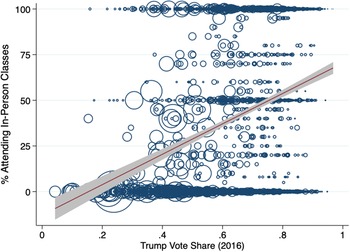
Although public schools have never been immune from politics, these events represent a notable shift for local school districts. As nonpartisan, single-purpose governments, districts have traditionally been more insulated from national partisan cleavages. Instead, they have historically been dominated by competition between local interest groups. Moreover, the sort of issues that are most directly analogous to re-opening schools in the pandemic are the very same technical and practical decisions that district officials make on a routine basis—decisions about building use, bell and bus schedules, the school calendar, and what sports to offer, issues that are neither partisan nor national in nature. At first glance, however, school re-opening decisions in fall 2020 appear to have been strongly shaped by partisan divisions in national politics. Figure 1 shows that that the decision to return to in-person learning was strongly correlated with county-level support for Donald Trump in 2016.
The partisan politics of returning students to the classroom
Note: The figure shows the county-level relationship between the percentage of K–12 public school students attending school in person this fall and support for President Trump in 2016. The size of each bubble corresponds to the size of the population in each county and the line shows the best fit (with 95% confidence). School reopening data is taken from Burbio’s school opening tracker (https://cai.burbio.com/school-opening-tracker) and elections data taken from MIT’s Election Data and Science Lab (https://electionlab.mit.edu/data).

In this study, we use COVID-19 to shed light on the expanding reach of partisan polarization in U.S. local politics. Some scholars have begun to show that Americans’ attitudes about local politics have increasingly nationalized (Hopkins Reference Hopkins2018), as partisan polarization has crept into virtually every aspect of American life (Iyengar and Westwood Reference Iyengar and Westwood2015). A logical extension of this is the claim that mass partisanship is an increasingly important determinant of local policymaking. Public schools offer a tough test of this claim. First, nearly all of America’s public schools are governed by lay citizens (essentially volunteers) who run for office in low- stakes nonpartisan elections. Second, because these elections are often oddly timed and low-turnout affairs, boards are more insulated from national partisan coattails and are instead dominated by local interests (Anzia Reference Anzia2013, Reference Anzia2019).Footnote 2 We thus add to the emerging literature on the increasing spread of partisan politicization into American life by examining whether the factors that scholars have traditionally used to explain local school politics—namely market forces and local vested interests—have been overtaken by national partisan forces. Moreover, we assess whether these national partisan forces have overwhelmed local public health considerations, namely the impact of the virus on school reopening decisions.
To investigate these dynamics, we analyze the re-opening decisions of over 9,000 school districts. Overall, we find that partisanship and teachers unions were key drivers of reopening decisions in fall 2020: local union strength and community support for President Trump best predict whether districts returned to in-person learning. We also find that geographic proximity to a larger share of affordable private schools boosted the likelihood that public schools re-opened in person. Notably, we find little consistent relationship between a variety of indicators measuring the severity of the pandemic and the type of re-opening plan adopted.
Beyond showing that national partisan divides can influence even the most technical decisions made by nonpartisan local governments, this study further informs our understanding of the political economy of K–12 education. Prior research shows that competition from private schools can influence public schools (e.g., Figlio and Hart Reference Figlio and Hart2014; Figlio, Hart, and Karbownik Reference Figlio, Hart and Karbownik2020; Hoxby Reference Hoxby1994, Reference Hoxby2000, Reference Hoxby2003). COVID-19 provides a unique opportunity to study these competitive dynamics because all schools—both public and private alike—had to deal with the same basic dilemma: how to balance public health concerns with the demand from families to re-open schools. Since private schools have been more likely to resume in-person learning than their public counterparts (Cano Reference Cano2020; Pandey Reference Pandey2021), we can directly evaluate whether public schools surrounded by more private schools were more likely to re-open in person. In sum, COVID-19 can also teach us more generally about the way in which markets shape the political economy of public education.
The remainder of this article proceeds as follows. We first review relevant literature while laying out our theoretical expectations for how partisanship, union strength, market forces, and public health considerations may have influenced school districts’ re-opening decisions. We then discuss our data and empirical approach to theory testing, after which we present our results. We conclude with a brief discussion of the implications of our findings for the study of education politics and policy and American local government more generally.
Relevant Literature and Theoretical Expectations
Public Health
After the arrival of the pandemic, scientists quickly set to work on understanding the virus to help policymakers weigh the public health risks of their decisions. Scientists modeled various school reopening scenarios to determine which approaches would be most successful at preventing another outbreak (Panovska-Griffiths et al. Reference Panovska-Griffiths, Kerr, Stuart, Mistry, Klein, Viner and Bonell2020). The Center for Disease Control (CDC), in turn, offered guidelines for school re-openings, though they were suggestive and did not spell out specific actions or metrics. Indeed, many school superintendents complained that they have not received adequate guidance (Simpson Reference Simpson2020). Still, the scientific community offered various suggestions—for instance, that school officials take into account the share of cases and the proportion of tests coming back positive (Simpson Reference Simpson2020).
One might expect that during a pandemic, these public health considerations would be a leading, if not the leading, factor guiding school re-opening decisions. However, even technical and scientific issues have become polarized in the United States, making it unlikely that public health indicators alone would give rise to purely technocratic decisions. Hart and Nisbet (Reference Hart and Nisbet2012), for example, find that people react to news on controversial scientific issues differently based on their partisanship. However, these authors examine climate change, which has long been polarized along partisan lines (Tesler Reference Tesler2018). Since COVID is a new and urgent public health issue, epidemiological and public health research should, in theory, be less polarized, allowing it to shape local policy decisions without regard to partisanship.
Polls show that the public wants expert voices involved in re-opening decisions. In a Pew survey from early August 2020, a majority of respondents said that health risks to teachers and students should play a key role in re-opening decisions. Within political parties, respondents living in coronavirus hotspots were slightly more likely than their co-partisans to say that schools should be completely remote (Horowitz Reference Horowitz2020). Although many scientific issues have polarized along partisan lines, public opinion and the severity of the virus lead us to expect that local officials’ responses would have been guided, at least partly, by science and the advice of public health experts.Footnote 3
Teachers Unions
Political scientists have long recognized that schools are “open systems,” meaning that they that are responsive to their institutional environments (Chubb and Moe Reference Chubb and Moe1990; Smith and Meier Reference Smith and Meier1994). Since public schools are agencies of government, school boards face intense pressure to appease numerous competing stakeholders (e.g., families, taxpayers, employees, and religious and racial minority groups, to name just a few). In general, we would expect the best-organized and most politically active groups to influence school district policy. The decision over when and how much to reopen schools during a public health pandemic is no exception. One group that should clearly matter in these debates is the teachers unions. In the typical American school district, the unions are much better organized and far more politically active than other stakeholders, even important ones like parents, the business community, and reform coalitions (Hess and Leal Reference Hess, Leal and Howell2005; Moe Reference Moe2011). While union leaders recognize that remote schooling is no substitute for in-person instruction, they have vigorously advocated for remote learning due to their members’ concerns about the safety of in-person instruction and the lack of adequate ventilation, personal protective equipment, and other safety measures (American Federation of Teachers 2020). Consequently, we anticipate that, all other factors being equal, school districts with stronger and more politically active teachers unions would have been more likely to adopt fully remote education.
Markets
In normal times, exit from the public school system is costly because families that forgo public schooling have to pay twice (taxes plus private tuition), which is economically infeasible for the average household (Hirschman Reference Hirschman1970). However, the pandemic changed this equation by reducing the nature and overall quality of the learning experience that families in fully remote districts got access to. Prior studies have shown that 1) parents respond to lagging school performance by leaving failing schools (Holbein Reference Holbein2016) and that 2) more public-school choice generally reduces the demand for private schools (Hoxby Reference Hoxby2000). Taken together, these findings would suggest that, where public schools are less available or their offerings are less desirable, private schools would have become an increasingly attractive option.Footnote 4
Competition from private schools has been shown to impact public schools (Figlio and Hart Reference Figlio and Hart2014; Figlio, Hart, and Karbownik Reference Figlio, Hart and Karbownik2020; Hoxby Reference Hoxby1994, Reference Hoxby2003). While existing work has looked at how the threat of exit influences student achievement in public schools, it is equally plausible that competition would have caused public school districts to avoid closing during the pandemic.Footnote 5 In particular, we expect that Catholic schools would have been the most widely available exit option for families looking to leave their public schools. Catholic schools enroll just over 37% of all privately enrolled children, making them the most popular religious private schools (NCES 2019a). They are typically more affordable than other private school alternatives (NCES 2019b), exerting the most competitive pressure on public schools (Hoxby Reference Hoxby1994). There is anecdotal evidence to suggest, in part because of the pandemic, that Catholic schools took market share away from public schools in fall 2020.Footnote 6 As such, we anticipate that public school districts surrounded by more Catholic schools would have been more likely to reopen for in-person learning.
Partisanship
Finally, while scholars have long recognized unions and market forces as influential factors in local school politics, during the pandemic we anticipate that national partisan cleavages have become increasingly important in local school politics. Schools are arguably less insulated from national political forces today than they were in the past, as they have increasingly been absorbed into general-purpose politics.Footnote 7 Until recently, however, these developments were relatively separate from partisan polarization; instead they were driven by a bipartisan coalition of school reformers.Footnote 8 School reform remained a relatively bipartisan issue up through the Obama presidency, with the two parties converging in favor of accountability, charter schools, and teacher quality reforms (Wolbrecht and Hartney Reference Wolbrecht and Hartney2014). During this time period, education was one of few policy areas where elite polarization along party lines was minimal (Grumbach Reference Grumbach2018). Polarization on education issues in the mass electorate was also relatively muted. As Houston (Reference Houston2019, 2) explains, “there are notable differences in public opinion on various education issues between Democrats and Republicans, but these differences tend to be smaller than the partisan gaps on issues in other high-profile policy domains.”Footnote 9
However, there have been some major changes in education politics in the last few years. At the federal level, the election of Donald Trump brought a controversial figure in Betsy DeVos into the administration as Secretary of Education. A major Republican donor and fervent advocate for private school choice policies, DeVos’s appointment has resulted in school choice becoming “toxic on much of the progressive left” (Petrilli Reference Petrilli2018, 2). With Trump in the White House, the bipartisan school reform coalition that endured during the Obama years quickly came undone (DiSalvo and Hartney Reference DiSalvo and Hartney2020). Consequently, partisan politics would seem primed to matter more in local education decisions today than ever before. At the same time, COVID mitigation policies—an arena that we might expect would be removed from partisan politics due to the primacy of public health concerns—became infected by both partisan and presidential politics.Footnote 10 In light of Hopkins’ (Reference Hopkins2018) findings that local politics have become more nationalized, we expect to find evidence that partisanship influenced school re-opening decisions.
Research Design
To examine how public health, interest groups, private school competition, and partisanship shaped public school districts’ responses to the pandemic, we draw on “COVID-19 IMPACT: School District Status Updates,” a massive database monitoring school reopening plans provided by MCH Strategic Data. The MCH dataset is impressive. It contains information on reopening plans for over 9,000 (~70%) of the nation’s 13,000+ public school districts, enabling us to classify each district into one of three categories: 1) fully remote learning, 2) hybrid learning, or 3) traditional in-person learning.Footnote 11 Overall, the majority of U.S. school districts (54%) began the fall 2020 school year by offering hybrid instruction with a mix of remote and in-person learning. Among the rest, 22% of districts were fully remote, while 24% returned to traditional (fully) in-person instruction.Footnote 12
Our basic empirical approach to understanding how much districts reopened in fall 2020 is to estimate a series of regression models that take the following form:
 $$ {\displaystyle \begin{array}{c}{Reopen}_{ds}={\mu}_s+{Partisanship}_{ds}\beta 1+{Unions}_{ds}\beta 2\\ {}\hskip22pt +\hskip2pt {Markets}_{ds}\beta 3+{COVID}_{ds}\beta 4\\ {}\hskip-44pt +{X}_{ds}\beta 5+{\varepsilon}_{ds}\end{array}} $$
Where Reopen ds is an ordinal (1–3) measure of how much district d in state s reopened (1 denotes a remote re-opening, 2 hybrid, and 3 fully in-person). We then model this ordinal district-level outcome as a function of 1) mass partisanship ( Partisanship ds ); 2) teacher union strength ( Unions ds ); 3) the supply of private school alternatives ( Markets ds ); and 4) the various public health indicators measuring the severity of the virus in the local community ( COVID ds ). We also include X ds , a vector of district-level controls that account for community resources and other demographic factors that may influence how districts reopened. Specifically, we include measures of (log) per-pupil spending, (log) median family income, and the percentage of white students to account for the expectation that, on average, wealthier and whiter communities enjoy resource advantages that may enable them to make adjustments to their buildings, like better ventilation and the use of outdoor space for social distancing that could accelerate the return to in-person learning.Footnote 13 Finally, we include dummies that account for the geographic locale that the National Center for Education Statistics (NCES) has assigned each district since urbanicity is closely related to population density, which should impact the feasibility of social distancing within a district and virus containment in the community more generally (i.e., the difference between New York City versus rural upstate New York). In what follows, we briefly discuss the specific indicators used to measure our explanatory variables of interest—partisanship, union strength, private school competition, and COVID-related public health conditions.
To assess whether the partisan divide in national politics has had an independent effect on local school district reopening decisions, we use the two-party share of the vote won by President Trump in each district’s parent county in 2016. Because there are no datasets that measure teacher union strength for all U.S. school districts, we examine whether unions influenced the type of reopening plan a district chose by using district size (log student enrollment), since prior studies unambiguously show that teachers unions are much stronger and their collective bargaining agreements (CBAs) are more restrictive in larger districts (see Moe Reference Moe and Howell2005, Reference Moe2009; Rose and Sonstelie Reference Rose and Sonstelie2010).Footnote 14 We prefer to use this measure of union strength in our baseline specification because it is available for all of the districts in our sample. However, while we are confident that district size is a reasonable proxy for union strength, large (especially urban) school districts are more likely to face other challenges unrelated to their unions as they seek to re-open schools (e.g., logistical issues, building space). Therefore, we make use of two additional district-level measures of teacher union strength—substituting information on a district’s 1) collective bargaining (CB) status and 2) level of teacher union political activity—for the sample of districts where we have access to these richer indicators.Footnote 15
Since market forces (concern that families might exit the public school system) may encourage districts to reopen more quickly (Hirschman Reference Hirschman1970), we include a measure of the prevalence of private school options in a local community. Specifically, we focus on the number of Catholic schools (per capita) located in each district’s parent county. Catholic schools are the most affordable private school option (e.g., Garnett Reference Garnett2010), and should therefore represent the lowest entry point for families who are considering leaving public schools. On the other hand, we do not expect that secular private schools, where tuition prices are typically much higher, will present as much of an exit threat to local public school districts since only the wealthiest families are able to afford this type of exit option.Footnote 16 Therefore, as a placebo test, we include the same per capita measure of secular private schools alongside our Catholic school measure under the term Markets ds in equation 1.
There are many potential ways to measure both the intensity and severity of COVID in a local community. For our purposes—examining how much the virus influenced the decisions of local school officials—we are less concerned with the actual epidemiological value of any given indicator. Instead, we need to identify public health indicators that local school officials 1) had access to on a regular basis and 2) were encouraged to use to make decisions. To measure the intensity and severity of the virus, two types of indicators are typically used: 1) indicators that capture the overall effect that the virus has had on a community (cumulative measures) and 2) indicators that capture the current level of viral spread and destruction in a community (acute measures). We prefer to focus on the latter type of measure—specifically the “average daily case rate” during the second fourteen-day period of August (August 15–28, 2020), when school districts needed to make a final reopening decision for parents and the general public.
The severity of the pandemic in the second two weeks of August 2020 should theoretically be more relevant to policymakers (including school district officials) tasked with making decisions about the safety of returning students to in-person instruction at the start of the fall school year.Footnote 17 Our measure of the average daily case rate in a county during the second two weeks of August was obtained from Carnegie Mellon University’s (CMU) Delphi Group COVIDcast API project.Footnote 18 While we prefer to focus on average daily case rates in the second two weeks of August, our findings are fully robust to substituting cumulative measures of the pandemic’s net impact on a local community at the time (late August) when school districts had to issue a formal reopening decision. More importantly, our findings are also robust to using actual public health outcomes—such as COVID hospitalization rates or death rates in a county—rather than case-based measures. In fact, to the extent that we uncover any relationship between local public health indicators and local school district reopening decisions, those relationships are largely confined to case-based measures of the acuteness of the pandemic in August rather than actual health outcomes like per capita COVID-related hospitalizations in a county.
Empirical Strategy
By far, the most important feature of our analytic approach is the inclusion of state fixed effects, represented by μs in equation 1.Footnote 19 These unit fixed effects can account for any time-invariant state level characteristics that may simultaneously influence a school district’s choice of reopening plan. The inclusion of state fixed effects is an essential element of our research design because it enables us to isolate the within-state differences across school districts that are associated with a district’s choice in reopening plan. Without this important step, we would essentially be estimating cross-state differences in school re-openings. Such cross-state differences, although interesting in their own right, tell us little about how politics, markets, and COVID-related public health indicators influenced the decisions of local school district governments. Although state political and regulatory conditions clearly influence the decisions of local governments, the market for K–12 private schooling options and the intensity of the pandemic itself play out at the local community (district) level.
Results
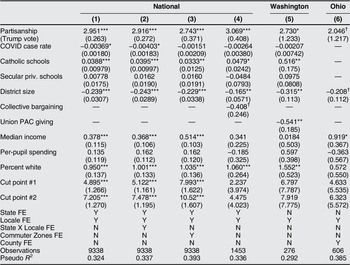
We begin by focusing on a series of four separate regressions based on equation 1 shown earlier, the results of which are displayed in columns 1-4 of table 1. Column 1 presents our baseline (and preferred) specification, which relies on state fixed effects to estimate the within-state effect of district partisanship, union strength, private school competition, and COVID case rates on the extent to which districts reopened schools for in-person learning.
Determinants of school district reopening decisions

Note: Cell entries are ordered probit coefficients with standard errors clustered by state reported beneath in parentheses. All measures are two-tailed tests. † p < 0.1, * p < 0.05, ** p < 0.01, *** p < 0.001
Overall, political factors best explain the degree to which districts reopened in-person. Specifically, the percentage of the vote earned by Donald Trump in 2016 and district size (a proxy for union strength) were the most consistently powerful predictors of how much districts reopened for in-person learning. Consistent with the partisan polarization that emerged in national debates over how aggressive governments should be in mitigating the spread of the virus (e.g., lockdowns), local school boards in strong Republican districts were far more likely than boards in strong Democratic districts to adopt in-person learning. These effects, which are both statistically (p < .001) and substantively significant, cannot be explained by local differences in COVID case rates, district demographics or urbanicity, or the range of resources available to boards in Republican- versus Democratic-leaning school districts, as all of these potential confounders are controlled. Moreover, our inclusion of state fixed effects indicates that the association between mass partisanship and district reopening decisions cannot be driven by unobserved cross-state differences in state-level political or economic factors that influenced how schools opened this fall. In other words, the finding that Republican districts are significantly more likely to choose in-person classes and Democratic districts are significantly more likely to choose fully remote learning are based on within-state estimates of how districts that must follow the same state regulatory reopening restrictions and guidelines behave on account of their differences in partisanship.
Next, we find evidence that the strength of a district’s local teachers union influenced how much schools reopened. Even after controlling for district urbanicity, partisanship, and case rates, we find that larger districts (where research shows that unions are more powerful in both politics and collective bargaining) were far less likely to reopen in person (p < .001). This finding is consistent with the public positions taken by the nation’s two largest unions in supporting their locals’ efforts to delay in-person learning until various public health benchmarks are met. It is also consistent with several other recent studies showing that teachers unions have influenced district reopening decisions, largely slowing the pace at which in-person learning has resumed (DeAngelis and Makridis Reference DeAngelis and Makridisforthcoming; Grossman et al. Reference Grossman, Reckhow, Strunk and Turner2021; Harris et al. Reference Harris, Ziedan and Hassig2021). Although we are confident that district size is a reasonable proxy for union strength, we acknowledge that the size of a school district itself is also likely to present different logistical challenges that may shape a district’s practical choice in a reopening plan. Therefore, later in the paper, we perform two additional tests using more direct measures of union strength (available to us for a subsample of districts) to confirm the robustness of this particular finding.
Turning to the effects of the virus itself, we find that COVID case rates in the weeks leading up to the fall 2020 school year were not an especially strong predictor of district decisions. Our preferred indicator for COVID intensity—the daily case rate per 100,000—is a statistically significant predictor; however, as we elaborate later, the magnitude of this indicator is substantively trivial. Because measurement error in COVID case rate data may obscure or artificially suppress the true relationship between the severity of the virus in a community and school re-opening decisions, we undertake several additional tests later in the paper to confirm the robustness of this finding, and we find that the weak relationship between COVID-related public health indicators and school reopening policies is observed irrespective of the specific COVID-related indicator one examines (e.g., deaths, cases, hospitalizations, doctor visits).
Finally, what role did market forces play in shaping school district reopening behavior? Recall that we measure market forces by examining the prevalence of private exit options available to parents: Catholic schools and secular private schools. Because of the relative affordability of parochial schools, we hypothesized that—to the extent private competition induced public schools to reopen—access to Catholic schools would most influence public school district behavior. That is precisely what we find. Specifically, we find a significant relationship between the number of Catholic schools per student and the degree to which public school districts adopted in-person learning rather than remote schooling. As expected, we find no consistent relationship between the prevalence of private (typically more expensive) nonsectarian schools and public school district reopening behavior.
To provide a sense of the substantive significance of the results presented in column 1 of table 1, figure 2 graphs the marginal effects of our four main explanatory variables of interest on the likelihood that a district elects to fully reopen (black dot markers) or remain closed (gray diamond markers). In each of these figures, changes in the explanatory variable are shown on the x-axis for values that represent (roughly) a standard deviation increase from one hash mark to the next while setting all other variables in the model at their mean values.
Marginal effects of partisanship, union strength, markets, and case rates on school districts’ reopening decisions
Note: Each figure plots the marginal effects of separate explanatory variables of interest on the likelihood that a local school district opted for fully in-person or fully remote schooling. These effects are derived from the model presented in column 1 of table 1 in the main text of the paper. In each instance, all other variables in the model are set at their mean values.

Beginning with partisanship in the upper left-hand quadrant of figure 2, we can see that the percentage of the vote won by Donald Trump in a county in 2016 has a substantively powerful effect on school reopening behavior. Moving from a district where Trump won just 40% of the vote to a district where he won a strong majority (60%) is associated with a decrease in the likelihood that a school district shuts its physical doors and chooses remote learning by 18 percentage points (29% versus 11% probability of fully remote learning). Conversely, that same shift from 40% to 60% support for Trump is associated with an 8-percentage point increase in the likelihood that a school district elects to return to in-person schooling in the fall (14% versus just 6% probability).
Figure 2 also reveals that larger school districts, where unions tend to be stronger, are far more likely to rely on remote learning. By contrast, the smallest districts in the sample—where unions have fewer members and tend to be less powerful in school politics (Moe Reference Moe and Howell2005; Rose and Sonstelie Reference Rose and Sonstelie2010) have a near 80% probability of conducting classes in person. In contrast, the largest districts—those where unions are more likely to have large membership rolls and bigger resources to compete in politics—have a roughly 30% probability of turning to remote learning to start the year.
The number of Catholic schools per capita proves to be a small, but non-trivial, factor in explaining public school reopening behavior in the fall of 2020. As the bottom right quadrant of figure 2 reveals, moving from a district anchored in a community with zero Catholic schools to one in which there are four Catholic schools per 10,000 students is associated with a 4-percentage point increase in the likelihood that the local school district resumed in-person classes. By the same token, school districts were 3-percentage points less likely to close schools and resort to fully remote education when they operated alongside that same robust supply of Catholic schools. These findings suggest that, at the margins, public school districts may be sensitive to the market forces induced by the prevalence of affordable private schools. However, this result is nowhere near the effect of partisanship and union strength.
Finally, as the very flat line in the upper right quadrant of figure 2 shows, COVID case rates are far less substantively important predictors than either partisan or union strength. The average daily case rate, while statistically significant, is substantively trivial in its effect on a district’s ultimate course of action. For example, each standard deviation uptick in the average number of new daily cases per 100,000 residents in a county (~twelve cases) is associated with just a 1-percentage point decrease in the likelihood that a district reopened in person. This is less than 10% of the effect of a standard deviation increase in Trump support on reopening.
On one hand, we might worry that the lack of a robust relationship between COVID cases and reopening decisions are a mere product of measurement error, rather than a true product of partisanship overwhelming reopening decisions. Undoubtedly, some of the variation in case rates are driven by regional differences in testing capacity across and within states. Although some of these biases can be mitigated (as we do later in the paper) by using more granular geographic fixed effects (e.g., commuting zones, counties), we also performed a variety of robustness checks to ensure that our inability to find a strong relationship between COVID-related public health indicators and district decisions was not simply the product of measurement error.
Specifically, we ran a total of seventeen additional modelsFootnote 20 that separately considered each of the following public health indicators to measure the severity and intensity of COVID in a county: average daily deaths per 100,000 (in early (1), late (2), and all of August (3)); cumulative deaths per 100,000 (in the beginning (4) and end of August (5)); cumulative cases per 100,000 (in the beginning (6) and end of August (7)) a combination of several COVID-19 health indicators provided by CMU’s COVIDcast API measuring COVID-related doctor visits and COVID-related symptom reports from community surveys (in early (8), late (9), and all of August (10)); and, finally, weekly hospitalization rates per 100,000 for the last week of July (11) and each week of August (12–14) and in early October (15–17).Footnote 21 Although many of these measures—especially hospitalization rates—are less prone to measurement error and better overall indicators of actual COVID health outcomes than are case rates, we notably do not find any robust relationship between variation in these measures and school district reopening decisions. Interestingly, the strongest substantive effect of any COVID-related public health indicator we examined is, in fact, case rates from August, and as noted earlier, that effect size is still just a 1-percentage point change in the likelihood of a district remaining remote. As figure 3 shows, all of these other COVID indicators are relatively weak predictors of district reopening behavior. Altogether, these results indicate that the usual determinants of school politics—teachers unions and market forces—mattered for reopening decisions, but partisanship mattered most. COVID-related indicators were, on the whole, less impactful than these institutional and political forces.
Main results are fully robust to different measures of COVID
Note: Each row shows the marginal effects of a one-standard deviation increase in the specific covariate on the likelihood that a local school district opted for fully in-person or fully remote schooling (using the baseline specification shown in column 1 of table 1).

Additional Robustness Checks
In this section, we carry out several important robustness checks to ensure that our preferred specification (presented in column 1 of table 1) is robust to a variety of alternative modeling choices.
Adding More Granular Fixed Effects
In columns 2 and 3 of table 1, we seek to allay any concerns that state fixed effects (on their own) do not adequately capture important regional differences within states that may influence local school district reopening decisions. For example, although it is important to include state dummies to account for regulatory or political differences at the state level that impact how local school districts respond, we might worry that regional intra state differences matter too and that once we account for them, partisanship, union strength, and private schools will not matter as much as public health indicators. Milwaukee and Eau Claire, for example, are both located within Wisconsin but share very little else in common. In column 2 of table 1, we augment our baseline specification by adding state-by-locale fixed effects. In other words, instead of simply incorporating fifty state dummies, we introduce 200 dummy variables that account for urbanicity within a state (e.g., rural Wisconsin, suburban Wisconsin, urban Wisconsin, and township Wisconsin). We take this step even further in the model presented in column 3 by incorporating fixed effects for the specific commuter zone where each district resides. The United States contains nearly 700 commuting zones. Developed in the late 1980s, commuting zones are most often used by economists to capture the foot traffic flows of people based not on the arbitrary lines of political boundaries (e.g., counties), but on the actual ways in which people live on a daily basis (an advantage for studying COVID-related phenomena).Footnote 22 In sum, these more granular fixed effects should account for smaller intra-state differences in geography. The results displayed in columns 2 and 3 confirm the robustness of our main findings. The coefficients and effect sizes of all of our key explanatory variables presented earlier in column 1 remain in place even after we run models that introduce these more granular fixed effects for region within a state. The coefficients on partisanship, district size, and Catholic schools are not noticeably attenuated. If anything, these fixed effects dilute the small effect we uncover between COVID case rates and district decisions (as we might expect from introducing the nearly 700 commuting zone dummies in column 3).
Alternative Measures of Union Strength
Next, in columns 4 and 5 of table 1, we run two new models that enable us to confirm the robustness of our finding that districts with stronger teachers unions were less likely to re-open for in-person schooling. To ensure that this earlier finding was not simply an artifact of using district size as a proxy for union strength, we gathered two superior indicators measuring union strength for a sample of districts where such measures were available. First, in column 4, we introduce a dummy variable for whether a school district bargains collectively with the local teachers union. This is a common indicator that scholars use to assess cross district differences in union strength, but it too is limited. For one thing, we only have information on districts’ CB status for about 15% of our national sample. Additionally, CB is only one way in which unions can influence education policy. Electoral politics is another (Hartney and Flavin Reference Hartney and Flavin2011; Moe Reference Moe2011). Therefore, in column 5, we introduce a novel measure of teacher union political activism across districts for the state of Washington: a binary indicator that denotes whether the majority of teacher union members in a district contribute to their union’s political action committee (PAC).Footnote 23 As the results on the collective bargaining indicator (column 4) and the PAC contribution indicator (column 5) demonstrate, teacher union strength in both electoral politics and collective bargaining is associated with greater union influence over district reopening decisions. Union concerns about the safety of reopening are better reflected in the decision of school boards where unions have collective bargaining and where teachers are more likely to support union campaigns. All other factors being equal, in the national sample, districts with collective bargaining were 14 percentage points more likely to begin the school year remotely. In Washington state, school districts where teacher union PAC giving exceeds 50% were 18 percentage points more likely to use remote schooling and 5 percentage points less likely reopen in person. In sum, across three measures of union strength—one proxy measure and two direct measures—we find that stronger unions are better able to represent their members’ preferences concerning reopening.Footnote 24
The Effect of Partisanship within Counties
Finally, in column 6, we subject our finding that mass partisanship had a strong and independent effect on how much schools reopened for in-person learning to an even tougher test. Specifically, we focus on Ohio’s 600+ school districts where we were able to assemble data on Trump vote share at the school district level along with administrative data from the Ohio Department of Education monitoring school re-opening decisions. The advantage of having detailed district-level data on mass partisanship for an entire state is that we can introduce county fixed effects into our analysis. In other words, we can compare how cross-district partisanship—within the same county in the same state—impacted a district’s decision about whether to use remote or in-person learning. Since multiple school districts are nested within Ohio counties, the inclusion of eighty-eight county dummies in our model allows us to hold constant the county-level severity of the virus, enabling us to focus on whether partisan differences across similarly geographically situated school districts impacted reopening. Since Ohio, like many states, has encouraged districts to rely on a county color-coded map denoting the severity of the pandemic, the inclusion of county-fixed effects essentially allows us to test how two school districts with different partisan makeups elect to reopen schools when they are being given the exact same public health information from state and county officials. The results of the Ohio analysis are shown in column 6 of table 1. Even after accounting for district-level demographic differences and including county fixed effects to partial out all unobservable county-level factors, the coefficient on Trump vote share remains positive and statistically significant (p < .1). It is also substantively significant. A one standard deviation increase in Trump vote share within a school district is associated with a commensurate 6 percentage point increase in the likelihood that the district reopened fully for in-person learning at the start of the fall school year.
Pandemic Severity and the Effect of Mass Partisanship on School Boards
So far, we have shown that partisanship loomed larger than any other factor in predicting how (mostly) nonpartisan local governments—school districts—reopened this fall. However, it is worth pushing our analysis further to consider the extent to which politics and public health considerations clash with one another. More specifically, we may want to know whether partisanship became less influential when the severity of the pandemic worsened in a local community. In carrying out this analysis, we can also examine whether Republican and Democratic-leaning communities responded differently based on the severity of the pandemic in their local community.
To investigate these possibilities, we re-estimated our main model (column 1, table 1) predicting how much districts re-opened for in-person learning. However, we now focus on a variable that interacts mass partisanship with the severity of the pandemic as measured by the late August case rate indicator.Footnote 25 If this interaction variable is significant and negative, it would indicate that when COVID case rates increase within a county, partisanship becomes less influential in shaping districts’ decisions. For ease of interpretation, we graph these conditional relationships in figure 4. The plain takeaway from the figure is that both Democratic and Republican districts are mostly unaffected by the level of case rates in their community.
Effects of partisan politics not mitigated by intensity of public health crisis
Note: Each figure shows the marginal effect of COVID case rates in a given community on the likelihood that the local school district selected fully in-person or fully remote schooling, separately for districts that are strongly Democratic, politically competitive, or strongly Republican. The full results of this regression model are available in table A2 of the online appendix.

In the strongest and the most anti-Trump districts, there is little movement toward the reopening decision that would be consistent with the pandemic conditions on the ground (i.e., reopening more in communities with few cases and reopening less in communities with more cases). In sum, mass partisanship still influences school re-opening policies irrespective of the severity of the pandemic in the community itself. The largely flat lines in figure 4 denoting strongly Democratic districts, competitive, and strongly Republican districts are indicative of two approaches to school reopening in America, where indicators of the severity of the pandemic in one’s local community are largely divorced from school districts’ reopening decisions.
Discussion and Conclusion
All politics is local.
—Former House Speaker Tip O’Neill
There may not be a Democratic or Republican way to “clean the streets,” but during the COVID-19 pandemic we find clear evidence of two distinctly partisan approaches to reopening America’s public schools. All factors being equal, Republican/Democratic leaning school districts located in counties with identical rates of viral spread were far more/less likely to bring students back to the classroom in the fall of 2020. In fact, on the whole, we find very little evidence that districts’ re-opening decisions were correlated with local public health indicators measuring the severity or the intensity of the virus itself. These are important findings that have large implications both for our understanding of American education policy as well as the growing role of national polarization in U.S. local government. Although public schools have always been subject to democratic forces, nonpartisan local school districts represent one of the only remaining forms of local government that are purposefully designed to be insulated from partisan and nationalizing influences. At least in theory, school boards are freer than state and federal political authorities to make technocratic decisions based on the best available evidence, which in the case of the pandemic would mean carefully weighing the risks of re-opening against the sizeable costs of keeping children out of school.
In such a scenario, one would expect that schools would have been more likely to resume traditional in-person learning in communities where the virus had been better managed and case spread remained low. Similarly, schools would have relied on remote learning to start the school year in those communities where case rates remained stubbornly high and public health conditions poor. The simple fact that we do not find any strong and consistent evidence that re-opening policies were driven by public health conditions on the ground—but do find a sizeable relationship between political partisanship and district re-opening plans irrespective of viral spread in a community—challenges much conventional wisdom about local education politics and policy in the United States. America’s public schools are governed by lay boards that run in low-turnout, nonpartisan elections. These single purpose, nonpartisan governments almost always rely on a professional expert (superintendent) to manage the most important day-to-day operational decisions about how to best educate and guard the safety and welfare of their community’s children. While scholars have long known that local special interests play an important role in school district decisions and our findings on teachers unions confirm this in the case of COVID, we show that the decisions of one of our least nationalized, least partisan governments are also increasingly affected by mass partisanship, even in the face of an unprecedented pandemic.
What should one make of the fact that local education governance can so easily and suddenly become absorbed into national and partisan disputes? On the one hand, we see our findings as something of a Rorschach test. Critics will no doubt argue that partisan politics are weakening our nonpartisan local political institutions, leading these actors to shun neutral expertise and the best available scientific evidence in favor of making partisan appeals anchored in national debates that are divorced from the specific needs of their local community. On the other hand, to the extent that Republicans and Democrats in the mass public are strongly divided on the question of reopening schools (Horowitz Reference Horowitz2020), the fact that school districts appear to be highly responsive to their constituents’ partisanship suggests that democratic accountability—for better or worse—is alive and well in the nation’s “ten thousand little democracies” (Berkman and Plutzer Reference Berkman and Plutzer2005).
Similarly, advocates of school choice can point to the role played by private schools to argue that markets can, in certain communities, bring important pressure to bear on public schools and ensure that they are meeting the needs and desires of families to offer a high quality learning experience. Yet even if the threat of exit nudged some school districts to avoid shuttering their doors, the pandemic has also illustrated that the consequences of exit can prove highly unequal. By all accounts, the largest, most racially diverse, and lowest-income school districts kept their doors closed this fall, leaving the most vulnerable families unable to find alternative forms of exit to supplement their children’s educational loss (Gross and Opalka Reference Gross and Opalka2020). Finally, it remains to be seen whether the influence of mass partisanship will continue to shape other local school district decisions now that Trump has left office and the pandemic itself has begun to subside. Will school boards revert to their old ways—dominated by local interests and actors—or will national partisan cleavages overwhelm other routine decisions? Will infrastructure and transportation, for example, become polarized over questions of environmental sustainability? Will athletic and extracurricular offerings lead to politicized debates about gender equity? Time will tell.
Supplementary Materials
Table A1: Descriptive Statistics.
Table A2: Full Regression Results for Figure 4 Effects of Mass Partisanship Unconditioned by Pandemic Intensity.
To view supplementary material for this article, please visit http://doi.org/10.1017/S1537592721000955.
Acknowledgements
The authors gratefully acknowledge the excellent research assistance of Romina Lilollari and Emily Zhang. They also wish to thank Vlad Kogan, Rob Lemke, Taylor Nardone, David Nickerson, Sarah Reckhow, and Zachary Peskowitz, as well as seminar participants at the Hoover Institution and Harvard University’s Program on Education Policy and Governance (PEPG) for their thoughtful comments and suggestions. Additionally, Hartney thanks the Hoover Institution for supporting his research as a W. Glenn Campbell and Rita Ricardo-Campbell National Fellow. Finally, they thank the editor and anonymous reviewers. An earlier version of this manuscript was published as a working paper at the Annenberg Institute’s EdWorkingPaper series.