Annual Report 2017
September 1, 2017
The following report (with attachments) covers the nine-month period from November 2016 through July 2017.
Précis of RoMES Organizational History
The data in this report primarily represents the dedicated work of both Richard Martin and Ashleigh Breske, who together conquered seemingly insurmountable tasks. They created a more efficient workflow and cataloguing system for internal managerial purposes; worked with the Production Department at Cambridge University Press to streamline the processes of copy editing, typesetting, and proofreading; sought to move toward a more consistent and timely publication schedule; and redesigned content so as to sketch a path for the future of RoMES. Significantly, Rich and Ashleigh also shepherded RoMES through its third year as a digital-only publication with Cambridge Journals Online (CJO) (www.journals.cambridge.org/rms). The “Future RoMES Agendas” section below outlines our plans to build on their achievements.
Notably, this report also represents work conducted during the transition from Richard Martin's editorship at Virginia Tech to the new RoMES offices at Claremont McKenna College. My tenure timeline delayed full assumption of editorial duties until July, and Richard and Ashleigh continued to invest time and energy preparing future journal issues and managing correspondence beyond the presumed conclusion of their appointments. Ashleigh has also facilitated the onboarding of a new managing editor, Kelsey Cherland, and for now both continue to ensure the quality and professionalism of RoMES.
Issues Published and in Production
During the period covered by this report, volume 50(2), 51(1), and 51(2) were published and 52(1) went into production. The following were published (See Attachment A for more complete data and analysis information):

Editorial Board Changes
New Associate Editors
Karl Barbir (History), Siena College
Louise Cainkar (Diaspora, Migration and Refugees), Marquette University
Terri DeYoung (Language and Literature), University of Washington
Kristin Fabbe (Political, International and Strategic Studies), Harvard Business School
Ghenwa Hayek (Levant and Popular Expressions of Material Culture), University of Chicago
David McDonald (Performing Arts), Indiana University
Associate Editors Rotating Off
Heidi Lane (Contemporary Conflicts & Strategic Studies), U.S. Naval War College
Ann Lucas (Music), Boston College
William Ochsenwald (History), Virginia Tech
Alison Snyder (Archaeology & Architecture), Pratt Institute
Inaugural Members of the Executive Board
Kenneth Cuno (Egypt & North Africa), University of Illinois at Urbana-Champaign
Laila Hussein Moustafa, (Information Technology), Illinois at Urbana-Champaign
William Ochsenwald, Virginia Tech
Open Associate Editor Portfolios
Arabian Peninsula (vacant, 2 requests sent, awaiting response from the 3rd)
Archaeology and Architecture (vacant, 2 requests sent, awaiting response from the 3rd)
Financial Information for RoMES Operations:
RoMES Office Operations at Virgina Tech FY 16–17:
Postage and Shipping - $675.58
Supplies (Mailers, labels, Ink Cartridges) - $199.01
TOTAL - $874.59

Present and Future RoMES Agendas
RoMES, under the guidance of Richard Martin, pivoted toward the new possibilities of an online publication, adding Associate Editorial board members attentive to film and material culture, and including more visual media in its virtual pages. He further, in his creatively designed “Interim Reports from the Field,” sought to position the Review at the forefront of emerging research concerns. Building on this effort, and more fully outlined in my Letter from the Editor, RoMES will actively move to serve as a bridge between often compartmentalized audiences and practices: research and pedagogy; scholar and practitioner; academia and “the public”; resource acquisition specialists and users; artists and critics. An initial step toward this goal will come to fruition in 52(1) with newly launched “Perspectives on Pedagogy” and “Curator's Corner” components. Both initiatives will embody a new angle of vision, intent on bringing pedagogical innovation and curatorial designs (articulated in museums, institutional libraries, database management, and beyond) into the scope of RoMES.
To aid in crafting these efforts, we launched a new Executive Board with inaugural members William Ochsenwald, Ken Cuno, and Laila Hussein Moustafa. Their varying expertise, either through long-time service to RoMES and MESA or as able participants in the burgeoning field of digital humanities, will serve to guide both my editorial work and the daily managerial concerns of the Review.
We have also added new Associate Board members, Kristin Fabbe, Ghenwa Hayek, and David McDonald, who each embody our efforts to bridge divides. Through research teams situated in Iraqi Kurdistan, Syria, and southeastern Turkey, contact with performing artists and comics, and methodologies committed to capturing performances as a living practice, these Board members will add to the already vibrant RoMES team.
Procedural Shifts
After my first meeting with the Cambridge team in July, we have shifted the publication schedule to October and April. Issue 51(2), released in September 2017, will be the final Issue published under the old schedule. Issue 52(1), slated for April 2018, will launch the new one. Accompanying this shift will be our efforts to clarify proofing and typesetting mechanisms to ensure efficiency. We have also launched a new RoMES Dropbox for our own cataloguing and, more significantly, for Board Members’ ease of access to editorial guides. As part of this new filing system, we have worked with the Cambridge marketing director of the journal to standardize fonts, headers, and stylized symbols for all correspondence and advertising purposes.
Working again with the Cambridge team, we have drafted an announcement for a Social Media Editor position in an effort to further augment the role of RoMES in ongoing conversations. This position will manage a RoMES twitter account, guide content toward blogs hosted on the Cambridge (and perhaps MESA) site, and work through varied social media outlets toward bridging the divides outlined above.
Content and Organization
Editors continue to ponder how to make RoMES distinct as a MESA publication, and in the immediate future my goal is to push toward using roundtable-type forums as the focal point for each Issue. A roundtable capably addresses pertinent concerns in the field, be they political, methodological, or theoretical, and showcase multiple voices around a topic of general interest. Initially, I have relied on the expertise of our board members to orient 52(1) on the antecedents and consequences of the referendum vote in Turkey, and 52(2) tackles the ongoing crises of refugees both within the region and globally. Further, we have elected to work more consistently toward assigning review essays rather than single book reviews, as these are more likely to tackle large interpretive questions and draw more attentive readers.
Book reviews of course remain a fixture of RoMES, yet following Richard and Ashleigh's lead, we will work toward ordering books directly from publishing houses to save time and reduce shipping expenses. This seemingly simple shift requires reorganizing how we, along with the Associate Editorial Board members, work with publication lists, and so will undoubtedly take some time to even partially implement.
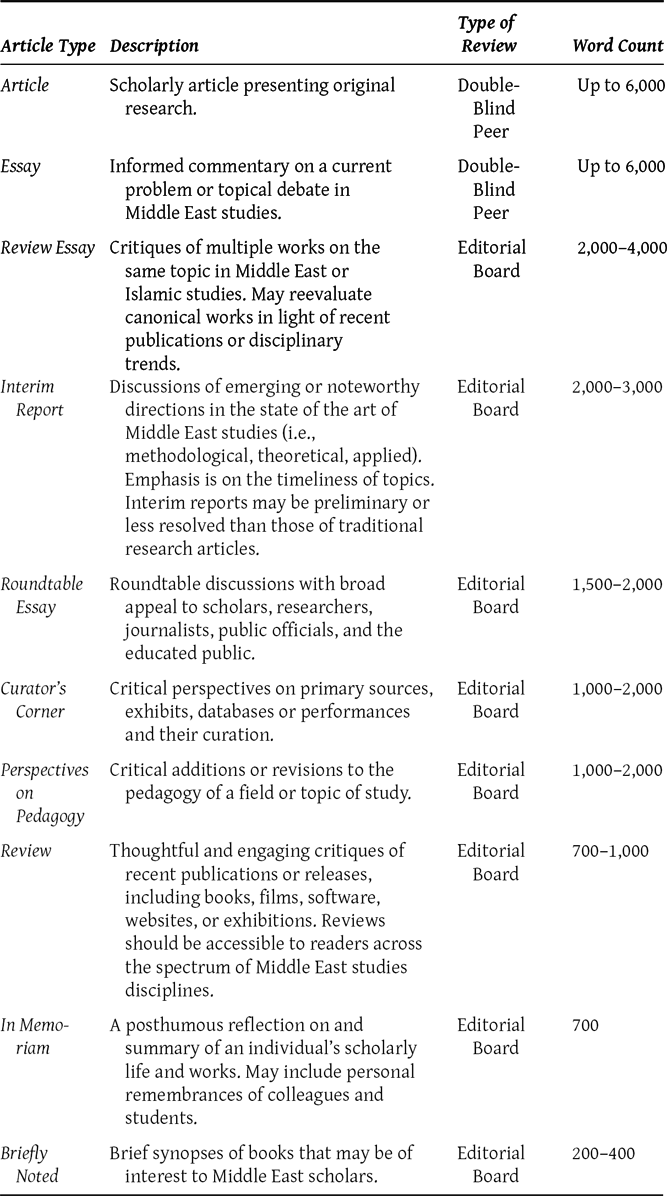
Finally, one distinct element of RoMES as a forum for book reviews has been its “Briefly Noted” section: short 200–400 word synopses written by undergraduates for books that might otherwise not appear within the Review’s pages. We will seek to draw on the collegiality of Middle East Studies professors within the consortium environment of the Claremont Colleges to implement this program once again. While the project may evolve slowly, Kelsey Cherland will lead the initiative and draw on her own time as a Middle East Studies/IR major at Claremont McKenna in order to do so.
In conclusion, RoMES has, and should more pointedly, spearhead an important shift toward a multi-sited platform that avoids flattening either the information it contains or the collaborators that produce it, and reaches instead toward capturing creative work “in action.” The implementation of “Perspectives on Pedagogy” and “Curator's Corner,” the expansion of roundtables and review essays, and the continuation of undergraduate participation are all preliminary steps taken toward that goal.
Respectfully submitted,
Heather Ferguson
Ashleigh Breske
Kelsey Cherland
Attachment A: Data Summary and Attachment B: Matrix of Article Types and Definitions
ATTACHMENT A: Data for 2017 RoMES Annual Report to MESA
Journal Statistics by Year (November 1, 2016- August 1, 2017)
Peer‐Reviewed Articles and Field Reports:
Invitations to submit issued: 12 (includes articles, roundtable articles, review essays, remembrance, and interims, etc.)
Invited submissions received: 12
Uninvited submissions: 14
Uninvited submissions accepted: 0
Uninvited submissions rejected: 12
Submissions under review: 3 (1 submission from before 11/1/16 is still under consideration)
Book Reviews:
Review books received by RoMES (VT): 102
Review books received by RoMES (CMC): 6
Books assigned to associate editors (w/o reviewers): 168
Reviewers found by associate editors (11/1/16 – 8/1/17): 79
Reviews currently being written: 49 (7 are overdue)
Completed reviews received: 58
Reviews written off (>6 months overdue): 15
Rejected reviews: 1
Books designated NO REVIEW: 18
Old book (pre-2015) purged from the system: 29
Books currently designated BRIEFLY NOTED: 8Footnote **
JOURNAL STATISTICS BY ISSUE
Issues Published:
Issue 50.2 (actual publication date: January 18, 2017)
Issue 51.1 (actual publication date: June 12, 2017)
Issue 51.2 (projected publication date: September 1, 2017)
Upcoming Issues:
Issue 52.1 (projected publication date: April 2018)
Issue 52.2 (projected publication date: October 2018)
Journal Content by Issue:

Publication Year of Books and Films Reviewed in Issue 50.2:


Publication Year of Books and Films Reviewed in Issue 51.1:


Publication Year of Books and Films Reviewed in Issue 51.2:

ATTACHMENT B: Article Types