Implications
Little information exists regarding the total economic value (TEV) of livestock breeds, especially concerning their breed-related public good functions. However, these functions are often used to justify support for endangered breed conservation. This paper illustrates how improved understanding of the relative importance of such values can help to inform conservation strategies by undertaking a case study exploration of the TEV of the Spanish Alistana–Sanabresa (AS) cattle breed. The cultural and existence values of this breed were highly valued, implying that AS conservation strategies focusing on these aspects would have higher public support and therefore be more likely to be successful.
Introduction
Worldwide, the number of livestock breeds is declining, mainly due to the expansion of intensive livestock production systems (Food and Agriculture Organization of the United Nations, 2007a). Such expansion has come largely at the expense of traditional diversified farming systems. Decisions about which breed to keep are increasingly being based on commercial considerations related to maximising the direct benefits arising from specialised animal production (Mendelsohn, Reference Mendelsohn2003). Therefore, many local breeds are no longer financially profitable and are hence increasingly unattractive to farmers whose livelihoods depend on income from livestock. However, significant non-market and/or public good values associated with livestock breed conservation have often been ignored in economic analysis. Such values relate to the use of livestock breeds in supporting agroecosystem resilience, in maintaining evolutionary processes and global option values, as well as maintaining landscapes, socio-cultural traditions, local identities and traditional knowledge (Mendelsohn, Reference Mendelsohn2003; Smale and Drucker, Reference Smale and Drucker2007; Narloch et al., Reference Narloch, Drucker and Pascual2011). Increasing awareness that the market has failed to fully account for the value of a wide range of livestock functions (i.e. the interactions of the animal with its environment, as expressed through performance and behaviour (Drucker and Anderson, Reference Drucker and Anderson2004)), particularly those associated with public goods, has led to conservation interventions with a view to maintaining these values for society.
One of the main instruments of government conservation policies has often been the use of direct support payments to compensate farmers for the reduced profitability of maintaining such breeds. In Spain, livestock conservation policies and programmes began in the mid-1990s leading to a period of stabilisation and a limited recovery of some population numbers. Despite this recovery, 29 out of the 37 indigenous Spanish cattle breeds are still currently recognised as endangered (Official Spanish Gazette, 15 February 2012). However, investment in the conservation of local livestock breeds competes with other socially desirable agricultural investments and the need for long-term support raises issues related to the sustainability of such approaches. Furthermore, the distribution of agricultural subsidies may not always be efficient and equitable (Cong and Brady, Reference Cong and Brady2012). It is therefore important to design any such interventions as effectively as possible.
The conceptual economic background to the loss of both plant and animal genetic resources has been described in detail elsewhere (among others see: Drucker et al., Reference Drucker, Gomez and Anderson2001; Narloch et al., Reference Narloch, Drucker and Pascual2011; Krishna et al., Reference Krishna, Drucker, Pascual, Raghu and EDIO2013). Proper assessment of the full range of functions provided by livestock, as expressed in terms of their total economic value (TEV), can support decision making in livestock conservation and sustainable use (Drucker et al., Reference Drucker, Gomez and Anderson2001). Improved understanding of the TEV of threatened breeds and the relative weights of its different components can be used to help determine which kinds of interventions and incentive mechanisms might be most appropriate for ensuring their long-term survival.
In this paper we apply a TEV framework (Bateman et al., Reference Bateman, Carson, Day, Hahnemann, Hanley, Hutt, Jones-Lee, Loomes, Mourato, Özdemiroğlu, Pearce, Sugden and Swanson2002), classifying such values into use and non-use components, where the latter include option and existence values. For livestock, direct use values include production outputs. Indirect use values relate to the role of livestock in supporting the maintenance of rural culture and landscapes. Option value is related to the potential future use of livestock including for adaptation to climate change and existence values relate to the utility derived by people from knowing that a specific resource simply exists. It has been argued that the relevance of such values may well depend on the type of stakeholder and their socio-economic status (Louviere et al., Reference Louviere, Hensher and Swait2000)
The challenge in determining the TEV of a livestock breed arises from the private and public good values of plant and animal genetic resources. Stated preference valuation methods have consequently been employed to determine such values. One method that has increasingly been used is based on the use of choice experiments (CE), which allows the valuation of individual attributes of a given good or components of its TEV (Hanley et al., Reference Hanley, Wright and Adamowicz1998). Under such methods the stated values are expressed by the respondent’s willingness to pay (WTP) or willingness to accept compensation for the existence of or changes in environmental quality. A number of economic studies using CE in order to examine farmers’ values for livestock breed traits have been undertaken to date (e.g. Scarpa et al., Reference Scarpa, Drucker, Anderson, Ferraes-Ehuan, Gomez, Risopatron and Rubio-Leonel2003; Zander and Drucker, Reference Zander and Drucker2008; Zander et al., Reference Zander, Signorello, De Salvo, Gandini and Drucker2013).
With a view to supporting the design of public intervention in the conservation of livestock breeds, this paper focuses on the threatened Alistana–Sanabresa (AS) breed as a case study with which to illustrate the above dynamics and implications of its non-market public good values for conservation strategy planning. This paper consequently seeks to contribute further to the literature by: (1) analysing the relative importance of the non-market components of the TEV of the AS breed; (2) determining the socio-economic variables that influence people’s valuation of the different components of its TEV; and (3) assessing the implications for AS conservation strategy in Spain.
This study was realised in the context of the project ‘Towards self-sustainable European regional cattle breeds’ (EURECA; Hiemstra et al., Reference Hiemstra, de Haas, Mäki-Tanila and Gandini2010), which included the valuation of cattle breeds using a common stated preference CE approach in four European countries; Italy (Zander et al., Reference Zander, Signorello, De Salvo, Gandini and Drucker2013), Spain, Estonia and the Netherlands.
Material and methods
Study breed and area
The AS breed is found in the mountainous regions of Aliste and Sanabria in the northwest of Zamora province. Traditionally, animals were bred in small herds, stabled during the winter and allowed to range freely when weather conditions permitted. The AS was a multipurpose breed located within a diversified family-based farming system oriented towards animal production, mountain agriculture and forestry. Such traditional farming systems have been increasingly restricted to the culturally and geographically isolated regions of Aliste and Sanabria. By the mid-1990s, the AS breed was close to extinction, with a population size of <1500 individuals (Yanes García, Reference Yanes García2000). A conservation programme began in 1998 when provincial agricultural authorities created a breed herdbook and promoted the foundation of the AS Breeders Association. Since its creation the Breeders Association has worked in the promotion and development of the breed and its products, contributing to the recovery of the AS population, which now numbers over 3000 breeding females (Alistana–Sanabresa Breeders Association data, 2013). Nevertheless, despite this population increase, it remains an endangered breed according to the Spanish Ministry of Agriculture, Food and Environment (Official Spanish Gazette, 15 February 2012). Nowadays, the breed can be characterised as being reared under three different types of farming systems: a slightly modified traditional system, an evolved traditional system and an extensive system. The first system is formed by farms that introduced some technical innovations, such as the use of compound feed, but are still using traditional stone stables and traditional marketing channels (cattle dealers and local cattle markets). The evolved traditional system has gone further in terms of transformation. Farms of this type are specialised in beef production, have modern infrastructure and make use of a variety of marketing channels as well as the traditional cattle dealers. Finally, farms rearing AS cattle under extensive systems have appeared, being mostly located in the agriculture-oriented regions of the centre of Zamora province. It is these types of farms that are responsible for the current limited growth of AS breed numbers.
Cultural elements generated through generations of coexistence with the AS breed still remain. An example is the AS breed market of Porto de Sanabria, which can be traced back to the XIX century. Meat from the AS has traditionally been considered in the province as a high-quality product. However, despite this reputation, it is not always straightforward for consumers to find breed-related products, as no breed-specific label has been developed, leading some producers to argue that niche product market development could be a successful strategy for supporting conservation activities.
The CE design
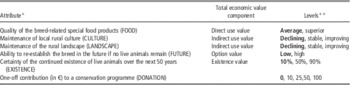
A CE was used to determine the non-market TEV components of the AS breed. In these sort of experiments respondents are presented with a series of choice sets each containing a finite number of scenarios which describe the environmental good in question (Hensher et al., Reference Hensher, Rose and Greene2005). The choice sets are described through attributes that change under each scenario. A monetary attribute is usually included which allows WTP estimates to be assigned to each of the attributes; with such estimates representing the utility that respondents derive from the attributes of a given scenario. The selection of the attributes and levels that would be used in the CE was carried out in consultation with Spanish cattle experts and the design was pre-tested before the main survey was undertaken. Table 1 contains a description of the attributes, their relationship to specific components of TEV and the number of attribute levels considered in the CE. We accounted for elements of direct use, indirect use, option and existence values. Cultural and landscape values of the AS breed were explicitly considered, as these two indirect use value attributes are often given as a justification for breed conservation interventions (Mendelsohn, Reference Mendelsohn2003; Food and Agriculture Organization of the United Nations (FAO), 2007a). The payment vehicle (the monetary attribute) used was a one-off contribution (ranging from €0 to €100) to a conservation programme for the AS. The use of such a one-off payment vehicle, that is commonly used in stated preference valuation approaches, can facilitate respondent recognition of the actual total cost associated with each conservation scenario and can ultimately be expressed in terms of an annualised equivalent.
Attributes used to describe the choice scenarios, their levels considered in the choice experiment and their relationship to specific components of the total economic value of Alistana–Sanabresa cattle breed

+ The variables names as used in the model and in the text are in brackets.
++ Status quo levels indicated in bold.
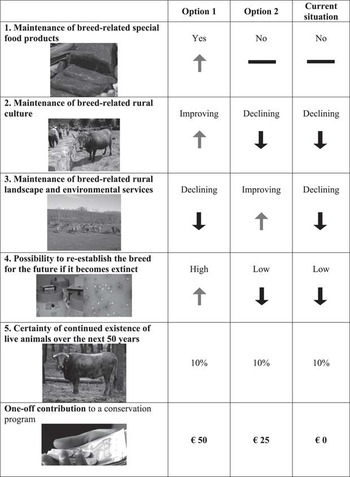
We created choice sets with three scenarios, one of which was always a status quo (SQ) scenario. The other two represented the outcomes of hypothetical conservation programmes relative to the SQ (Figure 1). Respondents were asked to select their preferred scenario, noting that they incurred no financial cost if selecting the SQ, while the other two scenarios would involve a once-off donation to an AS breed conservation programme. Given the number of attributes and their levels, there were 540 (2^2×3^3×5^1) potential choice sets. To optimise the design we used Ngene software (Rose et al., 2008) in order to determine a design with a reduced number of choice sets while permitting the estimation of parameters with the lowest possible standard errors. The resulting design comprised 12 choice sets, which were divided into two blocks. Each respondent was presented with one of the two blocks and was hence asked to make six choices.
Example of choice set presented to respondents describing the scenario outcomes of alternative hypothetical Alistana–Sanabresa breed conservation programmes and the one-off donation required.

Survey procedure
A total of 203 households were interviewed, 102 in Zamora city and 101 in six villages within Zamora province. Villages selected were located in the Aliste and Sanabria regions. This sampling approach permitted us to differentiate between areas with residents for whom the AS is local and areas whose residents are more distant from the places where the AS breed is found, in order to test for differences in the AS TEV between these different types of stakeholder.
Data related to several socio-economic variables were also collected in order to explore their effect on AS TEV. Respondents were selected in such a way as to ensure a balanced sample of the population with regard to gender, age and job status. Additional data related to respondent knowledge about the AS breed was also compiled. The full questionnaire is presented in Supplementary material S1. Potential adult respondents were approached in public places such as public squares, markets, universities and schools. Before the application of the CE they were informed about the objectives of the research and, for those who agreed to take part, were provided with additional introductory information. This included information regarding the importance of livestock breeds, the current status of animal genetic resources worldwide, as well as the specific status of local Spanish cattle breeds, including that of the AS. Such information included a set of photographs also shown to the respondents to help to familiarise them further with the topic and the breed in question. Given that information about the status of local breeds can be relatively easily placed in the context of environmental degradation and biodiversity loss, we consider that the limited information provided was in fact sufficient for people to build an informed opinion about farm animal genetic resources conservation issues.
Theoretical framework
Random utility theory (Luce and Tukey, Reference Luce and Tukey1964; McFadden, Reference McFadden1974) provides the theoretical framework for analysing choice data. It is assumed that respondents choose their most preferred scenario which yields the highest utility. Utility is a function of a vector of the attributes (and potentially socio-economic characteristics of respondents) and some unexplained component (random residual term). The probability of respondents choosing a scenario can then be expressed by a probabilistic model. Dependent on different assumptions of the unexplained (stochastic) component, different models can be applied, such as multinomial logit (MNL) models or random parameter logit (RPL) models.
Because of the well-known limitations of MNL models (Hensher et al., Reference Hensher, Rose and Greene2005), we applied RPL models. These models are flexible, allowing preference variation across respondents and the use of panel data (resulting from the multiple choices made by any one respondent). Detailed random parameter model specifications can be found in Hensher and Greene (Reference Hensher and Greene2003) and Hensher et al. (Reference Hensher, Rose and Greene2005). Choice models are based on modelling the level of utility that a respondent obtains from an alternative. Utilities for each of the scenarios are not directly observable but can be modelled by a set of known covariables (usually, the attributes of each alternative and, possibly, characteristics of the respondents) and a random residual term that captures the unexplained variation in utility values. In the random parameter choice models, the respondent’s perceived utility from a given alternative is allowed to differ on each occasion the alternative is evaluated by the same individual. In addition, and the explanatory covariables receive weights that are not fixed but vary among respondents to allow for different preferences. The general model can be written as:
 $$U_{{njt}} =\beta _{{\rm n}}^{{\rm '}} x_{{nj}} {\plus}{\varepsilon}_{{njt}} $$
where U njt is the utility perceived by the decision maker n of alternative j on occasion t, β n is a vector of random parameters defining the weight of each covariable on the value of the utility, x nj is a vector containing the known values for the level of covariables (attributes and monetary value) associated with alternative j, and, ε njt is a random residual term.
In our study, covariables included values for the attributes of the breed (Table 1), as well as socio-economic variables (Supplementary Table S1 and Table 2). The monetary attribute was coded using the actual values presented, while all other variables were dummy coded. We also included scenario specific constants to capture the average effect on utility of all factors that are not included in the model. Interaction terms between the socio-economic/attitudinal parameters (Supplementary Table S1) and the SQ were included in order to detect the source of preference heterogeneity among respondents by explaining which kind of respondents were more likely to be unwilling to pay (i.e. preferring to choose the SQ) for the conservation of AS breed. Estimation was carried out by maximising the log likelihood of the observed choices using simulation procedures to sample values of the marginal distributions of the parameters of interest. The levels of the SQ alternative were used as the reference levels for the attribute levels. Consequently, results for the estimated coefficients are considered in relation to the coefficients of the attributes of the SQ. The monetary attribute was coded using the actual monetary values presented in the CE, while all other variables were dummy coded.
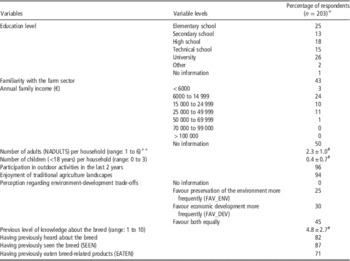
Respondents’ socio-economic characteristics

+ 101 from villages and 102 from Zamora city.
++ The variables names as used in the model and in the text are in brackets.
# Mean±standard deviation.
The WTP or welfare estimates of a marginal change in an attribute level were calculated as the (negative) ratio of the attribute coefficients to the monetary coefficient. Positive values of the ratio signify that respondents are willing to pay, negative value signify that respondents suffer a loss in welfare, expressed by their willingness to accept compensation. Because we used a RPL model, the welfare estimates had to be obtained through simulating these ratios. Using the mean and standard deviation of each distribution, we simulated the WTP distribution for each attribute 10 000 times (as per Thiene and Scarpa, Reference Thiene and Scarpa2009). We report the mean, and the upper and lower quartiles (i.e. the amounts that individuals would be willing to pay at least 25% or 75% of the time, respectively) to account for randomness (Marsh, Reference Marsh2012).
Results
Respondents’ characteristics
Job status, age and gender were evenly represented among respondents in the villages and in Zamora city (Supplementary Table S1). Respondents covered the full range of educational levels (Table 2). A high proportion of respondents (43%) had agricultural sector-related jobs. The vast majority of respondents stated that they had undertaken an outdoor activity in the countryside at least once in the last 2 years and that they enjoy seeing traditional agricultural landscapes when they are in the countryside. Thirty per cent of respondents stated that they favoured economic development, while 25% favoured nature conservation when trade-offs arise. The remainder placed equal importance on both aspects. The mean stated level of knowledge related to the AS breed averaged 4.8 on a 10-point scale. Most respondents (84%) had heard of the AS breed, 87% had seen it before and 74% had eaten its products. Approximately half of the respondents refused to give information regarding their family income, while the remainder mostly stated that they have a low level of family income.
Results of the CE
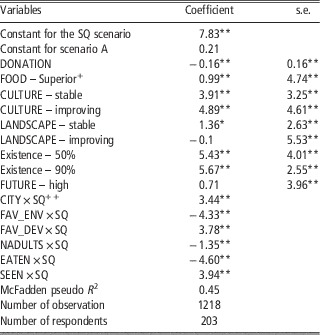
The best model, according to the likelihood ratio tests, was found to be one in which the two alternative specific constants were non-random and all attributes entered the model as random and normally distributed; apart from the monetary attribute which was constrained to having a triangular distribution with a standard variation not larger than the mean. This constraint avoids the coefficient of the monetary attribute taking a negative sign (Hensher et al., Reference Hensher, Rose and Greene2005). The model had a McFadden R 2 (McFadden, Reference McFadden1974) of 0.45. The SQ constant was found to be significant and positive (7.83), meaning that respondents were more likely to choose the SQ than choosing one of the other two scenarios. Approximately half of the respondents (105% or 51%) always chose the SQ option. The alternative specific constant for Alternative A was not significant, which is desirable as it means that ‘left-right’ bias (i.e. the order in which scenarios are presented on a choice card) was not present in respondents’ choices. The coefficient for donation was negative and significant (−0.16), meaning that, as expected, the higher the costs for respondents, the less likely that that alternative would be chosen.
All the coefficients of the significant attributes had positive signs meaning that respondents preferred improvements compared with the levels of the SQ (Table 3). Respondents were found to be indifferent towards the attribute FUTURE (see Table 1 for a detailed description of the attributes named in uppercase) and to the level ‘improving’ of the LANDSCAPE attribute. The standard deviations were significant for all attributes (Table 3), meaning that the preference parameter is not constant across the population. This is reflected in the large difference between the upper and lower quartiles in the welfare estimates of the significant attributes of the model (Table 4).
Results of the random parameter logit model, attributes of the components of the total economic value of Alistana–Sanabresa cattle breed and respondents’ socio-economic characteristics that influence such values

+ Name and level of the attribute of the components of the total economic value of the Alistana–Sanabresa cattle breed as explained in Table 1.
++ Interaction between socio-economic variables and the status quo (SQ). Name of the socio-economic variable as explained in Table 2. CITY refers to respondent living in Zamora city as opposed to those living in villages.
* 5% significance level.
** 1% significance level.
Welfare estimates of the attributes of the components of the total economic value of the Alistana–Sanabresa beef cattle breed

+ The table includes the significant attributes of the model.
++ The total economic value (TEV) of the Alistana–Sanabresa breed was calculated by summing the welfare estimates of the highest levels of the attributes.
# Status quo levels to which attribute levels are compared indicated in brackets.
In order to understand preference variation, interaction terms between socio-economic variables and the SQ were included in the model and those that were significant are reported in Table 3. Respondents who lived in Zamora city were more likely to choose the SQ (CITY×SQ coefficient equal to 3.44). Regarding respondents’ general attitude towards economic development-environment trade-offs, those who stated favouring environment (FAV_ENV×SQ) were less likely (−4.33) to choose the SQ, while those who favour economic development (FAV_DEV×SQ) were more likely to do so (3.78). Households with fewer adults (NADULTS×SQ) were less likely to prefer the SQ (−1.35), as were respondents who had previously eaten (EATEN×SQ) AS breed-related products (−4.60). Unexpectedly, respondents who had seen the breed before (SEEN×SQ) were more likely (3.94) to choose the SQ.
Estimating TEV
Overall, the welfare estimates of the significant attributes (Table 4) reveal that respondents would be willing to pay €7 for superior quality breed-related special food products, €25 for stabilising and €31 for improving the maintenance of local rural culture, €9 for a stable landscape, €34 for a 50% certainty of the breed’s continued existence and €36 for a 90% certainty.
The total economic value of the AS breed was calculated by summing the highest levels of the attributes (see Table 4) and represents a one-off WTP. The TEV for the AS can therefore be seen to total €83 (€7 direct use value+€40 for indirect use values (€9 for landscape and €31 for cultural value)+€36 for non-use existence values). It can therefore be seen that over 91% of TEV of the AS breed is associated with public good indirect use and non-use values, with existence values and the maintenance of traditional culture being particularly important (representing just over 80% of TEV).
Discussion
Socio-economic variables influencing TEV
Several socio-economic variables influencing people’s valuation of the AS breed were identified. As hypothesised, the location of the respondent had a significant influence on WTP for AS conservation, with villagers being more likely to pay than city residents. Such a result may be expected as the villagers surveyed were in the region of origin of the AS breed and their inhabitants are more closely linked to the breed, with it forming a recognisable element of their local culture. Their support for AS conservation may be seen as a recognition of the importance of the AS breed and an appreciation of how its loss could threaten their culture and way of life, as such breed loss has threatened to do elsewhere (Zander and Drucker, Reference Zander and Drucker2008).
With regard to family income, it was hypothesised that income status would influence WTP. However, no such significant impact was found. One explanation for such a finding is that the one-off contribution requested may have been small enough to be affordable to everybody independently of their income level. However, we are unable to test for this explicitly.
Awareness regarding endangered farm animal breeds is considered to be an important factor for the success of conservation programmes (FAO, 2007b). In our study, none of the factors measuring respondent knowledge about the breed were found to influence WTP for its conservation. However, we have to consider that many of the respondents did in fact already have some knowledge regarding the current situation of the AS, as most of the respondents (82%) had heard about it or had some previous knowledge of the breed (with a rating of 4.8 out of 10).
Respondents’ attitude towards economic development-environment trade-offs influenced WTP for AS conservation in the expected direction. Those people who stated that they tend to favour environment over economic development in situations where a trade-off exists were shown to be more likely to be WTP to conserve the AS breed, as were those respondents who had eaten AS beef. However, those who had previously seen the AS were unexpectedly less likely to do so. Such a result may arise as a result of the fact that aesthetically the AS breed is very similar to other breeds in the neighbouring regions of Northwest Spain (Yanes García, Reference Yanes García2000).
Attribute values and policy implications
In our study, the AS breed has been shown to have significant public good values associated with it. Although people placed a value on direct use aspects they placed higher values on the indirect use cultural and landscape maintenance functions, as well as its existence value (Table 3).
The direct use value of AS beef was not highly valued overall (€7), with some respondents not placing any value at all on this attribute (Table 4). Since AS breed products do have a good reputation as a high-quality traditional product, this may suggest that improved differentiation and marketing of its products may be necessary. However, the low overall value also suggests that the ability of such niche product market development investments to generate sufficient funding for attaining conservation strategy goals may in fact be limited.
The indirect use cultural value of the AS was found to be between three to four times higher than the direct use value. Respondents were willing to pay more (31€) for improving cultural aspects associated with the breed than for merely maintaining them (€25), a fact that might reflect that the current status of AS cultural traditions is perceived as poor. The limited increase in AS population numbers has largely arisen from an increase in farm sizes and as a result of the development of extensive farming systems, while the semi-stabled ones continue to disappear. This dynamic has been more pronounced among the slightly modified traditional farms, which may be particularly associated with the maintenance of cultural traditional practices; only tens of such farms now remain scattered across the Aliste and Sanabria regions.
The findings related to the indirect use value related to landscape maintenance contrast with the above. Although respondents would pay €9 for maintaining the landscape as it is, they are not willing to pay to improve it (Table 4). This finding may indicate that the current landscape status might be considered to be satisfactory from the perspective of the respondents. This perspective seems logical since the farming sector continues to remain important in Zamora province and the agriculture landscape is still ‘well conserved’. The corollary to this is that if such environmental quality declines, it might be expected that the AS indirect value related to landscape maintenance would become more highly appreciated.
The high existence value indicates the importance respondents place on the AS breed regardless of its use values. Respondents would pay €36 for a 90% probability of ensuring the existence of the AS over the next 50 years, which is the highest valued attribute of AS TEV. Finally, and unexpectedly, respondents did not place importance on the option value of the AS breed. Although this may indicate that the public does not perceive the AS breed as having a role in adapting to future change (which may be related to the incomplete levels of public awareness about farm animal genetic resources functions, as noted earlier), the high existence value figure may also be an indication of the fact that respondents’ perceive these values to largely overlap.
Overall, the results indicate that respondents were willing to pay around three to four times as much for the existence and cultural values of the AS than for its landscape and direct use values, which is in line with the findings of Zander et al. (Reference Zander, Signorello, De Salvo, Gandini and Drucker2013). In particular, the cultural value of the AS (37.3% of TEV) suggests that agritourism development, with funds being invested to help farmers to maintain/restore cultural aspects related to traditional farming practices (e.g. restoring traditional stables, holding fairs, etc.) and to attract tourists to farms, may well be worth exploring in greater detail as a potential component of a comprehensive AS conservation and use strategy. The establishment of anthropological museums as part of such a campaign to foster ecotourism could also complement such development, especially in the Sanabria region where the rural tourism sector is well developed. Where linked with cultural dimensions, niche product development opportunities may also be worth exploring. Furthermore, although our results have indicated that public WTP for such products is likely to be limited, the identification of any such opportunities would nonetheless be of particular importance to those farmers using evolved management systems or those located outside of areas with culturally unique attributes. Such niche product development work is already on-going to some extent, with the AS Breeders Association supporting the promotion of the breed and its products, as well as helping to raise public awareness in general.
Given that farmers cannot be expected to, or be able to afford to maintain the AS at socially desirable levels, the development of incentive mechanisms to allow farmers to capture some of those public good values when they are significant (as has been shown in this study, where they comprise 91% of TEV) may be justified. The development of such positive incentives is also in line with those advocated for all types of biodiversity under the Convention of Biological Diversity 2011–2020 Strategic Framework. Based on the figures presented above, the value the general public in Zamora province placed on the public good functions of the AS breed may be estimated as being approximately €12.2 m (€76×160 000 adult individuals) or €608 000 on an annualised basis (over 20 years, assuming a standard 5% discount rate). Thus, we may conclude that the loss of this breed (even where total meat/milk production remains unchanged by using an alternative breed) would imply the loss of significant public good values. Finally, we note that although half of the respondents stated that they were not willing to pay for the conservation of AS breed, this may not necessarily reflect a lack of interest in conserving the breed rather than a perception of responsibilities. Martín-Lopez et al. (Reference Martín-Lopez, Montes and Benayas2007) in a wildlife conservation study found that many respondents stated that they considered that the conservation of wildlife species is the duty of governments and not of private individuals. The extent to which policies related to public spending and government interventionism may actually influence people’s perception of responsibility and therefore private WTP for the conservation of local breeds is thus a future research topic of interest, since it could have a significant influence on the design of stated preference approaches.
Conclusions
This paper has shown how CEs can be used to explore the value that people place on the non-market attributes of local livestock breeds. The results of such stated preference techniques may be used to inform the design of conservation strategies. While the approach used has broader applications, the case study analysis carried out in this paper reveals that the most valuable attributes of AS cattle breed were shown to be related to securing cultural aspects and the long-term continued existence of the breed. Insofar as the intervention strategies with the highest potential to maximise societal welfare would be those that secure the breed-related functions that people value most, appropriate in situ conservation interventions and strategies may be identified accordingly.
Acknowledgments
The authors wish to thank UE 012 AGRIGENRES 870/2004 (EURECA) and the Collaboration Agreement (CC09-009) between INIA and FEAGAS which is supported with funds from the Spanish Ministry of Agriculture Food and Environment for funding this study. They are very thankful to the Alistana–Sanabresa Breeders Association for their collaboration and assistance with fieldwork.