The Nabonidus Chronicle is an ancient Babylonian text inscribed in cuneiform script on a clay tablet preserved in the British Museum in London. The chronicle lists the key events of each year from the beginning of the reign of Nabonidus in 556 bc to some time after 539 bc, and includes a reference to the conquest of Babylon by Cyrus the Great and the beginning of the reign of his son, Cambyses. It describes Cambyses’ royal investiture ceremony, saying that this took place in the temple of Nabû at Babylon on the fourth day of the month of Nisannu (March/April) in 538 bc, a year after the Persian conquest.Footnote 1 According to the latest collation of this text by A R George,Footnote 2 a reference is made to either Cambyses or, more likely, his father Cyrus, wearing an ‘Elamite’ garment at the ceremony. The translation reads:
When, on the fourth day [of Nisannu], Cambyses, the son of Cyrus, went to E-ningidar-kalamma-summu, the official of the Sceptre House of Nabû [or possibly the shangû-priest of Nabû] [… gave him …] the Sceptre of the [… Land …]. When [… Cyrus …] came, in Elamite attire he [… took …] the hands of Nabû […] lances and quivers he picked [… up, and …] with the crown-prince [… he came down …] into the courtyard. He [or possibly they] went back [… from the temple …] of Nabû to E-sagil. [… He/they libated …] ale before Bēl and the Son of […].
In discussing this passage, George notes that ‘the detail that was most noteworthy for the chronicler was evidently the fact that someone involved in the ceremony wore Elamite clothing’.Footnote 3 George elaborates: ‘probably Elamite clothing means Persian dress’. This particular line was modified slightly by Kuhrt when she reiterates that ‘the detail that was most noteworthy for the chronicler was evidently the fact that someone involved in the ceremony wore Elamite-Persian clothing’.Footnote 4 Lastly, Henkelman has suggested that reference to Elamite attire may primarily be interpreted as ‘non-Babylonian’, the main reason being the archaic nature of the terms used in the Chronicle and the title ‘king of Elam’ given to Cyrus by the Dynastic Prophecy.Footnote 5
A contrary view was articulated by Oppenheim who suggested that Cambyses’ appearance at the temple of Nabû in Elamite attire, ‘armed to the teeth with spears and quivers’, was possibly an irrational act.Footnote 6 The illogical nature of this act, in Oppenheim’s view, relies on the idea that, by wearing an Elamite-style garment, Cambyses was being insensitive to Babylonian protocol and that the chief priest of the temple, considering this attire unfit for the occasion, therefore refused him the sceptre.Footnote 7 In his concluding remarks Oppenheim stresses the peculiar nature of the entire passage, commenting that ‘it would be interesting to find out what “Elamite attire” meant specifically in this instance in view of the well-known relationship between Elamite and Persian dress’.Footnote 8
Without overstating the fact that the conqueror of Babylon and the restorer of the cult of Marduk (Cyrus) must have had an extensive range of ceremonial garments at his disposal (and, consequently, a wide range of symbols by which to state the personal, religious and political circumstances of the moment), it is indeed significant that Cyrus came to the time-honoured religious centre of Mesopotamia fully clad in what is said to be ‘Elamite’ attire.Footnote 9 Because of the enormous significance of the investiture ceremony, it is difficult to believe that every detail of the performance, ritual dress and associated regalia were not carefully choreographed (for what must have been an extraordinary visual display).Footnote 10 This is further underlined by the fact that on those exceptional occasions when the (Babylonian) king could not be present in the ceremonies to ‘take Bel by the hand’, he was asked to send a garment.Footnote 11 The enormous significance of the royal garment is emphasized by another example, this time from Assyria, revealing that a kusîtu garment was used by Esarhaddon as royal insignia: ‘you have girt your son with the kusîtu and [thus] you have endowed him with the kingship over Assyria’.Footnote 12 One may infer that in Assyrian and Babylonian investiture ceremonials it was the king’s garment that symbolically represented the persona of the king, that is, his vestis regia. Hence, in the light of this tradition, the adoption by Cyrus of an ‘Elamite’ garment suggests a careful choice of regalia providing a significant reference to aspects of the political and cultural identity of Cyrus the Great.
The notion that the Elamite dress ought to be interpreted as meaning a Persian or an Elamite-Persian dress should be dispelled.Footnote 13 Nowhere in the Nabonidus Chronicle is it said that Cyrus was a Persian. Neither is Cyrus ever identified as a Persian (or, for that matter, as an Elamite) but as king of Anšan or as king of Parsu, the former term most likely referring to the ancient eastern Elamite capital located in Tall-e Malyan, the latter term perhaps coterminous with some area of Fārs.Footnote 14 Accordingly, there is no indication that, at this particular moment and from a Babylonian viewpoint, the terms Elamite and Persian were interchangeable. The second presumption, that the adjective Elamite is an archaism denoting a non-Babylonian garment, has all the signs of becoming an academic concern, given the relative nature of archaisms (defined as an antiquated word no longer in use).Footnote 15 The overall pattern of language used in the Nabonidus Chronicle purposely follows antiquated scribal traditions well attested in both neo-Babylonian and neo-Assyrian royal inscriptions. From the point of view of the Mesopotamian learned class, these words expressed a notion of time in which historical events were conceived mythically (not chronologically); it is in the scribal tradition to preserve, as it were, the essence of the past.Footnote 16 As such, some words not only remained suitable many centuries after they were first conceived, but were not replaced or updated even with the emergence of new historical realities.Footnote 17 This perpetuation of past historical realities, moreover, is not applicable to Elam, which clearly remained a political and cultural reality at least until the time of Darius i. It should also be noted that Babylonian astronomical and astrological literature of the first millennium bc conceived the word Elamite as a geographic term referring to the east or the south east.Footnote 18 In sum and no matter what meaning we ascribe to the adjective ‘Elamite’, Cyrus did not wear traditional Babylonian regalia.Footnote 19
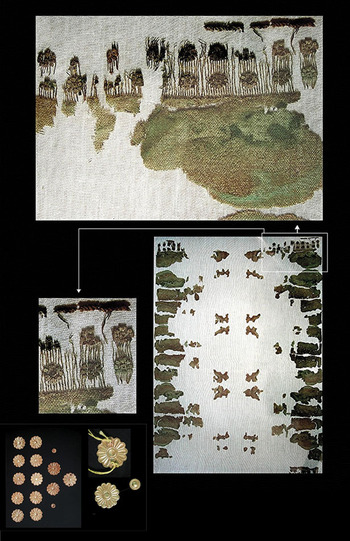
The fact that the Babylonian Chronicle described what must have been an elite, ceremonial, non-Babylonian garment as ‘Elamite’ forces examination of the characteristics of seventh- and sixth-century bc elite Elamite garments. Despite the wealth of artistic, textual and material evidence, the systematic study of Elamite dress and textiles is still largely in its infancy. Recently, and prompted by the discovery inside the Arjan tomb of cotton textiles and golden bracteates (see fig 1), the author was able to assess the late neo-Elamite physical and artistic evidence and suggested the likelihood that by around 600 bc the ruling Elamite class wore fine fringed garments, possibly made of cotton fabric festooned with embroideries and ladder bands (a row of evenly spaced parallel lines segmented into squares or rectangles), and with golden bracteates.Footnote 20
Remains of cotton textiles and gold bracteates from the Arjan tomb. Photographs: courtesy of the National Museum of Iran

By the time of Ashurbanipal, the ornamentation of elite neo-Assyrian garments had clearly evolved towards a more ‘minimalist’ display of arrangements and motifs, but this reduced repertoire of motifs contrasts with the greater affluence of bracteates in the shape of rosettes, circles or dots, and squares.Footnote 21 Seventh-century bc Babylonian texts may also tell a similar story, as they reveal that the ‘golden sky garments’ of female divinities were thoroughly embellished with limited styles of bracteates: aiaru (rosettes), niphu (disks) and tenšia (possibly squares).Footnote 22 But perhaps the most notable addition to fibre used in antiquity was the introduction of cotton in the Near East. Indeed, as revealed by both textual evidence from Assyria and material evidence from Nimrud and Arjan, cotton can be said to have been introduced in Mesopotamia and Elam between the eighth and sixth centuries bc.Footnote 23 Additionally, material evidence from Marlik, the royal tombs of Nimrud and the tomb of Arjan reveals the existence of golden bracteates in the shape of rosettes, stars, circles and triangles; at Arjan, for instance, we have a representation of thirty-four rosettes and sixty-four disks with convex elevation and a circular row of granulation (fig 1).Footnote 24 Taken all together, this summary substantiates the presence of splendid wardrobes and luxurious fabrics, sumptuously ornamented with sophisticated embroidery (needle work), fringes (knotted work, including embroidered rosettes) and metal appliqués (bracteates).
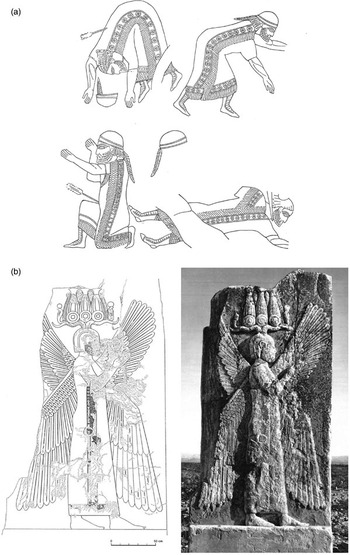
Beside this background of material evidence, the most direct artistic reference to the ‘Elamite’ garment of Cyrus is supplied by the so-called four-winged genius sculpted on a stone door jamb from Pasargadae (post-dating c 539 bc).Footnote 25 The two doorways to the hypostyle building known as Portal or Gate R used to house four comparable images of the winged guardian facing into the interior of the building (fig 2b).Footnote 26 To this day, the winged guardian from Pasargadae remains the single most important surviving relief made during the time of Cyrus the Great (559–530 bc). Justifiably, this enigmatic figure has also been widely and differently described, discussed and interpreted.Footnote 27 The body is clad in a full-length fringed robe that passes over the right arm. The only visible remains of ornamentation are reduced to vertical and horizontal hems, which are backed by a narrow border of rosettes, each rosette having eight petals and eight minute sepals. Many scholars since Dieulafoy have commented on the close parallels between the costume of the Pasargadae figure and that worn by Elamite king Te’umman, as represented in extensive slab-relief narratives in the South-west Palace of Sennacherib and the North Palace of Assurbanipal, both at Nineveh (c 653 bc).Footnote 28 In these reliefs Te’umman is represented wearing a small dome-like cap with a horizontal band at the border and an attachment in the shape of a feather (fig 2a). He has a short beard and a hairstyle of distinctive locks reaching down to shoulder level. He wears a short-sleeved long robe, embellished with vertical and horizontal fringes and decorated with a band of rosettes.Footnote 29 This fringed garment style has been labelled a fransenmantel.Footnote 30
(a) The Elamite king, Te’umman. Drawings: Sarre and Herzfeld Reference Sarre and Herzfeld1910, fig 78; (b) winged protective genius from Pasargadae. Drawing: after Stronach Reference Stronach1978, fig 25; photograph: after Ghirshman Reference Ghirshman1964, 128

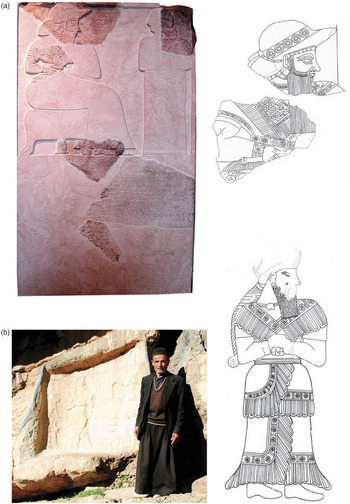
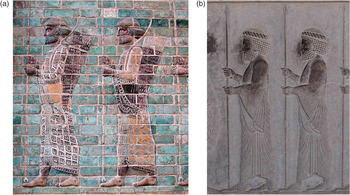
The fransenmantel style of garment worn by the winged guardian from Pasargadae (c 538 bc) coincidentally finds its most noticeable reference on Assyrian reliefs manufactured more than a hundred years earlier. A key characteristic of the fransenmantel is an emphasis on conspicuous fringes ornamented with a ladder band of rosettes or disks. This concentration on the depiction of fringes and bracteates may imply either that the remainder of the garment was not ornamented or that the revelation of its ornamental characteristics was not the artist’s primary interest, though we need to be cautious, as there are grounds for believing that most reliefs originally included decorative patterns and colours that, for the most part, have not survived (for example, compare the treatment of identical garments in two different media: those worn by the Persian royal bodyguards depicted in the glazed tiles from Susa, now in the Louvre, and those depicted in slab reliefs from the Apadana at Persepolis, fig 3).Footnote 31 As it stands, however, the dominance of the fringe and complementary bracteates overrides any other consideration of style. Small variations also exist at the level of the fringe itself. For instance, the highland-style, segmented, fringed coat worn by Hanni, ‘protector’ or ‘lord’ of Aiapir (c 625–585 bc), was treated with long fringes and ladder bands of oversize rosettes (fig 4b), and the fransenmantel worn by the Elamite king Atta-hamiti-Inšušinak (c 645/620 bc–c 530/520 bc) was ornamented with fringes and ladder bands of small nested discs (fig 4a).Footnote 32 Nevertheless, as we have seen, both the garments of Te’umman and the winged guardian from Pasargadae have fringes with bands of rosettes but no ladder bands. In brief, these four examples of elite Elamite, or Elamite-related, fringed wardrobes provide a significant and distinct background to the characteristics of seventh- and sixth-centuries bc royal ceremonial garments. The distinctiveness of this clothing is further accentuated by a broader stylistic garment repertoire represented, at one end, by lavish Mesopotamian wardrobes and, at the other end, by a variety of new garment styles introduced during the Persian empire, including softer and lighter fabrics and pleated garments, which, most notably, are divested of fringes.Footnote 33
(a) Stele of Atta-hamitti-Inšušinak; (b) relief of Kul-e Farah i representing Hanni of Aiapir. Photographs and drawings: author

Persian royal bodyguards exhibited: (a) on glazed tiles originating from Susa; (b) on a slab relief from Persepolis. Photographs: author

According to Root, the particular choice of protective spirit(s) guarding the gate of the royal city at Pasargadae and depicted with a local facial appearance, wearing traditional Elamite royal costume, wings and head-dress, was ‘made to look the way it looks for specific reasons’.Footnote 34 Inasmuch as the combination of these elements represents a novelty, and while the actual channels of artistic transmission remain unidentified, they exhibit a language combining aesthetic elements borrowed from both the Elamite and the Assyrian artistic repertoire. The aesthetic connotations reflected, perhaps, political overtones, in which the founder of Pasargadae sought to manifest an illustrious past with direct visual references to the great urban civilizations of Assyria and Elam.
It is within the general background of elite Mesopotamian garments and the framework provided by the elite Elamite fransenmantel, exhibited in late Elamite art and at Pasargadae, that we ought therefore to consider the hypothetical characteristics of the elusive ‘Elamite’ garment of Cyrus mentioned in the Nabonidus Chronicle. The topic of the Elamite cultural identity of Cyrus has enjoyed the attention of recent scholarship.Footnote 35 The notions that Cyrus’ cultural past is linked to the city of Anšan, that some members of the Teispid line of rulers (including, perhaps, Cyrus himself) had Elamite names, that the local administrative language, religion and artistic styles present a direct link with Elamite heritage, all suggest that Cyrus may also have modelled court etiquette and ceremony on an Elamite model.Footnote 36 In this context, therefore, reference to an ‘Elamite’ garment appears to be both a fashion statement and the logical manifestation of a cultural heritage that not only identified Cyrus with Elam but, at the same time, resonated with authority in the ears and eyes of the Mesopotamians. Cyrus’ choice of outfit for this most exceptional circumstance was undoubtedly made in full awareness of its implication for Babylonian and non-Babylonian audiences.
To conclude, available textual, artistic and material evidence invites us to consider that, within the context of elite late neo-Elamite garments, the author of the Nabonidus Chronicle may have done no more than state the obvious: in 538 bc Cyrus went to Babylon clad in traditional, Elamite-style, ceremonial attire, conceivably to be identified with a fine, cotton-made, fringed garment, ornamented with ladder bands including golden bracteates. To a Babylonian audience, so it seems, the king of Anšan may not have been recognized independently from an Elamite cultural heritage. It must be conceded, however, that much remains unknown about the cultural characteristics of the city of Anšan during the sixth century bc and about how the Elamite past of Anšan was perceived during this time. In this latter context, the label Anšanite may have acquired a different meaning from one that would have been familiar to a Babylonian audience: it may have come to represent a new political reality that was viewed in the highlands of Iran as increasingly distinct from an earlier Elamite configuration.Footnote 37
DEDICATION
- This paper is dedicated, with gratitude, to David Stronach, FSA.