1. INTRODUCTION
Clandestine marriages are those with no prior public notification of intent that took place outside the neighbourhood of residence of bride and groom. Such marriages were legal in England until Hardwicke's ‘Act For the Better Preventing of Clandestine Marriage’ came into force in 1754. For more than a century before this date, the operation of extra-parochial centres of marriage, coupled with ease of access to marriage licences, gave Londoners unprecedented choice in where they might marry. Rather than marry in their local parish church, many couples chose to marry in another location entirely, displaying a marked fondness for marrying clandestinely or ‘privately’, without the public announcement of banns in their home churches in the weeks running up to their wedding.Footnote 1 Rebecca Probert's recent work on the impact of the Marriage Act has tended to downplay somewhat the impact of clandestine marriage before this date.Footnote 2 While it is true that such marriages were not evenly available throughout seventeenth- and eighteenth-century England, they were a major factor in the huge metropolitan marriage market. Jeremy Boulton drew attention to the effect on parochial registration of the unique nature of marriage availability in London in two important papers published in the early 1990s.Footnote 3 This paper seeks to add to the available evidence of clandestine marriage among Londoners and to scrutinise whether there were demographic reasons why it was preferred.
Attention focused on marriage at clandestine centres often emphasises its scandals and irregularities, and the ways in which it deviated from what was prescribed by church authorities.Footnote 4 However, there was no contemporary stigma to marrying clandestinely, and the popularity of this way of marrying was such that in eighteenth-century London a clandestine marriage became not so much the exception as the rule.Footnote 5 In the seventeenth century too, tens of thousands of Londoners enjoyed both licence and clandestine marriages in locations other than their own parish church.Footnote 6 The growing tendency to marry away from the home parish makes it difficult to trace the behaviour of London residents across the early modern period. This means that we know very little about what impact this increased ease in getting married might have had on the behaviour of urban couples.
We know from Vivien Brodsky Elliott's work on the Bishop of London marriage licence allegations that while moderate- and high-status London men in the early seventeenth century married relatively late, they were inclined to marry young women.Footnote 7 Peter Earle's work on the wealthy London middle class has confirmed a very young age of female marriage.Footnote 8 But what of the marriage habits of more ordinary Londoners? Boulton's work on stated ages at marriage from a brief period in the 1650s for Stepney and from the clandestine marriage centre of St James Duke Place in the 1690s suggested that even relatively poor suburban women in London married very young, but that the age at which they entered marriage may have been rising over the second half of the seventeenth century.Footnote 9 The ages of the men these women married received less attention.
Hitherto, family reconstitutions of London parishes have provided little evidence on marriage habits in London, but these have been based on small, central London parishes where it is difficult to muster sample sizes large enough for analysis.Footnote 10 In any case, by the seventeenth century the bulk of ordinary Londoners lived not in the city centre but in the rapidly growing suburbs surrounding the densely packed parishes of intramural London. Over the next century these suburbs would each grow so populous as to eclipse entire cities elsewhere in England. Meanwhile the central city parishes declined slightly in population terms, even as their inhabitants continued to accumulate ever more personal and institutional wealth from mercantile activity.
Using family reconstitutions constructed from the baptisms, marriages and burials of two large London suburbs, we shall compare the behaviour of individuals and couples entering marriage, at times contrasting residents of these suburbs with a sample of more prosperous Londoners from Cheapside in the city centre. The suburbs in question are Clerkenwell, in the north-west, and Aldgate, immediately to the east of the city. We will also make reference to some unusually rich late seventeenth-century clandestine marriage records at St Katherine by the Tower, neighbouring St Botolph Aldgate. The city centre parishes comprise St Mary le Bow, All Hallows Honey Lane, St Pancras Soper Lane, St Martin Ironmonger Lane and St Mary Colechurch. The difference in scale between city and suburbs can readily be appreciated by considering their estimated populations around the time of the 1695 Marriage Duty Assessment listing of London inhabitants. The five city parishes combined housed around 1,700 inhabitants in 1695.Footnote 11 Aldgate in the same year was home to between 15,500 and 17,000 persons, larger than the estimated population of all English towns other than Norwich, Bristol and perhaps Newcastle in 1700. By 1711 Clerkenwell had a population of between 7,200 and 10,300, smaller than Aldgate but still exceeding the numbers that many major settlements could boast, including Canterbury, Hull and Oxford.Footnote 12 At the suburban scale, London family reconstitutions yield a robustly large sample of hundreds or thousands of men and women's ages at marriage.
The family reconstitutions of Aldgate and Clerkenwell include marriages from the centres of clandestine marriage that were so important in London's marriage regime. Marriages of those resident in Clerkenwell and Aldgate can therefore be compared with those conducted elsewhere, especially at the clandestine centres of the Fleet, and Holy Trinity Minories. From this we will be able to glimpse how clandestine marriage fitted in with the family formation strategies and subsequent behaviour of London families throughout the seventeenth and eighteenth centuries.
2. THE APPEAL OF CLANDESTINE MARRIAGE
Where the opportunity exists, marrying at locations separate from the community in which one lives is a preference that transcends both place and historical period, especially when it proves easy to arrange. Londoners were among the earliest to have had widespread access to a range of different marriage venues, but they were not the last to prefer convenience over community when getting married. Nineteenth-century census enumerators were well acquainted with problems in accounting for the marriages of English persons living near the Scottish border, for in Scotland couples could still marry without the need for banns or licence.Footnote 13 While the number of such marriages was curtailed after 1856 when a 21-day period of prior residence was introduced, Scottish law continued to permit marriage without parental consent at younger ages than in England or Wales (this incentive for cross-border Scottish marriages remains in place). Today the residence restriction no longer applies and Gretna Green retains a strong appeal: in 2004, one-sixth of all marriages in Scotland were performed there, almost all of them between non-residents.Footnote 14
In the United States, attempts were made to standardise marriage requirements between states in the early twentieth century, but the 1912 Uniform Marriage Evasion Act was only adopted in some states, contributing to the rise in popularity of marriages (and divorces) in locations under more lax jurisdiction, such as Las Vegas, and leaving incentives for cross-border marriage in place, especially for interracial unions.Footnote 15 In the 1930s and 1940s, cross-state boundary ‘Gretna Green’-style marriages were strongly preferred in Tennessee, especially once a waiting period and premarital blood tests were introduced for home state marriages but not required in neighbouring states.Footnote 16 The popularity of cross-state marriage continues in present-day America, especially for same-sex marriages which are legally permitted in some states but not others.Footnote 17 A similar situation exists between different European nations.Footnote 18
The factors that fostered a supply of clandestine marriage centres in early modern London are relatively straightforward. There were clergy willing and even eager to conduct marriages, since marriage fees were an important source of income, especially for those without a benefice.Footnote 19 The complexity of administrative divisions in post-Reformation London afforded them pockets of protection from legal or ecclesiastical consequences.Footnote 20 Institutionally, clandestine marriage centres developed in extra-parochial areas exempt from the usual jurisdiction of ecclesiastical authorities, often on land once occupied by the religious houses that had been dissolved in the 1530s.Footnote 21 The reasons for Londoners' demand for private marriages, however, were probably more various and sociologically complex than the evidence can be expected to reveal fully. However, some speculative conclusions may be drawn.
Evidence of a purely economic motive for clandestine marriage has not been found, for local marriages were not necessarily more expensive, and parishes set their own fees according to the ability of parishioners to pay.Footnote 22 As well as convenience, privacy was understood to be an important motivating factor. R. B. Outhwaite notes that there was a genuine ‘horror of public participation in the marriage process’.Footnote 23 Marrying away from the parish meant that one's neighbours (or friends and family, for that matter) were only aware of the celebration if one chose to inform them. However, the distaste for banns marriage on the grounds of unwanted public display, or fear of public involvement, has sometimes proven difficult to empathise with. Instead, the demand for privacy has been interpreted as suggesting that those marrying clandestinely had some authority figure to avoid, or something to hide, such as a pregnancy. But as we shall see below, claims of widespread large age differences, child brides or bridal pregnancy among those marrying clandestinely are not borne out by the facts.
The habit of marrying privately by licence, obviating the need for banns to be announced, originated in the upper classes. To many, a private marriage would therefore have been an aspirational choice. As the cost of a licence relative to average wages fell, the custom was able to progress down the social scale, stimulated by the desire to emulate the customs of the rich and powerful; to borrow some of their glamour for a momentous occasion. Licence marriages permitted greater liberties than banns marriage, but in some respects compared unfavourably with clandestine marriage. The chief advantages of licence marriages were the free choice of marriage location, and no public announcement of banns. There was also a wider range of non-proscribed dates to choose from. However, like banns marriages, licence marriages had to be arranged in advance, and a certificate had to be procured. For any who were illiterate this would have been an intimidating prospect. In a clandestine marriage centre nothing needed to be arranged beforehand, but one could still marry on any day of one's choosing, with privacy guaranteed.
By the eighteenth century the availability of other forms of marriage seems to have exerted pressure on some ministers to be less stringent in enforcing the timing of banns in ways that could perhaps make home parish marriage feel more private, or be more convenient. For example, in St John Clerkenwell's marriage register, the 1726 marriage of Christopher Dickenson and Mary Haygurth occurred 11 days after banns were first publicised. Rather than being advertised on three Sundays, banns were announced on two Sundays and the Annunciation of St Mary.Footnote 24 Considering that the 1687 edition of the Book of Common Prayer allows that banns may also be published on holy days, so far this is no irregularity. However, all of the banns dates were during Lent, Easter Sunday in 1726 falling on 10 April. A law dictionary published in 1729 underlines the prohibition on banns marriage at this time: ‘yet persons may marry with Licences in Lent, although the Banns of Marriage may not then be published’.Footnote 25 Effectively, the minister allowed this couple a right normally restricted to those paying for a licence marriage. There are many other examples, some allowing as little as six days between first publication of banns and the marriage itself. Such practices probably contributed to the relative popularity of St John Clerkenwell for marriage ceremonies over the original parish church of St James.
One reason why the Fleet was so extraordinarily successful in attracting clandestine marriage custom may stem from its provision of food, drink and a range of other entertainments. The original location for Fleet marriages, the Fleet prison itself, was a much more comfortable and well-appointed location for celebrations than one might assume. Its amenities included a coffee house, taproom, public kitchen and eating room, and even sports facilities.Footnote 26 Once tighter restrictions on marriages within the prison chapel forced the marriage trade into the surrounding streets, numerous public houses and parlours began to host marriages. The proximity of suitable premises in which to celebrate a marriage must have been appealing indeed to ordinary suburban Londoners, whose living conditions were growing increasingly cramped and squalid as population growth fast outpaced the new building of houses. By 1742 the warden estimated that the Fleet itself was still receiving up to 3,000 visitors per day, suggesting that it had become a notable visitor attraction, and corroborating its function as an entertainment venue. Once a marriage centre had set up shop, people might be encouraged to use it specifically through the advertisement of entertainments. Competing with the Fleet, Alexander Keith's Mayfair chapel famously sought to drum up business by providing a spectacle for its customers' amusement in the form of the embalmed corpse supposedly of the parson's former wife.Footnote 27 While this may seem a strange inducement to marriage, as something akin to a fairground curiosity it is easier to understand its appeal.
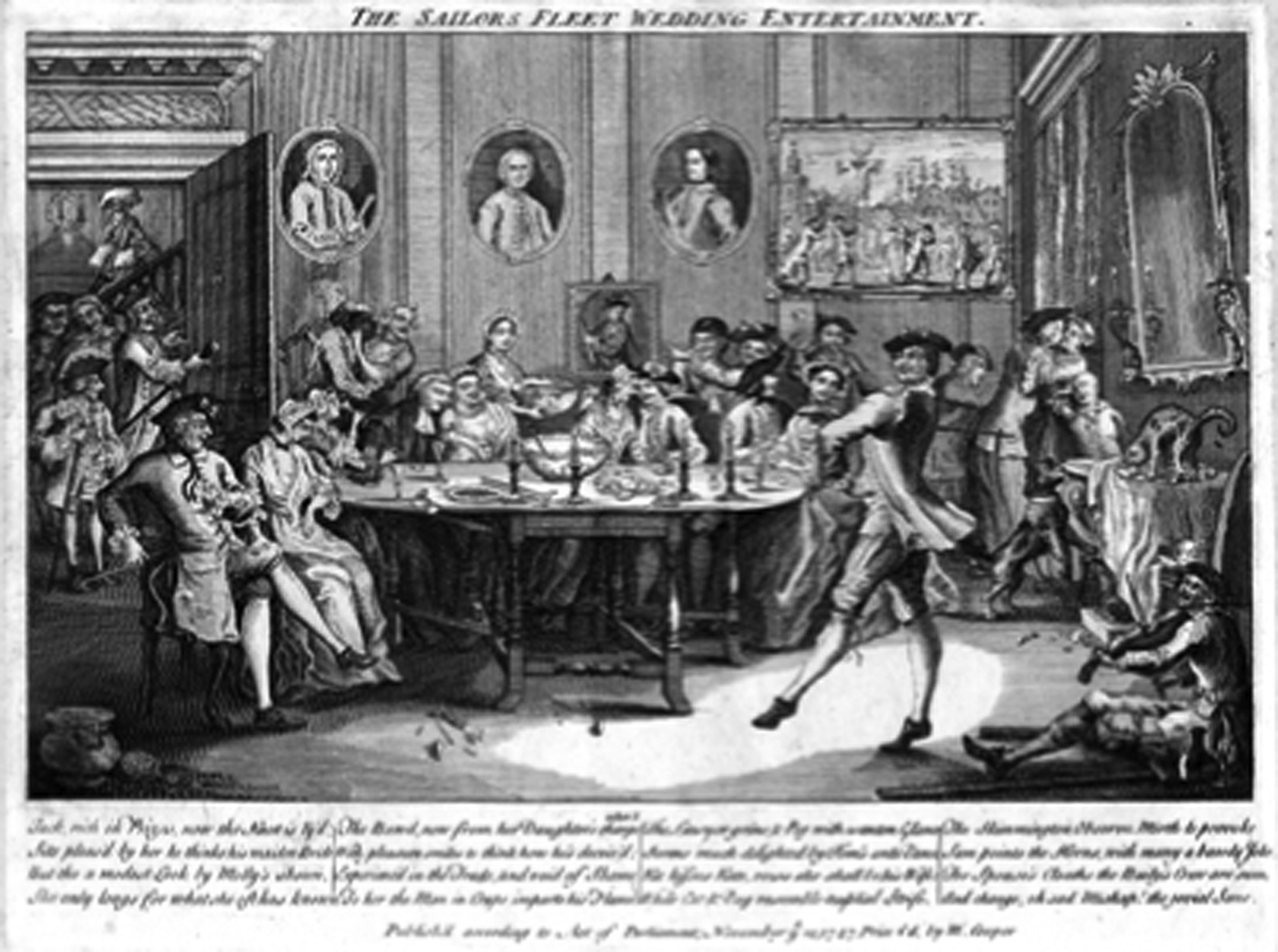
Contemporary observers were not blind to the importance of entertainment when celebrating a marriage. In this respect, it is informative to re-examine a well-known 1747 engraving satirising a Fleet wedding. Reproduced in Figure 1, this depicts a tavern wedding breakfast following the Fleet marriage of a sailor. As the verses below it describe, newly enriched by prize money from a naval battle, this sailor has been duped into marriage by a seemingly modest young woman who is in fact a prostitute. She has been aided by a crafty procuress, and a smiling Fleet parson whispers familiarly into the ear of this unconventional mother of the bride. Bailiffs at the door are about to inform the sailor of his new family's debts. Cuckold's horns in the painting of a skimmington on the wall behind, and the cat and dog fighting each other on the right, suggest further future misfortunes likely to befall the hapless bridegroom.
The Sailor's Fleet Wedding Entertainment.

The skimmington painting in the background depicts one form of intrusive public participation in others' marital lives. Skimmingtons were noisy, ribald public processions intended to express disapproval at unfaithfulness or otherwise transgressive marital behaviour by ridiculing the people involved. In the exaggerated circumstances depicted here, it may be felt that a skimmington is morally deserved, and it also serves to foreshadow future infidelities. However, remembering that ordinary, more conventionally moral couples also feared the heckling and ribald speculations that banns marriage could entail, we can also see in this engraving evidence that a clandestine marriage successfully allowed even this odd couple to avoid public humiliation on their wedding day. Clandestine marriage offered peace of mind to the majority of couples whose circumstances were far less extreme.
Significantly, the tone of the engraving is light-hearted rather than caustic: the verse refers to it as a ‘jovial scene’. Unlike in William Hogarth's more famous (but then unpopular) Marriage à-la-Mode paintings of 1743–1745, which satirise an arranged society marriage involving a London merchant's daughter, the damaging consequences of an unsuitable marriage partner are only lightly implied.Footnote 28 The focus is instead on the present exuberance of the wedding celebrations. There is food and plenty to drink, pipe-smoking, music and dancing, and almost everyone seems to be enjoying themselves. In effect, there is fun to be had not only at the expense of the unwitting bridegroom, but also in engaging with this convivial atmosphere. This emphasis on the merry-making aspects of the wedding celebration offers a glimpse of an important and often neglected aspect of the appeal of clandestine marriages.
3. SPATIAL PATTERNS OF MARRIAGE OUTSIDE THE HOME PARISH
Having considered some of the reasons why Londoners might marry outside their own parish or parishes of residence, we will now turn to an evidential base to examine which locations they preferred, and how this varied over time. In this study, for both suburban parishes of Aldgate and Clerkenwell, marriages in the parish church have been supplemented with marriage records of inhabitants that took place in other locations. Under normal circumstances, family reconstitutions use only the marriage registers of the parish being reconstituted. Parish registers almost always record only those marriages conducted at the parish church, rather than the marriages of all parishioners, and do not always distinguish between banns and licence marriages. For seventeenth- and eighteenth-century London, however, this is not a practical way of proceeding because of the extent of marriage outside the home parish.
In Aldgate, supplementary marriages were recovered only from the nearest clandestine marriage centre of Holy Trinity Minories. For Clerkenwell, attempts were made to trace marriages of inhabitants that took place outside the parish more widely, both in London and in surrounding counties.Footnote 29 At times this more than doubles the total number of marriages in observation, giving some indication of the scale of marriage outside the home parish. Some locations were much more popular than others, and almost all of the additional marriages of Clerkenwell inhabitants outside the parish were recovered from other London parishes and extra-parochial locations. Mapping these places and the extent to which they were used by Clerkenwell residents will make it clear that clandestine marriage centres and parishes near licence-issuing authorities received the bulk of non-home parish marriages. There are some limitations on this exercise since not every parish recorded residence of the bride and groom in the marriage register.
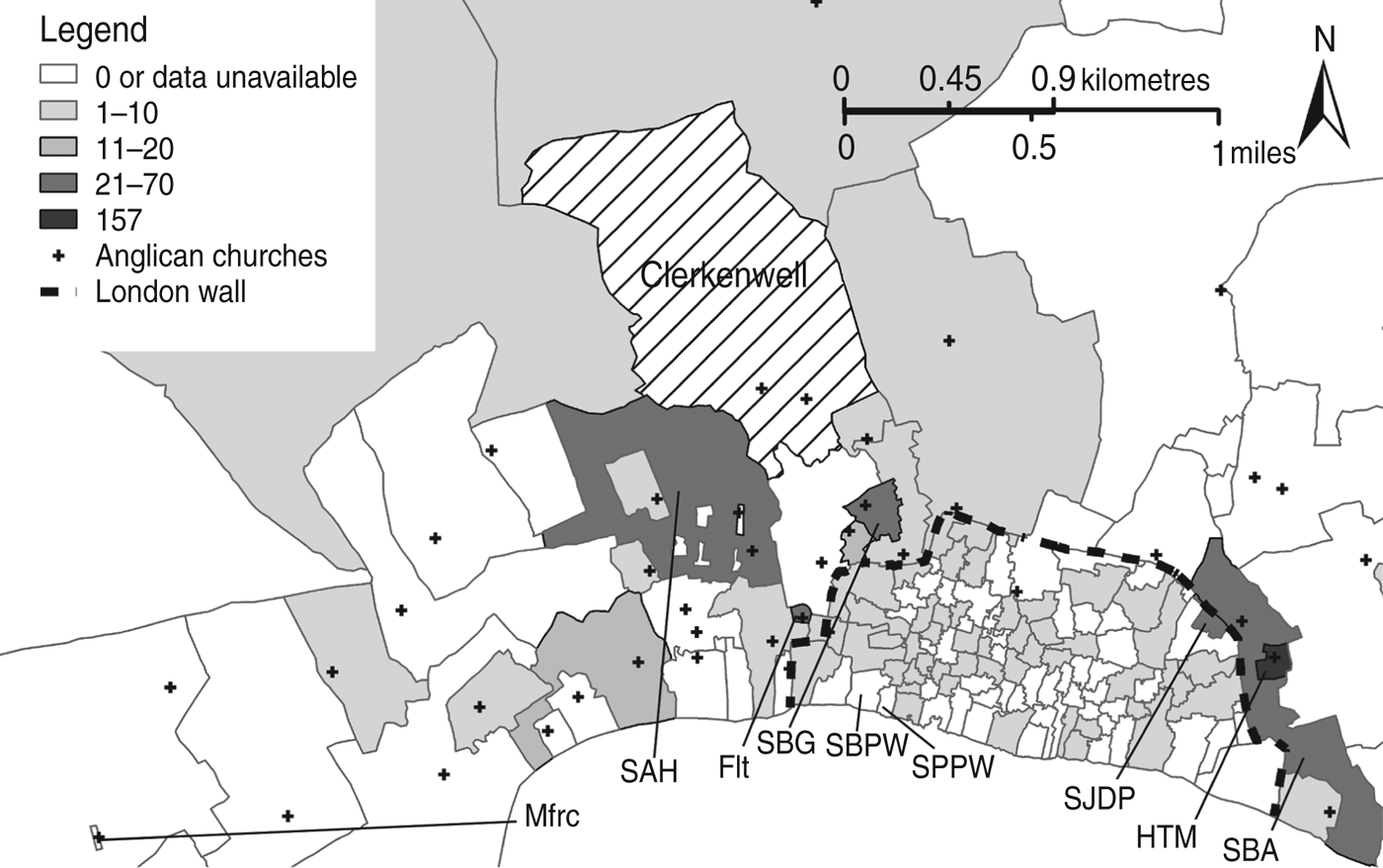
Figure 2 shows the distribution of marriages of Clerkenwell inhabitants in foreign parishes between 1650 and 1699. For the larger extramural parishes, the location of the parish church is also indicated. In this period the number of traceable Clerkenwell inhabitants marrying elsewhere is small compared with the almost 8,000 marriages in Clerkenwell itself, with the lowest category of between one and ten persons marrying elsewhere being typical for most locations. Such marriages are usually exogamous ones, where Clerkenwell men or women married in the home parish church of their spouse. However, several locations are considerably more popular than exogamy could reasonably account for.
Map showing the number of Clerkenwell inhabitant marriages in foreign parishes 1650–1699, marking the location of churches in extramural parishes. Mfrc, Mayfair chapel; SAH, St Andrew Holborn; Flt, Fleet prison; SBG, St Bartholomew the Great; SBPW, St Benet Paul's Wharf; SPPW, St Peter Paul's Wharf; SJDP, St James Duke Place; HTM, Holy Trinity Minories; SBA, St Botolph Aldgate.
The most popular place for Clerkenwell inhabitants to marry at this time was Holy Trinity Minories, near the eastern wall of the city. This was one of the main loci of clandestine marriage, together with St James Duke Place, which actually conducted many more such marriages. It is unclear why Clerkenwell inhabitants seem to have preferred Holy Trinity Minories to St James Duke Place, especially as it was slightly further away from Clerkenwell. Perhaps it was simply more convenient to reach without traversing the busy city area, being outside the city wall. Between Clerkenwell and the walled city, the small parish of St Bartholomew the Great was popular. It too was performing clandestine marriages, since as the former location of the Priory of St Bartholomew in Smithfield it could claim exemption from episcopal scrutiny. A little further south the tiny area of the Fleet prison, which would become the most popular and famous centre of clandestine marriage, had already begun to draw in custom.
Our sample eastern suburb of St Botolph Aldgate is the larger parish surrounding Holy Trinity Minories and in it large numbers of marriages of inhabitants from other parishes by licence took place at this time, as we shall see. In Figure 2 it shows up as a moderately popular place for Clerkenwell inhabitants to marry. Aldgate's popularity may be a consequence of its proximity to the two clandestine centres of St James Duke Place and Holy Trinity Minories. There were strong financial motives for those involved with issuing licences to make it as easy as possible to procure one, and it would have been mutually beneficial for them to work in partnership with ministers, especially ministers whose proximity to a clandestine centre made them conscious of a loss in fees income. By referring couples to local licence issuers, parish priests and their deputies could hope to recoup some fees when the couple returned to be married. If couples wishing to marry were shepherded in this manner it would explain too why the bureaucratic requirements of obtaining a licence that must otherwise have daunted the uneducated proved increasingly little obstacle.
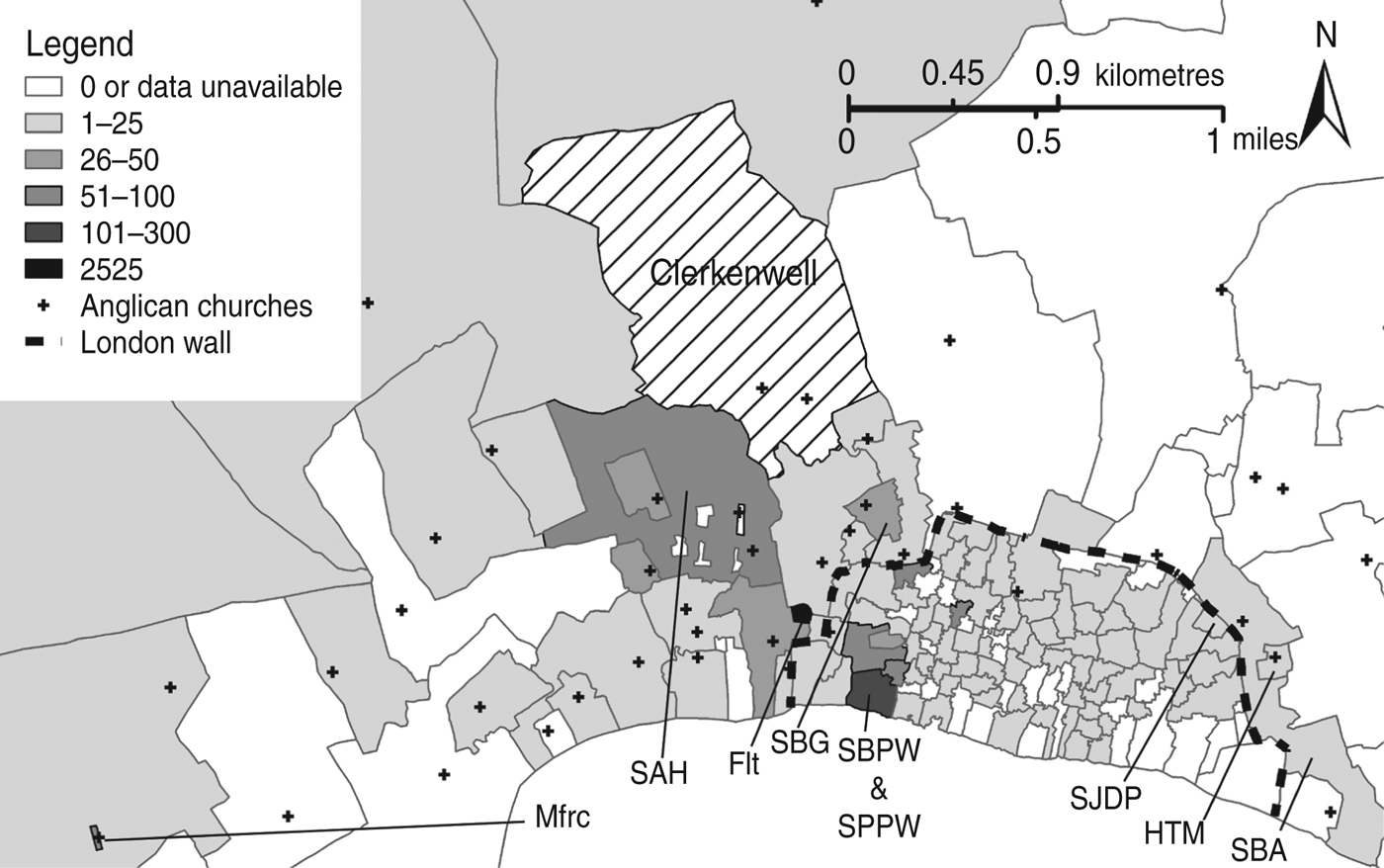
The eastern centres of clandestine marriage in the late seventeenth century declined after the provisions of the 1695 Marriage Duty Act curtailed their activities, but the effect of these provisions was local rather than London-wide, allowing new centres to arise elsewhere. In the next half-century, Clerkenwell consumers of the marriage trade moved westwards (see Figure 3). They now went overwhelmingly to the Fleet and its environs, where over 2,500 marriages where at least one party was a Clerkenwell inhabitant were conducted. This is almost as many as were conducted within Clerkenwell itself during the same period.
Map showing the number of marriages of Clerkenwell inhabitants in foreign parishes 1700–1749, marking the location of churches in extramural parishes. Mfrc, Mayfair chapel; SAH, St Andrew Holborn; Flt, Fleet prison; SBG, St Bartholomew the Great; SBPW, St Benet Paul's Wharf; SPPW, St Peter Paul's Wharf; SJDP, St James Duke Place; HTM, Holy Trinity Minories; SBA, St Botolph Aldgate.
In smaller numbers, Clerkenwell inhabitants went to the united riverside parishes of St Benet Paul's Wharf and St Peter Paul's Wharf near the lax licence-issuing authority of Doctors' Commons. Clerkenwell's neighbouring parish of St Andrew Holborn was moderately popular, but a similar number of inhabitants were prepared to travel much further west to a new clandestine marriage centre, the Mayfair chapel in fashionable Westminster, represented in Figure 3 by the small rectangle in the south-western corner.
In both periods, foreign parish marriages were not concentrated in the nearest churches, although the later westward shift in clandestine marriage availability to areas closer to Clerkenwell may at first give the impression that distance is more of a factor than was truly the case. Comparison with the earlier period reveals that proximity to Clerkenwell was much less important than availability of marriage on demand. Given the short distances involved, it would have been easy for Clerkenwell inhabitants to reach other London locations on foot. Most of Clerkenwell's population was concentrated in the southernmost portion of the parish closest to the city, and from there it is little more than two kilometres in one direction to the eastern side of the city and rather less in the opposite direction to the parishes of Westminster.
4. THE IMPACT OF DIFFERENT FORMS OF MARRIAGE ON PARISH REGISTERS
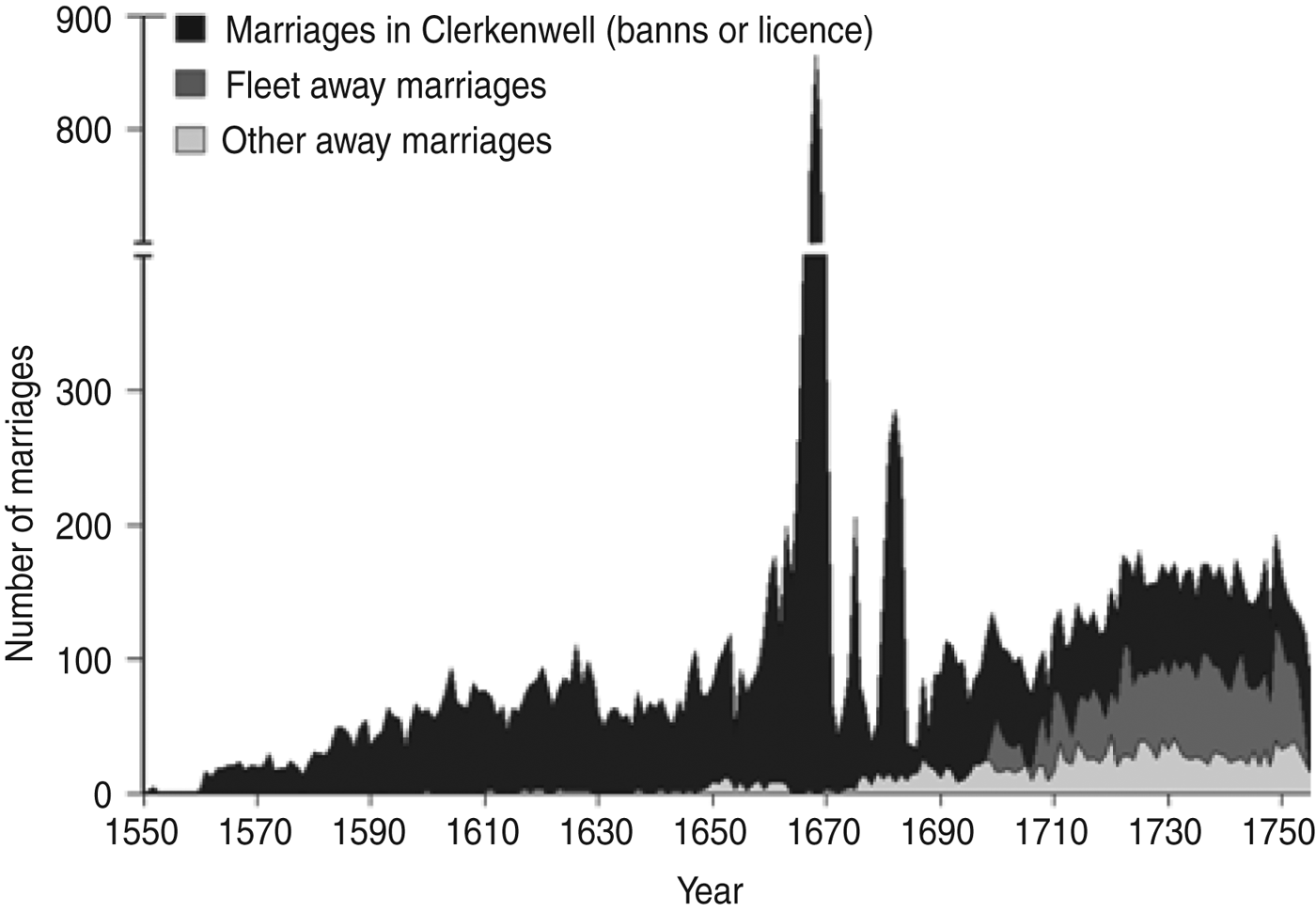
London parishioners were marrying at many locations other than their home parish, but their propensity to do so also varied over time. We shall now consider how the popularity of different forms of marriage in Clerkenwell, Aldgate and in central Cheapside affected the annual total of marriages in those parishes between 1550 and 1750. Beginning with Clerkenwell, Figure 4 shows the combined annual total of marriages by category, for all those who married at the parish churches supplemented with all traceable marriages of Clerkenwell inhabitants marrying elsewhere. Those marrying outside Clerkenwell are divided into two groups: those who married at the Fleet, and those whose marriage could be traced in other locations outside Clerkenwell.
Combined annual totals of marriages undertaken in Clerkenwell or by Clerkenwell inhabitants, 1550–1753.
The impact of extra-parochial marriage is negligible before 1650, but by 1710 it is striking: the majority of Clerkenwell inhabitants were not marrying in their own parish. In fact, the true extent of marriage outside the parish was probably even more extreme than is evident, since some portion of the marriages in Clerkenwell churches were licence marriages where neither party is from Clerkenwell. Unfortunately the parish of residence was not usually stated in the marriage registers so it is difficult to ascertain precisely how many marriages were non-parishioner marriages where neither party was a Clerkenwell resident. The proportion of marriages in Clerkenwell by licence and therefore potentially liable to be of non-parishioners was high. After 1730 when the registers reliably distinguish between licence and banns marriages, approaching half, or 1,072 of the 2,504 marriages before 1753, were by licence.
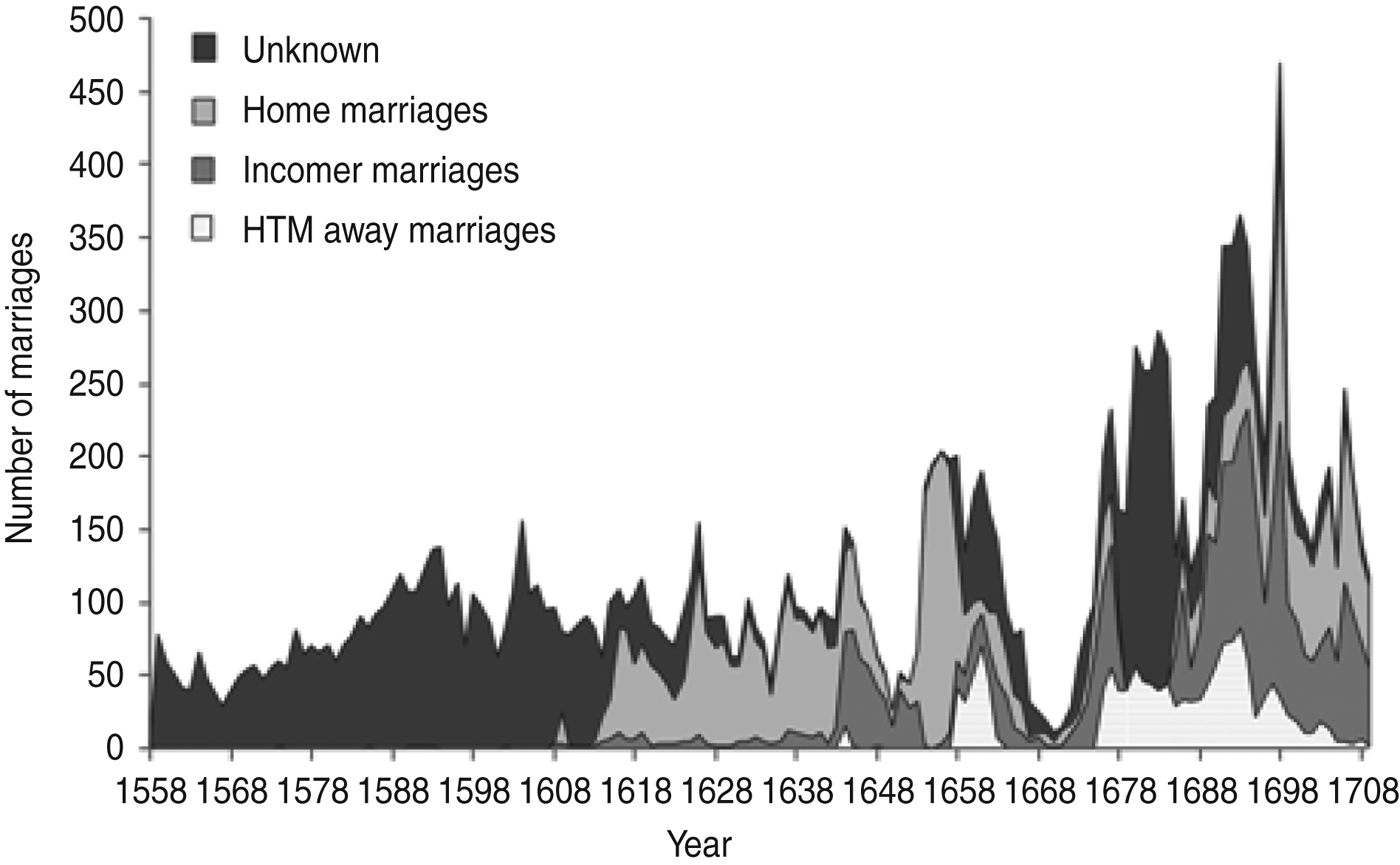
In Aldgate, residence information in the marriage register allows for a more detailed consideration of the extent to which marriages conducted in the parish church were of persons not resident there. Figure 5 shows the share that non-parishioner marriages took of marriages in Aldgate in those years where they can be distinguished, and the contribution to the total made by Holy Trinity Minories marriages of Aldgate residents. (This is not exactly parallel to Figure 4 since marriages in other locations were not recovered, as they were for Clerkenwell inhabitants.) The civil war period (1643–1647) marks the first of several precipitous declines in the observable total number of marriages. The number of non-parishioner marriages, presumably by licence, rises dramatically at the same time. This is the earlier of two periods in which non-parishioner marriages dominate the Aldgate marriage register, the other being from 1687 to 1695. Especially striking is the proportion of marriages in each category in 1698, when a sharp increase in home parish marriage caused by the reinforcement of Marriage Duty Act legislation is actually exceeded by the number of licence marriages of incomers.
Combined annual totals of marriages undertaken in Aldgate or by Aldgate inhabitants marrying at Holy Trinity Minories (HTM), differentiating between home, away, incomer, and unknown residence marriages that may be home or incomer.
During the brief period of civil registration (1653–1660) when all inhabitants' marriages should theoretically have been recorded in the register, home parish marriages in Aldgate at first surge, but then abruptly lose out to clandestine marriages at Holy Trinity Minories. At times Holy Trinity Minories evidently took a major share of the marriages of Aldgate residents. However, although marriage records for Holy Trinity Minories begin in 1644, there are many gaps in the registers now extant for the years before 1676, so it is difficult to be sure how many Aldgate inhabitants married there in earlier years. Other clandestine marriage centres such as St James Place performed marriages of Aldgate residents, but did not form part of this study.
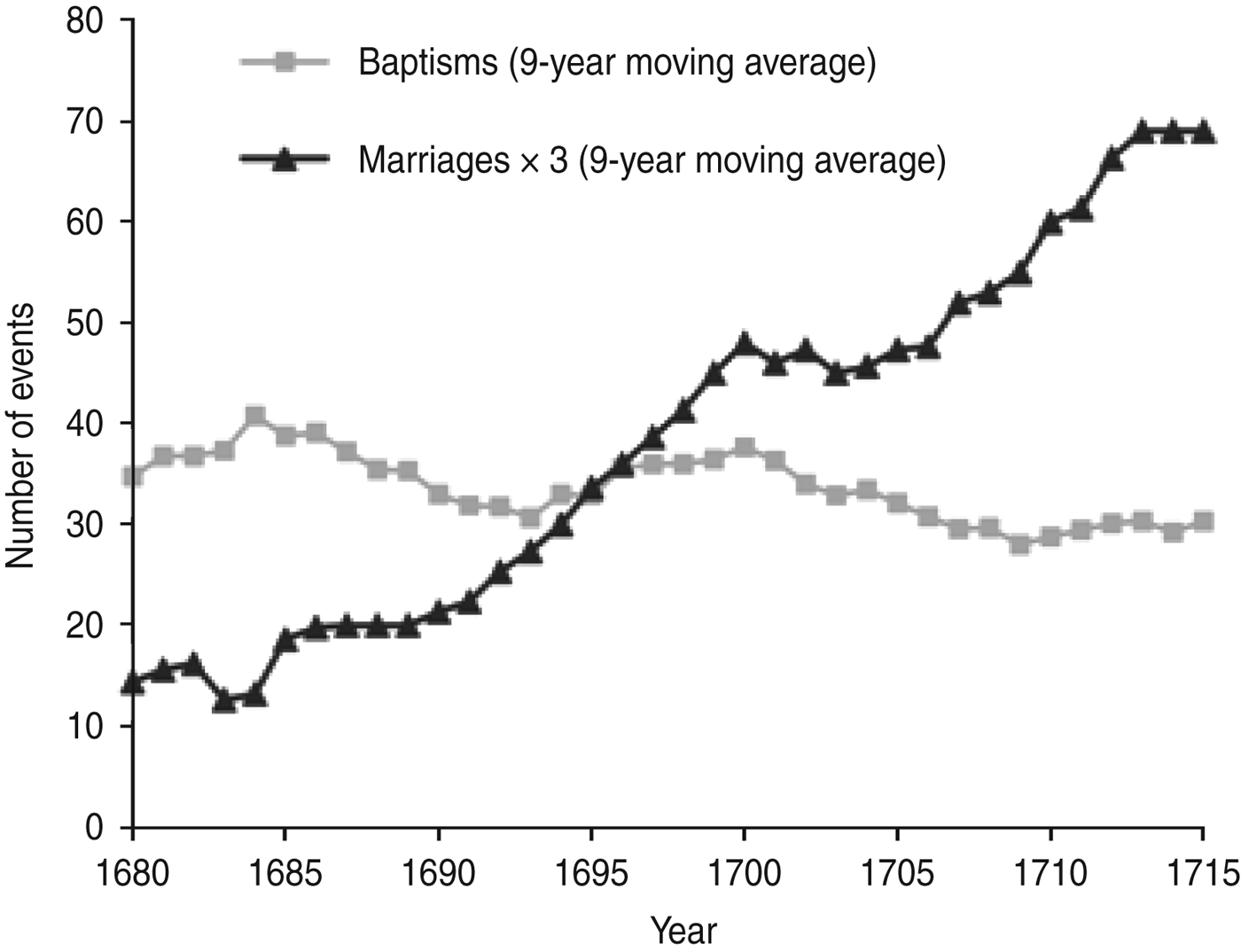
Aldgate was not unique in attracting large numbers of licence marriage of non-parishioners. We have already noted that a number of Clerkenwell marriages were by licence. The wealthy city parishes in Cheapside provide detailed evidence of this behaviour. Figure 6 illustrates the number of marriages celebrated each year in St Mary le Bow united with the parishes of St Pancras Soper Lane and All Hallows Honey Lane, compared with the number of baptisms, using baptisms as a proxy for the size of the population.Footnote 30 While the population was stable or falling, the number of marriages taking place at St Mary le Bow rose, particularly after 1695 and 1698 when the activities of some clandestine marriage centres were curtailed by legislation. Had couples who might previously have married in these centres returned to home parish marriage, or did they instead find other ways to marry where they chose? The sustained rise in marriages seems immediately suspect given the decline in population implied by the fall in baptisms.
St Mary le Bow (united with All Hallows Honey Lane and St Pancras Soper Lane) baptisms and marriages per year 1680–1720, 9-year moving averages.
Closer scrutiny of the registers reveals that the greater part of the rise in marriages even around the time of the Marriage Duty Act of 1695 and its reiteration in 1698 was caused by an increase in marriages of parties where both bride and groom were foreign to the parish, presumably by licence enabling them to marry at whichever church they preferred. Between 1695 and 1706 when the Marriage Duty Act was in force, less than one-fifth, or only 31 of 173 marriages, have at least one partner resident in the parish. Other city parishes probably experienced similar phenomena.
These examples caution against simple interpretations of the response of home parish church marriages to changes in legislation based on counts of the number of marriages alone. Many London parishes, whether rich or poor, will not have experienced the sustained recovery in home parish marriage in the late 1690s that Boulton interpreted from the frequency of marriages in St Botolph Bishopsgate.Footnote 31 Where any apparent recovery exists in the total number of marriages per year, we must suspect that large numbers of couples from outside the parish marrying by licence were a substantial part of the increase, if not all of it.
Returning to the Aldgate marriages, it is clear that we are at times missing substantial numbers of parishioner marriages that took place elsewhere but not at Holy Trinity Minories. Some indication of the expected level of home parish marriages if all Aldgate residents had married in the parish can be taken from the brief period after Civil Registration already mentioned. From 1654 until 1657, between 173 and 200 home marriages per year were recorded. In 1698, during the brief recovery of home parish marriage, 199 home marriages were recorded, together with 46 marriages of unknown residence, giving a potential maximum of 245 home marriages per year. We might therefore expect Aldgate's inhabitants to have produced between 170 and 250 marriages per year after 1650. An increase over time is expected since the population was growing rapidly. However, there are many years in which the numbers actually observed fall far short of this even when supplemented with marriages of Aldgate residents recovered from Holy Trinity Minories, and counting all marriages of unknown residential status as home parish marriage. The deficit must either be because of gaps in the resisters of Holy Trinity Minories, or because other locations were drawing Aldgate parishioners in substantial numbers.
The contribution of observable Holy Trinity Minories clandestine marriages to all marriages of Aldgate inhabitants was far smaller than that of Fleet marriages to all marriages of Clerkenwell inhabitants in the following half century. One way of ascertaining whether the expected number of marriages generated by a parish's population has been obtained is to consider whether the trend in annual frequencies of marriages follows that of baptisms. Such a correspondence can be observed between 1550 and 1750 for a nationwide sample of 404 English parishes.Footnote 32 In both Clerkenwell and Aldgate, marriages and baptisms closely follow the same trend as each other until around 1600, and thereafter diverge to differing extents. Once supplemented with non-home parish marriages, Clerkenwell marriages continue to follow the same trend as baptisms within the parish but more loosely, whereas there is little correspondence after 1600 in the Aldgate series.
In a similar vein, Boulton suggests that the ratio between baptisms and marriage should stay fairly constant, so changes in it can be used to gauge in which periods a parish is likely to have been losing marriages to some other location, or conversely gaining more marriages than its population can be expected to have generated.Footnote 33 But this will hold true only if losses of home parishioners and gains of non-parishioners in a given parish did not counterbalance each other. It is also worth noting that fluctuations in annual totals of marriages can be affected by changes in mortality, which varied greatly from one year to the next in London because of periodic severe epidemics. This most obviously affects remarriage, since it follows the death of a spouse. However, the break up of households and increased housing availability resulting from the epidemic death tolls probably also resulted in post-epidemic booms in first marriages. There is an enormous peak in marriages in 1666–1668 following the 1665 plague in Clerkenwell, although some portion of these was marriages of central city dwellers whose churches were being repaired or rebuilt after the Fire of 1666. Peaks in Aldgate annual marriages evident in 1593–1594, 1604, 1626 and 1637 and less prominently in Clerkenwell in 1604, 1626 and 1647 immediately follow plague years. The 1665 plague was also severe in Aldgate and its church survived the Fire, but there is no observable peak in marriages in the years following, strongly suggesting that Aldgate inhabitants were choosing to marry elsewhere at this time. Unfortunately, Holy Trinity Minories marriages for the late 1660s are no longer extant, but it is reasonable to suppose that it was taking at least a similar share of London marriages as it had hitherto.Footnote 34 The sudden loss of so many churches after the Great Fire in 1666 must have propelled clandestine marriages centres to greater prominence, especially given the coincidence of a post-epidemic surge in demand created by the 1665 plague.
5. AGE AT FIRST MARRIAGE
So far we have seen that London couples often took advantage of the opportunity to marry privately outside their home parish, and now we consider what effect on their demographic behaviour this may have had. Did the widespread availability of marriage on demand induce men and women to marry on impulse at younger ages than they might otherwise have contemplated? Calculating ages at first marriage through family reconstitution based on London parish records provides perhaps the only possible means of studying how change occurred over a long period of time. Reported ages are rare, and where they are given it is typically for only a handful of years, and only for brides. We shall also consider what can be pieced together from stated ages of marriage in London registers in more detail below, but first we will consider what the Aldgate, Clerkenwell and Cheapside family reconstitutions reveal about long-term trends.
Marriage ages calculated from family reconstitutions of London parishes need to be interpreted with caution, especially in the light of the tendency of Londoners to marry outside their home parish and potentially escape observation. We are restricted to studying the London-born, and only the minority among them who resided in the same parish until they married. This is because age is calculated from dates of marriage and baptism. As baptism records do not begin continuously until the mid 1560s in Clerkenwell, age at first marriage can only be measured from 1610 onwards. The periods in Aldgate have been calculated so as to be comparable. For this study the bride or groom's own baptism and first marriage were allowed to be up to 45 years distant rather than the more usual 50 years because the large volume of same-named individuals in London produces many more false-positive record links than a smaller parish community might, and there is a trade-off between allowing all possible matches for the sake of completeness, or restricting the period in which matches may be made more stringently in order to prevent unlikely matches. The final issue is that if too many marriages are missing, there is a risk that baptisms will be incorrectly linked to a marriage of some other person of the same name, even if records for which competing possible links exist are excluded. This issue is particularly relevant to the Aldgate reconstitution, given the highly variable coverage of the Aldgate marriage register.
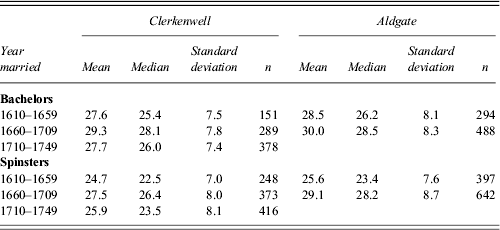
Table 1 sets out the ages at first marriage for Aldgate and Clerkenwell inhabitants of both sexes that have been obtained from the family reconstitutions, in three periods. As the Aldgate records were gathered up to 1711 only, the third period can only be studied in Clerkenwell. The figures for Clerkenwell include marriages of Clerkenwell inhabitants taking place outside the parish at the Fleet and elsewhere, and those for Aldgate include marriages at Holy Trinity Minories. As we have seen, these supplementary marriages do not make an equal contribution in the two locations, with Holy Trinity Minories marriages augmenting Aldgate marriages less than the more comprehensively recovered extra-parochial marriages of Clerkenwell parishioners.
Age at first marriage (years) for suburban-born bachelor to spinster/widow marriages and suburban-born spinster to bachelor/widower marriages
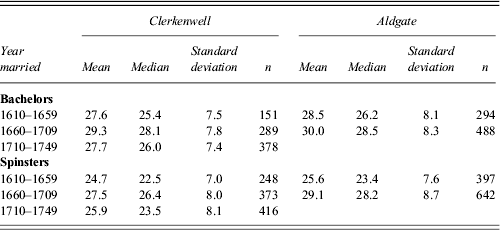
Sources: Clerkenwell and Aldgate family reconstitutions.
Between 1660 and 1709 these results indicate that there was a peak in bachelor and spinster marriage ages in both these suburban populations, at least among those who continued to marry in their parish of residence. The very late mean age of Aldgate spinsters marrying in this period appears to have been driven by marriages in the 1660s and 1670s. By the early eighteenth century, Aldgate women were marrying at younger ages similar to those of Clerkenwell women. This is not readily apparent from the long periods used for comparative purposes in the table, but if we take only the end portion of Aldgate marriages taking place post-1700 and before the end of our dataset in 1711, for 173 Aldgate women married then the mean age at marriage had fallen to 27.8 years. Returning to Table 1, in the latest period of 1710 to 1749, male and female marriage ages in Clerkenwell fell, but remained higher than in the earliest period.
On average, women married younger than men in every period, usually by about two to three years, and the age at which they married fluctuated more over time than did male age at first marriage. With a median age upwards of 22.5 years, these suburban women were older than 77 higher-status women of central London traceable in our Cheapside family reconstitutions, half of whom were married by their 20th birthday. The delay was probably a reflection of the need, among less privileged women, to work and save up earnings before contemplating marriage.
Bachelors who married widows and spinsters who married widowers typically married later than those couples where both parties were marrying for the first time. Since the figures above include both types of marriage for each sex, changes in age over time could potentially reflect changes in the extent of remarriage. However, Boulton's evidence on remarriage of widows in Stepney, London suggests that if anything there was a decline in female remarriage over this period, so it was unlikely to have affected bachelors' ages.Footnote 35 Clearly the increasing availability of other marriage locations did not lead to universally younger ages at first marriage in London. However, it may have affected the ages observed for brides and grooms marrying in their home parish, especially if younger couples were more likely to marry by licence or at clandestine centres.
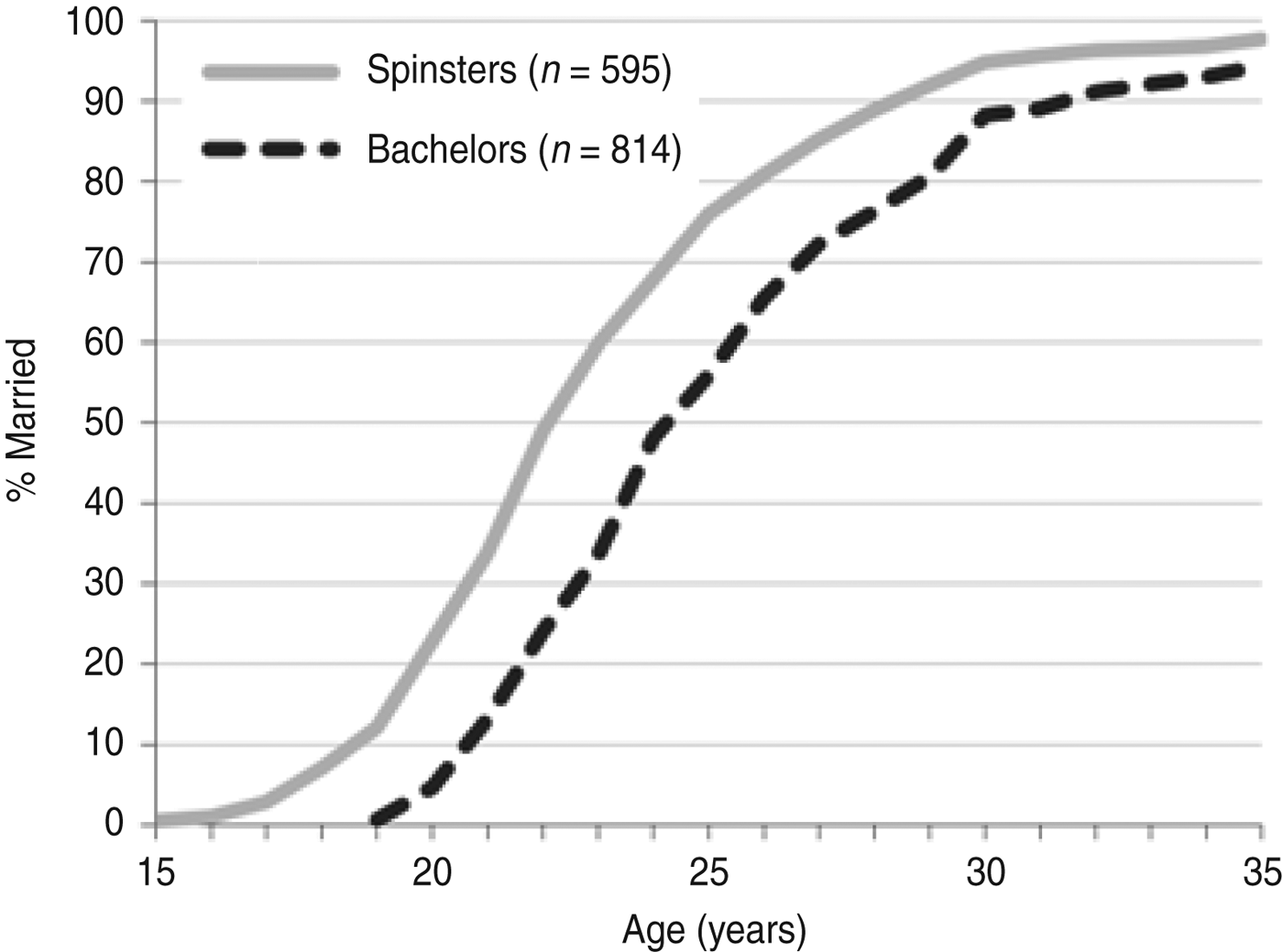
Reported ages from clandestine marriage centres reveal that they may indeed have been especially popular with younger couples. St Katherine by the Tower, neighbouring the riverside portion of St Botolph Aldgate and the Tower of London, was an extra-parochial area that seems to have operated as a modest centre of clandestine marriage. In its registers, ages were consistently stated between 1687 and 1712, and late marriage was extremely unusual. Among 595 spinsters married there in this period, almost all (92 per cent) were married before their 30th birthday, and the mean age at first marriage was just 23.5 years. There was less variation among women in this dataset, with a low standard deviation of 4.19 years. In other words, a young age at marriage was almost universal, as the frequency distribution curve in Figure 7 illustrates.
Cumulative frequency distribution of ages at first marriage for bachelors and spinsters marrying at St Katherine by the Tower between 1687 and 1712.
Bachelors who married at St Katherine by the Tower were also young, typically only two years older than spinsters, although there were fewer very young grooms than brides: less than 5% of grooms married before their 21st birthday, the age after which parental consent was not required, whereas almost a quarter (23 per cent) of the brides had married before reaching 21 years. Equally, there were very few ‘child’ brides, with less than 3% marrying before their 18th birthday. It is possible that clandestine marriage centres allowed young women to enter the marriage market earlier than they might have otherwise have been permitted to do so, but men evidently were seldom in a position to contemplate marriage until reaching their majority, wherever they chose to marry. The watershed ages of 18 years for females and 21 years for males may not have fallen far beyond the completion of growth following puberty.Footnote 36 This is not to say that earlier marriage was not possible, and earlier childbearing too, but it was very rare.
Male entry into marriage was constrained by apprenticeship for some, since apprentices were not usually free to marry. The average age on beginning apprenticeship in London fell from about 18 years to 16 years between 1600 and 1750, although it varied by geographical origin of the apprentice.Footnote 37 This gives an average age on completion of 23 to 25 years, if apprenticeship lasted a full seven years. Apprenticeship was the traditional route to citizenship in London, and citizenship was not available to those under 24 years. After attaining citizenship one could set up shop and legitimately trade in one's own right, starting to train one's own apprentices. Daniel Defoe's advice to tradesmen suggests that he saw some time after this as the best time for marriage, although we might suspect that many actually married sooner from the fact that he devotes an entire chapter of The complete tradesman (1729) to the ills of marrying too soon.Footnote 38 However, neither citizenship nor a business of one's own was a realistic prospect for many poorer Londoners. In a fast-growing city with a high proportion of new migrants and many labouring opportunities, there must have been numerous suburbanites who had never had an apprenticeship, or left it early, or attained journeyman status without ever becoming a master. Citizenship was in any case much less important in the suburbs since they were outside guild jurisdiction, and even in central London there were areas exempt from guild authority. Alien craftsmen and merchants in London were well aware of these loopholes, and settled disproportionately in these parts of the metropolis.Footnote 39
Returning to the St Katherine by the Tower marriages, what of the reliability of this source? We cannot know for sure how accurately the ages in St Katherine by the Tower were reported or recorded, but little evidence of age heaping was detected.Footnote 40 The accuracy of age reporting can be spot-checked for a handful of instances where the bride or groom was resident in Aldgate and was found to have been baptised there. In the three cases so identified between 1686 and 1699, the calculated age concurred with that reported.Footnote 41 The low number of such traceable individuals hints at another important reason for variation between these stated ages and those calculated from family reconstitution. About four-fifths of those marrying in St Katherine by the Tower were resident in London, but the majority of them were almost certainly not London-born, unlike those traceable through family reconstitution. Some may only have been passing through the metropolis: mariners, a particularly transient occupational group, formed a large proportion of the men. However, excluding marriages where the groom was a mariner makes no statistically significant difference to female age at first marriage.
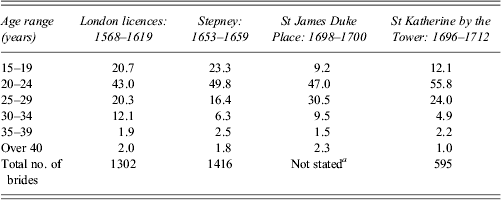
Compared with other London sources of stated ages at marriage, St Katherine by the Tower brides were unusually concentrated in particular age groups, as can be seen in Table 2. This compares St Katherine's with brides (or intended brides) from the Bishop of London marriage licence allegations, Stepney residents during the period of comprehensive Civil Registration, and the clandestine marriage centre of St James Dukes Place. The two clandestine marriage centres have similar age distributions, and much less variance than the Stepney parish population or those marrying by licence. Four-fifths of marriages in St James' and St Katherine's are concentrated into the 20–24 years and 25–29 years age groups, compared with two-thirds of Stepney residents, or those marrying by licence. Records with ages from the two clandestine centres are from overlapping time periods whereas the other sources are earlier, so whether this is truly a difference between those marrying in different locations, or change over time, remains to be seen.
Age distribution (%) of spinsters marrying bachelors or widowers 1598–1712
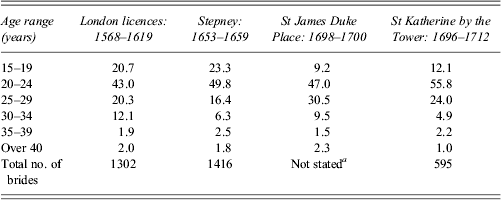
a Although the St James Duke Place total number of brides is not stated, according to Jeremy Boulton, ‘Clandestine marriages in London: an examination of a neglected urban variable’, Urban History 20, 2 (1993), 191–210, here 198, the total number of marriages in this location between 1696 and 1700 was 578, so it is presumably less than this figure.
Sources: St Katherine by the Tower parish registers; other London figures from Jeremy Boulton, ‘London widowhood revisited’, Continuity and Change 5, 3 (1990), 323–55, here 334 and 339.
Using the family reconstitution data, we can test the hypothesis that clandestine marriage centres were popular among couples of different ages to those who stayed in their home parish to marry for a specific parish population, by comparing the mean age at first marriage in Clerkenwell churches and of Clerkenwell inhabitants marrying at the Fleet. The first Fleet marriage that can be matched to the baptism of bride or groom in Clerkenwell took place in 1699. Taking the 391 Clerkenwell resident women who married between 1700 and 1749 either in the parish churches or at the Fleet, the mean age of home marriers was 27.5 years, whereas the mean age of those marrying in the clandestine centre was almost two full years younger, at 25.6 years. The difference between the mean ages was t-tested for statistical significance and found to be significant (P < 0.05). If we repeat the exercise, extending the comparison to all women marrying in the parish or away from it between 1660 and 1749, whether in a clandestine centre or by licence, a similar difference of almost two years is again evident, with the mean age of home marriers being 27.2 years compared with 25.4 years for those who married elsewhere. The increased sample size of 789 women allows for greater confidence that this is significant and no chance finding (P < 0.01). Considering the 667 men who married in the same period, again there is a highly significant (P < 0.01) age difference between those who married in their home parish and those who married elsewhere, with the difference between mean ages also about two years, at 29.1 and 27.4 years, respectively.
Clearly there is an association between marriage location and age at marriage, but this was not because the clandestine marriage centres were crowded with underage couples desperate to marry with or without parental permission. Rather, clandestine marriage centres simply attracted more of those in the ‘prime’ years for marriage. Where marriage did begin at very young ages, it was most likely to involve higher-status men and women fulfilling their parents' wishes and marrying by licence.
6. PRENUPTIAL PREGNANCY
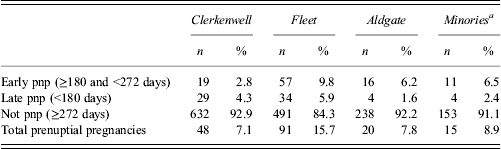
We have now seen that clandestine marriage was not a widespread means of marrying for the first time at extremely young ages, nor with large age differences between bride and groom, so couples seem to have had little to hide in this respect. But what of bridal pregnancy? Did the knowledge that marriage could be procured so quickly and easily induce Londoners to relax their attitudes towards premarital sex? These are questions that can be addressed directly through the family reconstitutions of Aldgate and Clerkenwell. For those couples where we observe a subsequent child baptism in the parish register, it is possible to determine what proportion of women were already pregnant at the time of their marriage. The results of this exercise are presented in Table 3, dividing the women into those who married in their home parish and those who married at a centre of clandestine marriage over two successive periods, the first when Holy Trinity Minories was conducting clandestine marriages and the second when the Fleet was in operation. The late prenuptially pregnant group in each case consists of those women who married during the first two trimesters of their pregnancy, whereas the early prenuptially pregnant group consists of those who were in the third trimester and probably visibly pregnant. Since gestation period varies between different women and many of the intervals are calculated using date of baptism rather than date of birth, assignment to these groupings cannot be regarded as definite, but is nonetheless a useful indicator of how far pregnancy had progressed before marriage took place.
Prenuptial pregnancy (pnp) by marriage location of parents, indicating the difference in days between marriage date and first baptism date for each category
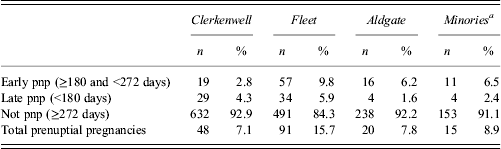
a Selected years where Holy Trinity Minories records are extant only, comprising the 26 years 1644–1647, 1659–1661 and 1676–1694.
Sources: Clerkenwell and Aldgate family reconstitutions.
Considering firstly the total number of prenuptial pregnancies, it is immediately clear that the great majority of London brides were not pregnant, wherever they chose to marry. At most, among Fleet brides, fewer than one in six women was pregnant at the time of their marriage. In London for the earlier period of 1600 to 1650, Roger Finlay observed an almost identical average prenuptial pregnancy rate of 16% among his home parish-marrying brides.Footnote 42 London does not seem to have been precocious in this respect. Rates of prenuptial pregnancy in England as a whole were higher over the period 1650 to 1750, with a fifth to a quarter of women prenuptially pregnant, and nationally there was a rising trend then and thereafter, except in the final quarter of the eighteenth century.Footnote 43 Other towns were more similar to London: by 1700–1749, the English market towns of Banbury and Gainsborough had total prenuptial pregnancy rates of 17.1 and 15.0 per cent, respectively.Footnote 44
Choice of marriage location does affect the prenuptial pregnancy rates of Clerkenwell inhabitants in the later period, with almost twice as many pregnant brides marrying at the clandestine marriage centre of the Fleet as in their own parish churches. A two-way chi-squared test confirmed that there was a strongly significant association between marriage location and whether the bride was pregnant for Clerkenwell (P < 0.001). Most of the difference is in the early prenuptially pregnant, where the bride would probably be noticeably pregnant. Concealment of pregnancy thus seems to have been, or to have become, a motive for clandestine marriage, although it could hardly have been a widespread reason for it. Among Aldgate inhabitants there was surprisingly little difference overall between those marrying clandestinely or at the parish church, and no statistically significant association between marriage location and bridal pregnancy.
The difference between the two clandestine centres of Holy Trinity Minories and the Fleet requires further consideration. Whereas 11.0 per cent of all Clerkenwell-resident brides were pregnant, only 8.2 per cent of all Aldgate resident brides were. Is the Aldgate figure too low to be plausible, especially for those who married clandestinely at Holy Trinity Minories? There could have been some real change in the proportion of women who were pregnant at marriage over time, as there are fluctuations in the national data, but it seems unlikely that such change would only have affected clandestine marriages and not home parish marriages. At 7.1 and 7.8 per cent, respectively, the proportions of those marrying in Clerkenwell churches and Aldgate's parish church who were prenuptially pregnant are very similar. The observation period for Minories marriages was fragmented owing to gaps in the registers, and this may have affected the calculations in some way, despite attempts to control for it by only using those periods where both St Botolph Aldgate church and Holy Trinity Minories registers were extant. There is, however, a possible behavioural explanation, deriving from the fact that the comparison between the behaviour of Clerkenwell residents and Aldgate inhabitants is not exactly equal in other respects than chronological period. The two clandestine centres differ in their relative importance and location.
While the Fleet dominated the clandestine marriage market in London in the first half of the eighteenth century and was overwhelmingly the most popular clandestine marriage centre for Clerkenwell inhabitants, Holy Trinity Minories was only one of several clandestine centres available to Aldgate inhabitants. It was initially supposed that Holy Trinity Minories would prove a popular place to marry among those Aldgate residents choosing a clandestine marriage because this extra-parochial area forms an enclave within the parish of St Botolph Aldgate, and was therefore conveniently close at hand; indeed, it is more centrally located than Aldgate's own parish church. By contrast, the Fleet and its environs are close to Clerkenwell but not immediately adjacent to the parish. It may well be that the extreme proximity of Holy Trinity Minories was actually a deterrent to those seeking privacy, especially to those Aldgate women who found themselves in the embarrassing situation of being visibly pregnant before marriage. They might instead have preferred other convenient but not quite so close at hand clandestine centres, such as St James Duke Place or St Katherine by the Tower.
In London, greater ease of marrying seems to have been accompanied by less premarital sex rather than more, although for the minority of couples who did have sex before marriage and experienced a pregnancy, a clandestine marriage was more likely than home parish marriage. Importantly, the rates of prenuptial pregnancy we can obtain from marriage and baptism registers are a far cry from those supposed to exist by contemporary commentators, and picked up on by later historians. For the Savoy Chapel, Outhwaite repeats the eighteenth-century commentator Horace Walpole's assertion that 900 in 1,400 brides were pregnant, implying a prenuptially pregnant rate of 65 per cent, which is nearly four times as great a proportion as that actually observed among Clerkenwell inhabitants marrying at the Fleet.Footnote 45 Nor did those women who married clandestinely display any greater tendency to be pregnant at marriage than other English populations; we might rather conclude that, at the population level, those couples marrying in their home parish were atypically reticent in commencing a sexual relationship.
7. CONCLUSION
Marrying privately, in a location other than the parish church of either bride or groom by licence, or at a centre of clandestine marriage, was the default choice for suburban Londoners by the mid-eighteenth century, and had been a major factor affecting London marriages since the early seventeenth century. Londoners could marry when and where they pleased and took full advantage of this freedom, but this did not mean behavioural constraints dissolved, nor did economic considerations cease to restrict entry into marriage.
Banns marriage was disliked, and there were many perceived advantages to marrying privately. Clandestine centres provided the quickest means of marrying, while licence marriage provided a wider choice of location. In the first half of the eighteenth century, the extraordinarily popular Fleet combined the attractions of an entertainment venue with a quick, convenient and cheap marriage ceremony in a way that held mass appeal. Mapping the spatial distribution of marriages of suburban inhabitants taking place elsewhere reveals its shifting topography, which depended largely on the availability of other forms of marriage. When clandestine centres were suppressed or unavailable, licence marriage could meet the demand for private marriage instead, with the consequence that a substantial proportion of marriages registered in many London parishes were not of the parish's own inhabitants, even after the Marriage Duty Act legislation of 1695 attempted to curtail the practice. This is often a hidden problem because parishes both lose their own parishioners to other locations and simultaneously receive incomers from other parishes, while not routinely distinguishing between banns or licence marriage, or stating the parish of residence.
The age at which sixteenth- and seventeenth-century suburban Londoners entered marriage for the first time was younger on average than in other English communities. Few married at very young ages except the daughters of wealthy merchants, as observed in city-centre parishes and among early licence allegations. At clandestine marriage centres in late seventeenth-century London, bachelors very seldom married before their 21st birthday or after their 35th birthday and spinsters rarely married until they were at least 18 years old or after reaching 30 years. Most spinsters were married before their 23rd birthday and most bachelors before their 25th birthday. These were relatively egalitarian partnerships in term of the age difference between couples, with bachelors most likely to marry spinsters the same age as themselves, or just one or two years younger. Among London-born suburbanites whose age at marriage can be calculated because they were baptised and married in the same parish, the median age of marriage between 1610 and 1660 was virtually the same as for those marrying clandestinely at the turn of the eighteenth century. However, there are reasons to question the long-term stability that this seems to suggest. The calculated marriage ages of the London-born in both Clerkenwell and Aldgate exhibit a rise for both sexes in the intervening years of 1660 to 1710. The situation is complicated by differences in the age structure of marriage depending on where the ceremony took place. Those marrying in clandestine centres were particularly likely to be drawn from the ‘prime’ ages for marriage, leaving a residual of older brides and grooms who married at their home parish churches.
The incidence of pregnancy before marriage in London was low and could not have come close to being responsible for the popularity of clandestine marriage overall. There may have been a slight increase over time, but rates of prenuptial pregnancy remained lower than elsewhere in England. Prenuptial pregnancy did vary by marriage location, and among eighteenth-century Clerkenwell inhabitants those brides who were pregnant were more likely to have a Fleet wedding than a banns marriage. Prior to this, the smaller number of late seventeenth-century Aldgate inhabitants who were pregnant before marriage displayed no significant preference for a clandestine marriage at Holy Trinity Minories. However, it appears likely that Holy Trinity Minories was not the most popular clandestine marriage venue for Aldgate parishioners, at least during the periods in the late seventeenth century when its registers are extant, as the Fleet was for Clerkenwell inhabitants in the later period. The reason for this may be because Holy Trinity Minories' location close to the centre of Aldgate parish rendered marriage there insufficiently private for many. At present we lack data on marriages of Aldgate residents at other marriage centres.
By now it will be clear that the negative connotations of ‘clandestine’ are misleading, and furtive or transgressive behaviour was not a significant motive for clandestine marriage in seventeenth- and eighteenth-century London. We have considered what the other attractions of marrying at a place and time of one's choosing might have been. But we still know relatively little about the identities of those who married in this way. It would be most interesting to learn from any autobiographical testimony that may exist what factors London brides and grooms themselves were aware of when choosing to marry clandestinely, particularly in contrast to those who married publicly by banns.
ACKNOWLEDGEMENTS
The author would like to thank: the Economic and Social Research Council, the Wellcome Trust and the Arts and Humanities Research Council for their financial support; the ‘Life in the Suburbs of Early Modern London’ research project team, especially Richard Smith for his guidance; and the late Amanda Copley for her pioneering focus on Clerkenwell parish records.