Schwartz’s work on personal values (for example Schwartz, Reference Schwartz and Zanna1992) provides a robust starting point for consideration of the role of values in political behaviour. To date the theory has been applied almost exclusively quantitatively, relying on surveys set up to answer specific research questions. Apart from the work of Bardi et al. (Reference Bardi, Calogero and Mullen2008), we are not aware of any systematic attempts to operationalise Schwartz’s theory for qualitative research. In this note we propose that the Schwartz theory can be used to inform and shape thematic analysis of political speeches by identifying the use of values appeals in persuasive speech. We acknowledge the limitations of presenting this approach in a brief research note. We have used a small selection of speeches for the purpose of introducing our arguments. Further work could draw on a much larger sample of speeches than we have used for illustrative purposes.
In 2020, the citizens of the state of Victoria in Australia were subject to their first lengthy lockdown as that State grappled with the COVID-19 pandemic. At this time, vaccines were not available in Australia so the impact of contracting the disease was serious and potentially deadly. Stringent public health measures were seen to be the only line of defence. The Premier of Victoria, the Hon Daniel Andrews MLA, fronted the media on an almost daily basis for over 100 days, delivering an update on the situation in the state. Using reflexive thematic analysis (Braun and Clarke, Reference Braun and Clarke2022), we examined the content of Andrews’ prepared comments at a selection of his media conferences and considered them as pieces of persuasive rhetoric. Drawing on Schwartz’s theory, we analysed Andrews’ prepared remarks and found that he framed his message in ways that appealed to multiple values. The high level of public support for his government’s response to the pandemic (Botterill et al., Reference Botterill, Lake and Walsh2021) suggests that this strategy was effective in persuading citizens that the course of action was appropriate.
As the world grapples with a once-in-a-century global pandemic, governments have responded with a range of public health measures. These have included social distancing, mask-wearing (both mandated and recommended), hand hygiene, and stay-at-home orders (lockdowns). Once efficacious vaccines became available, actions were extended to include mass vaccination programmes. Public health initiatives are classic examples of responses to collective action problems where individuals are required to act, often against their own preferences, for the good of the broader community (see Siegal et al., Reference Siegal, Siegal and Bonnie2009 for a discussion of vaccination and organ donation from this perspective). Until mass vaccination is achieved, individuals have been asked to adapt their behaviour to mitigate the spread of the virus. In this environment, effective and persuasive political communication is critical as these measures impinge on personal liberties and have significant economic consequences. Messaging needs to move beyond the bounds of partisan affiliation to reach and persuade the majority of citizens to abide by the measures in place.
Although 2021 and 2022 saw a resurgence of COVID-19 in Australia, in 2020 the country was looking to be in a strong position in the face of the pandemic. By global standards, infections, hospitalisations, and deaths were extremely low. The main exception to this picture was in the state of Victoria where a series of increasingly stringent measures were introduced to bring the virus under control. Under the Australian constitution the States have responsibility for health, so responses to the COVID-19 pandemic varied between jurisdictions. In Victoria, the Labor Government led by the Hon Daniel Andrews MLA took a tough line, locking down Melbourne and imposing restrictions on economic activity and personal freedoms which lasted from August to November 2020. Similar measures were reintroduced a year later when an outbreak of the Delta variant, which began in the state of New South Wales, spread into the other eastern states. The measures introduced in Victoria in 2020, and repeated in 2021, were controversial. In 2020 Andrews faced, at times hostile, media questioning every day for over 100 days throughout the period of the tight restrictions (ABC News, 2020a), remaining in media conferences for up to 90 minutes or more, until the questions were exhausted. While Andrews’ standing as preferred Premier during the period reflected the partisan divide in the State, his handling of the pandemic attracted much higher levels of approval. In other research (Botterill et al., Reference Botterill, Lake and Walsh2021), a relationship has been established quantitatively between citizens’ values and both their support for COVID response measures, and the likelihood of their complying with those measures. In this paper, we take a step back from the response to government appeals for particular behaviour, to examine the content of those appeals.
Rhetoric, persuasion, and political communication
Policy issues and debates inevitably involve multiple, at times competing, goals that are based in different values priorities, with the consequence that ‘the most difficult political choices are not between good and bad but between good and good’ (Galston, Reference Galston1999). Consequently one value or set of values is prioritised over others, and policy makers exercise judgement in arriving at decisions about appropriate courses of action for the community. Once a choice has been made, the next step is to persuade citizens, including those beyond their traditional support base, that this judgement is appropriate. This can be achieved by framing messages in multiple ways which tap into a range of values priorities in order to find common ground: ‘If orators are identifying with their audiences, then they are emphasising communal links, foremost amongst which are shared values or beliefs’ (Billig, Reference Billig1996).
The question of communicator persuasiveness and message effectiveness has attracted attention across a range of disciplines – from studies of rhetoric, through political communication, marketing and advertising, to political psychology. Among other questions, researchers have considered the framing of messages (for example Chong and Druckman, Reference Chong and Druckman2007; Iyengar, Reference Iyengar2005; Jacoby, Reference Jacoby2000; Sniderman and Theriault, Reference Sniderman, Theriault, Saris and Sniderman2004); the characteristics of the messenger in terms of their likability (Abu-Akel et al., Reference Abu-Akel, Spitz and West2021; Roskos-Ewoldsen and Fazio, Reference Roskos-Ewoldsen and Fazio1992), their credibility (Sternthal et al., Reference Sternthal, Phillips and Dholakia1978), their expertise and/or attractiveness (DeBono and Harnish, Reference DeBono and Harnish1988) or their charismatic skills (Sheafer, Reference Sheafer2001); the emotive content of the communication (Kosmidis et al., Reference Kosmidis, Hobolt, Molloy and Whitefield2019); the nature of the narrative employed (Hammack and Pilecki, Reference Hammack and Pilecki2012; Moss and Sandbakken, Reference Moss and Sandbakken2021); the impact of the personality traits of citizens on their receptiveness to persuasive messages (Nofal et al., Reference Nofal, Cacciotti and Lee2020); and cultural variables (Schouten, Reference Schouten2008). Hammack and Pilecki (Reference Hammack and Pilecki2012) have argued that
Studies of the discourse of political leaders reveal the way in which narratives are constructed and presented to the populace to serve political interests. While this approach has become increasingly popular, an analysis of the way in which the narratives of political leaders impact individual subjectivity remains unstudied. [our emphasis]
We seek to make a modest contribution to this latter project by suggesting that the link between political narratives and individual citizens occurs through the values appeals embodied in rhetoric. When individual action is required to achieve collective goals, the political message needs to appeal at the level of the individual. One promising approach is to connect understandings of political communication with the burgeoning research across the social sciences on individual values. Effective rhetoric, we argue, taps into the values of the audience in the process of persuasion, appealing to different values rather than assuming a single values position which will leave part of the audience unconvinced.
Applying Schwartz’s theory to political speeches
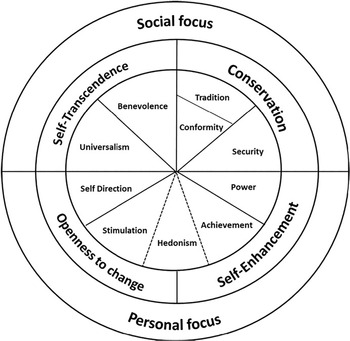
We are by no means the first to suggest that values are implicated in policy (see for example Lindblom, Reference Lindblom1959; Stone, Reference Stone2002; Thacher and Rein, Reference Thacher and Rein2004), or to suggest that politicians draw on values-based language when seeking to persuade citizens to support them, or their policies (see for example Brewer, Reference Brewer2001; Nelson and Garst, Reference Nelson and Garst2005; Feldman, Reference Feldman1988). Since the publication of Rokeach’s important book The Nature of Human Values (Reference Rokeach1973), there has been significant progress across the social sciences around the theorising, empirical identification, and measurement of human values. A direct intellectual descendent of Rokeach’s work is that of Shalom Schwartz (for example 1992). The circular representation (Figure 1) of the ten universal human values he identifies, and their relationships to each other, provides an accessible visual tool for researchers, and we have used his theory as the basis for the analysis that follows. Decades of empirical work has confirmed the existence of these ten universal human values and their structure. These sit under four higher level values: Self-Transcendence, Conservation, Openness to Change, and Self-Enhancement. Prioritising the values comprising the first two of these higher order groupings indicates a set of personal values that have a social focus; while an individual prioritising values under the latter two has a more personal focus. This emphasis has clear implications in situations requiring collective action as more socially focused individuals are more likely to be amenable to action taken for the public good.
The Schwartz Values Circle.
(Source: Lake et al., Reference Lake, Gerrans, Sneddon, Attwell, Botterill and Lee2021)

Research using the Schwartz theory has been almost exclusively quantitative, relying on self-reporting of values through the Personal Values Questionnaire, which is then used to arrive at conclusions based on responses to various statements of interest to the researcher. The only significant attempt, of which we are aware, that has used the Schwartz model qualitatively is the work of Bardi et al. (Reference Bardi, Calogero and Mullen2008). They argued that ‘developing a measure of individual values that does not rely on the administration of self-report questionnaires is crucial for contexts in which it is undesirable, impractical or impossible to administer a questionnaire’ (Bardi et al., Reference Bardi, Calogero and Mullen2008). They proposed a lexicon of words that represented the ten values in the Schwartz circle, which they then used to study societal values shifts over time. Whereas the standard quantitative approach requires the researcher to develop research questions on a specific topic in advance, a lexicon-based approach allows for the retrospective analysis of texts and speeches – in fact of any documentary record. In our case we were seeking out the values embodied in persuasive talk, using the Schwartz theory to inform the identification of these values. This required interpretation of the rhetorical approach overall, marking a departure from the method of Bardi et al. (Reference Bardi, Calogero and Mullen2008),who counted specific words and then undertook a quantitative analysis of their occurrence. We were interested in the use of values-based appeals by the Victorian Premier in his daily briefings on the response to the COVID-19 outbreak in his state. As well as differing from the standard quantitative approach to research using the Schwartz theory, we also diverged in that we were not seeking to correlate individuals’ values with agreement with specific statements, but rather to examine Andrews’ rhetoric for values-based messages. We set out, in this research, to undertake a preliminary testing of the approach described. Accordingly, we make no claims about our findings with respect to all of Andrews’ speeches across the period of the 2020 lockdown in Melbourne. The purpose of this research note is to stimulate interest in applying thematic analysis to persuasive political documents using Schwartz’s values theory. Our approach to thematic analysis is reflexive but there is clear scope for other forms of values-based thematic analysis.
The study
Throughout the 2020 lockdowns in Australia’s eastern states, political leaders held daily media conferences. These were opportunities to provide updates on the impact of the virus, and on the policy measures in place to combat its spread. They contained a strong persuasive element designed to promote compliance with the restrictions on personal liberties. In an initial pilot study undertaken as part of an undergraduate student research internship, a convenience sample of Andrews’ speeches during the 2020 lockdown was obtained in the form of freely available transcripts on the website of the company Rev (www.rev.com). Three speeches were analysed as part of this research (10 August, 14 September and 26 October), providing preliminary support for the proposition that Andrews appealed to a range of values in his media conferences. We subsequently engaged Rev to produce transcripts of ten media conferences which were selected purposively to test the proposition with a larger sample.
The first transcript was from the media conference at which the Premier announced the decision to move into a stricter (Stage 4) lockdown in Melbourne than had previously been in place. The last was the day on which the State of Victoria returned to Stage 3 restrictions. Between those two dates we selected media conferences at which significant announcements were made relating to advertising campaigns, childhood vaccination, and changes to the restrictions both for Melbourne and for non-metropolitan regional Victoria. We recognise that other researchers may have selected different speeches for analysis; our rationale for the choice of these particular media conferences is available along with the transcripts as indicated in the Data Availability section at the end of this Note.
Analysis and findings
We focused our analysis on the first 10–12 minutes of each media briefing that was Andrews’ prepared presentation. We excluded the question and answer session with members of the media that followed on the basis that the opportunity for Andrews to craft his comments to appeal to a range of values was more limited in this more impromptu setting. We each undertook a reflexive thematic analysis (TA) (Braun and Clarke, Reference Braun and Clarke2022) of the speeches, and highlighted words and phrases that appealed to the four higher level values described in the Schwartz theory. Consistent with reflexive TA, we resolved any differences collaboratively (Braun and Clarke, Reference Braun and Clarke2019). Our analysis was undertaken at the latent rather than the semantic level. As Braun and Clarke (Reference Braun and Clarke2006) explain,
a thematic analysis at the latent level goes beyond the semantic content of the data, and starts to identify or examine the underlying ideas, assumptions, and conceptualisations – and ideologies – that are theorised as shaping or informing the semantic content of the data.
Compared with semantic coding, latent coding is ‘much more interpretive, requiring a more creative and active role on the part of the researcher’ (Byrne, Reference Byrne2022). We also worked from within a constructionist epistemology emphasising not recurrence of particular phrases but their meaningfulness (Byrne, Reference Byrne2022) in contributing to our capacity to answer our research question and test the application of Schwartz’s values in a qualitative study.
The first of Andrews’ speeches in our sample stood out in that it did not contain identifiable values appeals. It was a listing of the restrictions associated with the implementation of a state of emergency and the Stage 4 lockdown and was factual rather than persuasive in tone. After that though, the approach shifted as the Premier’s messages contained both policy announcements and exhortations for Victorians to comply with the measures in place. In these speeches, we focused on identifying phrases and metaphors employed to convey values messages. For example, the following phrases were coded as appeals to self-transcendence values:
[the virus] will only be defeated if we are united (Transcript 10 August 2020)
that [strategy of moving towards COVID normal] only works if everybody plays their part (Transcript 22 August 2020)
The emphasis on unity and acting together for the common good appeals to both individuals who prioritise benevolence and those who prioritise universalism, the pro-social values. In the Schwartz model, ‘[t]he motivational goal of benevolence values is preservation and enhancement of the welfare of people with whom one is in frequent personal contact’ (Schwartz, Reference Schwartz and Zanna1992) while ‘[t]he motivational goal of universalism is understanding, appreciation, tolerance, and protection for the welfare of all people and for nature’ (Schwartz, Reference Schwartz and Zanna1992).
For appeals to self-enhancement values, we identified phrases and words that appealed to individual circumstances and concerns and recognised the individual sacrifice of the lockdown. For example,
we can’t fritter away all of that good work, all that sacrifice. That pain, the challenges that every Victorian has endured and worked through, we can’t have that count for nothing (Transcript 30 August 2020)
There’s been a lot of pain, a lot of hurt. There’s a need for healing, for investment, for all sorts of repair at a very personal level (Transcript 8 November 2020)
These statements appeal to the value of self-direction – described by Schwartz as having as its ‘defining goal’ ‘independent thought and action – choosing, creating, exploring’ (Schwartz, Reference Schwartz and Zanna1992). The statements recognise the sacrifice associated with the loss of the capacity to pursue these values.
Some of Andrews’ comments contained appeals to more than one value and were coded accordingly, for example:
I know it’s frustrating, I know there’s a lot of pain out there in the community [self-enhancement values]. But we need to, as a community focus. As a state, we need to focus on the fact that, yes, we have stayed apart, but at the same time we have stuck together. We have looked out for each other [self-transcendence values]. (Transcript 18 October)
Having examined the transcripts to identify the diversity of values appeals, we looked at the speeches more holistically in terms of their structure. The format of Andrews’ prepared comments was consistent across the media conferences, beginning with four regular topics. The first was a report providing an update on the number of COVID-19 cases, hospitalisations, and deaths in the state. In announcing these numbers Andrews expressed his sympathy for those who were ill or who had lost loved ones to the pandemic, as well as his thanks to health care workers for their work. As part of these updates, he also reported on the number of people coming forward to get tested. This latter number was then clearly linked to the second theme of his communication – thanking Victorians for ‘playing their part’. This point was expressed as gratitude to community members for their perseverance and compliance with the restrictions. The third theme was empathy for citizens frustrated by the disruption to their lives, and the ongoing uncertainty about how long the restrictions were going to last. The second and third themes appeal to pro-social and personally focused values respectively.
The fourth element involved convincing the Victorian community to comply with restrictions, and to trust that the government’s policy settings were right. It was in these elements of the speech that we identified the main use of values appeals. Andrews’ hard lockdown was not universally applauded. The opposition party in the state of Victoria, members of the Federal government (from the opposite side of politics from Andrews), sections of the media, and some political commentators argued that the restrictions were unnecessary and unjustifiably draconian. There were some protests against the measures – for example, on 23 October (ABC News, 2020b) and 3 November, the latter resulting in over 400 people being arrested for breaching health orders (Visontay, Reference Visontay2020).
All but one speech in our sample included the use of metaphor, which is a very effective rhetorical device for convincing diverse audiences through the appeal to widely held values (Mio, Reference Mio1997). Sporting metaphors are common in political rhetoric (Howe, Reference Howe1988), and Andrews used this device in all of the speeches that we sampled. For example, on 18 October he stated that ‘You cannot run, you cannot sprint to COVID normal’; and the most frequently used metaphor was ‘staying the course’, a term common in horse racing and sailing. Howe (Reference Howe1988) identifies war metaphors as a second dominant political metaphor and Andrews referred to the virus in half of the speeches we examined as an ‘enemy’ or ‘wicked enemy’ that needed to be ‘defeated’. On 30 August, in the relatively early days of the Stage 4 lockdown, he drew on the metaphor of bushfire, one with particular resonance in his state, telling Victorians that,
We all want this to be, this second wave to be defeated, but it needs to be defeated properly so that it’s not some smoldering fire that then takes off again and potentially burns more intensely than it ever has (Transcript 30 August 2020).
There were two parts to the persuasive appeal. First, Andrews needed to convince Victorians that the policy settings were right and second, that it was in individuals’ interests to comply with those settings. While response to the former appeals is likely to split along partisan lines, the receptiveness to the latter is influenced by personal values (Botterill et al., Reference Botterill, Lake and Walsh2021). Lake et al. (Reference Lake, Gerrans, Sneddon, Attwell, Botterill and Lee2021) demonstrated that message persuasiveness around COVID behavioural restrictions was related to values, suggesting that a rhetor who mixes up the values messages can increase the range of people to whom they appeal. Andrews proved adept at this. Consistent with the need to inspire and sustain collective action against the virus, his focus was very much on the collective good, appealing to socially focused values. For example,
We are strong. We are resilient. We are at our best when we are one, when we are together. When we look out for each other, when we understand that how all of us act, how all of us behave, makes a difference. That even individual decisions can have a big and profound impact on much larger groups. That’s when we are strongest. (Transcript 10 August 2020)
Elsewhere, he appealed much closer to home, and to personal self-interest:
all Victorians should be [in] no doubt that this is a matter of life and death. And even for those who are able to survive this virus, there are lingering consequences, there are lingering impacts for many. (Transcript 10 August 2020)
He also acknowledged the trade-offs in the policy choices:
Rules that balance both the protection of public health, but also, so protecting lives, but also protecting livelihoods and making sure that we can open back up again, rebuild businesses, repair the damage that this pandemic has done to us right across the state. (Transcript 30 August 2020)
It is the task of politicians to juggle the values at play in policy debate (Botterill and Fenna, Reference Botterill and Fenna2019), and it is their rhetorical skills that are important in encouraging compliance with health measures. This is particularly critical in situations where collective action is required.
Our analysis is unable to determine whether Dan Andrews’ effectiveness was the result of skilled prior framing of the message by the Premier and his team in preparing for the media conferences, or the result of Andrews’ inherent skills as a communicator. This is an area for further research but there are clearly lessons to be drawn from his rhetoric. Appealing to a range of values in political communication contributes to effective messaging which can cut across partisan divides. This is particularly important where adherence to collective action is quite literally a matter of life or death.
Conclusion
For values researchers, developing qualitative methods for expanding the application of the Schwartz theory holds a great deal of promise. Such methods open up a range of areas of investigation of interest in the fields of political psychology, political science, rhetoric, political communication, and political history. We have sought to demonstrate that thematic analysis can benefit from being informed by Schwartz’s work by identifying values appeals in political rhetoric. In addition to analysing the rhetoric of political leaders, it could be applied to data sources such as Parliamentary records, election manifestoes/party platforms, and other policy and political documents. This paper has sought to make a modest contribution to this expansion of Schwartz’s theory beyond quantitative, survey-based research. Previous work in political science and political psychology has identified the importance of values-based messaging in political persuasion, however the choice of values being studied has been somewhat idiosyncratic, and the term ‘values’ itself often remains undefined. We argue that introducing some consistency would greatly strengthen this area of research and suggest that the Schwartz theory provides an empirically validated, and already widely used, framework that would meet that need.
Data Accessibility Statement
The transcripts on which this analysis is based and the rationale for the transcript selections are available through Mendeley Data at Botterill, Linda (2022), ‘Transcripts: Andrews 2020’, Mendeley Data, V1, doi: https://doi.org/10.17632/4m54tfbv34.1
Acknowledgments
We would like to register our thanks to Dr Michael Walsh for his comments on earlier drafts of this paper.
Competing Interests
The authors declare none.