Significant outcomes
• Excessive daytime sleepiness (EDS) is frequent in bipolar disorder, presenting in 40% of chronic patients in an euthymic state.
• Sleepiness strongly associates with poor sleep quality.
• When present, excessive sleepiness contributes to functional impairment independently of sleep disturbance or use of sedative medications.
Limitations
• Results are based on cross‐sectional relationships, so no causal inferences can be drawn.
• Sleep measures are based on self‐reports, not on direct observation.
Introduction
Biological rhythm disturbance is a core feature of bipolar disorder Reference Soreca, Frank and Kupfer1. Among other symptoms, patients suffer from insomnia, hypersomnia, early morning awakening, reduced sleep efficiency and altered rapid eye movement (REM) sleep latency Reference Lamont, Coutu, Cermakian and Boivin2. While insomnia is recognised as a central symptom across mood disorders, the role of hypersomnia syndromes is often underestimated.
EDS is the tendency to fall asleep during the day despite volitional efforts Reference Chellappa, Schroder and Cajochen3. Previous studies have reported diverse impairments associated with EDS, including worse cognitive function Reference El‐Ad and Lavie4, work attainment Reference Dauvilliers and Buguet5, daily activities and level of productivity Reference Gooneratne, Weaver and Cater6.
Notwithstanding the current literature showing the clinical relevance of EDS, its global impact in patients with bipolar disorder is not adequately understood. People with bipolar disorder, especially those with chronic illness tend to have significant biological rhythm dysfunction and disability, even in the absence of acute mood episodes Reference Giglio, Magalhaes, Kapczinski, Walz and Kapczinski7. They further tend to use multiple medications that potentially cause sedation and impair cognition.
To clarify the prevalence and clinical relevance of EDS in bipolar disorder we conducted a cross‐sectional case–control. Here, we further report on the impact of sleep disturbance and sleep medication on daytime sleepiness as well as the impact of EDS on functional impairment in a sample of clinically stable outpatients.
Methods
Participants
Eighty‐one outpatients with a diagnosis of bipolar disorder were consecutively recruited from September to November 2006. Patients had a clinical diagnosis of bipolar disorder (BD) type I, type II or BD not otherwise specified and were required not to be in an acute mood episode, according to the Structured Clinical Interview for DSM‐IV (SCID‐I). Only those with comorbid mental retardation were excluded.
Seventy‐nine healthy control subjects were recruited from the hospital catchment area. They were frequency matched for type of health service used, sex, age and educational level. This group was screened with the non‐patient version of the SCID to exclude current psychiatry morbidity, had no first‐degree relatives with BD, schizophrenia or other psychotic disorders Reference Giglio, Magalhaes, Kapczinski, Walz and Kapczinski7, Reference Giglio, Magalhaes and Andreazza8, Reference Giglio, Magalhaes, Aandersen, Walz, Jakobson and Kapczinski9. Participants gave written informed consent before entering the study, which was approved by the local ethics committee.
Instruments
Daytime sleepiness was assessed with the Epworth Sleepiness Scale (ESS) Reference Johns10. This is a questionnaire that assesses the probability of falling asleep in eight different situations, known to be soporific. Each item is rated from zero to three (highest). It has been translated into Portuguese with good reliability and validity similar to the original instrument Reference Bertolazi, Fagondes, Hoff, Pedro, Barreto and Johns11. Scores above 10 were used in this report to indicate EDS, as has been previously used in Latin America Reference Bouscoulet, Vazquez‐Garcia and Muino12.
The Pittsburgh Sleep Quality Index Reference Buysse, Reynolds, Monk, Berman and Kupfer13 is a self‐rated questionnaire which assesses sleep quality and disturbances over a 1‐month time interval. It was used to indicate the presence of significant sleep disturbance in the sample, with a cut‐off point of 6. We further use the ‘use of sleep medication’ subscale to verify the impact of sedatives on EDS. Functional impairment was assessed with the Functioning Assessment Short Test (FAST). It includes items on autonomy, work, cognitive functioning, financial issues and interpersonal relationships. It is reliable, both in terms of internal consistency (α = 0.95) and test‐retest (ICC = 0.90). It had good construct validity, with the five‐factor structure explaining over 70% of item variance. It also discriminates patient and control groups and converges with the Global Assessment of Functioning. It has been validated in Portuguese and Spanish speaking populations with very similar factor structures Reference Rosa, Sanchez‐Moreno and Martinez‐Aran14, Reference Cacilhas, Magalhaes and Cereser15, Reference Cacilhas, Magalhaes and Cereser16.
Statistical analyses
Differences in raw ESS scores were tested with the nonparametric Mann–Whitney's U. We use robust binary Poisson regression to estimate prevalence ratios for excessive sleepiness Reference Barros and Hirakata17. We report a model for EDS with main effects for group and sleep disturbance and an interaction term.
As the distribution of FAST scores was skewed, a negative binomial regression model was employed to estimate independent effects of EDS, sleep disturbance, sedative medication and group on FAST scores.
Results
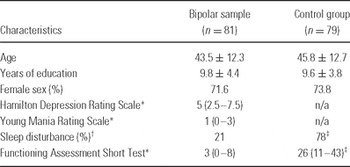
Table 1 displays basic demographic characteristics of patients and control subjects. Median scores for the ESS were 8 [interquartile range (IQR) 7] in the patient group and 5 (IQR 11) in the control group (Z = 2.11, p = 0.035).
Demographic and clinical characteristics of the study sample

n/a, not applicable.
*Results are shown as median (interquartile range).
†According to the Pittsburgh Sleep Quality Index.
‡p < 0.001.
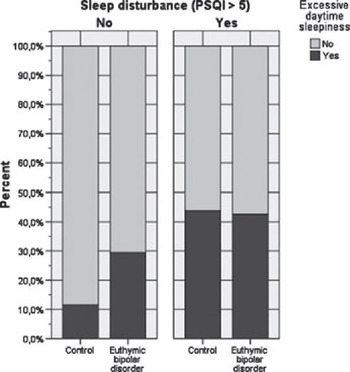
The prevalence of EDS was 40% in the euthymic patients as compared to 18% in the control group [prevalence ratio (PR) = 2.26, 95% CI 1.30–3.91, p = 0.004]. In the bivariate analysis, use of sleep medication (PR = 2.16, 95% CI 1.34–3.47, p = 0.001) and sleep disturbance (PR = 2.79, 95% CI 1.56–4.99, p = 0.001) were associated with EDS as well. The multivariate model retained sleep disturbance as a predictor (PR = 3.70, 95% CI 1.50–9.08, p = 0.004), but group (p = 0.092) and use of medication (p = 0.441) were dropped. There was also a trend for an interaction between group and sleep disturbance (p = 0.085), suggesting differential group effects according to the presence of sleep disturbance (Fig. 1).
Proportion of participants with excessive daytime sleepiness according to group (bipolar disorder or control) and the presence of sleep disturbance.

Functioning scores were associated with EDS scores in both the patient (Z = 2.33, p = 0.020) and control groups (Z = 2.84, p = 0.005). Fig. 2 displays a smoother plot with the relation between functioning and sleepiness. The regression model retained group (B = 0.73, 95% CI 0.28–1.18, p = 0.001), sleep disturbance (B = 0.87, 95% CI 0.40–1.35, p < 0.001) and EDS (B = 0.44, 95% CI 0.11–0.77, p = 0.009) as independent predictors of higher FAST scores, but not the use of sleep medication (p = 0.162).
Relationship between sleepiness and functioning in patients and healthy controls.
Discussion
In this study, EDS was associated with bipolar disorder, with patients having more than twice the prevalence of healthy control subjects. Patients also presented often with a sleep disturbance, and this association is a plausible explanation for the sleepiness. Remarkably, EDS was independently associated with disability in our study, even when controlled for sleep disturbance and use of sleep medication.
As mentioned, one possible interpretation is that daytime sleepiness is merely a marker of a more severe sleep disturbance. If this is the case, EDS could still prove to be an interesting target. It is often associated with cognitive dysfunction Reference Ohayon18, another relevant target in bipolar disorder Reference Lewandowski, Cohen and Ongur19. Interestingly, modafinil and armodafinil are two drugs used to treat excessive sleepiness that show preliminary efficacy as add‐on in bipolar disorder Reference Frye, Grunze and Suppes20, Reference Calabrese, Ketter, Youakim, Tiller, Yang and Frye21. Future randomised trials might be able to disentangle this association, showing to what extent it is possible to affect functioning and cognition via sleepiness.
The finding of excessive disability further reinforces the clinical relevance of EDS. The rating scale we employed here was developed to gauge the main dimensions of disability associated with bipolar disorder Reference Rosa, Sanchez‐Moreno and Martinez‐Aran14, Reference Cacilhas, Magalhaes and Cereser15. Bipolar disorder is a highly disabling illness, with biological rhythm dysfunction contributing to the cognitive impairment Reference Giglio, Magalhaes, Kapczinski, Walz and Kapczinski7. We show here that daytime sleepiness is a further symptom contributing to the prevailing functional impairment often present. Disability in mood disorders, of course, is a complex and multifactorial construct. It is highly clinically relevant that a simple symptom, such as daytime sleepiness, has the potential to impact functioning, whether as a marker or an independent factor.
Limitations in this study relate to the cross‐sectional design. It is not possible here to investigate causal links between sleepiness, sleep disorders, bipolar disorder and functioning. As mentioned, one interesting solution would be to investigate these factors in the context of a randomised controlled trial. Also of relevance, the ESS is a self‐reported questionnaire and no direct patient observation was obtained. The scale has, however, demonstrable validity and reliability in the clinical setting Reference Bertolazi, Fagondes, Hoff, Pedro, Barreto and Johns11.
This study suggests that EDS is a relevant clinical dimension in patients with bipolar disorder. It is a frequent symptom that often overlaps with other sleep disturbances and once present it augments the patients' functional impairment. Clinically, it is reasonable to ask about daytime sleepiness in the routine assessment of patients with bipolar disorder.
Acknowledgements
Dr P. V. M. was supported by a post‐doctoral scholarship from CNPq, Brazil. Dr F. K. has received grant/research support from Astra‐Zeneca, Eli Lilly, the Janssen‐Cilag, Servier, CNPq, CAPES, NARSAD and the Stanley Medical Research Institute; has been a member of the speakers boards for Astra‐Zeneca, Eli Lilly, Janssen and Servier and has served as a consultant for Servier. The other authors declare they have no conflict of interest in the matter.