INTRODUCTION
The family Monhysteridae is regarded as one of the most successful families within the free-living nematodes (Lorenzen, Reference Lorenzen1978). Members of this family inhabit marine and continental biotopes. Unfortunately, the two most recent studies covering this family (Andrássy, Reference Andrássy2005; Coomans & Eyualem-Abebe, 2006) only considered the inland (limnic and terrestrial) species. The last study covering the whole family, including marine representatives, was carried out by Jacobs (Reference Jacobs1987a). Jacobs recognized 12 valid genera (Eumonhystera Andrássy, Reference Andrássy1981, Monhystera Bastian, 1865, Thalassomonhystera Jacobs, 1987, Diplolaimella Allgén, 1929, Diplolaimelloides Meyl, 1954, Monhystrium Cobb, 1920, Odontobius Roussel de Vauzéme, 1834, Tripylium Cobb, 1920, Gammarinema Kinne & Gerlach, 1953, Geomonhystera Andrássy, Reference Andrássy1981, Monhystrella Cobb, 1918 and Sinanema Andrássy, 1960) and two genera inquirenda (Anguimonhystera Andrássy, Reference Andrássy1981 and Sitadevinema Khera, 1921). More recently, four additional genera have been described, Cryonema Tchesunov & Riemann, Reference Tchesunov and Riemann1995, Halomonhystera Andrássy, Reference Andrássy2006, Tridentula (Eyualem-Abebe & Coomans, Reference Eyualem-Abebe and Coomans1995) Andrássy, Reference Andrássy2007 and Hieminema Tchesunov & Portnova, Reference Tchesunov and Portnova2005, and the genus Anguimonhystera was provisionally retained by Coomans & Eyualem-Abebe (2006). From these, 17 valid genera, seven are known to be free-living inhabiting thalassic, saline and brackish waters: Cryonema (Tchesunov & Riemann, Reference Tchesunov and Riemann1995), Halomonhystera (Andrássy, Reference Andrássy2006; Zekely et al., Reference Zekely, Sørensen and Bright2006; Derycke et al., Reference Derycke, Backeljau, Vlaeminck, Vierstraete, Vanfleteren, Vincx and Moens2007), Thalassomonhystera (Tchesunov & Miljutina, Reference Tchesunov and Miljutina2005; Zekely et al., Reference Zekely, Sørensen and Bright2006), Monhystrella (Vanhove et al., Reference Vanhove, Arntz and Vincx1999), Hieminema (Tchesunov & Portnova, Reference Tchesunov and Portnova2005), Diplolaimella (Kito & Aryuthaka, Reference Kito and Aryuthaka1998; Zhou, Reference Zhou2001; Da Rocha et al., Reference Da Rocha, Venekey, Bezerra and Souza2006) and Diplolaimelloides (Alkemade et al., Reference Alkemade, Wielemaker, Herman and Hemminga1994; Moens et al., Reference Moens, Verbeeck, de Maeyer, Swings and Vincx1999; Moens & Vincx, Reference Moens and Vincx2000). These taxa are distinguished from each other by few diagnostic characters and the combination of several other morphological characters.
The marine monhysterid genera mainly occur in shallow marine areas and brackish waters. In the last two decades, however, the importance of this family in other marine environments such as anoxic regions (Jensen, Reference Jensen1986) and deep seas (Vanreusel et al., Reference Vanreusel, Clough, Jacobsen, Ambrose, Jivaluk, Ryheul, Herman and Vincx2000; Van Gaever et al., Reference Van Gaever, Moodley, de Beer and Vanreusel2006; Fonseca & Soltwedel, Reference Fonseca and Soltwedel2007) has become apparent. For instance, a nematode assemblage of the deep-sea sediment may be characterized by 50% of monhysterids (Vanreusel et al., Reference Vanreusel, Clough, Jacobsen, Ambrose, Jivaluk, Ryheul, Herman and Vincx2000) with more than 10 species per 10 cm2 of mud (Fonseca & Soltwedel, Reference Fonseca and Soltwedel2007). It is believed that the majority of marine monhysterid species belong to the genus Thalassomonhystera (Vopel & Thiel, Reference Vopel and Thiel2001). However, ecologists who encountered individuals from the family Monhysteridae usually overlooked their taxonomic distinctness and reported only one group ‘monhysterids’ (Vanreusel et al., Reference Vanreusel, Clough, Jacobsen, Ambrose, Jivaluk, Ryheul, Herman and Vincx2000; Muthumbi et al., Reference Muthumbi, Vanreusel, Duineveld, Soetaert and Vincx2004).
The identification of the group is considered difficult because, on the one hand, most of the taxonomic descriptions of marine species are based on few poorly described individuals and often published in less accessible scientific journals, while on the other hand, recent descriptions often do not include data on morphological variability and identification keys to genus or species level. Moreover, many species encountered during ecological studies are new to science. For example, Bussau (Reference Bussau1993) recognized 14 Thalassomonhystera species coming from bathyal depths of which only one was previously described. Unfortunately, the low number of active taxonomists together with the lack of taxonomic identification tools and the large number of undescribed nematode species hampers ecological and evolutionary assessments of the marine environment (Coomans, Reference Coomans2000).
Nevertheless, two attempts to assemble all data on descriptions and records of the monhysterid species were carried out. The first database compiling all aquatic species of the family Monhysteridae, known as the Bremerhaven-checklist, was published by Gerlach & Riemann (Reference Gerlach and Riemann1973). The authors considered all taxonomic descriptions which resulted, more in particular for the family Monhysteridae, in a large number of synonyms. Several years later, a more comprehensive checklist on the family Monhysteridae regardless of the environment was published by Jacobs (Reference Jacobs1987a). This author presented a new classification for the Monhysteridae, followed by a checklist including a list of valid species, species inquirendae, and synonyms. In this checklist, Jacobs introduced one new subfamily Diplolaimellinae, three new tribes Thalassomonhysterini, Diplolaimellini and Geomonhysterini, and one new genus Thalassomonhystera. Jacobs (Reference Jacobs1987a) erected the genus Thalassomonhystera with the purpose of encompassing all marine species previously described within the genus Monhystera. His classification has been accepted and used later as reference by numerous authors (Bussau, Reference Bussau1993; Riemann, Reference Riemann1995; Eyualem-Abebe et al., 2001; Andrássy, Reference Andrássy2005, Reference Andrássy2006; Coomans & Eyualem-Abebe, 2006). In the last two decades, several new species were added to this family. Although some of these recent studies stated clearly the taxonomic grounds for proposing new species, others did not and embroiled the taxonomic identity of the group as proposed by Jacobs (Reference Jacobs1987a). With the exception of Andrássy (Reference Andrássy2006) and Tchesunov & Riemann (Reference Tchesunov and Riemann1995), other recent studies including marine species did not provide taxonomic tools for species identification.
In the current study, we first present an adapted diagnosis of the family followed by an illustrated classification of the marine taxa. Then, we provide for each subfamily, tribe and marine genus a brief historical background, a diagnosis and a list of valid species. Based on the species lists, dichotomous keys to species level and illustration ‘guides’ are given to stimulate and facilitate future ecological and taxonomic studies of the family Monhysteridae.
BACKGROUND, DIAGNOSIS AND SPECIES LIST OF THE FREE-LIVING MARINE MONHYSTERIDAE
In the present study, the historical backgrounds of each taxonomic level are given. The diagnoses provided include possible morphological variability of all valid species listed. The lists of species are based on the most recent checklists and/or generic reviews published together with recent descriptions. In the species lists, the type species is underlined and the marine/brackish species/genera are marked in bold. For each species, the sampling location of the original description is given in parentheses. Additional, dichotomous-keys to species level and illustrations from the anterior and posterior end of each species are added. The keys are solely based on the original descriptions. In all genera, males and females are needed to identify up to species level. Unfortunately, not all original illustrations could be reproduced here; some of them were printed too small and/or were of poor quality. All the illustrations presented in this study were also based on the original description but did not intend to reproduce all the details from the original drawings.
According to Eyualem-Abebe & Coomans (Reference Coomans, Eyualem-Abebe, Eyualem-Abebe, Traunspurger and Andrássy2006), the Monhysteridae is the only family within the superfamily Monhysteroidea de Man, 1876. The Monhysteroidea are easily distinguishable from the other two superfamilies, Sphaerolaimoidea Filipjev, 1918 and Siphonolaimoidea Filipjev, 1918 by the type of cuticle, absence of sub-cephalic setae and the presence of a single gonad on the right side of the intestine (see diagnosis below).
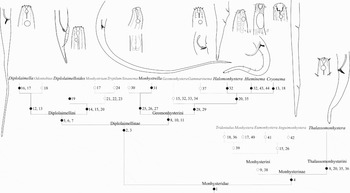
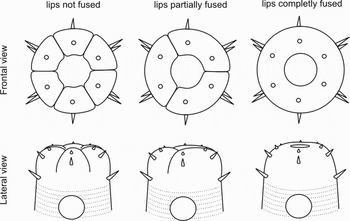
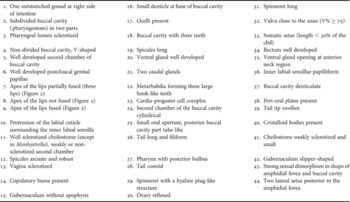
Jacobs (Reference Jacobs1987a) divided the family Monhysteridae into two subfamilies based on the shape of the buccal cavity: (1) the Monhysterinae including species with a single V-shaped buccal cavity; and (2) the Diplolaimellinae possessing species with a double buccal cavity (features 2 and 4; Figure 1 and Table 1). He further divided the Monhysterinae into two tribes based on the presence of peri-oral plates and apex of the lips fused (Figure 2) for the tribe Monhysterini (features 9 and 38; Figure 1 and Table 1) and absence of such plates and separate lip tips (Figure 2) for the Thalassomonhysterini. The Monhysterini are represented by the genera Tridentula, Eumonhystera, Anguimonhystera and Monhystera. These four genera are restricted to freshwater and terrestrial environments and will not be considered in this study. The tribe Thalassomonhysterini is monogeneric with Thalassomonhystera being restricted to marine and brackish water environments.
Identification-key for the genera from the family Monhysteridae and schematic drawings for the free-living marine genera. Full lines and circles, and black names stand for the marine genera; dashed lines, open circles and grey names stand for the non-marine. List of characters is given in Table 1.

Frontal and lateral views of the three types of lips within the family Monhysteridae.

List of diagnostic characters used in Figure 1 to identify at genus level the family Monhysteridae.

The sub-family Diplolaimellinae is also divided into two tribes, Diplolaimellini and Geomonhysterini, based on the shape of the second buccal chamber and post-cloacal supplements which both are largely developed in the first tribe (features 5 and 6; Figure 1 and Table 1). The Diplolaimellini consists of 5 genera, two of which are commonly found in marine environments (Diplolaimella and Diplolaimelloides). The main differences between these two genera are: long or short spicules, vagina sclerotized or not, presence or absence of a copulatory bursa and presence or absence of a caudal apophysis of gubernaculum (features 12–15; Figure 1 and Table 1). The tribe Geomonhysterini includes seven genera with the genera Cryonema, Halomonhystera, Hieminema and Monhystrella being mainly free-living marine. These four genera differ from each other by a combination of different characters (see features 25–27 versus 28–29 and features 32, 36, 38 43 and 44; Figure 1 and Table 1).
In total, seven of the 17 genera in the family Monhysteridae are known to be free-living mainly inhabiting marine and coastal sediments (Cryonema, Diplolaimella, Diplolaimelloides, Halomonhystera, Hieminema, Monhystrella and Thalassomonhystera). Three genera comprise species living in gill chambers of aquatic (Gammarinema) or inland (Monhystrium and Tripylium) crustaceans. The other 7 genera are known to inhabit inland water bodies (see Appendix 1 for species lists of the inland and commensal genera).
DIAGNOSIS
Aadapted after Jacobs (Reference Jacobs1987a), Lorenzen (Reference Lorenzen1994), Andrássy (Reference Andrássy2005) and Coomans & Eyualem-Abebe (2006).
Monhysteroidea
Small, slender nematodes with body length usually less than 2.5 mm (except Odontobius, L > 3 mm); body cuticle finely striated and frequently smooth under light microscope. Anterior sensillae in two circles: anterior circle with six inner labial sensillae (usually papilliform), posterior circle with six outer labial sensillae and four cephalic (usually setiform) sensillae. Amphidial fovea circular or cryptospiral ventrally wound, varying in size (may be result of sexual dimorphism) and in position from the anterior end. Ocelli often present in shallow-water and inland species. Buccal cavity (excluding cheilostome) surrounded by pharyngeal tissue and of varying shape: either bipartite or single V-shaped, cylindrical or minute; with or without denticles. Pharynx cylindrical, well muscularized, sometimes slightly swollen at its anterior end and in some genera (Monhystrella, Sinanema and partly in Eumonhystera) with more or less developed muscular posterior bulb. Cardia with conoid part lying between pharynx and intestine, and oblong valve-like, inner part protruding in intestinal lumen. Intestine with few cells (oligocytous) arranged in two rows; dorsal and ventral. Ventral gland often present in marine and freshwater species; secretory–excretory pore from just anterior to nerve ring to the labial region. Female reproductive system monodelphic, prodelphic, with the gonad always outstretched (except in Sinanema where the ovary is reflexed) on the right side of the intestine. Male monorchic, spicules generally simple, of varying length, 1–5 times the anal body diameter (abd). Gubernaculum of varying shape: thin without apophysis to robust with apophysis. Spermatozoan spherical. Tail conoid to elongate–conoid, similar in sexes with caudal glands opening through a single pore at the terminal spinneret; terminal setae absent.
This subfamily was erected by Jacobs (Reference Jacobs1987a) mainly to accommodate all the genera with a subdivided (i.e. double) buccal cavity (feature 2; Figure 1 and Table 1) and originally included nine genera (Diplolaimella, Odontobius, Diplolaimelloides, Monhystrium, Trypilium, Sinanema, Monhystrella, Gammarinema and Geomonhystera). Since then, three genera have been added: Halomonhystera Hieminema, and Cryonema.
DIAGNOSIS
Adapted after Jacobs (Reference Jacobs1987a).
Monhysteridae
Buccal cavity complex; rhabdia separated, forming a second buccal chamber. Radii of pharyngeal lumen, short and sclerotized. Common spinneret chamber and/or duct elongated and/or sclerotized. Reproductive mode: bisexual or parthenogenetic. Two tribes.
This tribe was introduced by Jacobs (Reference Jacobs1987a) with the intention of grouping the genera Diplolaimella, Odontobius, Diplolaimelloides, Monhystrium and Trypilium based mainly on the shape of the second chamber of the buccal cavity, the presence of fused lips and paired postcloacal genital papillae (features 5–7; Figure 1 and Table 1). Diplolaimella and Odontobius are distinguished from the other genera by the robust arcuate spicules, a sclerotized vulva and small denticles or teeth in the second chamber, (features 12, 13, 16 and 18; Figure 1 and Table 1). Diplolaimelloides, Monhystrium and Trypilium are grouped together by the presence of a copulatory bursa, gubernaculum without apophysis, a well developed ventral gland (features 14, 15 and 20; Figure 1 and Table 1) and absence of denticles (Figure 1).
DIAGNOSIS
Adapted after Jacobs (Reference Jacobs1987a).
Diplolaimellinae
Inner labial sensillae papilliform. Apex of lips almost completely fused; sometimes forming three lips. Second buccal chamber (buccal cavity) well sclerotized and well developed; shape of second buccal chamber similar for at least all the first and second juvenile stages. Males with well developed postcloacal genital papillae, gubernaculum apophyse present and caudal alae absent or caudal alae present and gubernaculum apophyse absent. Common spinneret chamber well developed. Reproductive mode: bisexual. Type genus Diplolaimella and four other genera (see classification).
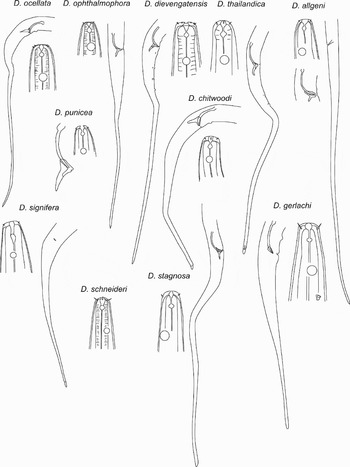
Allgén (1929) erected the genus Diplolaimella on the basis of a single female of D. monhysteroides and differentiated the new taxon from Monhystera mainly on the basis of the double buccal cavity (see also Allgén, 1934: p. 296). In the following year, Allgén (1930) described a single male of the same species. Later on, when more species were added to the genus Diplolaimella, two types of males were observed: (1) males with short spicules and without bursa; and (2) males with long spicules and a bursa. The latter group was transferred by Meyl (1954) into a new genus Diplolaimelloides, morphologically highly similar to Diplolaimella except for presence of a bursa in male versus absent and shape amphidial fovea cryptospiral versus circular in Diplolaimella. Chitwood & Murphy (1964) introduced a new subgenus Diplolaimita (type species D. schneideri) within Diplolaimella for males with short arcuate spicules and gubernaculum with apophysis and differentiated from the monotypic subgenus Diplolaimella sensu stricto (type species D. monhysteroides) with long spicules and gubernaculum not observed; thus the genus Diplolaimelloides was not accepted (p. 313). Timm (1967) deduced from the lengthy spicule and curved tail tip that the male specimen described by Allgén (1930) was actually a Diplolaimelloides species in which the thin bursa and thickening of the wall of the rectum were assumed overlooked. He synonymized Diplolaimita with Diplolaimella. Timm also remarked that Allgén's male specimen was rather similar in measurements and structure of the copulatory apparatus with Diplolaimelloides delyi Andrássy, 1958. Further, the posterior position of the vulva (V = 63.6%) in Diplolaimella monhysteroides female holotype is characteristic of Diplolaimelloides species but the thinner body confines it to Diplolaimella. Consequently, Timm (1967) considered D. monhysteroides a species dubia (i.e. a species inquirenda according to the Code of Zoological Nomenclature) although he still included D. monhysteroides in his key to the species of Diplolaimella. So far, D. monhysteroides was never reported again nor redescribed more in detail. Jacobs (Reference Jacobs1987a) classified D. monhysteroides sensu Allgén (1930) as a new species Diplolaimelloides longispicula (based on a male) without further comment or additional data. Subsequent reviewers of the genus all have accepted Diplolaimella monhysteroides as type species (Gerlach & Riemann, Reference Gerlach and Riemann1973; Jacobs, Reference Jacobs1987a; Coomans & Eyualem-Abebe, 2006). It would be preferable in the future to substantiate Diplolaimella monhysteroides either by redescribing the holotype (provided it still exists) or by designating a neotype. With the exception of D. monhysteroides, all species are illustrated in Figure 3.
Illustration guide: Diplolaimella.

DIAGNOSIS
Adapted after Coomans & Eyualem-Abebe (2006).
Diplolaimellini
Posterior labial and cephalic sensillae small setiform. Sub-median somatic setae less than 20% of long. Cheilostome inverted funnel- or cup-shaped, second chamber of stoma spherical, may be denticulate. Amphidial fovea circular, 1.5–3 times the head diameter (hd) from anterior end. Ocelli may be present. Ventral gland obscure, opening in anterior region. Spicules arcuate and robust (1.3–2.0 abd), gubernaculum and apophysis well developed, pre- and postcloacal papillae (or setae) usually present. Vagina may be sclerotized; vulva located at mid-body region. Tail elongated with an anterior conical portion and a posterior cylindrical portion ventrally curved.
SPECIES LIST
1. D. allgeniSchneider, 1937 (Indonesia)
2. D. chitwoodiGerlach, 1957 (Brazil)
3. D. dievengatensisJacobs, Van de Velde, Geraert & Vranken, 1990 (brackish, The Netherlands)
4. D. gerlachiPastor de Ward, 1984 (Argentina)
5. D. monhysteroidesAllgén, 1929 (Baltic Sea)
6. D. ocellata(Bütschli, 1874) Gerlach, 1957 (Kiel Bay, Baltic Sea)
7. D. ophthalmophoraTimm, 1952 (Chesapeak Bay, USA)
8. D. puniceaTimm, 1952 (Chesapeak Bay, USA)
9. D. schneideriTimm, 1952 (Chesapeak Bay, USA)
10. D. signifera(Paramonov 1929) Gerlach & Riemann, 1973 (brackish, Black Sea)
11. D. stagnosaLorenzen, 1966 (brackish, North Sea)
12. D. thailandicaKito & Aryuthaca, 1998 (shrimp pounds, Thailand)
IDENTIFICATION KEY FOR THE SPECIES OF THE GENUS DIPLOLAIMELLA
1. Ocelli absent ……… 2
– Ocelli present at the level of the first quarter of the pharynx (<25%) ……… 4
– Ocelli present at the level of one-third and half of the pharynx ……… 5
2. Ratio a smaller than 35 ……… D. signifera
– Ratio a between 35 and 55 ……… D. allgeni
– Ratio a equal or larger than 59 ……… 3
3. Vulva located anteriorly to the mid-body ……… D. stagnosa
– Vulva located at least at 64% of the total body length ……… D. monhysteroides
4. Ratio c equal or larger than 15 ……… D. schneideri
– Ratio c equal or smaller than 12 ……… D. gerlachi
5. Amphidial fovea between 1 and 1.4 head diameters from the anterior end ……… D. chitwoodi
– Amphidial fovea between 1.5 and 2 head diameters from the anterior end ……… 6
6. Pre-cloacal supplements absent ……… 7
– Pre-cloacal supplements present ……… 8
7. Size of the amphidial fovea equal or less than 25% of the corresponding body diameter ……… D. punicea
– Size of the amphidial fovea equal or larger than 35% of the corresponding body diameter ……… D. ophthalmophora
8. Ratio c equal or larger than 17 ……… D. ocellata
– Ratio c between 14 and 15 ……… D. thailandica
– Ratio c smaller than 13 ……… D. dievengatensis
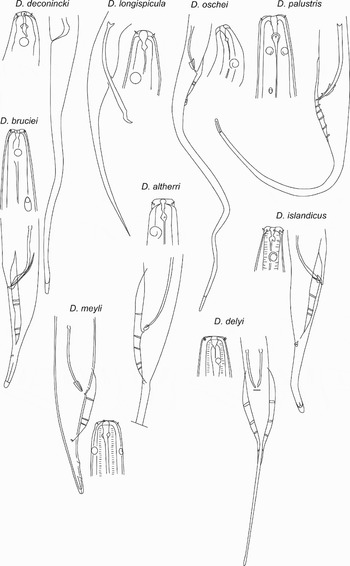
The genus was erected by Meyl (1954) to embrace all the species from the genus Diplolaimella with males and bursa with fine genital papillae. The most recent checklist published for the genus recognized nine valid species (Jacobs, Reference Jacobs1987a), including a new species D. longispicula Jacobs, 1987 for Diplolaimella monhysteroides Allgén, 1929 sensu Allgén, 1930. Since, the original description of D. longispicula based on a single male is poor, i.e. no bursa nor genital papillae were described nor illustrated, we consider it as species inquirenda. Timm (1967) considered both D. monhysteroides Allgén, 1930 based on a female as well as D. monhysteroides sensu Allgén, 1930 based on a male as doubtful species. The nine species are illustrated in Figure 4.
Illustration guide: Diplolaimelloides.

DIAGNOSIS
Adapted after Coomans & Eyualem-Abebe (2006).
Diplolaimellini
Outer labial and cephalic sensillae small, setiform. Cheilostome sub-cylindrical, second chamber of buccal cavity often denticulate. Amphidial fovea cryptospiral, i.e. ventrally wound spiral with a broken or circular aspect, placed 1–2 hd from anterior end. Ventral gland mostly present, opening anterior to nerve ring (mid-pharynx). Ocelli usually present, varying in position from anterior end. Vulva located at mid-body region in long-tailed species, more posterior in shorter-tailed ones. Spicules slender, arcuate to almost straight, varying in length from 1.8 to 4.4 abd. Gubernaculum poorly sclerotized, without dorsal apophysis. Bursa encompassing the anterior portion of the tail and supported by several pairs of fine postcloacal papillae. Tail with posterior section cylindrical; length equal in sexes, but variable according to species. Reproductive mode: bisexual.
SPECIES LIST
1. D. altherriMeyl, 1954 (brackish, North Sea)
2. D. brucieiHopper, 1970 (Lousiana, USA)
3. D. deconincki(Gerlach, 1951) Meyl, 1954 (Kiel Bay, Germany)
4. D. delyiAndrássy, 1958 (brackish, Egypt)
5. D. islandicus(De Coninck, 1943) Meyl, 1954 (Iceland)
6. D. meyliTimm, 1961 (Bay of Bengal, India)
7. D. oscheiMeyl, 1954 (brackish, Germany)
8. D. palustris Tsalolikhin, 1985 (Mongolia)
SPECIES INQUIRENDA
1. D. longispiculaJacobs, 1987
Syn. Diplolaimella monhysteroides apud Allgén, 1930.
IDENTIFICATION KEY FOR THE SPECIES OF THE GENUS DIPLOLAIMELLOIDES
1. Ratio c equal or larger than 14.5 ……… D. oschei
– Ratio c between 7 and 14 ……… 2
– Ratio c smaller than 6 ……… 5
2. Ratio c between 4.6 and 9.4 ……… 3
– Ratio c equal or smaller than 4.5 ……… 4
3. Spicules length divided by the anal body diameter equal or larger than 4 ……… D. altherri
– Spicules length divided by the anal body diameter equal or smaller than 2.6 ……… D. delyi
4. Ocelli present, ventral gland absent ……… D. palustris
– Ocelli absent, ventral gland present ……… D. deconincki
5. Amphidial fovea placed less than one head diameter from the anterior end ……… D. bruciei
– Amphidial fovea placed further than one head diameter from the anterior end ………6
6. Body length equal or shorter than 750 µm ……… D. islandicus
– Body length equal or longer than 800 µm ……… D. meyli
This tribe was erected by Jacobs (Reference Jacobs1987a) with the intention of grouping four genera (Sinanema, Monhystrella, Geomonhystera and Gammarinema) according to their bipartite buccal cavity, which is less developed compared to that in its sister tribe Diplolaimellini, their lip apices not fused, protrusion of the labial cuticle surrounding inner labial papillae and a prominent spinneret (features 8, 10 and 11; Figure 1 and Table 1). Later, three new genera have been described: Cryonema Tchesunov & Riemann, Reference Tchesunov and Riemann1995, Hieminema Tchesunov & Portnova, Reference Tchesunov and Portnova2005 and Halomonhystera Andrássy (Reference Andrássy2006). These three genera are closely related to Gammarinema by sharing a similar tail shape, a well developed ventral gland opening at the anteriormost neck region and a tube- or cap-like hyaline structure surrounding a common spinneret chamber (features 20, 28, 29, 30 and 35; Figure 1 and Table 1). The two remaining genera, Sinanema and Monhystrella, resemble each other by a small oral aperture, a tube-like buccal cavity, a pharynx with posterior bulbus and a long filiform tail (features 25–27; Figure 1 and Table 1). At present, six genera are recognized within this tribe.
DIAGNOSIS
Adapted after Jacobs (Reference Jacobs1987a).
Diplolaimellinae
Inner labial sensillae surrounded by cylindrical protrusion of labial cuticle. Apex of lips not fused, sometimes forming valve-like structures closing the oral opening like a diaphragm. Cheilostome well sclerotized, but rest of buccal cavity only weakly developed or absent. Median zone of cuticle of tail tip expanded, forming a tube- or cap-like structure that surrounds the common spinneret duct. Reproductive mode: bisexual or parthenogenetic.
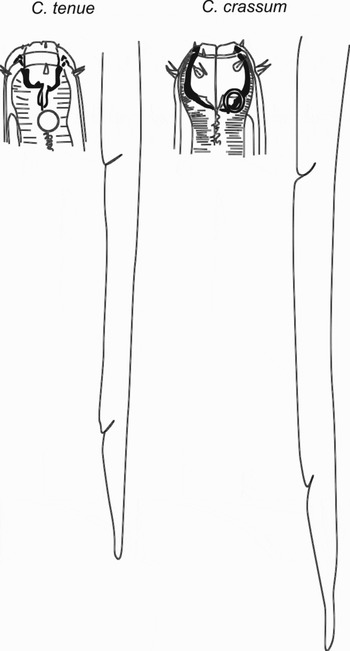
This genus has been erected based on the material collected from drifting sea-ice of the Laptev Sea. According to their descriptions, this genus shares the features from the tribe Geomonyhsterini (features 8, 10 and 11; Figure 1 and Table 1), more precisely within the subgroup composed by the genera Geomonhystera, Gammarinema and Halomonhystera (features 28 and 29; Figure 1 and Table 1). With these last two genera, Cryonema shares the features 20 and 35 (Figure 1 and Table 1). The genus Cryonema is distinguished by the presence of three uniform teeth (feature 43) and the setiform inner labial sensillae (opposed to the feature 36). Tchesunov & Riemann (Reference Tchesunov and Riemann1995) also noticed the resemblance between Cryonema and Odontobius. Both genera have a sclerotized vagina and presence of three teeth on the base of the buccal cavity (features 13 and 18; Figure 1 and Table 1). The genus has only two species (Figure 5).
Illustration guide: Cryonema.

DIAGNOSIS
Aadapted after Tchesunov & Riemann (Reference Tchesunov and Riemann1995).
Geomonhysterini
Anterior end truncated. Anterior sensillae setiform arranged in two crowns in the 6 + 10 pattern. Inner labial sensillae shorter than outer and cephalic sensillae. Second crown formed by inflated outer labial setae and slender cephalic setae. Amphidial fovea cryptospiral, with a marked circular contour. Short somatic setae sparsely distributed in the sublateral body region. Buccal cavity strongly sclerotized, barrel- or cup-shaped, with three equal-sized teeth on its base. Pharynx cylindrical, muscular, slightly expanding to the posterior end. Ventral gland well developed opening at the anterior neck region, at level of the amphids. Males unknown.
SPECIES LIST
1. C. crassumTchesunov & Riemann, 1995
2. C. tenueTchesunov & Riemann, 1995
IDENTIFICATION KEY FOR THE SPECIES OF THE GENUS CRYONEMA
1. Buccal cavity (cheilostome) barrel-shaped; second chamber absent; amphidial fovea one head diameter from the anterior end C. crassum
2. Buccal cavity cup-shaped; second chamber small and conical; amphidial fovea more than one head diameter from the anterior end C. tenue
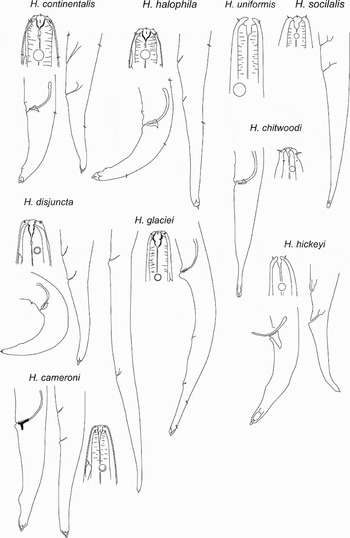
This genus has been recently erected by Andrássy (Reference Andrássy2006) to accommodate all the marine species previously described within the genus Geomonhystera as well as two new species. Since Andrássy (Reference Andrássy2006), only one species has been added (Zekely et al., Reference Zekely, Sørensen and Bright2006). Currently, 11 species are recognized; all species are illustrated in Figure 6, except H. antarctica (Cobb, 1914) Andrássy, Reference Andrássy2006 and H. ambiguoides (Bütschli, 1874) Andrássy, Reference Andrássy2006.
Illustration guide: Halomonhystera.

DIAGNOSIS
Adapted after Andrássy (Reference Andrássy2006).
Geomonhysterini
Cuticle thin, smooth with few inconspicuous somatic setae (mostly papilliform). Labial region not set off. Outer labial and cephalic setae very short, never longer than 1/4 of labial width. Cheilostome sclerotized, cup- to funnel-shaped, rest of buccal cavity weakly developed. Amphidial fovea circular, located from 1–3 hd from anterior end. Pharynx nearly cylindrical and relatively short (b = 5–10). Ventral gland well developed with opening at level of first third of pharynx, occasionally close to the labial region. Gonads (testis and ovary) usually long almost reaching the ventral gland. Vulva far posteriorly at 76% to 92% of the body length from anterior; mostly close to anus. Spicules thin, arcuate with or without a marked capitulum and always longer than (1.2–2.5 times) abd. Gubernaculum short, enveloping distal section of spicules and usually possessing a caudal process or apophysis. One large ventromedian precloacal papilla and two or three pairs of smaller caudal papillae. Rectum short and thin. Tail conoid, length ranging from 2.5 to 7 abd, usually shorter in males than in females. Three caudal glands: two large and one more anterior smaller. Spinneret duct sclerotized, surrounded by a tube like structure.
SPECIES LIST
1. H. ambiguoides(Bütschli, 1874) Andrássy, 2006 (Kiel Bay, Baltic)
2. H. antarctica(Cobb, 1914) Andrássy, 2006 (Antarctic Ocean)
3. H. cameroni(Steiner, 1958) Andrássy, 2006 (Bay of Chaleur, commensal in crustaceans)
4. H. chitwoodi(Steiner, 1958) Andrássy, 2006 (in Sargassum, Gulf of Mexico)
5. H. continentalisAndrássy, 2006 (Antarctic, Ace Lake)
6. H. disjuncta(Bastian, 1865) Andrássy, 2006 (cosmopolitan)
7. H. glaciei(Blome & Riemann, 1999) Andrássy, 2006 (Antarctic Ocean)
8. H. halophilaAndrássy, 2006 (Antarctic, Highway Lake)
9. H. hyckeyiZekely, Sørensen & Bright, 2006 (Hydrothermal vents, East Pacific Rise)
10. H. socialis(Bütschli, 1874) Andrássy, 2006 (North Sea)
11. H. uniformis(Cobb, 1914) Andrássy, 2006 (Antarctic Ocean)
IDENTIFICATION KEY FOR THE SPECIES OF THE GENUS HALOMONHYSTERA
1. Body length equal or longer than 1900 µm ……… 2
– Body length longer than 800 µm and shorter than 1900 µm ……… 3
– Body length longer than 600 µm and shorter than 800 µm ……… H. hickeyi
– Body length shorter than 600 µm ……… 7
2. Ratio a equal or larger than 60 ……… H. glaciei
– Ratio a equal or smaller than 50 ……… H. socialis
3. Spicules length divided by the anal body diameter equal or larger 1.5 ……… 4
– Spicules length divided by the anal body diameter less than 1.5 ……… 5
4. Amphidial fovea placed equal or less than 1.2 head diameters from the anterior end ……… .H. halophila
– Amphidial fovea placed equal or further than 1.3 head diameters from the anterior end ……… .H. antarctica
5. Distance between the vulva and the anus equal to the tail length ……… .H. chitwoodi
– Distance between the vulva and the anus equal to 1.5 the anal body diameter ……… H. disjuncta
– Distance between the vulva and the anus equal to the anal body diameter ……… 6
6. Amphidial fovea placed equal or less than one head diameter from the anterior end ……… H. ambiguoides
– Amphidial fovea placed equal or further than two head diameters from the anterior end ……… H. cameroni
7. Ratio a equal or smaller than 24 ……… H. continentalis
– Ratio a equal or larger than 38 ……… .H. uniformis
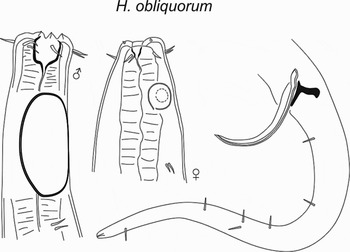
This monospecific genus was recently described by Tchesunov & Portnova (Reference Tchesunov and Portnova2005) from coastal ice-cores collected in the White Sea. According to Tchesunov & Portnova (Reference Tchesunov and Portnova2005), females and juveniles belonging to this genus were already found in ice-regions along the Arctic Canadian coast by Riemann & Sime-Ngando (Reference Riemann and Sime-Ngado1997). Within the tribe Geomonhysterini the genus Hieminema resembles Halomonhystera by having a conoid tail, papilliform inner labial sensillae and a well developed ventral gland opening at the anterior neck region (features 20, 28, 35; Figure 1 and Table 1). Hieminema differ from the other genera within the tribe by a combination of characters: (1) strong sexual dimorphism, where the male has a large buccal cavity and the amphidial fovea as large as the corresponding body diameter, while the female has a small buccal cavity and small amphidial fovea; (2) spinneret without a refractive plug-like structure; (3) the presence of two somatic setae just posterior to the amphids; and (4) buccal cavity weakly sclerotized. The type species of this genus is illustrated in Figure 7.
Illustration Hieminema obliquorum.

DIAGNOSIS
Aadapted after an English translation provided by A.V. Tchesunov based on Tchesunov & Portnova (Reference Tchesunov and Portnova2005).
Geomonhysterini
Hieminema obliquorum is characterized by long body length (>2 mm). Cuticle finely striated, with inconspicuous somatic setae. Six inner labial sensillae papilliform. Six outer labial and four cephalic sensillae setiform of equal length. Lips apices not fused. Cheilostome weakly sclerotized, cup- to funnel-shaped, larger in males than in the females. Three small teeth may be present at the base of the buccal cavity. Size and shape of the amphidial fovea dependent on the gender: females with a small and circular aperture, males with a large and ovoid circular aperture. In both genders, they are located 1–1.5 hd from anterior end. Two small lateral setae posterior to the amphidial fovea. Pharynx nearly cylindrical and relatively short (b = 9.5–12.5). Pharyngeal region dorsally bent. Ventral gland well developed with the ampulla at level of the amphids, pore not seen. Gonads (testis and ovary) usually long almost reaching the ventral gland. Vulva not sclerotized, far posteriorly at 75.5 to 78.4% of the body length from anterior end. Spicules arcuate with a marked capitulum. Gubernaculum short, enveloping distal section of spicules and usually possessing a caudal process or apophysis. Rectum short and thin. Tail conoid, length ranging from 4.5 to 6.5 abd. Three caudal glands of equal size opening in a common duct. Spinneret as a hyaline cap with a thin axial canal weakly sclerotized.
SPECIES LIST
1. H. obliquorumTchesunov & Portnova,Reference Tchesunov and Mokievsky2005
The genus Monhystrella was introduced by Cobb (1918) with M. plectoides as type species and Monhystera bulbifera de Man, 1880 as second species. Jacobs (Reference Jacobs1987b) redefined the genus Monhystrella and provided a dichotomous-key to species level. He transferred three Monhystera species to the genus Monhystrella bringing the total number of valid species to 18. Monhystrella elegantula (Schuurmans & Stekhoven, 1935) Jacobs, 1987 and Monhystrella bulbifera (de Man, 1880) Cobb, 1918 were considered as species inquirendae due to the poor taxonomic descriptions. Although Jacobs (Reference Jacobs1987b) provided precise identification tools for all valid species, confusion appears when he published the Monhysteridae checklist (Jacobs, Reference Jacobs1987a). In his checklist, Monhystera trichura Allgén, 1930 was also transferred to the genus Monhystrella. The transfer was consistent, since M. trichura has typical Monhystrella features: a cylindrical buccal cavity, a posterior bulbus, a long and filiform tail and a long tail tip. However, the measurements given by Allgén (1930) are within the range of the original description of M. microphthalma de Man, 1880, with the exception of the larger ratio a (57.9 versus 35–40). It is important to note that the description made by Allgén was based on a single female. Therefore, as suggested before by Wieser (1956) and Schneider (1939), we considered M. trichura as synonym of Monhystrella microphthalma. Recently, Eyualem-Abebe & Coomans (Reference Eyualem-Abebe and Coomans1996) added six species to the genus, thereby raising the total number of species to 24.
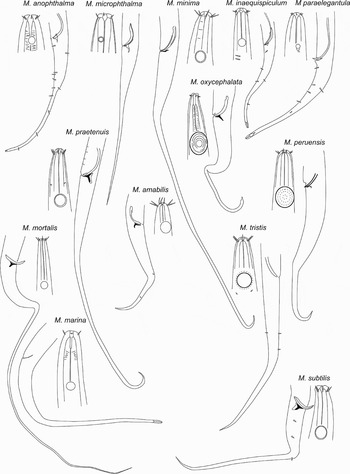
According to the generic definition proposed by Jacobs (Reference Jacobs1987b), the seven new Thalassomonhystera species (T. amabilis, T. gracilis, T. mortalis, T. peruensis, T. praetenuis, T. subtilis and T. tristis) described by Bussau (Reference Bussau1993) from the East Pacific deep sea, and one species Thalassomonhystera oxycephalata described by Tchesunov & Miljutina (Reference Tchesunov and Miljutina2005) from the Arctic deep sea, should be classified in the genus Monhystrella. All these species do not present the typical diagnostic characters of the genus Thalassomonhystera (see further) but instead share more similarities with the Monhystrella species such as, a minute oral aperture, amphidial fovea far posterior from the anterior end, a narrow pharynx slightly enlarged at the posterior end, absence of ventral gland, females with a short ovary, tail with a long cylindrical posterior portion and spinneret present (as deduced from Bussau's illustrations). The present transfers of these species do not change the diagnosis of Monhystrella nor Thalassomonhystera. In total we recognize 36 valid species of which only 13 appear in the marine environment. All the marine species are illustrated in Figure 8.
Illustration guide: Monhystrella.

DIAGNOSIS
Adapted after Jacobs (Reference Jacobs1987a, Reference Jacobsb) and Coomans & Eyualem-Abebe (2006).
Geomonhysterini
Short body length (<0.8 mm). Cuticle finely striated, often with small somatic setae. Six outer labial and four cephalic sensillae usually setiform. Labial region often set-off. Cheilostome usually small, rest of buccal cavity tubiform, funnel-shaped or conoid, often with well cuticularized walls. Dorsal denticle usually present, but difficult to observe in small species. Amphidial fovea circular or cryptospiral usually 1.5–2 or more hd from anterior end, rarely closer to anterior end (about 1 hd in M. parvella). Ocelli rarely present. Posterior part of the pharynx enlarged forming a single or double bulb without valves. Anterior part of intestine (progaster) globe-like. Ventral gland usually absent. Female reproductive system medium-sized to short with ovary comprising few oocytes; gravid females mostly with only one egg in uterus. Vulva near mid-body. Males rare or unknown in freshwater species (except in M. macrura) and more common in marine species. Spicules mostly arcuate and short (<2 abd) or less commonly unequal and large as in M. inaequispiculum Lorenzen, 1979. Tail with usually ventrally curved conical anterior portion and dorsally curved cylindrical filiform posterior part in fixed specimens. Spinneret a long and slender cone or cylinder.
SPECIES LIST
1. M. amabilis(Bussau,Reference Bussau1993) comb. nov. (deep sea, Pacific Ocean)
Syn. Thalassomonhystera amabilis Bussau, 1993
2. M. anophthalma(Lorenzen, 1969) Jacobs, 1987 (North Sea)
3. M. arsiensis Eyualem-Abebe & Coomans, 1996
4. M. atteae Eyualem-Abebe & Coomans, 1996
5. M. ethiopica Eyualem-Abebe & Coomans, 1996
6. M. fukiensis (Hoeppli & Chu, 1932) Jacobs, 1987
7. M. gracilis Khera, 1966
8. M. hastata Andrássy, 1968
9. M. hoogewijsi Eyualem-Abebe & Coomans, 1996
10. M. inaequispiculumLorenzen, 1979 (sand beach, Patagonia)
11. M. iranica Schiemer, 1965
12. M. jacobsi Eyualem-Abebe & Coomans, 1996
13. M. kerryi Khan, Hussain, Sultana & Tahssen, 2005
14. M. lepidura (Andrássy, 1963) Andrássy, 1968
M. lepidura lepidura Andrássy, 1963
M. lepidura chinensis Eyualem-Abebe, Liang & Coomans, 2001
M. lepidura altherri (Juget, 1969) Jacobs, 1987
M. lepidura seelyae Heyns & Coomans, 1989
15. M. longistoma (Khera, 1971) Andrássy, 1981
16. M. macrura (de Man, 1880) Andrássy, 1981
17. M. marinaTimm, 1964 (Bay of Bengal)
18. M. microphthalma(de Man, 1880) Jacobs, 1987 (brackish, Netherlands)
Syn. Monhystera trichura (Allgén, 1930) Jacobs, 1987
19. M. minima(Bussau,Reference Bussau1993) comb. nov. (deep sea, Pacific Ocean)
Syn. Thalassomonhystera gracilis Bussau, 1993
20. M. monachilensis Picazo-Muñoz, 1988
21. M. mortalis(Bussau,Reference Bussau1993) comb. nov. (deep sea, Pacific Ocean)
Syn. Thalassomonhystera mortalis Bussau, 1993
22. M. oxycephalata(Tchesunov & Miljutina,Reference Tchesunov and Miljutina2005) comb. nov. (deep sea, Arctic)
Syn. Thalassomonhystera oxycephalata Tchesunov & Miljutina, 2005
23. M. paramacrura (Meyl, 1954) Andrássy, 1968
24. M. parelegantula(De Coninck, 1943) Andrássy, 1981 (brackish, Iceland)
25. M. parvella (Filipjev, 1931) Jacobs, 1987
M. parvella parvella (Filipjev, 1931) Jacobs, 1987
M. parvella filiformis (Gerlach, 1951) Jacobs, 1987
26. M. peruensis(Bussau,Reference Bussau1993) comb. nov. (deep sea, Pacific Ocean)
Syn. Thalassomonhystera peruensis Bussau, 1993
27. M. plectoides Cobb, 1918
28. M. postvulvae Khan & Araki, 2001
29. M. praetenuis(Bussau,Reference Bussau1993) comb. nov. (deep sea, Pacific Ocean)
Syn. Thalassomonhystera praetenuis Bussau, 1993
30. M. raphae Ocaña, 1987
31. M. subtilis(Bussau,Reference Bussau1993) comb. nov. (deep sea, Pacific Ocean)
Syn. Thalassomonhystera subtilis Bussau, 1993
32. M. spiralis (Wu & Hoeppli, 1929) Andrássy, 1981
33. M. stewarti (Khera, 1971) Andrássy, 1981
34. M. thermophila (Meyl, 1953) Andrássy, 1981
35. M. tristis(Bussau,Reference Bussau1993) comb. nov. (deep sea, Pacific Ocean)
Syn. Thalassomonhystera tristis Bussau, 1993
36. M. woitorum Eyualem-Abebe & Coomans, 1996
SPECIES INQUIRENDAE
1. M. elegantula (Schuurmans Stekhoven, 1935) Jacobs, 1987
Syn. Monhystera elegantula Schuurmans Stekhoven, 1935
2. M. bulbifera sensu de Man, 1880 nec Steiner, 1920; Jacobs, 1987
IDENTIFICATION KEY FOR THE MARINE SPECIES OF THE GENUS MONHYSTRELLA
1. Amphidial fovea placed less than 2 head diameters from the anterior end ……… 2
– Amphidial fovea placed equal or further than 2 head diameters from the anterior end ……… 4
2. Ratio c equal or smaller than 4.7; size of the amphidial fovea equal or smaller than 35% of the corresponding body diameter ……… 3
– Ratio c equal or larger than 5.4; size of the amphidial fovea equal or larger than 60% of the corresponding body diameter ……… M. amabilis
3. Ocelli present; apophysis weakly cuticularized ……… M. microphthalma
– Ocelli absent; apophysis strongly cuticularized ……… M. anophthalma
4. Size of the amphidial fovea equal or less than 50% of the corresponding body diameter ……… 5
– Size of the amphidial fovea between 50% and 65% of the corresponding body diameter ……… 8
– Size of the amphidial fovea equal or larger than 65% of the corresponding body diameter ……… 10
5. Ratio c equal or smaller than 4.7; spicules symmetrical ……… 6
– Ratio c equal or larger than 5.2; spicules asymmetrical ……… M. inaequispiculum
6. Double bulbus ……… M. marina
– Single bulbus ……… 7
7. Ratio c equal or smaller than 10 ……… M. paraelegantula
– Ratio c equal or larger than 16 ……… M. minima
8. Ratio c equal or smaller than 10 ……… M. subtilis
– Ratio c equal or larger than 14 ……… 9
9. Ratio a equal or larger than 50; pre-cloacal supplements present ……… M. praetenuis
– Ratio a between 40 and 46; pre-cloacal supplements absent ……… M. mortalis
10. Body length equal or longer than 785 µm ……… M. tristis
– Body length equal or shorter than 450 µm ……… 11
11. Apophysis present ……… M. oxycephalata
– Apophysis absent ……… M. peruensis
When reviewing the family, Jacobs (Reference Jacobs1987a) grouped the genera Thalassomonhystera, Monhystera and Eumonhystera based on the shape of the buccal cavity; i.e. a single chamber, V-shaped, weakly sclerotized (feature 4; Figure 1 and Table 1) and he considered Anguimonhystera as a genus inquirenda. However, Andrássy (Reference Andrássy2005) and Coomans & Eyualem-Abebe (2006) retained the genus as valid. Eyualem-Abebe & Coomans (Reference Eyualem-Abebe and Coomans1995) added the genus Tridentulus within this subfamily. Andrássy (Reference Andrássy2007) noted that the genus Tridentulus was already described under Reptilia, and suggested Tridentula as a new name. Presently, Monhysterinae is divided into two tribes, Thalassomonhysterini and Monhysterini, based on separated lips or fused lips apices (respectively features 8 and 9 in Figure 1 and Table 1) and absence or presence of peri-oral plates (feature 38; Figure 1 and Table 1).
DIAGNOSIS
Adapted after Jacobs (Reference Jacobs1987a).
Monhysteridae
Inner labial sensillae setiform or papilliform. Buccal cavity with a single V-shaped chamber, poorly sclerotized. Radii of pharyngeal lumen broad, long and only slightly sclerotized. Common spinneret chamber and duct not elongated or sclerotized. Reproductive mode: bisexual or parthenogenetic. Two tribes.
This tribe is monogeneric with Thalassomonhystera as type genus. Jacobs (1987a)'s intention was to separate this marine genus from the other inland genera (Monhysterini). The separation of this tribe was mainly based on the apex of the lips not fused, opening of the ventral gland at level of the first third of pharynx and occasionally in the labial region, papilliform inner labial sensillae and absence of peri-oral plates (features 8, 20, 35 and 36; Figure 1 and Table 1).
DIAGNOSIS
Adapted after Jacobs (Reference Jacobs1987a).
Monhysterinae
Labial sensillae papilliform. Apex of lips not fused. Buccal cavity wide and V-shaped without peri-oral plates. Ocelli mostly absent. Ventral gland usually well developed and opening at the anterior neck region. Crystalloides bodies absent. Tail tip not swollen with the exception in T. gerlachii (Meyl, 1954) Jacobs, 1987. Reproductive mode: bisexual.
When Jacobs (Reference Jacobs1987a) erected the genus Thalassomonhystera he included all the marine species (except those transferred to Monhystrella) previously belonging to the genus Monhystera. The new genus was mainly characterized by the presence of a large ventral gland with outlet in the anterior neck region. The division of the Monhystera species over two genera coincides with an environmental separation, Thalassomonhystera marine versus Monhystera inland. Consequently, authors started to identify the genus Thalassomonhystera based on its ecological occurrence rather than on the diagnostic set of characters proposed by Jacobs (Reference Jacobs1987a). For instance, in a recent taxonomic paper, Tchesunov & Miljutina (Reference Tchesunov and Miljutina2005) considered all the marine ‘Monhystera’ belonging either to the genus Geomonhystera (G. disjuncta related species) or to Thalassomonhystera (not related to G. disjuncta). There are two main problems when genera are separated based on such a statement: first it is well known that in the marine realm there are seven genera of the family Monhysteridae (as presented in this study) and second, most important, a genus cannot be defined because its members do not belong to the other known genera without indication of diagnostic features. Tchesunov & Miljutina (Reference Tchesunov and Miljutina2005) proposed two new Thalassomonhystera species, T. molloyensis and T. oxycephalata. The first species resembles T. bathyslandica Riemann Reference Riemann1995, while the second belongs to the genus Monhystrella. Thalassomonhystera oxycephalata is characterized by a small oral opening and a sclerotized cylindrical buccal cavity instead of a V-shape as in Thalassomonhystera. Furthermore, the amphidial fovea is located five times the head diameter from the anterior end and such a far posterior position is unknown for Thalassomonhystera but has been more frequently observed in the genus Monhystrella. Finally, the tail in T. oxycephalata is divided into two equal parts, one conical anterior portion and a cylindrical posterior part with a well developed spinneret, two characters that are typical for the genus Monhystrella, while Thalassomonhystera has a conical tail tapering gradually towards the tip and the spinneret is very small and barely distinguishable.
In the same way, Bussau (Reference Bussau1993) appeared to have overlooked some diagnostic characters of the genera Thalassomonhystera and Monhystrella as proposed by Jacobs (Reference Jacobs1987a, Reference Jacobsb) when describing 9 new species of Thalassomonhystera, 3 unnamed species and one known species. Seven of the new species belong to Monhystrella (see previously).
Recently, Eyualem-Abebe et al. (2001) described T. traesti Eyualem-Abebe, Liang & Coomans, 2001 from a river in China, expanding the occurrence of the genus to the freshwater environment. They stated that ‘Although our species was found in fresh water and despite some differences (slightly longer than the longest species in the genus so far, more developed inner labial sensillae, ventral gland poorly developed), it better fits the generic diagnosis of Thalassomonhystera than that of any other genus so far established in the Monhysterinae de Man, 1876’ (Eyualem-Abebe et al., 2001). However, the position of this species is rather uncertain. According to Jacobs (Reference Jacobs1987a), in order to belong to the genus Thalassomonhystera, a species should possess separated lip apices, no peri-oral plates, a well developed ventral gland opening at the anterior neck region and papilliform inner labial sensillae. Peri-oral plates and separated lips apices were not reported and discussed in their description. It could be argued that both characters were implicit in their description, since they are diagnostic characters to genus level. However, T. traesti has inner labial sensillae setiform and a poorly developed ventral gland with its opening at the mid-pharynx, which are common features of the subfamily Monhysterinae. Nevertheless, T. traesti does not completely agree with the other generic diagnoses of the subfamily Monhysterinae. The genera Eumonhystera and Anguimonhystera are characterized by a long filiform tail (feature 26; Figure 1 and Table 1), Tridentula by the presence of three teeth in the buccal cavity (feature 18; Figure 1 and Table 1) and Monhystera by the presence of crystalloid bodies and ocelli (features 17 and 40; Figure 1 and Table 1). Thus, in order to classify T. traesti in a genus, a revision considering all these genera should be conducted, followed by a redescription of the taxa. At the moment, T. traesti has an uncertain taxonomic position (incertae sedis).
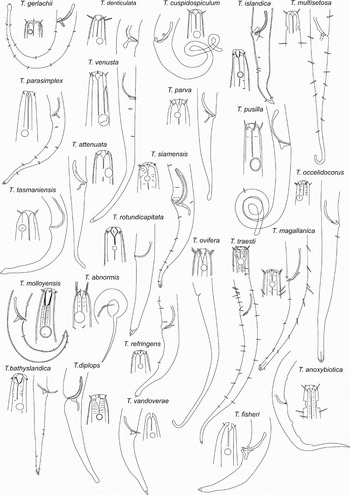
Coomans & Eyualem-Abebe (2006) transferred Monhystera amabilis Gagarin, 2001 to the genus Thalassomonhystera without substantiating their decision. Since this species does not present the diagnostic characters of the genus Thalassomonhystera (well developed ventral gland, ventral pore in the anterior neck region, apex of the lips not fused and inner labial papillae), we do not recognize the relocation. At present, the genus Thalassomonhystera comprises most of the marine species described within the family Monhysteridae. After the erection of the genus by Jacobs (Reference Jacobs1987a), seven new species were added and at present, there are 25 valid species. With the exception of T. uria (Stewart, 1914) Jacobs, 1987, all the species, including T. traesti incertae sedis, are illustrated in Figure 9.
Illustration guide: Thalassomonhystera.

DIAGNOSIS
Adapted after Jacobs (Reference Jacobs1987a).
Thalassomonhysterini
Body medium-sized, submedian somatic setae less than 30% of cbd. Inner labial sensillae papilliform. Outer labial sensillae (usually setiform) and cephalic setae shorter than 1/3 of the head diameter. Buccal cavity undivided, funnel-shaped. Pharynx cylindrical with the posterior part slightly broader. Ocelli absent. Ventral gland well developed, opening in the anterior end (labial region). Spermatheca may be well developed. Spicules length varying between 1–2.2 abd; spicules vary from arcuate-shaped and well sclerotized to setaceous and slender. Gubernaculum either small and robust with a dorsal apophysis, or slender without apophysis. Tail elongate conical usually with the anterior part ventrally bent and the posterior dorsally bent. Tail of females shorter than V–a distance.
SPECIES LIST
1. T. abnormisBussau, 1993 (deep sea, Pacific)
2. T. anoxybiota(Jensen,Reference Jensen1986) Jacobs, 1987 (brine seep, Gulf of Mexico)
3. T. attenuata(Filipjev, 1922) Jacobs, 1987 (Black Sea)
4. T. bathislandicaRiemann, 1995 (deep sea, north-east Atlantic)
5. T. cuspidospiculum(Allgén, 1932) Jacobs, 1987 (Campbell Island)
6. T. denticulata(Timm, 1952) Jacobs, 1987 (Chesapeak Bay, USA)
7. T. diplops(Cobb, 1894) Jacobs, 1987 (Australia)
8. T. fisheriZekely, Sørensen & Bright, 2006 (deep sea, East Pacific Rise)
9. T. gerlachii(Meyl, 1954) Jacobs, 1987 (vulcanic sand beach, Ische Island)
10. T. islandica(De Coninck, 1943) Jacobs, 1987 (brackish, Iceland)
11. T. magallanica(Wieser, 1956) Jacobs, 1987 (littoral algae, Chile)
12. T. molloyensisTchesunov & Miljutina, 2005 (deep sea, Arctic)
13. T. multisetosa(Meyl, 1955) Jacobs, 1987 (saltmarsh, North Sea)
14. T. ocellidecorus(Hopper & Meyers, 1967) Jacobs, 1987 (Biscayne Bay, Florida)
15. T. oviferaBussau, 1993 (deep sea, Pacific)
16. T. parasimplex(De Coninck, 1943) Jacobs, 1987 (brackish, Iceland)
17. T. parva(Bastian, 1865) Jacobs, 1987 (tide pools, England)
18. T. pusilla(Boucher & Helleouetes, 1977) Jacobs, 1987 (sublittoral, Atlantic-France)
19. T. refringens(Bresslau & Schuurmans-Stekhoven, 1935) Jacobs, 1987 (North Sea)
20. T. rotundicapitata(Filipjev, 1922) Jacobs, 1987 (Black Sea)
21. T. siamensisKito & Aryuthaka, 2001 (shrimp pounds, Thailand)
22. T. tasmaniensis(Allgén, 1927) Jacobs, 1987 (Tasmania)
23. T. uria(Stewart, 1914) Jacobs, 1987 (Bay of Bengal)
24. T. vandoveraeZekely, Sørensen & Bright, 2006 (deep sea, Mid-Atlantic Ridge)
25. T. venusta(Lorenzen, 1979) Jacobs, 1987 (sublittoral, North Sea)
SPECIES INQUIRENDAE
See Jacobs (Reference Jacobs1987a).
SPECIES INCERTAE SEDIS
1. Thalassomonhystera traesti (Eyualem-Abebe, Peng & Coomans, Reference Eyualem-Abebe, Liang and Coomans2001)
SPECIES TRANSFERED TO THE GENUS MONHYSTRELLA
1. M. amalbilis(Bussau,Reference Bussau1993) comb. nov.
Syn. Thalassomonhystera amabilis Bussau, 1993
2. M. minima(Bussau,Reference Bussau1993) comb. nov.
Syn. Thalassomonhystera gracilis Bussau, 1993
3. M. mortalis(Bussau,Reference Bussau1993) comb. nov.
Syn. Thalassomonhystera mortalis Bussau, 1993
4. M. oxycephalata(Tchesunov & Miljutina,Reference Tchesunov and Miljutina2005) comb. nov.
Syn. Thalassomonhystera oxycephalata Tchesunov & Miljutina, 2005
5. M. peruensis(Bussau,Reference Bussau1993) comb. nov.
Syn. Thalassomonhystera peruensis Bussau, 1993
6. M. praetenuis(Bussau,Reference Bussau1993) comb. nov.
Syn. Thalassomonhystera praetenuis Bussau, 1993
7. M. subtilis(Bussau,Reference Bussau1993) comb. nov.
Syn. Thalassomonhystera subtilis Bussau, 1993
8. M. tristis(Bussau,Reference Bussau1993) comb. nov.
Syn. Thalassomonhystera tristis Bussau, 1993
IDENTIFICATION KEY FOR THE SPECIES OF THE GENUS THALASSOMONHYSTERA
Since this key is based on characters from both genders, T. ovifera was not included in it because it was described based solely in females; diagnostic data for this species are: L = 730−1075 μm, a = 39.8−44, b = 5.5, c = 6−7.2, c′ = 8.3−10 and somatic setae absent. Although the classification of T. traesti is uncertain, we include it in the key.
1. Caudal apophysis present ……… 2
– Caudal apophysis absent ……… 9
2. Body length longer than 1000 µm; ratio a equal or larger than 50; ratio c equal or larger than 10 ……… T. denticulata
– Body length between 700 µm and 1000 µm ……… 3
– Body length shorter than 700 µm ……… 4
3. Ratio a equal or larger than 50 ……… T. pusilla
– Ratio a between 28 and 45 ……… T. fisheri
– Ratio a equal or smaller than 25 ……… T. diplops
4. Amphidial fovea located equal or less than one head diameter from the anterior end ……… 5
– Amphidial fovea located between 1.7 and 2.5 head diameters from the anterior end ……… 8
– Amphidial fovea located equal or further than 2.7 head diameters from the anterior end ……… T. molloyensis
5. Ratio c equal or smaller than 6.1 ……… 6
– Ratio c equal or larger than 6.5 ……… 7
6. Somatic setae absent ……… T. parva
– Somatic setae present ……… T. gerlachii
7. Spicules length divided by the anal body diameter equal or shorter than one ……… T. attenuata
– Spicules length divided by the anal body diameter equal or larger than 1.8 ……… T. siamensis
8. Body length equal or smaller than 470 µm ……… T. multisetosa
– Body length equal or larger than 570 µm ……… T. bathyslandica
9. Ratio a equal or larger than 40 ……… 10
– Ratio a smaller than 40 ……… 11
10. Ratio c equal or larger than 6 ……… T. anoxybiotica
– Ratio c equal or smaller than 5.6. … T. cuspidospiculum
11. Body length equal or shorter than 550 µm ……… 12
– Body length equal or longer than 600 µm ……… 17
12. Amphidial fovea located equal or further than 2.5 head diameters from the anterior end ……… 13
– Amphidial fovea located equal or less than 2 head diameters from the anterior end ……… 14
13. Spicules length divided by the anal body diameter equal or longer than 1.8 ……… .T.venusta
– Spicules length divided by the anal body diameter equal or shorter than 1.7. ……… T. parasimplex
14. Ratio c equal or smaller than 7.5 ……… 15
– Ratio c equal or larger than 8 ……… 16
15. Spicules length divided by the anal body diameter equal or longer than 1.8 ……… T. uria
– Spicules length divided by the anal body diameter equal or shorter than 1.7. ……… .T. islandica
16. Size of the amphidial fovea equal or smaller than 40% of the corresponding body diameter; cephalic setae 1.3 times longer than the head diameter ……… .T. ocellidecorus
– Size of the amphidial fovea equal or larger than 60% of the corresponding body diameter; cephalic setae equal to the head diameter ……… T. abnormis
17. Ratio c equal or longer than 8 ……… 18
– Ratio c equal or smaller than 7.8 ……… 19
18. Body length equal or longer than 850 µm ……… T. rotundicapitata
– Body length equal or shorter than 760 µm ……… T. vandoverae
19. Somatic setae present ……… 20
– Somatic setae absent ……… 21
20. Ratio c equal or smaller than 6 ……… T. magallanica
– Ratio c between 8.5 and 9.3 ……… T. traesti
21. Ratio c equal or smaller than 5.4 ……… T. refringens
– Ratio c between 5.5 and 6.2 ……… .T. tasmaniensis
– Ratio c equal or larger than 6.7 ……… T. uria
DISCUSSION
From the literature, it appears that all species descriptions within the Monhysteridae are based on the morphological species concept whereby species boundaries are defined on the basis of particular essential features. There is no proof of gene flow and morphological distinctiveness is considered as a surrogate to lineage independence. The hypothesis of a new species using the morphological species concept can more easily be tested compared to new species based on the phylogenetic species concept. So far no phylogenetic study has been carried out for the Monhysteridae below the family level. An attempt for a phylogenetic analysis was made by Jacobs in his PhD thesis but never published (Jacobs, Reference Jacobs1988). The main difficulty to perform such analysis in this family is to determine the polarity of the characters; several features being probably convergent.
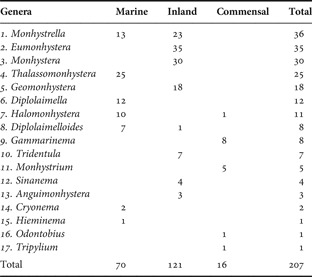
At present, the family Monhysteridae is composed of 17 genera with a total of 207 valid species (Table 2). Roughly, 58.5% of the species are described from the inland environment and 33.8% from the marine realm. On average, the inland and marine genera are species rich and characterized by a large morphological diversity (Table 2). Although the number of species descriptions within this family is large, only few studies provide complete illustrations, morphometric data and discuss relationships with other species of the genus. Most species descriptions are poor and even the most recent papers do not include data on variability within genus. However, we do realize that the diagnostic characters in such small nematodes are not always evident and are easily overlooked leading to a misclassification (Riemann, Reference Riemann1995). Therefore, instead of increasing our knowledge in the different groups, many problems have arisen (Coomans, Reference Coomans2002).
Number of valid species of each Monhysteridae genus at the different biotopes.

Wrong classification is particularly evident in the two most species rich marine Monhysteridae genera, Thalassomonhystera and Monhystrella. For the latter, the situation became clearer after the redefinition of the genus and redescription of a species by Jacobs (Reference Jacobs1987b, Reference Jacobsc). Nevertheless, as shown in the present study, the diagnostic characters of the genus Monhystrella have been largely overlooked. For the genus Thalassomonhystera, the situation is somewhat more complicated because the characters that separate it from the tribe Monhysterini are sometimes difficult to recognize by light microscopy and were barely reported in the older literature. Consequently, there is a huge morphological variability, no well defined genus border nor clear differentiation from the other genera. Additional characters that help to identify the genus Thalassomonhystera, such as well developed ventral gland opening at the labial region and inner labial sensillae papilliform, are also present in the genera Halomonhystera and Tridentula respectively.
The lack of phylogenetic information and molecular data hampers the progress of systematics in the group as well as a straightforward identification method. In fact, as shown in the present study, the mostly used characters to separate monhysterids species throughout the different genera are the same (e.g. body length, size and position of the amphidial fovea, length of the tail, length of the spicules; see dichotomous-keys). In some way, this means that evolutionary processes are selecting the same characters in the different genera and therefore generating a large number of homoplasies (Hall, Reference Hall2003). For instance, the transfer of the eight deep-sea species from the genus Thalassomonhystera to the genus Monhystrella proposed here did not disrupt the morphological unity of the latter genus, but increased the morphological range of two characters. As presented in the dichotomous-key, nearly all deep sea species have a larger amphidial fovea and a longer tail in relation to the anal body diameter (c ratio) than shallow-water species.
Morphological adaptation to live in the deep-sea is a common feature among other invertebrate taxa (Kaariainen & Bett, Reference Kaariainen and Bett2006 and references therein) and seems to be related to the low input of food (Thiel, Reference Thiel1975). Perhaps, having large sensorial organs, such as amphidial fovea, may increase their ability for foraging and mating recognition in such nutrient poor environment characterized by low population densities. The increase in tail length towards the deep is probably related to the very fine sediment type and the hemi-sessile life-strategy adopted by these organisms in this environment (Riemann, Reference Riemann1974). So far, without extra taxonomic information, it is still difficult to speculate whether the deep-sea species within the genus Monhystrella have a common ancestor and species with large amphidial fovea and long tails represent one monophyletic group, or whether they have different ancestors and therefore their body shape converged to similar morphotypes. Conjectures in favour of a monophyletic deep-sea group were already suggested within the family Draconematidae (Bathychaetosoma (Kito, 1983) Decraemer, Gourbault & Backeljau, Reference Decraemer, Gourbault and Backeljau1997, Cephalochaetosoma Kito, 1983 and Dinetia Decraemer & Gourbault, 1997; Decraemer et al., Reference Decraemer, Gourbault and Backeljau1997).
At this point, the classification of the Monhysteridae into subfamilies, tribes and genera is based on similarity/dissimilarity of diagnostic morphological features with the assumption that phenetic similarity underlay similarity of genotype. Now, if this classification is one that reflects natural grouping or phylogenetic relationships remains to be tested by other methods. Thus, to avoid further confusion in this family, new descriptions should also include user friendly identification-keys to species level and a more detailed differential diagnosis. Preferably they should also integrate different taxonomic methods (Fonseca et al., in press). There are numerous possibilities for identification tools used in nematology: dichotomous (Andrássy, Reference Andrássy1981, Reference Andrássy2006), polytomous (Decraemer & Gourbault, Reference Decraemer and Gourbault2000; Lamberti et al., Reference Lamberti, Molinari, Moens and Brown2000), graphical polytomous (Fonseca et al., Reference Fonseca, Vanreusel and Decraemer2006a), pictorial (Platt, Reference Platt1984; Decraemer et al., Reference Decraemer, Gourbault and Backeljau1997; Tchesunov & Mokievsky, 2006), tabular (Fonseca et al., Reference Fonseca, Decraemer and Vanreusel2006b; Zhang & Zhang, Reference Zhang and Zhang2006) and computer-assisted (Diederich et al., Reference Diederich, Fortuner and Milton2000). Recently, several authors have shown the importance of using statistics for species differentiation (Gozel et al., Reference Gozel, Lamberti, Duncan, Agostinelli, Rosso, Nguyen and Adams2006; Derycke et al., Reference Derycke, Fonseca, Vierstraete, Vanfleteren, Vincx and Moens2008; Fonseca et al., in press). Independent of the method used, identification tools are especially necessary in order to transmit the taxonomic knowledge to non-taxonomists. Moreover, it guides researchers to identify and describe different taxa increasing our taxonomic knowledge in the group. Hopefully, in the near future, when molecular markers will become generally accessible and their use compulsory in taxonomic descriptions, identification-keys may also become phylogenetically informative.
ACKNOWLEDGEMENTS
The first author is supported by the Brazilian Ministry of Science and Technology CNPq (n-200852/2005-1). We thank Dr F. Riemann for giving important literature support and Professor A.V. Tchesunov for translating Russian literature. We also show gratitude to Professor Dr A. Coomans, Professor Dr I. Andrássy and one anonymous referee for commenting on a previous version of this manuscript. This is the publication 16999 from the Alfred Wegener Institute for Marine and Polar Research.
APPENDIX 1
Checklist of the valid species of the inland and commensal genera belonging to the family Monhysteridae (after Andrássy, Reference Andrássy1981; Jacobs, Reference Jacobs1987a; Andrássy, Reference Andrássy2005; Coomans & Eyualem-Abebe, 2006). Type species of each genus are underlined.
INLAND GENERA
Anguimonhystera Andrássy, 1981
1. A. ampliceps (Goffart, 1950) Andrássy, 1981
2. A. stadleri (Goffart, 1950) Andrássy, 1981
3. A. tenuissima (Goffart, 1950) Andrássy, 1981
Eumonhystera Andrássy, 1981
1. E. alpina (Filipjev, 1918) Andrássy, 1981
2. E. altherri Andrássy, 1981
3. E. andrassy (Biró, 1969) Andrássy, 1981
4. E. ballesterosi Picazo-Muñoz, 1988
5. E. barbata Andrássy, 1981
6. E. borealis Turpeenniemi, 1997
7. E. dispar (Bastian, 1865) Andrássy, 1981
8. E. elegans (Allgén, 1928) Jacobs, 1987
9. E. filiformis (Bastian, 1865) Andrássy, 1981
10. E. geraerti Eyualem-Abebe & Coomans, 1996
11. E. gerlachi (Meyl, 1954) Andrássy, 1981
12. E. gracilior (Johnston, 1938) Andrássy, 1981
13. E. hungarica Andrássy, 1981
14. E. huruii Yunliang, Eyualem-Abebe & Coomans, 2002
15. E. kuzmini Gagarin, 1997
16. E. longicaudata (Gerlach & Riemann, Reference Gerlach and Riemann1973) Andrássy, 1981
17. E. maxima Gagarin, 1996
18. E. media Hernández & Jordana, 1988
19. E. minuta (Filipjev, 1929) Jacobs, 1987
20. E. mwerazii (Meyl, 1957) Andrássy, 1981
21. E. pannonica Andrássy, 2002
22. E. papuana (Daday, 1899) Andrássy, 1981
23. E. parasimilis (Allgén, 1926) Andrássy, 1981
24. E. patiens Armendariz, Agudo & Hernandez, 1992
25. E. pseudobulbosa (Daday, 1896) Andrássy, 1981
26. E. rustica (Bütschli, 1873) Andrássy, 1981
27. E. serena Gagarin 1993
28. E. sibirica Gagarin, 2003
29. E. similis (Bütschli, 1873) Andrássy, 1981
30. E. simplex (de Man, 1880) Andrássy, 1981
31. E. subfiliformis (Cobb, 1918) Andrássy, 1981
32. E. sudanenesis Zeidan, Jacobs & Geraert, 1990
33. E. tatrica (Daday, 1896) Andrássy, 1981
34. E. tuporis Gagarin, 1991
35. E. vulgaris (de Man) Andrássy, 1981
Geomonhystera Andrássy, 1981
1. G. aenariensis (Meyl, 1953) Andrássy, 1981
2. G. altaica Gagarin, 2002
3. G. antarticola Andrássy, 1998
4. G. auvillis Saha, Lal & Singh, 2002
5. G. breviseta Brzeski, 1993
6. G. dubia Siddiqi & Shahina, 2004
7. G. glandulata Khan & Tahseen, 2006
8. G. japonica Khan & Araki, 2001
9. G. karuni Siddiqi & Shahina, 2004
10. G. longicaudata Gagarin, 2002
11. G. media Gagarin, 2002
12. G. mexicana Brzeski, 1993
13. G. parvillosa (Meyl, 1954) Andrássy, 1981
14. G. pervaga (Argo & Heyns, 1973) Andrássy, 1981
15. G. steineri (Micoletzky, 1922) Andrássy, 1981
16. G. taurica Tsalolikhin, 2007
17. G. tripyloides (Andrássy, 1968) Andrássy, 1981
18. G. villosa (Bütschli, 1873) Andrássy, 1981
Monhystera Bastian, 1865
1. M. africana Andrássy, 1964
2. M. afromacramphis Jacobs, 1987
3. M. amabilis Gagarin, 1997
4. M. coomansi Jacobs & Heyns, 1992
5. M. deleyi Eyualem-Abebe & Coomans, 1996
6. M. euromacramphis Jacobs, 1987
7. M. fasciculate Skwarra, 1921
8. M. gabaza Joubert & Heyns, 1980
9. M. hamata Gagarin & Vu Thanh, 2005
10. M. lemani Juget, 1969
11. M. longicaudata Bastian, 1965
12. M. macramphis Filipjev, 1929
13. M. magnacephala Joubert & Heyns, 1980
14. M. nubiae Eyualem-Abebe & Coomans, 1996
15. M. paludicola de Man, 1880
16. M. paramacramphis Meyil, 1954
17. M. psammophila Juget, 1969
18. M. psilocephalus (Onorato de Cillis, 1917) Meyl, 1960
19. M. riemanni Jacobs & Heyns (in Jacobs, Reference Jacobs1987a)
20. M. rivularis Bastian, 1865
21. M. robustospiculum Jacobs & Heyns (in Jacobs, Reference Jacobs1987a)
22. M. shibrui Eyualem-Abebe & Coomans, 1996
23. M. somereni Allgén, 1952
24. M. stagnalis Bastian, 1865
25. M. taaiboschiensis Joubert & Heyns, 1980
26. M. tanae Eyualem-Abebe & Coomans, 1996
27. M. uncibrevispiculata Lemzina, 1990
28. M. uncigubernaculum Zeidan, Jacobs & Geraert, 1990
29. M. uncispiculata Gagarin, 1979
30. M. wangi Wu & Hoeppli, 1929
Sinanema Andrássy 1960
1. S. ginlingensis (Hoeppli & Chu, 1932) Andrássy, 1960
2. S. godeti (Steiner 1920) Jacobs, 1987
3. S. mongolicum Tsalolikhin, 1985
4. S. mysorensis (Moorthy, 1938) Jacobs, 1987
Tridentula (Eyualem-Abebe & Coomans, Reference Eyualem-Abebe and Coomans1995) Andrássy, 2007
1. T. bidenticulata (Gagarin, 1997) Andrássy, 2007
2. T. brzeskii (Gagarin & Gusakov, 2000) Andrássy, 2007
3. T. floreana (Eyualem-Abebe & Coomans, 1995) Andrássy, 2007
4. T. fluviatilis (Gagarin, 2004) Andrássy, 2007
5. T. minor (Gagarin, 2001) Andrássy, 2007
6. T. obscura (Gagarin, 2001) Andrássy, 2007
7. T. palustris (Gagarin & Holovachov, 2001) Andrássy, 2007
COMMENSAL GENERA
Gammarinema Kinne & Gerlach, 1956
1. G. ampullocauda (Paramonov, 1926) Lorenzen, 1986
2. G. cambari (Allgén, 1933) Osche, 1955
3. G. cardisomae Riemann, 1968
4. G. gammari Kinne & Gerlach, 1953
5. G. ligiae Gerlach, 1967
6. G. mesidoteae Belogurov, Kulikov & Russkikh, 1978
7. G. paratelphusae (Farrouqui, 1967) Sudhaus, 1974
8. G. prilepskyi Tchesunov & Pletnikova, 1986
Monhystrium Cobb, 1920
1. M. brevis Yoshimura, 1990
2. M. inquilinus Riemann, 1969
3. M. transitans Cobb, 1920
4. M. tenuis Yoshimura, 1990
5. M. wilsoni (Baylis, 1915) Cobb, 1920
Odontobius Roussel del Vauzéme, 1834
1. O. ceti Roussel del Vauzéme, 1834
Trypilium Cobb, 1920
1. T. carcinicula (Baylis, 1915) Cobb, 1920