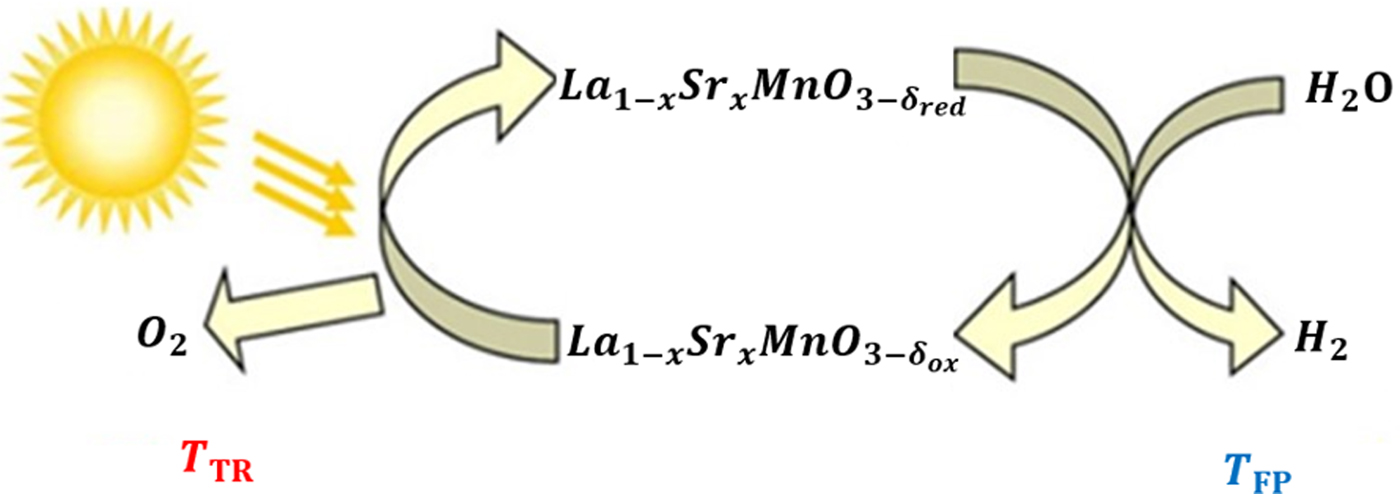

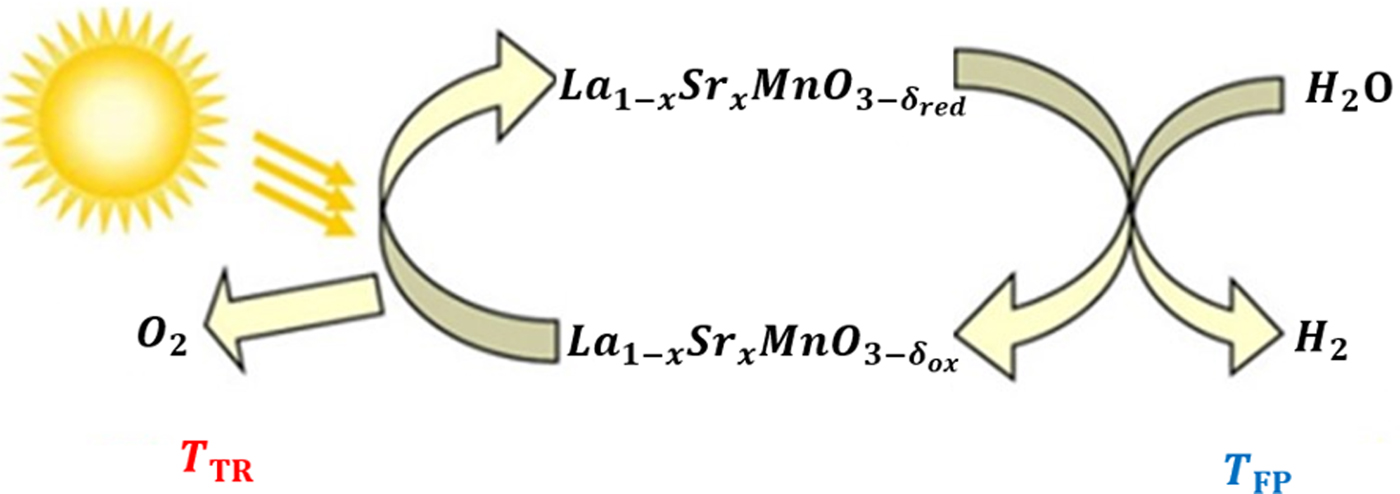
Fuel production by two-step solar-driven thermochemical cycling (STC) has received significant attention as a means of storing solar energy.[ Reference Kodama and Gokon 1 – Reference Agrafiotis, Roeb and Sattler 3 ] Non-stoichiometric oxides, in combination with a temperature swing cycle, Fig. 1, have proven to be especially effective for this process.[ Reference Chueh, Falter, Abbott, Scipio, Furler, Haile and Steinfeld 4 , Reference Chueh and Haile 5 ] Here, in a first step, thermal reduction of the oxide is carried out at high temperature, typically 1200–1500 °C (T TR). Subsequent oxidation by steam and/or carbon dioxide at a lower temperature, typically 800–1000 °C (T FP), generates the product fuel. While oxides of the fluorite structure-type (ceria and its doped derivatives) were the first, explicitly nonstoichiometric oxides evaluated for STC fuel generation,[ Reference Chueh and Haile 6 ] perovskite-structured materials have emerged as attractive alternatives because of the possibility of lowering cycling temperatures.[ Reference Scheffe, Weibel and Steinfeld 7 , Reference McDaniel, Miller, Arifin, Ambrosini, Coker, O'Hayre, Chueh and Tong 8 ] In particular, decreasing the thermal reduction temperature from ~1500 °C as required for reasonable efficiency from undoped ceria would significantly ease reactor design constraints and minimize solar re-radiation losses.[ Reference Scheffe, Weibel and Steinfeld 7 ]
A thermochemical cycle that converts H2O to H2 by cyclic reduction and oxidation of a lanthanum strontium manganite oxide at respective temperatures T TR (thermal reduction temperature) and T FP (fuel production temperature) using solar-derived thermal energy as the input.
The technological motivation for identifying an STC material with decreased thermal demands in combination with the compositional flexibility of perovskites has led to a surge of redox cycling studies in this material class.[
Reference McDaniel, Miller, Arifin, Ambrosini, Coker, O'Hayre, Chueh and Tong
8
–
Reference Bork, Povoden-Karadeniz and Rupp
16
] A large majority of these efforts have focused on one key metric, fuel produced per cycle per unit mass (or mole) of oxide, i.e., fuel productivity. For oxidation by 20–40% steam values as high as 400
 ${\rm \mu mo}{\rm l}_{{\rm H}_2}/{\rm g}_{{\rm oxide}}$
for La0.5Sr0.5MnO3−δ
(T
TR = 1400 °C/T
FP = 800 °C)[
Reference Yang, Yamazaki, Aydin and Haile
9
] and 307
 ${\rm \mu mo}{\rm l}_{{\rm H}_2}{\rm /}{\rm g}_{{\rm oxide}}$
for La0.6Sr0.4Mn0.6Al0.4O3−δ
(T
TR = 1350 °C/T
FP = 1000 °C)[
Reference McDaniel, Miller, Arifin, Ambrosini, Coker, O'Hayre, Chueh and Tong
8
] have been obtained. In contrast, for ceria, the expected fuel productivity for an equilibrium cycle with T
TR = 1350 °C/T
TR = 800 °C is just 128
 ${\rm \mu mo}{\rm l}_{{\rm H}_2}{\rm /}{\rm g}_{{\rm oxide}}$
.[
Reference Chueh and Haile
5
,
Reference Panlener, Blumenthal and Garnier
17
] For oxidation by CO2, perovskites appear to provide even larger fuel productivities than the attractive values obtained for hydrogen production. However, because fuel productivity in such cases is often estimated from mass gain on exposure to CO2 and, as reported for the example of (Ca,Sr)(La,Mn)O3−δ
, mass gain can occur due to carbonate formation,[
Reference Galvez, Jacot, Scheffe, Cooper, Patzke and Steinfeld
11
] such results must be viewed with some caution.
While productivity is an important criterion for identifying a desirable STC material, the rate at which the fuel is produced is equally important. To date, there have been few systematic studies of oxidation rates for perovskites, although some authors have noted sluggish kinetics relative to ceria.[
Reference Demont, Abanades and Beche
18
] Using as a metric the peak rate of fuel production in a fuel evolution profile, typical values in the range 0.06–0.50 mLfuel/min/goxide are evident in the perovskite literature. In contrast, peak fuel production rates as high as 12.5
 ${\rm m}{\rm L}_{{\rm H}_2}/{\min} /{\rm g}_{{\rm oxide}}$
[
Reference Chueh and Haile
5
] and even 60 mLCO/min/goxide
[
Reference Venstrom, De Smith, Chandran, Boman, Krenzke and Davidson
19
] have been obtained from ceria. While direct comparisons are not entirely meaningful without complete knowledge of the details of the experimental cycling conditions, these differences are extreme. Furthermore, while the oxidation reaction reaches completion within just a few minutes for ceria, perovskites often require as much as 2 h or more to attain an equivalent extent of reaction.[
Reference Yang, Yamazaki, Aydin and Haile
9
] The question immediately arises then whether there is a fundamental difference between the fluorite-structured and perovskite-structured classes of oxides that is responsible for this more than an order of magnitude difference in rates. We show here that the low fuel production rates observed in previous studies of La1−x
Sr
x
MnO3−δ
(LSM) perovskites in particular are largely a consequence of the thermodynamic properties of the oxides rather than their kinetic properties. Because of the thermodynamic similarities between redox active perovskites, such limitations are likely to explain the behavior of many in this class.
Fundamental to the behavior of an STC material are the thermodynamic functions, the entropy and enthalpy, of the reduction reaction. In the limit of infinite material and infinitesimal changes in oxygen nonstoichiometry (ε) this reaction is expressed as
 $$\mathop {\lim} \limits_{\varepsilon \to 0} \displaystyle{1 \over \varepsilon} {\rm L}{\rm a}_{1 - x}{\rm S}{\rm r}_x{\rm Mn}{\rm O}_{3 - \delta} \Leftrightarrow \displaystyle{1 \over \varepsilon} {\rm L}{\rm a}_{1 - x}{\rm S}{\rm r}_x{\rm Mn}O_{3 - \delta - \varepsilon} + \displaystyle{1 \over 2}{\rm O}_2,$$
with equilibrium constant
 $$K_{{\rm red}} = e^{ - \Delta _{{\rm red}}G^0/RT} = \exp \left[ {\displaystyle{{T{\rm \Delta} _{{\rm red}}S^0(\delta ) - {\rm \Delta} _{{\rm red}}H^0(\delta )} \over {RT}}} \right] = \hat P_{{\rm O}_{\rm 2}}^{\textstyle{1 \over 2}} (\delta, T).$$
Here, R is the universal gas constant, T is temperature, and Δred
G
0, Δred
S
0(δ), and Δred
H
0(δ) are, respectively, the standard Gibbs energy, the standard entropy and the standard enthalpy of the reduction reaction, each of which depends on oxygen nonstoichiometry, δ.
 $\hat P_{{\rm O}_{\rm 2}}(\delta, T)$
is
 $P_{{\rm O}_{\rm 2}}(\delta, T)/P_{{\rm ref}}$
, where
 $P_{{\rm O}_{\rm 2}}(\delta, T)$
is the oxygen partial pressure at equilibrium with the solid at a nonstoichiometry of δ. It is perhaps immediately obvious that knowledge of Δred
S
0(δ), and Δred
H
0(δ) allows one to directly compute the equilibrium fuel productivity for any given cycle spanning two thermodynamically defined endpoints. Less obvious is the connection between these thermodynamic quantities and the fuel production profile.
In recent works, we have shown that for a material with sufficiently high surface reaction coefficient and bulk diffusion coefficient, the rate at which fuel is produced from the reaction of the reduced oxide with the oxidant gas is dictated by the rate at which the gas is supplied to the material and the relative oxidizing capacity of that gas.[ Reference Davenport, Yang, Kucharczyk, Ignatowich and Haile 20 , Reference Davenport, Kemei, Ignatowich and Haile 21 ] Under conditions in which (i) the gas fully interacts with the solid, (ii) the solid has a spatially uniform nonstoichiometry at any given time, (iii) the gas has a spatially uniform composition within the reaction zone, immediately equilibrating with the solid, and (iv) the product gases are in equilibrium with respect to thermolysis, the hydrogen evolution profile can be obtained from simple mass balance considerations. The result is[ Reference Davenport, Yang, Kucharczyk, Ignatowich and Haile 22 ]
 $$\dot \upsilon _{{\rm H}_{\rm 2}} = - \dot \upsilon _{{\rm ox}}\left( {\displaystyle{{(2\; P_{{\rm O}_{\rm 2}}(\delta, T_{{\rm FP}}))} \over {(P_{{\rm tot}} - P_{{\rm O}_{\rm 2}}(\delta, T_{{\rm FP}}))}} - \displaystyle{{(\chi _{{\rm H}_{\rm 2}{\rm O}}K_{{\rm H}_{\rm 2}{\rm O},T})} \over {({\hat P}_{{\rm O}_{\rm 2}}{(\delta, T_{{\rm FP}})}^{1/2} + K_{{\rm H}_{\rm 2}{\rm O},T})}}} \right),$$
where
 $\dot \upsilon _{{\rm H}_{\rm 2}}$
is the oxide-mass-normalized volumetric flow rate of generated hydrogen (i.e., volumetric flow rate per unit mass of oxide),
 $\dot \upsilon _{{\rm ox}}$
is the oxide-mass-normalized inlet volumetric flow rate of oxidizing gas (comprising a mixture of steam and inert gas),
 $\chi _{{\rm H}_{\rm 2}{\rm O}}$
is the mole fraction of steam in the oxidizing gas,
 $K_{{\rm H}_{\rm 2}{\rm O},T}$
is the equilibrium constant for water thermolysis, at the temperature of fuel production, T
FP, and P
tot is the total system pressure, equal to 1 atm for a non-pressurized system. The oxygen partial pressure
 $\hat P_{{\rm O}_{\rm 2}}(\delta, T_{{\rm FP}})$
, is that which is in equilibrium with the solid at any given instant, and evolves with time as the reaction proceeds. Under this formalism, an initial volume of gas enters the reactor and instantaneously equilibrates with the oxide. This instantaneous equilibration implies that the gas oxygen partial pressure decreases slightly and the oxygen content in the oxide increases slightly, such that the oxygen chemical potentials in the two phases equalize. The exiting gas is in equilibrium with the solid, and no further reaction takes place until the next volume of gas enters the reactor volume. From knowledge of the process parameters (T
FP,
 $\chi _{{\rm H}_{\rm 2}{\rm O}}$
, inlet gas flow rate, and mass of oxide), and the material thermodynamics of Eq. (2), it is possible via an iterative calculation to compute the hydrogen evolution profile,
 $\dot \upsilon _{{\rm H}_{\rm 2}}(t)$
, where t is time.
Amongst perovskites considered for STC applications, the LSM series is unique in that the thermodynamic properties have been established with high reliability, and the hydrogen evolution profiles have been measured quantitatively under controlled thermodynamic conditions. In particular, in a previous study we reported Δred
S
0(δ), and Δred
H
0(δ) for La0.8Sr0.2MnO3
−δ
(LSM82), La0.7Sr0.3MnO3−δ
(LSM73), and La0.6Sr0.4MnO3−δ
(LSM64) using
 $\delta (P_{{\rm O}_{\rm 2}},T)$
data generated on the basis of earlier CALPHAD modeling of the LSM class of materials from Grundy et al.[
Reference Grundy, Chen, Hallstedt and Gauckler
23
,
Reference Grundy, Povoden, Ivas and Gauckler
24
] The results were validated against more recent thermogravimetric measurements of LSM64.[
Reference Takacs, Hoes, Caduff, Cooper, Scheffe and Steinfeld
15
] We apply the same analysis methodology here of extracting thermodynamic parameters from CALPHAD computed nonstoichiometry data to La0.9Sr0.1MnO3−δ
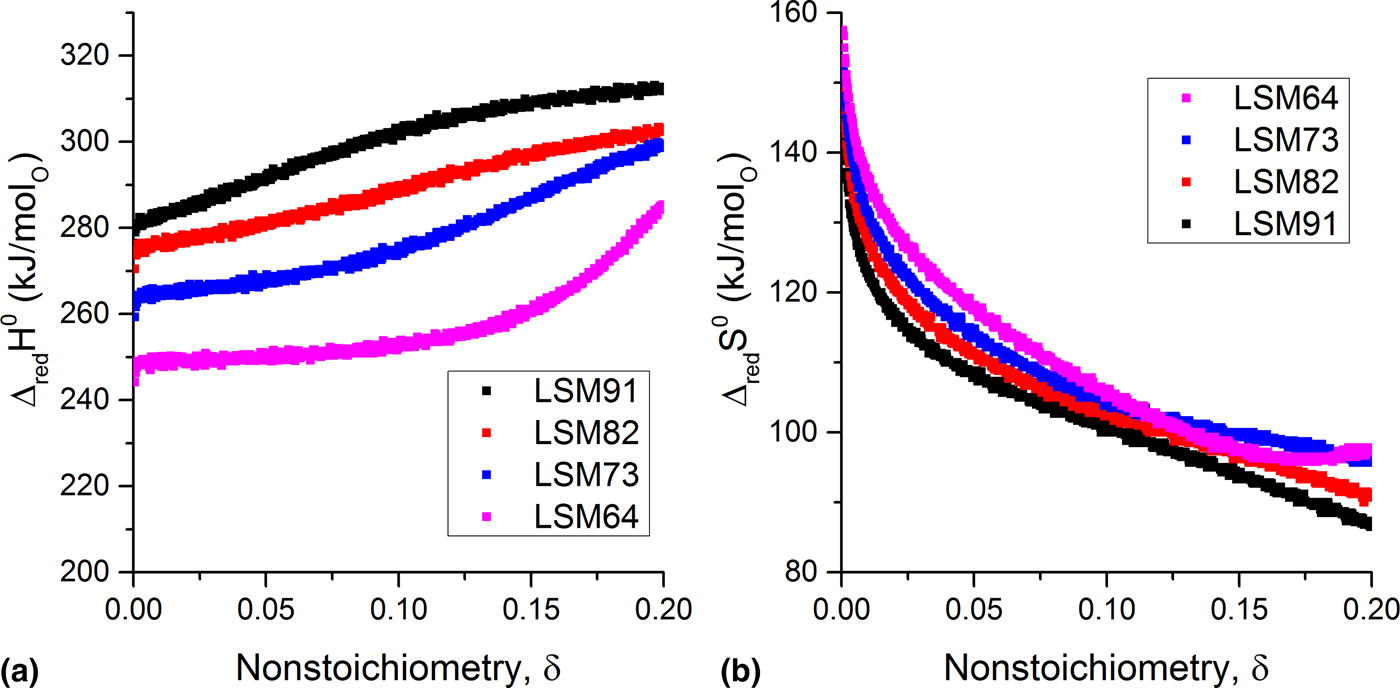
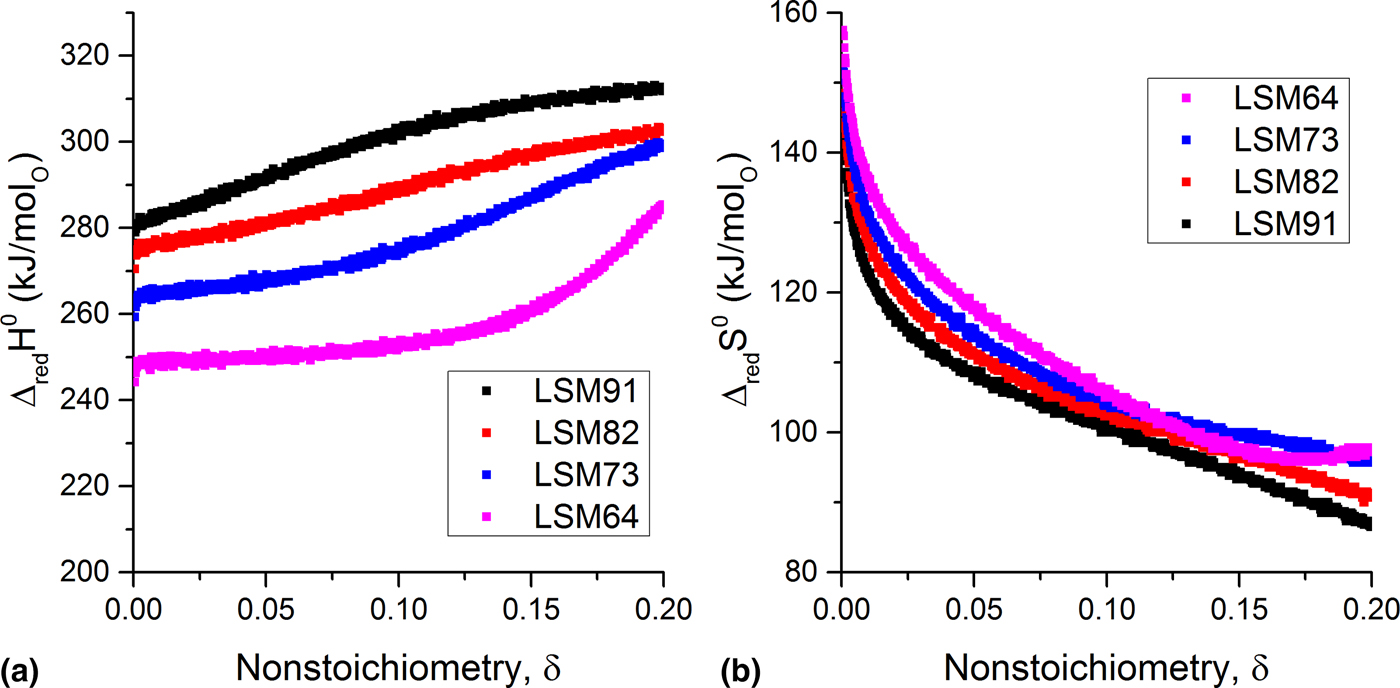
(LSM91). The complete set of results, somewhat updated in the case of LSM82, LSM73 and LSM64 using slightly refined interpolation procedures, is presented in Fig. 2. A clear decrease in the magnitude of the enthalpy of reduction with increasing Sr content is evident, a feature noted in previous studies[
Reference Yang, Yamazaki, Aydin and Haile
9
,
Reference Bork, Povoden-Karadeniz and Rupp
16
,
Reference Grundy, Povoden, Ivas and Gauckler
24
,
Reference Mizusaki, Mori, Takai, Yonemura, Minamiue, Tagawa, Dokiya, Inaba, Naraya, Sasamoto and Hashimoto
25
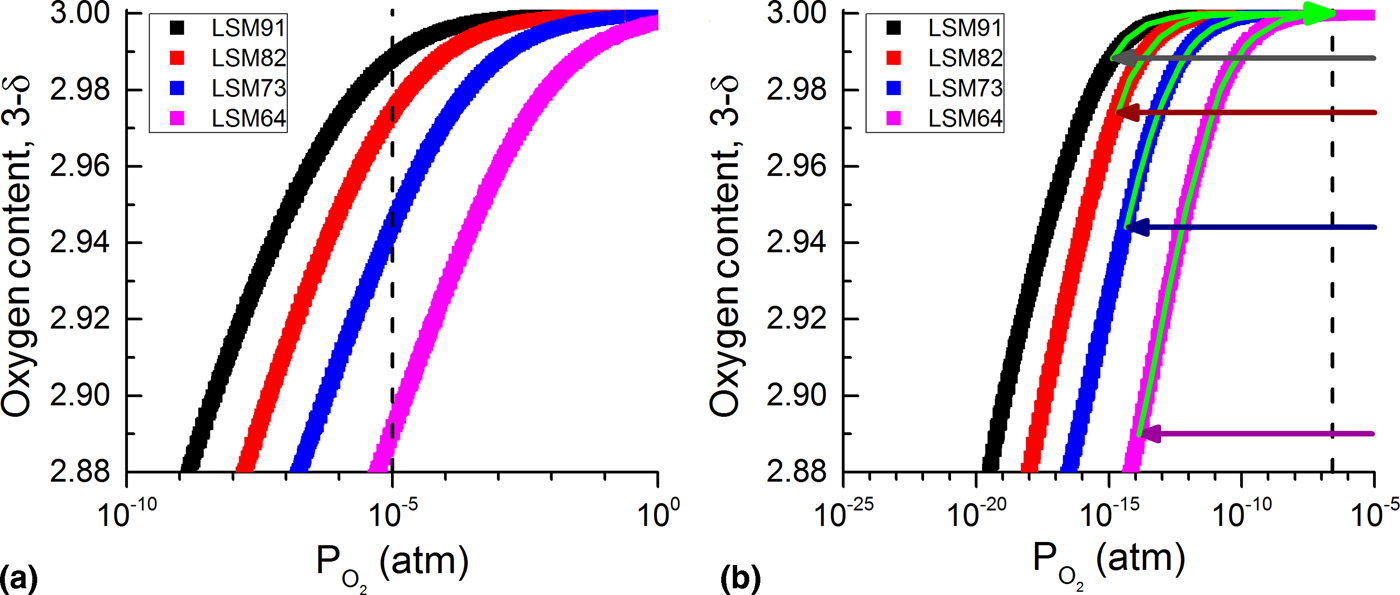
] and one that results in the increased reducibility of the Sr-rich compositions. The associated oxygen nonstoichiometry curves, Fig. 3, shown for 800 and 1400 °C, also reflect this increased reducibility.
CALPHAD derived (a) enthalpy and (b) entropy of reduction of La1−x Sr x MnO3−δ (LSM) compounds with strontium content from x = 0.1 (LSM91) to x = 0.4 (LSM64) each as a function of oxygen nonstoichiometry.
Oxygen content in LSM compounds as a function of oxygen partial pressure at (a) 1400 °C and (b) 800 °C. Reduction under 10 −5 atm O2 is indicated by the vertical line in (a). Upon quenching from the reduction condition to 800 °C, the materials retain the δ attained at high temperature, implying an internal chemical potential corresponding to the intersection of the horizontal δ i lines in (b) with the 800 °C curves. The vertical line in (b) is the equilibrium oxygen partial pressure resulting from thermolysis of 20% H2O in Ar, used experimentally for the fuel production half-cycle. The thermodynamic driving force for the initiation of the oxidation reaction is determined by the distance between the vertical line in (b) and the nonstoichiometry curve at δ i .
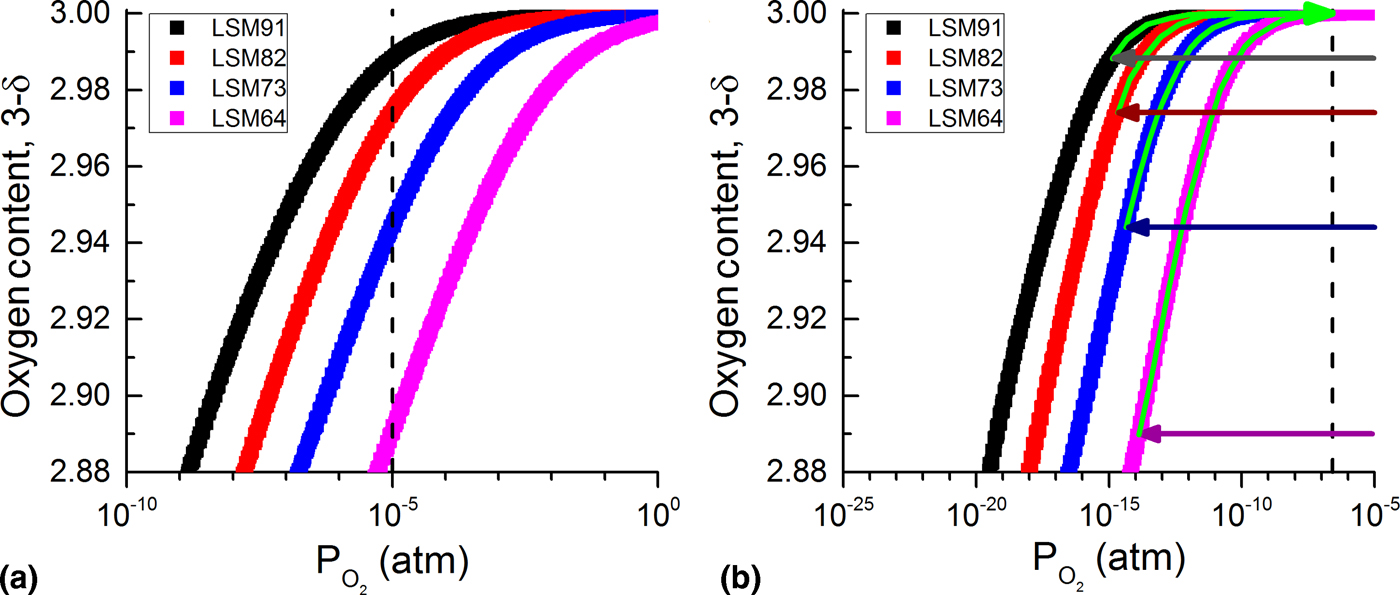
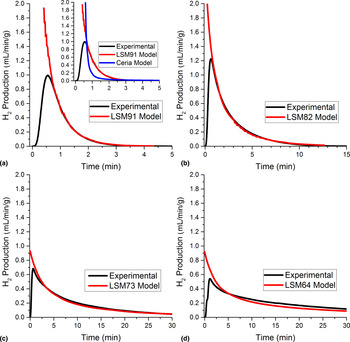
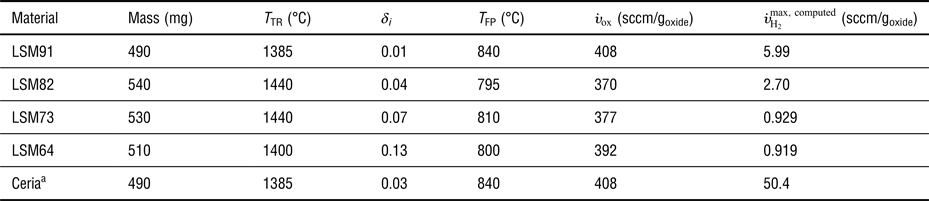
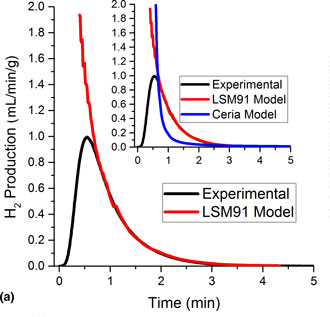
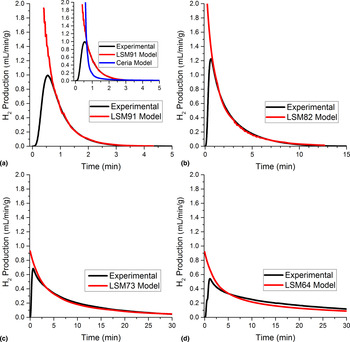
The experimental hydrogen evolution profiles were obtained, as reported earlier, upon reduction at ~1400 °C under 10 ppm O2 in flowing Ar, followed by oxidation at ~800 °C under 20% steam (balanced by Ar).[ Reference Yang, Yamazaki, Aydin and Haile 9 ] The non-stoichiometry values resulting from the reduction step are indicated in Fig. 3(a), and the strong increase in oxygen loss with increasing with Sr content is clear. As a result of the rapid quench from high temperature, these non-stoichiometries correspond to the values, δ i, at the initiation of the oxidation reaction. Oxidation then occurs in accordance with the low temperature oxygen nonstoichiometry curves, Fig. 3(b). Due to anticipated kinetic challenges with the creation of material volume to accommodate oxygen nonstoichiometry in the oxygen excess region, oxygen content beyond 3 is not considered here. A comparison of experimental and computed profiles, Fig. 4, shows that, with the exception of the very short time results (at which gas mixing effects impact the measured profiles[ Reference Davenport, Kemei, Ignatowich and Haile 21 ]), good agreement is obtained, particularly for LSM91 and LSM82. We note that due to uncertainty in the exact sample temperature in the IR imaging furnace employed for the experimental studies, both reduction and oxidation temperatures were slightly adjusted, Table I, to achieve the level of agreement evident in Fig. 4. Regardless of this detail, it is clear that enhanced reducibility with increasing Sr content directly translates into a decrease in fuel production rates. For LSM91 and LSM82, the rates appear entirely limited by this thermodynamic effect. For LSM73 and LSM64, an additional material-kinetic effect, likely a surface reaction limitation, appears to play a role. These two compositions underperform the model for a short period just beyond the peak in the hydrogen evolution profiles (beyond which the effects of gas mixing are negligible), and subsequently produce hydrogen for a much longer period than predicted by the thermochemical model.
Hydrogen production calculated by the thermo-kinetic (quasi-equilibrium) model compared to experimental data for two temperature cycling of LSM compounds: (a) LSM91, (b) LSM82, (c) LSM73, and (d) LSM64. Reduction performed nominally at 1400 °C under 10 ppm O2, and oxidation nominally at 800 °C under 20% steam at 200 mL/min. The inset in (a) additionally shows the computed behavior of ceria in the thermokinetic limit. Experimental data have been reported previously and reflect the hydrogen detected by mass spectrometry in the evolved gas stream. [ Reference Yang, Yamazaki, Aydin and Haile 9 ]
Process parameters for the computation of thermo-kinetic hydrogen production profiles.
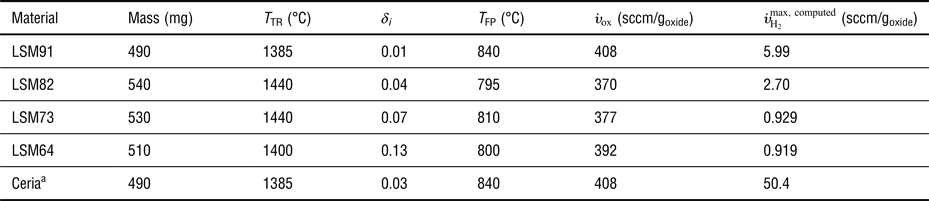
Experimentally, reduction of LSM was carried out at 1400 ± 40 °C under flow of 10−5 atm O2 in Ar. The 40 min reduction period was sufficient to achieve equilibration. Fuel production was carried out at 800 ± 40 °C under flow of 0.2 atm H2O in Ar, provided at a flow rate of 200 mL/min.
a Cycling conditions are selected to match those of LSM91.
The slow rates of hydrogen generation with increasing Sr content can be understood by directly considering the oxygen nonstoichiometry profiles, Fig. 3(a). The total driving force for oxidation is effectively the difference between
 $P_{{\rm O}_{\rm 2}}(\delta _i,T_{{\rm FP}})$
, the oxygen partial pressure which would be in equilibrium with the quenched nonstoichiometry from the high-temperature reduction,
 $\delta (P_{{\rm O}_{\rm 2}} = 10^{{\rm -} 5}\; {\rm atm},\;$
T = 1400 °C), and the oxygen partial pressure of the inlet steam, 1.6 × 10⁻⁷ atm. This difference systematically decreases with increasing Sr, although the total Δδ between oxidized and reduced conditions systematically increases. The fact that
 $P_{{\rm O}_{\rm 2}}(\delta _i,T_{{\rm FP}})$
is relatively high for LSM64 is a direct consequence of the thermodynamic ease by which reduction of this material occurs. The diminished Δred
H
0(δ) at high Sr content with relatively unchanging Δred
S
0(δ) implies a diminished driving force for oxidation at all temperatures. Decoupling the high and low temperature responses, as dictated by ΔredG0(δ) = ΔredH0(δ) −TΔred
S
0(δ), would require manipulation of Δred
S
0(δ). The benefit of designing materials with large Δred
S
0(δ) in the context of increasing fuel productivity (quantity of fuel per unit oxide per equilibrium cycle) has been previously discussed in the literature.[
Reference Meredig and Wolverton
26
] Here it is evident that the benefits extend to fuel production rates (fuel per unit oxide per unit time). To put the magnitude of the latter effect into context, we note that for all LSM compositions, the computed peak production rates for the quasi-equilibrium model fall below 3
 ${\rm m}{\rm L}_{{\rm H}_2}{/\ \!\!{\rm min}} \!/{\rm g}_{{\rm oxide}}$
. In contrast, for ceria reduced and oxidized under similar conditions the computed peak rate is almost 60
 ${\rm m}{\rm L}_{{\rm H}_2}{/\ \! { \!\rm min}} /{\rm g}_{{\rm oxide}}$
, although material kinetic effects (i.e., finite surface reaction rates) have precluded observation of this extremely high value for hydrogen production.[
Reference Davenport, Kemei, Ignatowich and Haile
21
] Increasing the fuel production rate from LSM to values comparable with those achieved from ceria could, in principle, be achieved by increasing the reactant gas flow rate, but an order of magnitude increase would be impractical. Given this reality, design of reactors making use of materials with low thermodynamic driving force for oxidation would have to address their inherently low fuel production rates.
Acknowledgments
Support for this work was provided in part by the US Department of Energy, ARPA-e HEATS program (DE-AR0000182), under subcontract from the University of Minnesota.