

Neurodegenerative diseases represent a significant clinical problem, especially in older individuals, because the population risk for disorders such as Alzheimer disease (AD) or Parkinson disease (PD) increases with age. Neurodegenerative diseases also have the insidious property of progressing with time, tending to involve increasing numbers of brain regions, and therefore with more disabling and sometimes fatal symptoms. Therefore, both at the level of public health and for the individual person living with a neurodegenerative disorder, there is a genuine need for therapies that will intervene in the course of the disease.
Despite this, there are no clinically helpful tools to modify progression of these diseases. At least part of the cause of the movement problems that a person with PD might experience, including bradykinesia (slow movement), tremor, rigidity and postural instability, is the loss of dopamine-producing neurons in part of the midbrain, the substantia nigra pars compacta. Treatment with the dopamine precursor L-DOPA has been a generally effective strategy for these aspects of the disease, but this is a purely symptomatic approach. Progression is not halted, not all symptoms respond, and there are problems associated with prolonged L-DOPA use. Alternative drugs (e.g. dopamine agonists) are available and there are nonpharmacological approaches such as deep brain stimulation, but in most cases PD worsens over time. PD is well served by L-DOPA, because there is at least some symptomatic benefit; for all the other major neurodegenerative conditions, however, there is no cure.
These considerations lead to the question of why there are no antidegenerative, or antiprogression, therapies for these conditions in current clinical use. There could be many reasons, and this article would probably stray into philosophy and politics to attempt to answer that question, but one reasonable argument is that we have simply not understood the aetiology or root causes of neurodegeneration. As has been argued elsewhere (Ref. Reference Cookson1), because most cases of neurodegenerative disease are apparently sporadic, it has been hard to develop a way of even thinking about causality compared with, for example, infectious diseases. The imperfect argument is that understanding aetiology should be the first priority and that developing therapeutics should incorporate our best understanding of causation as much as we can understand it.
Of course this is circular, because if a disease is truly sporadic then aetiology is going to involve guesswork. But, there is a subset of neurodegenerative conditions where aetiology can be established with some certainty – the genetic forms. Even more intriguingly, there are inherited diseases that overlap clinically and pathologically with their sporadic counterparts, suggesting a shared aetiology. For PD, there are about half a dozen genes that appear to be causative for the condition and several chromosomal regions in the human genome that might yet yield more relevant genes (Refs Reference Cookson and Bandmann2, Reference Hardy3). Furthermore, some of the genes that are found in familial PD also act as risk factors for the sporadic disease (Refs Reference Cookson4, Reference Taymans and Cookson5), strengthening the idea that aetiology might be shared between the two forms of disease.
Summarising the above points, it seems reasonable to examine the genetic forms of PD for clues about the pathogenic process, recognising that genes do not work alone and are influenced by aspects of their biological environment. From there, we can determine how the protein products of genes are changed by mutation and, using model systems, try and understand how this might result in damage to neurons. Finally, and at the moment this last stage is hypothetical, we can discuss possible therapeutic applications.
The aim of this review is to take one of the known genes for PD, leucine-rich repeat kinase 2 (LRRK2), and put it through its paces in the above scheme. Our focus here is on how a single gene product could lead to an understanding of disease pathogenesis that might, in the future, have clinical implications. We also try to identify some of the outstanding questions that should be answered before the full potential of the discovery of this gene can be realised.
The LRRK2 gene, protein and enzyme
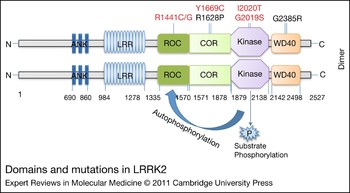
Before discussing mutations in LRRK2, we will first outline what is known about the wild-type version of the gene. LRRK2 is a large gene located on human chromosome 12 that has 51 exons and encodes a protein of 286 kDa (shown diagramatically in Fig. 1). Before its role in PD was reported, LRRK2 and the homologous LRRK1 had been identified as a small family of protein kinases (Ref. Reference Manning6). LRRK1 and LRRK2 have a modular structure that includes a series of leucine-rich repeats towards the N-terminus, and hence were named leucine-rich repeat kinases. The kinase domains of LRRK1 and LRRK2 can be separated from most other kinases and are an offshoot of the tyrosine-like kinase family, which includes other large modular kinases involved in diverse biological functions.
Domains and mutations in LRRK2. The LRRK2 protein is shown diagrammatically with amino acid numbers below each domain. Above the dimer are positions of known pathogenic mutations (in red) and some possible risk variants (in black). The effects of kinase activity might be either phosphorylation of external substrates or autophosphorylation, as indicated. Whether the dimer is present in a head-to-head orientation as shown here is not known. Abbreviations: ANK, ankyrin-like repeats; COR, C-terminal of ROC; LRR, leucine-rich repeats; LRRK2, leucine-rich repeat kinase 2; ROC, Ras of complex proteins.

LRRK1 and LRRK2 are also part of another group of proteins, the ROCO family. These are named because they have a tandem motif that includes a ROC (Ras of complex proteins) domain followed by a COR (C-terminal of ROC) domain (Ref. Reference Marin, van Egmond and van Haastert7). The ROC domain is a GTPase, hydrolysing GTP to GDP to act as a molecular motor of some kind. The COR domain is thought to regulate the activity of the ROC domain by bringing together two monomers, as demonstrated by the structure of a ROC–COR domain from a slime mould (Ref. Reference Gotthardt8).
LRRK2 therefore is a single polypeptide with both kinase and GTPase enzyme activity. The kinase activity of LRRK2 has been demonstrated by a number of different assays using recombinant protein in vitro (Refs Reference Berger, Smith and Lavoie9, Reference Dzamko10, Reference Giasson11, Reference Greggio12, Reference Nichols13, Reference West14). The GTPase activity is weak, and therefore more difficult to quantify; although values have been reported in some studies (Refs Reference Deng15, Reference Guo16, Reference Lewis17, Reference Li18), negative results have also been reported (Ref. Reference Ito19).
Kinases and GTPases both work to influence cellular signalling pathways, implying that LRRK2 is a signalling molecule of some kind. Furthermore, many kinases and GTPases work together and this might also be true for LRRK2 in the sense that the two domains communicate. There is some evidence that adding nonhydrolysable GTP analogues, mimicking the GTP-bound state, increases kinase activity, although this has been challenged with some negative reports (Ref. Reference Liu20). The kinase domain of LRRK2 phosphorylates its ROC domain at several sites (Refs Reference Gloeckner21, Reference Greggio22, Reference Kamikawaji, Ito and Iwatsubo23, Reference Pungaliya24). One interpretation of these data is that the role of the kinase domain is to regulate GTP-dependent functions of LRRK2 (Ref. Reference Cookson4), as indicated in Figure 1. If correct, this hypothesis suggests that kinase-dead versions of LRRK2 will be active in terms of GTP-dependent functions but would lack regulation that allows mutant effects to be expressed, which will be discussed below.
Because enzyme activities are measurable and because mutations are found in these domains (see below), these domains have been a major focus of attention. However, there are several other important regions of LRRK2 outside the central LRR, ROC, COR and kinase domains. The N-terminus of LRRK2 is characterised by a series of repeats that have some homology to armadillo (ARM) and HEAT motifs. These are characteristically longer in LRRK2 than in LRRK1 and therefore might be an important distinguishing region between the two otherwise similar kinases. Towards the C-terminus is a putative WD40 repeat and a short C-terminal region; these again differ between LRRK1 and LRRK2. The significance of the LRRK2 repeats and WD40 domains is that, along with the LRR, they probably act as scaffolds for protein–protein interactions. Conceptually, these regions could be important in binding LRRK2 partners modified by the activity of kinase and GTPase regions. Although several LRRK2 interactors have been proposed, interestingly, none have yet been shown to map to these regions.
One additional interesting aspect of the large LRRK2 protein is that it can assemble to form dimers and probably larger complexes (Refs Reference Gotthardt8, Reference Berger, Smith and Lavoie9, Reference Deng15, Reference Greggio22, Reference Greggio25, Reference Jorgensen26, Reference Klein27, Reference Ko28, Reference Lu29, Reference Sen, Webber and West30). Dimers are more active as a kinase than other forms (Refs Reference Berger, Smith and Lavoie9, Reference Sen, Webber and West30), and there have been suggestions that dimerisation is important for GTPase function (Ref. Reference Gotthardt8). Therefore, the transitions of LRRK2 between monomer, dimer and high-molecular-weight complex are likely to regulate the overall enzyme output.
LRRK2 is generally cytoplasmic, and never nuclear, at least when overexpressed in various cell lines and neurons (Refs Reference Dzamko10, Reference Giasson11, Reference Greggio12, Reference Nichols13, Reference West14, Reference Alegre-Abarrategui31, Reference Hatano32, Reference Miklossy33). Localisation to the cytoplasm might be related to the association of a proportion of the protein with cellular membranes, including autophagic vesicles (Refs Reference Berger, Smith and Lavoie9, Reference West14, Reference Alegre-Abarrategui31, Reference Hatano32, Reference Biskup34, Reference Higashi35). Although the precise significance of these observations is not clear, the implication is that LRRK2 might transition between cytoplasmic and membrane-associated compartments as part of its putative signalling function.
LRRK2 mutations and molecular mechanisms
In 2002, Funayama and colleagues reported a novel PARK locus linked to chromosome 12 (Ref. Reference Funayama36). The family, from the Sagamihara region of Japan, had clear evidence of autosomal dominant inheritance over several generations and relatively high but incomplete penetrance. Subsequently, several other families were linked to the same locus and two independent groups identified LRRK2 as the causal gene in 2004 (Refs Reference Paisan-Ruiz37, Reference Zimprich38). Importantly, the family that was used to generate the initial linkage was shown to have a mutation in LRRK2 (Ref. Reference Funayama39). Sequencing of additional cases throughout the world demonstrated a common and recurrent mutation in many small families (Refs Reference Gilks40, Reference Goldwurm41, Reference Infante42, Reference Kachergus43, Reference Lesage44, Reference Lesage45, Reference Lesage46, Reference Ozelius47, Reference Rajput48).
There are five unambiguously causal mutations in different domains of LRRK2. The original cloning papers identified R1441C and R1441G in the ROC domain, as well as Y1699C in the COR domain. The very common mutation G2019S is found in the kinase domain, and the original Japanese family has an I2020T mutation at the adjacent residue also in the kinase domain. The location of these mutations is illustrated in Figure 1.
There are additional variants in the LRRK2 gene, which is large and polymorphic, but most of these are thought to be nonpathogenic. However, two variants are associated with altered risk of PD in Asian populations: R1628P in the COR domain and G2385R in the WD40 domain (Ref. Reference Kumari and Tan49). These variants are found in controls and cases, but at significantly different frequencies.
Given that most of the dominant mutations are in the enzymatic ROC–COR–kinase tridomain, a reasonable approach to understanding mutations is to examine whether they affect enzyme activity. Of the known mutations, only G2019S has been consistently shown to increase kinase activity (Ref. Reference Greggio and Cookson50). Mutations in the ROC–COR domain cause a decrease in GTPase activity, where it can be measured (Refs Reference Guo16, Reference Lewis17, Reference Liu20, Reference Daniels51).
A reasonable next question is whether these two observations are related. It has been proposed that kinase activity is stimulated by GTP binding (Refs Reference Ito19, Reference West52), in which case lower GTPase activity would lead to higher GTP-stimulated kinase activity. However, this is difficult to reconcile with the lack of effect of mutations in the ROC–COR domain on kinase activity. Furthermore, some studies have not seen the effect of addition of nonhydrolysable GTP analogues on kinase activity, as would be predicted (Ref. Reference Liu20).
Another possibility is that instead of GTP stimulating kinase action, the kinase domain is modulatory to GTP binding or hydrolysis. This is potentially supported by identification of sites in the ROC domain that are modified by autophosphorylation (Refs Reference Gloeckner21, Reference Greggio22, Reference Kamikawaji, Ito and Iwatsubo23). In this model, the kinase activity of LRRK2 would change GTPase activity such that the enzyme would be more likely to be in an active, GTP-bound state. Support for this comes from recent data showing that one of the autophosphorylation sites, T1410, subtly regulates GTP binding in vitro (Ref. Reference Pungaliya24).
If this scenario is correct, then the implication is that understanding the GTP-dependent functions of LRRK2 is a crucial step forward in the field. Many GTPases are active in the GTP-bound form; hence one possibility is that GTP-bound LRRK2 is an effector of signalling, perhaps acting as a scaffold, given that large portions of the protein have potential protein–protein interaction domains. Conceptually, a kinase hyperactive mutant would be more likely, and a kinase-dead version less likely, to be switched into a higher-affinity, GTP-dependent state. In other words, all mutants would have persistent GTP-dependent functions, and kinase-dead mutations would counteract this effect. However, this remains speculative because there is little evidence that autophosphorylation occurs in vivo. This, along with some other outstanding questions, will be discussed below.
LRRK2 phenotypes in man and model organisms
LRRK2 mutations are usually associated with clinical parkinsonism – with typical movement problems of tremor, rigidity, bradykinesia and postural instability (Ref. Reference Haugarvoll and Wszolek53). Where autopsies have been performed, prominent loss of melanised dopamine neurons in the substantia nigra pars compacta has been noted. As might be expected, movement problems in these patients respond to L-DOPA treatment.
The age at which symptoms are first noted in LRRK2 cases is variable, but is generally when patients are in their 50s or 60s (Ref. Reference Kumari and Tan49). This contrasts with mutations of genes involved in recessive parkinsonism, including PINK1 and PARKIN, which tend to cause onset nearer to the age of 30 (Ref. Reference Alcalay54). Whether this distinction has a mechanistic basis is unclear at this time, but based on clinical symptoms and age at onset, PD cases due to LRRK2 mutation are therefore similar to sporadic PD and distinct from some other types of inherited parkinsonism. Also, similarly to sporadic PD, a subset of LRRK2 cases gives clear evidence of the involvement of other brain regions in the clinicopathological picture, including, for example, dementia (Ref. Reference Haugarvoll and Wszolek53) and autonomic problems (Ref. Reference Goldstein55).
The apparent homogeneity of clinical syndromes, with variation that is probably similar to that seen in sporadic PD, stands in contrast to the more variable pathology associated with LRRK2 mutations. This variability was emphasised in one of the original cloning papers (Ref. Reference Zimprich38), and further variability has been discovered over time (Ref. Reference Wider, Dickson and Wszolek56). Most cases appear to have Lewy bodies, the characteristic pathology of α-synuclein deposition seen in PD and related conditions, but an appreciable fraction has either no distinctive pathology or tau-positive lesions (Ref. Reference Cookson, Hardy and Lewis57). The significance of this is unclear. It is possible that LRRK2 is informative for many pathological events, but it might equally be the case that pathological events are epiphenomena and LRRK2 does nothing to help resolve this problem.
There are some people who have LRRK2 mutations and never develop clinical parkinsonism in their lifetime. For example, there have been reports of relatively elderly people with mutations who were found to be clinically normal even after extensive evaluation (Ref. Reference Kay58). LRRK2 mutations therefore show age-dependent but incomplete penetrance. Overall penetrance has been estimated as 80% by the age of 70 years (Ref. Reference Dachsel and Farrer59), although lower estimates in some population-based studies have also been reported (Ref. Reference Clark60). A recent study in Basque families reported a GTPase domain R1441G mutation penetrance of 83.4% by the age of 80 years (Ref. Reference Ruiz-Martinez61). The number of non-G2019S cases that have been examined is low and so firm conclusions are difficult to make, but it appears that cases with kinase-domain and non-kinase-domain mutations have variable ages of onset.
Increasing evidence suggests that Drosophila melanogaster (Refs Reference Gehrke62, Reference Imai63, Reference Kanao64, Reference Lee65, Reference Lee66, Reference Lin67, Reference Liu68, Reference Ng69, Reference Tain70, Reference Venderova71) and Caenorhabditis elegans (Refs Reference Hsu72, Reference Saha73, Reference Sakaguchi-Nakashima74, Reference Samann75, Reference Yao76) can be used as model organisms for investigating neurodegenerative diseases, including PD. Here, we will only briefly review work in flies and worms and direct the interested reader to the original literature.
In D. melanogaster, overexpression of mutant LRRK2 causes loss of dopaminergic neurons, retinal degeneration, motor impairment and shorter life, whereas wild-type protein produces less severe phenotypes (Refs Reference Gehrke62, Reference Imai63, Reference Liu68, Reference Venderova71). These animals can be used to identify pathways important in neurodegeneration, and in various studies, a contribution of alterations in protein translation (Ref. Reference Imai63), microRNA synthesis (Ref. Reference Gehrke62) and mitochondrial effectors (Refs Reference Ng69, Reference Venderova71) has each been suggested to modify LRRK2-related phenotypes. In C. elegans models, overexpression of LRRK2 also causes phenotypic changes, including axonal damage in neurons, which seems to involve altered mitochondrial function (Ref. Reference Saha73).
One way to understand the normal function of LRRK2 is to knock out the gene. Knockout of the nearest homologous gene in Drosophila produces variable effects, with loss of dopamine cells reported in one study (Ref. Reference Lee66), but this was not replicated in an independent laboratory (Ref. Reference Wang77). Knockout of the C. elegans homologue causes changes in axonal polarity (Ref. Reference Sakaguchi-Nakashima74) and in neurite outgrowth in response to stress (Ref. Reference Samann75). What complicates interpretation of these data is that flies and worms have single LRRK homologues compared with the two distinct genes in vertebrates (Ref. Reference Marin78), and at this time we cannot be sure whether there are specific functions associated with LRRK2 in higher organisms.
Three independent mouse knockouts have been reported (Refs Reference Andres-Mateos79, Reference Lin80, Reference Tong81). In all three published studies, the brains of the animals were reported to be grossly normal and there was no loss of dopamine neurons in the substantia nigra. Andres-Mateos and coworkers further stressed LRRK2-knockout mice by exposing them to the dopaminergic neurotoxin 1-methyl-4-phenyl-1,2,3,6-tetrahydropyridine, and reported no differences between wild-type and knockout animals. Therefore, LRRK2 appears to be dispensable for the survival of neurons under both basal and stressed conditions. This argues against a dominant negative effect of mutations, with the caveat that mice have a much shorter lifespan than humans, which might be an important difference for a disease with age-dependent penetrance.
In contrast to the lack of brain phenotypes, one of the reported knockout mice had significant pathology in the kidney (Ref. Reference Tong81). Although the mechanistic details have not yet been worked out, several correlated events occur in these animals, namely changes in markers of autophagy, accumulation of α-synuclein, cell death and tissue damage. This report still needs to be confirmed by other groups, but it shows that LRRK2 has an important role in organs other than the brain. Whether there is similar kidney damage in human LRRK2 patients is not yet clear.
Several groups have expressed mutant forms of LRRK2, either under the endogenous promoter using a knock-in strategy (Ref. Reference Tong82) or using heterologous promoters (Refs Reference Lin80, Reference Li83, Reference Li84, Reference Melrose85, Reference Winner86). Generally, phenotypes of these animals have been modest. No substantial loss of dopamine neurons in the substantia nigra was noted, although tau-positive axonal pathology (Refs Reference Li84, Reference Melrose85) and alterations in dopamine transmission (Refs Reference Tong82, Reference Li83, Reference Li84, Reference Melrose85) have been noted in different models, suggesting that these phenotypes might be early but consistent phenomena that indicate damage to the nigrostriatal system.
Two groups of models have shown more extensive neurodegenerative phenotypes. Using a transgenesis approach, Lin and colleagues showed that although expressing mutant LRRK2 alone is not sufficient to trigger extensive neurodegeneration, coexpression of both mutant LRRK2 and mutant α-synuclein causes neuronal loss in regions of the brain where the transgenes are active. Because these researchers used a forebrain-active CAMKII promoter, neuronal loss and reactive gliosis were seen in the striatum and cortex rather than in the substantia nigra; hence this is not a full model of PD, but it does indicate that there are strategies that might result in mouse models that have useful phenotypes.
More recently, two groups have reported that transient overexpression of mutant LRRK2 using viral vectors will result in loss of dopamine neurons in the substantia nigra of mice (Ref. Reference Lee87) or rats (Ref. Reference Dusonchet88). Importantly, wild-type protein or kinase-dead versions of LRRK2 had no effect, suggesting that simple overexpression of any similar large protein would not be sufficient to cause neurodegeneration. Therefore, this approach has the potential to provide a model that more fully replicates the phenotypes seen in human LRRK2 patients than are seen in conventional transgenic models.
Several groups have shown that LRRK2 mutations affect neurite branching in growing neurons. In primary neuronal cultures, overexpression of Y1699C or G2019S LRRK2 causes significant reduction in neurite branching compared with that in control cells (Refs Reference Dachsel89, Reference MacLeod90, Reference Parisiadou91). LRRK2 expression in flies also causes changes in neurites in vivo (Ref. Reference Lee65). Wild-type LRRK2 expressed at similar levels does not cause neurite shortening, although knockout of LRRK2 causes increased neurite outgrowth (Refs Reference Dachsel89, Reference MacLeod90, Reference Parisiadou91). It is therefore currently unclear whether wild-type human or mouse LRRK2 is important in these phenomena, or whether there is a mutant-specific effect.
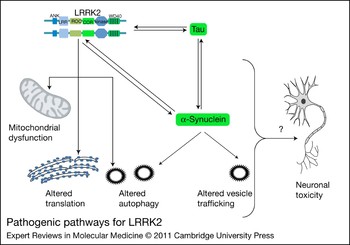
How mutant LRRK2 causes neuronal dysfunction and cell death is unclear, although several themes have arisen from the literature in recent years (Fig. 2). As discussed above, LRRK2 appears to have effects on vesicle function, including potentially the autophagy–lysosome system, and on synaptic vesicles. Evidence from Drosophila models suggests an additional role in protein translation. Finally, there are poorly defined relationships with α-synuclein and tau that might be important in understanding LRRK2 in the context of other dominant genes associated with parkinsonism. It is not clear whether any or all of these effects are either necessary or sufficient for the detrimental effects of mutant LRRK2, but conceptually, each might cause some neuronal dysfunction that collectively results in neuronal cell death (Fig. 2).
Pathogenic pathways for LRRK2. LRRK2 has been suggested to directly or indirectly affect several cellular pathways, including mitochondria, protein translation and autophagy–lysosome function. Collectively, these might result in neurotoxicity. It is also probably important that there are genetic interactions between LRRK2 and tau and α-synuclein, which are other genes involved in autosomal dominant parkinsonism.

Clinical implications
One of the major clinical implications of identifying LRRK2 as a relatively common gene for PD is that it highlights how powerful genetics is for understanding disease. In some populations, LRRK2 accounts for a significant proportion of all PD cases and so identification of this gene has implications for genetic testing and other clinical considerations (Ref. Reference Nuytemans92).
More broadly, evidence that LRRK2 dysfunction is related to α-synuclein (Ref. Reference Lin80), the protein that defines the Lewy body pathology found in all cases of sporadic PD, suggests that inherited and sporadic PD might share pathogenic pathways. This supposition is potentially supported by the identification of common genetic variants around both α-synuclein and LRRK2 that are associated with altered risk of sporadic PD (Refs Reference Satake93, Reference Simon-Sanchez94). If correct, then thinking about therapeutics, which is certainly the underlying motivation behind a great deal of work on neurodegenerative diseases, would not involve a separation between inherited and sporadic diseases. Rather, we could think about PD as a pathogenic entity and distinguish only between those cases with a strong genetic basis and those where genetics has a more modest role.
At the current time, the idea that one could develop treatments for sporadic PD based on the minority of inherited forms is speculative. But, it is also clear that developing tools for LRRK2 is one way of testing this hypothesis. Specifically, it has been proposed that the detrimental effects of LRRK2 both in vitro (Refs Reference Greggio12, Reference Smith95) and in vivo (Ref. Reference Lee87) rely in part on kinase activity. This leads to the suggestion that kinase inhibitors for LRRK2 might have therapeutic potential for people who have mutations in that gene (Refs Reference Liu96, Reference Nichols97, Reference Reichling and Riddle98). Such tools would be invaluable and will be discussed in the next section of this review.
Research in progress and outstanding research questions
As discussed above, perhaps the key tool for understanding LRRK2 would be to have a highly specific, potent compound that inhibits kinase activity. Such a compound would need to be extremely well tolerated at inhibitory doses and would preferably be orally available and brain permeable. Although this is not yet available, the theoretical kinase inhibitor would allow for a test of the hypothesis that kinase activity is important for LRRK2 pathogenesis. If such compounds were available, then they could be used to test the ancillary hypothesis that LRRK2 might be relevant for sporadic PD.
However important it is to have tools to inhibit kinase activity, it is not clear exactly where kinase activity fits into the overall picture of LRRK2 pathogenesis. It is crucial to identify the authentic physiological substrates of the LRRK2 kinase activity, which have been debated for some time (Ref. Reference Greggio and Cookson50). For a substrate to be considered authentic, a specific phosphorylation site needs to be identified on the substrate that comes from a given kinase, that phosphorylation site should be responsive to inhibition of LRRK2 activity in vivo, and the reaction should also be able to be reconstituted in vitro using physiologically reasonable concentrations of substrate and enzyme. Is the autophosphorylation of the ROC domain really the key output of the protein, or is there a heterologous substrate that mediates damaging effects of LRRK2 mutations? And if the ROC–COR bidomain is critically important, as would be implied by the presence of pathological mutations, then what is its function?
Related to this, it is important to understand how other signalling pathways in the cell regulate LRRK2. Most signalling molecules receive input from initiating pathways as diverse as growth factors and oxidative stress, as well as signalling from other cellular pathways, that is important in maintaining homeostasis. An understanding of what regulates LRRK2 might give important hints as to normal function, as well as providing the practical benefit of increasing activity, making many of the currently used biochemical assays much more feasible.
Finally, how is LRRK2 related to α-synuclein? Because α-synuclein is such an important protein for sporadic PD as a major component of Lewy bodies, it is important to understand whether LRRK2 pathogenesis requires the involvement of α-synuclein, thus linking two dominant genes with sporadic disease. This is likely to be a difficult problem, not least because not all cases with LRRK2 mutations have Lewy bodies. Clinical and pathological surveys of LRRK2 mutation carriers are needed to provide a stronger basis for understanding the pathology in this disease by cataloguing its variability.
Overall, therefore, LRRK2 has provided an important set of clues as to pathogenesis for an otherwise enigmatic disorder. Furthermore, there is at least one potential way forward to therapeutic avenues by targeting the kinase activity of LRRK2. However, there are a number of important required further steps to move this idea forward into the clinic. Kinase-inhibitor tools that have good specificity and potency for LRRK2 versus other kinases are required. These are starting to be reported in the literature (Ref. Reference Deng99) and, in conjunction with loss-of-function models, such as knockout mice, will be useful in dissecting out the effects of normal LRRK2 function in the adult nervous system. We also need to understand how mutant LRRK2 diverges in function from the normal wild-type protein, because this might identify processes in cells on which mutant LRRK2 impinges that might provide intervention points for new therapeutic ideas.
Acknowledgement and Funding
This research was supported by the Intramural Research Program of the NIH, National Institute on Aging. The authors thank the reviewers for their helpful and critical comments.