Syncope, a common symptom in children and adolescents, is a short-lasting loss of consciousness due to cerebral hypoperfusion, usually leading to a fall, but followed by spontaneous and complete recovery. The cerebral hypoperfusion responsible for the event may be caused by venous pooling in the lower limbs after a change in posture to upright standing.1
Testing using the head-up tilt table, with prolonged passive standing, is an established method in the diagnostic work-up for diagnosis of the causes of syncope.2 The task-force-monitor, manufactured by CNSystems, from Graz, Austria, has recently been developed to perform continuous non-invasive haemodynamic monitoring.3 We report our experience with tilt table testing of children using this device, and our attempts to classify the positive reactions according to the recommendations published by the European Society of Cardiology.4
Patients and methods
Between March 2002 and 2004, we performed tilt table testing in 100 non-selected consecutive patients. Of the patients, 39 were male and 61 female, with their ages ranging from 6 to 18, with a median age of 14 years. All had been referred for investigation of syncope or presyncope. The task-force-monitor, which integrates electrocardiographic, impedance cardiographic, oscillometric and continuous plethysmographic registration of arterial blood pressure measured on a finger, was chosen for acquisition of data. Informed consent was obtained from the patients, and from their parents if they were minor. An experienced paediatric cardiologist personally conducted the examination.
Testing started two hours after a meal in order to avoid postprandial circulatory response. A motorised table, with footboard-support and security straps at the hip, was used to ensure safety of the patients. The initial supine position was held for 15 minutes. Then passive tilt to 70 degree was applied for an interval of 45 minutes, followed by a second interval in the supine position for 5 minutes. For children less than 12 years the duration of tilting was shortened to 20 minutes. In cases of provoked syncope, patients were immediately brought to a head-down position at minus 15 degrees. A test was deemed positive if syncopal or severe pre-syncopal symptoms were provoked5 in association with pathologic haemodynamic changes, which were classified on the basis of the guidelines given by the European Society of Cardiology.4 Orthostatic hypotension was defined as a decrease in systolic blood pressure of more than 20 millimetres of mercury within the first 3 minutes of tilt associated with syncope or pre-syncope.4
Results
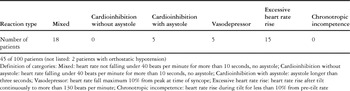
Forty-five of hundred consecutive patients tested showed a positive response. The duration of tilting until the onset of syncopal symptoms was from 1 to 44 minutes, with a mean of 21 minutes. After tilting, head-down recovery was always immediate, and no complications occurred. The interpretation of the positive reactions as based on the classification of the European Society of Cardiology4 is given in Table 1. We failed to detect any reaction as defined by the postural heart rate falling beneath 40 beats per minute for more than 10 seconds without asystole and chronotropic incompetence, while 5 patients tested positive for asystole, the maximum period being 17 seconds.
Table 1. Classification of positive responses to tilt table testing according to the guidelines of the European Society of Cardiology.

The mean values of blood pressure and heart rate did not differ significantly in the patients with positive reactions, regardless to their subclassification.
In our syncopal patients, orthostatic hypotension persisted for longer than 2 minutes, and the postural rise in heart rate rise was more pronounced, at greater than 50 beats per minute above the supine rate. These values clearly differed from those obtained in the patients not reacting to tilting.
Such negative findings were obtained in 55 patients, all of whom remained asymptomatic, such that their reaction could not be classified within the system of the European Society of Cardiology.4
Interestingly, two of the pathologic haemodynamic changes as defined by the European Society of Cardiology for patients reacting positively were also found in our patients who failed to show positive reactions. These were, first, a pronounced dip in blood pressure of greater than 20 millimetres of mercury as the initial orthostatic reaction, and second, an orthostatic increase in heart rate to more than 130 beats per minute. These changes were observed in 31 patients.
Discussion
According to the guidelines established by the European Society of Cardiology,4 a positive response to tilting is classified on the basis of the degree and duration of induced bradycardia. Sheldon,6 however, has argued that the classification of reactions to tilting based on changes in haemodynamics has not thus far proved convincing. We support these comments, since we were unable to find a cardioinhibitory response without asystole in any of our patients responding positively to tilting. Such a response, therefore, seems to be uncommon in the young population, and we are unable to recommend subdivision on the basis of cardioinhibitory reaction.
Furthermore, the suggested category of excessive heart rate to more than 130 beats per minute never occurred alone in our patients, but always resulted in a concomitant final cardioinhibitory or vasodepressive response. The duration of asystole depends on how quick the table can be reset to the supine position, and when this manoeuvre is started. The vasodepressive response to tilting is currently dependent on a decrease in heart rate of less than 10%, and not by the reaction in blood pressure, which also seems insufficient for use in our population. Due to the finding of artefacts in our restless patients, with loss of muscular tone during syncope, it was impossible in those exhibiting the most common mixed reaction to discriminate whether the fall in blood pressure occurred before or after bradycardia. And some of our patients showing a negative response to tilting exhibited similar haemodynamic changes to those responding positively.
We conclude, therefore, that children and adolescents show different alterations of heart rate and blood pressure when responding positively to drug free tilt table testing than do adults. We assume that this is independent of the protocol applied, which rather influences specificity or sensitivity, than the underlying mechanism once syncope has been provoked. It possibly indicates a different pathophysiology for syncope in the young than in adults.
We are aware that a more detailed assessment of the haemodynamic changes occurring during syncope is thus far of little practical consequence, since there is no general acceptance as to how these observations might influence therapeutic strategies. Such assessments, nonetheless, might lead to a better understanding of the pathophysiology in syncope. If our experience is representative, it suggested that Investigators caring for children must find it difficult to adopt the current guidelines provided by the European Society of Cardiology for interpretation of tilt table testing.4 Much clearer in this context is the older statement from the American College of Cardiology,5 which defines a positive response to tilting simply on the basis of provocation of syncope or presyncope due to bradycardia and/or hypotension.
We suggest the strong need for establishment of a task force to develop specific guidelines for protocols for tilt table testing in children and adolescents and its interpretation. Based on our limited data, we suggest a modified classification of responses to tilting in young patients, preferring to use relative rather than absolute parameters (Table 2).
Table 2. Our proposed classification for positive reactions to tilting in children.