


1. Introduction
Chromite (chromian spinel, Cr-spinel) commonly occurs as an accessory phase in mafic-ultramafic rocks and as the major mineral in chromitite (e.g. Irvine, Reference Irvine1965; Arai, Reference Arai1992, Reference Arai1994; Rollinson, Appel & Frie, Reference Rollinson, Appel and Frie2002). Chromite is one of the earliest minerals to crystallize from a mafic-ultramafic magma and a sensitive indicator of primary magma/melt compositions; it has therefore been widely used to understand the petrogenesis of its host rocks (Irvine, Reference Irvine1965; Cameron, Reference Cameron1975; Roeder, Campbell & Jamieson, Reference Roeder, Campbell and Jamieson1979; Arai, Reference Arai1994; Barnes & Hill, Reference Barnes and Hill1995; Rollinson, Reference Rollinson, Blenkinshop and Tromps1995, Reference Rollinson2008; Barnes, Reference Barnes2000; Mukherjee et al. Reference Mukherjee, Mondal, Rosing and Frei2010; Arai et al. Reference Arai, Okamura, Kadoshima, Tanaka, Suzuki and Ishimaru2011; González-Jiménez et al. Reference González-Jiménez, Griffin, Gervilla, Proenza, O'Reilly, Akbulut, Pearson and Arai2014a ,Reference González-Jiménez, Griffin, Gervilla, Proenza, O'Reilly and Pearson b , Reference González-Jiménez, Locmelis, Belousova, Griffin, Gervilla, Kerestedjian, O'Reilly, Pearson and Sergeeva2015; Zhou et al. Reference Zhou, Robinson, Su, Gao, Li, Yang and Malpas2014; Ishwar-Kumar et al. Reference Ishwar-Kumar, Rajesh, Windley, Razakamanana, Itaya, Babu and Sajeev2016a ). Interpretation of chromite chemistry becomes difficult if it has undergone alteration (Evans & Frost, Reference Evans and Frost1975; Eales, Wilson & Reynolds, Reference Eales, Wilson and Reynolds1988; Burkhard, Reference Burkhard1993) or post-crystallization re-equilibration (Hamlyn & Keays, Reference Hamlyn and Keays1979; Scowen, Roeder & Heltz, Reference Scowen, Roeder and Heltz1991). Metamorphosed chromite is generally richer in iron than its unmetamorphosed equivalent because of Mg–Fe exchange with silicates (Barnes, Reference Barnes2000). The degree of mantle melting, magma composition, crystallization sequence and pressure–temperature conditions can vary significantly among different geotectonic regimes, leading to distinctive variations in the composition of chromite (Ahmed et al. Reference Ahmed, Arai, Yaser and Rahimi2005; Karipi et al. Reference Karipi, Tsikouras, Hatzipanagiotou and Grammatikopoulos2007; Aswad, Aziz & Koyi, Reference Aswad, Aziz and Koyi2011). The chemistry of chromite is therefore a diagnostic indicator of different tectonic settings (Irvine, Reference Irvine1967; Arai, Reference Arai1980, Reference Arai1994; Barnes & Roeder, Reference Barnes and Roeder2001; Arai et al. Reference Arai, Okamura, Kadoshima, Tanaka, Suzuki and Ishimaru2011; Dharma Rao et al. Reference Dharma Rao, Santosh, Sajeev and Windley2013).
The Precambrian basement of Madagascar (Besairie, Reference Besairie and Rankama1967) is made up of several Mesoarchaean–Neoproterozoic crustal blocks separated by shear/suture zones. The Betsimisaraka suture zone in NE Madagascar separates the Neoarchean Antananarivo block in the west from the Mesoarchean Antongil-Masora blocks in the east (Collins et al. Reference Collins, Fitzsimons, Hulscher and Razakamanana2003; Kröner et al. Reference Kröner, Hegner, Collins, Windley, Brewer, Razakamanana and Pidgeon2000; Collins & Windley, Reference Collins and Windley2002; Raharimahefa & Kusky, Reference Raharimahefa and Kusky2009). The Betsimisaraka suture zone consists predominantly of paragneisses and mica-schists that dip shallowly to the west. In recent studies, the existence and exact position, shape and age of the Betsimisaraka suture has become controversial (Tucker et al. Reference Tucker, Ashwal, Handke, Hamilton, Legrange and Rambeloson1999, Reference Tucker, Roig, Delor, Amerlin, Goncalves, Rabarimanana, Ralison and Belcvher2011, Reference Tucker, Roig, Moine, Delor and Peters2014; Key et al. Reference Key, Pitfield, van Hinsbergen, Buiter, Torsvik, Gaina and Webb2011; Ishwar-Kumar et al. Reference Ishwar-Kumar, Windley, Horie, Kato, Hokada, Itaya, Yagi, Gouzu and Sajeev2013, Reference Ishwar-Kumar, Sajeev, Windley, Kusky, Feng, Ratheesh-Kumar, Huang, Zhang, Jiang, Razakamanana, Yagi and Itaya2015,Reference Ishwar-Kumar, Santosh, Wilde, Tsunogae, Itaya, Windley and Sajeev2016 b; Rekha et al. Reference Rekha, Viswanath, Bhattacharya and Prabhakar2013; Rekha, Bhattacharya & Prabhakar, Reference Rekha, Bhattacharya and Prabhakar2014; Ratheesh-Kumar et al. Reference Ratheesh-Kumar, Ishwar-Kumar, Windley, Razakamanana, Nair and Sajeev2015). The Ranomena complex consists of layered gabbro, harzburgite, orthopyroxenite, clinopyroxenite, garnet websterite and chromitite-layered harzburgite (Hottin, Reference Hottin1969; Bauer & Key, Reference Bauer and Key2005; Grieco, Merlini & Cazzaniga, Reference Grieco, Merlini and Cazzaniga2012; Grieco et al. Reference Grieco, Merlini, Pedrottia, Moronia and Randrianja2014). The chromite in the chromitite may potentially reveal valuable information about its petrogenesis and tectonic setting. In this study, we present chromite chemical data from the Ranomena chromitite to constrain its petrogenesis, parental magma composition and crystallization temperature in order to better understand its tectonic setting.
2. Geological background
The Ranomena ultramafic complex (hereafter Ranomena complex) is located c. 25 km NW (17° 45′ S; 48° 06′ E) of Toamasina (Tamatave) town in northeastern Madagascar (Fig. 1) (Kröner et al. Reference Kröner, Hegner, Collins, Windley, Brewer, Razakamanana and Pidgeon2000; Collins & Windley, Reference Collins and Windley2002). It is a c. 700 m long, 300 m wide lens that consists of harzburgite, orthopyroxenite, clinopyroxenite, chromitite-layered harzburgite and two pyroxene-hornblende gabbro (Hottin, Reference Hottin1969), the chromitites occurring between alternating layers of harzburgite and pyroxenite (Grieco, Merlini & Cazzaniga, Reference Grieco, Merlini and Cazzaniga2012; Grieco et al. Reference Grieco, Merlini, Pedrottia, Moronia and Randrianja2014). The Ranomena complex occurs in garnet-sillimanite paragneiss, amphibolite and c. 3100 Ma migmatitic gneiss (Bauer & Key, Reference Bauer and Key2005). The Betsimisaraka belt, which consists largely of high-strain paragneisses that contain emerald mineralization, graphite-rich schists and several major lenses of garnet-bearing mafic-ultramafic rocks (Hottin, Reference Hottin1969; Besairie, Reference Besairie1970), is widely regarded as a west-dipping suture zone between the Antongil and Masora blocks to the east and the Antananarivo block to the west (Kröner et al. Reference Kröner, Hegner, Collins, Windley, Brewer, Razakamanana and Pidgeon2000; Collins & Windley, Reference Collins and Windley2002; Collins et al. Reference Collins, Fitzsimons, Hulscher and Razakamanana2003; Raharimahefa & Kusky, Reference Raharimahefa and Kusky2009). Tucker et al. (Reference Tucker, Roig, Delor, Amerlin, Goncalves, Rabarimanana, Ralison and Belcvher2011) suggested an alternative model, according to which the zone was occupied by a sedimentary basin (the Manampotsy Group) that was deposited during the period 840–760 Ma and was inter-thrust with the margins of the Antananarivo and Antongil–Masora blocks during 560–520 Ma. According to these authors there was an ocean on the site of the Manampotsy basin, which was destroyed during Neoarchean time.
Geological map of the Ranomena complex and surrounding region, showing part of the west-dipping Betsimisaraka suture, the Antananarivo block and the Antongil block in NE Madagascar. The Ranomena complex (modified after Collins and Windley, Reference Collins and Windley2002; Bauer & Key, Reference Bauer and Key2005; Raharimahefa & Kusky, Reference Raharimahefa and Kusky2009) is situated in a slice of the Betsimisaraka suture that has been thrust eastwards over the Antongil block. A schematic geological cross-section along the AB line is given below the map.
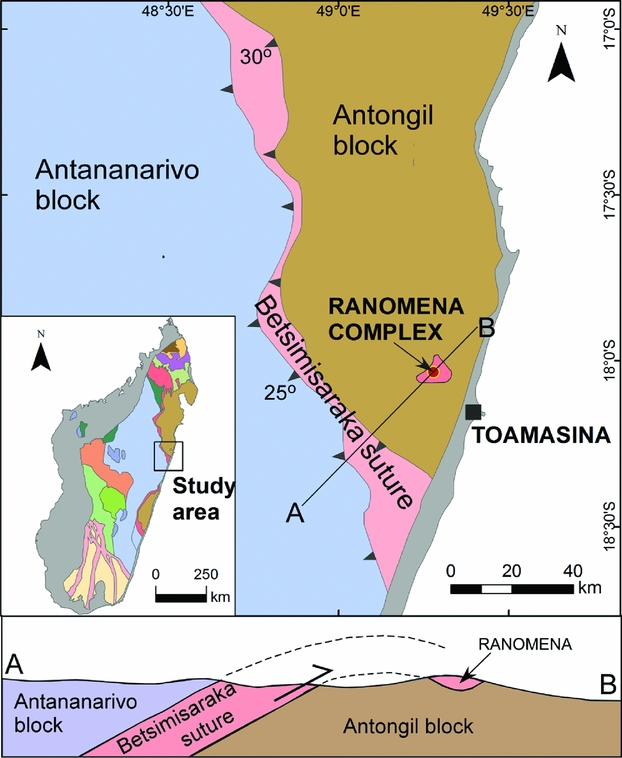
The Betsimisaraka suture contains several relict mafic-ultramafic complexes (Hottin, Reference Hottin1969). From a study of platinum-group minerals (PGM), Grieco, Merlini & Cazzaniga (Reference Grieco, Merlini and Cazzaniga2012) and Grieco et al. (Reference Grieco, Merlini, Pedrottia, Moronia and Randrianja2014) interpreted the Ranomena complex as a continental layered/stratiform intrusion. The Antananarivo block to the west of the suture mainly consists of Neoarchean (c. 2500 Ma) granulite to amphibolite facies orthogneisses intruded by arc-generated 820–740 Ma aged granitic rocks and gabbros (Kröner et al. Reference Kröner, Windley, Jaeckel, Brewer and Razakamanana1999, Reference Kröner, Hegner, Collins, Windley, Brewer, Razakamanana and Pidgeon2000; Tucker et al. Reference Tucker, Ashwal, Handke, Hamilton, Legrange and Rambeloson1999, Reference Tucker, Roig, Delor, Amerlin, Goncalves, Rabarimanana, Ralison and Belcvher2011, Reference Tucker, Roig, Moine, Delor and Peters2014). On the eastern side of the suture is a remnant, thin quartzite-dominated shelf that has been imbricated with gneisses from the under-thrusted Archean Antongil craton (Windley et al. Reference Windley, Razafiniparany, Razakamanana and Ackermand1994; Collins & Windley, Reference Collins and Windley2002; Schofield et al. Reference Schofield and Thomas2010). Figure 1 shows that the Ranomena complex is situated in a small slice of gneisses that has been thrust eastwards from the west-dipping Betsimisaraka suture over the Antongil block.
3. Petrography and mineral chemistry
3.a. Petrographic and textural characteristics
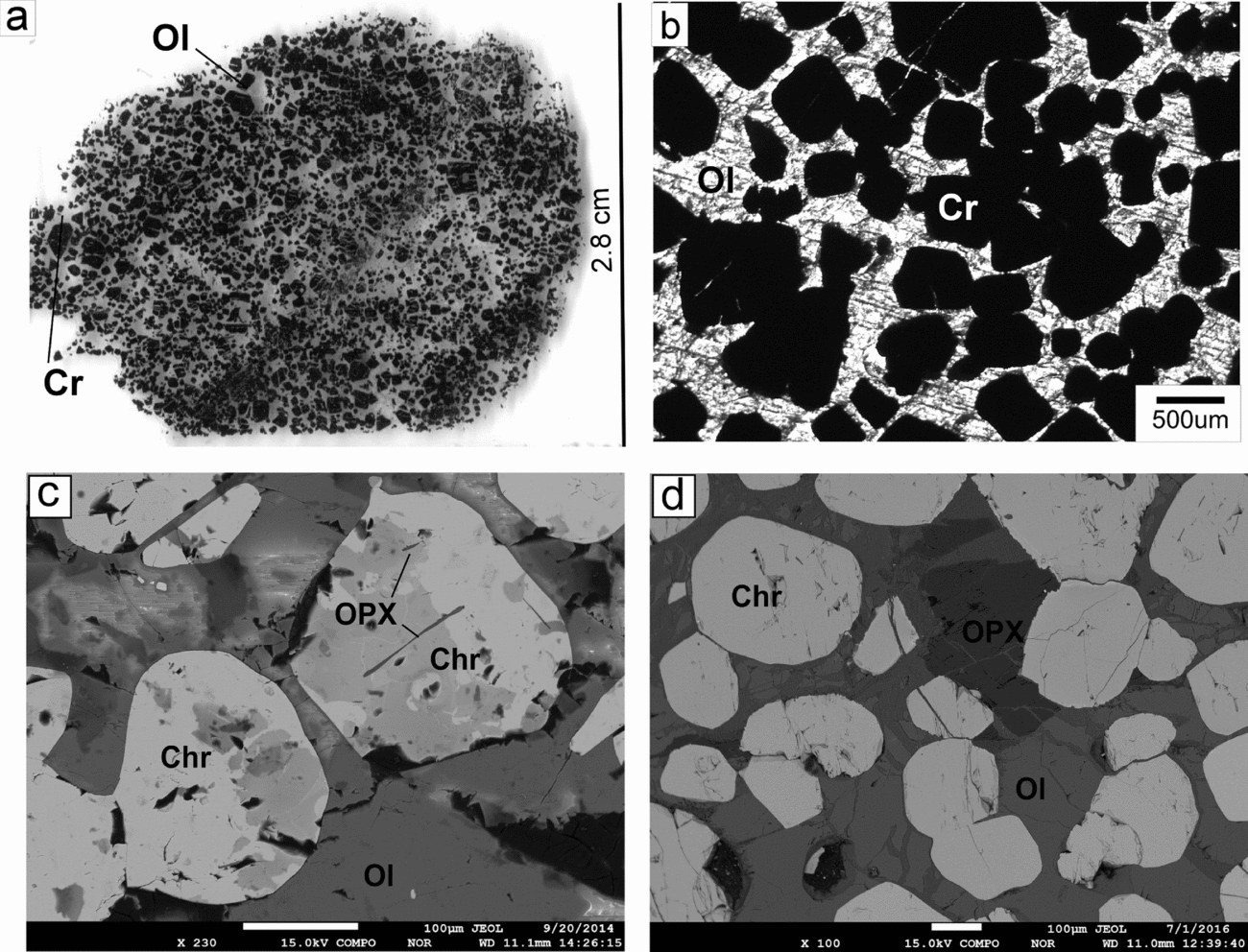
The Ranomena chromitite mainly consists of c. 85 vol. % chromite, c. 10 vol. % olivine and c. 5 vol. % orthopyroxene (Fig. 2a–c). Chromite grains are mostly euhedral; grain size varies over the range 0.01–0.1 mm and is characterized by a cumulate texture. Anhedral olivine and orthopyroxene are main inter-cumulus minerals.
Thin section micrographs. (a) Chromitite from the Ranomena complex, showing the massive texture of a chromitite layer. (b) Chromitite sample from the Ranomena complex, plane polarized light. (c) Backscattered electron image of chromite grains showing the mineral inclusions and textures of chromitite. (d) Backscattered electron image of chromitite showing chromite, olivine and orthopyroxene grains. Cr – chromite; Ol – olivine; OPX – orthopyroxene.
3.b. Mineral compositions
The constituent minerals of the Ranomena chromitite were analysed with a Cameca SX-100 electron-probe micro-analyser at the Geological Survey of India, Bangalore, India, a JEOL JX8900 electron probe micro-analyser in the Okayama University of Science, Okayama, Japan (Tsujimori et al. Reference Tsujimori, Esaka, Abimbola, Nishido, Ninagawa and Itaya1998), and a Cameca SX-100 electron probe micro-analyser at the National Geophysical Research Institute, Hyderabad, India. The inclusions in chromite were studied with a JEOL JXA 8300 at the Advanced Facility for Microscopy and Microanalysis, Indian Institute of Science, Bangalore, India. Analytical conditions in all instruments were 15 kV accelerating voltage and a probe current of 12 nA; natural silicate and oxide minerals were used as standards. The data were reduced using ZAF (in JX8900 and JXA 8300) and phi-rho-z (in SX100) correction procedures. SiO2, TiO2, Al2O3, Cr2O3, FeO, MnO, MgO, CaO, Na2O and K2O were analysed for all samples. Representative mineral chemical data are given in Table 1 and a full dataset is provided in online Supplementary Table S1 (available at http://journals.cambridge.org/geo). Back-scattered images were taken (Fig. 2c) with a JEOL JX8900 electron probe micro-analyser at the Okayama University of Science with an accelerating voltage of 15 kv and a 2.387e−7 Å beam current.
Representative mineral chemistry of chromite, olivine and orthopyroxene from chromitites, Ranomena complex.

3.b.1. Chromite
The chromites from the chromitite are weakly zoned. The Cr# (Cr/(Cr + Al)) varies over the range 0.59–0.69 and the Mg# (Mg/(Mg + Fe2+)) over 0.37–0.44, with little variation between cores and rims (Table 1).
3.b.2. Mineral inclusions in chromite
The chromite grains contain elongate orthopyroxene inclusions (Fig. 2c), which are slightly poor in SiO2 (c. 53 wt %) and Al2O3 (c. 0.35 wt %) and weakly enriched in Cr2O3 (c. 1.37 wt. %) compared with the orthopyroxene in the matrix, which have SiO2 (c. 57 wt %), Al2O3 (1.0–1.4 wt %) and Cr2O3 (0.05–0.15 wt %) (Fig. 2c, d).
3.b.3. Silicate mineral chemistry
In Ranomena chromitite the major intercumulus minerals are olivine and orthopyroxene. The olivine is highly magnesian forsterite with FO92-93 (X Mg = 0.92–0.93) and a low NiO content (0.21–0.27 wt %). Orthopyroxene is highly magnesian enstatite that is depleted in iron (Mg# 0.90–0.91) and is slightly enriched in silica (52.00–57.80 wt %) (Table 1).
4. Discussion: petrogenesis and tectonic setting of the Ranomena complex
Many studies of ultramafic rocks have long established that chromite can be a useful petrogenetic and tectonic indicator (Irvine, Reference Irvine1967; Ahmed, Arai & Attia, Reference Ahmed, Arai and Attia2001; Ahmed et al. Reference Ahmed, Arai, Yaser and Rahimi2005; Hellebrand et al. Reference Hellebrand, Snow, Dick and Hoffmann2001, Reference Hellebrand, Snow, Hoppe and Hofmann2002). The composition of chromite depends strongly on its parental magma composition and its magma evolution (e.g. Irvine, Reference Irvine1965; Thayer, Reference Thayer1970; Roeder, Reference Roeder1994; Barnes & Roeder, Reference Barnes and Roeder2001); the Cr# of chromite can therefore be used to calculate the degrees of partial melting experienced by ultramafic rocks (e.g. Dick & Bullen, Reference Dick and Bullen1984; Michael & Bonatti, Reference Michael, Bonatti, Bougault and Cand1985; Arai, Reference Arai1994; Hellebrand et al. Reference Hellebrand, Snow, Hoppe and Hofmann2002). The Cr# of chromite increases with increasing degrees of melting, which reduces the Al contents of orthopyroxene and the host rock (Jaques & Green, Reference Jaques and Green1980; Ohara & Ishi, Reference Ohara and Ishi1998). Furthermore, the tectonic setting of a particular chromite can be evaluated by geochemical modelling of the liquidus chromite composition (e.g. Roeder & Reynolds, Reference Roeder and Reynolds1991). The application of chromite composition as a petrogenetic and geotectonic indicator therefore needs thorough petrographic and textural observations to recognize periods of magmatic and post-magmatic events experienced by the host rock (e.g. Rollinson, Reference Rollinson, Blenkinshop and Tromps1995; Suita & Streider, Reference Suita and Streider1996).
4.a. Implications from chromite chemistry
The chromitite in the Ranomena complex has undergone greenschist to lower amphibolite facies metamorphism. A Cr/(Cr + Al) (Cr#) v. Fe3+/(Cr + Al + Fe3+) plot (Ahmed et al. Reference Ahmed, Arai, Yaser, Ikenne and Rahimi2009) (Fig. 3a) illustrates the alteration trend. All the chromite values from the Ranomena chromitite plot within the spinel core field (from Ahmed et al. Reference Ahmed, Arai, Yaser, Ikenne and Rahimi2009). The development of Fe3+-enriched spinel is controlled by a decrease in size of the miscibility gap between a chromite core and a magnetite rim with increasing temperature (Barnes, Reference Barnes2000), where a complete solid solution between chromite and magnetite occurs at 600°C. However, the compositions of the cores of chromite in the Ranomena chromitite plot outside the 600°C field (the spinel stability field was calculated for equilibrium with Fo90 olivine) of Sack & Ghiorso (Reference Sack and Ghiorso1991) (Fig. 3b). This indicates that the chromite cores were not affected by post-magmatic re-equilibration, and therefore preserve their primary compositions.
Mineral chemistry of chromite showing the effect of alteration. (a) Cr/(Cr + Al) v. Fe3+/(Cr + Al + Fe3+) plot defining the alteration trend of the Ranomena chromites (modified after Ahmed et al. Reference Ahmed, Arai, Yaser, Ikenne and Rahimi2009). (b) The Al–Cr–Fe3+ ternary diagram for chromite compositions from the Ranomena complex, which plot on the spinel stability boundary (Sack & Ghiorso, Reference Sack and Ghiorso1991), calculated for spinel in equilibrium with Fo90 olivine.
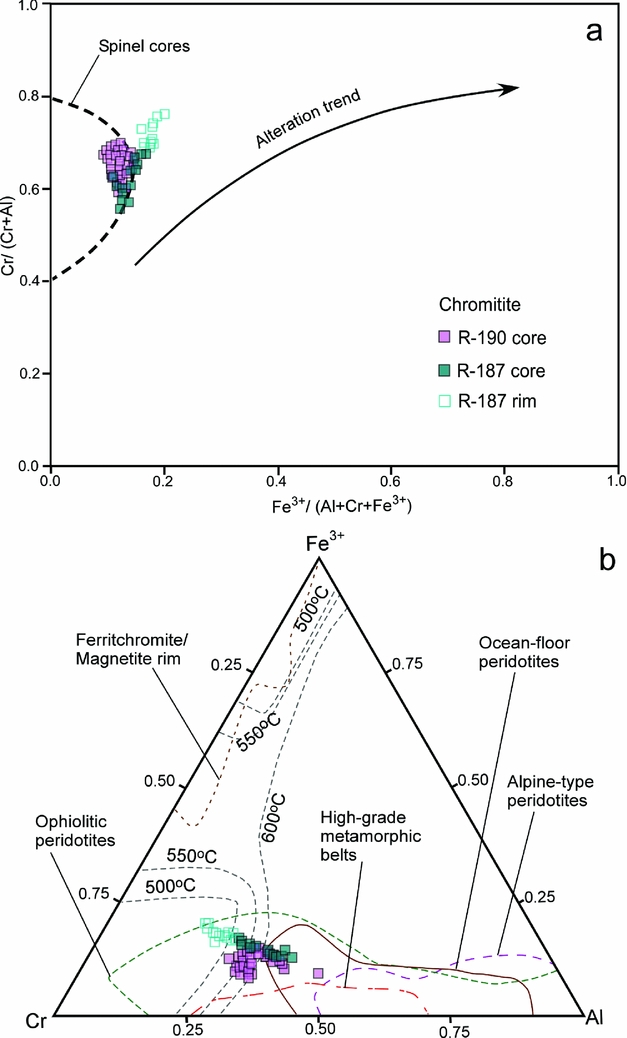
The alteration trend of the Ranomena chromites is shown in Cr/(Cr + Al) v. Fe3+/(Cr + Al + Fe3+) space (Fig. 3a; Ahmed et al. Reference Ahmed, Arai, Yaser, Ikenne and Rahimi2009). On an Al–Cr–Fe3+ ternary diagram (Fig. 3b; Jan & Windley, Reference Jan and Windley1990; Barnes & Roeder, Reference Barnes and Roeder2001) the rims of chromites plot in the Cr–Al field and the chromite cores in the ophiolite field. In a Cr/(Cr + Al) v. Mg/(Mg + Fe2+) diagram (Fig. 4a; after, Tamura & Arai, Reference Tamura and Arai2006; Oh et al. Reference Oh, Seo, Choi, Rajesh and Lee2012) the chromites fall close to the peridotite field of a supra-subduction zone. On a TiO2 v. Al2O3 diagram (Fig. 4b; Kamenetsky, Crawford & Meffre, Reference Kamenetsky, Crawford and Meffre2001) the chromites plot in the arc field. The Al2O3 (wt %) v. Cr2O3 (wt %) relations of Franz & Wirth (Reference Franz and Wirth2000) (Fig. 4c), which discriminate arc cumulate spinels from mantle arrays, suggest that the Ranomena chromite cores are arc cumulate spinels (Fig. 4c). In a Fe2+/Fe3+ v. Al2O3 (wt %) plot (Fig. 4d) (after, Kamenetsky et al. Reference Kamenetsky, Crawford and Meffre2001) the Ranomena chromites plot within the fields of supra-subduction zone peridotite and volcanic spinel. The low TiO2 content also indicates that the ultramafic rocks formed in an arc-tectonic setting. In summary, the composition of chromite cores from the Ranomena chromitite indicates that they evolved in a supra-subduction zone arc setting (Fig. 4a–d) and the chromites have low NiO (c. 0.2 wt %), suggesting an ophiolitic origin (Fig. 5b).
Tectonic discrimination diagrams for chromite. (a) Cr/(Cr + Al) v. Mg/(Mg + Fe2+) (after Tamura & Arai, Reference Tamura and Arai2006; Oh et al. Reference Oh, Seo, Choi, Rajesh and Lee2012). (b) TiO2 (wt %) v. Al2O3 (after Kamenetsky et al. Reference Kamenetsky, Crawford and Meffre2001). (c) Al2O3 (wt %) v. Cr2O3 (wt %) (after Franz & Wirth, Reference Franz and Wirth2000). (d) Fe2+/ Fe3+ v. Al2O3 (wt %) (after Kamenetsky et al. Reference Kamenetsky, Crawford and Meffre2001).

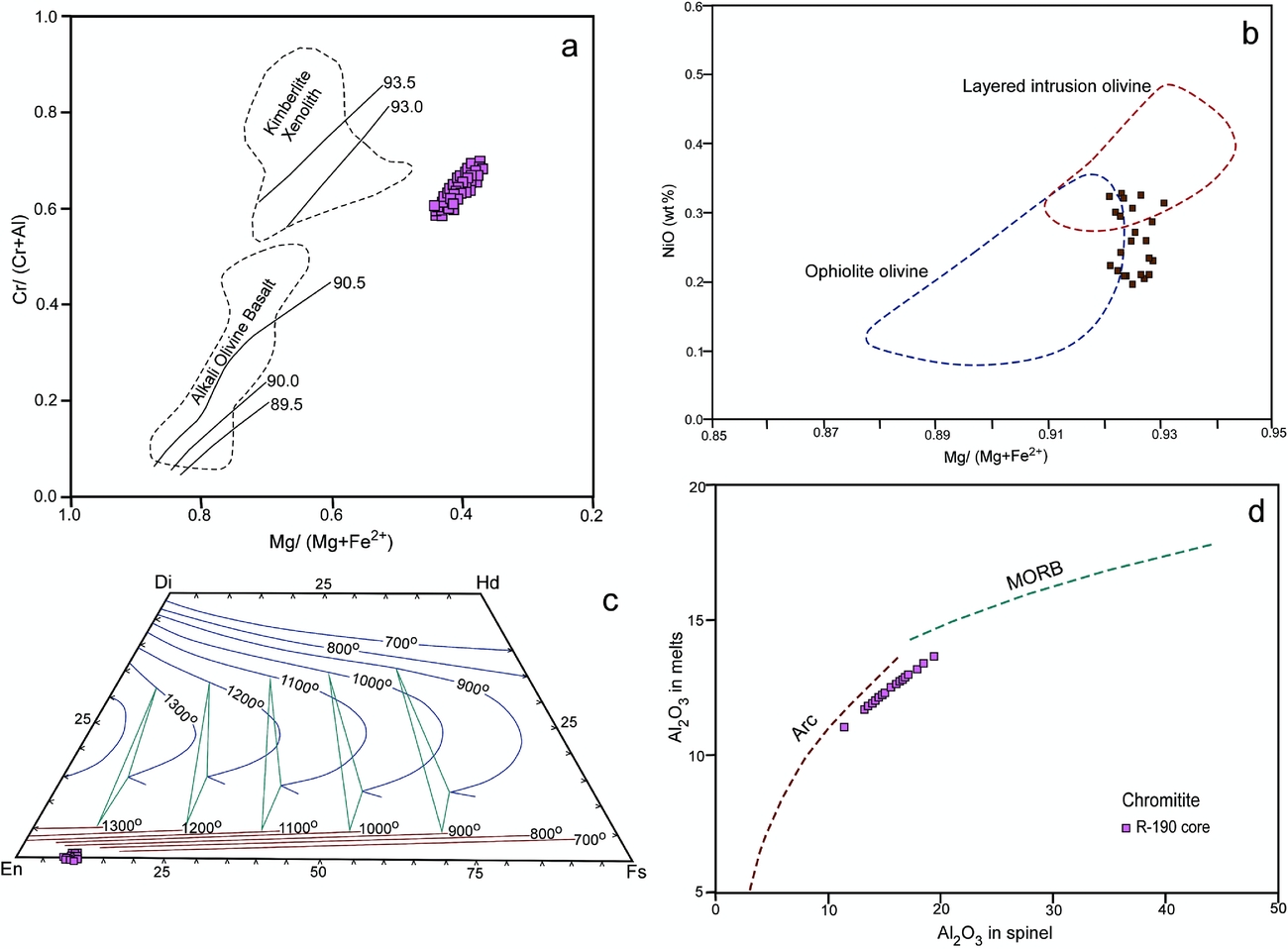
(a) Cr# v. Mg# diagram showing the discrimination between alkali-basalt and kimberlite xenoliths (after Basu & McGregor, Reference Basu and McGregor1975). The chromites from the Ranomena complex plot near the kimberlite xenolith field, suggesting a high-pressure origin. (b) Tectonic discrimination diagram based on the NiO v. Mg/(Mg + Fe2+) of chromites from Ranomena chromitites (Fields are after, Rehfeldt et al. Reference Rehfeldt, Dorrit, Carlson and Foley2007). (c) Orthopyroxene composition from the Ranomena complex in an experimentally contoured Ca–Mg–Fe phase-relation diagram at 1.0 GPa (after Lindsley, Reference Lindsley1983). (d) Al2O3 in melts v. Al2O3 in spinel (after, Rollinson, Reference Rollinson2008), based on melt calculations of Maurel & Maurel (Reference Maurel and Maurel1982).
4.b. Pressure–temperature estimations
Directly estimating the pressure and temperature of crystallization of mafic-ultramafic rocks is difficult, especially in metamorphosed rocks. We have therefore calculated empirically the P–T conditions of the Ranomena ultramafic rocks. Basu & McGregor (Reference Basu and McGregor1975) proposed that the crystallization pressure of ultramafic rocks can be estimated using the relationship between Mg# and Cr# because there is a distinct variation of these parameters in chromite compositions between alkali-basalt and kimberlite xenoliths. Generally, chromite textures are related to their tectonic environments. The chromites from the Ranomena complex have a euhedral texture, which is a characteristic of spinels in xenoliths from kimberlite pipes. These euhedral spinels have higher Cr/(Cr + Al) (0.62–0.68) and lower Mg/(Mg + Fe2+) (0.40–0.44) ratios, which is a characteristic of euhedral spinels. The xenoliths from kimberlites have higher Fe3+/(Cr + Al + Fe3+) values than alkali olivine basalt xenoliths. The high Cr/(Cr + Al + Fe3+) values also indicate that the spinels formed at a high pressure. The Ranomena chromites have Cr/(Cr + Al + Fe3+) values ranging over 0.55–0.65, indicating a medium- to high-pressure origin. The chromites from the ultramafic rocks in this study plot very close to the kimberlite xenolith field in the Mg# v. Cr# diagram of Basu & McGregor (Reference Basu and McGregor1975), suggesting a high-pressure (a minimum of 1.0 GPa) origin (Fig. 5a). The absence of plagioclase in the Ranomena ultramafic rocks suggests that the pressure conditions during crystallization were higher than those of the plagioclase peridotite field (e.g. Green & Ringwood, Reference Green and Ringwood1970; Schmidt & Poli, Reference Schmidt and Poli1998). The estimated crystallization pressure at or over 1.0 GPa for the chromite corresponds to the melting conditions in the spinel peridotite field (Dick & Bullen, Reference Dick and Bullen1984). To calculate the crystallization temperature, the Fe and Mg mole fractions of orthopyroxene were plotted in an experimentally contoured pyroxene quadrilateral (pyroxene-solvus thermometer of Lindsley, Reference Lindsley1983) at 1.0 GPa. The orthopyroxenes from the Ranomena chromitite give a crystallization temperature of 1300-1250°C (Lindsley, Reference Lindsley1983) (Fig. 5c). This high value is interpreted as the igneous crystallization temperature of the residual mantle, and the lower temperature as a result of sub-solidus re-equilibration. The above results suggest that the Ranomena ultramafic rocks formed under upper mantle pressure and temperature conditions.
4.c. Parental magma composition
We used the mineral chemistry of the primary phases of chromite and clinopyroxene to determine the parental melt composition because the composition of chromite is strongly related to its parental melt composition, the degree of partial melting and its fractional crystallization (Irvine, Reference Irvine1977; Dick & Bullen, Reference Dick and Bullen1984; Barnes & Roeder, Reference Barnes and Roeder2001). The Al2O3 content of chromite is commonly used to determine the nature of its parental melt and its ambient tectono-magmatic environment (e.g. Zhou et al. Reference Zhou, Robinson, Malpas and Li1996; Kamenetsky et al. Reference Kamenetsky, Crawford and Meffre2001; Rollinson, Reference Rollinson2008; Zaccarini et al. Reference Zaccarini, Garuti, Proenza, Campos, Thalhammer, Aiglsperger and Lewis2011). The Al2O3 contents of melts in equilibrium with chromite (equilibrium at 1 bar) were calculated using the equation:
 $$\begin{equation*}
{\rm{A}}{{\rm{l}}_2}{{\rm{O}}_{3,{\rm{spinel}}}} = 0.035 \times {\left( {{\rm{A}}{{\rm{l}}_2}{{\rm{O}}_{3,{\rm{melt}}}}} \right)^{2.42}}
\end{equation*}$$
as proposed by Maurel & Maurel (Reference Maurel and Maurel1982). The results indicate that the parental melts through which the Ranomena chromite crystallized had Al2O3 contents of 10.98–13.62 wt % (Table 1). Such high Al2O3 contents are representative of boninitic melts (Wilson, Reference Wilson1989) so the parental melts of the Ranomena chromitite had an arc parentage. The data indicate a high-Al nature of the parental magma and suggest that high-alumina basalt was the source magma. The parental melt data, along with the Al2O3 contents of chromite, plot very close to the evolutionary trend of an arc system in a diagram of Al2O3 in melt v. Al2O3 in spinel (Fig. 5d; Kamenetsky et al. Reference Kamenetsky, Crawford and Meffre2001; Rollinson, Reference Rollinson2008) and the trend extends towards a mid-ocean-ridge basalt (MORB) setting with increasing degrees of partial melting. The FeO/MgO ratio of a parental melt in equilibrium with chromite at 1 kbar can also be estimated from a chromite composition using the equation:
 $$\begin{eqnarray*}
&& \ln {\left( {\frac{{{\rm{FeO}}}}{{{\rm{MgO}}}}} \right)_{{\rm{spinel}}}} = 0.47 - 1.07{Y_{{\rm{spinel,}}\;{\rm{Al}}}}\nonumber\\
&&\quad + 0.64{Y_{{\rm{spinel,}}\;{\rm{F}}{{\rm{e}}^{3 + }}}} + \ln {\left( {\frac{{{\rm{FeO}}}}{{{\rm{MgO}}}}} \right)_{{\rm{liquid}}}}
\end{eqnarray*}$$
where FeO and MgO are in wt % and
 $$\begin{eqnarray*}
&&{Y_{{\rm{spinel,}}\;{\rm{Al}}}} = \frac{{{\rm{Al}}}}{{{\rm{Al}} + {\rm{Cr}} + {\rm{F}}{{\rm{e}}^{3 + }}}}\quad {\rm{and}}\nonumber\\
&&\quad {Y_{{\rm{spinel,}}\;{\rm{F}}{{\rm{e}}^{3 + }}}} = \frac{{{\rm{F}}{{\rm{e}}^{3 + }}}}{{{\rm{Al}} + {\rm{Cr}} + {\rm{F}}{{\rm{e}}^{3 + }}}}
\end{eqnarray*}$$
as proposed by Maurel & Maurel (Reference Maurel and Maurel1982). The results show that the parental magma from which the chromite crystallized had a FeO/MgO ratio of 0.9–1.8. Boninites have a FeO/MgO ratio over the range 0.7–1.4, whereas the same ratio in MOR basalts varies over 1.2–1.6, suggesting the Ranomena chromite had an arc derivation. The parental magma was therefore Al- and Fe-rich and is comparable to the chemical characteristics of a tholeiitic basalt magma. Based on all the above lines of evidence, we suggest that the composition of the parental magma of the Ranomena ultramafic rocks was similar to that of a primitive tholeiitic basalt formed by a high degree of partial melting of a mantle peridotite. These results indicate that the parental melt had a composition equivalent to that of an island-arc tholeiite (IAT).
Regarding the origin of chromitite, Irvine (Reference Irvine1977) suggested that the mixing of a chemically primitive mafic melt with a more evolved mafic melt could produce a hybrid magma from which chromitite layers could crystallize. The Ranomena chromitite is characterized by a massive texture. González-Jiménez et al. (Reference González-Jiménez, Griffin, Gervilla, Proenza, O'Reilly, Akbulut, Pearson and Arai2014a ) proposed that disseminated chromitite can form with a low melt/rock ratio and massive chromitite with a high melt/rock ratio. A high abundance of olivine facilitates movement of melt along grain boundaries and enhances the formation of three-dimensional networks of olivine to form disseminated chromitite, whereas melts from different provenances with different physico-chemical properties such as SiO2 content, viscosity, density and temperature inter-mix and give rise to nodular and orbicular chromitite, which continues to grow forming massive chromitite González-Jiménez et al. (Reference González-Jiménez, Griffin, Gervilla, Proenza, O'Reilly, Akbulut, Pearson and Arai2014a ).
5. Conclusions
The main conclusions of this study are as follows.
1. The composition of orthopyroxene from the Ranomena chromitite indicates a crystallization temperature range of 1250–1300°C at 1.0 GPa.
2. Melt calculations using chromite cores show that the composition of the parental magma of the Ranomena complex was similar to that of a primitive tholeiitic basalt formed by a high degree of mantle melting.
3. The chemistry of chromite in chromitite from the Ranomena complex indicates that it formed in a supra-subduction zone arc tectonic setting.
Acknowledgements
This study is a contribution to ISRO-IISc Space Technology Cell projects ISTC/MES/SK/232 and ISTC/CEAS/SJK/291. We are grateful to the Ministry of Earth Sciences, Government of India (project MoES/ATMOS/PP-IX/09) for laboratory facilities. We utilized the Electron Micro-Probe facility at the Advanced Facility for Microscopy and Micro-analysis, IISc, Bangalore, Electron Probe Micro Analysis Laboratory, CSIR-NGRI, Hyderabad and thank Mr Anil Kaushik for his support. EVSSKB thanks the Director, CSIR-NGRI for permission to work with this project supported by MLP-6513-28-EVB and INDEX-WP-2.1.
Supplementary material
To view supplementary material for this article, please visit https://doi.org/10.1017/S0016756816000972.



