Introduction
Antarctic silverfish (Pleuragramma antarctica) are a keystone species in the Ross Sea, providing one of the major links between lower and higher trophic levels (La Mesa et al. Reference La Mesa, Eastman and Vacchi2004, Smith et al. Reference Smith, Ainley and Cattaneo-Vietti2007, Pinkerton et al. Reference Pinkerton, Forman, Bury, Brown, Horn and O’Driscoll2013, Vacchi et al. Reference Vacchi, Pisano and Ghigliotti2017). Despite their importance in Antarctic food chains, relatively little is known about the spatial distribution and abundance of silverfish in the Ross Sea and this has been identified as a research priority for ecosystem modelling (Pinkerton et al. Reference Pinkerton, Bradford-Grieve and Hanchet2010).
Silverfish have a circumpolar distribution in high latitude Antarctic waters (De Witt et al. Reference De Witt, Heemstra and Gon1990), occurring at depths down to 1000 m (Robison Reference Robison2003, O’Driscoll et al. Reference O’Driscoll, Macaulay, Gauthier, Pinkerston and Hanchet2011). They are unique among notothenioid fish because all stages of development live throughout the water column (La Mesa & Eastman Reference La Mesa and Eastman2012). Eggs are spawned in areas along the continental ice shelves during late winter/early spring. In the Ross Sea, Vacchi et al. (Reference Vacchi, La Mesa, Dalù and Macdonald2004) observed eggs and newly hatched larvae under the sea ice among the platelets in Terra Nova Bay in mid-November, and the northern part of Terra Nova Bay seems to be a nursery ground for silverfish (Vacchi et al. Reference Vacchi, La Mesa, Dalù and Macdonald2004, Reference Vacchi, DeVries, Evans, Bottaro, Ghigliotti, Cutroneo and Pisano2012a). Post-larval fish (8–30 mm standard length (SL)) are known to occur in large numbers in the Ross Sea: early post-larval silverfish may be distributed in the water column down to at least 700 m; while late post-larvae inhabit progressively more superficial depths, mostly in the surface 100 m (Granata et al. Reference Granata, Cubeta, Guglielmo, Sidoti, Greco, Vacchi and La Mesa2002). Metamorphosis of larvae to juvenile stages occurs at 2–3 years old (30–40 mm SL) and is accompanied by a move to occupying the deeper water column (Hubold Reference Hubold1985, Kellermann Reference Kellermann1986). Larger fish (over 60 mm SL) live at greater depths than juveniles, but both juveniles and adults are still largely pelagic (Hubold Reference Hubold1985). Adult silverfish have been found in greatest concentrations over the continental slope and shelf of the Ross Sea (Donnelly et al. Reference Donnelly, Torres, Sutton and Simoniello2004, O’Driscoll et al. Reference O’Driscoll, Macaulay, Gauthier, Pinkerston and Hanchet2011). Silverfish reach sexual maturity from 6–7+ years at a size greater than c. 130 mm SL (Faleyeva & Gerasimchuk Reference Faleyeva and Gerasimchuk1990, Sutton & Horn Reference Sutton and Horn2011).
Although silverfish eggs and larvae are abundant during spring among the sea ice in Terra Nova Bay (Vacchi et al. Reference Vacchi, La Mesa, Dalù and Macdonald2004, Reference Vacchi, DeVries, Evans, Bottaro, Ghigliotti, Cutroneo and Pisano2012a, Guidetti et al. Reference Guidetti, Ghigliotti and Vacchi2015), it is not known whether the eggs are spawned elsewhere and accumulate under the ice or whether there is mass migration of silverfish to coastal spawning sites in winter (Vacchi et al. Reference Vacchi, DeVries, Evans, Bottaro, Ghigliotti, Cutroneo and Pisano2012a). To test the latter hypothesis, an upward-looking echo sounder was moored under the ice over winter in Terra Nova Bay to observe potential spawning migration of adult silverfish. Opportunistic acoustic observations in McMurdo Sound and Terra Nova Bay were also made by lowering an echo sounder through the ice during spring.
Fisheries acoustics, using high-frequency echo sounders, provides a non-invasive technique (relative to extractive methods) to measure fish distribution and abundance across a range of spatial and temporal scales (Simmonds & MacLennan Reference Simmonds and MacLennan2005). Acoustic methods to estimate silverfish distribution and abundance were reviewed by O’Driscoll et al. (Reference O’Driscoll, Leonori, De Felice and Macaulay2017). O’Driscoll et al. (Reference O’Driscoll, Macaulay, Gauthier, Pinkerston and Hanchet2011) used vessel-mounted multi-frequency acoustics to detect aggregations of silverfish, verified by targeted trawling, and used acoustic data to describe the spatial and vertical distribution, and to estimate abundance of juvenile and adult silverfish in the Ross Sea. These authors and Azzali et al. (Reference Azzali, Leonori, Biagiotti, De Felice, Angiolillo, Bottaro and Vacchi2010) also developed models of acoustic scattering by silverfish. Ship-mounted acoustic surveys are not possible in the Ross Sea during winter, as the area is covered in ice. Moored acoustic equipment has been used to study fish distribution and behaviour in the past (e.g. Trevorrow Reference Trevorrow2005), but these studies have been limited by power requirements and battery life. Recently, low-power and long endurance moored echo sounders have been developed which can collect data continuously for up to one year at high temporal and spatial resolution. In this respect, these instruments match the performance of moored acoustic Doppler current profilers (ADCPs) (e.g. Cisewski et al. Reference Cisewski, Strass, Rhein and Krägefsky2010) but have the advantage that they can be calibrated to produce quantitative estimates of fish density and abundance.
Methods
Terra Nova Bay mooring location
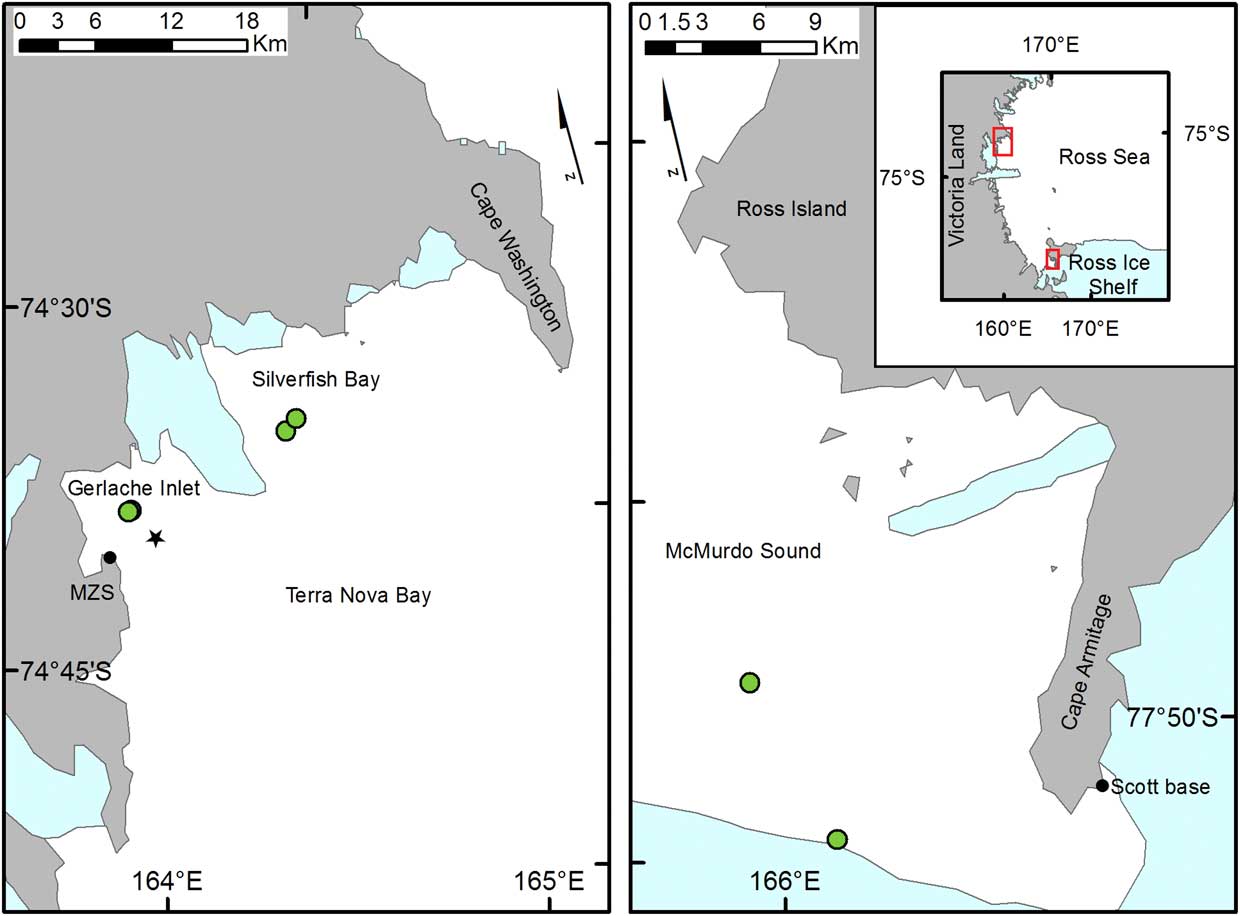
The mooring location in Terra Nova Bay was chosen based on observations of silverfish eggs and larvae (Vacchi et al. Reference Vacchi, DeVries, Evans, Bottaro, Ghigliotti, Cutroneo and Pisano2012a), and was near the head of a large canyon that extends from deeper water in the Ross Sea into the bay (Fig. 1).
Map showing location of study areas in Terra Nova Bay and McMurdo Sound. Green circles show locations of sea-ice deployments. Black star in Terra Nova Bay is location of moored echo sounder.
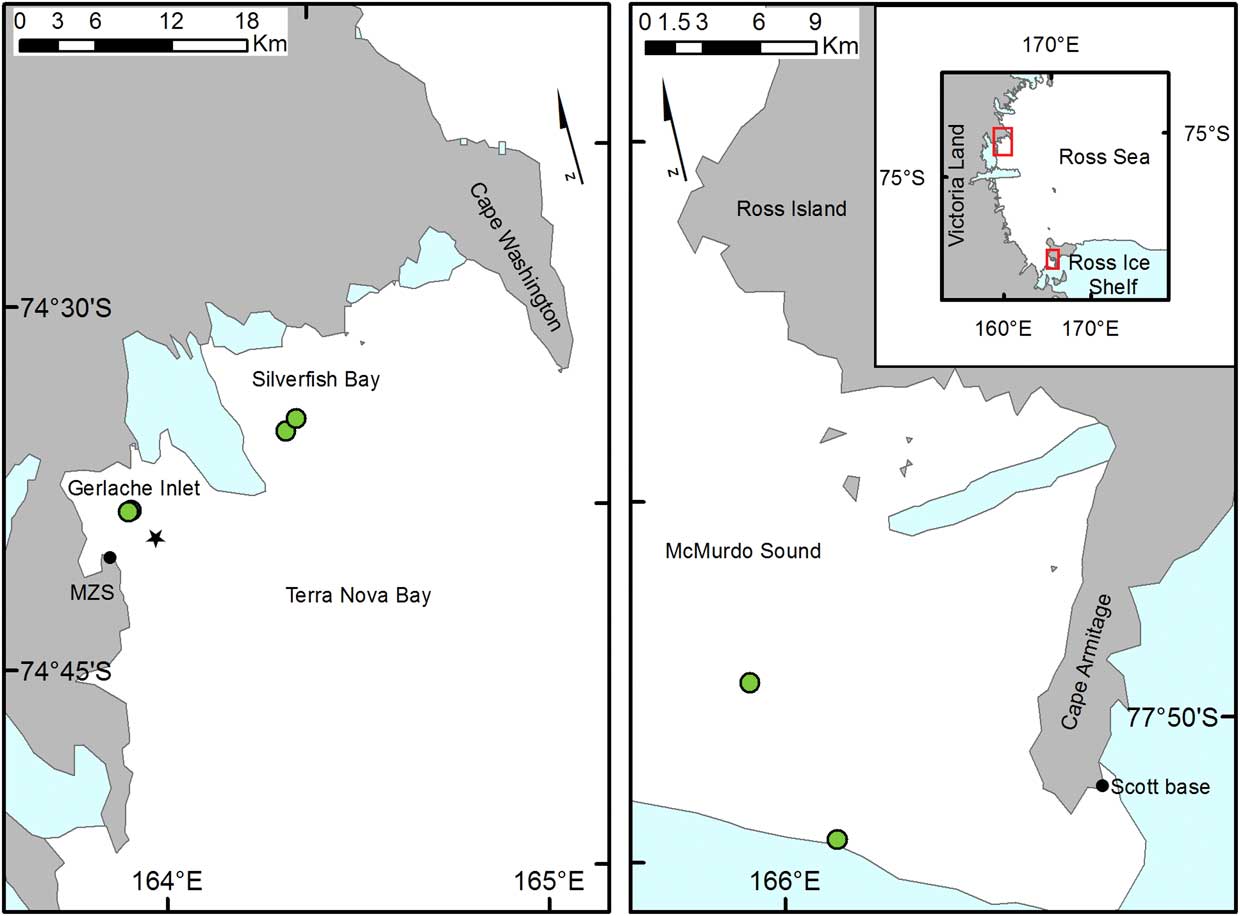
Terra Nova Bay is a coastal area of Victoria Land (western Ross Sea), approximately 6000 km2 in area. The coastline is indented with numerous embayments including Gerlache Inlet and Silverfish Bay in its northern part. The Drygalski Ice Tongue, the Nansen Ice Sheet and the Campbell Glacier Tongue flow down from the continent into the bay. The bottom topography is rather irregular, and it is characterized by steep slopes and by the Drygalski depression, a deep pit, elongated along shore, reaching more than 1100 m (the greatest depth of the Ross Sea shelf). The marine environment of Terra Nova Bay is among the coldest in the world, due to its high latitude and the presence of large floating masses of continental ice. The seawater temperature is commonly at its freezing point (-1.91°C), with only rare excursions above -1.0°C (Buffoni et al. Reference Buffoni, Cappelletti and Picco2002).
A large polynya (mean area 1300 km2, with a maximum open area up to 5000 km2) is maintained during the winter by a combination of persistent katabatic winds, coupled with a barrier effect of the Drygalski Ice Tongue on pack ice advection from the south/south-west (Kurtz & Bromwich Reference Kurtz and Bromwich1983). The Terra Nova Bay polynya acts as an ice factory during winter and drives local sea-ice dynamics (van Woert Reference van Woert1999). As a result, a major environmental feature of Terra Nova Bay is the seasonal sea-ice cover, bordering coastal areas for almost nine months of the year. Platelet ice is present under the sea-ice cover, making up a semi-consolidated layer ranging from a few centimetres to metres in thickness.
Mooring configuration
The main component of the mooring was an ASL acoustic zooplankton and fish profiler (AZFP) 67 kHz echo sounder (http://www.aslenv.com/brochures/AZFP-2013.pdf) This was mounted in a frame at the top of the mooring, 170 m above the seabed facing upwards towards the surface. The echo sounder was programmed to turn on for six hours immediately after deployment to test functioning, then to go into sleep mode, before turning on again on 15 May 2015 and running for 200 days until 1 December 2015. The echo sounder had a nominal 3 dB beamwidth of 12°, a nominal source level of 197 dB, and was set to ping every 15 s, with a pulse length of 1 ms. The echo sounder frame also included eight orange cylindrical syntactic floats, giving it an overall buoyancy of 91 kg. A Sabel radio beacon was attached to the frame and a swivel was mounted below the frame to reduce torsional strain and breakages.
At c. 10 m below the echo sounder frame was a set of three yellow nautilus floats and, directly beneath these, the oceanographic instrumentation comprised of an Aanderaa RCM-9 current meter and a Sea-Bird SBE-37 SM CTD (conductivity, temperature, pressure) sensor. A 125 m length of 8 mm spectra was connected to the bottom set of three nautilus floats and below these were two Sonardyne deep-rated acoustic releases secured together in a pairing plate. The releases were set up with a 0.5 m galvanized chain running between them. This was inserted through a masterlink shackled to a ballast weight (a 400 kg set of linked chain).
Mooring deployment and recovery
The mooring was deployed from the New Zealand research vessel Tangaroa on 21 February 2015 at position 74°41.40′S 164°14.51′E, at 380 m in a seabed depth of c. 550 m (see Fig. 1). This position was confirmed by measuring ranges to the acoustic releases from four different positions around the mooring site, and triangulating to obtain an accurate seabed position. The mooring floats could also be observed at this position on the vessel echo sounders. The mooring was recovered from the Italian research vessel Italica on 5 February 2016.
Sea-ice deployments
As part of a research project to survey Antarctic toothfish (Dissostichus mawsoni Norman) (Parker et al. Reference Parker, Mormede, DeVries, Hanchet and Eisert2016), vertical lines were set through the sea ice at seven sites in McMurdo Sound from 31 October–13 November 2015. At two of these sites (Table 1), acoustic data were opportunistically collected with a portable Simrad EK60 echo sounder with an ES38-12 split-beam 38 kHz transducer (nominal 3 dB beamwidth 12.5°). The transducer was lowered through the hole in the sea ice and held approximately 2 m below the ice surface. The ping interval was 1 s, and data were collected to a maximum range of 500 m (at a bottom depth of 518–579 m) with a power output of 1000 W and a pulse length of 0.512 ms.
Summary of sea-ice deployments. Locations are shown in Fig. 1.

Acoustic observations were also made through the ice at four sites in Terra Nova Bay from 6–16 November 2017 (Table 1). Data were collected using the same portable Simrad EK60 echo sounder and ES38-12 split-beam 38 kHz transducer used in 2015, with a power output of 1000 W, but using a longer pulse length of 1.024 ms, and ping interval of 1.5 s.
Baited underwater video (BUV) systems were deployed in conjunction with the collection of acoustic data and were used for target identification. The BUV consisted of a GoPro (McMurdo Sound) or Mobius (Terra Nova Bay) video camera in an underwater housing with associated LED lights. Camera and lights could be rigged to look either vertically downwards or horizontally.
Echo sounder calibration
Both moored and sea-ice echo sounders were calculated using a reference target (38.1 mm tungsten carbide sphere) following standard procedures for on-axis calibration (Demer et al. Reference Demer, Berger, Bernasconi, Bethke, Boswell, Chu and Domokos2015). The moored ASL echo sounder was calibrated in a tank in New Zealand before and after deployment. Calibration coefficients depend on depth and environmental conditions (e.g. Haris et al. Reference Haris, Kloser, Ryan and Malan2018). Because the moored AZFP echo sounder was not calibrated at depth, nor in Antarctic conditions, quantitative estimates may not be accurate, but the instrument still provides useful relative estimates. The sea-ice Simrad EK60 echo sounder was calibrated in McMurdo Sound on 7 November 2015 and in Terra Nova Bay on 9 November 2017, in the same conditions and depth as those during data collection, suitable for quantitative analyses.
Acoustic data analysis
Acoustic data were analysed to determine occurrence and density of silverfish using standard fisheries acoustic methods (Simmonds & MacLennan Reference Simmonds and MacLennan2005) as implemented by NIWA’s custom echo sounder analysis software ESP3 (Ladroit Reference Ladroit2017). Moored acoustic data were recorded in hourly files with a proprietary ASL format. Sea-ice acoustic data were recorded as Simrad.raw files. Echograms were visually examined in ESP3, and the data groomed by a combination of in-built algorithms and manual editing. Echoes closer than 15 m from the transducer (near-field), and from the sea surface (moored echo sounder) and seabed (sea-ice echo sounder) were removed, and noise spikes and missing pings were defined as ’bad transmits’, so these were not included in subsequent analysis. Background noise was removed using the method of de Robertis & Higginbottom (Reference De Robertis and Higginbottom2007). Regions corresponding to biological scattering were then identified. Acoustic backscatter from silverfish were distinguished from that of other potential targets based on the previous work of O’Driscoll et al. (Reference O’Driscoll, Macaulay, Gauthier, Pinkerston and Hanchet2011).
Biological backscatter was then integrated in cells of 10 m depth and ten minutes (moored echo sounder) or one minute (sea-ice echo sounder) duration to produce estimates of the volume backscattering coefficient (sv in m-1) and its logarithmic equivalent mean volume backscattering strength (Sv in dB re 1 m-1 where Sv = 10 log10 (sv)). Estimates of sv were converted to (approximate) silverfish densities (fish m-3) using model estimates of acoustic target strength (TS) derived by O’Driscoll et al. (Reference O’Driscoll, Macaulay, Gauthier, Pinkerston and Hanchet2011) for adult silverfish of mean standard length 115 mm, which gave values of -61 dB re 1 m2 at 70 kHz and -63 dB at 38 kHz. The area backscattering coefficient (sa in m2 m-2) was calculated by vertically summing sv values. During integration, acoustic backscatter was corrected using an estimated sound absorption of 17.5 dB km-1 (67 kHz) or 9.9 dB km-1 (38 kHz) from Doonan et al. (Reference Doonan, Coombs and McClatchie2003), and sound speed of 1440 m s-1 from Fofonoff & Millard (Reference Fofonoff and Millard1983), which were based on mean water temperature between 0 and 400 m depth of -1.9°C and mean salinity of 34 PSU.
Results
Moored echo sounder
The echo sounder turned on as scheduled on 15 May 2015 and ran for 210 days until 11 December 2015 recording data to 400 m range.
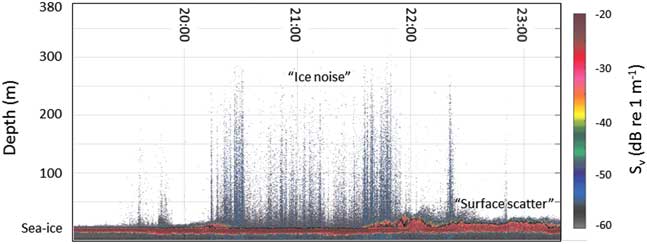
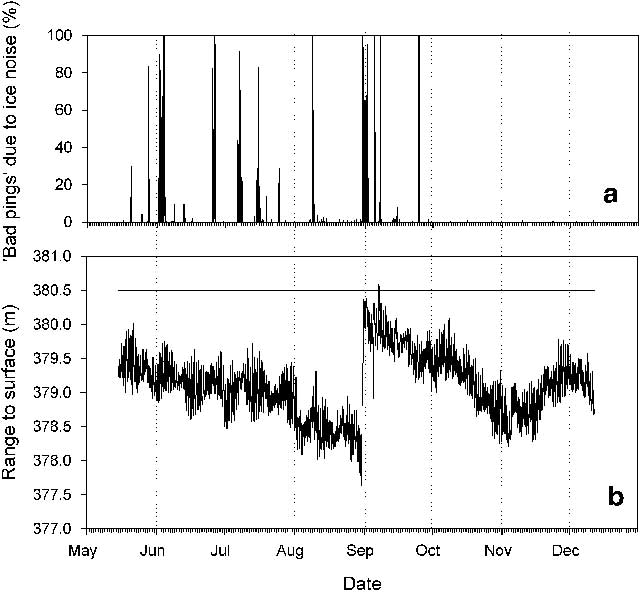
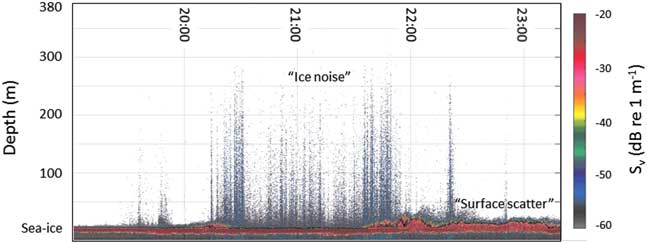
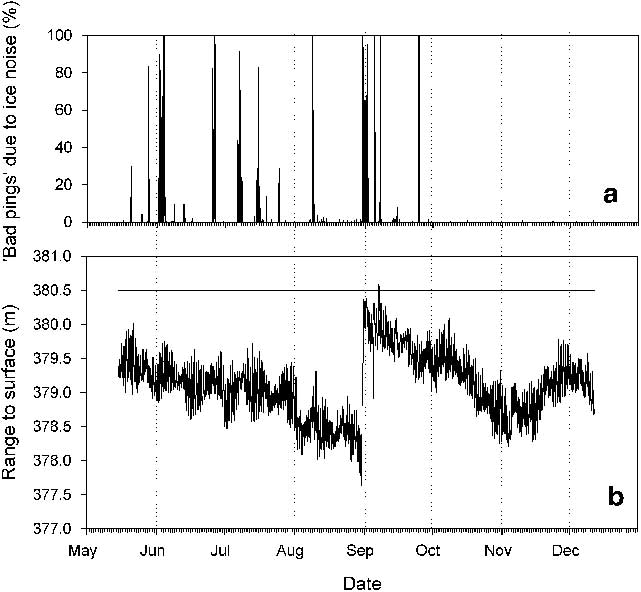
Overall levels of detected backscatter from the water column were generally very low, however there were periods of ’ice noise’, which propagated from the surface down to over 200 m depth (e.g. Fig. 2). Periods of noise occurred from May to October (Fig. 3a) and it is hypothesized that these were associated with the movement and cracking of sea ice. By comparing ranges during the deployment to the detected range to the surface when the mooring was first deployed (in ice-free water) the thickness of the sea ice (Fig. 3b) could be estimated. The ice thickness increased from c. 1 m in May to over 2 m in August, then rapidly decreased to near zero (open water), following periods of ’ice noise’ during 30 August–2 September. There was strong scattering associated with the surface during this period (see Fig. 2). It was concluded that this scattering was most likely due to physical processes such as fracture and subduction of ice, rather than biological sources, and it was excluded from further analysis. The possibility could not be rejected, however, that this ’’surface scatter’’ may have been due to extremely dense aggregations of organisms, or possibly biologically or physically created bubble clouds. During September and October the ice thickness gradually increased again to 2 m in early November, before reducing in thickness during November (Fig. 3b).
Example echogram showing ice noise and associated increase in near-surface scattering on 30 August 2015. Times are NZST (UTC+12h00).
a. Occurrence of noise due to ice (expressed as percentage of ’bad pings’ rejected per hour); b. estimated range to acoustically detected surface. Horizontal line at 380.5 m shows surface on 23 February 2015 when mooring was in open water. Difference between lines represents ice thickness. Date labels are 1st of the month.
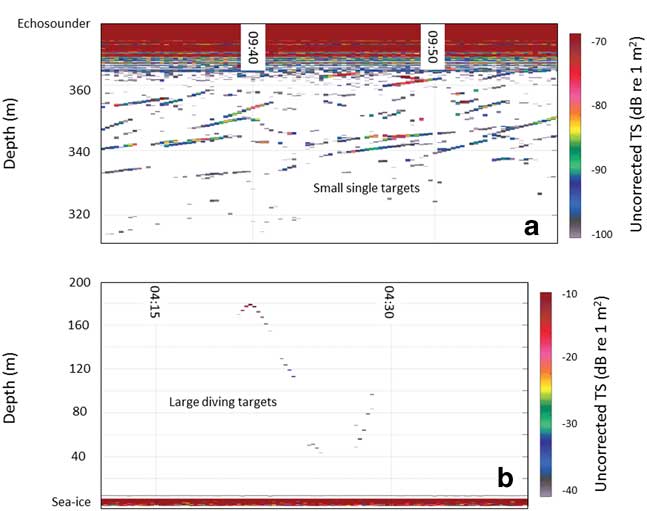
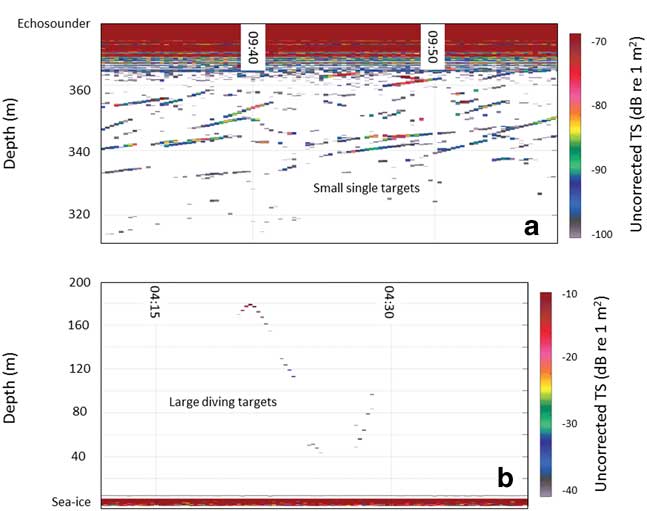
The estimated background noise level for the moored AZFP echo sounder (Sv,noise) was -125 dB at 1 m. Close to the transducer (where signal-to-noise ratio was high), very weak single targets were detected (e.g. Fig. 4a). Very strong single targets were detected in the upper 200 m of the water column (i.e. at 180–380 m range from transducer). These strong targets decreased or increased in range over consecutive pings (e.g. Fig. 4b) and may have been associated with diving behaviour of air-breathing animals such as Weddell seals (Leptonychotes weddellii (Lesson)).
Example echograms showing: a. weak single targets close to the moored echo sounder (at 380 m depth) on 5 August 2015; b. strong diving targets in the upper 200 m on 3 October 2015. Note difference in depth and colour scales. Times are NZST (UTC+12h00).
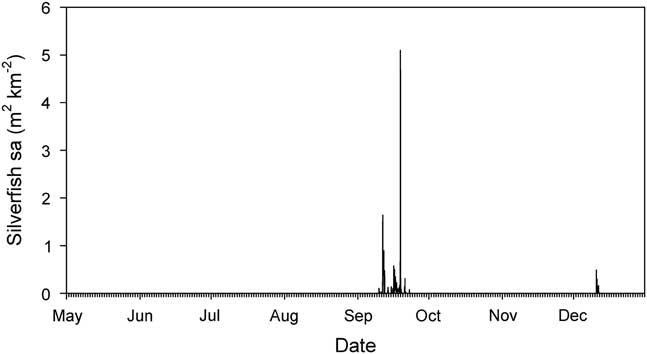
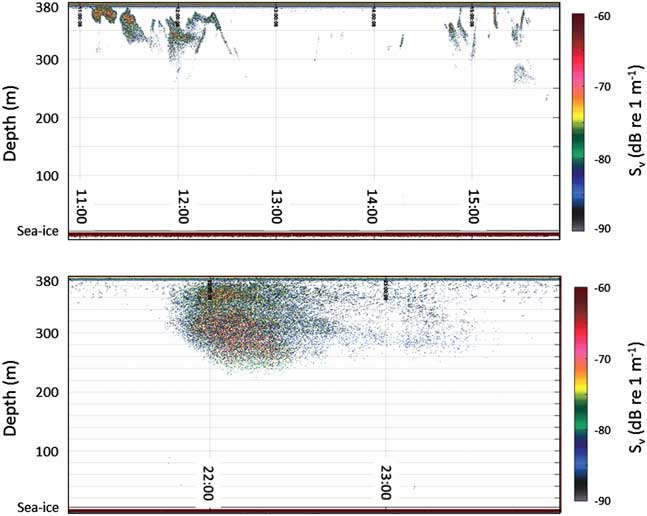
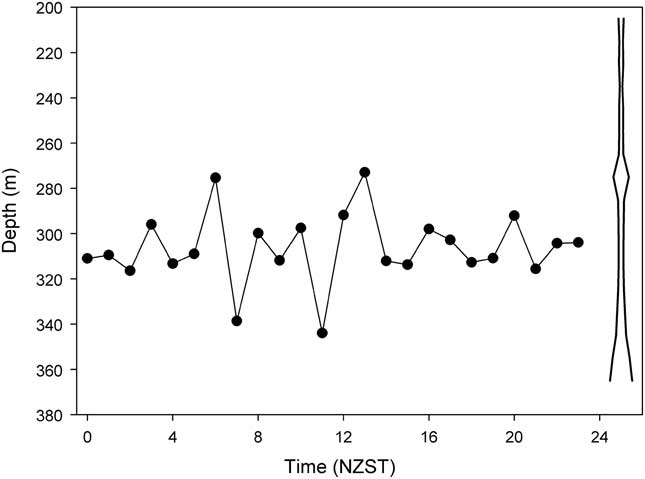
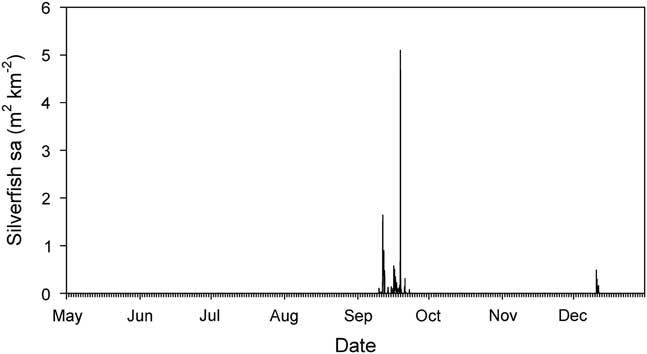
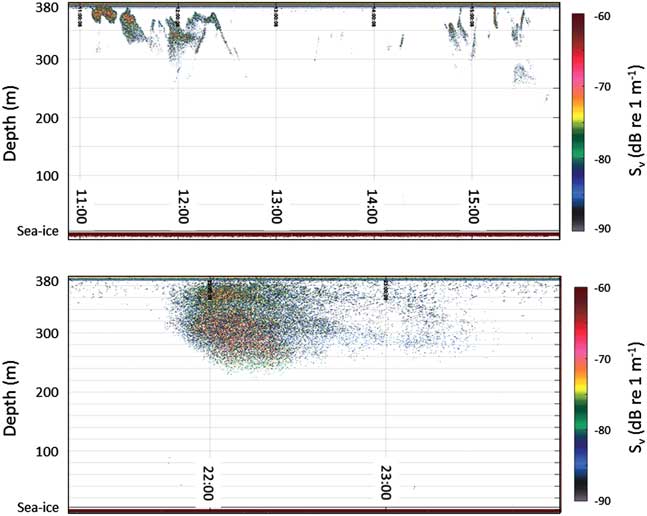
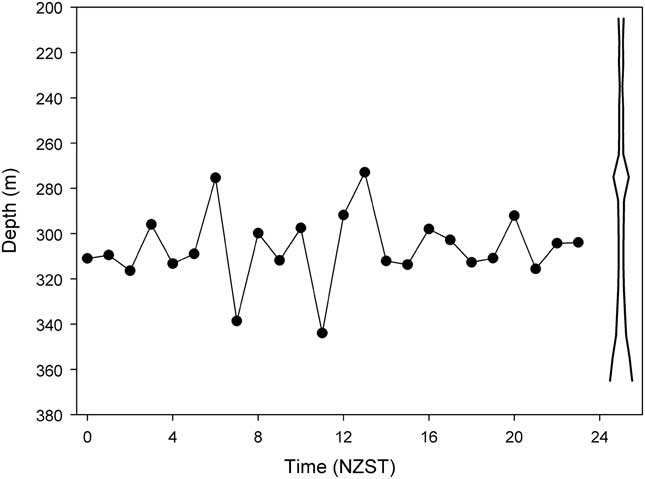
Silverfish-like targets were detected from 9–22 September (Fig. 5). These consisted of aggregations at depths of 230–380 m (i.e. within 150 m of the transducer) and were similar to those described for adult silverfish by O’Driscoll et al. (Reference O’Driscoll, Macaulay, Gauthier, Pinkerston and Hanchet2011) (Fig. 6). There were also weak silverfish-like targets in the upper 100 m immediately before the mooring switched off on 10–11 December (see Fig. 5). Biological scattering attributed to silverfish peaked on 11 and 18 September (echograms shown in Fig. 6). There was no clear evidence for diel vertical migration from the mooring observations in September, with backscatter peaks at 270–290 m and 330–360 m (Fig. 7).
Estimated acoustic backscattering cross-section (sa) attributed to silverfish in one-hour intervals from 15 May to 11 December 2015. Date labels are 1st of the month. Echograms for peak values on 11 and 18 September are shown in Fig. 6.
Echograms showing strongest silverfish aggregations during the mooring deployment. These were observed on 11 September 2015 (upper panel) and 18 September 2015 (lower panel). Times are NZST (UTC+12h00).
Mean weighted depth of silverfish marks observed in Terra Nova Bay in September 2015 as a function of time of day. Vertical lines show mean depth distribution of silverfish backscatter (all times combined), with the gap between the two bold lines proportional to the backscatter at each depth.
The mean estimate of sv within September silverfish aggregations was 2.97 × 10⁻⁹ m-1 (standard deviation 9.86 × 10⁻⁹ m-1) from 24,054 cells of 10 pings (= 150 seconds) by 10 m depth, with maximum sv of 5.95 × 10⁻⁷ m-1. Notwithstanding the caveat about the lack of a deep calibration of the instrument, which may lead to biased estimates, this is equivalent to a mean silverfish density of 0.004 fish m-3 and maximum of c. 0.75 fish m-3.
Oceanographic observations
The CTD instrument leaked and it was not possible to recover any data. The RCM current meter failed three months into the deployment on 20 May 2015, just after the echo sounder turned on. It appears that cold temperatures expended the batteries faster than usual causing the voltage to drop and sampling to stop. While it was active the current meter recorded a temperature of -1.9°C and current speeds of typically less than 10 cm s-1.
Sea-ice deployments
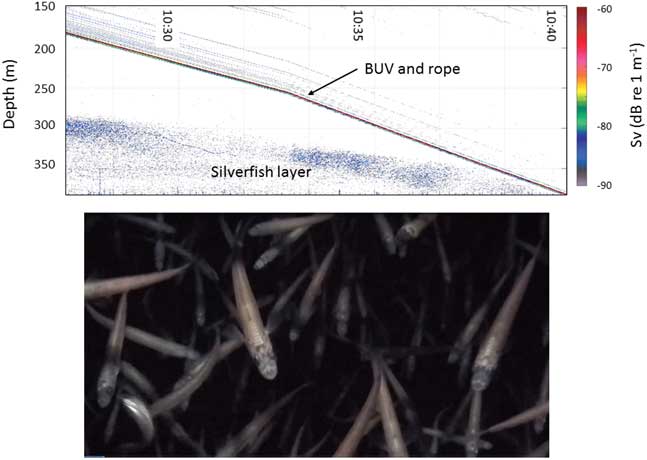
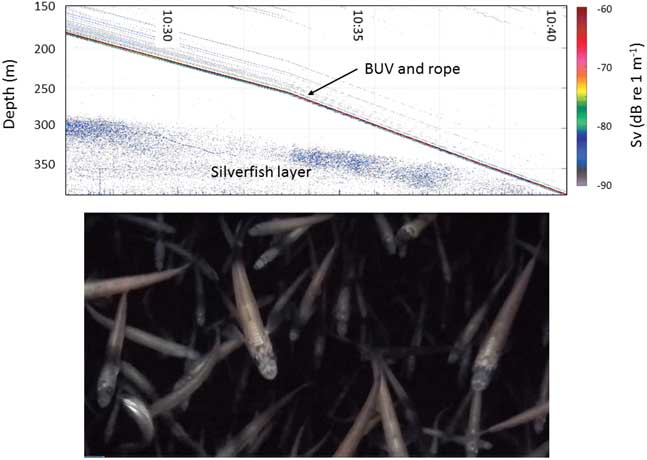
The echo sounder was deployed on four occasions at each of the two sites in McMurdo Sound in 2015 (Table 1). No silverfish were detected at the first site, but a layer was observed at 300–350 m at station 29 on 10 November 2015 (Fig. 8). This layer descended as the BUV was lowered towards it, and adult silverfish were recorded on camera within the layer from c. 500 m to the seabed (Fig. 8). Mean sv in the midwater layer was 2.38 × 10⁻⁹ m-1 (standard deviation 1.87 × 10⁻⁹ m-1), equivalent to c. 0.005 fish m-3, with a maximum sv of 9.49 × 10⁻⁹ m-1, or c. 0.019 fish m-3. Silverfish densities recorded on the camera were much higher (0.4 fish m-3 assuming an estimated sampling volume for the camera of c. 110 m3). This may be because silverfish were ’herded’ or attracted by the camera, so densities increased. Unfortunately as the echo sounder was only set to record data to 500 m range, the acoustic data where the silverfish layer was compressed (and filmed) close to the seabed at 579 m were not stored.
Upper panel shows echogram of baited underwater video (BUV) being lowered towards silverfish layer in McMurdo Sound on 10 November 2015. Lower panel is image of adult silverfish from downwards-looking BUV taken at c. 500 m depth. Times are NZST (UTC+12h00).
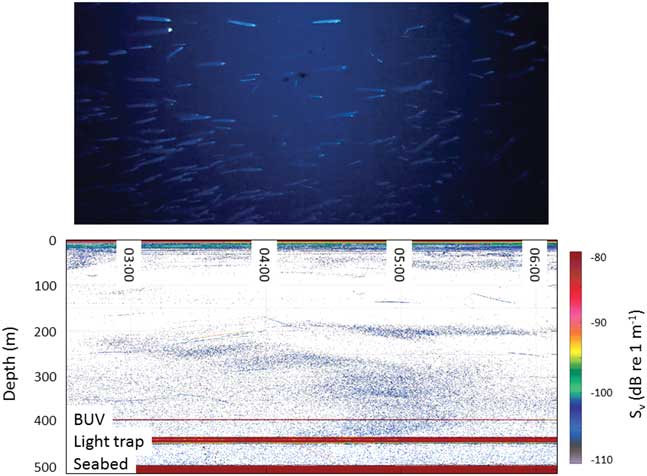
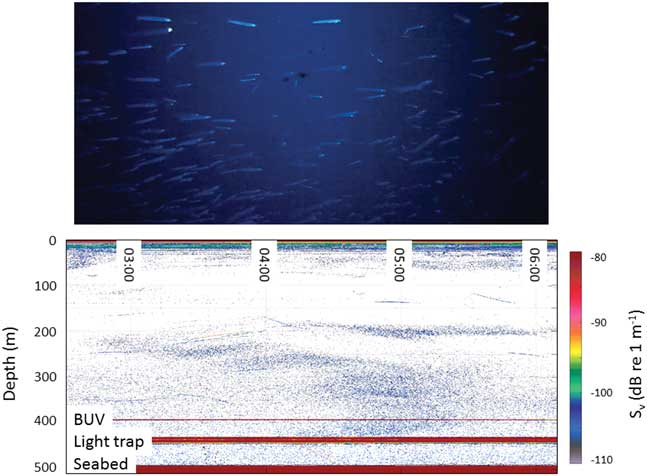
In 2017, the echo sounder was deployed at four sites in Terra Nova Bay: two adjacent sites in Gerlache Inlet and two in Silverfish Bay (Table 1). No aggregations of silverfish were recognized initially on acoustics, but juvenile silverfish (estimated to be c. 50 mm standard length) were observed on BUV in Gerlache Inlet at 390–440 m depth (i.e. 50–100 m off the seabed) during 11–12 November 2017 (Fig. 9) and at 200–440 m (15–250 m off the seabed) in Silverfish Bay during 13–16 November. These juvenile silverfish were not easily distinguishable in the associated synchronous acoustic recording. The Sv,noise for the sea-ice EK60 echo sounder was -158 dB at 1 m. Following background noise removal, weak scattering was observed between 170 and 450 m depth that may have been due to juvenile silverfish (e.g. Fig. 9)
Upper panel shows image of juvenile silverfish from horizontally-looking BUV taken at c. 390 m depth in Gerlache Inlet on 12 November 2017. Lower panel is echogram at the same location. Note the very low levels of backscatter (Sv). Times are NZST (UTC+12h00).
Discussion
Our objective was to document the timing of a hypothesized spawning migration of silverfish by deploying a moored echo sounder in Terra Nova Bay over winter in 2015. The mooring deployment was successful, and weak aggregations attributed to adult silverfish were detected in September. No aggregations of adult silverfish were observed through the sea ice at four locations in Terra Nova Bay in November 2017. While the results support the hypothesis that silverfish are moving into Terra Nova Bay during winter to spawn, the sampling was restricted to a few point locations and may not reflect distribution and abundance over a broader area. Also, the 380 m depth of the moored echo sounder may not have been deep enough to fully cover the depth distribution of silverfish, as fish were observed near the transducer (e.g. Fig. 6). It is therefore possible that there may be populations of adult silverfish present year round.
Silverfish eggs and newly hatched larvae are abundant in the platelet ice of Terra Nova Bay in late October to early December (Vacchi et al. Reference Vacchi, DeVries, Evans, Bottaro, Ghigliotti, Cutroneo and Pisano2012a, Guidetti et al. Reference Guidetti, Ghigliotti and Vacchi2015), with the earliest observation of eggs on 18 September (Ghigliotti et al. Reference Ghigliotti, Pisano, Carlig, Kim, Choi and Vacchi2015). Because the development period for silverfish eggs is uncertain, it is difficult to backdate the spawning time. Vacchi et al. (Reference Vacchi, DeVries, Evans, Bottaro, Ghigliotti, Cutroneo and Pisano2012a) suggested that spawning may occur in July–August, with a development time for the eggs of 4–5 months. The observations of adult silverfish in September may indicate a later spawning time, or alternatively it may have been silverfish in the area post-spawning. Biological sampling during winter is required to determine the timing of spawning but would be logistically difficult due to Antarctic winter conditions. There is also no proven sampling technique to capture silverfish through the ice. In 2017, attempts were made by the researchers of the present work to use baited and light traps and small ’sabiki’ hooks without success, although acoustic data suggested no adults were present to catch.
Sea-ice deployments recorded adult silverfish in McMurdo Sound in November 2015. Fresh silverfish have also been found in the stomachs of toothfish sampled during October and November in McMurdo Sound (Eastman Reference Eastman1985). Using cameras mounted on Weddell seals, Fuiman et al. (Reference Fuiman, Davis and Williams2002) observed silverfish in a similar location between October and early December during 1997–1999. Most (97%) of their observations occurred between 160 and 414 m depth, with silverfish being shallowest between midnight and 03h00 (mean depth 218 m) and deepest between 14h30 and 17h30 (mean depth 348 m), noting that the area is in continuous daylight from late October to February (Fuiman et al. Reference Fuiman, Davis and Williams2002). This distribution is in contrast to the mooring observations in Terra Nova Bay in September which showed no clear evidence for diel vertical migration (see Fig. 7), but noting that the depth range covered by the moored echo sounder was restricted to the upper 380 m. The literature is conflicted on the occurrence of diel migration in silverfish (e.g. Robison Reference Robison2003, O’Driscoll et al. Reference O’Driscoll, Macaulay, Gauthier, Pinkerston and Hanchet2011). This is difficult to assess using nets as this species can avoid small trawls and there may be day–night differences in catchability. It may also vary with time of year, location, and size. For example, Robison (Reference Robison2003) demonstrates vertical migration of silverfish in net catches off the Antarctic Peninsula, but there is no mention of the size of fish involved. Vertical migration is another biological process that may be better understood using acoustic technology in the future.
Mean densities of adult silverfish observed in both Terra Nova Bay and McMurdo Sound were very low (0.004–0.005 fish m-3) which suggests that this species is loosely aggregated rather than exhibiting synchronous schooling behaviour. Fuiman et al. (Reference Fuiman, Davis and Williams2002) estimated higher mean shoal densities of 0.023–0.15 fish m-3 from consecutive encounters by Weddell seals. The acoustic estimates of density depend on calibration and on estimates of TS, which are still uncertain for silverfish. Target strength for silverfish has been derived from scattering models and in situ and ex situ measurements. Azzali et al. (Reference Azzali, Leonori, Biagiotti, De Felice, Angiolillo, Bottaro and Vacchi2010) measured TS of preserved (frozen and defrosted) silverfish of total length 110–202.5 mm ex situ (Ancona Bay, Adriatic Sea) at 38, 120 and 200 kHz, and carried out nine in situ acoustic-trawl experiments targeted at post-larvae and juveniles of silverfish (total length 13.3–68.9 mm) in the Ross Sea. Azzali et al. (Reference Azzali, Leonori, Biagiotti, De Felice, Angiolillo, Bottaro and Vacchi2010) also used a general TS modelling approach based on the measured morphological characteristics of the silverfish (obtained by radiographs). O’Driscoll et al. (Reference O’Driscoll, Macaulay, Gauthier, Pinkerston and Hanchet2011) used anatomically detailed scattering models based on computer tomography (CT) scans of frozen specimens to estimate acoustic TS for silverfish at 12, 18, 38, 70, and 120 kHz. Both models suggest that adult silverfish exhibit different scattering properties to post-larvae and juveniles (Azzali et al. Reference Azzali, Leonori, Biagiotti, De Felice, Angiolillo, Bottaro and Vacchi2010; O’Driscoll et al. Reference O’Driscoll, Macaulay, Gauthier, Pinkerston and Hanchet2011), but there is still considerable uncertainty around the TS-length relationship, with a 4.6 dB difference between model estimates of TS for a 15 cm standard length silverfish (which equates to a change in estimated density of nearly threefold). There is a particular need for further in situ TS data collection to help resolve differences between model estimates (O’Driscoll et al. Reference O’Driscoll, Leonori, De Felice and Macaulay2017).
Observations of juvenile silverfish on BUV, that were not initially recognized on the echo sounder, during sea-ice deployment in Terra Nova Bay in November 2017 (see Fig. 9), supports the model estimates of O’Driscoll et al. (Reference O’Driscoll, Macaulay, Gauthier, Pinkerston and Hanchet2011) that indicated that juvenile silverfish have very little density contrast and therefore very low acoustic TS at 38 kHz. O’Driscoll et al. (Reference O’Driscoll, Macaulay, Gauthier, Pinkerston and Hanchet2011) estimated a TS of -101.8 dB for a 60 mm standard length silverfish at 38 kHz. Azzali et al. (Reference Azzali, Leonori, Biagiotti, De Felice, Angiolillo, Bottaro and Vacchi2010) estimated a higher TS for juvenile silverfish between c. -72.5 and -75.8 dB. At the densities observed in video (more than 1 fish m-3), a much stronger backscatter would have been expected from the shoals of juvenile silverfish if they had TS of the levels suggested by Azzali et al. (Reference Azzali, Leonori, Biagiotti, De Felice, Angiolillo, Bottaro and Vacchi2010). Although TS for juvenile silverfish is estimated to be c. 12 dB higher at 70 kHz (O’Driscoll et al. Reference O’Driscoll, Macaulay, Gauthier, Pinkerston and Hanchet2011), it is probable that the signal-to-noise ratio of the moored (67 kHz) echo sounder was too low to detect juvenile silverfish except those very close to the transducer. It is possible that the weak single targets shown in Fig. 4a were juvenile silverfish, but these could also have been zooplankton.
Although not a primary objective of this study, the moored echo sounder also provided insight into the physical properties of the sea-ice cover, which was dynamic at the mooring location (see Fig. 3). The use of moored upward-looking sonar systems to study sea ice is well established (e.g. Melling et al. Reference Melling, Johnston and Riedel1995), and such sonars have been widely used to monitor ice thickness and velocity for studies of climate change (e.g. Fissel et al. Reference Fissel, Marko and Melling2008). These data might provide useful empirical observations of sea ice for future studies in Terra Nova Bay.
Understanding silverfish ecology is necessary to reduce uncertainty in predictions about impacts of environmental change on the coastal Antarctic system. Because of the influence of sea ice on silverfish biology (Vacchi et al. Reference Vacchi, Koubbi, Ghigliotti and Pisano2012b), future changes in sea-ice dynamics in Ross Sea may impact spawning success and abundance of silverfish (La Mesa & Eastman Reference La Mesa and Eastman2012, Mintenbeck & Torres Reference Mintenbeck and Torres2017). As silverfish are a keystone species, these changes may affect the entire Ross Sea ecosystem (Smith et al. Reference Smith, Ainley, Arrigo and Dinniman2014). This study provides a proof of concept, showing that echo sounders can be deployed over winter and spring in the Ross Sea either by mooring, or through the sea ice, to monitor biological processes. Ongoing acoustic moorings may constitute a component of the research and monitoring programme for the recently established CCAMLR Ross Sea Marine Protected Area and the Antarctic Treaty Antarctic Specially Protected Area (ASPA) between Cape Washington and Silverfish Bay. Future work should include calibration of systems at depth for quantitative measurements (Haris et al. Reference Haris, Kloser, Ryan and Malan2018) and should also make sure that instruments are deployed deep enough to ensure that they cover the full vertical distribution of the silverfish. This may require the use of instruments at lower frequencies and/or with improved signal-to-noise ratios.
Acknowledgements
We thank the officers, crew and scientific staff on RV Tangaroa and RV Italica for their expertise in deployment and recovering the mooring. We also thank staff at Antarctica New Zealand, Scott Base and Mario Zucchelli Station for logistical support. This research was jointly funded by NIWA, Antarctica New Zealand, the New Zealand Ministry for Primary Industries, the New Zealand Ministry for Business, Innovation and Employment and the Italian National Programme of Antarctic Research. The paper was improved following comments from two anonymous reviewers.
Author Contributions
The concept and design of the study were by O’Driscoll, Parker, Vacchi, and Ghigliotti. All of the authors were involved in execution of the research. Analyses were carried out by O’Driscoll and Ladroit. Drafting of this article and interpretation were by O’Driscoll, Parker, Vacchi and Canese.