At least 96 fish families have been reported in the literature to occur in association with drifting objects (Castro et al., Reference Castro, Santiago and Santana-Ortega2002). Among them, association of pelagic cnidarians and ctenophores with fish is a frequent situation. These non-specific facultative associations commonly occur between Scyphomedusae and juvenile fish, mainly of three families: Gadiidae, Stromatidae and Carangidae (Purcell & Arai, Reference Purcell and Arai2001). Reports of association with hydromedusae (Runge et al., Reference Runge, Pepin and Silvert1987), ctenophores (Auster et al., Reference Auster, Griswold, Youngbluth and Bailey1992) and siphonophores (Arai, Reference Arai1988) are less frequent. The main ecological functions of this fish behaviour are protection from predation, utilization of the jellyfish preys or jellyfish itself as food (Masuda, Reference Masuda2009), and the transport of larvae and juveniles to richer areas for their development (Castro et al., Reference Castro, Santiago and Santana-Ortega2002). The nature of the relationship may change as the fish grows (Purcell & Arai, Reference Purcell and Arai2001).
Carangids are one of the most dominant fish groups that associate with biotic and abiotic objects, especially jellyfish (Mansueti, Reference Mansueti1963; Kingsford, Reference Kingsford1993). Trachurus trachurus (Linnaeus, 1758) is a carangid living in the eastern Atlantic and Mediterranean, and it is one of the 11 species of this family present in Galician waters (Bañon, personal communication). Aequorea forskalea Péron & Lesueur, 1810, is a hydromedusae in family Aequoridae, distributed throughout the Atlantic and Indo-Pacific Oceans in all suitable temperate to tropical waters, and in the Mediterranean Sea (Cornelius, Reference Cornelius1995; Bouillon et al., Reference Bouillon, Medel, Pagès, Gili, Boero and Gravili2004).
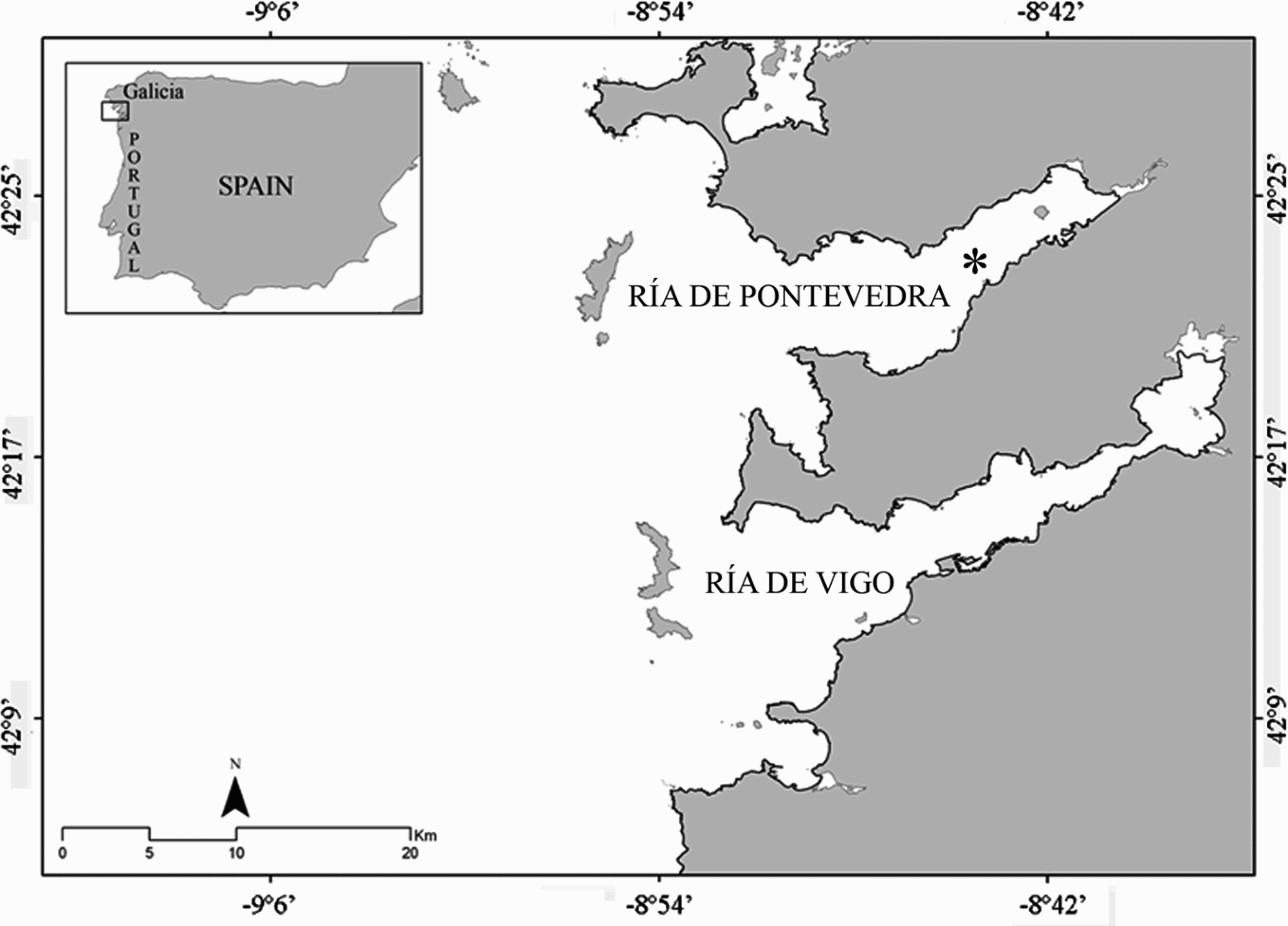
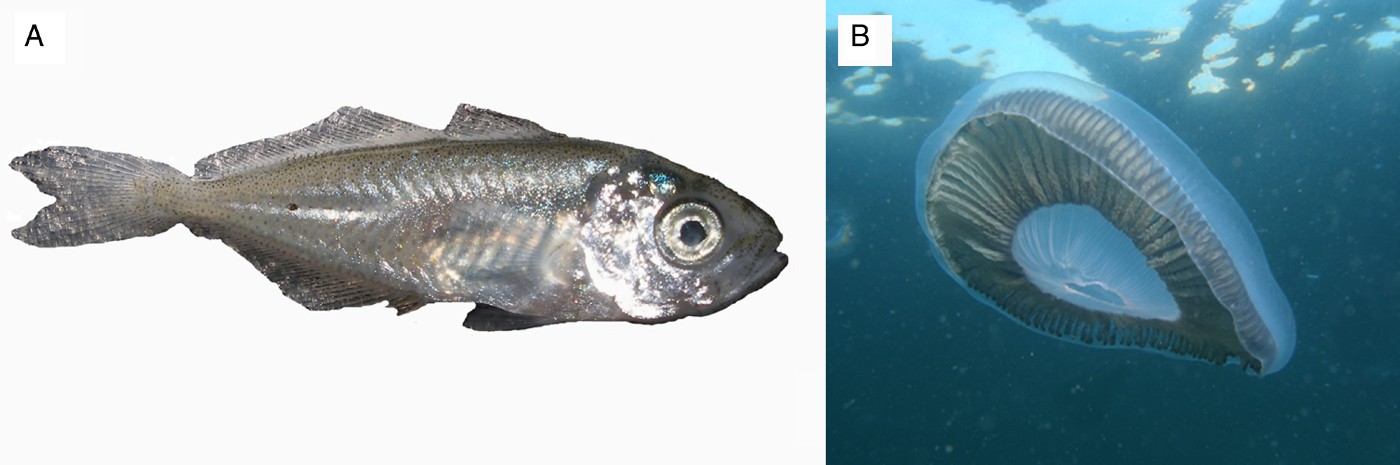
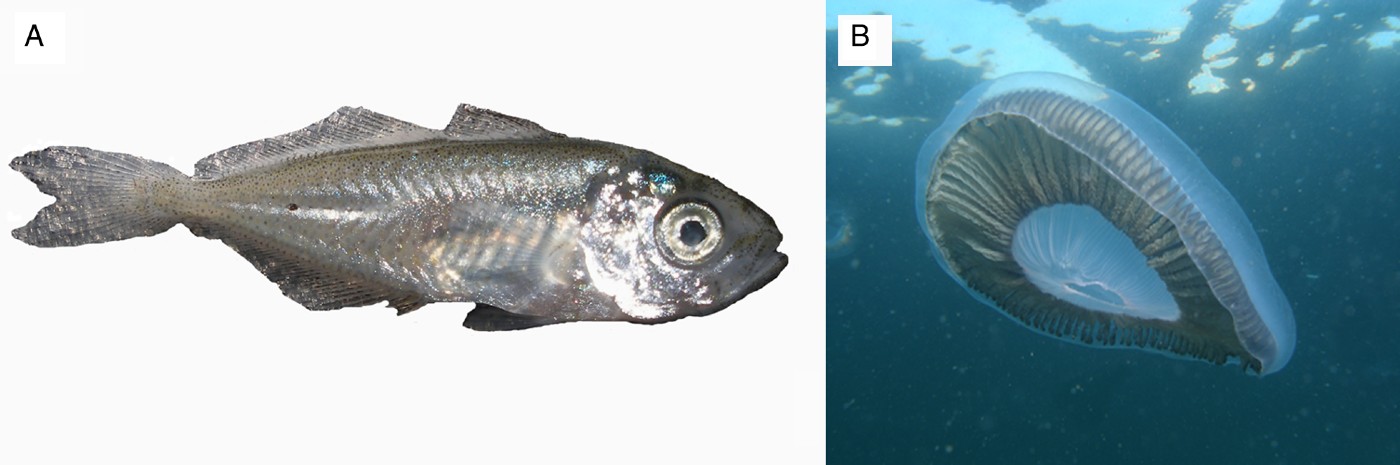
In July 2008, a great amount of A. forskalea entered the Rías Baixas (Figure 1), four coastal inlets in the south of Galicia (north-western Spain) between 42°06′N–42°48′N and 8°35′W–9°05′W, and remained there for a week. They made great masses (several patches of >1000 m2) in open water and drifted over the beaches. Observations of the associative behaviour were made during a routine SCUBA dive in one of the inlets (Ría de Pontevedra: 42°22′N–8°44′W). Only some of the jellyfish were observed to be hosted. Juveniles of Trachurus trachurus were found sheltered under the jellyfish umbrella or swimming around from one jellyfish to another. Three individuals, measuring 26, 28 and 32 mm total length (TL), were captured (Figure 2A) with the aid of a small hand net, and were identified as T. trachurus following Smith-Vaniz (Reference Smith-Vaniz and Whitehead1986) and Laroche et al. (Reference Laroche, Ditty, Lamkin, Whitcraft and Richards2006). Identification of A. forskalea (Figure 2B) followed Russell (Reference Russell1953) and Bouillon et al. (Reference Bouillon, Medel, Pagès, Gili, Boero and Gravili2004).
Map showing the location where underwater observations were made.

Photographs of (A) one of the individuals of Trachurus trachurus captured (26 mm TL) and (B) Aequorea forskalea (24 cm umbrella diameter) in Galician waters.
In the past, T. trachurus has been reported in association with Cyanea capillata (Linnaeus, 1758) and Rhizostoma pulmo (Macri, 1778) in the north-eastern Atlantic, North Sea and Black Sea (Mansueti, Reference Mansueti1963); with Aurelia aurita (Linnaeus, 1758) in the North Sea and north-eastern Atlantic (Mansueti, Reference Mansueti1963) and with Cotylorhiza tuberculata (Macri, 1778) and probably Pelagia noctiluca (Forsskål, 1775) in the Balearic Islands (Fischer et al., Reference Fischer, Patzner, Müller and Winkler2007). The present record means a new association for the species, and represents the first report of fish–jellyfish association in Galician waters.
ACKNOWLEDGEMENTS
The author is especially grateful to A. Carvalho-Filho for providing information and for his comments on the manuscript and to N. Alvaro for the help with the map. I also thank O. Villegas and J.M. Villegas for the diving assistance.