Background
Urinary incontinence (UI) is a common problem worldwide,1, Reference Irwin, Kopp, Agatep, Milsom and Abrams2 with higher rates in women,Reference Hunskaar, Lose, Sykes and Voss3 older age groupsReference Wagg, Potter, Peel, Irwin, Lowe and Pearson4 and adults in institutions (50%).Reference Norton and Brubaker5 Precise figures of prevalence can be difficult to estimate due to the hidden nature of the subject and the unwillingness of some people to present for treatment.6 There is a common public misconception that incontinence is an inevitable consequence of ageing and therefore not amenable to treatmentReference Irwin, Kopp, Agatep, Milsom and Abrams2, Reference Harari and Igbedioh7 and this can be compounded by similar beliefs held by healthcare professionals.Reference Dingwall and Mclafferty8, Reference Shaw9 UI can have a significant impact on quality of life,Reference Bogner, Gallo, Sammel, Ford, Armenian and Eaton10, Reference Papanicolaou, Hunskaar, Lose and Sykes11 and also contributes to institutionalization.Reference Armstrong12
Whilst appropriate management can result in improvement in about 70% of cases,13 there remains a group of people who will have intractable incontinence due to failed treatments, co-morbidities and associated disabilities, terminal illness, impaired cognition and mobility: these often co-exist with old age.Reference Ouslander14 The belief that any improvement or cure is unachievable due to age or disability impacts significantly on motivation and treatment adherence, constituting a further barrier to successful treatment. In addition, many people will never seek help or admit to having continence problems.6, Reference Brittain, Perry and Williams15, Reference Fonda, Woodward, D'Astoli and Chin16 Patient, carer and physician lack of knowledge on options for the management of intractable incontinence, plus the immense array of continence aids available, results in confusion and frustration.Reference Shaw9
Nurse specialists, general practitioners or general physicians can undertake the initial assessment and management of UI. Where appropriate, a referral should be made to a continence specialist. Aids and devices are used while treatment is being optimized, or when treatment options have been exhausted. Product choice requires skilled assessment of patient requirement, choice and ability as inappropriate choice could result in dependence upon containment, poor motivation for participation in treatment programmes and increased UI. Resorting to containment devices for the convenience of the healthcare professional must be avoided.Reference Dingwall and Mclafferty8
This article provides an overview of the more popular and successful aids available for the management of urinary incontinence based on the available research and empirical evidence. We also include guidance on selection of continence aids to meet the needs of patients and their carers. The focus is on aids used specifically for the prevention and containment of urinary incontinence. Aids to treat incontinence are not considered.
Product selection
The use of any continence aid needs to follow or run alongside the assessment and possible treatment of the causes of incontinence with the primary aim being to achieve continence. External factors such as aids to improve mobility or adaptations to improve access to toilets should be considered, with input from physiotherapists and occupational therapists as appropriate.
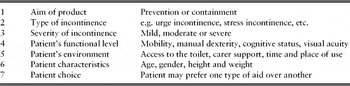
Table 1 describes some of the general factors that should be considered when selecting the most appropriate and effective continence aid. A comprehensive assessment of the patient is essential.Reference Cottenden, Bliss, Buckley, Abrams, Cardozo, Khoury and Wein17–Reference White19 To increase concordance and product effectiveness, it is important to teach and demonstrate correct use of the continence aid to the patient and the carer. This should be supplemented by intensive initial support plus long-term periodic follow-up, to confirm appropriate choice of aids, monitor efficacy and identify any additional factors influencing choice of aid, e.g. severity of incontinence, change in patient characteristics or environmental factors.
Factors influencing the choice of continence aid

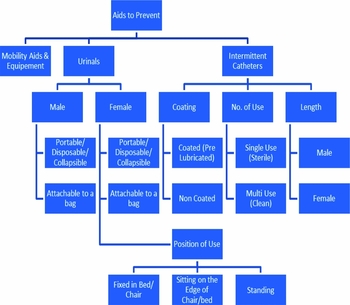
Figures 1 and 2 depict a practical classification of continence aids and Figure 3 describes a stepwise approach to their selection.
A practical classification of aids to contain incontinence

A practical classification of aids to prevent incontinence

A stepwise approach to the selection of continence aids

Continence aids for the prevention of urinary incontinence
Bedpans
Bedpans are receptacles that are used either on a bed or chair. They can be disposable (mainly used in hospital environments) or re-usable. These can be made of stainless steel or even glass, but the majority of modern bedpans are plastic. They are used in immobile patients of both genders for collection of urine and faeces, but mainly for urine collection in females. They come in two main shapes (Figure 4). The bowl-shaped regular bedpan is designed to fit into the patient's sacral area and is used mainly for patients with some mobility, and the fracture bedpan is oval and wedge-shaped, and can be slid underneath a patient who is completely immobile.
Examples of types of bedpans (reproduced with permission from Warwick Sasco Ltd)

Bedpans can be uncomfortable and can discourage adequate bladder emptying due to poor patient positioning. If the patient is able to sit out of bed then bedpans should generally not be used.
Commodes
A commode is a chair-like frame with a toilet seat and a removable disposable or washable collection bowl beneath (Figure 5). Commodes are chiefly used where access to the toilet is impossible or difficult, if mobility is a problem or where there is significant urgency of micturition. They can be particularly useful in managing nocturia, especially if the patient is at high risk of falls. They can be static or mobile. Mobile commodes are generally used to place the patient over a conventional toilet.
Examples of types of commodes (reproduced with permission from G & J Logistics Ltd)
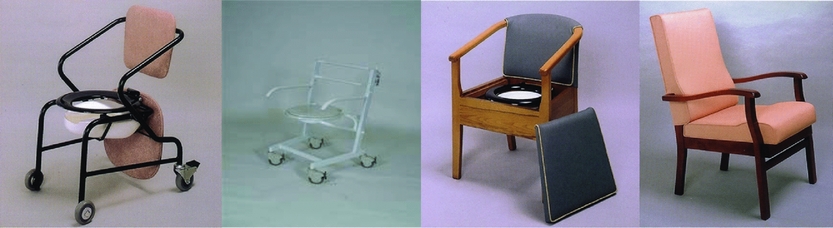
Risk assessments need to be performed to ensure patient safety, especially if the commode is being used independently. Ensuring a stable commode is important, as some commodes can tip over easily.Reference Ballinger, Pain, Pascoe and Gore20 The patient's core sitting stability, ability to transfer on/off the commode, space, access, and privacy and dignity in the environment where the commode will be placed should be considered.
This initial risk assessment should be followed by regular reviews in the face of changing physical and cognitive abilities, especially important if the patient lives alone or care circumstances change. Occupational therapist advice may help.
Hand-held urinals
Hand-held urinals are used for patients with limited mobility or poor toilet access. They are also useful in nocturia, frequency and urgency. Urinals can be disposable or washable, with disposable urinals being used mainly in a hospital environment, although some washable urinals are also used under the guidance of local infection control policies.
Research and evaluations of urinals are limited. While the male hand-held urinal design has not changed for many years, a large variety of female urinals is now available. Successful use requires easy access to the urinal, confidence in use without spillage, and ability to empty and wash the urinal. Position of use is an important consideration in the urinal's effectiveness. Men may find the standard male urinal (Figure 6) difficult to use lying down or sitting. The most effective hand-held female urinals are those that are used with the female positioning themselves to the edge of a bed or chair rather than lying down.Reference Fader, Pettersson, Brooks and Cottenden21
Examples of standard and non-spill male urinals (reproduced with permission from Warwick Sasco Ltd)

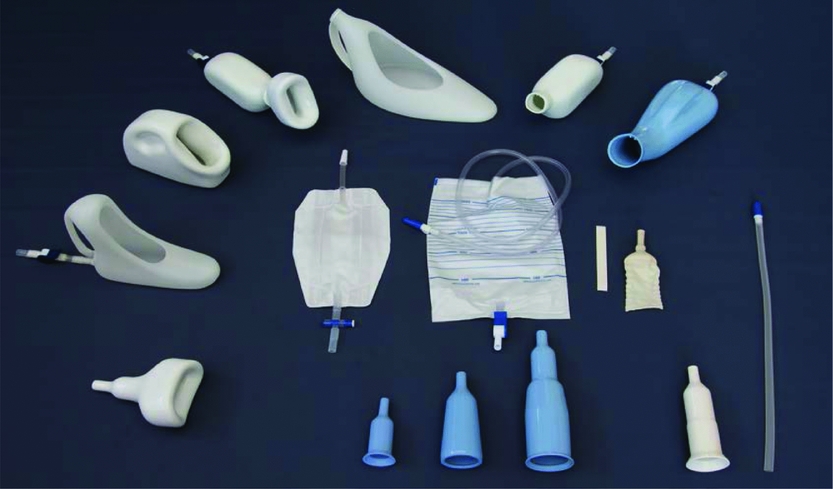
Assessment needs to consider the volumes of urine being passed, especially if it is to be used more than once overnight. Non-spill valves reduce the risk of spillages, and along with hydrophilic absorbent powder (which turns liquid into a gel), can enable multiple uses without the need of emptying. Usage can be optimized by attachment of drainage bags obviating the need for frequent emptying (Figure 7).
Examples of specialized male and female urinals and collecting bags (reproduced with permission from Beambridge Medical Ltd)

The success of female urinals can be limited, with positioning having a main impact. However, in select situations, where they can prove useful, they are often overlooked.22 Sufficient dexterity to remove obstructing clothing and/or pads is essential and simple clothing alterations or clothing adaptation in liaison with an occupational therapist may be helpful.
With the large variety of urinals available, a period of assessment may be required to identify the most appropriate one,Reference Cottenden, Bliss, Buckley, Abrams, Cardozo, Khoury and Wein17 and some areas have developed a loan equipment service to facilitate this,Reference Vickerman23 although infection control policies need to be considered. Regular review of the use of products is recommended.
Intermittent catheters
Overflow incontinence is defined as the involuntary loss of urine connected with bladder over-distension (urinary retention) in the absence of detrusor contraction. This can be due to bladder outlet obstruction or detrusor under-activity. While commoner in men due to prostatic enlargement, it is seen in both genders in neurological conditions like multiple sclerosis. Urinary retention may be acute or chronic and can cause damage to the upper urinary tract if left untreated. For these patients the bladder requires draining to preserve kidney function, reduce bladder distension and the risk of urinary tract infections.
Once treatment options for the underlying cause and all other non-invasive methods have been explored, intermittent catheterization (IC) should be considered. While long-term use of IC is associated with complications including urinary tract infections, bladder stones, false passages and urethritis, overall risks are lower than with in-dwelling catheters.24
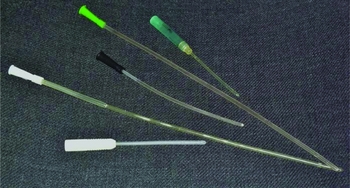
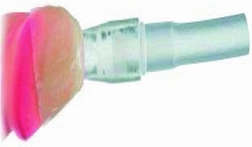
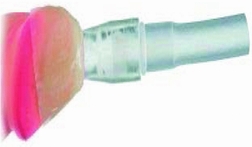
Intermittent catheters can be single- (Figure 8) or multi-use and be either coated or uncoated. Single-use catheters are sterile with a hydrophilic or gel coating. The hydrophilic coating requires immersion in water; this can be sterile water provided with the catheter, or tap water. Gel-coated catheters do not require any preparation. Multi-use catheters are washed and re-used for up to 1 week. They are non-coated and usually made from polyvinyl chloride. Ideally IC should be performed by the individual themselves using the ‘clean intermittent self catheterization’ (CISC) technique, though carers or healthcare professionals can successfully be trained to carry this out, dependent upon the frequency of IC required to maintain continence.
Examples of single-use male and female intermittent catheters

By inserting a catheter into the bladder at specific times of the day and thus draining the bladder completely, the risk of overflow incontinence is reduced. Monitoring of post-void residual volumes of urine will indicate the frequency of catheterization required to prevent incontinence, which can range from one to a few times daily.
A detailed assessment of the individual is required to determine if CISC is possible and then to determine the appropriate catheter for the user's functional abilities and lifestyle. A large variety of intermittent catheters is manufactured, many with different unique selling points requiring specialist knowledge when assessing for suitability. Catheterization teaching should be performed by experienced healthcare professionals with effective teaching and communication skills. Support and careful monitoring of initial progress is important, as the risk of urinary tract infections is higher during the learning phase. Reference Logan, Shaw, Webber, Samuel and Broome25 Long-term follow-up and access to advice is needed for as long as IC continues, to reduce the risk of complications.26
Mechanical devices
Mechanical devices are designed to prevent urinary leakages by obstructing the drainage of urine.
Female mechanical devices work either by occluding the urethra externally or internally or by providing support to the bladder neck intra-vaginally. External female devices were not well accepted by patients or healthcare professionals and are no longer commercially available.Reference Cottenden, Bliss, Buckley, Abrams, Cardozo, Khoury and Wein17 There are two internal urethral occlusion devices available for women in the UK, but only one on drug tariff (Figure 9). It is inserted into the urethra and remains in place until the user needs to urinate, at which time it is removed and disposed of. Due to invasiveness, cost and limited evaluations, this product is only recommended for occasional use by appropriately assessed women for episodes of stress incontinence.Reference Cottenden, Bliss, Buckley, Abrams, Cardozo, Khoury and Wein17 The main types of intra-vaginal devices for management of urinary incontinence are specially designed tampons, vaginal pessaries and contraceptive diaphragms. Menstrual tampons and ring pessaries are not recommended for this use.Reference Irwin, Kopp, Agatep, Milsom and Abrams2 Appropriate manual dexterity and healthy urethral and vaginal mucosa are required. Infection is the main complication.Reference Irwin, Kopp, Agatep, Milsom and Abrams2 However, despite proven efficacy of these devices for some women, they are not widely used.Reference Addison and Roberts27
Examples of mechanical devices for continence (internal urethral occlusion device for women and penile clamps for men) (reproduced with permission from Rochester Medical Corporation and S.G. & P. Payne Company)

Male mechanical devices or penile clamps which compress the penis and occlude the urethra (Figure 9) are used occasionally for patients with stress incontinence. Impaired cognition and poor dexterity should be considered as relative contraindications.Reference Cottenden, Bliss, Buckley, Abrams, Cardozo, Khoury and Wein17 Major complications include skin damage and ischaemia to the penis. Consequently, these penile clamps are not generally recommended in the United Kingdom.24
Continence aids for the containment of urinary incontinence
Sheaths
Penile sheaths are useful for men with moderate to severe urinary incontinence. These are supple sleeves, also known as condom catheters (Figure 10), attached to a drainage bag. They can be continually used or used intermittently, e.g. for nocturia. Men tend to prefer the use of sheaths to disposable absorbent products due to a conception that it is a more masculine product.Reference Pomfret28
Examples of some available penile sheaths (reproduced with permission from Coloplast UK Ltd, Rochester Medical Corporation & Beambridge Medical Ltd)

Sheaths can be ‘single piece’ with an in-built adhesive mechanism, or two piece where the adhesive is separate: adhesive is applied directly to the penis or external strap applied over the top of the sheath. The single piece sheath is preferred, mainly due to ease and simplicity of application. No one type of design will be suitable for all men.Reference Pomfret28, Reference Thelwell, Symon, Gay, Dean, Cottenden and Feneley29 Sheaths are of varying width, length and thickness. Most sheaths are non-latex: latex, silicone or plastic versions are available. Some manufacturers supply sheaths with an applicator with the intention to make sheaths easier to put on and provide a non-touch technique mainly for carers but, as these are often ineffective, they are not very popular.Reference Fader, Pettersson, Dean, Brooks, Cottenden and Malone-Lee30
Sheaths are preferable to in-dwelling catheters due to lower incidence of infection and comfort.Reference Saint, Kaufman, Rogers, Baker, Ossenkop and Lipsky31 Disadvantages include skin damage, bacteriuria and urinary tract infections, and poorly fitted sheaths can cause constriction. Rarely, sheaths may get kinked and cause urinary retention, and prolonged contact with urine may cause damage to the skin of the glans penis.
Assessment for suitability and type of sheath needs to be performed by a skilled health professional. Standard sheaths are not recommended in the presence of scrotal or penile skin damage, retracted penis or a penis which retracts on sitting. Incorrect sizing not only causes skin trauma but could severely affect the patient's confidence if the sheath does not stay on, resulting in incontinence. Simple measuring devices are available from the manufacturers. Correct application of the sheath should be ensured by careful demonstration and teaching to the patient and the carer. Regular monitoring for any signs of skin damage, urinary infection and allergy to the material of the sheath is essential.
A product is available as an alternative to the traditional penile sheaths, which is useful for men with a retracted penis. It adheres directly to the glans penis, not the shaft, by a thin wafer of hydrocolloid. An integrated tube then attaches to a drainage bag (Figure 11).Reference Wells32
External continence device for men (reproduced with permission from Clinimed Ltd)
Body worn urinals
Body worn urinals for men are mainly used when penile sheaths are impractical due to retracted penis or because of inefficacy. Like sheaths these systems can be used to drain urine into a bag or pouch. Many attempts have been made and research continues to design an acceptable female body worn urinal which stays in place.Reference Pieper, Cleland, Johnson and O'Reilly33
There are several types of body worn urinals:
• Pubic pressure urinals have a ring or cone-shaped area which is worn over the penis and held firmly against the pubic area using a belt or strap (Figure 12). They can provide scrotal support with many being useful for retracted penises. Some are made-to-measure and modified to meet individual patient needs and require expert measurement and fitting. This device can usually be re-used many times and should be washed and dried before re-use.
• One piece disposable external urine collection devices are loose-fitting pouches (Figure 12) attached directly to the skin surrounding the penis, usually changed every 24–48 hours. When used with a small pouch, they are useful for light incontinence, post-micturition dribble and as urine directors. With a drainage bag attached, they can be used for more moderate incontinence.
• Two piece external urine collection devices are receptacles with either re-usable rigid attachments or disposable pouch-like attachments. They are fitted into washable men's underwear where the penis sits loosely into the collection device (Figure 12). They are suitable for light, moderate and some heavy incontinence, but physical activity can result in poor performance.Reference Cottenden, Bliss, Buckley, Abrams, Cardozo, Khoury and Wein17 They can be more acceptable than disposable products for patients with dementia as the washable briefs are more recognizable as conventional underwear.
Body worn urinals for men. Examples of pubic pressure urinal, disposable external urine collection device and two piece urine collection devices (reproduced with permission from Jade-Euro-Med Ltd, Hollister Ltd, Bullen Healthcare Group Ltd and IMEDicare Ltd).

Many varieties of these devices are available from different manufacturers. Correct assessment of suitability and application of the device is essential for effective use. Continence specialist input is required for demonstrating the correct technique and also for monitoring for any skin damage, which can be a major complication.
Absorbent products
This is the most widely used form of urinary containment and the variety available is immense. It was estimated in 2000 that the total cost of absorbent products used in the UK was £69 million,34 far more than any other method of containment. For older people, the emphasis can wrongly be on containment rather than treatment.35 Absorbent products can be useful alongside treatment programmes or in intractable incontinence. However, long-term reliance on absorbent products can occur if used without assessment or too early in the treatment process.22 There is also evidence of incontinence pads use for the convenience of the healthcare professional, causing avoidable incontinence.Reference Dingwall and Mclafferty8
The two main categories of absorbent products are re-usable washable products or disposable pads (Figure 13), or sheets. It is the degree of incontinence and not patient size which should be the primary factor in product selection. Selecting the appropriate product type, shape, size and absorbency can be complex and be dependent upon availability. The frequency of incontinence and time of day it occurs influence selection, but the weighing of pads to determine types of absorbents is not recommended.Reference Cottenden, Bliss, Buckley, Abrams, Cardozo, Khoury and Wein17 Another factor is patient choice, as the product that may be more suitable for the patient's degree of incontinence may not necessarily be the patient's choice, or fit into the patient's lifestyle.Reference Fader, Cottenden and Getliffe36 Both washable and disposable products can be further categorized into two different types: underpads and body worn products.
Examples of washable incontinence underwear and disposable products (reproduced with permission from P&S Healthcare Ltd)

Underpads are rectangle flat products of varying sizes used under the patient on either a bed or chair. They are also known as bed or chair protection sheets or ‘inco’ sheets. They come in varying degrees of absorbency with disposable underpads being the least absorbent with a tendency to crease up underneath the patient, which can impact upon skin viability. Underpads are not recommended to be used as sole management of urinary incontinence as this usually requires the patient to be unclothed from the waist down. Disposable underpads placed on a chair or bed can also display to others that the patient is incontinent. Both of these issues can impact upon patient dignity and should only be used to protect beds or chairs during clinical procedures.Reference Cottenden, Bliss, Buckley, Abrams, Cardozo, Khoury and Wein17
Body worn absorbent products can be divided into two-piece pad and pant system, pull-up pant design and all-in-one type products not requiring additional underwear. They can be washable or disposable having differing degrees of absorbency levels. Most disposable products are manufactured to draw the urine away from the skin, ‘locking’ the urine inside the pad with a water-permeable topsheet next to the patient's skin.Reference Cottenden, Bliss, Buckley, Abrams, Cardozo, Khoury and Wein17 They are more useful for heavy incontinence, with washable being more cost-effective in light incontinence. It is recommended that inserts are worn closely to the body with the correct size net fixation pant and not laid under the patient to reduce leakage.Reference Clancy and Malone-Lee37 They can also have wetness indicators to indicate when a product has reached capacity and requires changing. This can assist in reducing skin damage caused by urine being in prolonged contact with the skin. Washable products are not as effective in reducing this risk.Reference Fader, Cottenden and Getliffe36
Of note is that pull-up pant type products, washable and disposable, are designed to look like conventional underwear. Although there is little guidance available for selecting appropriate absorbent incontinence products for patients with impaired cognition, products that closely resemble their own underwear may be more acceptable and therefore less prone to be removed. They can also be useful in promoting continence as the user may find them easier to manipulate when using a toilet. Washable pants are more useful and cost-effective in light incontinence.Reference Fader, Cottenden and Getliffe36
Careful explanation and demonstration needs to be given to the patient and/or carer as to the correct application and care of absorbent products; incorrect application can cause urinary leakages to occur. Long-term use of absorbent products needs to be re-evaluated regularly to ensure they remain effective or if there needs to be a change in absorbency, either higher or lower.
In-dwelling catheters
In-dwelling urinary catheters can be attached to drainage bags or have a valve fitted to control timings of urine drainage. The self-retaining Foley catheter is most commonly used. Catheter size is expressed in Charrière (Ch) units, which reflects the catheter's diameter in millimetres (1 Ch = 0.33 mm diameter) or French units (F = circumference in millimetres). When inserted urethrally, size 12 Ch is the most commonly used size for women and for men it is size 14 Ch. Most urethral catheters are 41–45 cm long; a shorter catheter (20–25 cm) is more discreet and comfortable in women.Reference McGill38, Reference Ramakrishnan and Mold39
The most common standard catheters are of polyvinyl chlorine (PVC), latex, polytetrafluoroethylene (PTFE), and particularly for long-term use silicone-elastomer, hydrogel, polymer hydromer and pure silicone. Catheters may be impregnated with antiseptic or antibiotic agents; the most common bactericidal agent is silver.Reference Robinson40 A systematic review has shown reduced incidence of bacteriuria with antibacterial catheters when used in hospitalized patients for short term, but this is influenced by many variables.Reference Johnson, Kuskowski and Wilt41
Appropriate indications for in-dwelling urinary catheters are listed in Table 2.Reference Apisarnthanarak42, Reference Refthomas43
Indications for urinary catheterization

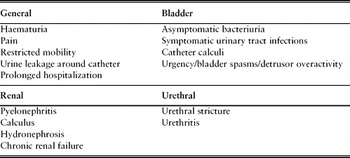
Urinary catheterization can be uncomfortable and is associated with complications (Table 3).Reference Ramakrishnan and Mold39 Short-term use may be appropriate in peri-operative situations, in acutely unwell patients where urine output needs close monitoring and in the presence of local skin complications. When considering using in-dwelling catheterization for intractable urinary incontinence, all other methods of containment should be considered first. A clear indication is needed to justify long-term use. Subsequently, the following issues need consideration:
(1) Who will be caring for the catheter? Will it be the patient, informal carer or formal carer? The appropriate teaching of correct catheter care is essential in reducing the risks of infection. This includes the person's ability to recognize complications and be able to act upon them.
(2) How will the urine be contained? What is the appropriate type of drainage bag? There are a variety of leg bags in differing lengths and shapes to fit the patient's needs, and overnight bags for larger amounts of urine.
(3) Can a catheter valve be used? Catheter valves attach directly to the catheter and allow urine to be stored in the bladder, with drainage at regular intervals or guided by a sensation of bladder filling. This can make the catheter more discreet and improve and maintain bladder tone.Reference Fader, Pettersson and Brooks44 It is also reported that the flushing effect of bladder emptying can reduce incidence of catheter blockage (from encrustation) and urinary tract infections.Reference Sabbuba, Stickler, Long, Dong, Short and Feneley45 Complications may include renal impairment due to failure to empty the bladder. Careful assessment is required to ensure appropriate use and avoidance of complications.
Complications of urethral catheterization

Conclusions
‘Continence aid’ is an umbrella term that includes devices used mostly to contain or prevent incontinence. These are an essential component of the management of people with incontinence, either to promote continence while trying alternative treatments, or when incontinence is refractory to treatment.
Containment aids include absorbent pads, catheters, sheaths for men and body worn urinals. Aids used to prevent incontinence include mobility aids, urinals and intermittent catheters. It is difficult for the healthcare professional to be aware of the wide variety of available products, but a basic knowledge of the types and functions of individual aids will enable a more informed and appropriate choice by healthcare professionals, which should translate to improved compliance and better outcomes. For patients with complex needs, a specialist assessment is recommended.
Conflicts of interest
The authors declared no conflicts of interest.