Introduction
Person–environment fit is one of the most frequently studied concepts in work and organizational psychology. This concept stresses the fact that individuals who can choose a working environment that is congruent with their personal characteristics (e.g., skills, values and needs) will experience more positive work-related outcomes (Kristof-Brown, Zimmerman, & Johnson, Reference Kristof-Brown, Zimmerman and Johnson2005; Piasentin & Chapman, Reference Piasentin and Chapman2006). According to the person–environment fit theory (French, Caplan, & Harrison, Reference French, Caplan and Harrison1982), ‘the misfit between the person and the environment may produce psychological, physiological, and behavioral strains and can take two different forms: (a) the extent to which the demands and requirements of the environment match the skills and abilities of the person and (b) the extent to which the rewards and supplies provided by the environment match the needs and preferences of the person’ (Edwards & Van Harrison, Reference Edwards and Van Harrison1993, p.628). Following Kristof-Brown, Zimmerman, and Johnson (Reference Kristof-Brown, Zimmerman and Johnson2005), it is now recognized that person–environment fit is a multidimensional concept which covers person–organization fit (PO fit), person–group fit, person–supervisor fit, person–vocation fit and, finally, person–job fit. Person–job fit can also be divided into two basic conceptualizations such as demands–abilities fit and needs–supplies fit (NS fit) (e.g., Kristof-Brown, Zimmerman, & Johnson, Reference Kristof-Brown, Zimmerman and Johnson2005; Edwards & Shipp, Reference Edwards and Shipp2007). Because it is important to further investigate the consequences of NS fit (Kristof-Brown & Billsberry, Reference Kristof-Brown and Billsberry2013), and because ‘needs-supplies fit may be the most important type of fit from an employee point of view’ (Cable & De Rue, Reference Cable and De Rue2002, p.875), we use it as our conceptual framework for this study.
This study has two objectives. First, we want to extend our knowledge about defining and assessing specific work-related needs derived from employment quality indicators as a basis for NS fit. We consider this a particularly useful and conceptually more advanced attempt compared with previous efforts to consider employment quality (Burchell, Sehnbruch, Piasna, & Agloni, Reference Brown, Charlwood, Forde and Spencer2014). Following Brown, Charlwood, Forde, and Spencer (Reference Brislin2007), using a subjective appraisal of job quality indicators, we suggest a focus on employees’ needs fulfillment to better understand the meaning of needs at work and to better understand how work-related needs fulfillment may result in positive job attitudes. Second, knowing that PO fit is an important antecedent of organization-focused outcomes (Kristof, Reference Kristof1996; Hoffman & Woehr, Reference Hoffman and Woehr2006), we will particularly focus on the importance of NS fit in this relationship. Indeed, although the scientific literature shows that NS fit is strongly related to job satisfaction or turnover intention, its relationship with job performance is unclear. Recent theorizing on organizational fit (Kristof-Brown & Billsberry, Reference Kristof-Brown and Billsberry2013) indicates that information is lacking on how NS fit is related to both task performance and organizational citizenship behaviors. In our study, task performance will refer to the recurring set of activities or expected behaviors of an individual that are typically described by formal job descriptions (Borman & Motowildo, Reference Borman and Motowildo1993), whereas organizational citizenship behaviors are defined as ‘individual behaviors that are discretionary, not directly or explicitly recognized by the formal reward system, and that in the aggregate promotes the effective functioning of the organization’ (Organ, Reference Organ1988, p.4). More precisely, because little attention has been paid to the underlying psychological mechanisms linking fit perceptions to task performance and organizational citizenship behaviors (Resick, Giberson, Dickson, Wynne, & Bajdo, Reference Resick, Giberson, Dickson, Wynne and Badjo2013), an important aim of this paper is to test the mediating role of organizational identification, using the Cognitive and Affective Personality System (CAPS) Theory (Mischel & Shoda, Reference Mischel and Shoda1995).
Employment quality and work needs
In this project, we will consider job requirements that mirror employment quality indicators as the basis for personal need fulfillment and NS fit.
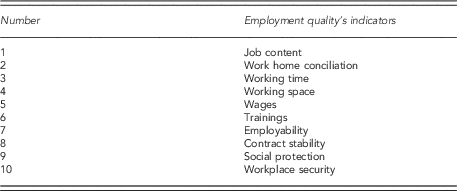
Employment quality has been defined in many different ways, making it difficult to find a consensus among its large number of definitions (Burchell et al., Reference Brown, Charlwood, Forde and Spencer2014). Some academics (e.g., Körner, Puch, & Wingerter, Reference Körner, Puch and Wingerter2009; Green & Mostafa, Reference Greguras and Diefendorff2012; Holman, Reference Holman2013; Van Aerden, Moors, Levecque, & Vanroelen, Reference Van Aerden, Moors, Levecque and Vanroelen2015) and institutions (e.g., Muñoz de Bustillo, Fernandez-Macias, Anton, & Esteve, Reference Muñoz de Bustillo, Fernandez-Macias, Anton and Esteve2009; International Labor Organization, 2012) have attempted to develop a range of indicators to help define employment quality. Globally, these studies have highlighted a large set of characteristics relevant to employment quality, including work organization, wages and payment system, security and flexibility, commitment to skills and development, employment stability, employees’ organization of time, material rewards, workers’ rights and social protection, employability opportunities, safety and ethics employment as well as the work–life balance. In Table 1, we summarized the academic and policy-related approaches, focusing on their overlapping characteristics. This was inspired by the 10 ‘decent work indicators’ provided by the International Labor Organization (2012) and presented by Burchell et al. as ‘a contrasting institutional approach to the dilemma of decent work measurement’ (Reference Brown, Charlwood, Forde and Spencer2014, p.10). This allows for an operationalization of the employment quality concept, or of ‘a good job,’ using 10 indicators: (a) job content, (b) work home conciliation, (c) working time, (d) working space, (e) wages, (f) trainings, (g) employability, (h) contract stability, (i) social protection and (j) workplace security.
Synthesis of the employment quality’s indicators

Following Brown et al. (Reference Brislin2007), the association between high-quality jobs (i.e., ‘good jobs’) and positive job attitudes is based on the perceived fulfillment of work-related needs. This useful and conceptually more advanced approach (Burchell et al., Reference Brown, Charlwood, Forde and Spencer2014), deemed subjectivist, focuses on the importance of fulfilling workers’ needs, as appraised by themselves, relative to objective employment characteristics (e.g., Brown et al., Reference Brislin2007; Holman, Reference Holman2013). Körner, Puch, and Wingerter (Reference Körner, Puch and Wingerter2009) already linked employment quality indicators to Maslow’s (Reference Maslow1958) basic needs. They argued that individuals will perceive their job as ‘good’ – having high employment quality – if, for example, their needs for safety, income, security, social dialogue or skills development are fulfilled. Hence, subjectively evaluated work-related needs are useful to understand how high-quality jobs may result in positive job attitudes. However, in our study, we rely on employment quality indicators as the basis for defining required needs and assess their fulfillment within the framework of NS fit.
Employment quality and NS fit
NS fit, defined as the congruence between the individuals’ needs on the one hand and the experienced job characteristics on the other (Kristof-Brown, Zimmerman, & Johnson, Reference Kristof-Brown, Zimmerman and Johnson2005), refers to the fit between needs and supplies that gives a general perception of need fulfillment (Edwards & Shipp, Reference Edwards and Shipp2007). A number of studies have already highlighted the positive consequences of needs fulfillment on well-being at work and job satisfaction (e.g., Verquer, Beehr, & Wagner, Reference Verquer, Beehr and Wagner2003; Lloyd, McKenna, & King, Reference Lloyd, McKenna and King2004; Edwards & Shipp, Reference Edwards and Shipp2007; Guan, Deng, Bond, Chen, & Chan, Reference Guan, Deng, Bond, Chen and Chan2010; Park, Monnot, Jacob, & Wagner, Reference Park, Monnot, Jacob and Wagner2011; Dylag, Jaworek, Karwowski, Kozusznik, & Marek, Reference Dylag, Jaworek, Karwowski, Kozusznik and Marek2013; Krumm, Grube, & Hertel, Reference Krumm, Grube and Hertel2013), advancing that employees feel satisfied when they perceive a fit between the supplies provided by the organization and their own needs. To explain this process, several authors (e.g., Greguras & Diefendorff, Reference Green and Mostafa2009) have used the Self-Determination Theory (Deci & Ryan, Reference Deci and Ryan2000): if individuals are able to satisfy their innate psychological needs (i.e., need for autonomy, for competence and for relatedness), they will develop their fullest potential and function optimally (Deci & Ryan, Reference Deci and Ryan2000). However, while the Self-Determination Theory presents fundamental psychological needs that govern our behavior in various life domains, we want to extend our knowledge about the effect of needs fulfillment by presenting more specific work-related needs linked to employment quality.
Moreover, based on a more diversified view of work-related needs, and because existing NS fit scales assess NS fit through a global indicator of the fit between the needs and the job characteristics in general (see Cable & De Rue, Reference Cable and De Rue2002; Resick, Baltes, & Shantz, Reference Resick, Baltes and Shantz2007; Greguras & Diefendorff, Reference Green and Mostafa2009), we expect that a global needs–supplies (G-NS) fit perception may be the result of a combination of specific needs–supplies (S-NS) fit perceptions. The Information Integration Theory (Anderson, Reference Anderson1962) supports this assumption. Following this theory, individuals integrate information from a number of sources in order to finally make an overall judgment. Information Integration Theory is thus a general theory explaining how, using ‘cognitive algebra,’ several information sources are combined by an individual to produce a response. According to Anderson’s theory, there are three main steps in the impression formation process. The first is the valuation function, in which individuals map each piece of information on a subjective scale. The second step is the integration function, consisting of the combination of the subjective values of information using adding (i.e., stimulus values) or averaging (i.e., stimulus values) cognitive algebra (Anderson, Reference Anderson1965). The third step is the response production function through which the internal impression is translated into a general response.
Such a differential approach has been advanced in organizational justice research as well. More precisely, the Fairness Heuristic Theory (Lind, Reference Lind2001) suggests that a global impression of fair treatment (i.e., an overall justice perception) is formed quickly through a judgment phase using procedural, distributive and interpersonal justice elements. These specific elements are then aggregated in order to come up with a global justice judgment (see Kim & Leung, Reference Kim and Leung2007; Ambrose & Schminke, Reference Ambrose and Schminke2009).
Thus, following the Information Integration Theory (Anderson, Reference Anderson1962) and the underlying Fairness Heuristic Theory (Lind, Reference Lind2001), we want to investigate whether overall NS fit is the result of underlying specific fit perceptions linked to employment quality characteristics. Therefore our first hypothesis is
Hypothesis 1: A specific work-related NS fit perception in terms of employment quality is positively associated with a G-NS fit perception.
The mediating role of organizational identification
According to several meta-analyses (e.g., Verquer, Beehr, & Wagner, Reference Verquer, Beehr and Wagner2003; Kristof-Brown, Zimmerman, & Johnson, Reference Kristof-Brown, Zimmerman and Johnson2005; Hoffman & Woehr, Reference Hoffman and Woehr2006), PO fit is found to be an important antecedent of organizational outcomes such as turnover intention and organizational commitment. Regarding performance, these meta-analyses show that PO fit is more strongly related to organizational citizenship behavior (e.g., Wei, Reference Wei2013) than to task performance. Nevertheless, up to now, little attention has been paid to the underlying mechanisms linking PO fit perceptions to performance. In this context, the CAPS theory (Mischel & Shoda, Reference Mischel and Shoda1995) suggests how organizational identification may play a mediating role between fit perceptions and behavioral outcomes such as task performance and organizational citizenship behaviors. When an individual perceives that his/her environment has personal relevance, then the CAPS theory states that a set of cognitive–affective reactions are activated that, in turn, generates patterns of behavior. For Mischel and Shoda (Reference Mischel and Shoda1995), there are three main processes at the basis of the motivational mechanisms linking fit to behavioral outcomes: (a) an encoding process, in which individuals make a conscious determination of the degree of fit with their environment, (b) a mediating process, referring to the activation of four cognitive–affective processes resulting from fit perceptions and (c) a generation process, in which behaviors are activated as a result of the preceding processes. Regarding the mediating process, four affective–cognitive mechanisms that provide motivational force can be highlighted (Mishel & Shoda, Reference Mischel and Shoda1995; Kristof-Brown, Zimmerman, & Johnson, Reference Kristof-Brown, Zimmerman and Johnson2005). One of them is social identification through which individuals define themselves in terms of various social group memberships (Banaji & Prentice, Reference Banaji and Prentice1994). In a work environment, organizational identification, defined as ‘a perception of oneness with or belongingness to the organization’ (Ashforth & Mael, Reference Ashforth and Mael1989, p. 21) is considered a kind of social identification (Resick et al., Reference Resick, Giberson, Dickson, Wynne and Badjo2013). Organizational identification has been found to be an important consequence of organizational fit perceptions (Cable & De Rue, Reference Cable and De Rue2002; Saks & Ashforth, Reference Saks and Ashforth2002; Kristof-Brown, Zimmerman, & Johnson, Reference Kristof-Brown, Zimmerman and Johnson2005). When employees perceive congruence between themselves and their organization, they are more likely to define themselves as a member of the organization (Saks & Ashforth, Reference Saks and Ashforth1997). Concerning NS fit, only few studies have demonstrated a link with organizational identification (Cable & Edwards, Reference Cable and Edwards2004) or job performance (Edwards & Shipp, Reference Edwards and Shipp2007). Nevertheless, regarding the CAPS theory, we can reasonably argue that perceiving a fit between employment quality-related needs and the actual job characteristics will activate a set of cognitive and affective mechanisms, positively related to organizational identification which, in turn, will activate positive organizational behaviors such as task performance and organizational citizenship behaviors. Consequently, our second and third hypotheses are as follows:
Hypothesis 2a: Organizational identification mediates a positive relationship between general NS fit and task performance.
Hypothesis 2b: Organizational identification mediates a positive relationship between general NS fit and organizational citizenship behaviors.
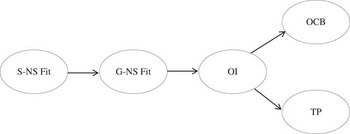
Regarding these hypotheses, Figure 1 summarizes our research model.
Hypothesized model Note. G-NS=global needs–supplies; OCB=organizational citizenship behaviors; OI=organizational identification; S-NS=specific needs–supplies; TP=in-role performance.

Method
Samples and procedure
In order to test the generalizability of our hypotheses with different populations, this study relies on two samples from two different organizational contexts: one private company from the air transport sector and one public company from a Belgian federal administrative service. Given the considerable differences between public and private organizations (Boyne, Reference Boyne2002), these two samples should help us to increase our model generalizability to a large set of workers.
Sample 1
For the first sample, data were collected online (through an electronic link to the survey, for the white-collars) and on-site (through collective sessions, for the blue-collars), in a private Belgian organization from the air transport sector. For both data collections, we explained the purpose of the study and stressed the confidentiality of the responses. Questionnaires were completed by 525 French-speaking workers (response rate=37.4%). Among the participants, 49.3% is blue-collar, 47.8% is white-collar and 2.7% is unknown. A majority of respondents (72%) is male, having between 11 and 20 years of seniority in that company. The average age is 39 years.
Sample 2
The second sample is made up of workers from a Belgian Federal Public Service. Data were only collected online through an electronic link to the survey including in an e-mail explaining the purpose of the study and stressing the confidentiality of the responses. For this study, we randomly selected 525 respondents from a larger data set. In this organization, we had three different professional status levels (from lower to higher): levels A (26.5%), B (55.2%) and C (17.7%). These levels can be compared with a traditional workforce differentiation: blue-collars, clerical and managers. A majority of respondents (88.2%) is male, 56.8% is Dutch speaking and 43.2% is French speaking. The average seniority is 20 years and the average age is 44 years.
Measures
Unless otherwise specified, the questionnaires were originally in English. We followed the back-translation procedure to propose version in French and Dutch (Brislin, Reference Burchell, Sehnbruch, Piasna and Agloni1980).
S-NS Fit
S-NS fit was measured using a newly created questionnaire based on previous interviews (see Travaglianti, Orianne, Pichault, & Hansez, Reference Travaglianti, Orianne, Pichault and Hansez2015) in order to empirically test the relevance of job characteristics as indicators of employment quality as presented in the theoretical section of this paper (see Table 1). This preliminary questionnaire was pretested on a separate snowball sample (N=250).
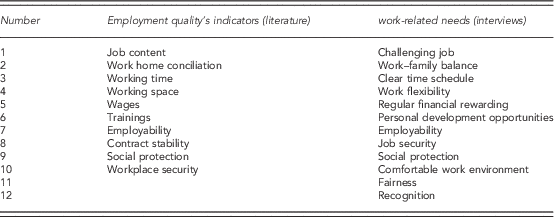
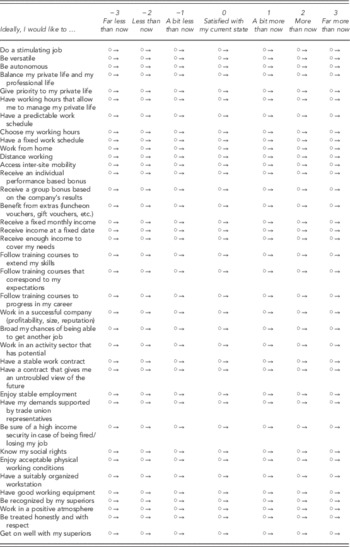
The final questionnaire (see Appendix) consisted of 37 items covering 12 work-related need factors, that is, the need for a challenging job (three items, α=0.58, e.g., ‘Do a stimulating job’), work–family balance (three items, α=0.83, e.g., ‘Balance my private and professional life’), a clear time schedule (three items, α=0.78, e.g., ‘Have predictable work schedule’), work flexibility (three items, α=0.73, e.g., ‘Work from home’) additional rewards (three items, α=0.80, e.g., ‘Receive an individual performance bonus’), regular financial rewards (three items, α=0.82, e.g., ‘Receive a fixed monthly income’), personal development opportunities (three items, α=0.91, e.g., ‘Follow training to extend my skills’), employability (three items, α=0.68, e.g., ‘Broad my chances to get another job’), job security (three items, α=0.84, e.g., ‘Have a stable work contract’), social protection (three items, α=0.73, e.g., ‘Be supported by trade-union’), a comfortable work environment (three items, α=0.85, e.g., ‘Have a good working equipment’), and fairness and recognition from the supervisor (four items, α=0.88, e.g., ‘Be recognized by superiors’) (Table 2).
The employment quality indicators and the work-related needs

The questionnaire was originally developed in French and we followed standard back-translation procedures to present also a Dutch version. For each item, participants were asked to indicate their ideal state as compared with the present state on a 7-point scale from 3=‘would like much less than now,’ to +3=‘would like much more than now’, with 0 (satisfied with my current state) as the middle value.
Since this paper focuses on the importance of fit and not on its valence (i.e., positive or negative fit), further analyses used the absolute values of the original response scale (Warr & Inceoglu, Reference Warr and Inceoglu2012), from 0 (no discrepancy=fit, i.e., satisfied with current state) to 3 (high perceived discrepancy, irrespective of it being negative or positive). In order to increase comprehensibility, we then reversed these scores, indicating that a high value represents optimal fit, and a low value is a misfit (either overfit or underfit).
G-NS Fit
G-NS fit perception was assessed using the 3-item scale developed by Cable and De Rue (Reference Cable and De Rue2002) (e.g., ‘There is a good fit between what my job offers me and what I am looking for in a job’). A 5-point Likert scale ranging from 1=‘totally disagree,’ to 5=‘totally agree’ was used.
Organizational identification
Employees’ identification with the organization was measured using a 5-point Likert scale (1=‘totally disagree,’ to 5=‘totally agree’) with the six-items suggested by Mael and Ashforth (Reference Mael and Ashforth1992) (e.g., ‘When someone criticizes the organization, it feels like a personal insult’).
Organizational citizenship behaviors
Citizenship behaviors were assessed with the Podsakoff, MacKenzie, Moorman, and Fetter (Reference Podsakoff, MacKenzie, Moorman and Fetter1990) scale. For this study, we chose the three items with the highest loading on each of its five dimensions (i.e., altruism, conscientiousness, sportsmanship, courtesy and civic virtue). In this way, we had a total of 15 items (e.g., ‘I help others who have been absent’). A 7-point Likert scale ranging from 1=‘totally disagree,’ to 7=‘totally agree’ was used to answer these items.
Task performance
Task performance was measured using the in-role performance scale developed by Williams and Anderson (Reference Williams and Anderson1991). From this scale, we chose the three items with the highest loading on the single in-role performance factor (e.g., ‘I perform task that are expected of me’). A 7-point Likert scale ranging from 1=‘totally disagree,’ to 7=‘totally agree’ was used to answer these items.
Covariates
Based on the full partial method recommended by Little (Reference Little2013), we accounted for the influence of covariates by specifying paths from all socio-demographic variables to all endogenous and exogenous variables. After running this initial model, we removed the nonsignificant effects. Thus, in sample 1, we controlled statistically for gender, age and status. In sample 2, we controlled for age, status and language. These variables have already been found to correlate with NS fit (e.g., Krumm, Grube, & Hertel, Reference Krumm, Grube and Hertel2013), organizational citizenship behaviors (e.g., Feather and Rauter, Reference Feather and Rauter2004; Beauregard, Reference Beauregard2012; Ng & Feldman, Reference Ng and Feldman2008) and task performance (e.g., Ng & Feldman, Reference Ng and Feldman2008).
Data analysis
We tested our research model using Structural Equation Modeling with maximum likelihood estimation (Mplus 7, Muthén & Muthén, 1998–Reference Muthén and Muthén2014). The model’s goodness-of-fit was evaluated with absolute and relative indices (Kline, Reference Kline2005). As the number of parameters to be estimated was large, relative to the overall sample size, we reduced the number of parameters using the subscale aggregation approach (Drasgow & Kanfer, Reference Drasgow and Kanfer1985). This parceling strategy allowed us to preserve the common construct variance while minimizing unrelated specific variance (Little, Rhemtulla, Gibson, & Schoemann, Reference Little, Rhemtulla, Gibson and Schoemann2013). In this way, our S-NS fit (latent variable) became a superordinate construct (Edwards, Reference Edwards2001) made up of 12 observed variables (our 12 dimensions) created by aggregating their respective items. To test the indirect effects, we used the bootstrapping approach, consistent with several authors (Shrout & Bolger, Reference Shrout and Bolger2002; Preacher & Hayes, Reference Preacher and Hayes2004; Hayes, Reference Hayes2009) who suggested this for studying relations in mediation models, because of the limitations of the traditional Sobel test (Reference Sobel1982). Finally, we used a full information maximum likelihood approach because of missing values being present. Therefore, all available information in the data set was used to estimate the individual log likelihood functions.
Results
Confirmatory factor analyses
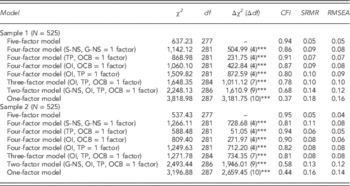
Following Bentler’s (Reference Bentler1990) recommendations, we first examined the fit of our hypothesized five-factor measurement model (i.e., S-NS fit, G-NS fit, organizational identification, organizational citizenship behaviors and task performance). The results indicate that our five-factor model fitted the data reasonably well in both samples (sample 1: χ2 (df)=637.23 (277), p<.001, comparative fit index [CFI]=0.94, standardized root mean square residual [SRMR]=0.05, root mean square error of approximation [RMSEA]=0.05; sample 2: χ2 (df)=537.43 (277), p<.001, CFI=0.95, SRMR=0.05, RMSEA=0.04).
Next, starting from this five-factor model, we compared its fit with a series of alternative and more constrained measurement models to ensure that the predicted model best reflected the data structure and to ensure that our constructs were independent (Anderson & Gerbing, Reference Anderson and Gerbing1988). In this way, in both samples, we compared our five-factor model with (a) a four-factor model (S-NS fit, G-NS fit=1 factor), (b) a four-factor model (task performance, organizational citizenship behaviors=1 factor), (c) a four-factor model (organizational identification, organizational citizenship behaviors=1 factor), (d) a four-factor model (organizational identification, task performance=1 factor), (e) a three-factor model (organizational identification, task performance, organizational citizenship behaviors=1 factor), (f) a two-factor model (G-NS fit, organizational identification, task performance, organizational citizenship behaviors=1 factor) and finally (g) a one-factor model (all variables as a unique factor). χ2 difference tests were then used to compare the fit of each of these nested models with that of the five-factor model (Bentler, Reference Bentler1990).
Results of these confirmatory factor analyses indicate that, in both samples, the five-factor model was significantly superior to all alternative models. Consequently, we treated these five constructs as independent from each other in subsequent analyses. Fit indices for these alternative models are presented in Table 3.
Confirmatory factor analysis fit indices for measurement model

Note. CFI=comparative fit index; G-NS=global needs–supplies fit; OCB=organizational citizenship behaviors; OI=organizational identification; RMSEA=root mean square error of approximation; S-NS=specific needs–supplies fit; SRMR=standardized root mean square residual; TP=in-role performance.
*p<.05, **p<.01, ***p<.001.
Relationships among variables
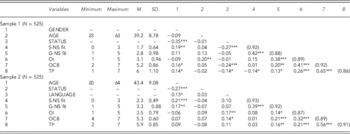
Means, standard deviations, Cronbach’s αs and correlations among variables are presented in Table 4.
Descriptive statistics and intercorrelations among variables

Note. Cronbach’s αs are provided on the diagonal.
AGE=age; GENDER=gender (men coded 0; women coded 1); G-NS, Global Needs–Supplies Fit; LANGUAGE=language (Dutch coded 0; French code 1); S-NS=specific needs–supplies fit; STATUS=status; OCB=organizational citizenship behaviors; OI=organizational identification; TP=in-role performance.
*p<.05, **p<.01, ***p<.001.
Test of the research model
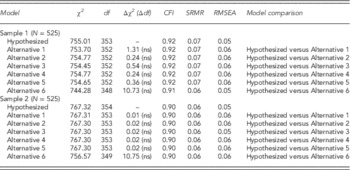
In order to investigate partial mediation instead of total mediation, we compared the fit of our hypothesized model with a series of alternative models to ensure that our hypothesized model offered the best depiction of our data. In this way, we successively added direct theoretically plausible paths (James, Mulaik, & Brett, Reference James, Mulaik and Brett1982) to our latent variables (see Table 5). We thus added a first path between S-NS fit and organizational identification (alternative model 1). We then compared this alternative model 1 with our hypothesized model using a χ2 difference test ( & Griffin, Reference Gonzalez and Griffin2001). As the χ2 difference test showed no significant result, we did not retain alternative model 1 as superior to our hypothesized model. Next, starting from the hypothesized model, we successively added a second path between S-NS fit and organizational citizenship behaviors (alternative model 2), a third path between S-NS fit and task performance (alternative model 3), a fourth path between G-NS fit and organizational citizenship behaviors (alternative model 4), a fifth path between G-NS fit and task performance (alternative model 5) and finally we included all five paths (alternative model 6). In both samples, and following the same procedure as explained above for alternative model 1 (χ2 difference test), none of these alternative models showed a significantly better fit than our hypothesized model. As shown in Table 5, in both samples, our hypothesized total mediation model (Figure 1) presented better fit indices (sample 1: χ2 (df)=755.01 (353), p<.001, CFI=0.92, SRMR=0.07, RMSEA=0.05; sample 2: χ2 (df)=767.32 (354), p<.001, CFI=0.90, SRMR=0.06, RMSEA=0.05). Thus, the best model is the one with no direct link, therefore we get no support for a total mediation model. Hence, we retained the hypothesized model as the best fitting model.
Fit indices for structural models

Note. CFI=comparative fit index; G-NS=global needs–supplies fit; OCB=organizational citizenship behaviors; OI, organizational identification; RMSEA=root mean square error of approximation; S-NS=specific needs–supplies fit; SRMR=standardized root mean square residual; TP=in-role performance; Alternative 1=direct path between S-NS and OI; Alternative 2=direct path between S-NS and OCB; Alternative 3=direct path between S-NS and TP; Alternative 4=direct path between G-NS and OCB; Alternative 5=direct path between G-NS and TP; Alternative 6=all paths together; ns=not significant.
*p<.05, **p<.01, ***p<.001.
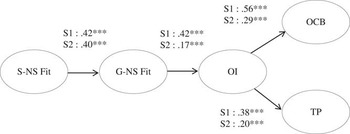
Standardized parameter estimates for the final model are shown in Figure 2. In order to make it more comprehensible, only structural relationships are shown and the effects of the covariates are described in the text. In sample 1, status was positively related to G-NS fit (γ=0.12, p<.05) and negatively to S-NS fit and organizational citizenship behaviors (γ=−0.33, p<.001; γ=−0.14, p<.001, respectively). Age was positively related to organizational identification (γ=0.12, p<.05) but not to S-NS fit (γ=0.10, p>.05). Gender was not significantly related to neither S-NS nor G-NS fit (γ=0.11, p>.05; γ=0.07, p>.05, respectively). In sample 2, age was positively related to S-NS and G-NS fit (γ=0.20, p<.001; γ=0.10, p<.05, respectively), status was positively related to G-NS fit and organizational identification (γ=0.13, p<.05; γ=0.13, p<.05, respectively) and finally language was positively related to organizational identification (γ=0.16, p<.01). Controlling for these variables, S-NS fit was positively associated with G-NS fit (sample 1: γ=0.42, p<.001; sample 2: γ=0.40, p<.001) which, in turn, was positively associated with organizational identification (sample 1: β=0.42, p<.001; sample 2: β=0.17, p<.001) which, in turn was positively associated with organizational citizenship behaviors and in-role performance (sample 1: β=0.56, p<.001; β=0.29, p<0.001, and sample 2: β=0.38, p<.001; β=0.20, p<.001, respectively). Our first hypothesis, Hypothesis 1 is thus supported.
Final model Note. Completely standardized path coefficients. G-NS=global needs–supplies; OCB=organizational citizenship behaviors; OI=organizational identification; S-NS=specific needs–supplies; TP=in-role performance.

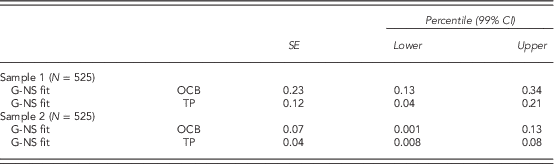
Regarding the indirect effect of S-NS fit on organizational citizenship behaviors and task performance (via organizational identification), bootstrap analyses indicated, in both samples, that no confidence interval included 0, highlighting the significance of the indirect effect (sample 1: p<.001, and sample 2: p<.05) (see Table 6). Hypotheses 2a and 2b, suggesting for the mediating role of organizational identification, are thus fully supported.
Mediation of the effects of global needs–supplies (G-NS) fit on organizational citizenship behaviors (OCB) and in-role performance (TP) through organizational identification (OI)

Note. 1000 bootstrap samples.
CI=confidence interval.
Discussion
Considering the importance of undertaking additional research on NS fit and on the underlying mechanisms linking needs fulfillment perceptions to organizational outcomes (Kristof-Brown & Billsberry, Reference Kristof-Brown and Billsberry2013), the present study had two objectives. First, we have revealed the relevance of 12 specific work-related needs, and their subjective assessment, linked to employment quality. We have converted existing knowledge on employment quality, both from a policy-related and an academic point of view, into work-related needs and shown its pertinence for NS fit research. We have thus shown that NS fit is affected by various specific work-related needs, and can be considered a multidimensional construct, contrary to its traditional treatment as a unidimensional construct (Cable & De Rue, Reference Cable and De Rue2002). Second, although NS fit is strongly related to job-related outcomes such as job satisfaction (Kristof-Brown, Zimmerman, & Johnson, Reference Kristof-Brown, Zimmerman and Johnson2005), we have contributed to clarifying the mediation effect of organizational identification in the relationship NS fit and behavioral outcomes.
Our first hypothesis: ‘a specific work-related NS fit perception in terms of employment quality is positively associated with a G-NS fit perception,’ is fully supported in both our samples. This can be explained through the Information Integration Theory (Anderson, Reference Anderson1962). This theory suggests that individuals integrate information from a number of (related) sources before making an overall judgment. In the context of our research, employees first judge whether their experienced job characteristics fulfill their specific employment quality-related needs before they have an overall NS fit perception regarding their job in general. Such a differential approach has also been advanced in organizational justice research (see Kim & Leung, Reference Kim and Leung2007; Ambrose & Schminke, Reference Ambrose and Schminke2009) leading to the Fairness Heuristic Theory (Lind, Reference Lind2001).
Thus, while NS fit is traditionally seen as a single-factor concept (e.g., Cable & De Rue, Reference Cable and De Rue2002; Resick, Baltes, & Shantz, Reference Resick, Baltes and Shantz2007; Greguras & Diefendorff, Reference Green and Mostafa2009), the present study highlights that individuals have S-NS fit perceptions based on 12 work-related needs associated with employment quality. This builds on the work of a number of instances involved in employment quality initiatives at a European level, whether policy- or academic-related. It seems that such endeavors are considered important by employees themselves, creating expectations about their fulfillment beyond any institutional or safety objective.
Our second and third hypotheses, Hypothesis 2a: ‘organizational identification mediates a positive relationship between general NS fit and task performance’ and Hypothesis 2b: ‘organizational identification mediates a positive relationship between general NS fit and organizational citizenship behaviors,’ are fully supported in both our samples. According to our results, NS fit perceptions are positively associated with behavioral outcomes such as task performance and organizational citizenship behaviors, only through organizational identification. This result is in line with the CAPS theory (Mischel & Shoda, Reference Mischel and Shoda1995) and suggests that organizational identification is an important cognitive mechanism through which perceived NS fit is linked to behavioral outcomes. Indeed, while organizational identification has already been found to be a consequence of PO fit perceptions (e.g., Saks & Ashforth, Reference Saks and Ashforth2002), our results advance that NS fit is also positively associated with organizational identification, confirming the few studies which have already explored this relationship (e.g., Cable & Edwards, Reference Cable and Edwards2004). More precisely, the present study highlights a new underlying process in the development of performance. Indeed, our results stress the importance of organizational identification in the relationship between NS fit perceptions, task performance and organizational citizenship behaviors. Therefore, we consider our study a promising first step towards better understanding the underlying mechanisms linking fit perceptions to job attitudes.
In view of the full mediation of the fit–outcomes relationship by organizational identification, it has to be emphasized that the claim that ‘a current unfulfilled need will motivate performance when anticipated supplies are expected to fulfil this need, indicating that needs fulfilled by current supplies have no motivating potential’ (Edwards & Shipp, Reference Edwards and Shipp2007, p. 229), is not supported by our data. In our study, even if employees perceived that their job characteristics fulfilled their work-related needs, they tended to indicate that they performed better and developed organizational citizenship behaviors, but only through their increased identification to the organization. Moreover, examining the intercorrelations among variables (Table 4), we note a negative relationship between S-NS fit and in-role performance (especially in sample 1; r=−0.14, p<.05). Without implying any causality, we may advance that a S-NS fit perception (based on 12 work-related needs) does not have the same motivational potential as a G-NS fit perception. In other words, when an individual perceives a fit between his/her needs and his/her job in general, (s)he will be motivated to perform. Conversely, perceiving a fit on different job facets does not seem sufficient to enhance job performance. In that case, referring to Edwards and Shipp’s (Reference Edwards and Shipp2007) assumptions, one may believe that it is simpler for the organization to provide supplies in order to fulfill certain specific unfulfilled needs, than to alter an overall NS fit perception. Consequently, employees will tend to be less motivated and perform less well.
Limitations and future directions
This study is not without limitations. First, we used self-reported data, which may lead to common method bias. Nevertheless, this bias was partially addressed through our confirmatory factor analyses showing, in both our samples, a single-factor model showed a poor fit to the data (i.e., Harman’s single-factor test; Podsakoff, MacKenzie, & Podsakoff, Reference Podsakoff, MacKenzie and Podsakoff2012). Second, our research design was cross-sectional, which precludes making inferences of causality among the variables. A longitudinal design should help us to be sure about the direction of our relationships and about the processes underlying the general NS fit perceptions. Finally, although we tested our hypotheses within two organizational contexts, additional research must be undertaken to generalize our findings even further. It would thus be useful to conduct additional studies to extend the validation of our newly created questionnaire and to test the direction of our relationships with a longitudinal design and in different populations.
Practical implications
Our results are also important for managerial practice. Indeed, the positive links between NS fit and behavioral outcomes suggest that managers ought to focus much more on work-related needs fulfillment and not only on a good demand–ability fit for successful job performance. Moreover, because organizational citizenship behaviors are important to enhance organizations’ success (Podsakoff, Whiting, Podsakoff, & Blume, Reference Podsakoff, Whiting, Podsakoff and Blume2009), we encourage managers to consider such behaviors more thoroughly. These suggestions emphasize the role of the manager in encouraging workers’ performance. They also recognize the need for an enhanced understanding of the skills, abilities and behaviors managers require if they are to prevent and reduce stress at work (i.e., management that tries to manage workload and resources, to deal with work problems, etc.; Yarker, Lewis, & Donaldson-Feilder, Reference Yarker, Lewis and Donaldson-Feilder2008). Our results also imply the need to restore what is called proximity management, that is, managers who try to make effective professional relationships and mutual respect coexist in a powerless context (Bourion, Reference Bourion2001). In such a context, the manager should be able to maintain and consolidate a trust relationship with his/her employees (Bourion & Persson, Reference Bourion and Persson2006). In our opinion, and regarding individuals’ needs, it is important for managers to know their team and individuals’ specific needs in order to motivate them to engage in citizenship and task performance.
Acknowledgements
None.
Conflicts of Interest
None.
Financial Support
This research was funded through the ARC grant, financed by the French Community of Belgium (University of Liège – ARC 2011, Flexicurity).
Publishing Ethics
This manuscript is an original work that has not been submitted to nor published anywhere else. All authors have read and approved the paper and have met the criteria for authorship listed above.
Appendix
Specific needs–supplies fit questionnaire