1. Introduction
Evolutionary convergence is often used to support claims about multiple realization. The idea is that convergence shows that the same function can be realized by different kinds of structures (Block and Fodor Reference Block, Fodor and Block1980; Kincaid Reference Kincaid1990). In the classic cases in biology, we are offered examples like the wings or eyes of different species. What these examples are supposed to show is that species from unrelated taxa have developed functionally identical structures (e.g., ‘eyes’) that differ in their anatomical details. The common level of functional organization in the structures is due to the similar selective pressures of the species’ environments. Because of the species’ environments in the past, there were similar pressures operating among them that produced identical solutions to the problems the environments posed. This explains why evolutionary convergence is thought by many to be so important. An understanding of convergence is important for understanding the distribution of functional properties that exists in nature. The ideal is for the functional similarities to be identified by researchers in biology and embodied in their generalizations.
The nature of convergence, though, is more complicated than it might appear at first look. Broad claims about convergence are made by researchers in biology during general discussions of the mechanisms of evolution. In their specialized work, however, researchers are often more limited in the claims they make (Hildebrand and Goslow Reference Hildebrand and Goslow2001; Suomi and Immelmann Reference Suomi, Immelmann and Rajecki1983). The idea that convergence produces the same functional kinds across species is recognized to be a simplification that needs to be qualified. This paper will look at researchers’ specialized work to show how claims about convergence can be oversimplified. The way researchers in biology think about the issue, I believe, has important implications for our understanding of functional kinds. One of the morals I will draw is that in the standard cases there is more diversity among the functional kinds than is usually supposed, and that evolutionary convergence does not provide support for certain claims about multiple realization.
In what follows, I will focus on the details of the eyes case. This is one of the classic cases of convergence in biology and provides an excellent example to consider.Footnote 1 I will, first, describe in some detail the structures of human, octopus, and fly eyes. By attending to the details of the structures we will be able to correct some common misunderstandings. After I have described the details of the structures, I will then explain how researchers group the eyes into functional kinds.
2. Three Kinds of Eyes
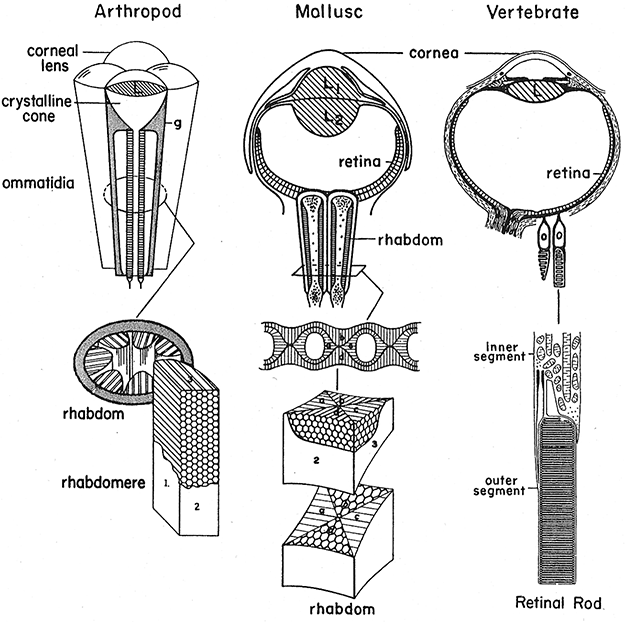
We can begin with the compound eye of Drosophila melanogaster (see Figure 1).Footnote 2 The compound eye consists of more than 700 units or ommatidia. Each ommatidium consists of a tube-like structure that contains a corneal lens and crystalline cone. Within each ommatidium are several receptor cells that contain the rhabdomeres, or light sensitive receptors. The light falling on the lenses is refracted onto the rhabdomeres, which have small microvilli that project into the center of the structures. Within the rhabdomeres are the visual pigments for transducing the light energy into neural signals. Two properties of the compound eye worth noting are that (1) the focusing power of the eye cannot be adjusted. Since the lenses of the ommatidia are fixed to the ends of the structures, the eye has no means of accommodation. The eye images best within about 20 cm, and to view objects farther away, Drosophila has to move closer to them. (2) Drosophila's eye contains two kinds of visual pigments and color vision is possible. The two visual pigments are sensitive in different regions of the electromagnetic spectrum: one absorbs wavelengths around 510 nm, and the other in the ultraviolet range. The ability to perceive wavelengths in the ultraviolet enables the flies to perceive parts of the world that we are perceptually unaware of.
Phylogenetic structural relationships in eyes (Wolken Reference Wolken1995, 181). Used by permission of Oxford University Press.

The next eye to consider is the human eye, which has been likened to a camera. The human eye is spherical in shape, and in adults is about 2.5 cm in diameter. The eye contains a cornea and lens through which the light enters the eye. The lens focuses the entering light with the help of muscles that change its shape for different distances. When the muscles are relaxed, the lens assumes a flatter position for focusing on distant objects. For focusing on nearby objects, the muscles contract to bend the lens and bring the objects into focus.
The back of the eye contains the retina that consists of several layers of photoreceptors and other neural cells. The photoreceptors consist of rods and cones for transducing the light into neural signals. The neural layer contains a mass of differentiated cells. The differentiated neural layers form the information processing system within the retina. The other properties of the eye to mention include (1) that the photoreceptors are reversed. The photoreceptors do not point towards the light, but face away from it behind the other retinal layers. So the light entering the eye has to travel through the layer of neural cells before reaching the receptors. And (2) the capacity of the eye for color vision. The cones in the retina contain three kinds of visual pigments sensitive at 430 nm, 535 nm, and 565 nm. When the cones are activated by light of different wavelengths, the visual cortex translates this into our perception of color.
The Octopus vulgaris has the last eye to consider. In textbooks the eye is often said to have the same structure as the human eye, but when we look closely it is apparent that there are differences. The eye consists of a spherical shell like the human eye. The refraction of light in the octopus eye is accomplished by the cornea and lens. The lens lies behind the iris, which in the octopus is rectangular. Also the method of accommodation used is different from the human eye. The muscles in the octopus eye move the lens backwards and forwards within the shell (without bending). The octopus eye functions more like a camera than the human eye in this respect, since bending the lens would, of course, be quite difficult to do with a camera.
The retina lies at the back of the eye. There are a limited number of retinal layers, and the majority of the processing occurs in the optic lobe in the brain. Some of the other properties of the eye to note are that (1) the receptors are of a single kind. Their number is less than the total number of rods in the human eye, which suggests that the image the eye produces is coarser. (2) The receptors have a structure like the rhabdomeres of Drosophila's eye. The result is that the octopus has the optical system of the vertebrate eye, but the photoreceptor system of the invertebrate eye. This helps to explain why the convergence between human and octopus eyes has not led to structures that are of identical types (more on this below). And (3) the photoreceptors contain only one kind of visual pigment that is sensitive around 475 nm. Since only one kind of visual pigment exists, that means the octopus is colorblind. Part of the reason for this is that octopi live in the ocean, which screens off most of the light except in the blue-green region.
3. The Functional Properties Involved
We have seen that the three kinds of eyes have differences in their structural properties. The eyes are different in their optical systems, their receptor systems, the kinds of visual pigments they contain, and so forth. Despite this fact, it is commonly said that the eyes belong to the same functional kind. The structures are ‘light receptors’ because they each serve to respond to light in the environment. The different kinds of structures are merely the different ways that nature has created to realize the property of being a light receptor.
But this way of describing the situation is somewhat misleading. For we have seen that there are differences in the functions the structures have. There are differences not only in the structural details of the eyes, but also in their capacities. The differences are related to the kinds of information the structures provide about the environment. For example, the human eye is capable of perceiving colors while the octopus eye is monochromatic. The human eye is capable of changing its focus for distances while the fly's powers of accommodation are fixed. The fly eye provides for cruder images and is good at detecting motion while the human eye is designed to provide images of higher resolution. And finally, we can add that the octopus eye is capable of perceiving the plane of polarized light while the human eye is not (which is useful for navigation). Notice that the differences involved here are not merely differences in magnitude among the functions of the structures. The functions performed by the human eye (say) are not just an intensification of the functions performed by the others. There is some overlap among the functions the three kinds of eyes perform, but the capacities present in some of the eyes are not present in the others. The differences in the functions of the eyes are related to differences in the kinds of capacities that they possess.
This is also how researchers describe the situation in their specialized work. They do not claim simply that the eyes have the same function of light reception. They are aware that there are differences among the structures, and that characterizing them as having the same function is, in fact, a simplification. For example, Packard describes the situation like this in speaking of the relation between fish and cephalopod eyes (note that the same point also applies to the human and cephalopod eye). In his discussion of the similarities that are produced between these groups, he notes that “… the resemblances between cephalopods and fish when pressed beyond a certain point are never complete, even at the functional level” (Reference Packard1972, 287).Footnote 3 He recognizes that convergence has produced similarities among the functions of the structures, but also that there are differences that exist as well.
Researchers on vision know that the differences need to be understood to characterize the nature of the structures. Describing an eye as a ‘light receptor’ has a limited use for characterizing the structures. This is because describing an eye in these terms indicates merely that the structure responds to (i.e., detects) information from light in the environment. But this is not sufficient to characterize what vision consists in for the species, since the eyes do more than just respond to light. We know that the human eye, for example, does not only respond to light in the environment, but acquires information about the color, shape, and distance of objects present in its field of view. Each of the capacities described is involved in providing different kinds of information about the environment. To characterize how the human or other kind of eye works, one needs to understand the contribution made by each of these capacities. The function of vision really refers to a complex of capacities that are involved in processing the information that is received from the environment. When we examine them closely, it becomes apparent that the function of vision is different in each of the species because the way the information is processed by each of the structures differs. The suggestion that the eyes perform the same kind of function does not reflect the differences that exist among the structures.
I think that this is the correct way of describing the situation. It may be replied, however, that this account of the functions of the eyes is problematic. We can surely accept that there are differences among the structures we have examined, and it may be that there are related differences in some of their capacities. But our basic interest is with finding similarities across the structures and with making generalizations.
This reply misunderstands why the differences among the eyes are important to researchers (beyond their intrinsic interest). Researchers are interested in finding generalizations where they can get them, of course. The three kinds of eyes that we described belong to species that live in environments with similar selective pressures. Given that the species faced similar problems in their environments, researchers want to understand how the eyes deal with the problems in similar ways. By understanding the environments of the species they can explain why a common level of functional organization developed in the structures. And an understanding of the common level of organization is what enables them to devise the generalizations they want.
But the eyes that species have did not only develop in similar environments. The eyes also developed in their local environments, and the structures they have reflect the demands of those environments (Cook Reference Cook, Greenberg and Haraway1998, 332; Schiffman Reference Schiffman1990, 201). It is important to recognize the effects of the local environments on the structures as much as the effects of the environments that are similar to the species. For we know that the development of the eyes is affected by these environments as much as by the similar environments the species occupy. A good illustration of this is the capacities of Drosophila's eye. The compound eye is capable of imaging ultraviolet light to acquire information about the features of its environment. The local environment the species lives in places specific demands on the capacities of the species’ eye: to be capable, e.g., of imaging the ultraviolet light that is present in its surroundings. Drosophila is able to use this resource because it developed the capacity to acquire the information that is not shared by the other species. The capacity enables the species to make use of resources in the environment that are helpful for it in certain ways. It is these kinds of features of the eye that researchers are interested in accounting for. The capacity to detect ultraviolet light is one of the capacities (along with the discrimination of form, color, depth, etc.) that researchers know make up the visual system of a particular species. An understanding of the capacity is part of understanding the patterns that are distinctive to the species’ behavior.
This helps to explain why the differences among the eyes are important to researchers. The three kinds of eyes can be classified as light receptors if we want to group them at a general level. But, in itself, this is not an interesting way of characterizing the structures. Merely focusing on a feature that the structures have in common overlooks the other features that are relevant to explaining how the structures work. To be adequate, the characterization of the eyes should also include the relevant differences that exist among the structures. When the differences are included, what we see is that the category of ‘light receptors’ refers to a group of structures that differs functionally in certain ways. The selection pressures have created some similarities in the structures, but there are also important differences to be noted.
Let me explain how I see this relating to claims made about multiple realization. There are two points that I want to make about this issue. First, it is important to claims about multiple realization that the structures in question have the same kinds of function. Being merely related in function in some way to the other kinds of structures is not sufficient. This is why claims about convergence, I think, need to be accepted with some amount of caution. The case of light receptors we have considered suggests that the similarities produced by convergence are rough in nature, and that they do not support the kinds of uses that proponents of multiple realization would like them for. This is not to deny, of course, that the category of ‘light receptors’ may play a role in enabling researchers to refer to a group of structures that have some of their features in common. But to admit this is not to say that the group of structures referred to must have the same kinds of functions when considered more carefully. The details of the case do not reveal the kinds of similarities that one might have thought existed based on a casual consideration of the structures.Footnote 4
Second, this point is related to the kinds of generalizations that one can expect to find in the present case. I have said that the structures can be classified as ‘light receptors’ if we need a way to group them together. But the problem with this is it is hardly informative to be told that the eyes all function to respond to light. Researchers in vision science are concerned to discover more interesting empirical generalizations than this. Their interest is with finding generalizations that can be used to explain a broad range of facts about the structures. The difficulty is that there is little more in common among the structures to be the basis of such generalizations. Given the differences that are present, there are only a limited number of generalizations about the eyes that hold across all the structures. This point should be evident from the kinds of facts about the structures that we have been considering so far. If we broaden our scope to consider other kinds of structures in addition to this (such as non-image-forming eyes), we will see that the differences only become more apparent. There is no interesting set of generalizations that can be applied universally to the kinds of features that all the structures have.
It is important to see that this fact conflicts with one of the reasons for appealing to multiple realization in the first place. One of the reasons was to identify a common level of functional organization about which researchers can make interesting generalizations (Putnam Reference Putnam1975). General functional categories were needed to enable researchers to express the commonalities that exist across the structures. What ‘interesting’ amounts to in this context, of course, is somewhat open, but the initial suggestion referred to categories that ranged across widely divergent taxa. Putnam mentioned the desire for species-independent laws that were universal in nature (Reference Putnam1975, 437). So it is apparent that the commonalities were to extend to a wide range of species indeed. What we have seen with our example, I think, is that the diversity that exists among the structures will preclude this possibility. Because of the diversity among the functions they have, there is no interesting set of generalizations that applies across all the different kinds of structures. If evolutionary convergence is supposed to underwrite a set of generalizations that applies across a very wide range of taxa, then I believe that there is little chance that this can be done. It may be the case that convergence had led to there being similarities of certain kinds among the eyes. But, even granting this, this is different from saying that convergence can underwrite a general theory of vision that applies across all the different kinds of structures we described.
4. The Role of Convergence
Let me now return to the role of convergence. I have suggested that there are differences in the functions of the eyes when we consider them carefully. But this raises the question that, if the differences exist as I have claimed, why are the eyes used as an example of evolutionary convergence? Why do biologists say that convergence has produced structures with related kinds of functions? The answer is that convergence produces functions in the structures that are roughly similar to one another in some way. We have seen this from our consideration of the structures. Take the human and fly eyes as an example. The structures are image-forming eyes, they have photoreceptors for transmitting the information about light, etc. These features have led the eyes to function in somewhat related ways. This is why the eyes are treated as a standard example of convergence in biology. But we have noted that the similarities in the functions do not extend to a fine-grained level. We have seen that there are differences in the eyes in their methods of accommodation, their receptor types are different, and the kinds of stimuli they respond to are different. The differences between the structures show that convergence has not produced functions of the same kinds. The most we can say is that convergence has produced functions in the structures that are roughly similar. That convergence usually leads to rough similarities is recognized by researchers as well. For example, the physiologists Hildebrand and Goslow explain this by saying: “Convergence is evolutionary change in two or more lineages such that corresponding features that were formerly dissimilar become similar. Descendants are more alike than were their ancestors, though the similarity seldom extends to correspondence of detail” (Reference Hildebrand and Goslow2001, 18).Footnote 5 The products of convergence for them are structures whose functions are merely more or less similar to one another.
The fact that the functions are only roughly similar is what makes them problematic in the present context. Some think that if there are similarities at all that are produced by convergence, then we have grounds for speaking of there being kinds at a general level. But this idea is not as plausible as it may seem. The presence of superficially similar functions is not by itself sufficient to support talk of a scientifically useful kind. That is, we should not infer from there being such similarities that there is a genuine kind that can figure in a scientific theory. Whether there is depends on the details of the particular structures in question. I mention this because I think that we need to be more careful in talking of convergence producing structures with the same kinds of functions. Whether there are enough similarities in a given case to support the claims that proponents of multiple realization make is a matter for empirical investigation. Furthermore, we need to keep in mind that there is no ubiquitous process of convergence that applies in the same way to every kind of structure. The similarities involved will vary in extent depending on the nature of the structures.
5. Conclusion
I have considered the relation between functional properties and the similarities produced by evolutionary convergence. As I mentioned, we are often told that convergence shows that the same function can be realized by different kinds of structures. I have tried to show that claims about convergence are more complicated than they might appear. The claim that convergence produces functions of the same kinds is an oversimplification. As we have seen in the case of eyes, the features produced are not the same across the structures. The most we can say is that convergence produces superficial similarities in different degrees of more or less. Now, I am willing to admit that there are cases in biology where the similarities present are worth observing. My point has been to show that the similarities involved are typically more superficial than is claimed. When we look closely at the structures, we see that there is more diversity among the functions than might be thought. This point is worth noting since it should make us wary of appeals to convergence that one sometimes finds being offered. From the fact that convergence occurs among the functional properties of different species, we cannot simply infer that the functions are of the same kinds. The extent to which the functions are similar is an empirical question, and one that needs to be decided on a case-by-case basis.