


Introduction
Psychological therapies have been shown to be effective for a variety of mental health difficulties. Cognitive behavioural therapy (CBT) has been reported as being the most research evidence-based therapy for depression and anxiety (Clark, Reference Clark2011; Cuijpers et al., Reference Cuijpers, Donker, Weissman, Ravitz and Cristea2016). The Improving Access to Psychological Therapies (IAPT) programme was an initiative launched in 2008 by the UK Government. The driving force behind this creative program was the Depression Report published by Lord Layard (Layard, Reference Layard2006). The report highlighted the crucial demand to improve the provision of psychological treatments, from both clinical and economic perspectives. The IAPT programme aims to improve access to evidence-based psychological treatments for depression and anxiety disorders (Shafran et al., Reference Shafran, Clark, Fairburn, Arntz, Barlow, Ehlers and Salkovskis2009) in line with the National Institute for Health and Clinical Excellence (NICE) guidelines. IAPT services use a stepped care model to deliver these interventions (Clark and Ehlers, Reference Clark and Ehlers1993; Shapiro et al., Reference Shapiro, Raymond and Arnell1994), which has been considered a more efficient use of therapy resources (Hamilton et al., Reference Hamilton, Hicks, Sayers, Faulkner, Larsen, Patterson and Pinfold2011; Scogin et al., Reference Scogin, Hanson and Welsh2003).
IAPT services are required to collect a minimum data set (MDS) at every clinical session to help evaluate the effectiveness of the treatments on offer. MDS consists of Patient Health Questionnaire (PHQ-9; Kroenke et al., Reference Kroenke, Spitzer and Williams2001), the Generalized Anxiety Disorder measure (GAD-7; Spitzer et al., Reference Spitzer, Kroenke, Williams and Löwe2006), phobia scales and Work and Social Adjustment Scale (Mundt et al., Reference Mundt, Marks, Shear and Greist2002). All clinical data collected, including MDS, are securely sent to NHS Digital on a monthly basis where the data are analysed and a monthly report outlining the service’s performance, including the recovery rates, are reported nationally. Recovery rate refers to the percentage of patients in IAPT services who have started treatment above caseness, reaching the score of 10 or more on PHQ-9 and/or score of 8 or more on GAD-7, and ended treatment with a score of 9 or less on PHQ-9 and 7 or less on GAD-7. Patients who have attended two or more treatment sessions will be included in the calculation, including those who have dropped out. The latest national evaluation study reported an average recovery rate of 50.7% nationally for all IAPT services (NHS Digital, 2018). Previous studies showed that patients who attended a greater number of treatment sessions showed a better clinical recovery (Gyani et al., Reference Gyani, Shafran, Layard and Clark2011). However, there are a high proportion of individuals failing to complete the full course of their offered treatment (Chan and Adams, Reference Chan and Adams2014) and focusing on the drop-out rate of treatment is considered to be an important area of research (Binnie and Boden, Reference Binnie and Boden2016). Yet little is known about the experiences of patients who discontinue their therapy, if they feel better or worse and what may contribute to their recovery.
Previous research suggests that different components could predict the drop-out rates from treatment including a low standard of education (Keijsers et al., Reference Keijsers, Kampman and Hoogduin2001), higher levels of social deprivation (Grant et al., Reference Grant, McMeekin, Jamieson, Fairfull, Miller and White2012; Self et al., Reference Self, Oates, Pinnock-Hamilton and Leach2005), psychological distress (Saxon et al., Reference Saxon, Barkham, Foster and Parry2017), avoidance (Lincoln et al., Reference Lincoln, Rief, Hahlweg, Frank, Witzleben, Schroeder and Fiegenbaum2005), high depression (Jarrett et al., Reference Jarrett, Minhajuddin, Kangas, Friedman, Callan and Thase2013), low motivation (Keijsers et al., Reference Keijsers, Kampman and Hoogduin2001), higher level of risk to self (Binnie and Boden, Reference Binnie and Boden2016), type of therapy format patients received (Karekla et al., Reference Karekla, Constantinou, Ioannou, Gloster and Kareklas2019) and personal circumstances such as work commitments and physical illness. Rachael et al. (Reference Rachael, Blackhall, Jones and Law2010) reported that drop-out rate for psychoeducation courses was more significantly associated with personal circumstances (75%) than dissatisfaction with the course (25%). A qualitative study by Marshall et al. (Reference Marshall, Quinn, Child, Shenton, Pooler, Forber and Byng2016) found that the rigidity of the service and the waiting process were also the main contributing factors for discontinuation of therapy. Although there were no differences found between factors contributing to drop-out rates amongst psychological treatment approaches (Grant et al., Reference Grant, McMeekin, Jamieson, Fairfull, Miller and White2012; Hembree et al., Reference Hembree, Foa, Dorfan, Street, Kowalski and Tu2003; Vaillancourt et al., Reference Vaillancourt, Manley and McNulty2015), the nature of the therapeutic alliance seems to correlate with therapy drop-out (Sharf et al., Reference Sharf, Primavera and Diener2010). The crucial role that the therapeutic relationship plays on positive progress in CBT treatments has been highlighted elsewhere (Cooper et al., Reference Cooper, Strunk, Ryan, DeRubeis, Hollon and Gallop2016; Easterbrook and Meehan, Reference Easterbrook and Meehan2017). Previous reviews have also revealed a broad range of reported drop-out rates from treatment in IAPT services and highlighted the importance of the therapeutic alliance, which may improve therapy outcome by preventing patient drop-out (Chan and Adams, Reference Chan and Adams2014; Clark, Reference Clark2011).
To date, literature shows that drop-out from treatment may have negative consequences both for patients and clinicians. Patients who leave treatment prematurely are less likely to recover on their own and are more likely to have a poor long-term outcome (DeJong et al., Reference DeJong, Broadbent and Schmidt2012). It can also be difficult for therapists, who may feel demoralised when patients leave therapy without any explanation. Initial drop-out from treatment is likely to limit the treatment evaluation. This is mainly because patients may not have remained in treatment for an adequate period of time to achieve substantial benefit. However, recent research highlighted the fact that patients could in fact feel better if they drop out from treatment. Gutner et al. (Reference Gutner, Gallagher, Baker, Sloan and Resick2016) found that patients who were diagnosed with post-traumatic stress disorder (PTSD) and dropped out in the second half of their treatment did so due to a significant reduction in their PTSD symptoms, therefore not feeling the need to continue their treatment. Yet, little is known about why people felt better after dropping out.
The current study aimed to explore what can cause discontinuation of therapy, as well as the experience of people who have received treatment with Talking Change Psychological Therapy services. Finally, this study will look at whether people recovered as part of the treatment withdrawal and what may have helped towards that recovery.
Method
Design
The present study was conducted by researchers from Talking Change (Solent NHS Trust). Talking Change is the primary care psychological therapy service in Portsmouth, UK. The service is affiliated to the IAPT framework. Talking Change offers a range of evidence-based therapies (e.g. CBT) to adult sufferers of common mental health difficulties (e.g. major depressive disorder, generalised anxiety disorder). The study was approved by the Academy of Research & Improvement (Solent NHS Trust) as a formal review of the standard service procedures.
As part of the service’s standard operating procedure, patients who have dropped out of treatment are followed up by the service research and audit team with mental health training and background who will contact them by telephone. The purpose of these calls is to elicit patients’ feedback and attempt to re-engage them with treatment. A brief semi-structured interview forms a part of the standard follow-up call (see Appendix 1). An audit of the follow-up interviews completed with 818 patients who had dropped out of treatment from November 2015 to January 2019 was undertaken by researchers as part of this study. Participating patients were telephoned after dropping out over a 2-month period post-discharge. As part of the follow-up calls, three attempts are made to seek feedback from patients and the same process was followed in this study.
The follow-up conversation was structured in three phases. In the first phase, a concentrated effort was made to engage the patients and elicit their feedback about their experience of the service. They were asked about how they were feeling after leaving their therapy and what could have improved their experience. Core counselling skills such as validation and attentive listening were an essential part of engaging patients initially during the call.
In the second phase, patients’ permission was sought to administer the MDS, as part of service evaluation, over the telephone to assess their symptoms of depression and anxiety. Only PHQ-9 and GAD-7 scores were collected at follow-up calls to participating patients.
In the third phase, patients were invited to re-engage with the service and were offered a follow-up assessment. The conversations typically lasted 10–15 minutes and the feedback was transcribed at the point of collection. The transcriptions obtained over this period were collated, and a thematic analysis was conducted. The themes that emerged were then analysed in the context of patients who had recovered and not recovered at the point of drop-out.
Inclusion/exclusion criteria
This study included patients who had an assessment and at least one session of treatment in the service. Patients who did not attend for their first session were excluded from the study.
Data analysis
Each main theme description is provided with illustrations, through direct quotes from participants. Thematic analysis was carried out continuously by the researchers to identify inductive themes from the transcripts, based on participants’ experiences. Regular discussions took place between the researchers to discuss theme development. Thematic analysis allows the researcher to recognise meaning within individual accounts of experience (Braun and Clarke, Reference Braun and Clarke2006). This approach provides researchers with flexibility to generate new themes emerging from the data, rather than testing the existing theories (Pope et al., Reference Pope, Ziebland and Mays2006). The researchers followed the six key stages of thematic analysis introduced by Braun and Clarke (Reference Braun and Clarke2006) to analyse the data in this study. The first stage was the familiarisation stage, which included looking at all the data and reading all the transcripts carefully, as all transcripts appeared to illustrate a different experience for each participant. Familiarisation enables the researchers to identify key points and initial ideas from the transcripts. The second stage of analysis was obtained by grouping data and refining them into the defined codes. The third stage was aimed at exploring the appropriate themes. This was achieved by making a connection between the gathered codes and the relevant themes. The themes were carefully re-read by the researcher in the fourth stage. A thematic map was used by the researchers as a tool to depict the range of themes and identify linked patterns within the themes. All the themes were titled systematically in the fifth stage, and defined in an appropriate way. Ultimately, the most vivid themes with rich descriptions were reported in the last stage. To provide sufficient and concise evidence of the themes within the data, the researchers avoided any recurrent examples (Braun and Clarke, Reference Braun and Clarke2006). Rigour was ensured as transcripts and themes were discussed within the research team: the first researcher coded it and the second and third researchers reviewed it. This could help to provide alternative interpretations of the data and avoid the influence of prejudices and preconceived ideas.
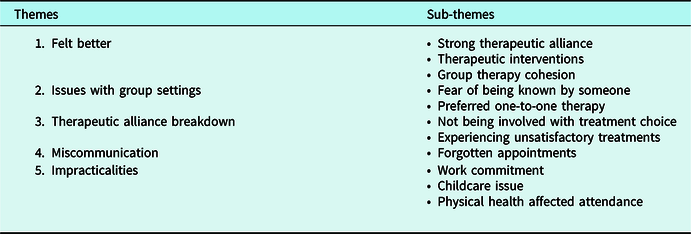
This evaluation has emphasised a number of areas where psychological services could address the needs of service users. From the thematic analysis, the five main themes were identified. They are: ‘Felt better’, ‘Issues with group settings’, ‘Therapeutic alliance breakdown’, ‘Miscommunication’ and ‘Impracticalities’. The quotes given are used to illustrate these themes. See Table 1 for a summary of the themes and sub-themes.
Outline of each theme and corresponding sub-themes

Results
In total, 365 people who had dropped out from the service had moved to recovery based on PHQ-9 and GAD-7 scores following the telephone call from the research and audit team. Table 2 shows the number of patients who completed their therapy between November 2015 and January 2019, those that recovered before our drop-out calls and those who did not.
Completed and recovered patients for the duration of the study

Felt better
A significant number of participating patients felt better despite dropping out of treatment and felt they did not need to continue with treatment. The benefit gained from therapy appears to have continued in the participants’ lives after dropping out of therapy. Below are some factors that appear to have contributed to patients feeling better after dropping out.
Strong therapeutic alliance
Confidence in the therapist’s skills and techniques is a crucial factor in building effective therapeutic relationships. Participating patients commented on how they felt better as a result of the treatment they received from the service. They commented on how the treatment delivered was offered in an effective and engaging manner. They referenced building a rapport and trust within the therapeutic relationship as playing an essential role in positive therapeutic outcomes. Other patients praised their therapist’s ability to help explain therapeutic concepts that led to a better understanding of themselves and their condition.
Patient: ‘My therapist was fantastic. I would really like to thank her. At the beginning I was not trusting her, but then the barriers went down and she helped me a lot.’
Patient: ‘I was happy with the therapist. He used diagrams which helped to explain things clearly.’
Therapeutic interventions
Participating patients appeared to manage their mental health better by using techniques and ‘tools’ which helped them to cope better. Some reflected on the impact of the mood management group, which covers depression and mechanisms for coping with low mood. Others referred to the CBT formulation and understanding of the vicious cycle, which could play an essential role. As patients became more aware of their vicious cycle, they learnt what could maintain their cycle of depression and how they could break that cycle.
Some participating patients felt better as a result of learning to utilise mindfulness techniques and breaking out of patterns of rumination and overthinking:
Patient: ‘My therapist helped me a lot and gave me lots of useful techniques such as tackling my rumination and I also felt much better as I was using mindfulness techniques as well.’
Group therapy cohesion
Participating patients had been able to access group therapies and courses. Attending these courses gave them additional tools and approaches. This could also enable them to have more opportunities to meet and socialise with other service users, to learn from them, to share their experiences and be able to compare their own situation with that of others. Positive comments were made by patients who received group treatments, showing how being in a group setting helped enhance their experience:
Patient: ‘I felt that the group was really good, the techniques we learnt were helpful, simple yet effective! I liked the group side of it, hand-outs were good and informative and benefited from it and gave me a clearer idea of how I am and what I should be doing. The people in the group were really friendly too and a few of us have a WhatsApp group together.’
Patient: ‘The course was really helpful and I’ve learned how to deal with my stress properly.’
Issues with group settings
Group-based treatments can help provide efficient and effective care. They can offer helpful solutions for services that deal with a high level of demand. However, withdrawal tends to be highest in psychoeducation group interventions and where there are pressures on resources, providing choices over treatment options can be challenging.
Fear of being known by someone
Some participating patients were ambivalent towards attending group treatment because they were concerned about being in a group with people who knew them, which in turn could be anxiety provoking. One patient stated that:
Patient: ‘I can’t manage group sessions; I really get stressed out in groups because I live around that area so there might be people from the same area.’
Preferred one-to-one therapy
Some participating patients felt group-based treatment was not the right type of therapy for them and preferred to have one-to-one treatment.
Patient: ‘I wasn’t shy but I wanted something one-to-one because in a group I couldn’t voice my opinion. Therapists were generally okay. It wasn’t their fault, but it was just me not liking being in a group because I didn’t understand it and overall it didn’t meet my expectation of the help I wanted.’
Therapeutic alliance breakdown
Not being involved with treatment choice
A number of participating patients wanted to have more of a choice and input in deciding which type and intensity of treatments they wanted to take up, highlighting the importance of choice when considering treatment options. Comments below highlight the importance of outlining how a treatment approach can be applied to patients’ difficulties and the need for collaboratively reviewing treatment options:
Patient: ‘I didn’t really feel it was relevant, I had CBT before and it worked but this time it wasn’t right. I didn’t feel CBT was the best offer. It’s not like I had negative feelings about myself, I was just feeling down and depressed. I had been offered self-help but I wanted something more serious.’
Experiencing unsatisfactory treatments
The majority of participating patients found the treatment and their therapist very helpful. They believed therapy was delivered in a responsive way to meet the individual requirements of patients. However, often being offered an inappropriate treatment approach that may be too generic and not tailored enough to patients’ needs led to unsatisfactory experiences. Consequently some patients felt that their level of difficulties and expectations were not effectively addressed by the course of treatment offered:
Patient: ‘I didn’t find it helpful, I only attended two sessions and it wasn’t really for me. I wasn’t experiencing worries, therefore stopped coming.’
Patient: ‘I think I was put on wrong treatment, as I have been suffering from eating disorder, I can’t go to places with my family, and I think a sort of therapy that deals with eating disorder would be more helpful.’
Miscommunication
Communicating changes to circumstances in therapy was another important factor in preventing drop-out. Participating patients had to change or miss their appointments due to their life circumstances. They emphasised practical difficulties, such as the difficulty in attending sessions near to Christmas time.
Forgotten appointments
Some participating patients forgot to attend the sessions and were eventually discharged from the service despite being sent session reminders via automated texts messages and a letter. A patient stated:
Patient: ‘I didn’t realise that I was discharged, we had 2 weeks off due to the therapist being on annual leave and then I received a letter about 3 weeks after my last session saying I was discharged because I didn’t turn up. I must have forgotten that we had a session.’
Impracticalities
Other factors found to influence drop-out included childcare and work commitments. However, patients did not always report these difficulties, or returned their therapist’s messages, which led to drop-outs. Some of the impracticalities are addressed in the sections below.
Work commitments
Participating patients generally felt that therapy helped them either find or keep their employment. However, for some patients it was difficult to continue their treatment due to their working hours. This sub-theme emerged in response to those who, despite their desire to attend their treatment, had to quit because the time of their appointment clashed with their working hours. Below is a comment from a patient who felt he was not able to continue:
Patient: ‘I found it very helpful it was good to have someone to talk to, it helped me to realise what causing me (difficulties). But I missed some apt, it clashed with my work appointment.’
Childcare issues
This sub-theme emerged where some participating patients felt they could have attended their sessions, but due to childcare difficulties they missed their sessions and were discharged as a result.
Patient: ‘The treatment was good, but it ran into the summer holidays and I couldn’t get childcare to make appointments.’
Physical health problem affected their attendance
Living with physical health conditions can be debilitating for those who are receiving psychological help for their mental health. Some patients discontinued their treatment as they could not attend due to their physical illness. It seems their personal health condition was the key factor that prevented them from continuing their treatment. Below is a comment from a patient who was suffering from breast cancer. It appears her illness interfered with her treatment:
Patient: ‘I was not in the best place during my treatment with my therapist. I had breast cancer and an operation and now am due to start chemotherapy in 8 weeks.’
Discussion
As well as identifying the progress withdrawal phenomenon, patients having successful treatment despite not attending all treatment sessions on offer, this research has highlighted factors that can help enhance patients’ experience of therapy and factors that can lead to drop-out. Overall, the majority of patients’ feedback was positive. Participating patients were mostly satisfied with the therapy and their therapist. They were able to implement what they learnt from therapy and apply it to their day-to-day functioning. However, some difficulties were identified by patients whose experience of the service was less satisfactory. Our results showed that dissatisfaction and inconvenient appointments were the main reasons for discontinuation. Ineffective therapeutic relationships between therapists and patients were noted as another key reason for dropping out for some participating patients, in line with findings reported by the Sharf et al. study (Reference Sharf, Primavera and Diener2010) and Easterbrook and Meehan (Reference Easterbrook and Meehan2017). Our study also reported dissatisfaction with the choice of therapy offered (i.e. psychoeducation groups), treatment types and restricted service policy in terms of cancellation and missing sessions without prior notice, in line with Hamilton et al. (Reference Hamilton, Hicks, Sayers, Faulkner, Larsen, Patterson and Pinfold2011).
Our study found that some of patients who left their treatment earlier than planned appeared to overcome their mental health difficulties by practising their learnt strategies and techniques during their treatment. This is in line with the previous findings reported by Gutner et al. (Reference Gutner, Gallagher, Baker, Sloan and Resick2016). This seems to highlight the importance of offering sufficient dosage of treatment based on patients’ needs given that some patients can get better after a few treatment sessions, whilst others may require more than the standard number of therapy sessions on offer (Reference Binnie and BodenBinnie and Boden, 2016; Gutner et al., Reference Gutner, Gallagher, Baker, Sloan and Resick2016).
Clinical implications
This study found a possible significant implication for service improvement for IAPT service delivery and other mental health services. On average, post-follow-up calls there was 4.5% increase in overall recovery rate. Previous to drop-out calls the recovery rate was 52.29%; however, after completing the follow-up calls the recovery rate increased to 57%. This highlights the benefit of building in drop-out calls to the overall service delivery model. As well as helping with recovery rate, drop-out calls can also enhance patients’ experiences and quality of care given that it provides an avenue for dissatisfied patients to air their concerns and help embed a measure through which they can re-start their treatment. It is crucial that patients are offered an easy way back into service and pick up their treatment before they dropped out, should they still feel the need to do so.
Our study shows that most patients do not discuss their treatment concerns with their therapists before dropping out and tend to drop-out in the initial stages of treatment, particularly in the case of psychoeducation courses. This is in line with the findings of DeJong et al. (Reference DeJong, Broadbent and Schmidt2012). One way of preventing drop-out may be to devise a feedback form for use prior to the mid-way point of group therapies. Giving these forms may encourage patients to express themselves more freely rather than needing to have a face-to-face conversation about their experience. It would also provide therapists with an additional way of being alerted to any patient who may be struggling with group content or therapy dynamics. Therapists can then look at ways of helping patients either re-engage with the therapeutic processes or be offered a different therapy format or approach. Written feedback can also be sought from patients’ midway through individual therapy by therapists or by the service to help elicit and address concerns before drop-out.
Early anticipation and recognition of barriers in attending or engaging with treatment, and problem-solving them jointly with patients, could support services to successfully re-engage with patients. Allowing patients’ involvement in making an informed choice about their treatment can be crucial in preventing drop-out. Moreover, providing patients with enough explanations about the nature of therapy involved, i.e. psychoeducational groups, can be helpful. This would help patients know what they are signing up for from the outset, what expectations they can have and what is expected of them in order to get the best out of their experience. A treatment information sheet can be devised to cover: (1) the rationale for why a certain type of treatment, i.e. group treatment or CBT, is suitable and how it might help with their difficulties; (2) in the case of a group, the size of the group; (3) location of the treatment; and (4) an outline of the treatment proposed, and in the case of structured group programmes, a session-by-session outline.
The current study shows the potential benefits of seeking feedback from patients who have dropped out given the improvements that can be made to service delivery. For example, feedback from patients who dropped out can help modify services’ cancellation and attendance policies and help to increase the chances of getting hold of patients before they drop out. Clinicians can be encouraged to make several contacts with patients who have not attended their session without prior notice via a number of routes, such as sending a letter, telephoning them and sending them a SMS text, to help re-engage them. Clinicians can also be supported, via supervision and training, to avoid offering rigid application of treatment protocols and to pay closer attention to therapeutic alliance and adapt their treatment flexibly so that it is fit for purpose for each individual patient. Seeking a feedback-informed approach to therapy and regularly modifying the pace, style of therapy and therapeutic relationship as and when needed could be crucial in reducing drop-out rates and potentially enhancing treatment outcomes.
Limitations
The present study explored the experience of patients who had dropped out of therapy with the aim of improving the standard and outcome of therapies on offer. However, the analysis did not involve looking at the type of therapies patients received. Consequently, it remains unclear whether the type of therapy offered has any bearing on drop-out rates and overall patients’ experience. Therefore, further research is needed to examine the influence of the type of therapy on drop-out rate. This study only managed to get hold of 818 out of 1748 patients, which may not be representative of the whole drop-out sample. Those who did not respond may have less favourable views of their experience. As patients were telephoned by the research team each month, some of them may also have felt under pressure to give favourable answers on the telephone. This in turn could be a barrier to capture their full experience with the service. This study was a quality improvement service evaluation, therefore the outcomes will need to be viewed with caution. Without a randomised control trial, it is difficult to examine whether the improvement after treatment was purely due to the treatment offered rather than other factors in their life or spontaneous recovery.
Acknowledgements
The authors would like to thank Eleanor Barlow and Carly Eddy for their help with data entry, and all the participating patients who allocated their time to take part in the study.
Financial support
No financial support was granted for this study.
Ethical statement
The study was approved by the Academy of Research & Improvement (Solent NHS Trust) as a service evaluation.
Conflicts of interest
The authors have no conflicts of interest with respect to this publication.
Key practice points
(1) Seeking feedback from patients at early stage or middle stage of therapy could in turn maximise service improvement and delivery.
(2) Early recognition of barriers in attending or engaging with treatment, and problem-solving them collaboratively with patients, could support services to successfully re-engage with patients.
Appendix 1
The follow-up call would start with a brief introduction of the person calling on behalf of the service, explaining that the call is part of the service evaluation to get feedback to help improve delivery and see if there are ways of improving patient’s experience of the service. Then the following semi-structured interview questions would follow with patients who dropped out from the Talking Change Psychological Service (November 2015 to January 2019)
Q1: How are you feeling?
Q2: How have you been coping since your therapy stopped?
Q3: Can you tell us your experiences with therapy and the service? What were the reasons therapy stopped?
Q4: As part of service evaluation, do you mind if I ask questions about your mood and anxiety symptoms (MDS)?
Q5: [if any outstanding areas uncovered] Would you be interested in re-engaging with the service?




Comments
No Comments have been published for this article.