1.0 INTRODUCTION
Guidance systems for missiles have developed rapidly in recent years, such that merely hitting the target accurately has become insufficient, but an expected impact angle is also required for missiles. A specific impact angle may increase the power of a warhead, which motivates the development of a guidance law with impact angle constraints.
To date, considerable research concerned with impact angle constraint problems has been conducted. Literature(Reference Kim and Grider1) studied impact angle problems and derived a suboptimal guidance law through optimal control theory. Literature(Reference Bryson and Ho2) provided an optimal solution for an ordinary intersection problem by minimising the performance index for terminal position and velocity constraints. This solution could be used for impact angle constraint problems if the intersection procedure was defined as an expected collision process. The performance index was selected as an apposite time-varying weighting function in Literature(Reference Cho3) for an optimal impact angle constraint guidance law. A traditional guidance law to achieve the expected impact angle was obtained by adjusting the gain of the weighting functions. In Literature(Reference Ryoo, Cho and Tahk4), arbitrary order missile dynamics were considered in optimal impact angle constraint problems, thereby providing a generalised formulation. In Literature(Reference Ratnoo and Ghose5), the state-dependent Riccati equation method, which was widely used in various types of nonlinear control issues, was applied to cope with impact angle constraint problems. In Literature(Reference Lee, Kim and Tahk6), a linear time-varying guidance law was addressed using the inverse problem in optimal control theory to obtain the expected impact angle and minimal miss distance. With the progress of model predictive static programming and generalised model predictive static programming approaches in recent years, Literature(Reference Maity, Oza and Padhi7) and (Reference Oza and Padhi8) proposed new suboptimal guidance commands to accomplish specific impact angles.
As indicated above, considerable researches have been performed based on optimal control theory. However, proportional navigation (PN) guidance laws are more widely used to solve impact angle constraint problems. In Literature(Reference Kim, Lee and Han9), a time-varying bias term was added to the traditional PN, called the biased PN guidance law, and the bias term achieved impact angle constraints. In Literature(Reference Ratnoo and Ghose10–Reference Erer and MerttopÇuoĞlu12), a two-phase guidance approaches for controlling the impact angle were proposed. In Literature(Reference Ratnoo and Ghose10), the guidance law consisted of a PN coefficient with two phases: one for generating an orientation trajectory to cover all impact angles from 0 to –Π with navigation gain  $N < 2$
and the other for attacking a stationary target at a desired impact angle with
 $\,N \ge 2$
. In Literature(Reference Ratnoo and Ghose11), the approach was further developed for the case of nonstationary nonmanoeuvering targets. In Literature(Reference Erer and MerttopÇuoĞlu12), another two-phase guidance approach that consisted of a conventional PN term and a biased PN term was proposed. The desired impact angle was satisfied by adjusting the integral of the bias term.
Variable structure control theory has been gradually applied to guidance law systems in recent years due to its robustness and simple control algorithm(Reference Li, Zhao and Chen13,Reference Deyin, Bin and Panshuo14) . The sliding mode can be designed as necessary and is independent of object parameters and disturbances. Thus, the terminal condition can be incorporated into the sliding mode to obtain the guidance law, thereby satisfying terminal constraints. The core of this type of guidance is determining how to select the switching function of the sliding surface to meet the requirements for zeroing in missed distance and impact angle constraints and to ensure that the system reaches the sliding surface in finite time. In Literature(Reference Lee, Kim and Tahk15), a new guidance law was established using a high-performance sliding mode technique, which not only satisfied the terminal angle constraint but also enhanced the observabilities of stationary and slow-moving targets. Literature(Reference Rao and Ghose16) proposed a linear sliding mode guidance law (LSMGL) to intercept nonmanoeuvering targets in an expected impact angle. In Literature(Reference He and Lin17), a terminal sliding mode (TSM) based on robust control was presented to intercept stationary or slow-moving targets whose terminal constraints were the impact angle and the seeker’s field-of-view limit. In Literature(Reference Kumar, Rao and Ghose18) and (Reference Kumar, Rao and Ghose19), TSM and nonsingular TSM (NTSM) guidance laws were developed for manoeuvering targets, respectively, and preset angle limits were implemented. However, the two studies have shortcomings: (1) the control input chattering problem and (2) the upper bound acceleration of the target manoeuvering was required. The target information is usually difficult to obtain in advance for practical applications. Therefore, a large value of switching gain is consumed to ensure the stability of sliding variable structure control, which increases the amount of control energy. Literature(Reference He, Lin and Wang20) provided a precise interception guidance law that considered impact angle constraints without the information of the target and used a disturbance observer to estimate target information in real time, thereby solving the aforementioned problems. In practical applications, a precision guidance system will be influenced by autopilot lag, particularly if target manoeuvering exists, thus autopilot delay in a guidance system design process should be considered(Reference Sun, Zhou and Hou21).
In the past decade, backstepping design procedures have been intensively introduced(Reference Zhang, Ge and Hang22–Reference Lin and Hsu25). The backstepping control is a systematic and recursive design method for nonlinear systems to offer a choice to accommodate the unmodeled nonlinear effects and parameter uncertainties. The essence of backstepping design is to select some appropriate functions of state variables as pseudocontrol inputs for lower dimension subsystems of the overall system. Each backstepping stage results in a new pseudocontrol design, expressed in terms of the pseudocontrol designs from preceding design stages. When the procedure is terminated, a feedback design for the true control input results, which achieves the original design objective by virtue of a final Lyapunov function, which is formed by summing up the Lyapunov functions associated with each individual design stage(Reference Hsu, Lin and Lee26). In(Reference Zhao, Yang and Karimi27), the author developed a backstepping design method of tracking controller for the systems under consideration. In(Reference Tong, Li and Shi28), based on the observer methodology, the adaptive fuzzy backstepping technique was extended to uncertain multiple-input and multiple-output (MIMO) systems, and an adaptive controller was developed. Then, for nonlinear time-delay systems, backstepping-based controllers were designed in(Reference Wang, Zhang and Qiu29).
The essence of guidance system is a nonlinear control problem, and usually the dynamics of the system is completely matched with its mathematical model. There are, of course, unavoidable model uncertainties for any practical system including the guidance systems, which lead the degradation of controller performance. For the guidance system, the target manoeuvering is an uncertainty, if the manoeuvering is not considered in the control command, the guidance performance will be reduced. In these cases, the conventional control approaches are not applicable, and usually the universal functions approximators (UFAs)-based adaptive approaches are suggested to address this issue(Reference Du and Chen30). Therefore, the analytical study of adaptive control of uncertain nonlinear systems using UFA has received much attention during last decade(Reference Arefi, Zarei and Karimi31). In this regards, neural networks (NNs) and fuzzy logic (FL) are usually exploited to approximate the unknown uncertainties(Reference Dong, Zhao and Karimi32). Then, adaptive laws are designed to adjust the parameters of the NNS and FL. Another important method to deal with these problems is to use the observer(Reference He and Lin17), which is the method adopted in this paper.
Motivated by these situations, the present study proposes a novel second-order sliding-mode guidance law (NSO-SMGL) using backstepping technique by considering autopilot lag. For target manoeuvering, this study adopts a general disturbance observer to estimate the manoeuvering and compensate for it in the guidance law. Through the designed command, the missile achieves precise interception with the desired impact angle even if autopilot delay exists. The convergence of the guidance system is proven through Lyapunov stability theorem, which ensures that the sliding surface and its derivative will converge to zero in finite time and guarantees that the sliding surface will not cross zero as what happened in(Reference Zhang, Tang and Guo33), thereby effectively eliminating undesired chattering.
The remainder of this paper is organised as follows. Section 2 establishes the kinematics equations between a missile and a target. Several theoretical bases are also given. Section 3 introduces the general disturbance observer and the approach to apply NSO-SMGL. The convergence of the sliding control method is also proven. Section 4 provides the expression for the proposed NSO-SMGL. Section 5 presents the simulation results of the derived guidance law for several typical situations. Section 6 gives the conclusions of the study.
Relative motion between the missile and the target.

2.0 PRELIMINARY
In this section, missile interception engagement on a vertical plane, including impact angle definition and an autopilot model, are derived. Necessary fundamental theories are also presented.
2.1 Problem formulation
The geometric relationship between the relative motion of a missile and a target on a vertical plane is established in Fig. 1. In the figure,  $M$
and
 $T$
denote the positions of the missile and the target, respectively.
 ${v_M}$
and
 ${v_T}$
indicate the velocity of the missile and the target, respectively.
 ${a_M}\,$
and
 $\,{a_T}\,$
represent the normal acceleration of the missile and the target, respectively.
 ${\theta _M}\,$
and
 $\,{\theta _T}\,$
are the flight path angle of the missile and the target, respectively.
 $q$
is the line-of-sight (LOS) angle between the missile and the target.
 $r$
is the relative distance between the missile and the target. The relative motion equation between the missile and the target can be obtained from Fig. 1
 \begin{equation}\dot r = {v_T}\cos \left( {q - {\theta _T}} \right) - {v_M}\cos \left( {q - {\theta _M}} \right)\!,\end{equation}
 \begin{equation} r\dot q = - {v_T}\sin \left( {q - {\theta _T}} \right) + {v_M}\sin \left( {q - {\theta _M}} \right)\!, \end{equation}
 \begin{equation}{\dot \theta _M} = {a_M}/{v_M},\end{equation}
 \begin{equation}{\dot \theta _T} = {a_T}/{v_T},\end{equation}
where  $\,\dot r\,$
is the derivative of the relative distance with respect to time,
 $\dot q\,$
is the derivative of the LOS angle
 $q$
, it represents the LOS angular rate, and
 ${\dot \theta _M}\,$
and
 $\,{\dot \theta _T}\,$
are the derivatives of the missile’s and target’s flight path angles with respect to time.
When both sides of Equation (2) are differentiated with respect to time, the following equation can be derived:
 \begin{align}\ddot q = - 2\frac{{\dot r}}{r}\dot q + \frac{{{{\dot v}_M}\sin (q - {\theta _M}) - {a_M}\cos \left( {q - {\theta _M}} \right)}}{r} + \frac{{{a_T}\cos \left( {q - {\theta _T}} \right) - {{\dot v}_T}\sin (q - {\theta _T})}}{r},\nonumber\\\end{align}
where  $\,{\dot v_M}\,$
and
 $\,{\dot v_T}\,$
are the tangential accelerations of the missile and the target; and
 $\,\ddot q\,$
is the derivative of the LOS angular rate with respect to time.
For the convenience of derivation, we firstly assume that the missile and the target are flying in a constant tangential speed. In fact, the guidance law is suitable for a varying speed missile because the tangential velocity is treated as the system uncertainty and is estimated and compensated by the observer together with the target manoeuvering. Then, Equation (5) can be organised as
 \begin{equation}\ddot q = - 2\frac{{\dot r}}{r}\dot q - \frac{{{a_{Mq}}}}{r} + \frac{{{a_{Tq}}}}{r},\end{equation}
where  $\,{a_{Mq}} = {a_M}\cos \left( {q - {\theta _M}} \right)\,$
and
 $\,{a_{Tq}} = {a_T}\cos \left( {q - {\theta _T}} \right)\,$
are the components of the missile and the target accelerations that are perpendicular to the LOS, respectively.
In accordance with the principle of parallel approach, the purpose of a guidance law is to make the LOS angular rate  $\,\dot q\,$
approach to zero by adjusting
 $\,{a_{Mq}}$
, thereby ensuring that the missile will attack the target accurately.
Assumption 1. Given the missile’s and the seeker’s physical limits, the missile’s and the target’s acceleration components and their first and second derivatives ( ${a_{Mq}}$
,
 ${a_{Tq}}$
,
 ${\dot a_{Tq}}$
, and
 ${\ddot a_{Tq}}$
) are bounded by the following conditions:
 \begin{equation}\left| {{a_{Mq}}} \right| \le {A_m},\,\left| {{a_{Tq}}} \right| \le {A_t},\,\left| {{{\dot a}_{Tq}}} \right| \le {A_1},\,\left| {{{\ddot a}_{Tq}}} \right| \le {A_2};\end{equation}
where  $\,{A_m}$
,
 ${A_t}$
,
 ${A_1}$
, and
 ${A_2}$
are unknown bounds which represent the manoeuverability; and the seeker’s minimum working distance is
 ${r_0}$
. The variable
 $r$
satisfies
 \begin{equation} r \ge {r_0}, \end{equation}
Considering the dynamic model of the autopilot, the autopilot model is approximated to the first-order inertia as follows:
 \begin{equation}{\dot a_{Mq}} = - \frac{1}{\tau }{a_{Mq}} + \frac{1}{\tau }u, \end{equation}
where  $\,\tau \,$
is the autopilot dynamic lag constant of the missile, and
 $u$
is the guidance command acceleration to be provided to the missile.
For problems with an impact angle constraint, the impact angle is first defined as the angle between the velocity vector of the missile and the target at the end of the collision. Therefore, considering the constraint on the impact angle, the flight path angle should be strictly limited when the missile is hitting the target. Defining the end of guidance as  ${t_f}$
, the expected impact angle of the missile is
 ${\theta _d}$
, and the desired LOS angle is
 ${q_d}$
at the end of guidance. Therefore, the design of the guidance law that considers the impact angle constraint refers to the missile hitting the target accurately at the desired impact angle; that is(Reference Zhang, Tang and Guo33),
 \begin{equation}\mathop {\lim }\limits_{t \to {t_f}} r\left( t \right)\dot q\left( t \right) \to 0, \end{equation}
 \begin{equation}{\theta _M}\left( {{t_f}} \right) - {\theta _T}\left( {{t_f}} \right) = {\theta _d}, \end{equation}
 \begin{equation}\left| {{\theta _M}\left( {{t_f}} \right) - {q_d}} \right| < \frac{\pi }{2}.\end{equation}
Equation (12) indicates that the target is within the field of view of the missile’s seeker when the missile hits the target. From Equations (2) and (10):
 \begin{equation}{v_T}\sin \left( {{\theta _T}\left( {{t_f}} \right) - {q_d}} \right) \approx {v_M}\sin \left( {{\theta _M}\left( {{t_f}} \right) - {q_d}} \right)\!. \end{equation}
From Equation (13), a unique flight path angle of the missile  ${\theta _M}\left( {{t_f}} \right)$
can be ascertained if the flight path angle of target
 ${\theta _T}\left( {{t_f}} \right)$
is known for the desired missile impact angle
 ${\theta _d}$
. Then, the desired LOS angle can be obtained from Equations (10) and (12). Hence, the control of the impact angle can be transformed into the control of the final LOS angle.
2.2 Fundamental theories
Before designing the guidance law, the definition of finite-time stability in sliding mode control is first introduced.
Definition 1 (Reference Bhat and Bernstein34). Consider the following system:
 \begin{equation}\dot x\!\left( t \right) = f\!\left( {x,t} \right),x \in {{\bf{R}}^n}, \end{equation}
where  $f\left( x \right):D \to {{\bf{R}}^n}$
is defined as a value of
 $D$
in
 $n$
dimensional space
 ${{\bf{R}}^n}$
that satisfies the local Lipschitz continuous condition. For the system Equation (14),
 $f\!\left( x \right):U \to {{\bf{R}}^n}$
is a continuous function for
 $x$
on the semi-open domain
 $U$
containing the origin. Finite-time convergence is represented by
 $\forall {x_0} \in {U_0} \subset {{\bf{R}}^n}$
, there exists a continuous function
 $T\!\left( x \right):{U_0}\backslash \left\{ 0 \right\} \to \left( {0, + \infty } \right)$
, thereby making the solution of the system Equation (14)
 $x\!\left( {{x_0},t} \right)$
satisfy: when
 $t \in \left[ {0,T\left( {{x_0}} \right)} \right]$
, there exists
 $x\left( {{x_0},t} \right) \in {U_0}\backslash \left\{ 0 \right\}$
and
 $\mathop {\lim }\limits_{t \to T\left( {{x_0}} \right)} x\left( {{x_0},t} \right) = 0$
, and when
 $t > T\left( {{x_0}} \right)$
, there exists
 $x\left( {{x_0},t} \right) = 0$
. Suppose the equilibrium point of the system Equation (14) is
 $x = 0$
, when and only when the system is strongly stable and converges in a limited time, the equilibrium point
 $x = 0$
of the system is then regarded as stable in a finite time. If
 $U = {U_0} \in {{\bf{R}}^n}$
, then the equilibrium point is stable globally in a finite time.
Lemma 1 (Reference Bhat and Bernstein35). Suppose the existence of a continuous differentiable positive definite function  ${\kern 1pt} V\!\left( x \right){\kern 1pt} $
defined in a neighborhood of the origin. For the real numbers
 $c \gt 0$
and
 $0 \lt \beta \lt 1$
, there is
 $\dot V\left( x \right) + c{V^\beta }\left( x \right) \le 0$
and
 $x \in U\backslash \left\{ 0 \right\}$
. Then, the system could converge to origin in finite time, and the upper bound of the convergence time is satisfied as follows:
 \begin{equation}T\left( {{x_0}} \right) \le \frac{{{V^{1 - \beta }}\left( {{x_0}} \right)}}{{c\left( {1 - \beta } \right)}}. \end{equation}
3.0 TARGET MANOEUVERING ESTIMATOR AND SECOND-ORDER SLIDING MODE THEORY
An estimation of target manoeuvering is required to effectively intercept manoeuvering targets. A general disturbance observer is presented in the first part of this section, and then a novel second-order sliding mode theory is established in the next part.
3.1 Target manoeuvering estimator
Consider the following system:
 \begin{equation}\dot x = f + bu + d. \end{equation}
where  $f$
is the known state variable of the system;
 $u$
and
 $b{\kern 1pt} $
are the control input and coefficient, respectively; and
 $d$
represents target manoeuvering, which is regarded as system interference.
For System Equation (15), the general disturbance observer is defined as
 \begin{equation}\left\{ \begin{array}{l}{{\dot z}_0} = {z_1} + {k_1}{\left| {x - {z_0}} \right|^{1 - 1/p}}{\mathop{\rm sgn}} \left( {x - {z_0}} \right) + f + bu\\[5pt]
{{\dot z}_1} = {k_2}{\left| {x - {z_0}} \right|^{1 - 2/p}}{\mathop{\rm sgn}} \left( {x - {z_0}} \right)\end{array} \right., \end{equation}
where  ${\kern 1pt} {k_1},{k_2} > 0$
and
 $p > 2$
are parameters to be designed; and
 ${z_0}$
and
 ${z_1}$
are estimations of
 $x$
and
 $d$
, respectively.
Theorem 1 (Reference He and Lin36). Variables  ${\eta _1} = x - {z_0}$
and
 ${\eta _2} = d - {z_1}$
are defined as estimation errors. If the derivative of system interference satisfies
 $\left| {\dot d} \right| \le {\dot d^{\max }}$
with
 ${\kern 1pt} {\dot d^{\max }}$
being a positive constant, then the vector can converge to the following domain in finite time:
 \begin{equation}\left\| \eta \right\| \le {\left( {\frac{{{{\dot d}^{\max }}\left\| \textbf{{B}} \right\|}}{{{\lambda _{\min }}\left( \textbf{{Q}} \right)}}} \right)^{\left( {p - 1} \right)/\left( {p - 2} \right)}}, \end{equation}
where  $\boldsymbol{\eta} = {\left[ {{\eta _1},{\eta _2}} \right]^T}$
,
 ${\lambda _{\min }}\left( \cdot \right)$
refers to the minimum eigenvalue of matrix
 $\left( \cdot \right)$
and the vector 2-norm
 $\left\| {\cdot} \right\|$
, and
 \begin{equation}\textbf{{Q}} = \left[ \begin{array}{c@{\quad}c} {{k_1}{k_2} + k_1^3\frac{{p - 1}}{p}} & { - k_1^2\frac{{p - 1}}{p}} \\[8pt] { - k_1^2\frac{{p - 1}}{p}} & {k\frac{{p - 1}}{p}} \end{array} \right],\,\textbf{{B}} = \left[ \begin{array}{c} { - {k_1}} \\ 2 \end{array} \right], \end{equation}
Proof of Theorem 1. According to Equations (16) and (17), the estimation error variable can be acquired as
 \begin{equation}\left\{ \begin{array}{l}{{\dot \eta }_1} = {\eta _2} - {k_1}{\left| {{\eta _1}} \right|^{1 - 1/p}}{\mathop{\rm sgn}} \left( {{\eta _1}} \right)\\[5pt]
{{\dot \eta }_2} = {{\dot a}_{Tq}} - {k_2}{\left| {{\eta _1}} \right|^{1 - 2/p}}{\mathop{\rm sgn}} \left( {{\eta _1}} \right)\end{array} \right., \end{equation}
For differential Equation (16), construct the Lyapunov function as follows
 \begin{equation}{V_1} = \frac{{{k_2}p}}{{p - 1}}{\left| {{\eta _1}} \right|^{2\left( {p - 1} \right)/p}} + \frac{1}{2}\eta _2^2 + \frac{1}{2}{\left( {{k_1}{{\left| {{\eta _1}} \right|}^{\left( {p - 1} \right)/p}}{\mathop{\rm sgn}} \left( {{\eta _1}} \right) - {\eta _2}} \right)^2}, \end{equation}
which can be written as the following vector form
 \begin{equation}{V_1} = {\boldsymbol{\eta }^T}\textbf{{P}}\boldsymbol{\eta }, \end{equation}
where
 \begin{equation}\textbf{{P}} = \frac{1}{2}\left[ {\begin{array}{c@{\quad}c}{\frac{{{k_2}p}}{{p - 1}} + k_1^2} &{ - {k_1}}\\[5pt]{ - {k_1}} &2\end{array}} \right]\!, \end{equation}
As  ${k_2} > 0$
and
 $p > 2$
are positive definite and radially unbounded, that is
 \begin{equation}{\lambda _{\min }}\left( \textbf{{P}} \right){\left\| \boldsymbol{\eta} \right\|^2} \le {V_1} \le {\lambda _{\max }}\left( \textbf{{P}} \right){\left\| \boldsymbol{\eta} \right\|^2}, \end{equation}
where  ${\lambda _{\max }}\left( \cdot \right)$
refers to the maximum eigenvalue of matrix
 $\left( \cdot \right)$
.
Advert that  ${V_1}$
is continuously differentiable, except on the set
 $\Omega = \left\{ {\left( {{\eta _1},{\eta _2}} \right) \in {{{R}}^2}\left| {{\eta _1} = 0} \right.} \right\}$
. However, if
 ${\eta _1} = 0$
,
 ${\eta _2} \ne 0$
, one can imply
 $\,{\dot \eta _1} = {\eta _2} \ne 0$
, this means that the trajectories of system Equation (20) just cross the area
 $\Omega \;$
and cannot maintain on it, except when the initial values
 $\,{\eta _1} = 0$
,
 ${\eta _2} = 0$
, have been achieved. Thus, the time derivative of
 $\,{V_1}\,$
can be calculated by derivation as
 \begin{align}{{\dot V}_1} & = \left( {\frac{{{k_2}p}}{{p - 1}} + \frac{1}{2}k_1^2} \right)\frac{{2p - 2}}{p}{\left| {{\eta _1}} \right|^{\left( {p - 2} \right)/p}}{\mathop{\rm sgn}} \left( {{\eta _1}} \right)\nonumber\\[4pt]
&\quad\left( {{\eta _2} - {k_1}{{\left| {{\eta _1}} \right|}^{\left( {p - 1} \right)/p}}{\mathop{\rm sgn}} \left( {{\eta _1}} \right)} \right)\nonumber\\[4pt]
&\quad + \left( {2{\eta _2} - {k_1}{{\left| {{\eta _1}} \right|}^{\left( {p - 1} \right)/p}}{\mathop{\rm sgn}} \left( {{\eta _1}} \right)} \right)\left( {{{\dot a}_{Tq}} - {k_2}{{\left| {{\eta _1}} \right|}^{\left( {p - 2} \right)/p}}{\mathop{\rm sgn}} \left( {{\eta _1}} \right)} \right)\nonumber\\[4pt]
&\quad - {k_1}\frac{{p - 1}}{p}{\left| {{\eta _1}} \right|^{ - 1/p}}\left( {{\eta _2} - {k_1}{{\left| {{\eta _1}} \right|}^{\left( {p - 1} \right)/p}}{\mathop{\rm sgn}} \left( {{\eta _1}} \right)} \right),\nonumber\\[4pt]
&= - {\left| {{\eta _1}} \right|^{ - 1/p}}\left( {{k_1}{k_2}{{\left| {{\eta _1}} \right|}^{2\left( {p - 1} \right)/p}} + \frac{{p - 1}}{p}k_1^3{{\left| {{\eta _1}} \right|}^{2\left( {p - 1} \right)/p}}} \right.\\[4pt]
&\quad\left. { - 2\frac{{p - 1}}{p}k_1^2{{\left| {{\eta _1}} \right|}^{\left( {p - 1} \right)/p}}{\mathop{\rm sgn}} \left( {{\eta _1}} \right){\eta _2} + \frac{{p - 1}}{p}{\kern 1pt} {k_1}\eta _2^2} \right)\nonumber\\[4pt]
&\quad + \left( {2{\eta _2} - {k_1}{{\left| {{\eta _1}} \right|}^{\left( {p - 1} \right)/p}}{\mathop{\rm sgn}} \left( {{\eta _1}} \right)} \right){{\dot a}_{Tq}}\nonumber\\[4pt]
&\le - {\left| {{\eta _1}} \right|^{ - 1/p}}{\boldsymbol{\eta}^T}\textbf{{P}}\boldsymbol{\eta} + {{\dot d}^{\max }}\left( x \right)\textbf{{B}}\boldsymbol{\eta}\nonumber \end{align}
As  $\,{k_1},{k_2} > 0\,$
an
 $\,p > 2$
, obviously, the matrix
 $\textbf{{Q}}$
is Hurwitz. Moreover, from the fact that
 $\,\left\| \boldsymbol{\eta} \right\| = \sqrt {{{\left| \eta \right|}^{2\left( {p - 1} \right)/p}} + \eta _2^2} \ge {\left| {{\eta _1}} \right|^{\left( {p - 1} \right)/p}}$
, one can imply
 $\,{\left| {{\eta _1}} \right|^{ - 1/p}} \ge {\left\| \boldsymbol{\eta} \right\|^{ - 1/\left( {p - 1} \right)}}$
. Then, from Equations (24) and (25) one can get
 \begin{equation}\begin{array}{l}{{\dot V}_1} \le - {\left| {{\eta _1}} \right|^{ - 1/p}}{\lambda _{min}}\left( \textbf{{Q}} \right){\left\| \boldsymbol{\eta} \right\|^2} + {{\dot d}^{\max }}\left( x \right)\left\| \textbf{{B}} \right\|\left\| \boldsymbol{\eta} \right\|\\[5pt]
{\kern 1pt} {\kern 1pt} {\kern 1pt} {\kern 1pt} {\kern 1pt} {\kern 1pt} {\kern 1pt} {\kern 1pt} {\kern 1pt} {\kern 1pt} \le - \left( {{\lambda _{min}}\left( \textbf{{Q}} \right){{\left\| \boldsymbol{\eta} \right\|}^{\left( {p - 2} \right)/\left( {p - 1} \right)}} - {{\dot d}^{\max }}\left( x \right)\left\| \textbf{{B}} \right\|} \right)\left\| \boldsymbol{\eta} \right\|,\\[5pt]
{\kern 1pt} {\kern 1pt} {\kern 1pt} {\kern 1pt} {\kern 1pt} {\kern 1pt} {\kern 1pt} {\kern 1pt} {\kern 1pt} {\kern 1pt} \le - \left( {{\lambda _{min}}\left( \textbf{{Q}} \right){{\left\| \boldsymbol{\eta} \right\|}^{\left( {p - 2} \right)/\left( {p - 1} \right)}} - {{\dot d}^{\max }}\left( x \right)\left\| \textbf{{B}} \right\|} \right)\frac{{V_1^{1/2}}}{{\sqrt {{\lambda _{\max }}\left( \textbf{{P}} \right)} }}\end{array} \end{equation}
If  $\,{\lambda _{min}}\left( \textbf{{Q}} \right){\left\| \boldsymbol{\eta} \right\|^{\left( {p - 2} \right)/\left( {p - 1} \right)}} - {\dot d^{\max }}\left( x \right)\left\| \textbf{{B}} \right\| > 0$
, Equation (26) can be written as
 \begin{equation}{\dot V_1} \le - \frac{{\gamma V_1^{1/2}}}{{\sqrt {{\lambda _{\max }}\left( \textbf{{P}} \right)} }}, \end{equation}
where  $\,\gamma = {\lambda _{min}}\left( \textbf{{Q}} \right){\left\| \boldsymbol{\eta} \right\|^{\left( {p - 2} \right)/\left( {p - 1} \right)}} - {\dot d^{\max }}\left( x \right)\left\| \textbf{{B}} \right\| > 0$
, In the light of Lemma 1, the area
 \begin{equation}\left\| \eta \right\| \le {\left( {\frac{{{{\dot d}^{\max }}\left( x \right)\left\| \textbf{{B}} \right\|}}{{{\lambda _{\min }}\left( \textbf{{Q}} \right)}}} \right)^{\left( {p - 1} \right)/\left( {p - 2} \right)}}, \end{equation}
can be approached in finite time, which also proves that the estimation errors will be converge in a small area around zero in finite time. The proof is completed.
Remark 1. By proper parameter selection,  $\left| {{{{{\dot d}^{\max }}\left\| \textbf{{B}} \right\|} \mathord{\left/{\vphantom {{{{\dot d}^{\max }}\left\| \textbf{{B}} \right\|} {{\lambda _{\min }}\left( \textbf{{Q}} \right)}}} \right.} {{\lambda _{\min }}\left( \textbf{{Q}} \right)}}} \right| < 1$
can be obtained. Furthermore, as
 $p > 2$
, a sufficiently large value of
 $\left( {p - 1} \right)/\left( {p - 2} \right)$
can be achieved. Therefore, the value of
 ${\left( {{{{{\dot d}^{\max }}\left\| \textbf{{B}} \right\|} \mathord{\left/{\vphantom {{{{\dot d}^{\max }}\left\| \textbf{{B}} \right\|} {{\lambda _{\min }}\left( \textbf{{Q}} \right)}}} \right.} {{\lambda _{\min }}\left( \textbf{{Q}} \right)}}} \right)^{{{\left( {p - 1} \right)} \mathord{\left/{\vphantom {{\left( {p - 1} \right)} {\left( {p - 2} \right)}}} \right.} {\left( {p - 2} \right)}}}}$
can be tuned very close to zero and highly precise estimation performance can be assured.
Remark 2. It should be noted that the setting of  $p$
is very important. If one set
 $p = 2$
, the presented target manoeuvering estimator reduces to classical super-twisting observer. However, the term
 ${\left| {x - {z_0}} \right|^{1 - 2/p}}{\mathop{\rm sgn}} \left( {x - {z_0}} \right)$
in Equation (17) with
 $p = 2$
is discontinuous while the proposed estimator is continuous and therefore the undesired chattering can be mitigated significantly.
Remark 3. Compared with classical linear state observer, the proposed observer has two main advantages: (1) guarantee finite-time convergence of the target manoeuvering estimation error; (2) exhibits strong robustness against the variation of target manoeuverings.
3.2 Second-order sliding mode control
In general, we use the first-order sliding mode method to deal with problems with a relative degree of 1(Reference Levant37). However, a higher-order sliding mode method should be used for problems with larger degrees. In higher-order sliding mode, the sliding surface and its successive derivatives will converge to zero; that is,
 \begin{equation}s,\dot s,\ddot s,...{s^\kappa } = 0, \end{equation}
where  $\kappa $
is the relative degree. The second-order sliding mode method is widely adopted in guidance system design. This method can be used to deal with problems with a relative degree of 2 or to eliminate chattering with a relative degree of 1. One example of an extensive second-order sliding mode method is the super-twisting algorithm(Reference Lee, Kim and Tahk15), in which the sliding surface and its derivative make countless twists around the origin and converge to zero in finite time. Despite being a useful method that has been considerably studied, the super-twisting algorithm exhibits a drawback, i.e., the sliding surface is forced to oscillate near the equilibrium point (zero), which results in command chattering. NSO-SMGL, which is based on a backstepping technique, is deduced in this section. This approach exhibits the advantage of ensuring that the sliding surface and its derivative converge to zero in finite time while guaranteeing that the sliding surface will not cross zero until the ultimate time.
First, the desired sliding surface is defined as follows:
 \begin{equation}s = f = 0. \end{equation}
The first and second derivatives of the sliding surface Equations (30) are
 \begin{equation}\dot s = h, \end{equation}
 \begin{equation}\ddot s = f + bu + d, \end{equation}
where  $h$
,
 $f$
, and
 $b$
are known functions of the system; and
 $d$
represents target manoeuvering, which is assumed as a bounded uncertainty. The guidance command
 ${\kern 1pt} u{\kern 1pt} $
emerges in the second derivative of the sliding surface; thus, surface Equations (30) has a relative degree of 2.
The objective is to search for a formula for sliding surface Equations (30) and its derivative Equations (31). Both equations converge to zero at an expected time  ${t_r}$
. A backstepping technique is used to achieve the objective. We set
 ${\kern 1pt} \dot s{\kern 1pt} $
as a virtual command, and
 ${\kern 1pt} \dot s{\kern 1pt} $
should be designed to send
 ${\kern 1pt} s{\kern 1pt} $
to zero. The Lyapunov function
 ${\kern 1pt} {V_2}$
is selected.
 \begin{equation}{V_2} = \frac{1}{2}{s^2} \end{equation}
Considering the derivative of Equation (33) with respect to time yields
 \begin{equation}{\dot V_2} = s\dot s. \end{equation}
To ensure that sliding surface Equations (30) will converge to zero in finite time,  ${\dot V_2}$
must be negative infinity. Then,
 ${\kern 1pt} \dot s{\kern 1pt} $
can be set as
 \begin{equation}\dot s = - \frac{{ns}}{{{t_r} - t}},n > 1, \end{equation}
where  ${t_r}{\kern 1pt} $
is the expected convergence time. Substituting Equations (35) into Equations (34) yields
 \begin{equation}{\dot V_2} = - \frac{{n{s^2}}}{{{t_r} - t}}. \end{equation}
Substituting Equation (33) into Equation (36) derives
 \begin{equation}{\dot V_2} = - \frac{{2n{V_2}}}{{{t_r} - t}}. \end{equation}
Integrating Equation (37) from the initial value  $\left( {{V_2}\left( {{t_0}} \right),{t_0}} \right)$
into the current value
 $\left( {{V_2}\left( t \right),t} \right)$
can result in
 \begin{equation}{V_2}\left( t \right) = \frac{{{V_2}\left( {{t_0}} \right)}}{{{{\left( {{t_r} - {t_0}} \right)}^{2n}}}}{\left( {{t_r} - t} \right)^{2n}}. \end{equation}
Notably, when  ${\kern 1pt} n{\kern 1pt} $
is greater than 0.5,
 ${\kern 1pt} {\left( {{t_r} - t} \right)^{2n}}{\kern 1pt} $
in Equation (38) will converge to zero because
 ${\kern 1pt} t{\kern 1pt} $
is close to
 ${\kern 1pt} {t_r}$
. Therefore, the Lyapunov function (and consequently, the sliding surface) is guaranteed to converge to zero at the expected time
 $\,{t_r}\,$
provided that
 $n > 0.5$
. Equation (35) depends on the values of the sliding surface and time
 $\,t$
; it can also ensure that
 $\,\dot s$
converges to zero at
 $\,{t_r}$
, as proven in(Reference Kumar, Rao and Ghose19). Furthermore, achieving such goal for
 $\,\dot s\,$
places an additional constraint on parameter
 $\,n$
, which should be satisfied as
 $\,n > 1$
.
Equation (35) provides an expected trajectory for  $\,\dot s\,$
to follow. Notably, condition Equation (35) should not necessarily be satisfied at the initial time because the initial value of
 $\,\dot s\,$
completely depends on the initial conditions of the problem. Therefore, guidance command
 $\,u\,$
must be used to send
 $\,\dot s\,$
from its initial value to the trajectory defined by Equation (35) in finite time, and then
 $\,\dot s\,$
must be maintained on the trajectory. Given that the system must comply with certain actions along trajectory Equation (35) to ensure that
 $\,s\,$
and
 $\,\dot s\,$
converge to zero, the trajectory should be reached in finite time.
To ensure that trajectory Equation (35) will be reached in finite time, the new sliding surface should be considered as follows:
 \begin{equation}{s_2} = \dot s + \frac{{ns}}{{{t_r} - t}} = 0. \end{equation}
The time derivative of surface Equation (39) results in
 \begin{equation}{\dot s_2} = f + d + \frac{{n\dot s\left( {{t_r} - t} \right) + ns}}{{{{\left( {{t_r} - t} \right)}^2}}} + bu. \end{equation}
As indicated in Equation (40), the new sliding surface Equation (39) has a relative degree of 1 to guidance command  $\,u$
.
The expression for  $\,u\,$
must be obtained to make
 $\,{s_2}\;$
converge to zero in finite time
 $\,t_r^{\ast} $
. The Lyapunov function is selected as follows:
 \begin{equation}{V_2} = \frac{1}{2}s_2^2. \end{equation}
The time derivative of Equation (41) yields
 \begin{equation}{\dot V_2} = {s_2}{\dot s_2} = {s_2}\left[ {f + \frac{{n\dot s\left( {{t_r} - t} \right) + ns}}{{{{\left( {{t_r} - t} \right)}^2}}} + d + bu} \right] \end{equation}
To ensure that the Lyapunov function will converge to zero in finite time,  $u\,$
is exhibited as
 \begin{equation}u = - \frac{1}{b}\left( {f + \frac{{n\dot s\left( {{t_r} - t} \right) + ns}}{{{{\left( {{t_r} - t} \right)}^2}}} + \hat d + \eta\, {\mathop{\rm sgn}} \left( {\dot s + \frac{{ns}}{{{t_r} - t}}} \right)} \right)\!. \end{equation}
where  $\eta $
is an appropriately positive constant, and
 $n > 2$
.
 $\hat d\,$
is the estimation of target manoeuvering. If
 $\,\hat d \to d\,$
is in finite time, then
 ${\dot V_2}\,$
is a negative definite function with guidance command Equation (43), which satisfies the following inequality :
 \begin{equation}{\dot V_2} < - \eta \left| {{s_2}} \right|\!, \end{equation}
where  $\,\eta \,$
is the design parameter that satisfies
 $\,\eta > 0$
and influences the convergence speed of the system.
The consequence from the preceding derivations can be summarised in Theorem 2.
Theorem 2 (Reference Nathan and Balakrishnan38). Assume that a sliding surface  $\,s = f$
has a relative degree of 2, with a second differential form
 $\,\ddot s = f + bu + d$
. Then, with the guidance command Equation (43),
 $\,s\,$
and
 $\,\dot s\,$
can converge to zero in finite time
 $\,{t_r}$
.
Remark 4. For the guidance command Equation (43), if there exists noises, the estimator can estimate the target’s acceleration together with the noises, and compensate in the guidance law, which could counteract the effects of noises. Therefore, the guidance law has certain robustness when there exists noises.
In terms of the application of guidance command Equation (43), the sign function is under guidance command. To eliminate the overload command chattering problem brought by the sign function, we use the following continuous saturation function to smooth it:
 \begin{equation}sat\left( {S,\phi } \right) = \left\{ \begin{array}{l}S/\phi {\kern 1pt} ,{\kern 1pt} {\kern 1pt} {\kern 1pt} {\kern 1pt} {\kern 1pt} {\kern 1pt} {\kern 1pt} {\kern 1pt} {\kern 1pt} {\kern 1pt} {\kern 1pt} {\kern 1pt} {\kern 1pt} {\kern 1pt} {\kern 1pt} {\kern 1pt} {\kern 1pt} {\kern 1pt} {\kern 1pt} {\kern 1pt} \left| S \right| \le \phi \\[5pt]{\mathop{\rm sgn}} \left( S \right){\kern 1pt} {\kern 1pt} ,{\kern 1pt} {\kern 1pt} {\kern 1pt} {\kern 1pt} {\kern 1pt} {\kern 1pt} {\kern 1pt} {\kern 1pt} {\kern 1pt} {\kern 1pt} \left| S \right| > \phi \end{array} \right., \end{equation}
where  $\phi $
is the defibrillation factor, and
 $\phi = 0.01$
is used in the simulation.
4.0 GUIDANCE LAW DESIGN
In this section, the proposed NSO-SMGL that considers autopilot lag and impact angle constraint is developed on the basis of sliding mode theory and the target observer technique. A backstepping method is adopted to design the guidance law.
First, state variables are defined as follows:
 \begin{equation}{x_1} = q - {q_d},\,{x_2} = \dot q,\,\,{\rm{and}}\,{x_3} = \ddot q, \end{equation}
where  ${q_d}$
is the expected LOS angle. Differentiating Equation (46) with respect to time yields the following system equations with autopilot lag and impact angle constraint:
 \begin{equation}{\dot x_1} = {x_2}, \end{equation}
 \begin{equation}{\dot x_2} = - \frac{{2\dot r}}{r}{x_2} - \frac{1}{r}{a_{Mq}} + \frac{1}{r}{a_{Tq}}, \end{equation}
 \begin{equation}{\dot x_3} = \left( { - \frac{{2\ddot r}}{r} + \frac{{2{{\dot r}^2}}}{{{r^2}}}} \right){x_2} - \frac{{2\dot r}}{r}{x_3} + {\kern 1pt} {\kern 1pt} \left( {\frac{{\dot r}}{{{r^2}}} + \frac{1}{{r\tau }}} \right){a_{Mq}} - \frac{1}{{r\tau }}u - \frac{{\dot r}}{{{r^2}}}{a_{Tq}} + \frac{1}{r}{\dot a_{Tq}}. \end{equation}
Equation (50) is derived from Equation (48) as follows:
 \begin{equation}\frac{1}{r}{a_{Tq}} = \frac{{2\dot r}}{r}{x_2} + \frac{1}{r}{a_{Mq}} + {\dot x_2}. \end{equation}
Substituting Equation (50) into Equation (49) yields
 \begin{equation}{\dot x_3} = - \frac{{2\ddot r}}{r}{x_2} - \frac{{3\dot r}}{r}{x_3} + \frac{1}{{r\tau }}{a_{Mq}} - \frac{1}{{r\tau }}u + \frac{1}{r}{\dot a_{Tq}} \end{equation}
Let  ${f_0}\left( {{x_3},{a_{Mq}}} \right) = - \frac{{3\dot r}}{r}{x_3} + \frac{1}{{r\tau }}{a_{Mq}}$
be recorded as
 ${f_0}$
, and
 ${f_1}\left( {{x_2},{{\dot a}_{Tq}}} \right) = - \frac{{2\ddot r}}{r}{x_2} + \frac{1}{r}{\dot a_{Tq}}$
be recorded as
 ${f_1}$
;
 $b = - \frac{1}{{r\tau }}$
.
Then, the preceding system can be organised as
 \begin{equation}\left\{ \begin{array}{l}{{\dot x}_1} = {x_2}\\[5pt]
{{\dot x}_2} = {x_3}\\[5pt]
{{\dot x}_3} = {f_0} + {f_1} + bu\end{array} \right.. \end{equation}
Then, the sliding surface is defined as
 \begin{equation}s = {m_1}{x_1} + {x_2}. \end{equation}
Therefore, the first and second order derivatives of Equation (52) are
 \begin{equation}\dot s = {m_1}{x_2} + {x_3}, \end{equation}
 \begin{equation}\ddot s = {m_1}{x_3} + {\dot x_3}. \end{equation}
Another sliding surface that contains the message of the first sliding surface is defined as follows:
 \begin{equation}{s_2} = \dot s + \frac{{ns}}{{{t_r} - t}}. \end{equation}
Differentiating Equation (55) from Equation (34) with respect to time yields
 \begin{align}{{\dot s}_2} & = \ddot s + \frac{{n\dot s\left( {{t_r} - t} \right) + ns}}{{{{\left( {{t_r} - t} \right)}^2}}} = {m_1}{x_3} + {{\dot x}_3} + \frac{{n\dot s\left( {{t_r} - t} \right) + ns}}{{{{\left( {{t_r} - t} \right)}^2}}}\nonumber\\[5pt]
& = {m_1}{x_3} + {f_0} + {f_1} + bu + \frac{{n\dot s\left( {{t_r} - t} \right) + ns}}{{{{\left( {{t_r} - t} \right)}^2}}}, \end{align}
where  ${m_1}{x_3} + {f_0}$
is known, and
 ${f_1}$
is a bounded uncertainty (which represents target manoeuvering). Therefore, from Theorem 2, the following guidance law:
 \begin{equation}u = - \frac{1}{b}\left( {{m_1}{x_3} + {f_0} + {f_1} + \frac{{n\dot s\left( {{t_r} - t} \right) + ns}}{{{{\left( {{t_r} - t} \right)}^2}}} + \eta {\mathop{\rm sgn}} \left( {{{\dot s}_1} + \frac{{ns}}{{{t_r} - t}}} \right)} \right) \end{equation}
can make the system converge to zero in finite time, thereby guaranteeing accurate interception and impact angle constraint.
Notably,  ${f_1} = - \frac{{2\ddot r}}{r}{x_2} + \frac{1}{r}{\dot a_{Tq}}$
in guidance law Equation (58) is regarded as a system uncertainty, which makes the guidance law difficult to implement. Considering
 $\dot r$
exhibits minimal change, suppose
 ${\kern 1pt} \,\dot r \approx {\rm{const}}$
; hence,
 $\ddot r \approx {\rm{0}}$
, then
 ${f_1} = - \frac{{2\ddot r}}{r}{x_2} + \frac{1}{r}{\dot a_{Tq}} \approx \frac{1}{r}{\dot a_{Tq}}$
. Combining with Assumption 1 yields
 \begin{align} \left| {{{\dot f}_1}} \right| & = \left| {\frac{{{{\ddot a}_{Tq}}r - {{\dot a}_{Tq}}\dot r}}{{{r^2}}}} \right|\nonumber\\[4pt]
& = \left| {\frac{{{{\ddot a}_{Tq}}}}{r} - \frac{{{{\dot a}_{Tq}}\left( {{v_T}\cos \left( {q - {\theta _T}} \right) - {v_M}\cos \left( {q - {\theta _M}} \right)} \right)}}{{{r^2}}}} \right|,\nonumber\\[4pt]
& \le \frac{{{A_2}}}{{{r_0}}} + \frac{{{A_1}v_T^{\max }}}{{r_0^2}} + \frac{{{A_1}v_M^{\max }}}{{r_0^2}}\\[4pt]
& = L \nonumber\end{align}
where  $v_M^{\max }$
and
 $v_T^{\max }$
are the maximum velocities of the missile and the target, respectively; therefore,
 ${\dot f_1}$
is bounded.
The target manoeuvering related variable  $\,{f_1}\,$
should be estimated to implement guidance law Equation (58). The following is an estimation of
 ${f_1}$
:
Given Equation (57),
 \begin{equation}{\dot s_2} = {m_1}{x_3} + {f_0} + {f_1} + bu + \frac{{n\dot s\left( {{t_r} - t} \right) + ns}}{{{{\left( {{t_r} - t} \right)}^2}}}. \end{equation}
The target manoeuvering estimator presented in Section 3.1 is used; thus,
 \begin{equation}\left\{ \begin{array}{l}{{\dot z}_0} = {z_1} + {k_1}{\left| {{s_2} - {z_0}} \right|^{1 - 1/p}}{\mathop{\rm sgn}} \left( {x - {z_0}} \right) + {m_1}{x_3} + {f_0} + bu + \frac{{n\dot s\left( {{t_r} - t} \right)\,{+}\,ns}}{{{{\left( {{t_r} - t} \right)}^2}}}\\[5pt]
{{\dot z}_1} = {k_2}{\left| {x - {z_0}} \right|^{1 - 2/p}}{\mathop{\rm sgn}} \left( {x - {z_0}} \right)\end{array} \right. \end{equation}
From Theorem 1, the variable  ${z_0} \to {s_2},{z_1} \to {f_1}\left( {{x_2},{{\dot a}_{Tq}}} \right)$
is in finite time.
Then, Equation (58) can be rewritten as
 \begin{equation}u = - \frac{1}{b}\left( {{m_1}{x_3} + {f_0} + {z_1} + \frac{{n\dot s\left( {{t_r} - t} \right) + ns}}{{{{\left( {{t_r} - t} \right)}^2}}} + \eta {\mathop{\rm sgn}} \left( {{{\dot s}_1} + \frac{{ns}}{{{t_r} - t}}} \right)} \right)\!. \end{equation}
Precise interception with the expected impact angle can be achieved through command Equation (62).
Remark 5. The guidance law is derived analytically when considering autopilot lag, so the derivation process is complicated. However, the method is simple in practical application. Another method to design the guidance law considering autopilot lag is the dynamic surface control. The derivation process of this method is simple but its application is complex. Since the differential operation is replaced by the low-pass filter, there are still some calculation errors in this method.
5.0 SIMULATION AND ANALYSIS
The simulation results and analyses of the proposed NSO-SMGL are presented in this section, where a self-seeking interceptor missile is launched by an airplane to intercept a manoeuvering target. In the simulation, the missile and the target move on the vertical plane. The initial position of the missile is  ${x_M}\!\left( 0 \right)$
= 0m,
 ${y_M}\!\left( 0 \right)$
= 1000m. The initial position of the target is
 ${x_T}\left( 0 \right)$
= 4330m,
 ${y_T}\left( 0 \right)$
= 3500m. The flight speed of the missile is
 ${v_M}$
= 600m/s, the initial flight path angle of the missile is
 ${\theta _M}\left( 0 \right)$
= 40°, and the autopilot dynamic lag constant of the missile is
 $\tau $
= 0.5. The initial speed of the target is
 ${v_T}\left( 0 \right)$
= 300m/s, the initial flight path angle of the target is
 ${\theta _T}\left( 0 \right)$
= 0°, and the initial LOS angle is
 ${q_0}$
= 30°. The simulation step size is 10ms, and the acceleration due to gravity
 $g = 9.8{\rm{m/}}{{\rm{s}}^{\rm{2}}}$
. To verify the effectiveness and superiority of NSO-SMGL, a target with different manoeuverings and a missile with different expected impact angles are divided into the following three cases.
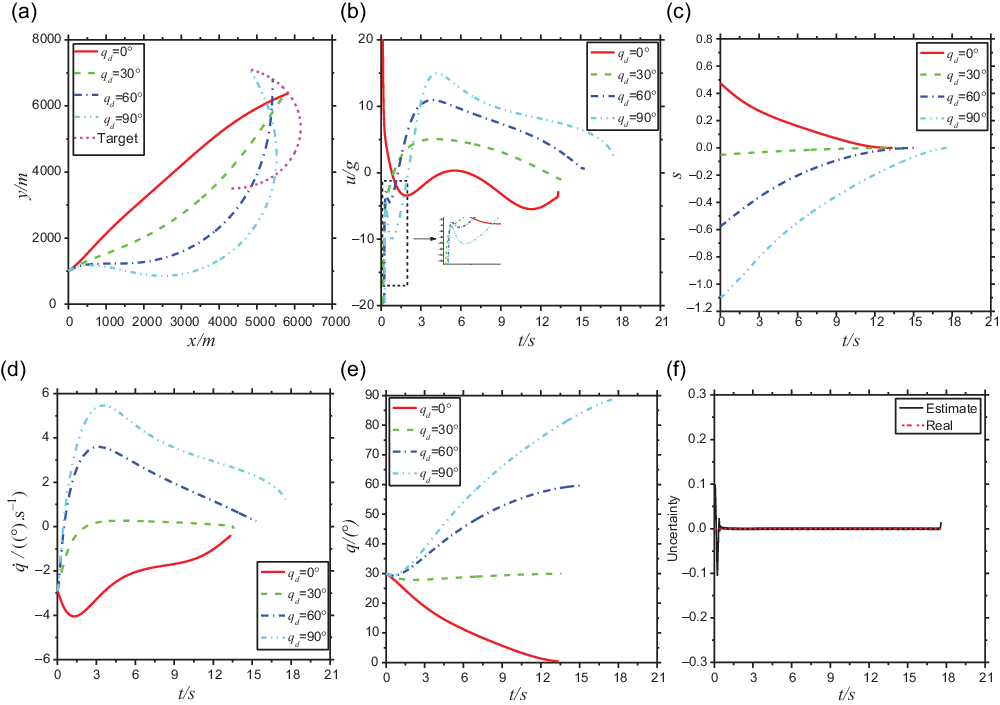
Case 1: The target performs a step manoeuver, i.e.  ${a_T}$
= 5g. The expected LOS angle is
 $0^\circ \le {q_d} \le 90^\circ $
for every 30°.
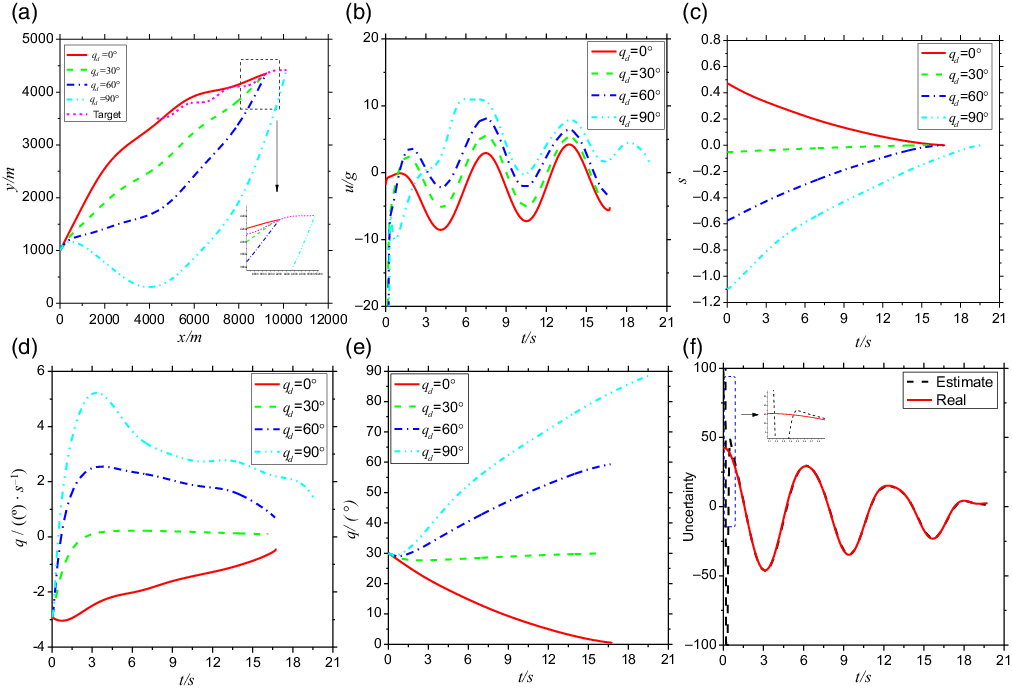
Case 2: The target performs a periodic waving manoeuver, i.e.,  ${a_T} = 5g\!\sin \left( t \right)$
. The expected LOS angle is
 $0^\circ \le {q_d} \le 90^\circ $
for every 30°.
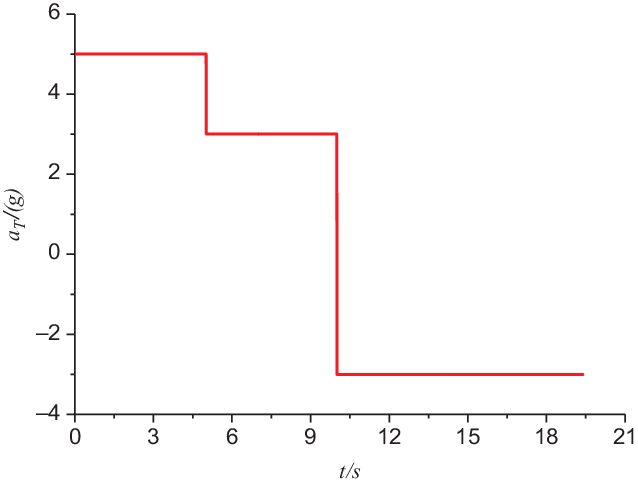
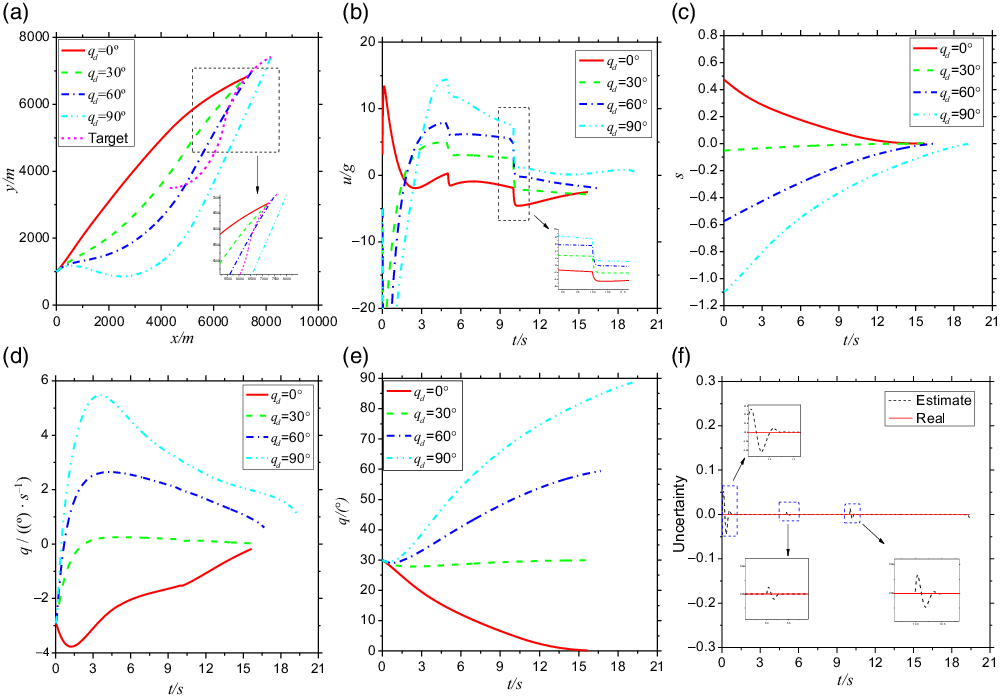
Case 3: The target performs random step manoeuvers as shown in Fig. 2. The expected LOS angle is  $0^\circ \le {q_d} \le 90^\circ $
for every 30°.
Target manoeuver form in Case 3.

The target estimation parameters are  $\,{k_1} = 4$
,
 ${k_2} = 10$
, and
 $p = 4.5$
. NSO-SMGL with parameters
 ${m_1} = 1$
and
 $n = 1.5$
is applied to the simulation.
Simulation results of Case 1: (a) trajectories of missile and target, (b) missile overload commands, (c) sliding surface profiles, (d) LOS angular velocity, (e) LOS angle, and (f) target manoeuvering estimations.

Simulation results of Case 2: (a) trajectories of missile and target, (b) missile overload commands, (c) sliding surface profiles, (d) LOS angular velocity, (e) LOS angle, and (f) target manoeuvering estimations.

The simulation results, including the trajectories of the missile and the target on the vertical plane, missile overload commands, sliding surface profiles, LOS angular velocity profiles, LOS angle profiles, and target manoeuvering estimations (uncertainty) are presented under different conditions in Figs. 3–5. NSO-SMGL can achieve high-precision interceptions to various types of manoeuvering targets within a wide range of expected impact angles as illustrated in the three figures. In Figs. 3(b)–5(b), the missile demands high control energy in the beginning of the terminal guidance phase because system states are far from the equilibrium. However, the overload commands are evidently reduced to a relatively lower level within an extremely short period. Such variation is beneficial for the guidance process, because the missile could produce high energy in the beginning of process and then gradually decrease during the flight. In Figs. 3(c)–5(c), the sliding surfaces gradually converge to zero, thereby avoiding oscillations between positive and negative values and preventing the unexpected chattering phenomenon. With the sliding surfaces converging to zero, the missile could hit the target at the desired angles. In Figs. 3(d), 3(e), 4(d), 4(e), 5(d), and 5(e), the LOS angular rate converges to zero and the LOS angle converges to expected values regardless of the target manoeuver, and the goal of the guidance law design is accomplished by considering autopilot lag. The estimation of uncertainty is  ${f_1} \approx (1/r){\dot a_{Tq}}$
in theory, but uncertainty is minimal except at the end of the guidance process; therefore, the estimation results are multiplied by
 $r$
. In Figs 3(f)–5(f), the performance of the target manoeuvering estimator achieves relatively satisfactory results. In the simulation, the missile could hit the manoeuvering target precisely, because the estimator obtains the target’s acceleration effectively and compensates in guidance law. Even if there exists noises, the estimator can acquire the target’s acceleration and noises together, and eliminate their influences in the final guidance law.
Simulation results of Case 3: (a) trajectories of missile and target, (b) missile overload commands, (c) sliding surface profiles, (d) LOS angular velocity, (e) LOS angle, and (f) target manoeuvering estimations.

To further verify the efficiency of the proposed NSO-SMGL, the LSMGL proposed in(Reference Zhou39), which considers the autopilot lag algorithm, is also used in the simulations for comparison. For the design of LSMGL, Equation (63) is selected as the sliding mode.
 \begin{equation}s = {b_1}{x_1} + {b_2}{x_2} + {x_3}. \end{equation}
The definitions of  ${x_1}$
,
 ${x_2}$
, and
 ${x_3}$
are the same as those in Section 4. The design parameters are
 ${b_1}$
and
 ${b_2}$
.
Comparison between LSMGL and NSO-SMGL: (a) trajectories of missile and target, (b) missile overload commands, (c) sliding surface profiles, (d) LOS angular velocity, (e) LOS angle, and (f) target manoeuvering estimations.

Differentiating Equation (63) yields
 \begin{equation}s = {b_1}{x_2} + {b_2}{x_3} + {\dot x_3}. \end{equation}
The approach law is selected as follows:
 \begin{equation}\dot s = - ks - \sigma {\left| s \right|^\gamma }{\mathop{\rm sgn}} \left( s \right)\!. \end{equation}
LSMGL is deduced by substituting Equation (51) into Equation (64) and combining with Equation (65)
 \begin{equation}u = - \frac{1}{b}\left( {{b_1}{x_2} + {b_2}{x_3} + {f_0}\left( {{x_3},{a_{Mq}}} \right)} \right. + {\kern 1pt} {\kern 1pt} {\kern 1pt} \left. {{f_1}\left( {{x_2},{{\dot a}_{Tq}}} \right) + ks + \sigma {{\left| s \right|}^\gamma }{\mathop{\rm sgn}} \left( s \right)} \right)\!, \end{equation}
where  ${f_0}\left( {{x_3},{a_{Mq}}} \right)$
and
 ${f_1}\left( {{x_2},{{\dot a}_{Tq}}} \right)$
are the same as those in Section 3. Let
 ${\hat f_1}\left( {{x_2},{{\dot a}_{Tq}}} \right)$
be an estimation of
 $\,{f_1}\left( {{x_2},{{\dot a}_{Tq}}} \right)$
. Then, guidance can be rewritten as
 \begin{equation}u = - \frac{1}{b}\left( {{b_1}{x_2} + {b_2}{x_3} + {f_0}\left( {{x_3},{a_{Mq}}} \right)} \right. + \left. {{{\hat f}_1}\left( {{x_2},{{\dot a}_{Tq}}} \right) + ks + \sigma {{\left| s \right|}^\gamma }{\mathop{\rm sgn}} \left( s \right)} \right)\!, \end{equation}
where  ${\kern 1pt} {b_1} = 1$
,
 ${b_2} = 1$
,
 $k = 1$
,
 $\sigma = 1$
, and
 $\gamma = 0.5$
. The simulation with terminal condition
 ${\kern 1pt} {q_d} = 0^\circ {\kern 1pt} $
cannot be accomplished via guidance law Equation (67); therefore, the terminal condition is modified to
 ${\kern 1pt} {q_d} = 10^\circ {\kern 1pt} $
. Other conditions are the same as those in Case 2. Figure 6 presents the simulation results. Both methods enable the LOS angle to approach the desired value and the LOS angular velocity to approach zero. However, the sliding surface of LSMGL rapidly converges to zero and oscillate between positive and negative values, thereby making the overload in the beginning of the guidance process immense and trajectory bending evident. The high-frequency chattering phenomenon occurs in LSMGL guidance law. The results illustrate the drawbacks of the first-order sliding mode. The trajectory of NSO-SMGL is smooth, and the guidance law exhibits no chattering, because the sliding surface has a relative degree of 2 and the observer is finite-time convergence and exhibits strong robustness against the variation of target manoeuverings. The simulation results verify the validity of the theory in Section 3.2, i.e., the advantage of the proposed NSO-SMGL is ensuring that the sliding surface and its derivative converge to zero in finite time and guaranteeing that the sliding surface does not cross zero until the ultimate time. Moreover, the proposed guidance law achieves a wider range of intercept angles than LSMGL. In summary, the performance of the proposed NSO-SMGL Equation (62) is superior to that of the general LSMGL Equation (67) and the associated drawbacks of LSMGL are overcome.
6.0 CONCLUSIONS
This study presents NSO-SMGL for intercepting manoeuvering targets by considering autopilot lag and terminal impact angle constraint. The proposed NSO-SMGL is constructed by combining a target manoeuvering estimator and a novel smooth second-order sliding mode through the application of a backstepping technique. The guidance law ensures that the sliding surface and its derivative converge to zero in finite time while guaranteeing that the sliding surface will not cross zero until the ultimate time, thereby effectively eliminating undesired chattering. Depending on the advantages of the target estimator, the presented NSO-SMGL requires no information regarding the target and provides a relatively effective estimation of the target manoeuvering, thereby making its implementation possible. The convergence of the guidance system is proven on the basis of Lyapunov stability theory. The simulation results of the comparisons with LSMGL validate the effectiveness and superiority of the proposed guidance system. Our future research will concentrate on the actuators saturation, dynamic characteristics of higher order autopilots and the guidance law in three-dimensional plane.