Introduction
Begonia L. (Begoniaceae), with more than 1550 species, is one of the largest genera of angiosperms (Hughes, Reference Hughes2008). One hotspot of species diversity lies in Malesia, where around 450 species have been described (Hughes, Reference Hughes2008; Thomas et al., Reference Thomas, Hughes, Phutthai, Ardi, Rajbhandary, Rubite, Twyford and Richardson2012). Recent expeditions to the Indonesian island of Sulawesi have resulted in the description of 22 new Begonia species since 2006 (Hughes, Reference Hughes2006; Thomas & Hughes, Reference Thomas and Hughes2008; Girmansyah et al., Reference Girmansyah, Wiriadinata, Thomas and Hoover2009; Thomas et al., Reference Thomas, Ardi, Hartutiningsih and Hughes2009a,Reference Thomas, Ardi and Hughesb, Reference Thomas, Ardi and Hughes2011; present study), raising the number of currently accepted species from the island to 44 (Thomas et al., Reference Thomas, Ardi, Girmansyah and Hughes2013). This recent high discovery rate of Sulawesi Begonia species reflects the past under-exploration of the island, which has the lowest collection density of the larger islands in Indonesia (Cannon et al., Reference Cannon, Summers, Harting and Kessler2007).
Several species of Begonia which were collected on expeditions to North and South Sulawesi organised by Bogor and Bali Botanic Gardens were brought into cultivation at Bali Botanic Garden. From these collections, two species, Begonia guttapila D.C.Thomas & Ardi and B. didyma D.C.Thomas & Ardi, have been recently described (Thomas et al., Reference Thomas, Ardi and Hughes2009b), and two more are newly described here. Like the vast majority of Sulawesi Begonia species, these two new species are placed in Begonia section Petermannia, as they exhibit typical characters of the section: protogynous inflorescences, two-flowered female inflorescences, three-locular ovaries with bilamellate placentae, and anthers with unilaterally positioned slits (Doorenbos et al., Reference Doorenbos, Sosef and de Wilde1998). A key to the Begonia species of North Sulawesi and Gorontalo provinces is provided to complement the key to the species of South and West Sulawesi provinces in Thomas et al. (Reference Thomas, Ardi and Hughes2011).
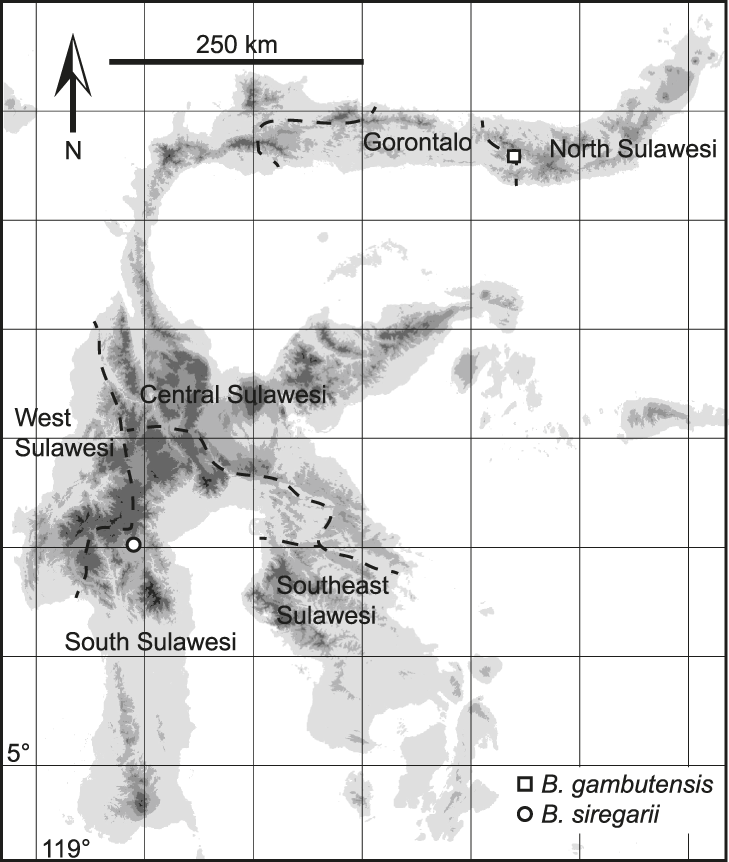
All available Begonia specimens from B, BM, BO, E, K, L, SING and WAG have been consulted and hence it must be assumed, at least until more intensive collecting in Sulawesi reveals otherwise, that both species described here have very restricted ranges (Fig. 1).
Distribution map. Collection sites are indicated by a square (Begonia gambutensis, based on georeferencing the locality ‘Desa Pinogu’ using the GeoNames geographical database at http://www.geonames.org/) and a circle (Begonia siregarii, based on GPS data). Topographical variation is indicated by five shades of grey: 0–500 m (the lightest shade), 500–1000 m, 1000–1500 m, 1500–2000 m, and > 2000 m (the darkest shade).

Species Descriptions
Begonia gambutensis Ardi & D.C.Thomas, sp. nov. Sect. Petermannia.
Differs from other Sulawesi Begonia species by the character combination of a dense crimson indumentum on vegetative parts, male inflorescences showing basal dichasial branching with well-developed internodes and distal monochasial branching, and female flowers with obovate tepals distinctly tapering towards the base. – Type: Cultivated in Bali Botanic Garden from vegetative material collected in the wild (Indonesia, Sulawesi, Gorontalo, Bone Bolango district, Suwawa Timur subdistrict, Gunung Gambuta, Desa Pinogu, side of river, c.700 m), 3 ix 2013, D.C. Thomas & W.H. Ardi 13-802 (holo BO; iso E, L). Figs 1,2.
Begonia gambutensis Ardi & D.C.Thomas. A, habit; B, abaxial leaf surface; C, stipule; D, inflorescence; E, male flower; F, female inflorescence; G, female flower, front view; H, ovary, cross-section, three-locular with axile, bilamellate placentae; I, fruit. A–I: D.C. Thomas & W.H. Ardi 13-802. Scale bars: B = 7 cm; C = 7 mm; E = 18 mm; F = 12 mm; G = 15 mm; H = 3 mm; I = 12 mm. (See online for a colour version of this figure.)
Perennial, monoecious herb with erect stems, to c.60 cm tall, with a dense indumentum of crimson, multicellular, simple trichomes up to c.1.2 mm long and a sparse indumentum of microscopic, glandular trichomes on stems and leaves. Stems branched; internodes c.3–5.5 cm long, reddish. Leaves alternate; stipules caducous, 8–17 × 6–7 mm, asymmetric, oblong to narrowly elliptic, with a slightly prominent midrib abaxially projecting up to c.2 mm at the apex; petioles c.4–9 cm long, red; lamina basifixed, 7–12.6 × 4.8–8 cm, asymmetric, ovate to elliptic, base cordate, lobes sometimes overlapping, apex acuminate, margin serrate to biserrate, undulate, the teeth long bristle-pointed, adaxial surface midgreen and abaxial surface pale green, primary veins 5–8, actinodromous, secondary veins craspedodromous. Inflorescences: protogynous; female inflorescences 2-flowered, one node basal to the male inflorescences or solitary, peduncles 4–7 mm long; male inflorescences distal to the female inflorescences or sometimes solitary, usually branched with 2–3 cymose partial inflorescences, each showing 1–2 basal dichasial branchings and several distal monochasial branchings, the internodes well developed in the basal part, but condensed in the most distal part. Male flowers: pedicels 9–15 mm long; tepals 2, pink, rarely white, 9–16 × 13–21 mm, broadly ovate, base slightly cordate, margin fringed by stiff hairs, apex rounded, abaxially hairy; androecium of c.40–60 stamens, yellow, filaments up to c.1.5 mm long, slightly fused at the very base, anthers up to c.1 mm long, obovate, dehiscing through unilaterally positioned slits > 1/2 as long as the anthers. Female flowers: pedicels 3–4 mm long; tepals (4–)5, whitish-pinkish, unequal, the smallest 8–14 × 5–7 mm, obovate, the larger 21–22 × 15–18 mm, obovate to elliptic, the margin serrulate and fringed with short stiff hairs, abaxially hairy; ovary ellipsoid, hairy, locules 3, placentation axile, placentae bilamellate, wings 3, subequal, narrowly triangular, base rounded, apex truncate, the margin serrulate with teeth extended into multicellular hairs up to c.1 mm long, styles basally fused, 3-branched, each stylodium bifurcate in the stigmatic region, stigmatic surface a spirally twisted papillose band, orange. Fruits: peduncles c.9–13 mm long; pedicels 5–7 mm long; ellipsoid, 14–16 × 5–7 mm (excluding the wings), sparsely to moderately densely hairy, dehiscent, splitting along the wing attachment, wing shape as on ovary, 9–11 mm wide at the widest point (at the apex); seeds ellipsoidal, c.0.3–0.4 mm long, collar cells c.1/5–1/4 of the length of the seed.
Distribution. Indonesia, endemic to Sulawesi, Gorontalo.
Habitat. Primary rain forest, forest floor at the side of a river, at c.700 m above sea level.
Etymology. The epithet ‘gambutensis’ refers to Gunung Gambuta, where the type material was collected.
Additional specimen examined. Sulawesi. Gorontalo: Gunung Gambuta (cultivated at Bali Botanic Garden from material collected in the wild), 4 iv 2009, D.C. Thomas & W. Ardi 09-53 (BO, E).
The complex inflorescence architecture of Begonia gambutensis with basal dichasial branching with well-developed internodes and distal monochasial branching (Fig. 2D) in combination with the crimson indumentum on vegetative parts (Fig. 2C), and tepals of the female flowers which conspicuously taper towards the base, separates this species from other Sulawesi Begonia species.
In molecular phylogenetic analyses on the basis of non-coding plastid DNA data, Begonia gambutensis (accession DCT 09-53) is retrieved in a well-supported clade with the Northern Sulawesi species B. macintyreana and B. chiasmogyna, which is sister to a clade containing the Northern Sulawesi species B. mendumiae, B. capituliformis, B. hispidissima and B. masarangensis (Thomas, Reference Thomas2010; Thomas et al., Reference Thomas, Hughes, Phutthai, Ardi, Rajbhandary, Rubite, Twyford and Richardson2012). The complex, many-flowered inflorescences of Begonia macintyreana, which show well-developed internodes as well as basal dichasial branching and distal monochasial branching, are similar to the ones found in B. gambutensis. However, apart from the inflorescence architecture the two species are morphologically dissimilar and the glabrous stems, leaves and generative parts and the somewhat pointed apices of the tepals of Begonia macintyreana separate this species from B. gambutensis. Begonia chiasmogyna has some similarity with Begonia gambutensis with regard to the dense indumentum on vegetative parts, the complex inflorescence architecture with relatively well-developed internodes, and the tepals of the female flowers, which taper conspicuously towards the base (Hughes, Reference Hughes2006). However, Begonia chiasmogyna can be easily differentiated from B. gambutensis by the colour of the indumentum (white, not reddish), as well as the number and shape of the tepals of the female flowers (four obtrullate tepals versus five obovate tepals).
Begonia siregarii Ardi & D.C.Thomas, sp. nov. Sect. Petermannia.
Similar to Begonia prionota D.C.Thomas & Ardi. Differs from this species by its dentate-denticulate leaf margins (biserrate to shallowly lobed in B. prionota), the longer peduncles of the female inflorescences (2.2–4 cm vs. 1.2–2 cm), more strongly condensed monochasia, and entire tepals of the female flowers (irregularly serrate in B. prionota). – Type: Cultivated in Bali Botanic Garden from vegetative material collected in the wild (Indonesia, Sulawesi, South Sulawesi, Tana Toraja, Kete Kesu village, burial site, 02°59′53.1″S, 119°54′35.3″E, 800 m), 3 ix 2013, D.C. Thomas & W.H. Ardi 13-801 (holo BO; iso E, L). Figs 1,3.
Begonia siregarii Ardi & D.C.Thomas. A, habit; B, abaxial leaf surface; C, stipule; D, inflorescence; E, male flower; F, female inflorescence; G, female flower, front view; H, ovary, cross-section, three-locular with axile, bilamellate placentae; I, fruit. A–I: D.C. Thomas & W.H. Ardi 13-801. Scale bars: B = 10 cm; C = 8 mm; E = 16 mm; F = 12 mm; G = 15 mm; H = 3 mm; I = 12 mm. (See online for a colour version of this figure.)
Perennial, monoecious herb with erect stems, to c.1 m tall, with a moderately dense to dense indumentum of white, multicellular, simple trichomes up to c.0.5 mm long and a sparse indumentum of microscopic, glandular trichomes on stems and leaves. Stems branched; internodes c.6.5–10.5 cm long, reddish to green. Leaves alternate; stipules caducous, 10–21 × 6–10 mm, slightly asymmetric, ovoid to elliptic, with an abaxially slightly prominent midrib projecting up to 5 mm at the apex; petioles 4–14 cm long, reddish; lamina basifixed, 7.5–23.5 × 4–14 cm, strongly asymmetric, ovate to elliptic, base cordate and lobes sometimes slightly overlapping, apex acute, margin irregularly and distantly dentate and denticulate between the larger teeth, the teeth long bristle-pointed, adaxial surface dark green and abaxial surface pale green, primary veins 8–10, actinodromous, secondary veins craspedodromous. Inflorescences: protogynous; female inflorescences 2-flowered, one node basal to male inflorescences; peduncles 2.2–4 cm long; male inflorescence branched and composed of 3–5 cymose partial inflorescences, each showing (0–)1–3 basal dichasial branchings and several distal monochasial branchings, the internodes well developed in the basal part, but strongly to moderately condensed in the distal part; peduncles of partial inflorescences c.9–31 mm long. Male flowers: pedicels 23–28 mm long; tepals 2, white or white tinged with pink, cream coloured or cream coloured tinged with pink when young, 15–19 × 15–22 mm, broadly ovate to suborbicular, base slightly cordate, margin entire, apex rounded, abaxially with a sparse indumentum or glabrescent; androecium of c.50–90 stamens, yellow, filaments up to c.2 mm long, slightly fused at the very base, anthers up to c.1 mm long, obovate, dehiscing through unilaterally positioned slits > 1/2 as long as the anthers. Female flowers: pedicels 10–20 mm long; tepals 5, white tinged with pink, unequal, the smallest 14–27 × 6–8 mm, ovate to elliptic, the larger ones 18–29 × 10–20 mm, elliptic to oblong, the margin entire, sparsely to moderately hairy or almost glabrous; ovary ellipsoid, hairy, locules 3, placentation axile, placentae bilamellate, wings 3, equal, base rounded, apex truncate, margin entire, styles basally fused, 3-branched, each stylodium bifurcate in the stigmatic region, stigmatic surface a spirally twisted papillose band, yellow. Fruits: pedicels 10–20 mm long; ellipsoid, 10–16 × 5–7 mm (excluding the wings), sparsely to moderately hairy to glabrescent, wing shape as on ovary, 5–10 mm wide at the widest point (at the apex); seeds ellipsoidal, c.0.4–0.5 mm long, collar cells c.1/5–1/4 of the length of the seed.
Distribution. Indonesia, endemic to Sulawesi, South Sulawesi.
Habitat. Strongly disturbed secondary forest, forest floor, limestone, collected at c.800 m above sea level.
Etymology. The species is named in honour of the former director of Bogor Botanic Gardens, Mr Mustaid Siregar, who collected living material of this species in 2007.
Additional specimens examined. Sulawesi. South Sulawesi: Tanah Toraja, Kete Kesu burial site, 4 iv 2009, D.C. Thomas & W. Ardi 09-51 (BO, E); ibid., 15 vi 2013, Rismita Sari RI 1367 (BO).
The male inflorescence architecture (Fig. 3D) in combination with the long peduncles of the female inflorescences (2.2–4 cm long) (Fig. 3F) and the moderately dense to dense indumentum of relatively short (up to c.0.5 mm), white hairs on stems and leaves (Fig. 3C, I) differentiate this species from other Sulawesi Begonia species. Among Sulawesi Begonia only B. prionota D.C.Thomas & Ardi shows a similar character combination. The male partial inflorescences are more condensed in Begonia siregarii, however, and the length of the peduncles of the female inflorescences, the dentate-denticulate leaf margins and entire tepals of the female flowers further differentiate B. siregarii from B. prionota, which shows shorter peduncles (c.1.2–2 cm), biserrate to shallowly lobed leaf margins and characteristic irregularly serrate tepal margins.
In molecular phylogenetic analyses on the basis of non-coding plastid DNA data, Begonia siregarii (accession DCT 09-51) is nested in a clade with other species from Central and South Sulawesi, including B. ozotothrix D.C.Thomas, B. nobmanniae D.C.Thomas & Ardi, B. didyma, B. prionota and material of some undescribed species (Thomas, Reference Thomas2010; Thomas et al., Reference Thomas, Ardi and Hughes2011). Begonia didyma and B. nobmanniae are smaller-leaved and relatively delicate plants vegetatively highly dissimilar to the much more robust B. siregarii. Begonia ozotothrix can readily be distinguished by the very short peduncles (1–5 mm) and pedicels (1–4 mm) of the female inflorescences and flowers, respectively, as well as the strongly condensed male partial inflorescences.
Key to Begonia in North Sulawesi and Gorontalo provinces
1a. Plants rhizomatous, creeping or decumbent, < 25 cm in height 2
1b. Plants erect, or if decumbent or arching > 25 cm in height 4
2a. Plants rhizomatous; ab- and adaxial leaf surfaces with long, erect trichomes Begonia mendumiae M.Hughes
2b. Plants creeping or decumbent, not rhizomatous; ab- and adaxial leaf surfaces glabrous, or abaxial surface with sparse, strigose indumentum 3
3a. Leaf margin unevenly dentate; pedicels of fruits > 10 mm Begonia heteroclinis Miq. ex Koord.
3b. Leaf margin shallowly lobed; pedicels of fruits < 10 mm Begonia gemella Warb. ex L.B.Sm. & Wassh.
4a. Leaves pinnatisect to bipinnatisect Begonia humilicaulis Irmsch.
4b. Leaves entire or lobed no more than halfway to the midrib 5
5a. Female inflorescences 1- or 2-flowered, separated from the male inflorescences by at least one internode; fruit dry and dehiscent 6
5b. Female and male flowers occurring together in bisexual cymose inflorescences with > 2 female flowers; fruit fleshy and indehiscent 14
6a. Petioles short (up to 10 mm), leaves long and narrow (c.5–12 × 1.5–3.1 cm, length/width ratio > 3:1) Begonia cuneatifolia Irmsch.
6b. Petioles usually longer than 10 mm; leaf length/width ratio < 3:1 7
7a. Male inflorescences subumbellate, i.e. consisting of strongly condensed cymes with internodes < 1 mm long Begonia capituliformis Irmsch.
7b. Male inflorescence not subumbellate, showing dichasial or monochasial branching with at least the basal internodes > 1 mm long 8
8a. Female flowers with 4 tepals Begonia chiasmogyna M.Hughes
8b. Female flowers with 5 tepals 9
9a. Wings on ovary and fruit < 6 mm at the widest point 10
9b. Wings on ovary and fruit > 6 mm at the widest point 11
10a. Leaves c.7–11 × 3–6 cm, margin irregularly dentate to serrate Begonia hispidissima Zipp. ex Koord.
10b. Leaves 4.9–6.6 × 1.8–3 cm, margin irregularly incised up to about halfway to the midrib Begonia masarangensis Irmsch.
11a. Male inflorescences with < 6 flowers Begonia strachwitzii Warb. ex Irmsch.
11b. Male inflorescences with > 8 flowers 12
12a. Plants with sparse indumentum of microscopic glandular hairs and dense indumentum of multicellular, simple trichomes on stems and leaves Begonia gambutensis Ardi & D.C.Thomas
12b. Plants glabrous except for microscopic glandular hairs 13
13a. Petioles < 2.6 cm long; peduncles of female inflorescences < 5 mm long Begonia insularum Irmsch.
13b. Petioles 4–7 cm long; peduncles of female inflorescences 10–15 mm long Begonia macintyreana M.Hughes
14a. Leaves oblong-lanceolate; male flowers with 4 tepals Begonia aptera Blume
14b. Leaves broadly ovate; male flowers with 2 tepals Begonia rieckei Warb.
Acknowledgements
We are grateful to the curators of B, BM, BO, E, K, L, SING and WAG for allowing us access to herbarium material and living collections; to Ms Rismita Sari for collecting additional living material of Begonia siregarii; to Mr I Wayan Warnatea (Bali Botanic Garden) who collected the material of Begonia gambutensis; and to the horticulture staff at Bali Botanic Garden and Bogor Botanic Gardens. The support of D.C.T.’s research on Begonia by the M.L. MacIntyre Trust is gratefully acknowledged.