Introduction
Soybean Glycine max (L.) Merrill (Fabales: Fabaceae) is a crop of major importance, with Brazil accounting for approximately 39% of the 398.2 million tons produced globally during the 2023/2024 harvest (USDA – United States Department of Agriculture 2024). These crops are vulnerable to insect attacks from germination to the end of the growing season. The Neotropical brown stink bug – Euschistus heros (F. 1798) (Heteroptera: Pentatomidae) – has become the most significant sucking insect pest for crops in the Neotropical region (Panizzi et al., Reference Panizzi, Lucini and Aldrich2022). This pest primarily targets the pods, causing significant damage by reducing oil content, deforming grains, and lowering germination capacity (Bueno et al., Reference Bueno, Ceolin Bortolotto, Pomari-Fernandes and França-Neto2015).
To control these pests, broad-spectrum chemical insecticides, such as pyrethroids and neonicotinoids, are commonly used. However, these insecticides can also harm natural enemies and pollinators (Bayram et al., Reference Bayram, Salerno, Onofri and Conti2010; Goulson Reference Goulson and Kleijn2013; Koppel et al., Reference Koppel, Herbert, Kuhar, Malone and Arrington2011). Beyond the environmental and health risks, the development of resistant stink bug populations has diminished the effectiveness of chemical pesticides, creating a growing need for alternative control methods (Somavilla et al., Reference Somavilla, Reis, Gubiani, Godoy, Stürmer and Bernardi2020; Sosa-Gómez et al., Reference Sosa-Gómez, Boucias and Nation1997).
Entomopathogenic fungi are known for their high genetic diversity and their ability to cause significant infections at various stages of the host’s life. These fungi can penetrate the integument and naturally spread throughout the environment (Mascarin and Jaronski Reference Mascarin and Jaronski2016; Saminathan et al., Reference Saminathan, Subramanian, Sankaran Pagalahalli, Anand Theerthagiri and Mariappan2025). Despite their potential against sucking insects (Thungrabeab and Tongma Reference Thungrabeab and Tongma2007), studies have shown that Pentatomidae, particularly Nezara viridula (L. 1758) and E. heros, exhibit low susceptibility to these natural enemies. This resistance is thought to result from chemical compounds in the insect cuticle that prevent fungal adhesion and germination, ultimately hindering disease development (Lopes et al., Reference Lopes, Laumann, Blassioli-Moraes, Borges and Faria2015; Silva et al., Reference Silva, Quintela, Mascarin, Pedrini, Liao and Ferri2015; Sosa-Gómez et al., Reference Sosa-Gómez, Boucias and Nation1997).
Although over 37 commercial products based on entomopathogenic fungi have been registered in Brazil to control the Neotropical brown stink bug (Agrofit, Sistemas de agrotóxicos fitossanitários 2025), there is limited information on their efficacy under field conditions. Only one recent study has assessed the integration of fungi and chemical insecticides for managing this pest in the field (Soares Reference Soares2023; Sosa-Gómez and Moscardi Reference Sosa-Gómez and Moscardi1998).
To overcome this limitation, a selection study can identify more effective isolates against brown stink bugs (Dalla Nora et al., Reference Dalla Nora, Piovesan, Bellé, Stacke, Balardin, Guedes, Michaud and Jacques2021; Resquín-Romero et al., Reference Resquín-Romero, Cabral-Antúnez, Sarubbi-Orue, Garrido-Jurado, Valverde-García, Schade and Butt2020; Silva-Santana et al., Reference Silva-Santana, Alves, Ferreira and Bonini2022; Sousa et al., Reference Sousa, Quintela, Boaventura, Silva, Tripode and Miranda2023). In addition to selecting isolates, choosing the right formulation can enhance the efficiency of entomopathogenic fungi in the field, such as with oil-based formulations (Ibrahim et al., Reference Ibrahim, Butt, Beckett and Clark1999; Saminathan et al., Reference Saminathan, Subramanian, Sankaran Pagalahalli, Anand Theerthagiri and Mariappan2025). These formulations have physicochemical properties that improve surface coverage during application and reduce suspension evaporation, thus increasing the effectiveness of the fungus (Bateman et al., Reference Bateman, Carey, Moore and Prior1993; Leemon and Jonsson Reference Leemon and Jonsson2008). One common formulation is oil dispersion (OD), a stable suspension of the active ingredient in a water-immiscible fluid. This formulation may also contain other dissolved active ingredients and is designed to be diluted in water before use (Faria and Wraight Reference Faria and Wraight2007). According to Acheampong et al., (Reference Acheampong, Hill, Moore and Coombes2020), vegetable oil and emulsifiable concentrate formulations in mycoinsecticides offer excellent protection for conidia against the damaging effects of UV radiation.
In field conditions, this is particularly important because environmental stressors, like heat and UV-B radiation, can reduce the effectiveness of entomopathogenic fungi against pests. A better understanding of their stress tolerance can lead to the development of more sustainable, eco-friendly pest management solutions that are safe for non-target organisms (Li et al., Reference Li, Alves, Roberts, Fan, Delalibera, Tang, Lopes, Faria and Rangel2010; Lord JC 2005; Roberts and St. Leger Reference Roberts and St. Leger2004). Therefore, studying and improving the fungi’s resilience to environmental stressors will enhance their persistence and efficacy in the field, reducing the reliance on chemical pesticides (Alves et al., Reference Alves, Bateman, Prior and Leather1998a; Rangel et al., Reference Rangel, Braga, Fernandes, Keyser, Hallsworth and Roberts2015).
Thus, the main objective of our study was to evaluate the effectiveness of B. bassiana Unioeste 76 isolate in an OD formulation for controlling E. heros in the field. Additionally, we evaluated in the laboratory the effect of the OD formulation in direct application on these insects, and the application strategy in greenhouse conditions. It was also compared the UV-B radiation and heat tolerance of the B. bassiana isolate in both pure conidia and OD formulations, as well as with standard isolates.
Materials and methods
Insects
The Euschistus heros (Heteroptera: Pentatomidae) used in the laboratory and greenhouse assays were obtained from a laboratory colony. The insects were kept in screened cages and fed with fresh bean pods, soybean seeds, sunflower seeds, peanuts, and ligustrum fruits. Food source were replaced every two days. For oviposition, cotton fabric strips were placed in the cages and fixed by the lid, with the setup kept in an air-conditioned room (25 ± 2 °C, 12-hour photoperiods, and 60 ± 10% relative humidity) (Silva et al., Reference Silva, Laumann, Blassioli, Pareja and Borges2008).
Fungus
The fungus Beauveria bassiana (sensu lato) isolate Unioeste 76 (GenBank sequence OK065593.1) was selected in a previous study for its higher virulence to E. heros (Silva-Santana et al., Reference Silva-Santana, Alves, Ferreira and Bonini2022). After 7 days of incubation (26 ± 1 °C, 14-hour photoperiod) in Petri dishes with sporulation medium (1.58 g NaNO3, 0.36 g KH2PO4, 0.60 g MgSO4·7H2O, 1.05 g NaHPO4·7H2O, 1.00 g KCl, 5.0 g yeast extract, 10.0 g glucose, 20.0 g agar, 1000 mL distilled water) (Alves et al., Reference Alves, Almeida, Moino, Alves and Alves1998b), conidia were collected by scraping the surface of the medium. After 7 days of drying in a silica gel desiccator, the conidia were separated using a 32-mesh sieve.
A conidial suspension (1 × 10⁹ conidia/mL) was prepared with pure conidia (TC) in distilled water containing 0.01% Tween 80. The oil-based formulation (OD) was also prepared, consisting of conidia, refined soybean oil, and an emulsifier made up of 0.3% non-ionic surfactants (Oliveira et al., Reference Oliveira, Pauli, Mascarin and Delalibera2015). For all bioassays, the formulation was diluted in distilled water (10%), resulting in a final concentration of 1 × 10⁹ conidia/mL, as determined using a Neubauer chamber. The conidia had a minimum viability of 90%, as assessed according to Oliveira et al. (Reference Oliveira, Pauli, Mascarin and Delalibera2015) and Oliveira et al. (Reference Oliveira, Lopes, Rezende and Delalibera2018b).
The fungus used in the field experiment was produced through solid fermentation on parboiled rice, following the method described by Leite et al. (Reference Leite, Batista-Filho, Almeida and Alves2003). The process included conidiogenesis and drying on trays. The conidia were then extracted and stored at −80°C until use.
Insect bioassays
Laboratory Assay: In the laboratory experiment, the aim was to verify whether the oil formulation presented greater mortality in vitro than pure conidia, and also to confirm whether the oil and adjuvant used affected the fungal virulence, or whether they alone (positive control) caused any effect on the insects. Thus, adult E. heros were selected 48 hours after emergence. The insects were grouped into sets of 20 individuals (10 males and 10 females) and placed in 250 mL plastic cups with perforated lids. Five replicates were prepared for each treatment and control.
The insects were sprayed with 1 mL of either the aqueous conidial suspension (TC) or the oil formulation (OD) (both containing 1 × 10⁹ conidia/mL) using a micropulveriser (Wimpel® MP-1003) connected to an air compressor (maintaining a constant outlet pressure of 0.6 kgf/cm2). In the positive control, the insects received 1 mL of a mixture of emulsifier and vegetable oil (10% mixture in distilled water). The negative control contained only distilled water and 0.01% Tween 80. After treatment, the insects were transferred to plastic containers (15 × 15 cm) with their natural diet (as described above) and kept in an environment-controlled room (25 ± 1°C, 12-hour photoperiod, and 60 ± 10% RH).
The insects were evaluated daily, with dead insects being removed and then immersed successively in 70% alcohol solution, 2.5% sodium hypochlorite, and distilled water. They were subsequently placed in a humid chamber (a Petri dish with filter paper moistened with sterile distilled water) to confirm mortality caused by the fungus.
The experiment was repeated twice in time using a completely randomised design. The data were analysed using the XLSTAT® statistical program (Statistical Software for Excel), and subjected to the Shapiro–Wilk test and analysis of variance (ANOVA). Means were compared using Tukey’s test (p ≤ 0.05).
Greenhouse Assay: Five conventional soybean seeds (cultivar BRS 284), untreated with phytosanitary chemicals, were sown in 3 L plastic pots containing a mixture of soil, organic compost, ground pine bark, and vermiculite in a 4:4:1:1 ratio. The pots were placed under a canopy providing 50% shading and watered daily with 250 mL of water. When the plants reached the [V3] stage (second trifoliate leaf established) (Fehr and Caviness Reference Fehr and Caviness1977), only one plant per pot was kept, and the others were removed. The pots were then divided into two groups: (i) pre-infestation and (ii) post-infestation, with five pots (replicates) per treatment. When the plants reached the [R1] stage of development (beginning to flower), they were placed in cylindrical nylon screen cages (40 cm diameter × 120 cm height), with a top closure for easy opening and handling.
In the pre-infestation group, the plants were sprayed to the point of run-off (approximately 10 mL) using a manual sprayer. After drying, the plants were infested with 10 males and 10 females. In the post-infestation group, the plants were infested with insects before spraying. The plants were then randomly placed in the greenhouse, with temperature and humidity monitored using a datalogger (Incoterm, LOG32T). The pots were watered with 500 mL of water every other day directly into the soil. Evaluations were conducted daily, and dead insects were removed. The cause of death was verified as described in the laboratory bioassay.
The experiment followed a completely randomised design. The data were analysed using the XLSTAT® statistical program (Statistical Software for Excel), with the Shapiro–Wilk test and analysis of variance (ANOVA) applied. Since non-parametric analysis was required, the data were compared using the Mann–Whitney test (p ≤ 0.05) for the OD × TC comparison within the same spraying strategy, and the Kruskal-Wallis test (p ≤ 0.05) for the pre vs. post comparison.
Field Assay: The bioassay was conducted in Londrina, PR, Brazil (23°20′39.2″ S; 51°18′04.1″ W), in a soybean field (cultivar BRS 1061 IPRO) planted at a density of 15 seeds per linear meter, with 45 cm spacing between rows. The field received chemical fertilisation with a 00-20-20 (N-P-K) mix, equivalent to 250 kg/ha. The seeds were treated with a chemical fungicide (Standak Top) to prevent fungal pathogens and insect pests, along with an inoculant. Throughout the crop’s development, disease monitoring and fungicide applications (Nimbus®: Epoxiconazole, Fluxapiroxade, Piraclostrobin; Ativus®: Sulfur) were conducted when the plants began their vegetative phase.
To address the critical period for stink bug attacks, the soybean were monitored, the insect population was sampled and treated over a 6-week period (Scopel et al., Reference Scopel, Salvadori, Panizzi and Pereira2016) following a particular recommendation for each treatment: (i) for the biological treatment (Unioeste 76 OD, 1 × 10⁹ conidia/mL), we decided to make four successive weekly applications (without relation to the sampled population), to increase the chances of establishing the fungal inoculum potential in the evaluated area; (ii) the chemical treatment involved commercial mixtures of Bifenthrin + Carbosulfan (600 mL/ha−1), Thiamethoxam + Lambda-Cyhalothrin (200 mL/ha), and a mineral oil adjuvant (1500 mL/ha−1), and two sprays were applied only when the economic threshold was reached, i.e. an average of two stink bugs per meter of sampling (Bueno et al., Reference Bueno, Paula-Moraes, Gazzoni and Pomari2013); (iii) also seeking a fungal inoculum potential (but with fewer applications), in plots where the fungus was combined with insecticides (biological + chemical treatment), two weekly sprays of fungus were carry out, followed by a chemical insecticide spray the following week; (iv) the control group received no treatment. The four treatments, as outlined in table 1, were randomly assigned to four plots (14 × 18 m) using a randomised block design.
Monitoring and spraying dates of the respective treatments to control the Neotropical brown stink bug (Euschistus heros), Londrina, PR, Brazil, 2020/2021 harvest

a Unioeste 76 (Beauveria bassiana isolate) = oil miscible flowable concentrate – OD 10% in water, final concentration of 1 × 10⁹ conidia/mL of suspension of application.
b Treatment with formulated fungus and subsequent spraying of insecticides.
c Insecticides = commercial mixtures of Bifenthrin + carbosulfan (600 mL/ha−1); Thiamethoxam + lambda-cyhalothrin (200 mL/ha−1); mineral oil adjuvant (1500 mL/ha−1).
d (–) = absence of spraying.
All sprays were applied during the early morning hours using a CO2 backpack sprayer with a 4 ATR 80 bar and cone nozzles, applying a volume equivalent to 150 L of mixture per hectare.
The E. heros population monitoring was conducted weekly, starting from the onset of pod formation and continuing until physiological maturation, using beating sheets (with four evaluation points per plot, between 7 and 9 am). For the population assessments, only nymphs from the third to the fifth instar and adult insects were included in the analysis, as these life stages cause the most significant damage to soybean crops (Scopel et al., Reference Scopel, Salvadori, Panizzi and Pereira2016).
This experiment followed a randomised complete block design. The data were transformed using the formula y = (x + 0.01)0.5, subjected to the Shapiro–Wilk test, and analysed using analysis of variance (ANOVA). The means were compared using Tukey’s test (p ≤ 0.05). Climate data, including temperature, air humidity, and solar radiation, were monitored at a meteorological station near the experimental area (Sibaldelli et al., Reference Sibaldelli, Gonçalvez and Farias2022).
The harvest was carried out mechanically using a plot harvester with two-point sampling. Production and quality data were analysed based on productivity (kg/ha), the mass (g) of 100 grains (moisture standardised to 13%), and seed quality (50 g), which was classified into categories such as good seeds, stink bug damage, and damaged seeds. Damage includes the total of burned, moldy, fermented, damaged, immature, withered, germinated, and scorched seeds (Brazil, 2007). Productivity and seed quality data were analysed using the Shapiro–Wilk test and analysis of variance (ANOVA), with means compared using Tukey’s test (p ≤ 0.05) in the XLSTAT® statistical program.
Fungal stress responses
The tolerance to UV radiation and heat conferred by the B. bassiana Unioeste 76 formulation was evaluated in the laboratory using conidial suspensions with pure conidia (TC) or formulated conidia (OD), as described earlier. As positive controls, Metarhizium acridum (ARSEF 324, known to be more tolerant to radiation and heat) and M. robertsii (ARSEF 2575, less tolerant to radiation and heat) were used, as their tolerances to UV-B radiation and heat are well-documented (Dias et al., Reference Dias, Araújo, Pupin, Ferreira, Braga and Rangel2018). The Metarhizium spp. isolates were prepared following previously published methods (Licona-Juárez et al., Reference Licona-Juárez, Andrade, Medina, Oliveira, Sosa-Gómez and Rangel2023). Three separate batches of conidia were produced, one for each replicate of each type of stress condition.
Tolerance to UV-B Radiation: Conidia from all isolates were collected after 14 days of growth and suspended in 10 mL of sterile Tween 80 solution (0.01%) in screw-cap Pyrex tubes (20 × 125 mm). The amount of conidia collected was sufficient to prepare a suspension of 105 conidia/mL. The suspensions were shaken vigorously using a vortex, and 40 µL were inoculated (dropped but not spread) onto the centre of the PDA medium. All suspensions were used immediately after preparation, at 26°C, under two UV-B fluorescent lamps (TL 20 W/12 RS, Philips, Eindhoven, Netherlands). Conidia were exposed to 847.90 mW m−2 of Quaite-weighted UV-B (Quaite et al., Reference Quaite, Sutherland and Sutherland1992a, Reference Quaite, Sutherland and Sutherland1992b) for 0 (control), 1, 2, 3 or 4 hours, resulting in doses of 0 (control), 3.05, 6.10, 9.15, or 12.20 kJ m−2 (Licona-Juárez et al., Reference Licona-Juárez, Andrade, Medina, Oliveira, Sosa-Gómez and Rangel2023).
Conidial germination was observed 24 hours after inoculation for the heat-unexposed control and 48 hours for the UV-irradiated treatments. The PDA medium was supplemented with 0.003% benomyl (25% active ingredient; Hi-Yield Chemical Company, Bonham, TX). Benomyl is commonly used in studies to slow down germination, making it easier to count germination rates at 24 and 48 hours (Rangel et al., Reference Rangel, Acheampong, Bignayan, Golez and Roberts2023).
Tolerance to Heat: To assess heat tolerance, the same conidial suspensions prepared for UV-B radiation exposure were also exposed to heat. Conidia from each isolate were harvested and suspended as previously described, then subjected to heat according to Souza et al. (Reference Souza, Azevedo, Lobo and Rangel2014). The conidial suspensions were shaken vigorously, and 2 mL of the suspension was transferred to screw-cap Pyrex tubes (20 × 125 mm). The tubes containing the suspensions were placed in a thermal bath at 45°C for 0 (unexposed control), 1, 2, 3, or 4 hours. After heat exposure, 40 μL of the suspension was inoculated onto the center of polystyrene Petri dishes (35 × 10 mm) containing 5 mL of PDA medium supplemented with 0.003% benomyl. Conidial germination was evaluated after 24 hours for the heat-unexposed control and 48 hours for the heat-exposed fungi. Germination percentages were determined as described earlier.
The stress tolerance of conidia was analysed using one-way factorial analysis of variance (ANOVA). Pairwise mean comparisons were made using Tukey’s test, with an overall p ≤ 0.05 to control for experiment-wise type I error. All analyses were performed using the Sisvar statistical program (Ferreira Reference Ferreira2014).
Results
Laboratory assay
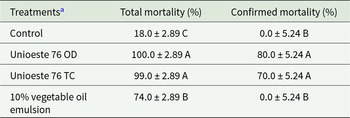
Both the OD and TC treatments with B. bassiana isolate Unioeste 76 caused nearly 100% mortality. In the positive control treatment with only the 10% vegetable oil emulsion, total mortality was 74%, which was significantly different (p ≤ 0.05) from the control, which had 18% mortality. Mortality caused specifically by the fungus was 80% in the OD treatment and 70% in the TC treatment, with no significant difference between these two treatments (table 2).
Total and confirmed mortality (%) of Euschistus heros adults subjected to spraying of Beauveria bassiana conidia in an oil dispersion formulation (OD) or pure conidia (TC)

Means (± SEM) followed by the same capital letter in the columns differ from each other according to Tukey’s test (p ≤ 0.05).
a Control = distilled water + 0.01% Tween 80; Unioeste 76 conidia in oil-based formulation (OD) = 10% in water, final concentration of 1 × 10⁹ conidia/mL mixture; Unioeste 76 isolate in pure conidia (TC) = suspension 1 × 10⁹ conidia/mL in distilled water + 0.01% Tween 80; Positive Control = soybean oil + emulsifier mixture in 10% water suspension.
Greenhouse assay
In the pre-infestation sprayed plants, the fungal treatments resulted in nearly 50% total mortality, with no significant difference (p ≤ 0.05) between the treatments. In the post-infestation spraying, mortality reached 87%, with no significant difference between OD and TC. The pre- and post-infestation application strategies showed significant differences in total mortality, with the post-infestation treatment leading to higher mortality rates (table 3).
Total and confirmed mortality of Euschistus heros adults sprayed with oil dispersion formulation (OD) or pure conidia (TC) of Beauveria bassiana (109 conidia/mL) pre- or post-infestation in soybean plants (greenhouse conditions)

Means (± SEM) followed by the same uppercase letter in the columns do not differ from each other in the Kruskal-Wallis test (p ≤ 0.05), and means followed by the same lowercase letter in the row do not differ from each other in the Mann–Whitney test (p ≤ 0.05).
a Unioeste 76 conidia in oil-based formulation (OD) = 10% in water, final concentration of 1 × 10⁹ conidia/mL mixture; Unioeste 76 isolate in pure conidia (TC) = suspension 1 × 10⁹ conidia/mL in distilled water + 0.01% Tween 80; Control = distilled water + 0.01% Tween 80.
Confirmed mortality was 46.7% for the OD treatment and 51.8% for the TC in the pre-infestation treatment, compared to 83.3% in the post-infestation treatment for both. The OD and TC treatments yielded similar results in the post-infestation treatment, with mortality higher than in the pre-infestation treatment (table 3).
Field assay
The initial mean population in day 0 (26/Jan) was above the economic threshold in all evaluated areas (averaging two insects per meter of sampling) (table 4). After the first applications (day 7), only the chemical treatment significantly reduced the population compared to the control. However, in all treatments, the population of E. heros remained below the economic threshold. In the third evaluation (day 14), the chemical treatment again differed from the others, maintaining the population below the threshold. In the fourth evaluation (day 21), all treatments were significantly different from the control, which was the only treatment above the economic threshold. By the fifth evaluation (day 28), only the biological + chemical treatment kept the E. heros population below the threshold, prompting another application in the chemical treatment. In the final evaluation, the sampled population was above the economic threshold in both the biological and chemical treatments (table 4 and fig. 1).
Population dynamics of Euschistus heros obtained by sampling throughout the experimental period (6 weeks). Soybean field planted at a density of 15 seeds per linear meter, with 45 cm spacing between rows, four plots (14 × 18 m) per treatment: biological = 4 successive applications of B. Bassiana Isolate Unioeste 76 conidia in an oil-based formulation at 10% in water, final concentration of 1 × 10⁹ conidia/mL mixture; chemical = 2 applications throughout the harvest with insecticides = commercial mixtures of Bifenthrin + carbosulfan (600 mL/ha−1); Thiamethoxam + lambda-cyhalothrin (200 mL/ha−1); mineral oil adjuvant (1500 mL/ha−1); biological + chemical = 2 successive applications with the biological, 1 application of chemical when the economic threshold was reached; control = free of any insecticide treatment.

Average number of Euschistus heros large nymphs (third to fifth instar) and adults in soybean after application of different treatments with chemical and biological insecticides. Londrina, PR, Brazil, 2020/2021 harvest

Means followed by the same letter in the columns do not differ from each other by Tukey’s test (p ≤ 0.05); Data transformed by the formula y = (x + 0.01)0.5.
a Biological = 4 successive applications of B. bassiana Isolate Unioeste 76 conidia in an oil-based formulation at 10% in water, final concentration of 1 × 10⁹ conidia/mL mixture; chemical = 2 applications throughout the harvest with insecticides = commercial mixtures of Bifenthrin + carbosulfan (600 mL/ha−1); Thiamethoxam + lambda-cyhalothrin (200 mL/ha−1); mineral oil adjuvant (1500 mL/ha−1); biological + chemical = 2 successive applications with the Biological, 1 application of Chemical when the economic threshold was reached; control = free of any insecticide treatment.
* Indicates fungus spraying, 2 days after sampling.
** Indicates insecticide spraying, 2 days after sampling.
The productivity and mass of 1000 grains did not differ significantly between treatments (table 5). However, seed quality was significantly affected (table 6). The biological + chemical and chemical treatments did not differ from each other in terms of ‘good seeds’ and insect damage, but both were different from the biological and control treatments. No differences were observed in the damaged grains.
Productivity parameters in soybean plots under different management systems with chemical and biological insecticides. Londrina, PR, Brazil, 2020/2021 harvest

Means followed by the same letter in the columns do not differ from each other by Tukey’s test (p ≤ 0.05).
a Biological = 4 successive applications of B. bassiana Isolate Unioeste 76 conidia in an oil-based formulation at 10% in water, final concentration of 1 × 10⁹ conidia/mL mixture; Chemical = 2 applications throughout the harvest with insecticides = commercial mixtures of Bifenthrin + carbosulfan (600 mL/ha-1); Thiamethoxam + lambda-cyhalothrin (200 mL/ha-1); mineral oil adjuvant (1500 mL/ha-1); Biological + Chemical = 2 successive applications with the Biological, 1 application of Chemical when the economic threshold was reached; Control = free of any insecticide treatment.
Seed quality (%) obtained in soybean plots under different management systems with chemical and biological insecticides. Londrina, PR, Brazil, 2020/2021 harvest

Means followed by the same capital letter in the column do not differ from each other by Tukey’s test (p ≤ 0.05).
a Biological = 4 successive applications of B. bassiana Isolate Unioeste 76 conidia in an oil-based formulation at 10% in water, final concentration of 1 × 10⁹ conidia/mL mixture; Chemical = 2 applications throughout the harvest with insecticides = commercial mixtures of Bifenthrin + carbosulfan (600 mL/ha-1); Thiamethoxam + lambda-cyhalothrin (200 mL/ha-1); mineral oil adjuvant (1500 mL/ha-1); Biological + Chemical = 2 successive applications with the Biological, 1 application of Chemical when the economic threshold was reached; Control = free of any insecticide treatment.
Tolerance to UV-B radiation
As expected, the positive control isolate M. acridum (ARSEF 324) was the most tolerant to UV-B radiation (F = 11.15, **p < 0.0001). Conidia of B. bassiana isolate Unioeste 76, whether formulated as OD or in TC, showed no significant difference in their tolerance to UV-B radiation across all exposure times. Conidia of another positive control, M. robertsii (ARSEF 2575), were the least tolerant to UV-B radiation after 3 and 4 hours of exposure (fig. 2A).
Tolerance to heat
Likewise, M. acridum (ARSEF 324) was the most heat-tolerant isolate across all exposure times (F = 94.49, **p < 0.0001). Conidia of M. robertsii (ARSEF 2575) were the second most heat-tolerant isolate after 1 and 2 hours of exposure but showed similar heat tolerance to B. bassiana (Unioeste 76) after 3 and 4 hours. Conidia of B. bassiana isolate Unioeste 76, whether formulated as OD or in TC, differed in heat tolerance during the 1- and 2-hour exposure times. Pure conidia were more heat-tolerant than those formulated in OD during the 1- and 2-hour exposures, but both showed similar tolerance after 3 and 4 hours (fig. 2B).
Mean conidial germination (%) of Beauveria bassiana (isolate Unioeste 76) in an oil-based formulation (OD) or Pure conidia (TC), and Metarhizium acridum (ARSEF 324 – positive control), and Metarhizium robertsii (ARSEF 2575 – positive control) after exposure to UV-B radiation for 0 (control), 1, 2, 3, and 4 h (A) or exposure to heat 45°C for 0 (control), 1, 2, 3, and 4 h (B). Error bars are standard deviation of at least three independent experiments with a fresh batch of conidia. Bars followed by the same letter do not differ from each exposure time by Tukey’s test (p ≤ 0.05).

Discussion
The results of this study provide valuable insights into the use of entomopathogenic fungi to control E. heros, as discussed below. We assessed the effectiveness of an oil dispersion formulation containing the B. bassiana isolate Unioeste 76 on stink bug mortality under laboratory, greenhouse, and field conditions. The compatibility of B. bassiana with the chemical insecticides tested here had previously been evaluated in the lab with other isolates, showing varying degrees of compatibility (Abbate et al., Reference Abbate, Rivas, Ribeiro, Bentancur, Castiglioni and Altier2024; Garcia-Riaño et al., Reference Garcia-Riaño, Torres-Torres, Santos-Díaz and Grijalba-Bernal2022; Sain et al., Reference Sain, Monga, Kranthi, Hiremani, Nagrale, Kumar, Verma and Prasad2022). Our study confirms that B. bassiana is compatible with thiamethoxam + lambda-cyhalothrin and Bifenthrin + carbosulfan at the field level. We also examined the impact of stressors on the B. bassiana isolate, the application of the fungus on soybean leaves or directly on insects, and the integration of biological and chemical methods for managing pest populations. Additionally, we evaluated the effect of this integrated management approach on certain crop productivity parameters.
While fungi can naturally infect stink bugs in the field, such instances are rare, and epizootics involving B. bassiana species have never been reported (Moscardi et al., Reference Moscardi, Correa-Ferreira, Diniz and Bono1988; Sosa-Gómez et al., Reference Sosa-Gómez, Boucias and Nation1997). In the laboratory, mortality rates above 80% can be achieved with virulent isolates of E. heros (Dalla Nora et al., Reference Dalla Nora, Piovesan, Bellé, Stacke, Balardin, Guedes, Michaud and Jacques2021; Oliveira et al., Reference Oliveira, Dudczak, Alves and Sosa-Gomez2016; Silva-Santana et al., Reference Silva-Santana, Alves, Ferreira and Bonini2022), as high concentrations of conidia are used to ensure the inoculum’s potential for causing severe infections.
Despite the stink bugs’ greater tolerance to fungal infections – often linked to factors related to their cuticle (Lopes et al., Reference Lopes, Laumann, Blassioli-Moraes, Borges and Faria2015; Oliveira et al., Reference Oliveira, Dudczak, Alves and Sosa-Gomez2016; Silva et al., Reference Silva, Quintela, Mascarin, Pedrini, Liao and Ferri2015; Sosa-Gómez et al., Reference Sosa-Gómez, Boucias and Nation1997) – entomopathogens tend to perform much better under laboratory conditions than in the field, which is common for most pests. This difference is mainly due to environmental factors that are difficult to control in the field, along with the much higher concentrations of fungi that can be achieved in lab tests compared to field applications (Jaronski Reference Jaronski2010; Mascarin and Jaronski Reference Mascarin and Jaronski2016). While several abiotic factors can influence the survival and infectivity of fungi, solar radiation, light exposure, hypoxia, relative humidity, and temperature are generally considered the most significant (Jia et al., Reference Jia, Camara, Zhang, Gao, Yang, Sangbaramou, Zhen, Shi and Tan2023; Luz and Fargues Reference Luz and Fargues1997; Oliveira et al., Reference Oliveira, Braga and Rangel2018a; Oliveira and Rangel Reference Oliveira and Rangel2018).
Strategies that improve the survival of infectious propagules under field conditions are crucial for effective biological control. One way to boost fungal performance is by enhancing resistance to harsh abiotic conditions through product formulation (Kaiser et al., Reference Kaiser, Bacher, Mène-Saffrané and Grabenweger2019; Saminathan et al., Reference Saminathan, Subramanian, Sankaran Pagalahalli, Anand Theerthagiri and Mariappan2025). Oil formulations have been shown to protect entomopathogenic fungi effectively (Devi et al., Reference Devi, Joshi and Sangha2018; Inglis et al., Reference Inglis, Goettel and Johnson1995; Jaronski Reference Jaronski, Goss, Hopinkson and Collins1997; Kaiser et al., Reference Kaiser, Bacher, Mène-Saffrané and Grabenweger2019; Lopes et al., Reference Lopes, Sosa-Gómez, Oliveira, Sanches, de Souza, Benito, Schmidt and Faria2020; Luz and Batagin Reference Luz and Batagin2005; Oliveira et al., Reference Oliveira, Lopes, Rezende and Delalibera2018b). Given these benefits, the oil dispersion suspension was used in our field study, as both laboratory and greenhouse experiments showed similar mortality rates with the OD and TC treatments. Under controlled abiotic conditions, the B. bassiana isolate Unioeste 76 caused comparable mortality regardless of the formulation, at high concentrations like those used in this study (1 × 10⁹ conidia/mL). Therefore, in our study, formulating the fungus with OD did not affect its virulence, as also observed by Wraight et al. (Reference Wraight, Filotas and Sanderson2016) in trials with Aphis gossypii Glover, 1877 (Hemiptera: Aphididae). The oil applied without conidia (positive control) resulted in high stink bug mortality (74%), suggesting that it may offer advantages under field conditions. In addition to providing abiotic protection, the oil’s effect on the insect cuticle might enhance fungal activity and the infection process (Ibrahim et al., Reference Ibrahim, Butt, Beckett and Clark1999; Jia et al., Reference Jia, Camara, Zhang, Gao, Yang, Sangbaramou, Zhen, Shi and Tan2023).
However, the protective effect of the OD formulation on B. bassiana isolate Unioeste 76 against stressors was not observed in our study. The evaluated formulation did not improve UV-B tolerance compared to pure conidia. In fact, the OD formulation made conidia more vulnerable to heat. McClatchie et al. (Reference McClatchie, Moore, Bateman and Prior1994) found that conidia formulated with oil were less heat-resistant than those formulated with oil and silica gel. The oil formulation may alter the ratio of saturated to unsaturated fatty acids in the conidial cell membrane, increasing membrane fluidity and causing cell disintegration at higher temperatures (Guerzoni et al., Reference Guerzoni, Lanciotti and Cocconcelli2001).
In the greenhouse treatments, we aimed to assess the potential residual effect of conidia on soybean leaves and the direct effect on the insects by spraying both before and after infestation. The insecticidal action of fungi is closely related to the number of propagules that reach the host (Mascarin and Jaronski Reference Mascarin and Jaronski2016), as seen previously with B. bassiana against E. heros (Silva-Santana et al., Reference Silva-Santana, Alves, Ferreira and Bonini2022). As expected, the direct application (post-infestation) resulted in higher mortality than the pre-infestation application, with 87% total mortality and 83% confirmed mortality. When applied to soybean leaves, fungal infection depends on the insects coming into contact with the propagules by walking, meaning conidia mainly adhere to their leg structures (integument and tarsal spaces). Although E. heros is a highly active insect that moves extensively on the plant (Dalla Nora et al., Reference Dalla Nora, Piovesan, Bellé, Stacke, Balardin, Guedes, Michaud and Jacques2021), this behavior can limit fungus-host contact and negatively impact adhesion, germination, penetration, and infection. In the direct application, conidia were able to reach more of the body surface of the stink bugs, improving the conditions for the initial stages of infection and increasing inoculum potential. Dalla Nora et al. (Reference Dalla Nora, Piovesan, Bellé, Stacke, Balardin, Guedes, Michaud and Jacques2021) found that at least five thousand B. bassiana conidia need to be deposited on each E. heros to achieve high infection rates. Therefore, while the residual effect (pre-infestation) resulted in 53% total mortality and 52% confirmed mortality, direct application proved more effective for E. heros in the greenhouse. Similar results were observed by Portilla et al. (Reference Portilla, Reddy and Tertuliano2022), who evaluated B. bassiana against N. viridula under laboratory conditions.
However, under field conditions, the residual effect is likely to occur more often. Despite efforts to directly target the insects during application, most of the contact that stink bugs have with the fungus happens when they walk on surfaces treated with the entomopathogen. The insects can become infected through the adhesion of propagules to their antennae, tarsi, and parts of the tibia (Portilla et al., Reference Portilla, Reddy and Tertuliano2022; Sosa-Gómez et al., Reference Sosa-Gómez, Boucias and Nation1997). To assess the performance and behaviour of the OD formulation of B. bassiana on E. heros, we tested different treatments: chemical insecticide alone (chemical, two applications), in which we followed the recommendation to apply only when the economic threshold was reached; formulated fungus alone (biological, four applications), seeking to increase the inoculum potential in the field initially; and a combination treatment where the fungus was applied at the beginning of the stink bug population increase, followed by a chemical insecticide application (biological + chemical, two applications of fungus + one application of chemical insecticide). The aim was to determine if combining control measures could keep the insect population below the economic threshold, while reducing the number of applications compared to using each treatment individually.
Chemical insecticides were used to control the brown stink bug, as the chemical treatment led to some of the lowest average populations of E. heros. When the population exceeded the economic threshold (more than two E. heros/m), the two applications were effective in reducing the population, as confirmed by evaluations conducted shortly after spraying. The effectiveness of thiamethoxam + lambda-cyhalothrin for E. heros is well-established and is one of the most studied and commonly used insecticides for controlling this pest (Fernandes et al., Reference Fernandes, Nascimento, Vanderleis, Silva, Falcão, Gomes, Reis and Leite2021; Moreira et al., Reference Moreira, Palharini, Massoli, Diniz, Godoy, Warpechowski, Steinhaus, Stürmer and Bernardi2024; Rossini et al., Reference Rossini, Santos and Picanço2021).
The treatment with B. bassiana OD formulation (biological), which involved four initial applications regardless of the sampled population index, showed variable efficacy. In the fourth week of the experiment, the insect population in the biological area was significantly lower than in the control area and remained within the economic threshold. Despite a notable population increase in the fifth week, by the end of the sixth week, the number of insects was once again below the economic threshold, similar to the levels observed in the chemical treatment. This demonstrates the fungus’s effectiveness under the conditions evaluated. Since the fungus’s action is density-dependent and its effectiveness in the field depends on the inoculum’s potential (Jaronski Reference Jaronski2010), the initial applications may have been enough to achieve medium-term control, even after the natural population increase and without additional treatments. The area that received the biological + chemical treatments showed different results. Two initial applications, followed by a chemical treatment, kept the insect population lower in the subsequent 2 weeks. However, the population increased again in the final week. Considering that this treatment received half as many applications as the others (chemical and biological treatments), the results obtained are significant for insect management.
Fungi are known for generating secondary cycles of infection in hosts (Lacey et al., Reference Lacey, Grzywacz, Shapiro-Ilan, Frutos, Brownbridge and Goettel2015), which is particularly beneficial for maintaining control. This was unexpected, as the fungal species B. bassiana is well-known as a facultative pathogen (despite its broad host range) (Shapiro-Ilan et al., Reference Shapiro-Ilan, Bruck, Lacey, Vega and Kaya2012), with a much more enzootic infection pattern. Epizootic occurrence is common under laboratory conditions, especially in insect farms (Chen et al., Reference Chen, Huang, He, Zhang and Li2015). However, in the field, very specific conditions are required for its occurrence (Latifian et al., Reference Latifian, Nehadian and Ghazavi2017; Qayyum et al., Reference Qayyum, Bilal, Ullah, Ali and Raza2021), and epizootics on E. heros have never been reported. More studies are needed to confirm this effect on E. heros in soybeans, especially through the recovery of dead insects and confirmation of fungal mortality. This was not the focus of the current study, which relied on population samples and did not observe a large volume of insects killed by the fungus in the field.
In a pioneering field study, Sosa-Gómez and Moscardi (Reference Sosa-Gómez and Moscardi1998) evaluated an isolate of M. anisopliae against soybean stink bugs. Their focus was not on population fluctuation, but rather on the percentage of infected insects recovered after treatment. During a harvest with milder temperatures and higher humidity, they observed up to 33% infection in E. heros by the fungus, noting that moisture levels were crucial to the efficiency and speed of the infection process (Sosa-Gómez and Moscardi Reference Sosa-Gómez and Moscardi1998). The abiotic field conditions in our study (table 4) may also have played a significant role in the results. The week of the final fungal application in the biological treatment (day 21), we recorded the highest solar radiation and lowest relative humidity (66%). A few days later, in day 28, we observed a significant population increase in the control, biological, and chemical treatment areas. The only area below the economic threshold was the biological + chemical treatment, which had received a chemical insecticide application about 13 days earlier, likely helping to maintain the low population levels. In addition to benefiting the stink bugs, the higher sun exposure and lower humidity may have negatively affected the fungal treatment.
For the soybean production parameters in the evaluated area, both productivity and the mass of 1000 grains were similar across all treatments, including the control. However, in the chemical treatment, more seeds were classified as ‘good’, and there was less observable stink bug damage compared to the biological treatment and control. The chemical + biological treatment showed intermediate results, with no significant difference. This could be related to the consistently lower pest population in areas that received the chemical treatment, suggesting that while the chemical treatment does not affect productivity, it does improve grain quality when the pest population reaches the crop’s economic threshold.
In general context, the in-vitro test was important for determining the use of OD formulation in field trial, as it proved suitable for the isolate (Uni 76), and the oil alone could also cause insect mortality. However, this expectation was not confirmed in the field, perhaps due to the way the assessment was carried out, since the population samples did not allow for more detailed observations of the causes of mortality, and also did not show a protective effect against temperature and UV-B that we evaluated later. Products based on B. bassiana (and other Hyphomycetes) have been used against insects with a similar application recommendation to chemical insecticides (Emaru et al., Reference Emaru, Nyaanga and Mwanarusi2024), targeting only direct contact, due to the enzootic nature of these fungi, as already discussed. From what we observed in the greenhouse test, the fungus was more effective in mortality of the stink bugs in direct contact (post-infestation), which influenced the decision to use a greater number of initial applications in the biological field treatment (four sprays). Although a possible secondary cycle of infection (which resulted in control) was observed in the sixth week of the evaluation, the field trial results seem to confirm that direct contact of the applied OD formulation with the insects is essential for achieving good results when using only biological control.
Conclusion
Treatments with B. bassiana isolate Unioeste 76, along with insecticides (two commercial mixtures of Bifenthrin + carbosulfan and Thiamethoxam + lambda-cyhalothrin), can be effectively used together to control E. heros populations, demonstrating compatibility at the field level. While individual chemical and biological treatments were the most effective in reducing pest populations by the end of the harvest, the biological + chemical treatments, with half the number of applications (both chemical and fungal), proved satisfactory in many respects.
This suggests that with the right strategy, Neotropical brown stink bugs can be effectively managed in crops. Exploring intervals between applications or alternating treatments could help reduce chemical usage, which is extremely beneficial for the agroecosystem environment. The fungus can also be used as a tool to delay or prevent the development of insect resistance.
The basic fungal OD formulation tested in this study (fungus + vegetable oil + emulsifying adjuvant) did not offer any advantages in terms of increased virulence or protection against stressors like heat and UV radiation. Future field studies should also consider the use of non-oil formulations, to develop a biocontrol product using this B. bassiana isolate, a more specialised formulation would need to be created, incorporating additional compounds that benefit the fungus.
Author contributions
Conceptualisation: LFAA and DGPO; data curation: LFAA and DGPO; formal analysis: LFAA, DGPO, and DENR; funding acquisition: LFAA; investigation: SR, VNR, DENR, LFAA, and DGPO; methodology: SR, VNR, DENR, LFAA, and DGPO; project administration: LFAA and DGPO; resources: LFAA; supervision: LFAA and DGPO; validation: LFAA and DGPO; roles/writing – original draft: LFAA, DGPO, AAR, and DENR; writing – review & editing: LFAA, DGPO, AAR, and DENR. All authors read and approved the manuscript.
Financial support
This research was supported by grants from the Conselho Nacional de Desenvolvimento Científico e Tecnológico (CNPq) of Brazil, PQ1D 302100/2018-0 and PQ1D 302282/2022-0, to DENR.
Competing interests
The authors declare that they have no known competing financial interests or personal relationships that could have influenced the work reported in this study.
Data availability
The data supporting the findings of this study are available from the corresponding author upon reasonable request.