Endovascular stenting for coarctation of the aorta has been established as a safe and effective method of treatment in older children and adults; however, it is not without complications, which include re-stenosis, aneurysm formation, and stent fracture.Reference McElhinney, Marshall and Schievano 1 – Reference Qureshi, McElhinney, Lock, Landzberg, Lang and Marshall 4 Data on the incidence of stent fracture are lacking, but it remains an occasionally feared complication. Most stent fractures are simple, involving single strut joint, and cause no loss of integrity of the stent; however, if they are associated with aneurysm formation or re-stenosis, fractures are commonly managed by inserting a covered stent using the stent-in-stent technique.Reference Forbes, Moore and Pedra 2 , Reference Santos 5
Case report
We report the case of a 42-year-old man who was diagnosed with atretic aortic coarctation at the age of 18 years at another institution, for which he underwent surgical implantation of a 16-mm tube graft from the left subclavian artery to the descending aorta. The patient’s condition improved over the years, but then he developed recurrence of his symptoms and systemic hypertension, and was found to have significant narrowing at the proximal anastomosis of the graft. He underwent cardiac catheterisation at the age of 26 years during which establishment of the communication across the atretic segment was carried out using a brockenbrough transseptal needle: a 45-mm Cheatham-Platinum stent (NuMed, Hopkinton, New York, United States of America) was covered with polytetrafluoroethylene, placed over an 18-mm Z-med balloon, and was successfully deployed at the site of coarctation. Unfortunately no imaging is available from the initial procedure. The patient reported improvement of his blood pressure, and reported no cardiac symptoms for several years following the procedure. Recently, he developed systemic hypertension and was found to have end-stage renal disease for which he was placed on peritoneal dialysis and is considered for haemodialysis. Echocardiography showed concentric left ventricular hypertrophy and evidence of recurrent coarctation. His blood pressure was 195/110 in the right arm, 115/75 in the left arm, and 140/90 in the right leg.
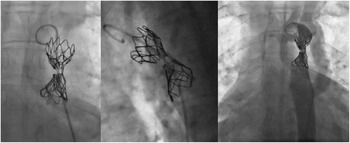
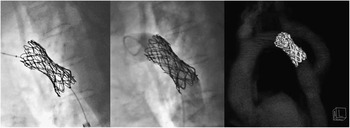
Cardiac catheterisation was carried out, and fluoroscopy showed circumferential fracture of the Cheatham-Platinum stent with significant narrowing. The proximal fragment of the stent was mobile with cardiac pulsations, whereas the distal fragment was fixed. There were also few other isolated strut fractures in both proximal and distal fragments (Fig 1a and b). Angiography was performed using minimal contrast material, and it confirmed the presence of severe coarctation; the bypass conduit filled slowly and appeared to be obstructed at its proximal anastomosis (Fig 1c). A covered 45-mm Cheatham-Platinum stent was deployed inside the fractured stent over an 18-mm balloon in balloon. There was significant narrowing in the middle of the new stent, despite maximum inflation of the balloon up to 6 atmospheres. A 16-mm ultra-high-pressure Mullins X balloon (Numed) was used and inflated to 12 atmospheres, which overcame the tight non-compliant lesion. The pressure gradient dropped from 42 to 12 mmHg, and angiography showed significant improvement of flow with filling of the left subclavian artery predominantly from the descending aorta through the bypass conduit. The patient had better control of his blood pressure following the procedure. Follow-up CT scan 6 weeks after the procedure showed no recurrence of coarctation and no aneurysm formation (Fig 2). Unfortunately, the patient developed bacterial peritonitis with methicillin-resistant Staphylococcus aureus, which progressed to bacteraemia and sepsis, despite removal of the peritoneal dialysis catheter, initiation of haemodialysis, and long-term antibiotics. The patient died of sepsis in the ICU 3 months after the procedure.
( a and b ) Cine-angiography in two projections 16 years after the Cheatham-Platinum stent placement in an adult male with coarctation of aorta, demonstrating circumferential fracture of the stent with severe re-stenosis. Few other isolated strut fractures are seen. ( c ) Angiography within the stent in caudal angulation demonstrating the severe re-stenosis, absence of aneurysm formation, and the presence of a previously placed tube graft between the left subclavian artery and the descending aorta; severe obstruction at the proximal anastomosis is not well-visualised.

( a ) Cine-angiography in lateral projection following deployment of a 45-mm Cheatham-Platinum stent over an 18-mm balloon in balloon within the old, fractured stent. There is significant residual narrowing seen despite maximum pressure inflation of 6 atmospheres. ( b ) Same stent following inflation using an ultra-high pressure 16-mm Mullins X balloon inflated to 12 atmospheres with minimal residual narrowing. ( c ) A three-dimentional re-construction of the CT scan 6 weeks following the procedure, demonstrating sustained stability of stent integrity and no aneurysm formation.

Discussion
Covered stents are the latest innovation in the field of endovascular coarctation repair. They have been used as a rescue treatment in patients with aneurysms or with previous stent-related complications or as primary treatment in patients with an elevated risk for developing complications due to complex anatomy – for example, near interruption or tortuous aortic arch – or in patients beyond the third decade.Reference Kenny, Margey, Turner, Tometzki, Walsh and Martin 6 – Reference Thanopoulos, Giannakoulas, Giannopoulos, Galdo and Tsaoussis 8
Stent fracture is a known complication of both bare-metal and covered stents. Simple, single strut, clinically insignificant stent fracture is likely to be overlooked and under-reported; however, complex fractures are less common and may result in significant aortic wall injury or re-stenosis.Reference McElhinney, Marshall and Schievano 1 , Reference Forbes, Moore and Pedra 2 , Reference Santos 5 , Reference Rohit, Garg and Talwar 9 In addition to metal properties and stent design, factors implicated in the development of fractures include mechanical stress exerted on the stent during implantation in an extremely narrow or tortuous aorta, stress due to high pulsatility of aortic blood flow, and location of the stent at a point where a mobile segment – proximal aortic arch – joins a fixed segment – distal aortic arch.Reference McElhinney, Marshall and Schievano 1 , Reference Santos 5 , Reference Carrozza, Santoro, Giovanna Russo, Caianiello and Calabrò 10 We believe that in our patient, this later mechanism was partially responsible for stent fracture; in addition, we also hypothesize that the presence of residual narrowing after primary implantation may have predisposed our patient to future late stent fracture, which could not be excluded in our patient due to unavailability of imaging from the initial procedure.
Repair of circumferential fractures, as was seen in our patient, is most commonly performed using a covered stent with stent-in-stent technique. This is carried out to stabilise the fractured stent and any of its fragments, while preventing aneurysm formation or dissection. The stent cover may also protect the balloon from rupture due to contact with sharp edges of the fractured stent during inflation.
Finally, we note that stent fracture has been proposed as a risk factor for re-stenosis in coarctation patients.Reference Forbes, Moore and Pedra 2 Although most native and post-operative recurrent coarctations are successfully dilated with medium-pressure balloons, we demonstrated that an ultra-high-pressure balloon was required in this case of fractured stent. We hypothesise that the long-standing circumferential fracture in our patient may have resulted in continuous cycle of injury followed by healing, causing excessive neo-intimal and smooth muscle proliferation. This may have added significantly to the non-compliant nature of the lesion.
Conclusion
Circumferential stent fractures of aortic coarctation stents result in loss of stent integrity and significant re-stenosis. It can be treated with stent-in-stent technique using covered stents. In such cases, ultra-high-pressure balloons are useful in overcoming tight and non-compliant stenotic lesions.
Acknowledgement
None.
Financial Support
This research received no specific grant from any funding agency, commercial, or not-for-profit sectors.
Conflicts of Interest
None.
Ethical Standards
The authors declare that this work has involved no human or animal experimentation, or the use of un-approved medical procedures. They also assert that all procedures contributing to this work comply with national ethical standards and has been approved by the institutional committees of Jordan University Hospital.