


Introduction
No trials examining the efficacy of CBT for people who meet criteria for established psychosis and do not wish to take antipsychotic medication have been conducted, although several published case reports suggest it may be beneficial (e.g. Morrison, Reference Morrison1994). Developing alternatives to medication ought to be an urgent concern given the right of patients in England under the new NHS Constitution to make informed choices about their treatment, the problematic side-effects of antipsychotics, and the significant proportion of people who have a poor response. Importantly, experiencing psychosis does not necessarily imply a loss of treatment decision-making capacity (Cairns et al., Reference Cairns, Maddock, Buchanan, David, Hayward and Richardson2005). Deciding not to take antipsychotic medication, a common event, does not necessarily imply a reluctance to receive some other form of effective help.
The following case study demonstrates how even short-term CBT can be a helpful and acceptable treatment for a young person meeting criteria for psychosis but not wishing to take medication. The client read a draft of this anonymized report and provided informed consent to publication.
Method
Client history
Sandy, an 18-year old man who had heard and seen an invisible figure (John) since he was 10, was referred to the Psychosis Research Unit because of limited access to psychological therapy in his local mental health service. He was highly distressed and actively seeking help. He repeatedly heard John talking and singing, and could offer a vivid and detailed description of his appearance. He believed John was real, although he could offer little explanation for his existence or why other people could not see him. He was frequently woken at night by John singing or instructing him to go to the bathroom, which he complied with. He did not wish to take antipsychotic medication and had never done so. Although he had not previously received CBT, he had received a successful intervention (family therapy, counselling and brief inpatient care) for an eating disorder over a year before. He had not disclosed his invisible companion to professionals at the time as he did not view it as a problem.
Assessment
Clinical assessment, including interview assessment with the Comprehensive Assessment of At-Risk Mental States (CAARMS; Yung et al., Reference Yung, Yuen, McGorry, Phillips, Kelly and Dell'Olio2005) and Psychotic Symptom Rating Scales for auditory hallucinations (PSYRATS-AH; Haddock, McCarron, Tarrier and Faragher, Reference Haddock, McCarron, Tarrier and Faragher1999), suggested Sandy was experiencing visual and auditory hallucinations of an intensity, frequency and duration that met criteria for established psychosis (see extended report for CAARMS criteria and CAARMS/PSYRATS scores). He also scored 23 on the Beck Depression Inventory (2nd edition) (BDI-II; Beck, Steer and Brown, Reference Beck, Steer and Brown1996), suggesting moderately depressed mood.
Sandy also completed an Interpretation of Voices Inventory (IVI; Morrison, Wells and Nothard, Reference Morrison, Wells and Nothard2002), which confirmed he believed he had no control over his experiences and that having them meant he was “weird” (see extended report for scores). However, he also mentioned that John supported him when he was having arguments with others and made him feel less lonely. His initial goals were to increase his perceived control over John from 0% to 80% and to reduce the number of arguments he had with his parents - from two large arguments a week to one small argument a week.
The advantages and disadvantages of therapy were discussed in detail (see extended report). Sandy concluded that he was willing to risk losing John in order to gain control. An initial contract of six sessions of CBT was agreed.
Formulation
Morrison's cognitive model of the maintenance of auditory hallucinations was used to guide the formulation and therapy (Morrison, Reference Morrison1998). Various triggers were identified, including falling asleep, doing mundane tasks, day-dreaming, feeling lonely and arguing with people (where John would take his side). Sandy was able to make John appear by thinking about him and wanting to speak to him, which he often did. Although he thought John made him feel less lonely, he also believed with 100% conviction that having John meant he was weird and that people would reject him if they found out about him. He also believed with 100% conviction that John was uncontrollable and that he would have him forever. Sandy's positive appraisals of John made him feel less lonely sometimes, but his negative appraisals led him to experience heightened anxiety and loneliness at others. This anxiety and loneliness in turn seemed to increase John's frequency and duration. In response to his fear that John was becoming uncontrollable, Sandy tried to reduce the duration of his appearances by either complying with him, singing over him, shouting at him to leave or trying to push him away. These responses were hypothesized to lead to an increase in John's duration and intensity, based on the underlying theory that John was in part a misattribution by Sandy of his own thoughts, feelings and visual imagination. Consistent with this theory, John shouted when Sandy shouted, sang when Sandy sang, and often appeared to be in a similar mood.
Although Sandy had previously used distraction as a way of managing John, the frequency and duration of John had recently increased to the point where this was no longer effective. This increase appeared to be due to the gradual formation of the previously mentioned catastrophic appraisals, which in turn led to mounting anxiety. It also seemed that Sandy's positive beliefs about John led him to engage with him frequently as he grew up, possibly causing John to become relatively “encapsulated”, leading to an “illusion of independent agency” (Taylor, Hodges and Kohanyi, Reference Taylor, Hodges and Kohanyi2003) or becoming an over-learned and automatic “skill”.
A final hypothesis was that increasing Sandy's control over John would lead to improved sleep, in turn leading to reduced irritability and fewer arguments with his parents.
Intervention
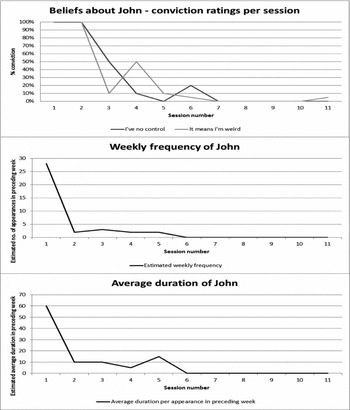
A thought suppression experiment in week 2 (session 2) helped Sandy realise that trying to push visual images away could be counterproductive. He was also encouraged to test his belief that he had no control over John by experimenting between sessions with a detached mindful approach (Wells, Reference Wells2005). He was advised to try not to engage with John and to try not to push him away, but simply to let him come and go as he pleased – observing but not getting involved. It was reasoned that not engaging with John would result in the experience becoming less encapsulated over time and therefore less intrusive and uncontrollable. The concurrent provision of detailed normalising information on the prevalence of invisible friends and other such phenomena in week 3 (session 3) led to a reduction in his conviction that John meant he was weird and that people would reject him if they knew about John (see Figure 1). Both interventions led to a reduction in anxiety and distress and a reduction in the frequency and duration of John, all of which appeared to be correlated with a reduction in his conviction in key appraisals concerning controllability and being different.
Change in frequency and duration of John and change in conviction in key appraisals

Once Sandy's conviction in his appraisal that John was uncontrollable decreased, and once the frequency and duration of John also decreased, he changed his goal (in week 5, session 4) to removing John entirely. He spontaneously stopped obeying him at night and discovered that nothing bad happened. A distinction between being different and unacceptable and being different and acceptable was introduced using the orthogonal continua technique. Sandy rated himself as different and acceptable along with people from ethnic minority groups and other people who generally encounter stigma and prejudice from others.
Results
By week 6 (session 5), Sandy reported his sleep had greatly improved and he was no longer having arguments with his parents. By week 12 (session 7), the frequency and duration of John had reduced to zero. Sandy no longer believed that John was uncontrollable, or that John meant he was weird or that people would reject him if they found out about John (see Figure 1). He also no longer believed that having John meant he had not grown up or that he would have John forever. At this stage Sandy reported being 99.1% confident he could cope on his own, as he said he knew what to do now and could consult the tapes and diagrams from the sessions should John return.
Although we agreed this would be a formal end to the CBT, he preferred to continue to meet for follow-up “monitoring” appointments until he felt they were no longer needed. Altogether, four follow-ups over a 9-month period were arranged (at 1 month, 3 months, 4 months and 9 months post-therapy).
At the 3-month follow-up (session 9), Sandy reported having been badly assaulted by a gang of youths as well as a serious argument with his parents. There was no reoccurrence of John despite these stressful events. His BDI-2 score at session 11 (9-month follow-up) was 1 (reduced from 23 at the beginning of therapy) and his IVI score was 2 (reduced from 60 – see extended report for scores), suggesting he held minimal positive and negative beliefs about his experiences (see Morrison et al., 2000, for description).
Discussion
This case suggests that brief CBT may have been beneficial for a person who met criteria for established psychosis and chose not to take antipsychotic medication, adding to the existing case study literature on CBT for this group. A trial comparing CBT to treatment as usual for this group is currently underway.Footnote 1 Although we cannot generalize from a single case, Sandy's progress supports the hypothesis that metacognitive therapy strategies (MCT; Wells, Reference Wells2008) may be useful in CBT for hallucinations (Morrison, Reference Morrison1998; Valmaggia, Bouman and Schuurman, Reference Valmaggia, Bouman and Schuurman2007). Further research examining the acceptability and effectiveness of MCT in reducing any associated distress may be warranted.
Sandy's case may be unusual because he had never taken antipsychotic medication before. As such, his progress may be of more interest to those providing services that seek to prevent or intervene early in a first-episode of psychosis. A combination of auditory and visual hallucinations is rarely described in the CBT literature, despite being a common occurrence. CBT approaches for visual hallucinations (Collerton and Dudley, Reference Collerton and Dudley2004) are similar to those for auditory hallucinations (Morrison, Reference Morrison1998) and Sandy's progress illustrates this.
Sandy may also have benefited from interventions designed to directly reduce his loneliness (see Masi, Chen, Hawkley and Cacioppo, in press). Further research examining whether there is a direct role for loneliness in the onset of non-organic hallucinations may be useful (see Epley, Akalis, Waytz and Cacioppo, Reference Epley, Akalis, Waytz and Cacioppo2008).
Finally, Sandy's progress illustrates the practical advantages of considering a person's experiences in terms of levels of distress and impaired autonomy, rather than assuming abnormality per se is problematic. Rather than labelling his experiences as symptoms of mental illness, we described them as events that were undesirable only if they led to other undesirable outcomes (i.e. distress and impaired autonomy), thus allowing us a degree of flexibility in the way we talked about them.




Comments
No Comments have been published for this article.